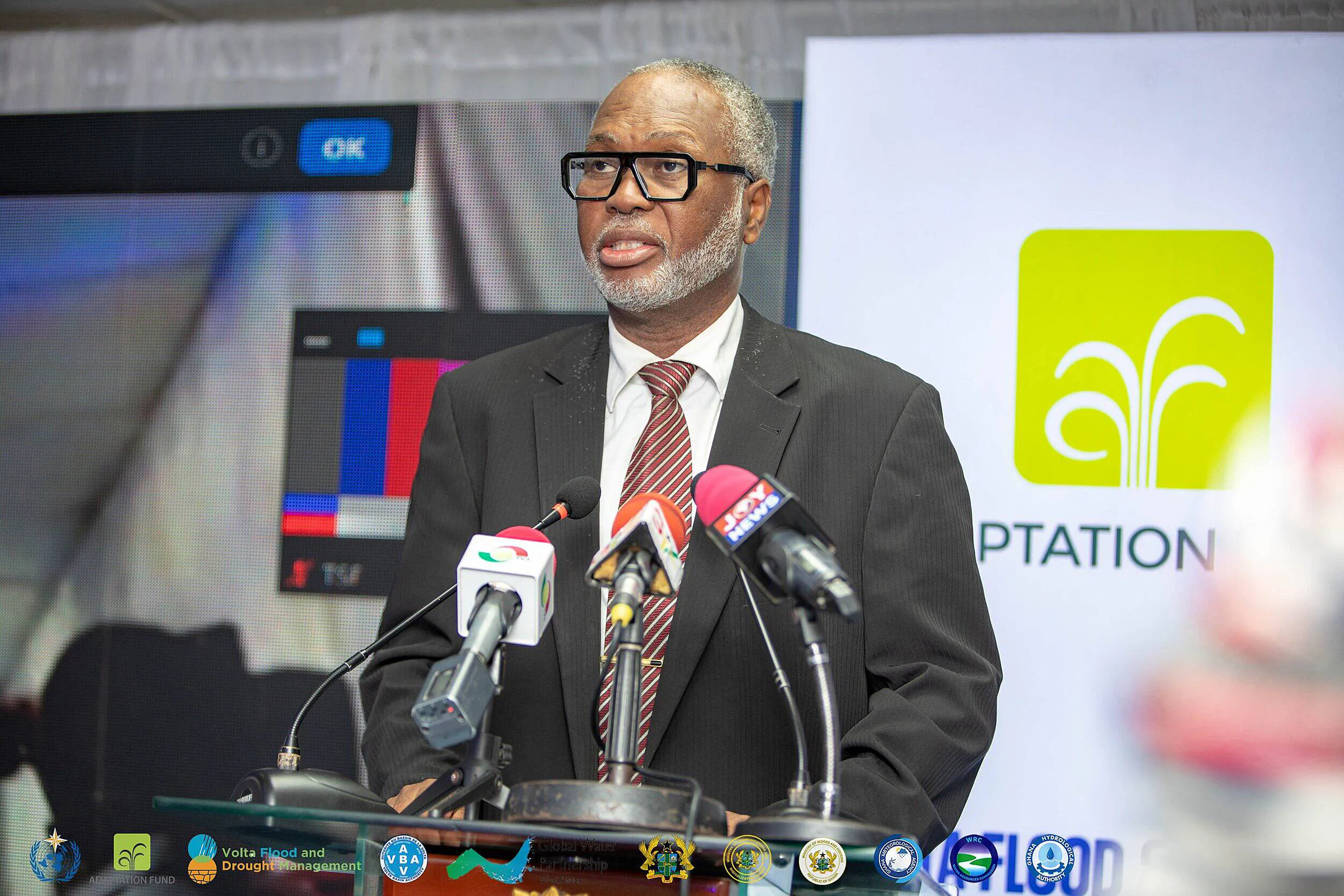
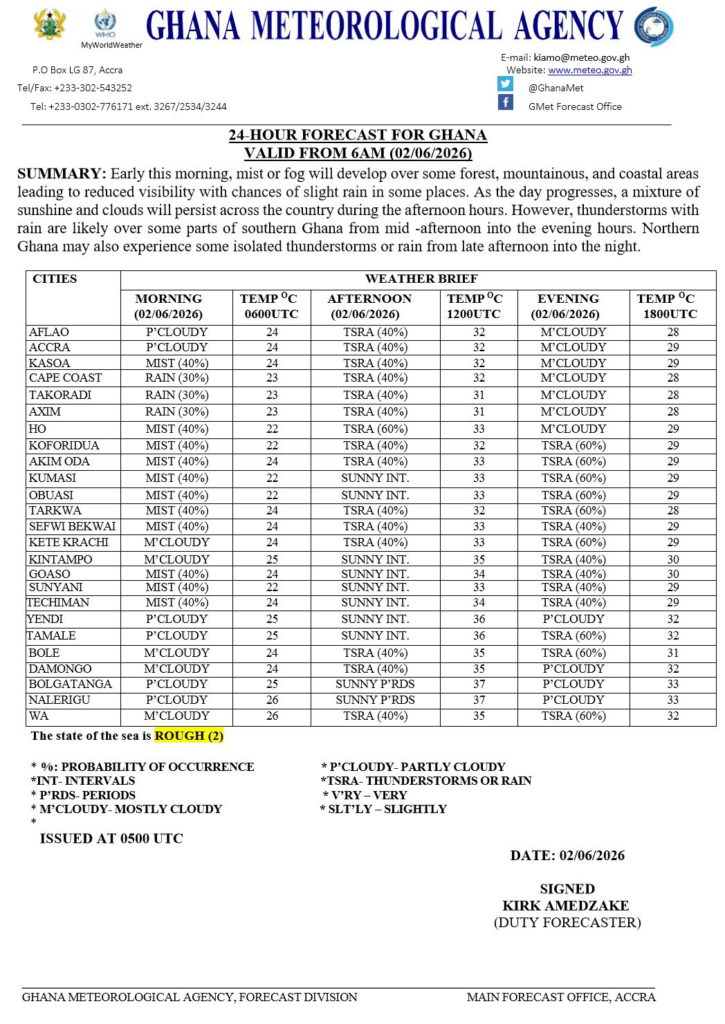
Rains are expected in parts of Accra and the middle belt and northern Ghana from the afternoon into the evening the Ghana Meteorological Agency (GMet) has forecast thunderstorms and rainfall across parts of Accra, the middle belt and northern Ghana from the afternoon into the evening.
The national weather agency announced this in a notice dated Tuesday June 2 citing mist and fog over coastal, forest and mountainous areas, leading to reduced visibility in some locations, including Accra.
According to GMet, some places are likely to experience light rainfall early in the morning due to foggy conditions.
Also, parts of southern and middle Ghana later this afternoon and evening including Accra, Kasoa, Cape Coast, Takoradi, Ho, Koforidua, Kumasi, Obuasi, Tarkwa, Sunyani, Techiman and Kintampo, are predicted to see thunderstorm accompanying rainfall with a probability of 40–60%.
On the other hand,Northern Ghana will experience isolated thunderstorms or rainfall particularly Tamale, Bole and Wa, with about a 60% probability extending into the night.
The agency has advised the public, especially motorists and outdoor workers, to exercise caution due to reduced visibility in the morning and possible storm activity later in the day.
GMet continues to monitor weather patterns and is expected to issue further updates if conditions change.
On Saturday, May 30, it was widely reported that transport fares will be increased by 20% effective Tuesday, June 2.
This was after the National Deputy Public Relations Office of GPRTU, Samuel Amoah, indicated that the increase in fares is long overdue while speaking with MyJoyonline news on Saturday, May 30.
He indicated that his outfit had earlier delayed increasing transport fares with hopes of improved economic conditions; however, with the recent increase in fuel prices in the last pricing window, it had become necessary.
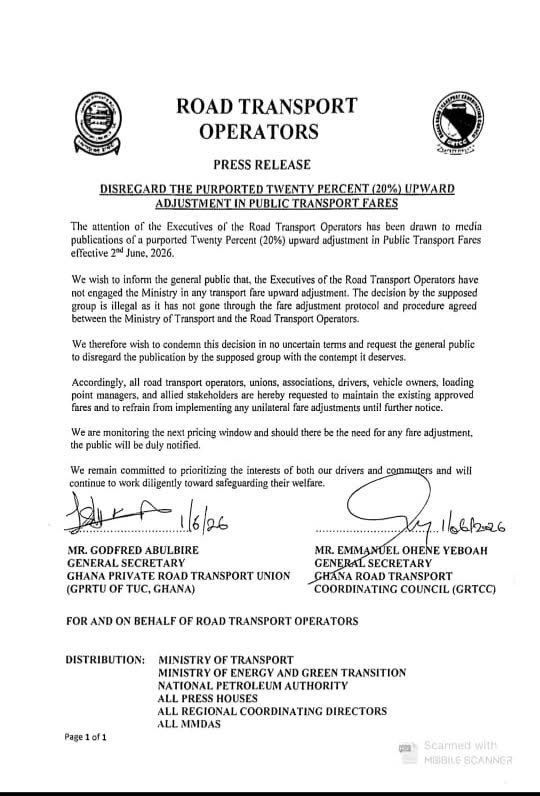
However, in response to this, the country’s largest umbrella organisation for commercial road transport operators, the Ghana Private Road Transport Union (GPRTU), in a collaborative rejoinder with the Ghana Road Transport Cordinating Council (GRTCC) issued today, Tuesday, June 1, has disassociated itself from the proposed 20% increase, urging the public to treat it “with the contempt it deserves.”
The Executives of the Union called the proposed increase illegal, citing that it hadn’t been approved by the appropriate authorities.
“We wish to inform the general public that the Executives of the Road Transport Operators have not engaged the Ministry in any transport fare upward adjustment. The decision by the supposed group is illegal as it has not gone through the fare adjustment protocol and procedure agreed between the Ministry of Transport and the Road Transport Operators,” the statement read.
Accordingly, all road transport operators, unions, associations, drivers, vehicle owners, loading point managers and allied stakeholders have been directed to refrain from implementing any unilateral fare adjustments pending the outcome of the next official pricing window.
“We are monitoring the next pricing window and should there be the need for any fare adjustment, the public will be duly notified,” the statement added.
Motives behind proposed increase earlier
According to Samuel Amoah, the 20% upward adjustment has become necessary due to the rising cost of fuel, linked to the intensified Middle East crisis, and increases in maintenance costs, engine oil prices, and other spare parts.
Mr Amoah added that several engagements had been held with government officials over the matter.
“There have been a series of indoor meetings to discuss this increment, but they kept asking us to hold on because of the promises and expectations,” he explained.
“The sustained high cost of fuel and spare parts has made it necessary and legitimate to review fares. The prices of tyres, engine oil, batteries and other essential components have increased considerably over the past months,” the operators said.
He noted that the adjustment would help cushion drivers and vehicle owners against rising operational costs while ensuring the continued provision of transport services.
To ensure compliance, the union said monitoring teams would work alongside the Motor Traffic and Transport Department (MTTD) of the Ghana Police Service at major transport terminals across the country.
“Our task force, working with the Police MTTD, will monitor compliance at major stations. Anyone found overcharging will face sanctions,” the union warned.
The last time the Ghana Private Road Transport Union (GPRTU) officially increased transport fares was in October 2025, when fares went up by about 20% nationwide due to rising fuel prices and spare parts costs.
Amid stakeholders and some experts’ predictions, the Middle East crisis at the time was indicated to affect fuel prices in Ghana, and given the country’s dependence on the Arabs states for about 20% of its fuel, commuters will bear the cost.
Speaking on the fares, GPRTU’s Industrial Relations Officer, Abass Imoro, indicated that transport fares may increase if fuel prices go up in the next pricing window.
He said the review will be to cope with rising operational expenses.
“You know we work for profit, and for some time now prices have remained the same. Some of our people even went out of their way to increase their prices, but we were able to stop them. This indicates that they are looking for a change in the prices of fares,” he explained while speaking on Accra-based Channel One TV.
In exactly 10 days, the 2026 FIFA World Cup will kick off in Mexico, and as Ghana makes preparations for it, the Finance Ministry has yet to release the budgeted funds earmarked for the Black Stars.
Speaking during a live interview on TV3’s Hot Issues with Keminni Amanor on Sunday, May 31, Minister for Sports, Kofi Eddie Adams, indicated that although the tournament is fast approaching, the funds will be released once they have gone through the necessary government processes before disbursement.
“We are waiting on the Ministry of Finance to release the GH¢150 million allocation for the World Cup after it goes through all the processes,” he said.
Also, he expressed optimism about the Black Stars’ potency and prospects of putting up a good showing at the global football tournament.
“We are not going there as mere participants, but we are going there as a team that is equally capable of winning whether people believe it or not,” he declared, dismissing claims that the later appointment of a head coach a few months ahead of the World Cup was knee-jerk.
He said, “Choosing a head coach a few months before the tournament is not out of place”.
His comments come at a time when a 28-man Black Stars squad has camped in Cardiff to prepare for its friendly against Wales tomorrow, Tuesday, June 2.
Before the match, a final squad list of players who will represent Ghana is expected to be released anytime today, Monday, June 1, with two players set to be dropped after the Wales friendly.
The Black Stars have been drawn in Group L alongside Panama, England, and Croatia. They open their campaign against Panama on June 17 in Toronto before facing England in Boston on June 23 and Croatia in Philadelphia on June 27.
On the injury of key midfielder Mohammed Kudus, who is among the notable absentees from the current squad, the Minister expressed regret but accepted the reality.
“We prayed for Kudus to be fit to play the World Cup tournament, but injury is part of the football profession,” he said.
Antoine Semenyo is now expected to be Ghana’s main attacking threat in Kudus’ absence, with the Black Stars hoping to advance beyond the group stage for the first time since their memorable quarter-final run at the 2010 World Cup in South Africa.
Blacks Stars budget reviewed
Reviewing and rationalising the Black Stars’ budget has saved the country about $700,000, the Sports and Recreation Minister Kofi Adams has said.
According to him, the savings come after a directive from President Mahama that the budget for the national team be made public ahead of the resumption of the 2026 FIFA World Cup qualifiers.
In compliance, the Buem Constituency Member of Parliament (MP) made it public after the Black Stars’ recent doubleheader against Chad.
The decision by the Buem Member of Parliament drew criticism from sections of the football fraternity, who questioned the disclosure of the team’s financial details.
However, speaking to the media after Vice President Jane Naana Opoku Agyemang paid a working visit to the Ministry of Sports and Recreation, Mr Adams defended the policy, describing it as prudent and beneficial.
“We worked closely with the FA to rationalise the budgeting and disbursement processes, and this has saved close to $700,000 across two Black Stars matches,” he said.
Mr Adams stressed that the cost-cutting measures did not negatively affect the team, noting that players and the technical staff received all their entitlements.
“These measures have gone a long way to build confidence. The players did not suffer, and the technical team did not suffer. They continued to receive what was due them, even with the savings,” he added.
The Vice President’s visit saw the presence of Ghana Football Association (GFA) President Kurt Okraku, Deputy Directors of the National Sports Authority, Veronica Commey and Gideon Hammond, as well as Sports Ministry Chief Director Wilhelmina Asamoah.
Meanwhile, the Black Stars are expected to regroup in March for international friendlies against Austria and Germany.
Given the country’s current economic situation, government is unwilling to sponsor supporters abroad for the upcoming 2026 FIFA World Cup, President Mahama has said.
Citing the nature of this year’s World Cup which is set to be hosted across three different nations, America, Mexico and Canada, President Mahama said it has increased the financial and logistical burden compared to the previous tournaments that was held in a single place.
This he said makes fans sponsorship unsustainable with a staggering cost estimate of nearly $11,000 per supporter, a figure he described as well beyond what the state can responsibly absorb under current economic conditions.
Consequently speaking at a diaspora town hall meeting in London on Sunday, May 31, President Mahama noted that,
“We cannot, you know, spend our money in that manner. The cost approximates for each person to be fed, accommodated, transported, and all that to watch the games, tickets, and all that is estimated at almost $11,000,”.
Govt’s new resolve
President Mahama announced an alternative approach where government will procure match tickets and distribute them to Ghanaian communities already based in the host cities, a targeted intervention designed to ensure that diaspora Ghanaians can attend matches without placing an unsustainable burden on the public purse.
“What we are doing is that we are procuring tickets for Ghanaians in the diaspora who want to attend the games. So if you want to attend the game, you will get a ticket to attend the game,” he said.
“We have organised our chapters, our Ghanaian citizens in Boston, Philadelphia, and Canada. The tickets that we have purchased, we will give to them to enable them to watch the matches,” he added.
The President encouraged Ghanaians abroad who are planning to travel to match venues to connect with recognised community groups and chapters, assuring them that arrangements are in place to ensure fair and organised access to the available tickets.
Ghana’s Health Ministry has issued new guidelines on public gatherings as part of measures to prepare for and respond to a possible Ebola outbreak in the country.
The latest Ebola outbreak in the Democratic Republic of Congo (DRC) was officially declared on May 15, 2026, in Ituri province. By May 17, 2026, the World Health Organization (WHO) had already classified it as a Public Health Emergency of International Concern (PHEIC) due to rapid spread and cross-border cases in Uganda.
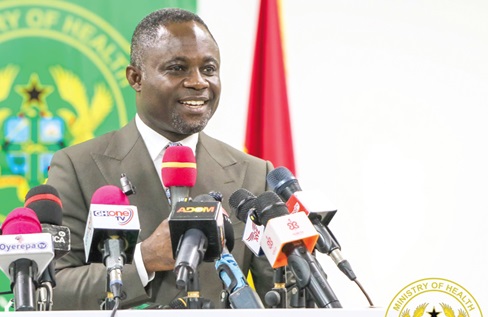
Consequently, Ghana’s Health Minister Mintah Akandoh during an operational tour to health facilities on Friday May 29, which was aimed at assessing surveillance systems and emergency preparedness at the country’s ket health and border facilities despite Ghana not recording any cases yet.
Addressing the media, Mr Akandoh admonished the general public to be vigilant and adhere the preventive measures such as frequent washing of hands particularly at gatherings citing that “It’s very important for all of us to cooperate. From today [Friday, May 29], there should not be any mass gatherings without a hand-washing station,” he warned.
This he said will enhance proper hygiene ams reduce risk of disease transmission.
Facilities visited by the Minister
As part of the tour, Mr Akandoh inspected screening installations at the Accra International Airport before visiting the Noguchi Memorial Institute for Medical Research (NMIMR) and the Ghana Infectious Disease Centre (GIDC).
Ghana’s Sports Minister has confirmed that the Black Stars will receive a $100,000 appearance fee for the upcoming 2026 FIFA World Cup.
He disclosed this during a live TV3 Hot Issues interview on Sunday, May 31. According to him, there were suggestions of a possible increase linked to the appreciation of the cedi against the dollar.
“The appearance fee for the Black Stars players has been pegged at $100,000 per player. Some said that because the cedi had become stronger, we should increase it, but we said no. Because if the cedi had become weaker, would you have said that we should reduce the dollar (equivalent) so it gives you the same cedi amount? You would not say so.”
The practice of paying appearance fees is as old as Ghana’s participation in the World Cup, with Ghana pegging the appearance fee at $100,000, in the last sixteen years
Since 2010, however, the appearance fees have been pegged at $100,000, and per the Minister’s comments, the current group will also benefit.
On players currently camping for the June 2 fixture against Wales as a preparatory game ahead of the tournament,he indicated that 28 players are currently in Ghana’s pre-tournament camp in Wales, with 26 slots up for grabs.
Two of the 28 players will be dropped before Ghana confirms the final 26-man squad on Monday, June 1, 2026.
On Saturday, Thomas Partey and Inaki Williams joined their teammates as the Black Stars prepared for their first pre-World Cup friendly against Wales.
List for Wales-Ghana friendly
The list for Ghana Black Stars’ final warm‑up match before their opening World Cup fixture against Panama on June 17 has been released by the head coach, Carlos Queiroz.
This was confirmed by the Ghana Football Association (GFA) in a formal statement on Monday, May 25.
The 28-man squad for the friendly against Wales in Cardiff, which includes five goalkeepers, nine defenders, seven midfielders, and seven forwards, began training on Monday, May 25, 2026, at Dragon Park.
Ghana will face Wales on Tuesday, June 2, as part of its build-up to the 2026 FIFA World Cup.
Defender Baba Abdul Rahman returns after a strong form with PAOK FC in Greece. The former Chelsea left back has made 35 appearances this season, scoring three goals and adding three assists.
Ernest Nuamah of Olympique Lyonnais is also back after nearly a year out with an ACL injury.
There are also recalls for Abdul Mumin of Rayo Vallecano in Spain, Augustine Boakye of AS Saint-Étienne, and Alidu Seidu of Stade Rennais FC.
Ajax youngster Paul Reverson has been included for assessment as part of long-term planning.
The team will continue preparations in Cardiff ahead of the World Cup in Canada, Mexico, and the United States.
Ghana is in Group L and will face Panama in Toronto, England in Boston, and Croatia in Philadelphia.
The match will be played at the Millennium Stadium in Cardiff.
Ghana to broadcast World Cup live on GBC
Ghana has, for the first time in over a decade, secured live broadcast rights for the 2026 FIFA World Cup following successful government-backed arrangements and a nationwide fundraising initiative.
The last time Ghana secured such broadcast rights was in 2014, with GBC leading coverage when Brazil hosted the tournament.
This was confirmed by the Minister for Sports and Recreation, Kofi Adams, while speaking during the presentation of a GH¢5 million donation from GCB Bank to the Black Stars support campaign.
According to the Buem MP, the broadcast rights cover a few selected media platforms nationwide.
“Through the support of government and fundraising efforts, we have been able to secure broadcast rights to telecast the World Cup matches live on some media stations,” he said.
Times Ghana has secured broadcast rights in World Cup history
In 2010, when the 2010 FIFA World Cup was hosted in South Africa, the Ghana Broadcasting Corporation, together with private partners, secured the rights and broadcast the matches live. This was historic because Ghana reached the quarterfinals, its best performance to date.
By 2014, during the 2014 FIFA World Cup, Ghana again secured broadcast rights, with GBC leading nationwide coverage.
In 2018, despite Ghana not qualifying for the tournament in Russia, broadcast rights were limited, and only selected pay-TV platforms carried the matches.
For the 2022 FIFA World Cup, Ghana qualified, but the country did not secure full nationwide broadcast rights. Coverage was mainly available through pay-TV providers such as SuperSport and DStv, leaving many fans without free access.
National Association of Graduate Teachers (NAGRAT), have threatened a nationwide strike effective June 1, if government fails to take action regarding the the alleged assault of three teachers at Adiewoso M/A Basic School in the Tarkwa-Nsuaem Municipality, by military personnel in the Tarkwa-Nsuaem Municipality.
President of NAGRAT, Jacob Anaba, made the warning on Saturday, May 30, during a press briefing in Ghana.
The alleged assault has sparked outrage among teacher unions, leading to an ongoing industrial action by teachers in the municipality.
Speaking on the matter, Mr. Anaba said the affected teachers have suffered emotional and psychological trauma and deserve justice. He called for a formal apology from the Ghana Armed Forces, disciplinary action against the soldiers involved, and adequate compensation for the victims.
According to him, the incident raises serious concerns about the safety and dignity of teachers in the performance of their duties.
“We cannot sit unconcerned while teachers are subjected to such treatment. The affected teachers deserve justice, and the necessary institutions must act swiftly to address the matter,” he stated.
He called on the Ghana Education Seevice (GES) and all other relevant authorities to step in to restore calm among teachers and prevent escalation ans any future occurrences .
He warned that if there is no meaningful response within one week of the ongoing strike action in the Tarkwa-Nsuaem Municipality, teacher unions nationwide will join in solidarity.
Commuters are to brace themselves for a hike in transport fares effective Tuesday, June 2, the Ghana Private Road Transport Union (GPRTU) and other commercial transport operators have announced.
According to the transport operators, the 20% upward adjustment has become necessary due to the rising cost of fuel, linked to the intensified Middle East crisis, and increases in maintenance costs, engine oil prices, and other spare parts.
Speaking to Accra-based media house MyJoyOnline News on Saturday, May 30, the National Deputy Public Relations Officer of the GPRTU, Samuel Amoah, indicated that the fare increase is long overdue. According to him, his outfit delayed it with hopes of improved economic conditions.
“This increment should have come long ago, but we held on because when the government came in, there was a promise that prices were going to go down. Looking at where prices are now, if we don’t come up with this increment, it will affect our operations. Even the drivers are complaining seriously,” he said.
Mr Amoah added that several engagements had been held with government officials over the matter.
“There have been a series of indoor meetings to discuss this increment, but they kept asking us to hold on because of the promises and expectations,” he explained.
“The sustained high cost of fuel and spare parts has made it necessary and legitimate to review fares. The prices of tyres, engine oil, batteries and other essential components have increased considerably over the past months,” the operators said.
They noted that the adjustment would help cushion drivers and vehicle owners against rising operational costs while ensuring the continued provision of transport services.
To ensure compliance, the union said monitoring teams would work alongside the Motor Traffic and Transport Department (MTTD) of the Ghana Police Service at major transport terminals across the country.
“Our task force, working with the Police MTTD, will monitor compliance at major stations. Anyone found overcharging will face sanctions,” the union warned.
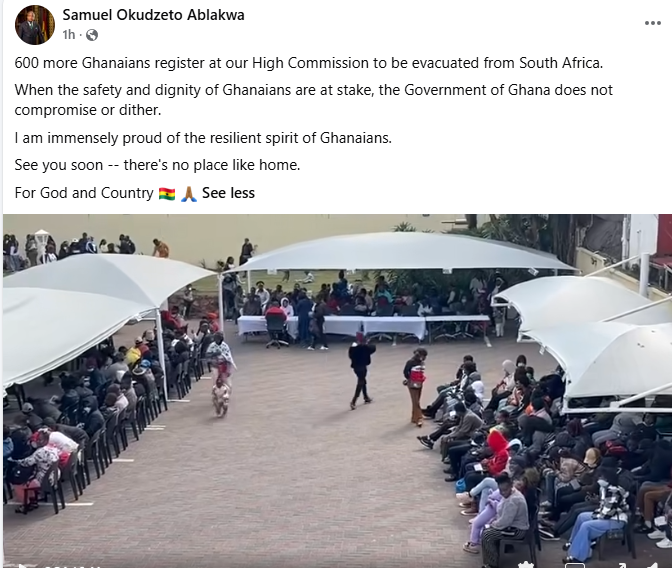
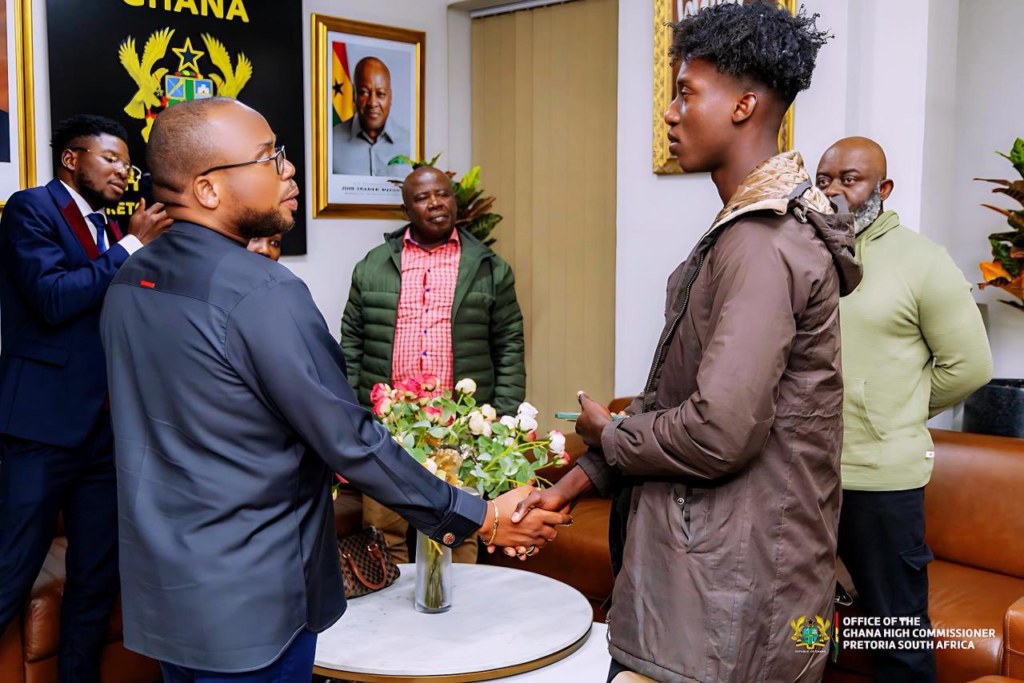
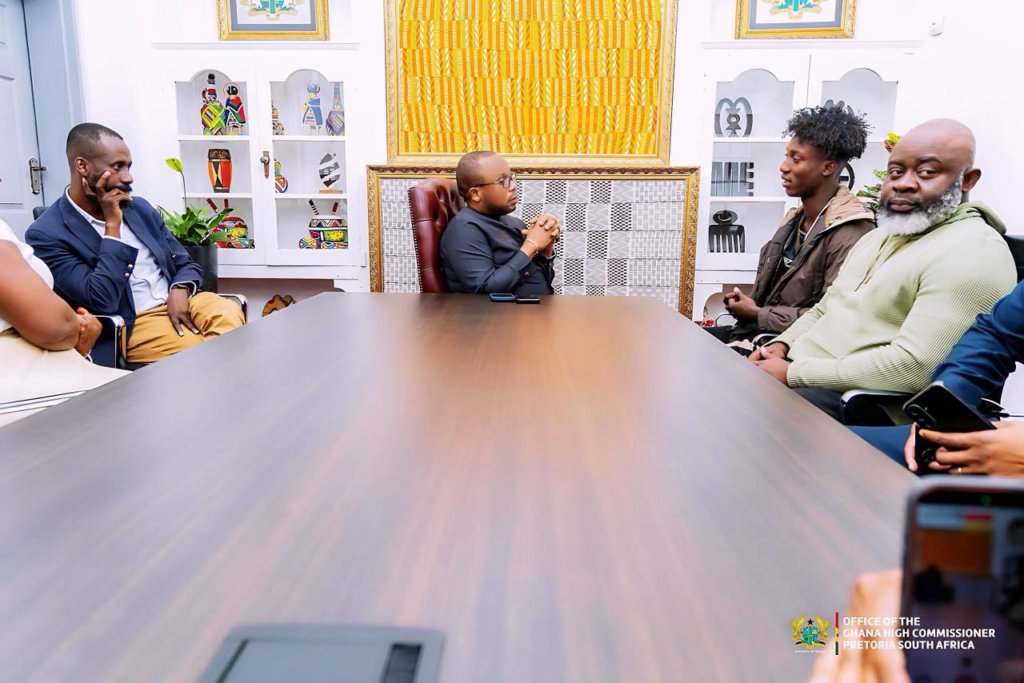
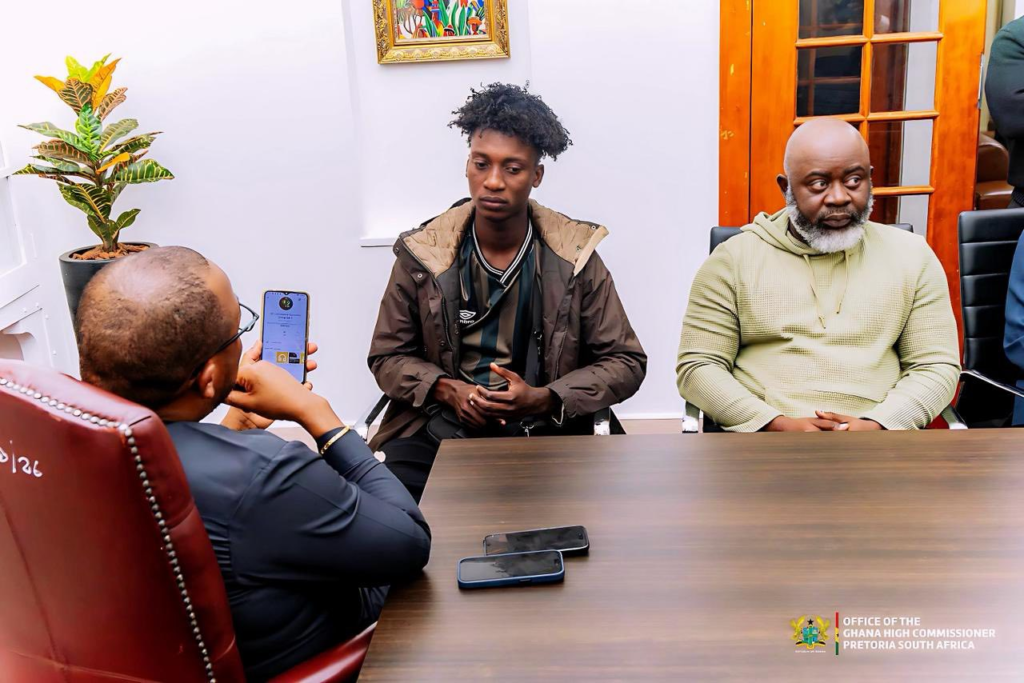
Following the successful repatriation of the first 301 Ghanaians from South Africa, an additional 600 more have registered at Ghana’s High Commission in the host country to be brought back home, the Ministry of Foreign Affairs has confirmed.
In a Facebook post on Saturday, May 31, Foreign Affairs Minister Samuel Okudzeto Ablakwa said that “600 more Ghanaians have registered at our High Commission to be evacuated from South Africa.”
Consequently, the government will not hesitate to respond to the desires of the distressed Ghanaians in South Africa amid the heightened xenophobic violent attacks on foreigners, including those from Ghana.
“When the safety and dignity of Ghanaians are at stake, the Government of Ghana does not compromise or dither”, he said.
Mr Ablakwa also expressed admiration for the resilience of affected Ghanaians, commending their calmness and determination in the face of the situation.
“I am immensely proud of the resilient spirit of Ghanaians,” he added.
He noted that efforts are ongoing to coordinate the evacuation process and ensure the safe return of all registered citizens.
The second batch of evacuees from South Africa is set to touch down this weekend. Ghana’s High Commissioner to South Africa, Benjamin Quashie, has revealed that 410 Ghanaians fleeing xenophobic attacks in South Africa will be evacuated over the weekend.
The weekend group will be the second batch to be repatriated, while the date for the rest is yet to be communicated after the arrival of the first 300 evacuees on Wednesday, May 27.
Speaking during JoyFM’s Super Morning Show on Thursday, May 28, the High Commissioner indicated that, “The next batch will be of 410 evacuees who have given us their names that they want to go home voluntarily. It is going to be the coming Sunday or Tuesday; we have not fixed the exact date yet, but it should be between these three days.”
He disclosed that about 1,000 Ghanaians living in South Africa have registered to return home over fears of the attacks.
“As of this morning (Thursday, May 28), I have been briefed that we have almost a thousand who have fully registered and have indicated that they want to leave South Africa and go back home,” he noted.
Meanwhile, Foreign Affairs Minister Samuel Okudzeto Ablakwa has urged the evacuees not to lose hope, assuring them that the government has plans in place to support their reintegration into society.
Addressing the returnees at the Accra International Airport on Wednesday, May 27, Mr Ablakwa encouraged them to remain optimistic despite their experiences abroad.
“We don’t want any of you to feel brokenhearted, don’t be downhearted, don’t be depressed, have confidence that the almighty has better plans for you,” he told the evacuees upon their arrival.
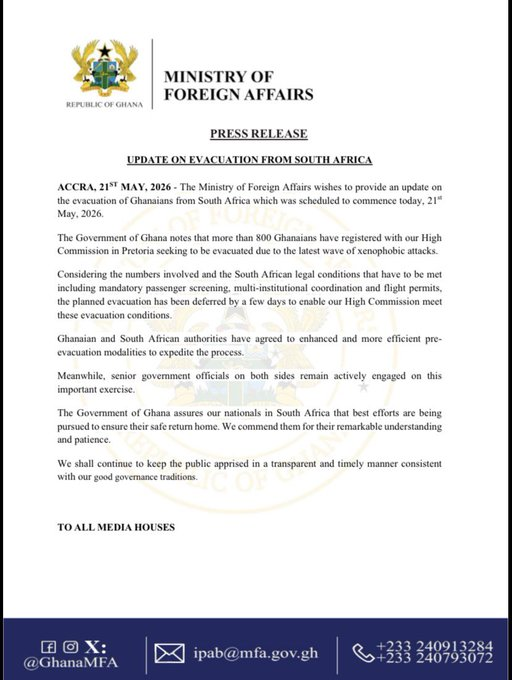
Earlier, the Foreign Affairs Ministry confirmed that over eight hundred (800) Ghanaians have registered at their Commission in Pretoria, for voluntary evacuation due to the worsening xenophobic attacks in South Africa. Consequently, “the planned evacuation has been deferred by a few days to enable our High Commission to meet these evacuation conditions”.
“The Ministry of Foreign Affairs wishes to provide an update on the evacuation of Ghanaians from South Africa, which was scheduled to commence today, 21 May, 2026. The Government of Ghana notes that more than 800 Ghanaians have registered with our High Commission in Pretoria seeking to be evacuated due to the latest wave of xenophobic attacks.
Considering the numbers involved and the South African legal conditions that have to be met, including mandatory passenger screening, multi-institutional coordination and flight permits, parts of the statement read.
To ensure that all the necessary regulatory requirements are met, an additional day of preparation to ensure a safe and orderly evacuation process.
“Ghanaian and South African authorities have agreed to enhanced and more efficient pre-evacuation modalities to expedite the process”, the Ministry added.
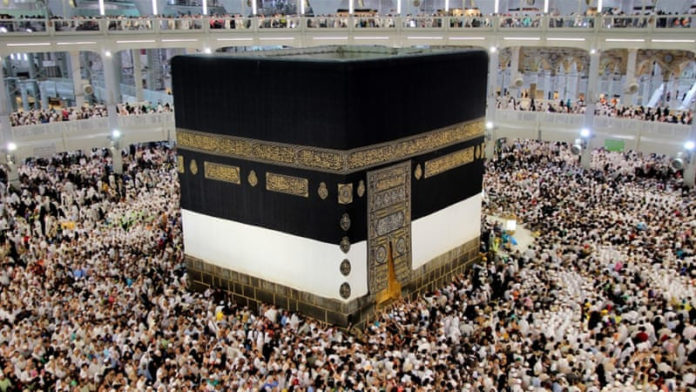
Ghana has lost another pilgrim, pushing the death toll at the 2026 Hajj pilgrimage in the Kingdom of Saudi Arabia. to three, the Pilgrims Affairs Office of Ghana (PAOG) has announced.
The Hajj organisers confirmed this in a formal statement dated May 29, citing that Hajia Kubura Salifu,” … died in Mina following an acute illness. Her sudden death occurred after the completion of the Hajj rituals”.
Her death comes barely a week after PAOG announced the death of two men who also died while at the pilgrimage.
Hajia Kubura Salifu is the first female to have lost her life in this year’s Hajj. PAOG indicated that “Her family has been duly informed, and the burial was conducted in accordance with Islamic principles governing the burial of a pilgrim.
“This sad event brings the total number of deceased Ghanaian pilgrims during this year’s Hajj to three (3). A pilgrim who dies in Mina after Arafat receives immense spiritual blessings. They are granted the continuous reward of Hajj until the Day of Judgment, will be resurrected chanting the Talbiyah, and are promised Paradise with no reckoning of their deeds”.
According to the Office, the deceased’s family has been informed of her passing, and she has since been laid to rest in Saudi Arabia in accordance with Islamic burial rites observed for pilgrims who die during Hajj.
The Office extended its heartfelt condolences to the bereaved family, relatives and friends, and prayed for strength and comfort for them during this difficult period.
The statement also underscored the spiritual significance attached to dying during the Hajj pilgrimage, noting that, in Islamic tradition, pilgrims who pass away in Mina are believed to continue receiving the rewards of their pilgrimage until the Day of Judgment.
President Mahama on the number of pilgrims who left for Mecca this year
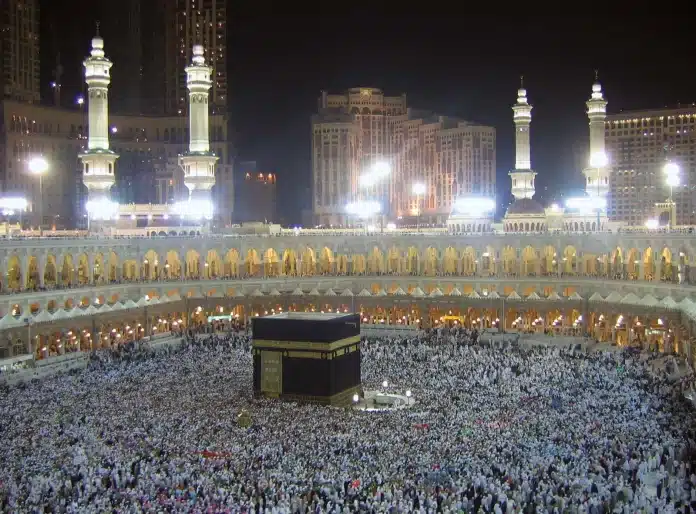
President John Mahama has confirmed that about 6,900 Ghanaian pilgrims were airlifted to the Kingdom of Saudi Arabia for this year’s Hajj, marking about 900 more than the 6000 earlier communicated by the Hajj Board.
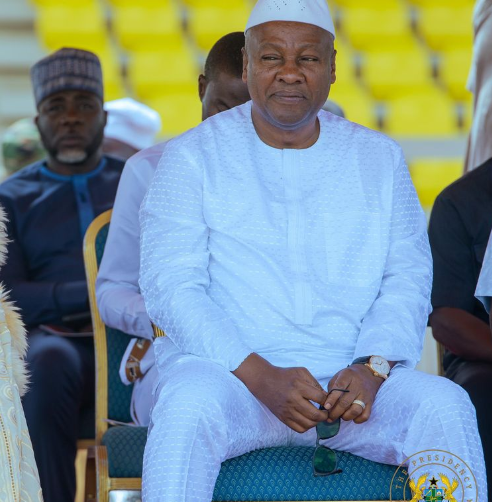
Speaking during the Eid‑ul‑Adha celebrations at Independence Square yesterday, Wednesday, May 27, President Mahama commended the Ghana Hajj Board and all other stakeholders for their remarkable role and dedication in ensuring the smooth operations of the year’s Hajj.
He indicated that he has received several commendations on the Board’s facilitations on feeding accommodations, among other arrangements that have contributed to the successful organisation of the trip to Mecca.
“This year’s Hajj operations have largely been successful. About 6,900 Ghanaian pilgrims were airlifted to the Kingdom of Saudi Arabia to undertake the sacred pilgrimage. I’ve received encouraging reports on their accommodation, feeding arrangements, transport, and overall welfare. I therefore wish to commend the Ghana Hajj Board and all stakeholders for their dedication and hard work in ensuring a smooth and successful Hajj this year”, he said.
Hajj village
The new multipurpose Hajj Village at the Kotoka International Airport is currently about 55% complete, according to Mawums Limited, the contractor responsible for the project. During a recent tour of the facility by the Board and Management of the Ghana Airports Company Limited (GACL), led by Board Chairman and Member of Parliament for Builsa North, James Agalga, the contractor indicated that the project is expected to be completed before the end of 2026.
The facility is intended to streamline pre-departure procedures and improve the overall management of Hajj operations, providing a more organised and efficient experience for Ghanaian pilgrims travelling to Mecca. It is also expected to ease congestion and enhance travel logistics associated with the annual pilgrimage.
The project has, however, attracted public debate over its necessity and funding source. In response to concerns that taxpayer money was being used for its construction, the Minister of State for Government Communications, Felix Kwakye Ofosu, clarified that the Hajj Village is being financed entirely by the Ghana Airports Company Limited and not through public funds.
Addressing the issue in a post on X, he stated:” The Hajj Village is primarily an Airport Terminal Building for check-in and pilgrim facilitation owned and being built by the Ghana Airport Company. Not a pesewa of taxpayers’ money involved.”
Despite these assurances, some Ghanaians have questioned the government’s priorities, citing challenges facing communities such as those in the Volta Region affected by coastal erosion. Former Auditor-General Daniel Yao Domelevo also criticised the project, arguing that such an investment is difficult to justify at a time when Ghana continues to face economic challenges. He further referenced the more than $58 million spent on the National Cathedral project, describing the Hajj Village as a misplaced priority.
The government, however, maintains that the facility is a strategic aviation and pilgrim facilitation project funded by GACL and not by the Ghanaian taxpayer.
Finally, after five (5) years of heated public debate and international attention, Parliament has passed the controversial anti-LGBTQ bill.
This comes after the Majority Chief Whip of the ruling National Democratic Congress (NDC), on May 26, hinted that the bill was likely to be passed on Friday, as it was yesterday.
The bill, formally titled the Promotion of Proper Human Sexual Rights and Ghanaian Family Values Bill, seeks to criminalise LGBTQ+ activities, advocacy, funding and the promotion of what it describes as non-conventional sexual relations.
Initially, when the bill was introduced, critics argued that the legislation could violate constitutional rights, including freedom of expression and association, and protection from discrimination.
However, the supporters of the bill, including religious bodies and traditional leaders, insisted that it is necessary to protect Ghanaian cultural, moral, and family values. Several openly supported the bill throughout parliamentary deliberations, insisting that it reflects the beliefs and values of the majority of Ghanaians.
One of the provisions in the bill that sparked heavy debate was an attempt to introduce clauses exempting journalists, media houses, lawyers, doctors, counsellors and other professionals from sanctions if their work involved LGBTQ-related matters in the normal course of duty.
The proposed amendments sought to protect media practitioners reporting on LGBTQ-related issues, as well as medical and mental health professionals providing services to affected persons.
But co-sponsor of the bill and Assin South MP, Rev John Ntim Fordjour, together with Bosome-Freho MP Nana Asafo-Adjei Ayeh and other Minority MPs, strongly opposed the changes.
According to them, such exemptions could create loopholes that may eventually be used to promote LGBTQ+ activities in the country.
About the Anti-LGBTQ Bill
It was first introduced in 2021 in Parliament on 2 August 2021 as a Private Members’ Bill sponsored by a bipartisan group of eight MPs, seven from the opposition NDC and one from the ruling NPP at the time. The lead sponsor was Samuel Nartey George, Member of Parliament for Ningo‑Prampram and Ghana’s Minister for Communication, Digital Technology and Innovations.
The MPs at the time included Emmanuel Kwasi Bedzrah, MP for Ho West (NDC). Rockson‑Nelson Dafeamekpor, MP for South Dayi (NDC), Helen Adjoa Ntoso, MP for Krachi East (NDC), Rita Naa Odoley Sowah, MP for La Dadekotopon (NDC), Della Sowah, MP for Kpando (NDC), Alhassan Suhuyini, MP for Tamale North (NDC), John Ntim Fordjour, MP for Assin South (NPP).
It was initially passed in February 2024; however couldn’t become a law as President Akufo-Addo did not assent to it.
Fast forward to after the NDC government assumed power, the bill was reintroduced in Parliament on February 17, 2026.
What was in the bill?
The bill was designed to criminalise LGBTQ+ activities, advocacy, and funding, with penalties ranging from 3 to 10 years imprisonment depending on the offence.
The bill sought to criminalise identifying as LGBTQ+, with offenders facing up to three years’ imprisonment.
It also proposed sanctions against individuals accused of promoting LGBTQ+ rights, including teachers, journalists, doctors, parents and advocates.
Under the bill, LGBTQ+ organisations would have been outlawed, while donors and partner organisations risked prosecution.
The legislation further proposed restrictions on media content, making digital or broadcast promotion of LGBTQ+ activities punishable by up to 10 years imprisonment.
It also sought to render same-sex marriages void and prohibit gender transition procedures.
Additionally, the bill proposed mandatory reporting requirements, compelling family members, educators, religious leaders and community members to report suspected LGBTQ+ activities.
President Mahama’s comments earlier this month
In early May, President John Dramani Mahama clarified that, although he would not hesitate to sign the Human Sexual Rights and Family Values Bill, popularly known as the anti-gay Bill, which is currently before parliament into law, he believes Ghana must first address its pressing issues.
During a Presidential Dialogue with Civil Society Organisations at Jubilee House in Accra on Monday, March 30, President Mahama urged restraint and constructive engagement in ongoing national discussions on LGBTQ+ issues.”LGBTQ+ issues it remains a highly emotive and sensitive issue even in the most advanced liberal democracies.
I explained during my recent engagement with the World Affairs Council that it is not the most important issue we face as a nation; we are still grappling with the provisions of basic needs of education, healthcare, jobs, food, clothing and shelter.
“Nevertheless, the private bill introduced in Parliament has sparked a complex and sensitive national conversation. Our position is guided by our constitution, respect for human rights and dignity for all persons and the need to preserve social cohesion. While there are strong and differing views within our society, we believe that issues must be addressed through democratic processes, our core values, dialogue, and the rule of law.
“I am also mindful of reactions from my international partners, including the recent development such as Lincoln University’s withdrawal of their honorary decoration. These developments underscore the importance of continuous dedication and mutual respect and situating our national decisions within our constitutional and cultural context,” he said.
Across the Higher Education sector in Ghana, there is one uncomfortable conversation that keeps resurfacing on social media, in academic corridors, and within faculty WhatsApp groups. No! It’s not about conditions of service, even though that still dominates the conversations each day. It is about predatory journals and questionable academic promotions, especially in several Ghanaian universities. While some may dismiss the discussion as mere academic politics or online “wars,” the reality is that the matter strikes at the very heart of academic integrity, institutional reputation, and the credibility of Ghanaian scholarship in general.
In my very candid opinion, I think the time has come for Ghanaian universities to treat the issue of predatory publishing with the seriousness it deserves.
For the ordinary Ghanaian, the phrase “predatory journal” may sound quite strange or technical, but the concept itself is straightforward. Predatory journals are fake or low-quality academic journals that pretend to be legitimate scholarly outlets, publishing the research works of some lecturers. They often charge researchers publication fees without conducting peer review or editorial scrutiny on the research works submitted. In many cases, these journals promise unrealistically quick publication timelines, send aggressive email invitations to academics, and falsely claim to have international credibility or indexing.
In simple terms, they are the academic equivalent of counterfeit products. They look genuine on the surface but lack the standards, rigour, and credibility of authentic scholarly publications.
The worrying reality is that some academics across universities globally, including in Ghana, have built parts of their academic careers on such publications. In some instances, individuals have reportedly gained appointments and promotions largely on the back of publications in questionable outlets. For me, this is both an administrative concern and an ethical issue that threatens the integrity of academia itself.
Universities are expected to be custodians of knowledge and intellectual honesty. If promotions and recognitions are based on publications that did not undergo scholarly scrutiny, then the value of academic titles and ranks becomes diluted. Over time, this can erode public confidence in universities and damage the reputation of institutions both locally and internationally.
Beyond institutional reputation, there is also a broader societal danger. Research published without proper peer review can produce misleading conclusions and harmful recommendations that unsuspecting members of the public may accept and act upon. Imagine, for instance, a predatory journal publishing a study falsely suggesting that drinking alcohol was beneficial for treating COVID-19. If such misinformation were circulated widely, some people could rely on it and suffer serious health consequences. The havoc that can arise from poorly scrutinised research is therefore not theoretical as it can directly affect public health, policy decisions, and the overall societal well-being.
More importantly, this is also a reputational issue for Ghanaian academia. We live in an era where the authenticity of journals can be verified within minutes. Numerous digital tools, indexing platforms, citation databases, and journal evaluation systems now exist to help assess the legitimacy of academic outlets. Increasingly, even non-academics can verify whether a journal is credible.
In fact, recent technological developments have made the situation even more transparent. Today, there are browser extensions that can provide quick indicators about the quality and credibility of publications directly from a researcher’s Google Scholar profile. With just a few clicks, people can now determine whether publications are indexed in reputable databases.
This is what makes the current situation particularly troubling. Despite the abundance of these verification tools, some individuals still freely parade academic ranks and titles that may have been significantly predicated on predatory publications that can easily be scrutinised and questioned. In an age of digital transparency, this creates long-term reputational risks for individuals and also for the institutions they associate with.
The recent social media battles around this issue should therefore not be ignored. While some conversations have, unfortunately, become personalised, they nevertheless reveal a growing public concern about academic standards. These discussions are forcing universities to confront difficult questions of whether current promotion systems are sufficiently rigorous and whether all faculties are equally equipped to evaluate journal quality. Again, the question is whether early-career academics receive adequate guidance on credible publishing pathways.
These are questions universities can no longer afford to avoid.
To be fair, not every academic who publishes in a predatory journal does so intentionally. Early-career researchers, particularly in developing academic environments, are often under immense pressure to “publish or perish.” Many may lack adequate mentorship or training in distinguishing credible journals from deceptive ones. Others may be misled by fake indexing claims or aggressive solicitation emails.
This is why peer mentoring is one of the most important solutions.
Academics who already publish in credible and internationally respected outlets must support their colleagues, especially early-career researchers. Senior scholars should help younger academics understand the rigour, culture, standards, rubrics, and processes associated with credible publishing. They can provide guidance on journal selection, manuscript preparation, peer review expectations, indexing systems, and publication ethics. Such mentoring arrangements should become an institutional responsibility.
Universities must also strengthen their internal quality assurance systems regarding promotions and appointments. Promotion committees should move beyond merely counting publication numbers and focus more critically on publication quality, journal indexing, editorial standards, impact, and scholarly contribution. Institutions should regularly train faculty evaluators on emerging predatory publishing tactics and maintain updated guidelines on acceptable publication outlets.
Additionally, universities should invest in institutional access to reputable journal databases and verification tools that can assist both staff and promotion committees in assessing journal credibility. Academic integrity cannot depend solely on assumptions or personal networks.
Ultimately, the credibility of Ghanaian higher education depends on the number of professors we produce and also the integrity of the scholarly processes that produce them. Academic titles must represent genuine scholarly contribution, rigorous peer review, and intellectual excellence and not merely publication counts accumulated through questionable outlets.
If Ghanaian universities fail to decisively address the predatory publishing phenomenon, the long-term consequences may extend far beyond academia. The global reputation of our institutions, the employability of our graduates, the credibility of our research outputs, and the trust society places in academic expertise may all be affected.
This conversation may be uncomfortable, but it is necessary. Protecting academic integrity is not an attack on individuals. It is a defence of the university system itself.
The writer is Dr Noel Nutsugah, a Senior Lecturer at the University of Media, Arts and Communication (UniMAC).
UniMAC is a public university birthed out of the merger of the former Ghana Institute of Journalism (GIJ), Ghana Institute of Languages (GIL) and National Film and Television Institute (NAFTI).
DISCLAIMER: Independentghana.com will not be liable for any inaccuracies contained in this article. The views expressed in the article are solely those of the author’s, and do not reflect those of The Independent Ghana
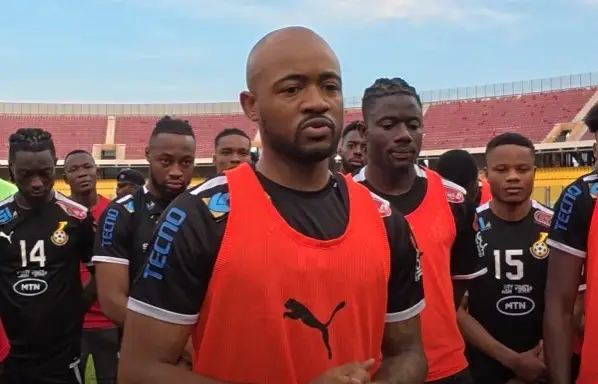
Black Stars captain Jordan Ayew will part ways with Leicester City at the end of this campaign, the club has announced.
The club confirmed this after releasing their retained list on May 24, following their relegation to League One, which named Jordan Ayew among the 10 players set to part ways with the club after their contract expires this summer.
According to an official statement on their website, Jordan Ayew, Ricardo Pereira (club captain), Patson Daka, Jamaal Lascelles, Stephy Mavididi, Bobby De Cordova‑Reid, Aaron Ramsey, Joe Aribo, Asmir Begović, and Wanya Marçal will all leave the club when their contracts expire on June 30.
LEICESTER, ENGLAND – APRIL 3: Leicester City’s Jordan Ayew during the Sky Bet Championship match between Leicester City and Preston North End at The King Power Stadium on April 3, 2026 in Leicester, United Kingdom. (Photo by Stephen White – CameraSport via Getty Images)
The Black Stars captain joined the club in 2024 on a 2-year deal worth up to £8 million (initial £5m fee plus £3m in add‑ons).
Jordan Ayew made a total of 78 appearances for Leicester City between 2024 and 2026, scoring 11 goals and providing 7 assists across all competitions.
Before his move, Ayew spent six seasons at Crystal Palace, making over 200 appearances. He also played for Swansea City and Aston Villa, and began his professional career at Olympique de Marseille.
Across his career, Ayew has made more than 500 club appearances and scored over 100 goals, establishing himself as one of Ghana’s most experienced exports in European football.
In a statement, Leicester City thanked the departing players for their service, confirming that several loan players, including Jordan James, Aaron Ramsey, Joe Aribo, Dujuan Richards, and Divine Mukasa, will return to their parent clubs.
In 2024, Jordan Ayew emerged as Black Stars’ top scorer.
The 32-year-old forward displayed remarkable consistency, scoring in the Africa Cup of Nations, friendly matches, and World Cup qualifiers.
He netted twice each against Nigeria and Uganda in friendlies and added crucial goals in qualifiers against Mali and the Central African Republic.
Ayew ended the year on a high note, delivering a spectacular goal against Angola in the AFCON qualifiers, solidifying his role as a pivotal player for Ghana.
Despite a tough year for the Black Stars, Ayew stood out with his strong performances, having his best year yet with the national team, thanks to his goal-scoring form.
He also made history in club football by scoring his 40th Premier League goal and his 50th goal in English football in 2024.
Ayew’s leadership was clear when he captained the Black Stars in their second-to-last match of the year, highlighting his importance to both the national team and his club, Crystal Palace.
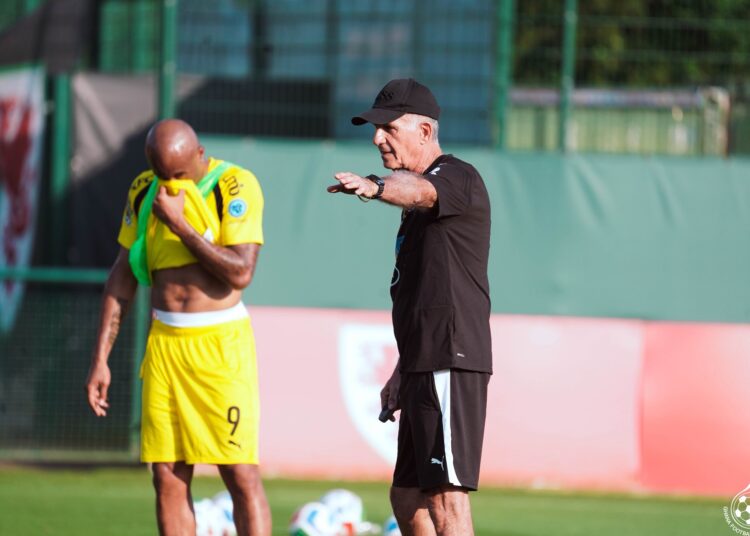
The Ghana Black Stars have confirmed that they are adapting to the training methods of their new head coach.
Defender Gideon Mensah described the training sessions under the newly appointed coach as intensive. However, he acknowledged the need for such intensity as preparations continue ahead of the friendly match against Wales and the 2026 FIFA World Cup.
Currently, 28 players are training in Cardiff ahead of the match scheduled for June 2. However, after the Wales fixture, two players will be dropped in accordance with FIFA’s squad limit requirements.
Speaking in an interview via the Ghana Football Association, the AJ Auxerre shared that the players were adapting to the former Real Madrid head coach’s training style.
“He-Carlos Queiroz-comes with a new form of training and everything; something that we are not used to, and I think we are adapting.”
“The training session, as I said, is very intensive; we are not really used to this, but then we are going to the World Cup, so that’s what we need as well”, Gideon Mensah said.
Squad list for Ghana-Wales fixture
The 28-man squad for the friendly against Wales in Cardiff includes five goalkeepers, nine defenders, seven midfielders, and seven forwards. The squad began training on Monday, May 25, 2026, at Dragon Park.
Ghana will face Wales on Tuesday, June 2, as part of its build-up to the 2026 FIFA World Cup.
Defender Baba Abdul Rahman returns after a strong form with PAOK FC in Greece. The former Chelsea left back has made 35 appearances this season, scoring three goals and adding three assists.
Ernest Nuamah of Olympique Lyonnais is also back after nearly a year out with an ACL injury.
There are also recalls for Abdul Mumin of Rayo Vallecano in Spain, Augustine Boakye of AS Saint-Étienne, and Alidu Seidu of Stade Rennais FC.
Ajax youngster Paul Reverson has been included for assessment as part of long-term planning.
The team will continue preparations in Cardiff ahead of the World Cup in Canada, Mexico, and the United States.
Ghana is in Group L and will face Panama in Toronto, England in Boston, and Croatia in Philadelphia.
Ghana to broadcast World Cup
Ghana has, for the first time in over a decade, secured live broadcast rights for the 2026 FIFA World Cup following successful government-backed arrangements and a nationwide fundraising initiative.
The last time Ghana secured such broadcast rights was in 2014, with GBC leading coverage when Brazil hosted the tournament.
This was confirmed by the Minister for Sports and Recreation, Kofi Adams, while speaking during the presentation of a GH¢5 million donation from GCB Bank to the Black Stars support campaign.
According to the Buem MP, the broadcast rights cover a few selected media platforms nationwide.
“Through the support of government and fundraising efforts, we have been able to secure broadcast rights to telecast the World Cup matches live on some media stations,” he said.
Times Ghana has secured broadcast rights in World Cup history
In 2010, when the 2010 FIFA World Cup was hosted in South Africa, the Ghana Broadcasting Corporation, together with private partners, secured the rights and broadcast the matches live. This was historic because Ghana reached the quarterfinals, its best performance to date.
By 2014, during the 2014 FIFA World Cup, Ghana again secured broadcast rights, with GBC leading nationwide coverage.
In 2018, despite Ghana not qualifying for the tournament in Russia, broadcast rights were limited, and only selected pay-TV platforms carried the matches.
For the 2022 FIFA World Cup, Ghana qualified, but the country did not secure full nationwide broadcast rights. Coverage was mainly available through pay-TV providers such as SuperSport and DStv, leaving many fans without free access.
The defending champions of the World Cup, Argentina, have released their squad list for the 2026 FIFA World Cup. While some names, including Ángel Di María, Paulo Dybala, Guido Rodríguez, and Ángel Correa, legendary World Champion and right time Ballon d’Or winner Lionel Messi is headlining the squad.
Argentina head coach Lionel Scaloni named his squad on Thursday, May 28, as they prepare to defend their title with games scheduled against Algeria, Jordan and Austria in Group J. Argentina beat France on penalties to win the 2022 World Cup and the country’s third overall.
Goalkeeper Emiliano Martinez, Nicolas Tagliafico, Lisandro Martinez, Cristian Romero, Nicolas Otamendi, Rodrigo De Paul, Enzo Fernandez, Lautaro Martinez and Julian Alvarez retained their place in the team while young standout performers in the 2025-2026 season, Nico Paz of FC Como and Valentin Barco of Strasbourg, were included.
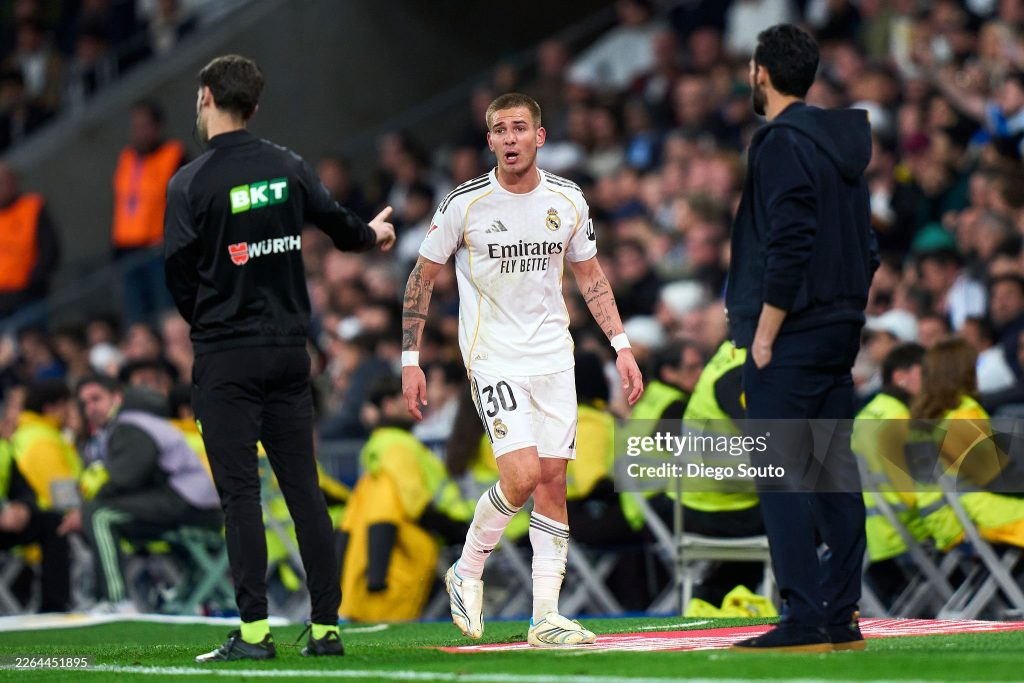
However, Real Madrid suffered another setback after its midfielder Franco Mastantuono was not included in the squad, as no Spanish player from there received a call-up to Spain’s World Cup setup.
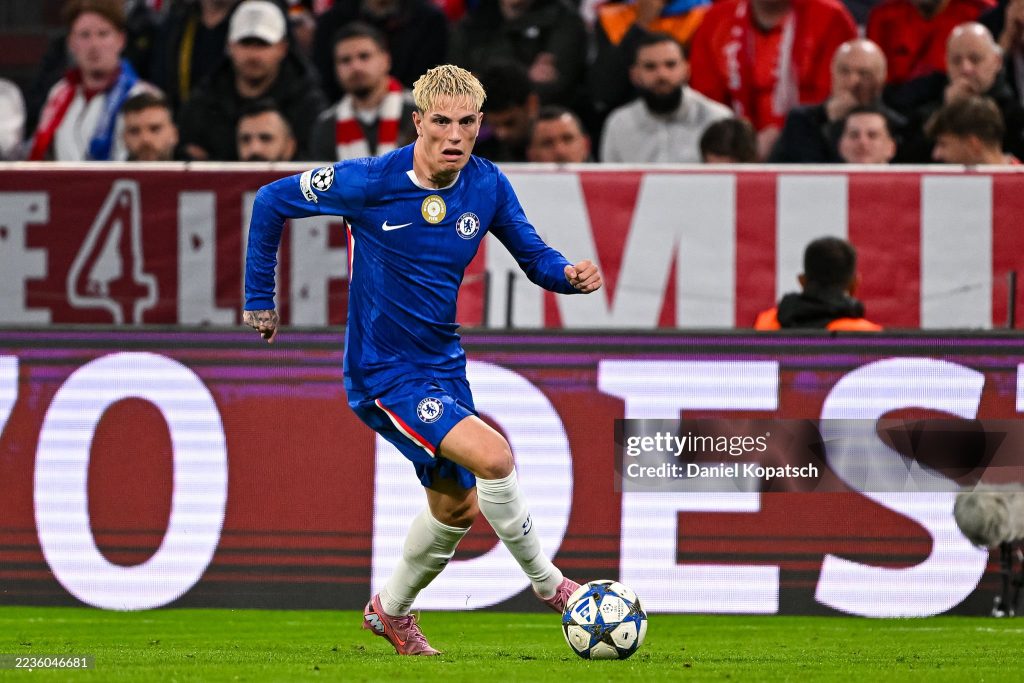
After a poor campaign in his debut season at Chelsea, Alejandro Garnacho was not called up for the World Cup.
Alejandro Garnacho of Chelsea FC in action during the UEFA Champions League 2025/26 League Phase MD1 match between FC Bayern München and Chelsea FC (Photo by Daniel Kopatsch/Getty Images)
Benfica’s Gianluca Prestianni was also overlooked in the wake of his much-publicised involvement in an alleged racist attack on Real Madrid forward Vinicius Jr during a UEFA Champions League game.
Gianluca Prestianni of Benfica speaks towards Vinicius Junior of Real Madrid during the UEFA Champions League 2025/26 League Knockout Play-off First Leg match between SL Benfica and Real Madrid C.F. (Photo by Angel Martinez/Getty Images)
Anticipated attendance
The FIFA World Cup scheduled for June-July 2026 is set to see approximately five to ten million people in attendance, as announced by the president of the football governing body, Gianni Infantino.
Speaking at a joint press briefing with U.S. President Donald Trump at the White House in Washington, D.C., on 17 November, he noted that the tournament is expected to attract millions of people across the three countries set to host the games next year.
“Millions of fans will be coming. One of the things I’ve observed in America is that the stadiums here are really built for people to have fun, to enjoy, to spend time. They don’t just watch the game and leave; they stay for hours, and I think that’s exactly what we need. We need occasions that bring people together from all over the world.”
The USA is giving priority access to fans, the WhiteHouse has announced.
People from all over the World will travel to support their countries. Consequently, the Whitehouse has announced that fans set to travel for the tournament to the USA will be given the FIFA Prioritised Appointment Scheduling System (Pass), given that most of the matches will be played there.
The FIFA Prioritised Appointment Scheduling System (FIFA PASS) is a special visa‑interview scheduling program created by the U.S. government and FIFA for the 2026 World Cup. It gives ticket holders priority access to U.S. visa appointments, ensuring fans can travel to matches in North America despite existing visa backlogs.
Speaking during a joint press briefing with FIFA President Gianni Infantino at the White House in Washington, D.C., on 17 November, President Donald Trump mentioned that “I’ve directed my administration to do everything within their power to make the 2026 World Cup an unprecedented success.”
Detailing how the ‘World’ will gain access into the US, the Secretary of State Marco Rubio noted that ticket-holders for the tournament, set for next June and July in the US, Canada and Mexico, will not be automatically granted a tourist visa.
But foreign nationals with tickets to World Cup football matches could get an interview at an embassy or consulate within six to eight weeks of applying, Rubio said.
“Your ticket is not a visa; it doesn’t guarantee admission to the US. We’re going to do the same vetting as anybody else would get. The only difference here is we’re moving them up in the queue,” the Secretary noted.
US Human Rights Groups warn fans, visitors ahead of the tournament
Some human rights groups in the USA have sent a cautionary message to all fans, journalists, players and others who will be travelling to the state for the World Cup this summer.
The message was shared as a formal travel advisory via press releases with the consent of a coalition of over 120 human rights and civil liberties groups, led by the American Civil Liberties Union (ACLU) and Amnesty International, on Thursday, April 23.
Parts of the statement told all fans and visitors to “exercise caution” if travelling to the United States amid an era they describe as “the Trump administration’s violent and abusive immigration crackdown”.
Also, according to ACLU Human Rights Program Director Jamil Dakwar, FIFA’s relationship with the American President, who he says has little regard for human rights, shows it is preaching a commitment it is far from upholding.
He said, “FIFA has been paying lip service to human rights while cosying up with the Trump administration, putting millions of people at risk of being harmed and their basic rights violated. The Trump administration’s rising authoritarianism and increasing violence pose serious risks to all.
Also a member of one of the 120 coalition, Jennifer Li (Dignity 2026 coalition) added that, “We are still waiting for public commitments from FIFA and host city organisers about plans to protect residents, workers, and visitors.”
Ghana is set to host a 3-day international high-level conference in Accra on June 17 2026, as conversations on global engagement with historical justice, remembrance, and the legacy of the transatlantic slave trade intensify.
This was announced in a statement issued by the Government Communications Spokesperson and Minister, Felix Kwakye Ofosu, following an apology by His Holiness Pope Leo XIV for the Holy See’s role in the transatlantic slave trade, which took place between the late 15th century and the late 19th century.
In a speech delivered by Pope Leo XIV, he gave a historic apology for the Holy See’s role in the transatlantic slave trade on Monday, May 25, at the Vatican during the presentation of his first encyclical, “Magnifica Humanitas: On Safeguarding the Human Person in the Time of Artificial Intelligence”, describing the act as “a wound in Christian memory”.
“It is impossible not to feel deep sorrow when contemplating the immense suffering and humiliation endured by so many in stark contrast to their immeasurable dignity as persons infinitely loved by the Lord. For this, in the name of the Church, I sincerely ask for pardon”, the Pope said.
In reaction to the Pope’s apology, the government, in a statement on May 28, 2026, welcomed the apology, describing it as “an act of moral courage” and announced Ghana’s hosting of the High-Level Consultative Conference on Historical Justice, Remembrance, and the Legacy of the Transatlantic Slave Trade from June 17–19.
“The Government of the Republic of Ghana warmly welcomes the historic statement by His Holiness Pope Leo XI acknowledging and apologising for the role played by the Holy See in legitimising and sustaining the enslavement of Africans and the transatlantic slave trade.
“His Holiness Pope Leo XI’s apology is particularly significant and refreshing, as it demonstrates a willingness to confront difficult historical truths in the interest of justice, understanding and reconciliation, ” parts of the statement read.
It went on to highlight the hardships Africans were subjected to under the slave system and the indelible prints it has left on them until now. According to the government, the Pope’s acknowledgement of the sufferings of Africans during the slavery era helps expedite the healing and reconciliation process.
“For five centuries, millions of Africans and people of African descent endured unimaginable suffering and dehumanisation through systems of racialised chattel enslavement whose effects continue to shape societies and communities across the world today.”
“Honest recognition of this painful history remains an essential step toward healing, reconciliation and a more just future” the government continued.
In this regard, Ghana looks forward to welcoming the international community to Accra from 17th to 19th June 2026 for the High-Level Consultative Conference being convened by His Excellency John Dramani Mahama, President of the Republic of Ghana, on the next steps following the adoption of the Resolution, aimed at sustaining global engagement on historical justice, remembrance, and human dignity.”
President John Dramani Mahama was also cited in the statement as viewing the development as significant in ongoing international discussions on historical accountability.
At the last United Nations General Assembly, President John Dramani Mahama presented a motion to declare the transatlantic slave trade and the enslavement of Africans as “the gravest crime against humanity,” describing it as a landmark in global efforts to preserve historical memory and promote justice.
Ghana also expressed hope that countries that did not support the resolution would eventually align with its objectives and participate in its implementation.
President Mahama, according to the statement, expressed appreciation to Pope Leo XIV for his apology and said he looks forward to continued global engagement on truth, healing, and reconciliation.
The Ghana Revenue Authority (GRA) has reported a billion cedis in revenue in the month of April, a performance Commissioner has confirmed.
Mr Anthony Kofi Sarpong, while speaking at the 10th Ghana CEO Summit, indicated that the revenue marks a significant improvement in tax collection, compliance, administrative efficiency and digital reforms targeted at strengthening the country’s economy.
Highlighting the massive improvement in revenue collection compared to the same period last year, the Commissioner attributed the increase to the introduction of the Republican Artificial Intelligence system at the ports.
The “Republican AI” (also called Publican AI) system is a Ghana Revenue Authority (GRA) initiative introduced in early 2026 to automate customs valuation at the ports to modernise operations and block revenue leakages.
“The Republican Artificial Intelligence system introduced at the ports helped improve compliance and blocked revenue leakages. “Indeed, the results for the first two months of deploying the AI are amazing and promising. In April alone, we added GHS1 billion to our revenue generation for customs,” the Commissioner noted.
He noted that the GH¢1 billion collection in April demonstrates the potential of a more efficient and modernised tax system, but stressed that broader structural reforms are still required to sustain and expand gains in revenue mobilisation.
“Our aspiration for a reset and transformed economy is not attainable if we fail to mobilise the needed domestic revenue as one of the most important catalysts for national development,” he said
He went on to highlight the need for a sustained revenue mobilisation channel to ensure development as the country makes efforts to reduce and gradually cut heavy reliance on external financial inflows.
“Education and development of Ghana rest and thrive on the provision of relevant enablers, including infrastructure, energy, a well-trained and equipped workforce, and efficient public services,” he stated, underscoring the importance of sustained revenue flows to support national priorities.
The Commissioner-General warned that reliance on external financing is increasingly uncertain, making domestic revenue mobilisation a matter of economic sovereignty.
“The alternative to mobilising domestic revenue is dependence on financing that is no longer reliably open or available,” he said.
Mr. Sarpong explained that ensuring fairness within the tax system remains essential to protecting compliant businesses from unfair competition created by operators who evade their tax obligations.
“The compliant business pays its share, while the non-compliant business does not. The gap between the two becomes a competitive penalty paid by firms that are actually doing the right thing,” he said.
He indicated that current tax reforms are aimed at widening the tax net and strengthening compliance through digitalisation instead of imposing additional burdens on already compliant taxpayers.
“We want this era of tax reform to be about ensuring that those who pay are no longer being competed against by those who do not,” he stated.
Touching on the role of innovation, Mr Sarpong said technology is transforming tax administration by creating efficiencies that were previously difficult to achieve.
“Technology is now available for us to change structurally what was not possible yesterday. A credible tax system is in itself a factor of production for the Ghanaian industry,” he noted.
He further praised ongoing reforms under the current administration, stressing that the emphasis has been on improving revenue collection efficiency rather than introducing new taxes.
“We are focused on the efficiency of collecting those that are there,” he stated.
Mr. Sarpong also revealed that the GRA is reviewing several tax laws, many of which have existed for more than a decade, in a bid to make them more responsive to current economic realities and address compliance loopholes.
“We are comprehensively revising our tax laws, many of which are over 10 years old, to make them relevant, practical, and up to date with current requirements,” he said.
He stressed that modernising the country’s tax framework would be key to sustaining recent revenue growth and advancing Ghana’s broader economic transformation agenda.
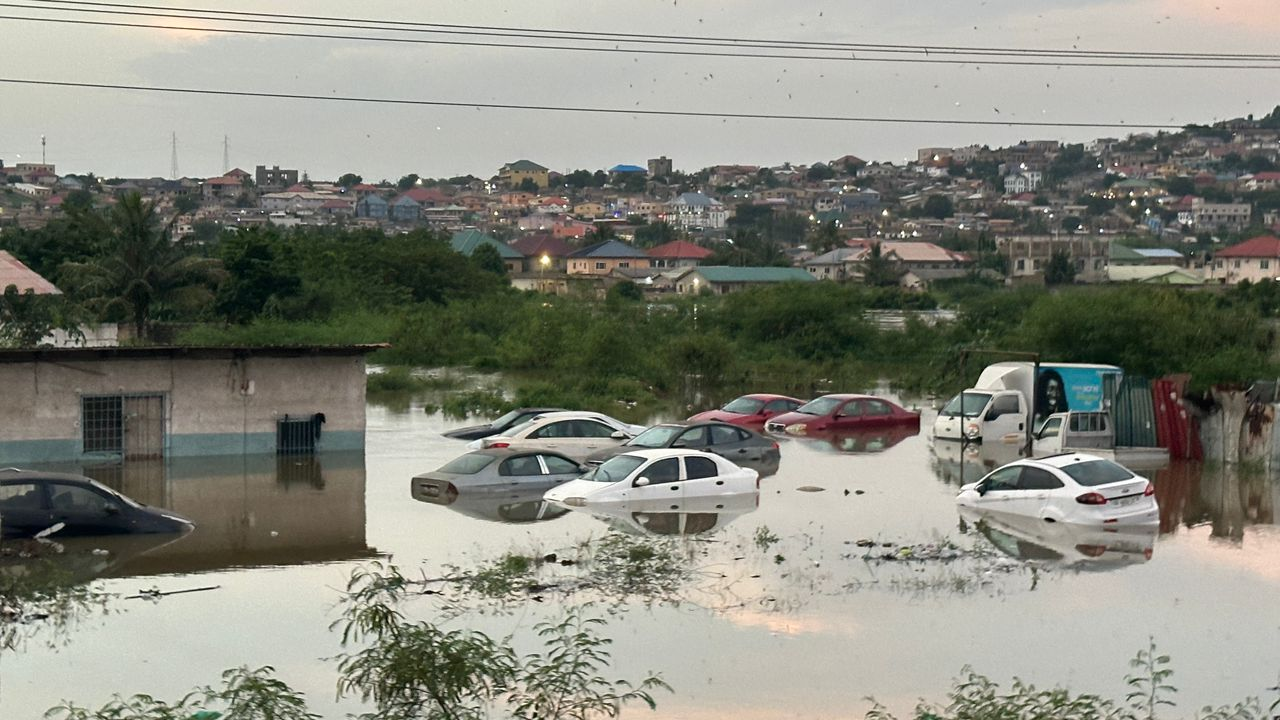
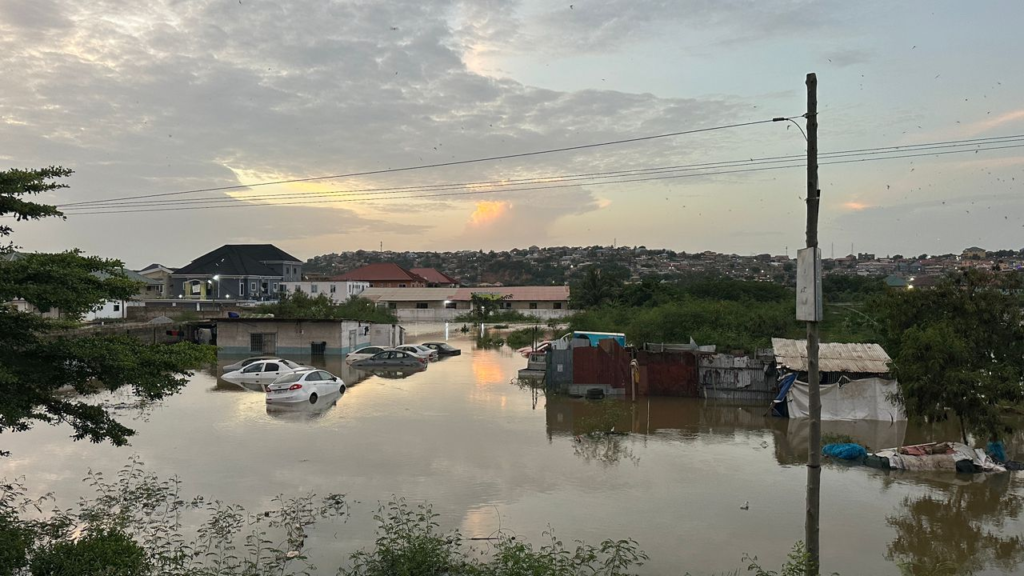
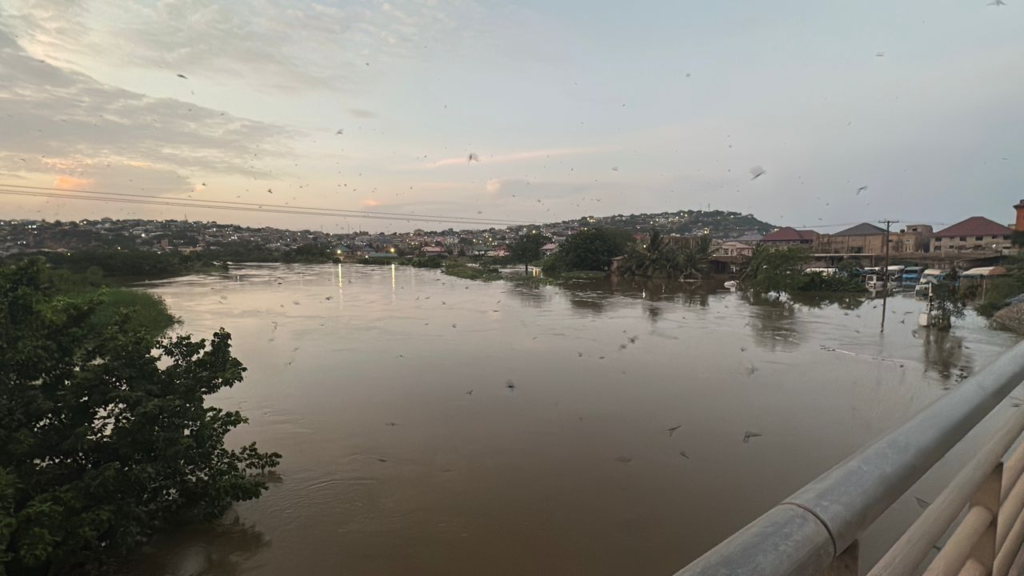
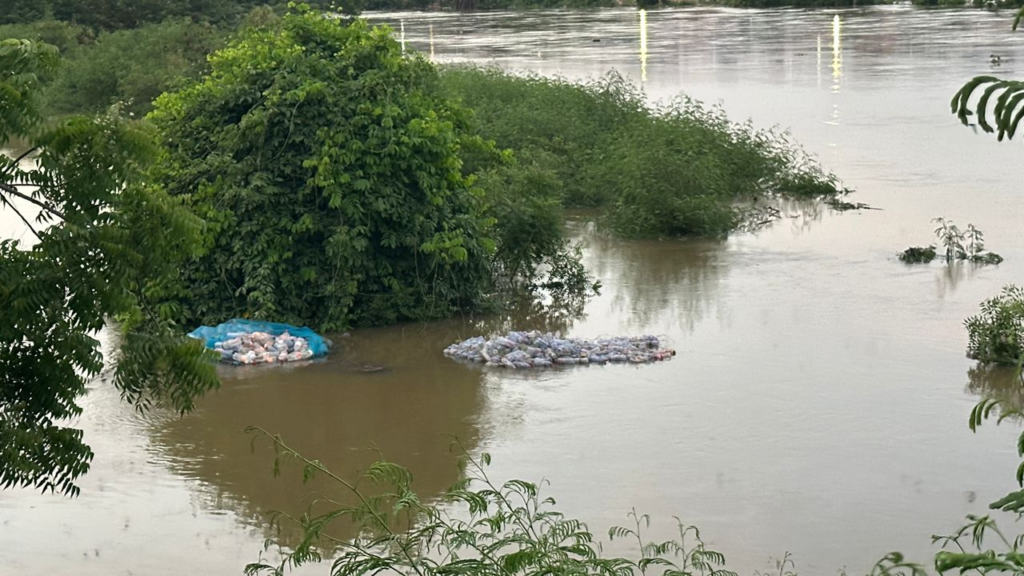
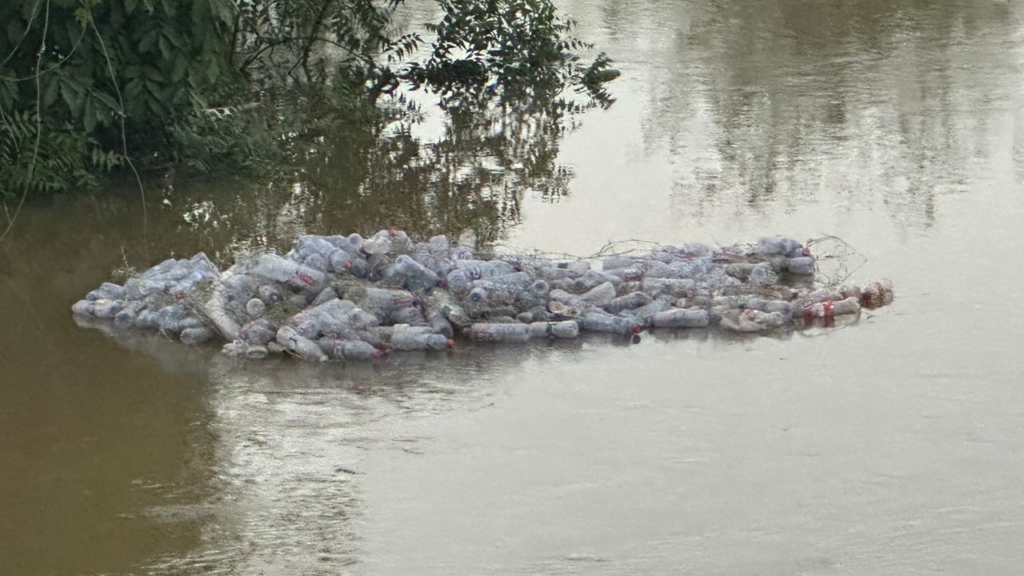
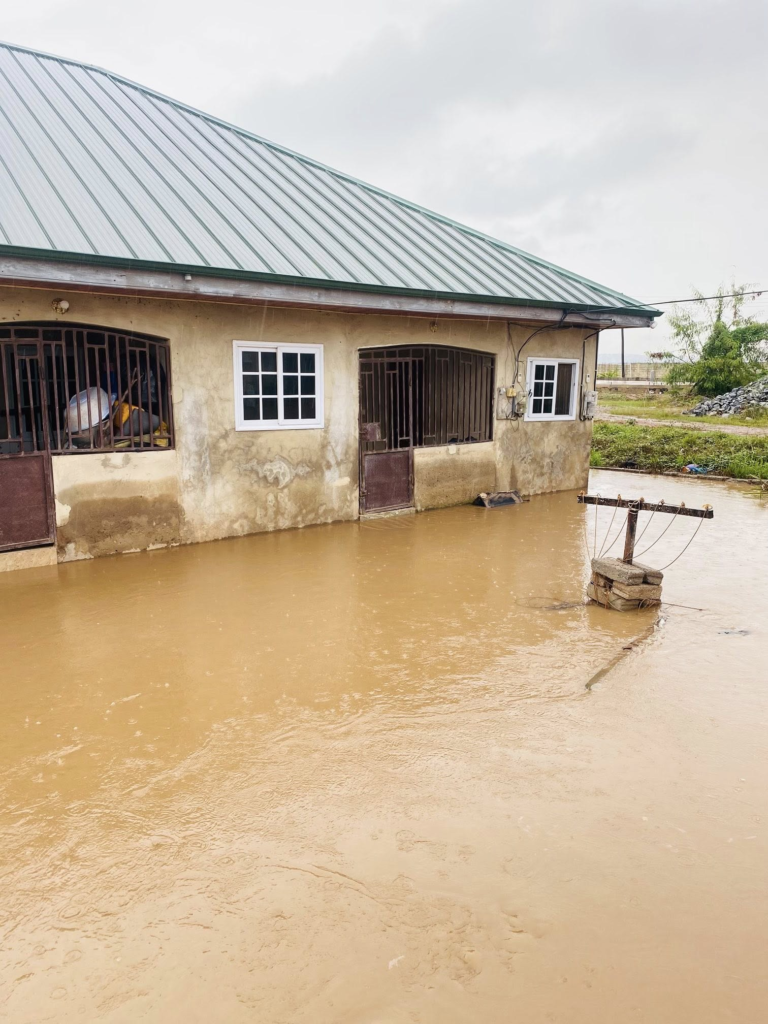
The recent downpours have led to heavy flooding in Accra, but residents of Weija are currently in distress with risk to life and property after hundreds of homes were flooded following a controlled spillage of the Weija Dam by the Ghana Water Limited (GWL).
The GWL confirmed the spillage in a formal notice issued on May 27, explaining that the decision was necessitated by rising water levels caused by recent downpours, which pushed the dam beyond its safe operating limits, i.e., above 48 feet, and heightened concerns over a possible overflow.
Consequently, as part of measures to avert any overflow.GWL explained that the controlled spillage is a standard safety procedure implemented during periods of heavy rainfall, when increased inflows place pressure on the dam’s capacity.
The situation has resulted in extensive flooding in surrounding communities, with several residents displaced and others struggling to salvage their belongings as water inundates homes and roads.
The second batch of evacuees from South Africa is set to touch down this weekend. Ghana’s High Commissioner to South Africa, Benjamin Quashie, has revealed that 410 Ghanaians fleeing xenophobic attacks in South Africa will be evacuated over the weekend.
The weekend group will be the second batch to be repatriated, while the date for the rest is yet to be communicated after the arrival of the first 300 evacuees on Wednesday, May 27.
Speaking during JoyFM’s Super Morning Show on Thursday, May 28, the High Commissioner indicated that, “The next batch will be of 410 evacuees who have given us their names that they want to go home voluntarily. It is going to be the coming Sunday or Tuesday; we have not fixed the exact date yet, but it should be between these three days.”
He disclosed that about 1,000 Ghanaians living in South Africa have registered to return home over fears of the attacks.
“As of this morning (Thursday, May 28), I have been briefed that we have almost a thousand plus who have fully registered and have indicated that they want to leave South Africa and go back home,” he noted.
Meanwhile, Foreign Affairs Minister Samuel Okudzeto Ablakwa has urged the evacuees not to lose hope, assuring them that the government has plans in place to support their reintegration into society.
Addressing the returnees at the Accra International Airport on Wednesday, May 27, Mr Ablakwa encouraged them to remain optimistic despite their experiences abroad.
“We don’t want any of you to feel brokenhearted, don’t be downhearted, don’t be depressed, have confidence that the almighty has better plans for you,” he told the evacuees upon their arrival.
Earlier, the Foreign Affairs Ministry confirmed that over eight hundred (800) Ghanaians have registered at their Commission in Pretoria, for voluntary evacuation due to the worsening xenophobic attacks in South Africa. Consequently, “the planned evacuation has been deferred by a few days to enable our High Commission to meet these evacuation conditions”.
“The Ministry of Foreign Affairs wishes to provide an update on the evacuation of Ghanaians from South Africa, which was scheduled to commence today, 21 May, 2026. The Government of Ghana notes that more than 800 Ghanaians have registered with our High Commission in Pretoria seeking to be evacuated due to the latest wave of xenophobic attacks.
Considering the numbers involved and the South African legal conditions that have to be met, including mandatory passenger screening, multi-institutional coordination and flight permits, parts of the statement read.
To ensure that all the necessary regulatory requirements are met, an additional day of preparation to ensure a safe and orderly evacuation process.
“Ghanaian and South African authorities have agreed to enhanced and more efficient pre-evacuation modalities to expedite the process”, the Ministry added.
Govt pledges support package for SA repatriates
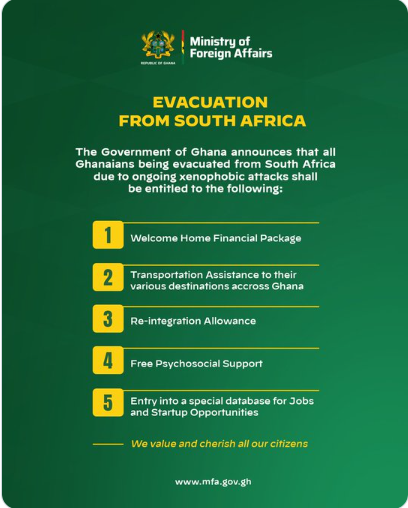
Before the planned evacuation, the government announced a support package for Ghanaians being evacuated from South Africa.
In a statement shared on the Ministry of Foreign Affairs’ (MoFA) official X (formerly Twitter) account on May 20, Foreign Affairs Minister Samuel Okudzeto Ablakwa stated that returnees would receive a welcome-home financial package, transportation assistance to their destinations across Ghana, and a reintegration allowance.
The package also included free psychosocial support for those who may have experienced trauma or violence, as well as counselling and medical assistance to aid their recovery.
President John Mahama has confirmed that about 6,900 Ghanaian pilgrims were airlifted to the Kingdom of Saudi Arabia for this year’s Hajj, marking about 900 more than the 6000 earlier communicated by the Hajj Board.
Speaking during the Eid‑ul‑Adha celebrations at Independence Square yesterday, Wednesday, May 27, President Mahama commended the Ghana Hajj Board and all other stakeholders for their remarkable role and dedication in ensuring the smooth operations of the year’s Hajj.
He indicated that he has received several commendations on the Board’s facilitations on feeding accommodations, among other arrangements that have contributed to the successful organisation of the trip to Mecca.
“This year’s Hajj operations have largely been successful. About 6,900 Ghanaian pilgrims were airlifted to the Kingdom of Saudi Arabia to undertake the sacred pilgrimage. I’ve received encouraging reports on their accommodation, feeding arrangements, transport, and overall welfare. I therefore wish to commend the Ghana Hajj Board and all stakeholders for their dedication and hard work in ensuring a smooth and successful Hajj this year”, he said.
He then sent his condolences to the family of Musah Sidi, 53, who collapsed during Tawaf at the Haram in Mecca and passed away shortly after praying that all pilgrims return home safely to their families.
“Yesterday was the Day of Arafah, one of Islam’s holiest days when pilgrims gather to pray, repent and supplicate to the will of Allah. We pray that Almighty Allah will accept the prayers and supplications of all our pilgrims and grant them a safe return journey back home.
“However, I’m saddened to note the passing of one of our Ghanaian pilgrims during this year’s Hajj. On behalf of the government and people of Ghana, I offer my heartfelt condolences to the bereaved family, and we pray that Allah will forgive all his sins and grant him Jannatul Firdaus”, President Mahama added.
Another Ghanaian pilgrim has died at the ongoing 2026 Hajj in Saudi Arabia, according to the Pilgrims Affairs Office of Ghana (PAOG).
The office announced this yesterday, in a formal notice dated May 27, which indicated that the deceased, Alhaji Sulemana Iddrisu, passed on Tuesday, May 26 and as the religious principles permit, he has since been buried after his family was duly informed and his death documented.
“The Pilgrims Affairs Office of Ghana (GAOG) regrets to announce the passing away of Alhaji Sulemana Iddrisu (60), who returned to his Lord at the blessed plains of Arafat on Tuesday, May 26. He has since been buried following Islamic traditions after his family was duly notified”, parts of the statement read.
It continued that “When a pilgrim dies in Arafat, they are considered by Islamic tradition to have completed one of the most spiritually blessed rites of Hajj. Under Saudi regulations, their body is respectfully prepared, buried in the Holy Land, and the death is officially documented without requiring others to complete Hajj on their behalf”.
PAOG highlighted that Alhaji Iddrisu’s death on the holy plains is a great honour, according to their Holy Book, as there is a promise of resurrection for such deaths.
“Dying in a state of Ihram on the Day of Arafat is considered a deeply honourable passing in Islam. According to the Prophet Muhammad (PBUH), a pilgrim who dies during the pilgrimage will be resurrected on the Day of Judgment still in Ihram,” a statement from PAOG, signed by Director of Communications Mohammed Amin Lamptey, noted.
The statement added that PAOG worked closely with Saudi authorities to notify the family of the deceased and provide regular updates before the burial while extending their condolences to the bereaved family.
“The Pilgrims’ Affairs Office of Ghana (PAOG) coordinated with the Saudi Authorities to notify the deceased’s family and provide them with regular updates before the interment. We extend our deepest condolences to his immediate family, loved ones and sympathisers. We pray that Allah (SWT) accepts his Hajj as Hajj Mabroor, forgives his sins, and grants him Jannatul Firdaus,” the statement added.
The death of Alhaji Sulemana Iddrisu comes just about five days after PAOG announced the death of another pilgrim in this year’s Hajj.
Ghana’s controversial Human Sexual Rights and Family Values Bill, also known as the Anti-LGBTQ bill, is likely to be passed this Friday, Majority Chief Whip, Rockson Nelson Dafeamekpor, has said.
He made these remarks during an appearance on Joy News PM Express on Tuesday, May 26, indicating that all work on the reintroduced Bill has been completed by the Committee that was put in charge, and is ready to present it before Parliament.
According to him, the House is ready to pass the bill once debate starts this week. He said, “The report will be laid on Thursday. Once it’s adopted, we move into consideration. Consideration, we can even decide to do consideration on Friday, and pass.“Yes, in a couple of weeks, not even months. We’ll pass it once we do the second reading on Thursday or Friday, and with consideration, we can pass it.”
According to him, Parliament is prepared to move quickly through the remaining stages of the legislative process once the report is presented.
“When it’s laid, we can take the report, debate it, that’s as part of the principles for second reading, and adopt it,” he explained.
He clarified that although his government expedited procedures to pass the bill, criticisms about the urgency should not arise in Parliament or from the public.
He argued that the House was already familiar with the contents of the bill because it had previously approved an earlier version of the legislation.
“You see, the Ghanaian family values bill, we have already passed it. It was a certain president who decided not to sign, so the terms of the bill are essentially what parliament had already passed.
But when we do consider expeditiously, let the NPP not shout that we are abusing the certificate of urgency. It will be rapidly done, because we cannot be reenacting what we have already read”, he stated.
About the Anti-LGBTQ Bill
It was first introduced in 2021 in Parliament on 2 August 2021 as a Private Members’ Bill sponsored by a bipartisan group of eight MPs, seven from the opposition NDC and one from the ruling NPP at the time. The lead sponsor was Samuel Nartey George, Member of Parliament for Ningo‑Prampram and Ghana’s Minister for Communication, Digital Technology and Innovations.
The MPs at the time included Emmanuel Kwasi Bedzrah, MP for Ho West (NDC). Rockson‑Nelson Dafeamekpor, MP for South Dayi (NDC), Helen Adjoa Ntoso, MP for Krachi East (NDC), Rita Naa Odoley Sowah, MP for La Dadekotopon (NDC), Della Sowah, MP for Kpando (NDC), Alhassan Suhuyini, MP for Tamale North (NDC), John Ntim Fordjour, MP for Assin South (NPP).
It was initially passed in February 2024; however couldn’t become a law as President Akufo-Addo did not assent to it.
Fast forward to after the NDC government assumed power, the bill was reintroduced in Parliament on February 17, 2026.
What was in the bill?
The bill was designed to criminalise LGBTQ+ activities, advocacy, and funding, with penalties ranging from 3 to 10 years imprisonment depending on the offence.
The bill sought to criminalise identifying as LGBTQ+, with offenders facing up to three years’ imprisonment.
It also proposed sanctions against individuals accused of promoting LGBTQ+ rights, including teachers, journalists, doctors, parents and advocates.
Under the bill, LGBTQ+ organisations would have been outlawed, while donors and partner organisations risked prosecution.
The legislation further proposed restrictions on media content, making digital or broadcast promotion of LGBTQ+ activities punishable by up to 10 years imprisonment.
It also sought to render same-sex marriages void and prohibit gender transition procedures.
Additionally, the bill proposed mandatory reporting requirements, compelling family members, educators, religious leaders and community members to report suspected LGBTQ+ activities.
President Mahama’s comments earlier this month
In early May, President John Dramani Mahama clarified that, although he would not hesitate to sign the Human Sexual Rights and Family Values Bill, popularly known as the anti-gay Bill, which is currently before parliament into law, he believes Ghana must first address its pressing issues.
During a Presidential Dialogue with Civil Society Organisations at Jubilee House in Accra on Monday, March 30, President Mahama urged restraint and constructive engagement in ongoing national discussions on LGBTQ+ issues.”LGBTQ+ issues it remains a highly emotive and sensitive issue even in the most advanced liberal democracies.
I explained during my recent engagement with the World Affairs Council that it is not the most important issue we face as a nation; we are still grappling with the provisions of basic needs of education, healthcare, jobs, food, clothing and shelter.
“Nevertheless, the private bill introduced in Parliament has sparked a complex and sensitive national conversation. Our position is guided by our constitution, respect for human rights and dignity for all persons and the need to preserve social cohesion. While there are strong and differing views within our society, we believe that issues must be addressed through democratic processes, our core values, dialogue, and the rule of law.
“I am also mindful of reactions from my international partners, including the recent development such as Lincoln University’s withdrawal of their honorary decoration. These developments underscore the importance of continuous dedication and mutual respect and situating our national decisions within our constitutional and cultural context,” he said.
Another Ghanaian pilgrim has died at the ongoing 2026 Hajj in Saudi Arabia, according to the Pilgrims Affairs Office of Ghana (PAOG).
The office announced this yesterday, in a formal notice dated May 27, which indicated that the deceased, Alhaji Sulemana Iddrisu, passed on Tuesday, May 26 and as the religious principles permit, he has since been buried after his family was duly informed and his death documented.
“The Pilgrims Affairs Office of Ghana (GAOG) regrets to announce the passing away of Alhaji Sulemana Iddrisu (60), who returned to his Lord at the blessed plains of Arafat on Tuesday, May 26. He has since been buried following Islamic traditions after his family was duly notified”, parts of the statement read.
It continued that “When a pilgrim dies in Arafat, they are considered by Islamic tradition to have completed one of the most spiritually blessed rites of Hajj. Under Saudi regulations, their body is respectfully prepared, buried in the Holy Land, and the death is officially documented without requiring others to complete Hajj on their behalf”.
PAOG highlighted that Alhaji Iddrisu’s death on the holy plains is a great honour, according to their Holy Book, as there is a promise of resurrection for such deaths.
“Dying in a state of Ihram on the Day of Arafat is considered a deeply honourable passing in Islam. According to the Prophet Muhammad (PBUH), a pilgrim who dies during the pilgrimage will be resurrected on the Day of Judgment still in Ihram,” a statement from PAOG, signed by Director of Communications Mohammed Amin Lamptey, noted.
The statement added that PAOG worked closely with Saudi authorities to notify the family of the deceased and provide regular updates before the burial while extending their condolences to the bereaved family.
“The Pilgrims’ Affairs Office of Ghana (PAOG) coordinated with the Saudi Authorities to notify the deceased’s family and provide them with regular updates before the interment. We extend our deepest condolences to his immediate family, loved ones and sympathisers. We pray that Allah (SWT) accepts his Hajj as Hajj Mabroor, forgives his sins, and grants him Jannatul Firdaus,” the statement added.
The death of Alhaji Sulemana Iddrisu comes just about five days after PAOG announced the death of another pilgrim in this year’s Hajj.
First death, Hajj 2026
Ghana recorded the first death of a pilgrim during the 2026 Hajj after the Pilgrims Affairs Office of Ghana (PAOG) confirmed the demise in an official statement dated May 22, 2026, signed by its Director of Communications, Mohammed Amin Lamptey.
According to the statement, Musah Sidi, aged 53, collapsed during Tawaf at the Haram in Mecca and passed away shortly after.
“The Pilgrims Affairs Office of Ghana (PAOG) regretted to officially announce the passing of Mr. Musah Sidi (53), a Ghanaian prospective pilgrim, who collapsed at the Haram during Tawaf… and passed away shortly afterwards”, parts of the statement noted.
The office confirmed that the bereaved family had been formally informed of his demise, while arrangements were underway for his body to be prepared for Janaza prayers after Jumu’ah prayers before burial, citing that according to Islamic tradition, it was an honour to die during worship.
“In Islamic tradition, a pilgrim who dies in a state of worship and in Ihram is promised immense spiritual honour in the hereafter,” the statement added.
The Pilgrims Affairs Office extended its condolences to the family, sympathisers and loved ones of the deceased.
“We extended our deepest condolences to his immediate family, sympathizers and loved ones. May Allah forgive his shortcomings and grant him Jannatul Firdaus”, the office noted.
Meanwhile, the first batch of Ghanaian pilgrims departed for the Kingdom of Saudi Arabia in early May. Their departure was announced by the Communications Director of the Hajj Board, Mohammed Amin Lamptey, during a media briefing on Friday, May 1.
The pilgrims left from Tamale Airport at about 11:30 GMT on Friday, May 1, for the annual pilgrimage to Mecca and were expected to arrive at 4:00 p.m. GMT.
According to the Hajj Board, of the 6,000 Ghanaians expected to undertake the pilgrimage that year, 430 had been airlifted, leaving 5,570 pilgrims yet to depart for Saudi Arabia on 18 scheduled flights between May 1 and May 18, 2026.
Mr Amin Lamptey stated that all the necessary arrangements had been put in place to ensure a successful pilgrimage.
To facilitate a smooth stay in Saudi Arabia, the Board had deployed a team ahead of the pilgrims to receive them. The pilgrims were scheduled to spend three days in Medina before proceeding to Mecca.
He said, “This year, we have enhanced our communication systems to ensure that sensitive information is handled accurately and shared appropriately”.
For his part, Mr John advised the prospective pilgrims to respect the laws of Saudi Arabia and conduct themselves in a manner that upheld Ghana’s image.
“You are not only carrying your personal faith, but also the image of our nation. Let your conduct reflect the values of peace, tolerance and unity that Ghana is known for,” he said.
A recent report by Joy News suggests that the Ghana cedi has weakened by 10.11% against the US dollar since January.
It attributes the depreciation to market pressures, i.e., the rising demand for dollars in transactions in the interbank market, the market where banks trade currencies with each other) in Ghana.
It closed at interbank mid-rates of GH¢11.63 to a dollar, GH¢15.62 against the pound and GH¢13.49 to the euro over two weeks. This reflected losses of 3.01%, 1.65%, and 1.56%, respectively.
Similar trends were observed in the retail market, where the currency weakened by 3.07% against the American greenback, 1.56% against the pound and 1.49% against the euro, closing at mid-rates of GH¢12.20 against the dollar, GH¢16.05 to the pound and GH¢14.10 to the euro, respectively.
“We note that the cedi’s depreciation exceeded our upper-band forecast of GH¢11.40 against the US dollar, as the central bank remained cautious about forex intermediation despite assurances from the International Monetary Fund of a likely US$385 million disbursement,” Database Research noted.
Per the report, the authorities appear to be conserving foreign exchange reserves while they wait for a more reliable flow of foreign currency into the country, especially as demand for dollars remains high.
“Looking ahead, we expect the cedi to trade largely on bearish expectations within a range of GH¢11.35 – 11.86/US dollar over the next two weeks [in the interbank market], with the path shaped by the balance between FX demand and the magnitude of supply into the market,” it further stated.
Meanwhile, the cedi began this week going for GH¢12.20 to the American greenback in the retail market. Its year-to-date loss now stands at 0.20%.
Cedi’s value earlier this year
The cedi recorded a 4% depreciation against major trading currencies, according to the Bank of Ghana’s January 2026 Summary of Economic and Financial Data.
The local currency traded at GH¢10.88 to the US dollar on the interbank market, compared with GH¢10.45 at the end of December 2025. It also traded at GH¢14.77 to the pound and GH¢12.80 to the euro, representing losses of 4.9% and 4.1%, respectively.
Despite the early-year depreciation, data from the International Monetary Fund (IMF), analysed across more than 20 major African economies, showed that the cedi emerged as the continent’s best-performing currency in 2025.
According to the report, the cedi strengthened by more than 40% against the US dollar in 2025, making it the top-performing currency among over 20 African currencies reviewed.
Ghana’s foreign exchange reserves also increased significantly during the period. The Bank of Ghana reported that reserves rose by 33.63%, or $3.02 billion, between December 2024 and October 2025, reaching approximately $12 billion by October 2025.
Speaking at the launch of the 60th anniversary of the Ghana cedi in Accra on October 28, 2025, Governor of the Bank of Ghana, Dr Johnson Pandit Asiama, attributed the improvement to coordinated fiscal and monetary policy measures implemented by the government.
He said the country had achieved a decisive economic turnaround, reflected in stronger foreign exchange reserves, improved investor confidence and increased resilience of the local currency against external shocks.
“Under the leadership of His Excellency John Dramani Mahama and Her Excellency the Vice President, and through coordinated, difficult but necessary policy actions, Ghana had turned a decisive corner, and the evidence was compelling. Our gross international reserves were around $12 billion,” he said.
Measures to strengthen the cedi
As part of a revamped reserve-building drive, large-scale gold miners have been instructed by the government to sell 30% of their gold output to the central bank from the earlier 20%, this is according to a Reuters report.
According to the report, the directive is yet to be accepted by miners, as key commercial terms remain unresolved. Last year, miners operating under valid mining license were offered a special temporary bonus scheme from the Ghana Gold Board (GoldBod) in efforts to support the industry as well as combating gold smuggling.
The licensed miners will enjoy an additional GH¢832 per pound of gold sold through the Ghana Gold Board. This information was contained in a statement issued by the GoldBod on Wednesday, August 27.
“This novelty is in response to legitimate complaints from licensed miners about the significant reduction in the local price of gold in the last few months due to the continuous appreciation of the Ghana cedi.
“The special bonus will ensure that licensed miners who have contributed immensely to the country’s increased gold output and foreign exchange earnings do not indirectly suffer as a result of the significant appreciation of the Ghana cedi that they have helped the country achieve,” the statement read.
According to GoldBod, the recent development has been made possible as a result of the continuous appreciation of the Ghana cedi.
One of Ghana’s veteran business journalists, now based in New York, reached out and asked if I have been following the NITA bill debate. Sadly, I hadn’t. Too much going on.
He pressed, subtly but firmly, so I did.
I appreciate the ambition of the current management at the Ministry. I am sure they want their names in neon above Black Star Square. But there is a serious katanomic odour blowing from the bill they are promoting.
They would do well to assemble a group of truly independent tech folks from the ICT chamber, not just a bunch of their friends, listen hard, talk less, and take the advice. If they did, they would gut that manuscript and return to the drawing board.
Here is why, based on my quick take on the bill.
Bottom line
The Ministry of Communications, Digital Technology, & Innovations (MOC) does not merely appear to be proposing to “license IT professionals.”
The draft NITA Bill is much bigger. The plan is to convert NITA from a coordinating ICT agency into a broad digital-sector regulator with powers over ICT infrastructure, cloud, SaaS, digital platforms, public-sector technology procurement, professional certification, business premises, mergers, ownership, standards, audits, sanctions, and even the structure of government digital infrastructure. It is a wholesale revamp.
No one would have quarrelled with the bill if it had focused on the big problems in the sector: public sector procurement indiscipline and a lack of incentives for R&D and support for local tech innovations.
Ghana certainly needs improved standards and practices in digital assurance, interoperability, and accountability for critical systems (already captured in the “critical infrastructure” policy).
The katanomics arise when instead of learning from national mistakes and proposing workable solutions, one jumps the process to venture into a whole range of areas where the country absolutely lack policy experience.
1. MOC’s Proposals
The draft/consultation bill proposes as follows:
A stronger NITA “Authority”
The Bill would establish NITA as a regulatory authority for ICT and digital services, with objects including regulation, coordination, promotion, standards, licensing, certification, interoperability, digital innovation, and public-sector ICT personnel management.
Mandatory licensing of ICT business activity
Section 35 (the bombshell that has sparked so much controversy). It says no person may engage in business or a related activity in the ICT sector unless granted a licence. It expressly includes installation of ICT infrastructure, development or provision of ICT products and services, and activities requiring licensing or certification. Doing any of these without a license could get one jailed, or at best fined.
Who is to be licensed?
Section 36 lists categories such as public/commercial ICT infrastructure, cloud hosting, SaaS providers, government digital services partnerships, national digital platform operators, data centre operators, and any other category the Authority later determines.
Citizen-only ownership qualification
Section 37 says a licence applicant must be an adult Ghanaian citizen, or a company/partnership/association/body “wholly owned by a citizen.” Essentially, it would now be illegal to engage remote experts to work on a system deployed in Ghana. Essentially, half the whiz kids in Silicon Valley would have been ineligible to build their genius gizmos had America had a law like this.
Certification of ICT professionals
Section 46 says a person shall not be appointed as an ICT professional in a public or private institution unless certified by the Authority, and that NITA shall determine the criteria and procedure. (Funnily, this contradicts the definitions section where “certified professional” is confined to the public sector.)
Closure, seizure, suspension and enforcement powers
NITA could close premises or facilities, seize ICT products/equipment, suspend business, revoke licences, and impose administrative penalties in specified circumstances.
M&A and business-structure control
Section 49 appears to require NITA approval before sale, transfer, merger, amalgamation, or alteration of the nature of an ICT service provider’s business.
There are also some less controversial proposals about setting up a special purpose national e-government vehicle, promoting transparency and interoperability, and preventing vendor lock-in.
Let’s focus, however, on the areas of the Bill that have rankled so many ICT professionals and would clearly not have seen the light of the day if the Ministry bosses had done any serious sounding beyond their clique.
2. What do they mean by “ICT professional” anyway?
“IT/ICT professional” is not like “nurse,” “electrician,” “lawyer,” “chartered accountant,” or “professional engineer.” Those occupations usually have a more defined body of practice, recognised training path, public-risk rationale, and a reserved act or protected title.
“ICT” and “IT” are very loose umbrella terms. International occupational systems do not treat ICT as one unified profession. The International Standard Classification of Occupations classifies jobs by skill level and specialisation, not by one vague “IT professional” identity.
Eurostat and O*NET both list many distinct computer and mathematical occupations within that bracket: software developers, network architects, cybersecurity analysts, database administrators, web developers, data scientists, support specialists, QA testers, IT project managers, and many more.
Is the government of Ghana going to insist on licensing every single person in Ghana who builds a website, uses Microsoft Power BI to create some charts for a company, or deploys mermaid to craft some flyers for an event organiser?
The whole idea is totally ridiculous.
A more sensible approach would be to pry open the ICT chest open and only target the most critical functions. Example:
Critical Public Digital Infrastructure management (with a clear and rigorous process properly defined as to how any system gets to be elevated to that status to begin with);
Financial services cybersecurity auditing;
Tier II & III datacenter operations;
Public hospital digital health network administration;
Public ERP procurement readiness certtification.
The bill could then have said that for those functions, licensed professionals are required. The licensing regime would then have been constructed in an industry-led fashion much like we have in leading accounting jurisdictions. Frankly, the civil service is the last place to situate licensing for a dynamic sector like ICT.
More importantly, under no circumstances should any government aspire to poke its long nose into stuff like “writing code,” “installing a router,” “maintaining a school website,” “handling some graphic design,” “being a product manager at a food delivery company,” “using AI to generate a UI for a service,” or “working in an IT department of a small law firm.” The risks are not national-scale and employers should be left to manage their own personnel validation.
3. Ghanaian laws already provide some protection
A standard feature of Katanomics is to pile laws upon laws without much effort being spent on reviewing how the current laws are performing, why gaps, if any, have formed, and what the lessons really teach.
The Cybersecurity Act creates a targeted licensing/accreditation regime for cybersecurity service providers, establishments, professionals and practitioners. That makes sense because cybersecurity services can create high systemic risk, and the Act contains a specific institutional mandate around cyber protection. If that has not stopped fraud in banks and telcos, there is a need to enhance our understanding and respond accordingly.
The Data Protection Act regulates controllers and processors of personal data, requires registration, imposes security obligations, requires written processor arrangements, and provides breach-notification duties. If the Data Protection Commission is only taking fees and isn’t really measuring up, the right approach is to fix it.
The Engineering Council could decide to create top-tier categories for “software engineering,” as well as hardware and electronic engineering if it aims to elevate the field. It already has the pedigree and legal infrastructure to proceed if it deems the time right.
4. But don’t other countries already do this?
Well, some have tried but the lessons are worth taking.
Nigeria, for instance. The Computer Professionals Registration Council of Nigeria was created under a 1993 law and has a broad mandate over persons and organisations providing computing professional services.
The arrangement in Nigeria has gone nowhere. The country still has a huge informal and startup-driven tech sector. In practice, broad computing-profession regulation tends to become procurement gatekeeping, dues, professional conferences, anti-“quackery” rhetoric, and credential signalling. It has generated nothing of clear value to the sector.
Canada shows a narrower and more legally coherent model. Engineering regulators restrict titles such as “software engineer,” “computer engineer,” and “firmware engineer” where those titles imply professional engineering. But even there, regulators recognise that not all software development is software engineering. The Canadian fights over “software engineer” titles show how hard it is to map old professional-engineering concepts onto modern tech labour markets.
The United States tried a software-engineering professional-engineer exam pathway. The software engineering PE exam was first offered in 2013 and discontinued after 2019 because candidate numbers were too low.
Almost everywhere else, the approach has been to rely more on voluntary professional bodies, chartered status, competence frameworks, sector standards, procurement rules, data protection, cyber regulation, product regulation, and critical-infrastructure obligations. In many of these contexts and jurisdictions, industry associations take the lead.
5. It can get absurd pretty quickly
Meanwhile, AI has thrown a wrench into the whole wheel of what “IT work” even means today. m
In the pre-AI world, one might imagine a recognisable “software developer” writing code manually. In the AI world, a founder describes an app to a model, a non-technical employee uses AI to build an internal workflow, a designer generates front-end code, a business analyst deploys automations, and a cloud platform assembles infrastructure through templates. Who is the “ICT professional” here? The geography graduate with a few hours on reddit and stackoverflow under her belt typing out prompts? The AI tool vendor? The person who clicks deploy? The person who reviews the code? The company using the system?
A licensing regime based on “professional identity” will clash with AI-generated work because AI diffuses technical production across the entire economy. The more powerful AI gets, the less realistic it becomes to require every producer of digital functionality to hold a state-issued ICT license. Once again, if the Ministry had engaged beyond their small clique, everyone would have told them.
6. Hardware, networking and informality
On the physical device and network level, the absurdity start to get out of hand.
Ghana’s ICT economy is not made up of just software startups. It includes laptop repairers, phone technicians, CCTV installers, router vendors, fibre/cabling contractors, school computer-lab maintainers, POS support agents, small network installers, market traders selling peripherals, informal refurbished-device dealers, cybercafé operators, church/media livestream technicians, and thousands of small businesses that keep digital life functioning. All these people are using ICT and making a living in the ICT-enabled economy.
If enforced aggressively, the scheme could:
raise the cost of basic repairs and installations;
push informal technicians further underground;
create opportunities for inspectors and middlemen to extract bribes;
make small businesses operate through “certified” fronts;
reduce access to affordable hardware support in rural and low-income areas;
increase e-waste if repair markets are chilled;
make public-sector maintenance more expensive by reducing the pool of eligible providers.
It is a whole mess, and must be reined in before it transmutes from panic to catastrophe.
7. And the MESS doesn’t end there
The citizen-only ownership clause is potentially devastating. A Ghanaian startup with foreign VC, non-citizen co-founders, regional holding structures, offshore investors, or employee stock held by non-citizens may struggle if licensed ICT activity requires wholly citizen ownership. This may be more economically explosive than the “IT professionals” headline.
NITA, the Cyber Security Authority, Data Protection Commission, National Communications Authority, Bank of Ghana, Ghana Standards Authority, Public Procurement Authority, GIPC, Engineering Council, and sector regulators may all touch the same digital product. A fintech, for example, could face payment regulation, data protection registration, cybersecurity obligations, NITA licensing, cloud/data-centre requirements, and public procurement rules. The cost of doing business is already too high. Don’t make it worse!
The Bill includes criminal offences, administrative penalties, licence suspension, business prohibition, closure, seizure, and penalties for negligent cybersecurity breaches or false certification claims. Some of that is justified for critical misconduct, but excessive criminalisation can chill innovation and incident reporting.
Now imagine:
A small NGO building a data-collection app could be treated as developing/providing an ICT product.
A small periurban school near Techiman appointing a self-taught but competent ICT teacher or network administrator could run into the Section 46 certification requirement if “ICT professional” is read broadly.
A startup adding cloud hosting, AI features, or platform functionality might need to ask whether it has changed the “nature” of its ICT business and needs approval.
A Ghanaian founder could be treated less favourably after raising foreign investment than before raising it.
An AI-assisted non-programmer could produce useful code, while a formally certified but incompetent person is legally privileged.
Even worse:
The merger/alteration approval clause is dangerous because it turns ordinary corporate switches into a whole regulatory fanfare. Startup pivots, acquisitions, restructurings and investment rounds depend on speed and certainty.
More licensing layers are likely to lead to slower product launches, especially in already tough fields like fintech. Think also about the higher legal costs, and more uncertainty for firms already dealing with Bank of Ghana, data protection, cybersecurity and AML obligations.
Paradoxically, overregulation can weaken cybersecurity. Small operators may avoid registration, breach reporting, or formal contracts because contact with the regulator feels dangerous.
Conversely, employers may over-apply the law and require NITA certification for analysts, IT support, product managers, data officers, website administrators, and junior developers, even where the legal risk is unclear.
Moreover, Ghana participates in regional and continental liberalisation frameworks, including ECOWAS free movement/establishment principles and AfCFTA services liberalisation. A broad citizen-only ICT licensing scheme may create avoidable trade and investment friction, even if Ghana retains policy space to regulate for legitimate objectives.
It is true that the Bill creates an appeals tribunal, but the tribunal is appointed through ministerial processes and funded through the NITA’s funds. Appeals to the Court of Appeal, on the other hand, are limited to points of law. That may be insufficient for a regime with such heavy commercial consequences.
9. A better law might look something like this
The Bill should be rewritten around regulated activities, not “IT professionals.”
The following quick fixes would be a good start:
Replace the broad Section 35 ban with a schedule of licensable high-risk ICT activities: public & sensitive commercial digital infrastructure, critical data centres, public cloud for government/critical sectors, critical SaaS for public services, cybersecurity-sensitive operations, and national platform operators.
Rewrite Section 46 so certification applies only to defined risk roles: public-sector chief information/security officers, critical infrastructure administrators, certified ICT auditors, digital identity administrators, public procurement sign-off professionals, and cybersecurity-sensitive roles. For everyone else, use voluntary certification or title protection.
Add exemptions for employees doing internal work, students, hobbyists, open-source contributors, micro repairers, ordinary retail sales, internal IT departments, low-risk website/app development, and small businesses below clear thresholds.
Remove or radically narrow the citizen-only ownership rule. Use public-procurement preferences, local-capacity requirements, security vetting for sensitive contracts, and Ghanaian participation incentives instead of a blanket nationality-based ownership restriction.
Limit transaction approvals to changes of control of high-risk licensees. Do not require approval for ordinary pivots, product changes, share issuances, acquisitions outside sensitive categories, or internal restructuring.
Create a lead-regulator rule. If the CSA, DPC, NCA, Bank of Ghana or another regulator already licenses the core risk, NITA should coordinate through memoranda and joint standards, rather than duplicating permissions.
Hardwire the due process in. The Bill should require that there should be published criteria, fee caps, timelines, deemed approvals where appropriate, written reasons, appeal stays except in emergencies, warrant requirements for seizure except imminent-risk cases, and compensation for wrongful closure.
Build an AI-specific assurance layer. Require secure development practices, AI-use documentation, human review for high-risk systems, logging, testing, model/data governance, incident reporting and audit trails. Avoid creating an “outmoded at birth” bill because of a failure to take AI into account.
Be sensitive to the informal economy. Ensure long transition periods, recognition of prior learning, apprenticeship routes, low-cost micro-certification, mobile registration, district-level support, and no criminal enforcement for low-risk actors during transition.
Require a regulatory impact assessment before commencement. The government should publish expected costs, affected occupations, SME effects, competition analysis, trade implications, institutional overlaps, enforcement budget, and anti-corruption safeguards.
10. Conclusion: the Ministry is off the bar but they can have another go
A careful NITA law could be one of Ghana’s most anti-katanomic and groundbreaking digital economy reforms. Especially if it focuses on fixing wasteful, opaque, and pooly thought through public ICT procurement.
But a careless version could become a massive burden on the heads of a struggling, still nascent, technology sector. The draft bill tilts more to the latter than the former.
The MOC should get off its high horse while there is still time, abandon the bill in its current form, return to the drawing board, and come back with something more aligned with modern realities.
DISCLAIMER: Independentghana.com will not be liable for any inaccuracies contained in this article. The views expressed in the article are solely those of the author’s, and do not reflect those of The Independent Ghana
The list for Ghana Black Stars’ final warm‑up match before their opening World Cup fixture against Panama on June 17 has been released by the head coach, Carlos Queiroz.
This was confirmed by the Ghana Football Association (GFA) in a formal statement on Monday, May 25.
The 28-man squad for the friendly against Wales in Cardiff, which includes five goalkeepers, nine defenders, seven midfielders, and seven forwards, began training on Monday, May 25, 2026, at Dragon Park.
Ghana will face Wales on Tuesday, June 2, as part of its build-up to the 2026 FIFA World Cup.
Defender Baba Abdul Rahman returns after a strong form with PAOK FC in Greece. The former Chelsea left back has made 35 appearances this season, scoring three goals and adding three assists.
Ernest Nuamah of Olympique Lyonnais is also back after nearly a year out with an ACL injury.
There are also recalls for Abdul Mumin of Rayo Vallecano in Spain, Augustine Boakye of AS Saint-Étienne, and Alidu Seidu of Stade Rennais FC.
Ajax youngster Paul Reverson has been included for assessment as part of long-term planning.
The team will continue preparations in Cardiff ahead of the World Cup in Canada, Mexico, and the United States.
Ghana is in Group L and will face Panama in Toronto, England in Boston, and Croatia in Philadelphia.
Ghana to broadcast World Cup live on GBC Ghana has, for the first time in over a decade, secured live broadcast rights for the 2026 FIFA World Cup following successful government-backed arrangements and a nationwide fundraising initiative.
The last time Ghana secured such broadcast rights was in 2014, with GBC leading coverage when Brazil hosted the tournament.
This was confirmed by the Minister for Sports and Recreation, Kofi Adams, while speaking during the presentation of a GH¢5 million donation from GCB Bank to the Black Stars support campaign.
According to the Buem MP, the broadcast rights cover a few selected media platforms nationwide.
“Through the support of government and fundraising efforts, we have been able to secure broadcast rights to telecast the World Cup matches live on some media stations,” he said.
Times Ghana has secured broadcast rights in World Cup history
In 2010, when the 2010 FIFA World Cup was hosted in South Africa, the Ghana Broadcasting Corporation, together with private partners, secured the rights and broadcast the matches live. This was historic because Ghana reached the quarterfinals, its best performance to date.
By 2014, during the 2014 FIFA World Cup, Ghana again secured broadcast rights, with GBC leading nationwide coverage.
In 2018, despite Ghana not qualifying for the tournament in Russia, broadcast rights were limited, and only selected pay-TV platforms carried the matches.
For the 2022 FIFA World Cup, Ghana qualified, but the country did not secure full nationwide broadcast rights. Coverage was mainly available through pay-TV providers such as SuperSport and DStv, leaving many fans without free access.
US rights group warn fans and travellers ahead of tournment
Some human rights groups in the USA have sent a cautionary message to all fans, journalists, players and others who will be travelling to the state for the World Cup this summer.
The message was shared as a formal travel advisory via press releases with the consent of a coalition of over 120 human rights and civil liberties groups, led by the American Civil Liberties Union (ACLU) and Amnesty International, on Thursday, April 23.
Parts of the statement told all fans and visitors to “exercise caution” if travelling to the United States amid an era they describe as “the Trump administration’s violent and abusive immigration crackdown”.
Also, according to ACLU Human Rights Program Director Jamil Dakwar, FIFA’s relationship with the American President, who he says has little regard for human rights, shows it is preaching a commitment it is far from upholding.
He said, “FIFA has been paying lip service to human rights while cosying up with the Trump administration, putting millions of people at risk of being harmed and their basic rights violated. The Trump administration’s rising authoritarianism and increasing violence pose serious risks to all.
Also a member of one of the 120 coalitions, Jennifer Li (Dignity 2026 coalition) added that, “We are still waiting for public commitments from FIFA and host city organisers about plans to protect residents, workers, and visitors.”
The coalition, which includes the American Civil Liberties Union, has called on FIFA to put pressure on US authorities “to respect the fundamental human rights of every person visiting and attending the games”.
The US government is yet to formally make any remarks on the coalition’s concerns, but FIFA has reacted, assuring the public of its commitment to protect human rights and protect the vulnerable in particular.
FIFA said, it is “committed to respecting all internationally recognised human rights and shall strive to promote the protection of these rights”….. “commitment to human rights across all key activities and actors connected to the tournament”, citing several documents and advisory groups it has set up to address human rights issues”.
In commemoration of the African Union Day, yesterday, Monday, May 25, President John Dramani Mahama officially launched Ghana’s electronic visa (e-Visa) portal, a key reform aimed at streamlining visa applications, improving travel facilitation, and modernising the country’s immigration system through digital technology.
According to the presidency, the platform is designed to make the visa application process more efficient and accessible while ensuring that all applicants continue to undergo strict security checks and due diligence in line with national security requirements.
At the same event, President Mahama also revealed that holders of African passports travelling to Ghana for tourism or business would be exempt from visa fees, reinforcing Ghana’s commitment to continental integration and openness.
The Aircraft Accident and Incident Investigation and Prevention Bureau (AIB Ghana) has announced that the final report on the fatal Tema microlight aircraft crash is set for release today, May 26.
Speaking during a press address earlier today, ahead of the official release of the Aircraft Accident and Incident Investigation and Prevention Bureau (AIB Ghana) report, Commissioner John Mmeb Kunyan Wumborti indicated that his outfit has finalised all extensive work on the case and is ready to present its final findings.
According to him, the investigation team has done an excellent and detailed work into finding the major events leading to the crash and all matters relating to it.
“We have done diligent work. We have gone into all lengths to find out what really happened, and so we are going to bring out the factual information that we gathered. The analysis that we have done with the factual information and everything that we have done, we are going to let you know,” he indicated.
He further disclosed that the Bureau will not only present the findings from its investigations but will also outline recommendations intended to improve aviation safety and prevent similar incidents in the future.
“And also, we have some recommendations that we will let the public know. There were a few things that we needed and that were really delayed. Like the autopsy reports and other things that we are waiting for. We haven’t gotten them, but we have to go ahead.”
Release to released ahead of schedule
The report’s release on May 26 comes three days ahead of the previously announced publication date of May 29, which investigators had indicated during their last public engagement.
This was announced by the Commissioner of the Aircraft Accident and Incident Investigation and Prevention Bureau (AIB) Ghana, John Wumborti, during a press briefing held in Accra on Friday, April 17. He explained that the briefing was in line with both national law and International Civil Aviation Organisation requirements, which mandate that the Bureau update the public on the progress of an investigation if the final report is not ready within 30 days of an incident.
“This is not the final report. We are satisfying the requirement of our law that says that after 30 days, if the final report is not ready, we should make the progress known to the public,” he said.
He added that the initial phase of the investigation had been completed. Still, they were awaiting critical inputs, including autopsy results, to determine the exact causes and contributory factors of the accident.
On the AIB’s part, the probe is not to point fingers at anyone but to identify shortfalls and propose safety recommendations to prevent future occurrences.
Incidents before the crash, movements of the aircraft
According to Captain Forjoe, the microlight departed Accra at 0645 UTC and landed safely at Ho Airport at 0757 UTC. The deceased, the pilot and his younger brother refuelled the aircraft with 20 litres of RON 95 fuel for the return journey after a brief stop.
He said a local circuit flight was conducted with a third person occupying the pilot’s seat, after which “white smoke was observed emanating from the engine as the aircraft taxied to its parking position”.
Just about 15 minutes later, the aircraft taxied again for take-off, however this time, the pilot’s brother was the one who occupied the pilot’s seat. Shortly after departure, the pilot contacted Air Traffic Control (ATC) and requested clearance to return to Ho Airport due to technical concerns.
The aircraft later landed and the pilot detected overheating as the issue and conducted a visual inspection of the engine.
“The pilot indicated that the coolant reservoir level was satisfactory and no further defect was identified during this inspection,” Captain Forjoe said.
Final moments before the crash
Approximately 30 minutes later, the aircraft took off again at 1337 UTC for Accra. Radar data later showed it flying at varying altitudes between 3,400 feet and 100 feet as it approached the capital.
Witnesses reported seeing the aircraft flying unusually low over Tema and attempting to signal children playing in the Oninku School Park to vacate the area for an emergency landing.
The aircraft subsequently crashed, triggering a post-impact fire. Emergency responders quickly contained the flames, limiting damage to parts of the school grounds and the roof of a building. However, both occupants sustained fatal injuries.
Captain Forjoe noted that there was no record of the crew declaring an emergency or informing ATC of plans to land in Tema.
“We continue to pray for the families of those who lost their lives that fateful day. We trust that the final report and its safety recommendations will help prevent a recurrence,” he said.
Aircraft history and maintenance
The aircraft, registered as 9G-ADV, was first registered in Ghana in 1996 and initially operated by the Sankofa Aeroclub at Afienya. It was later transferred to the Ghana Armed Forces in 2001 before being returned to its owner in 2022.
Since then, it has undergone several maintenance checks and inspections approved by the GCAA. Its engine was replaced in December 2022, followed by the issuance of a Permit to Fly.
The most recent major maintenance check was conducted on December 31, 2025, with a subsequent GCAA inspection on January 14, 2026.
Captain Forjoe said a Flight Test Permit (ADV230) issued in January 2026 expired on January 26, while subsequent permits (ADV235 and ADV236), issued on March 9, 2026, authorised the aircraft’s relocation from Accra to Ho and expired on March 21, 2026.
GN Bank is set to resume operations after nearly a seven-year legal battle over the revocation of the financial institution’s licence in 2019.
During an appearance on Channel One TV’s The Point of View with Bernard Avle on Monday, May 26, President of Groupe Nduom Ghana, Dr Nana Kweku Nduom, indicated that GN Savings and Loans could resume operations before the end of 2026 following the restoration of its licence by the Court of Appeal.
Speaking in the interview, Dr Nduom said the reopening of the institution would depend on the completion of the necessary approvals and regulatory clearances.
Despite the outstanding processes, he expressed confidence that the company would resume operations before the close of the year.
“I think it would be this year. I think maybe in the quarter. I think before the end of the year will be a very safe estimate. Before September will be somewhat ambitious,” he said.
His comments come after an appellate ruling on the Group’s Savings and Loans licence reinstatement by the Court of Appeal on Thursday, May 21, after it was revoked in 2019, about two years after the then Akufo-Addo-led administration embarked on a banking sector “clean-up exercise”, a regulatory overhaul carried out by the Bank of Ghana between 2017 and 2019 to address insolvency, weak governance, and capital shortfalls in the financial system.
Not only will their licence be reinstated, but the three-member panel further directed that all assets of the bank be returned to their original owners, ordering the Receiver to hand over management of the company to its previous management team.
GN Bank’s status
GN Bank first suffered a downgrade from operating as a bank to a savings and loans company on January 4, 2019, and was subsequently renamed GN Savings and Loans Company Limited.
Seven months later, on August 16, 2019, under the leadership of former Bank of Ghana Governor Ernest Addison, the central bank revoked the company’s operating licence and appointed Eric Nana Nipah as Receiver.
Unsatisfied with the ruling, the group led by Papa Kwesi Nduom challenged the decision, describing the revocation as unlawful, malicious, and unreasonable.
As part of the reasons why they lost the case against BoG in 2024 was that the court held that governance deficiencies had rendered GN Savings and Loans incapable of meeting its debt obligations and concluded that the company failed to prove it was solvent at the time its licence was revoked.
The judge also stressed that claims of unfairness and illegality in the bank’s licence revocation by the BoG were in accordance with law and were in consonance with Article 130 of the 1992 Constitution.
The court further rejected allegations of discrimination, noting that other financial institutions affected by the banking sector reforms were subjected to similar regulatory actions.
Despite the ruling, GN maintained that the revocation breached existing laws and appealed the decision, leading to the latest judgment by the Court of Appeal.
Speaking to journalists after the appellate ruling, Mr Nduom described the years of legal battle as “unimaginable”, citing the death of some employees and the loss of properties.
“It’s been a very difficult seven years. We definitely give thanks to the Almighty for keeping us healthy enough to be where we are because this has been a very tough and difficult time that we have gone through. It’s just unimaginable,” he said, adding that at the appropriate time, his outfit would address the public on the challenges it faced during these years.
“There’s a lot to say, but not today. At the appropriate time, we will hold a press conference to go through what we have experienced and the difficulties we faced,” he added.
He went on to commend the government for creating a good political environment leading to significant systemic changes.
“What I want to say is that we are in a very good political environment. That environment has brought about a wind of change, and we are expecting that, with our licence restored, we will now play our part in making sure that this country achieves the level of prosperity that is needed,” he indicated.
Despite the difficulties the revocation caused, such as the deaths of some employees and customers, as well as the loss of businesses, among other implications, Mr Nduom assured that GN Bank would come back stronger.
“There are just too many difficulties. Some people have died, some have lost their jobs, assets have been destroyed, and many things cannot be recovered.
“But what we promise is that we will restore our business and do our part to help restore this country. We will make certain that our second chance is not wasted,” he continued.
Colombian music icon Shakira has announced a collaboration with Uganda’s Ghetto Kids. The global pop star will share the stage with the kids for the 2026 FIFA World Cup final halftime on Sunday, July 19, 2026, at MetLife Stadium in East Rutherford, New Jersey.
Shakira disclosed this in a post on her official IG page on Wednesday, May 20. She explained her desire to showcase global diversity through dance.
“I’ve already invited the Ghetto Kids from Uganda,” Shakira said in her video address.
Co-healing would be American pop legend Madonna and K-pop sensation BTS. The final concludes a historic 34-day tournament hosted across 16 cities in the United States, Canada, and Mexico.
About the ghetto kids
Ghetto Kids, a music and dance group, was established by Dauda Kavuma in 2014 in Katwe, a slum area within the Ugandan capital of Kampala.
The group ros to fame after their homemade dance video for Eddy Kenzo’s hit song “Sitya Loss” went viral online, earning them their global footprint by appearing in the music video for French Montana’s hit single “Unforgettable.”
They had the opportunity to shine in entertainment activities surrounding the 2022 FIFA World Cup in Qatar. In 2023, the troupe earned a rare Golden Buzzer and reached the finals on the television program Britain’s Got Talent.
Shakira indicated that the upcoming performance is designed to highlight various dance cultures and talents from around the globe. The halftime show will centre around the tournament’s official anthem, “Dai Dai.” The track features Nigerian Afrobeats star Burna Boy and blends elements of Afrobeats, dance-pop, world music, and reggaetón.
The artist is also utilising her digital platforms to engage the global audience directly before the tournament begins. She encouraged fans worldwide to create and share their own routines to the official anthem.
“I’ve seen incredible creations for Dai Dai, the official World Cup song,” Shakira added. “I really, really would love to see all your creations and your videos, so keep sending them because I’ll be watching very closely.”
The singer noted that she wants the final performance at MetLife Stadium to be “special” and “unforgettable.”
The tournament anthem also carries a philanthropic component. Royalties generated from “Dai Dai” will directly support the FIFA Global Citizen Education Fund.
The charitable initiative aims to raise $100 million (approximately GHS 1.16 billion) by the conclusion of the tournament. The organisation will use the funds to expand access to education and soccer opportunities for underprivileged children globally.
President John Dramani Mahama launched it in Accra today, according to a report by GraphicOnline news.
This comes after the Foreign Affairs Minister, Samuel Okudzeto Ablakwa, in a Facebook post on Friday, May 22, announced that the launch was set for today, Monday, May 25.
He wrote “President Mahama set to launch Ghana’s first e-Visa service on Africa Day — Monday May 25, 2026. Ghana’s warm digital handshake with the world”.
The development comes after the Cabinet approved the e-Visa policy as part of efforts to modernise Ghana’s travel system. The E-Visa system aims to simplify visa processing and strengthen security.
Meanwhile, trade, tourism, educational and cultural exchange across Africa is set for a boost following President John Mahama’s new visa policy.
President John Dramani Mahama announced the policy on April 2, during bilateral talks with Zimbabwean President Emmerson Mnangagwa in Ghana’s Eastern Region at the Peduase Presidential Lodge. He said Ghana will introduce a visa-free regime for all African nationals starting May 25 to coincide with Africa Day.
He said, “I am also pleased to announce that, effective 25th May, 2026, when we commemorate Africa Day, Ghana will commence a free visa regime for all Africans. Africans travelling to Ghana will receive their e-visas online free of charge,” President Mahama announced at the end of a bilateral meeting with his visiting Zimbabwean counterpart, President Emmerson Mnangagwa, at the Peduase Lodge in the Eastern Region.
However, President Mahama noted that citizens of Ghana and Zimbabwe do not require visas to travel between the two countries.
“But between Ghana and Zimbabwe are in-laws, have a visa-free environment already. We can travel to each other’s countries without needing a visa. You just hop onto the plane and arrive in each other’s country.”
Over 6000 prospective applicants have missed the opportunity to become security personnel in Ghana after failing the medical screening as part of the requirements in the recruitment process.
During an interview with Accra-based Pan African TV on Saturday, May 23, the Interior Minister, Mohammed Muntaka Mubarak, indicated that the disqualified applicants were disqualified in the medical screening stage of the ongoing security services recruitment exercise after testing positive for drug use or being diagnosed with mental health conditions.
According to him, his outfit introduced these extra examinations due to long-standing concerns about the mental health of the security personnel in the country. However, following the screening (drug testing and mental health assessments), more than 4,000 applicants failed the drug tests, while about 2,000 others were disqualified on mental health grounds.
“We have over 100,000 people who have gone through the medicals. Because of the large numbers and because of what we have observed within the services, we introduced additional checks, including mental health assessments and drug tests. Interestingly, over 4,000 people failed the drug test, and we have over 2,000 who also failed due to mental health conditions,” he said.
Mr Muntaka noted that the outcome of the screening highlights the importance of strengthening recruitment procedures to ensure that only qualified and medically fit individuals are enlisted into the security services.
About two months ago, President Mahama made a U-turn regarding the number of personnel to be recruited into the country’s security services.
Originally, 20,000 personnel were expected to be recruited, but was increased to 40,000. These recruits will be deployed gradually from now until 2029.
President Mahama, together with heads of security agencies, Interior Minister Mohammed Muntaka Mubarak, and Acting Defence Minister Cassiel Ato Forson, reviewed and approved the decision on Monday, March 16.
According to a press release by the presidency indicated, “Following a briefing on the process, the President has directed that the number of men and women to be recruited to the various security agencies should be increased from twenty-thousand (20,000) to forty thousand (40,000) over a four year period”.
The Minority in Parliament had pressed the government to refund about GH¢113 million of registration fees collected from applicants who failed to progress to the medical screening stage.
Most applicants had been dropped from the recruitment process, which had begun the previous year, after failing an online aptitude test organised by the government.
The online test, which had been confronted with a lot of challenges according to reports, had been generated using artificial intelligence (AI).
In a media engagement on Wednesday, March 11, the Interior Minister, Mubarak Mohammed Muntaka, revealed that the government would only employ 5,000 individuals out of the 105,000 applicants who had made it to the last stage.
He further disclosed that about 500,000 applications had been submitted by Ghanaian youth.
He asked rhetorically: “Were you going to allow over 400,000 people to go and do medicals when you knew you had space for only 5,000? How fair were you to the people? You needed to devise a method to slow down the numbers and have a reasonable figure. So at 65, as we spoke, we still had 105,000 that had qualified for medicals when in actual sense the total number that we could now take after medicals was 5,000.”
Speaking at a press briefing on Wednesday, March 10, Mr. Muntaka explained that authorities had set the pass mark for the recruitment examinations at 65 to control the number of candidates progressing to the medical stage.
Reacting to the Interior Minister’s revelation, the Minority in Parliament had called the entire recruitment process a Ponzi scheme to extort from suffering youth.
The caucus had questioned why the government would accept applications from half a million persons when it intended to employ only a small number.
With immediate effect, the Minority in Parliament had pressed the government to refund monies collected from the affected applicants.
They argued: “Already, we had a national security threat and unemployment on our hands. You promised them jobs. You didn’t add any conditions. Then you turned around, you politically expanded the age limit from twenty-five to thirty-five, signaling that there was more room and more access, more financial clearance, which was a lie. You knew from the very beginning you were recruiting only 5,000, and yet you did all this to lure half a million people, took their money, milked them GH¢113 million cedis and over, only to turn around yesterday, after you had knocked them out by technology and internet disruptions from the aptitude test.”
The development had left scores of Ghanaians, particularly affected applicants, criticising the government. Some unsuccessful applicants said they had answered the questions without engaging in examination malpractice, yet failed the test, while others who allegedly outsmarted the system had qualified.
Prior to the test, the Ministry of the Interior Ghana had warned applicants against cheating, stating that the system used for the online aptitude test had been designed to detect and disqualify individuals who attempted any form of malpractice.
Some applicants also recounted how they had purchased recruitment forms for multiple security agencies, including the Ghana Police Service, Ghana Prisons Service, Ghana National Fire Service, and the Ghana Immigration Service, but had been denied the opportunity to proceed after failing the aptitude test.
Under the recruitment guidelines, applicants who failed the aptitude test had been automatically eliminated from the process, regardless of the number of forms purchased, since only one test had been taken for all the security agencies. Others disclosed that although they had initially qualified for the test, they were later disqualified after revisiting their recruitment portals.
Despite the frustrations expressed by many disqualified applicants, the Interior Minister, Mubarak Mohammed Muntaka, maintained that the recruitment exercise had been free and fair, unlike those organised by previous governments.
He explained that the government had introduced a third-party aptitude test with a pass mark of 65% as a measure to manage the large number of applicants.
Ghana’s Vice President, Jane Naana Opoku-Agyemang, has left for Guyana, a country on the northern coast of South America, to join them in celebrating their 60th Independence Anniversary, the Presidency announced on Sunday through the Ministry of Information.
The Vice President left Ghana the same day, leading a delegation that included officials from the Ministry of Foreign Affairs and Regional Integration and members of her office to represent the country at the historic national event being commemorated by the government and people of Guyana.
Upon her arrival, she was received by Nii Amasah Namoale, Ghana’s Ambassador to Brazil, together with members of the diplomatic team and Guyana’s Minister for Culture, Youth and Sport, Charles Ramson, as well as members of the Ghanaian community living in Guyana who had gathered to welcome her.
The visit forms part of efforts to strengthen diplomatic relations and deepen historical ties between Ghana and Guyana, two countries that share longstanding cultural and historical connections rooted in African heritage.
The anniversary celebrations are anticipated to feature a series of official state events, cultural showcases, and engagements highlighting Guyana’s history, achievements, and future aspirations.
Ghana and Guyana have maintained cordial diplomatic relations over the years, with both countries continuing to explore opportunities for collaboration across several sectors of mutual interest.
Guyana, which gained independence from British colonial rule in 1966, is celebrating six decades of nationhood this year, with activities attracting participation from leaders and representatives from different parts of the world.
Ghana needs to have an important and urgent conversation, one that goes beyond the heated online debates we’ve seen regarding the proposed National Information Technology Authority Bill, 2025. While the discussions have drawn considerable attention, they’ve mainly focused on legal arguments and political rebuttals. The real question we should be asking is not just about the law’s validity, but about whether it’s the right approach for Ghana’s future, whether we’re aiming for a thriving digital economy or just digital regulation. This is a crucial conversation that deserves thoughtful and open dialogue.
Let’s clarify one point from the start: the government has a valid argument. The National Information Technology Agency Act of 2008 (Act 771), the Electronic Transactions Act (Act 772), along with the fee schedules set under L.I. 2481 (2023) and L.I. 2512 (gazetted July 2025), are official, enacted laws of Ghana. Thus, the sector Minister is right to say that the Ministry is not enforcing a future Bill. The current fees and registration categories are based on subsidiary legislation that has already gone through its parliamentary process.
However, legality and wisdom are not identical. A law may be constitutional but still harm the economy. Likewise, a regulation could be enforceable yet lead to unintended consequences. The key question for Ghana, one that warrants serious discussion behind closed doors rather than dismissive social media debates, is whether this Bill, as it stands, will foster the digital economy we aspire to or inadvertently stifle it.
It would be dishonest to have this conversation without acknowledging how we arrived here. Since the passage of the NITA Act in 2008, we have had ample opportunities to amend/update the act in previous regimes. Our golden opportunity was the most recent administration, where the word Digitalisation, at one point, became synonymous with the name of the Head of our Economic Management team. The aspirations were real, and some of the execution was genuine…..but from recent happenings and bills in relation to technology, it showed that we were just brushing the surface.
Recent technology-related bills that came to the fore over the past year reveal a fragmented digital governance architecture: overlapping agencies with competing jurisdictions, no consolidated national data sovereignty framework, no AI governance policy, and, critically, a very shaky legislative foundation for NITA, an institution that has operated for seventeen years under a 2008 Act never designed for modern cloud computing, artificial intelligence, cybersecurity threats, or platform economies.
The current Minister, Hon Sam George, and his team at the Ministry of Communication, Digital Technology and Innovations deserve sincere recognition for their ambition to address the issue. The proposed bills, including the NITA Bill, Digital Economy and Innovation Development Fund Bill, Data Harmonisation Bill, Data Protection Bill, Emerging Technologies Bill, along with 10 other bills, truly demonstrate a renewed sense of commitment. This fresh approach to the legislative agenda shows a level of seriousness that we haven’t seen in previous years.
We are at this bridge precisely because the preceding administrations did not adequately fulfill their legislative responsibilities. That context matters. But it also means there is an even stronger case now for getting these laws right, because we cannot afford to spend another decade correcting legislation passed in haste.
The NITA Bill is, in several respects, a serious and forward-looking document. It introduces a regulatory sandbox for ICT innovation (Section 60), a risk-based, principles-oriented regulatory approach (Section 61), provisions for technology-neutral, adaptive regulation (Section 62), digital inclusion mandates (Section 63), and a multi-stakeholder advisory forum (Section 64). These are not the provisions of a government hostile to innovation. They reflect genuine engagement with modern regulatory thinking.
The problem is that several other provisions, some already in force under existing instruments and others proposed in the Bill, create conditions that will disproportionately burden small Ghanaian technology businesses, precisely the segment the Bill elsewhere seeks to protect.
Consider the fee structure. Under the current regulatory instruments, Fintech entities face accreditation fees of GHs 20,000, and e-commerce service providers face fees of GHs 10,000. The administrative penalties under Section 94 of the proposed Bill run from GHs20,000 to GHs50,000 for non-compliance with directives. For a Ghanaian startup with eight employees operating out of a shared workspace in Accra Digital Centre, these are not regulatory costs; they are existential barriers.
The World Bank’s 2024 Doing Business indicators consistently identify regulatory compliance costs as a primary determinant of whether small businesses in emerging economies can survive their first three years. Ghana’s own Ghana Stock Exchange and the Ghana Investment Promotion Centre regularly highlight the need to reduce the cost of doing business as a prerequisite for attracting investment. Imposing regulatory fees that treat a one-person app developer the same as a large commercial ICT infrastructure provider is disproportionate regulation. It is a blunt instrument in a context that requires surgical precision.
Ghana is not the first country to face the challenge of building a regulatory framework robust enough to protect consumers and national interests while remaining agile enough not to crush the ecosystem it governs. The experiences of comparable economies offer instructive lessons.
Kenya – The Startup Act Model
Kenya’s Startup Act of 2022 deliberately carved out a protected regulatory category for startups, defined by age, size, and revenue thresholds, and exempted them from certain licensing fees and compliance timelines for the first three years of operation. The principle is straightforward: emerging entities need space to prove viability before bearing the full weight of a mature regulatory regime. Kenya’s approach recognised that the same registration fee that Safaricom can easily pay is fatal for a seed-stage Nairobi startup. Ghana’s Bill, as drafted, makes no such distinction.
Rwanda – Progressive Compliance Tiers
Rwanda’s Rwanda Utilities Regulatory Authority (RURA) has built one of Africa’s most admired ICT regulatory frameworks using a tiered compliance model. Small and emerging ICT providers operate under simplified registration requirements, with full licensing obligations phased in as revenue and market share grow. The ITU’s ICT Regulatory Toolkit cites this model as a best practice for ICT regulation in developing economies. Ghana’s Section 58 introduces certification tiers for infrastructure and services but does not link them to differentiated fee structures or compliance-burden thresholds.
Estonia – Adaptive Legislative Architecture
Estonia, renowned as one of the world’s most advanced digital societies, built its digital governance framework on a principle that Ghana’s Bill partially adopts but does not fully embrace: technology neutrality paired with legislative flexibility. Since its initial passage, Estonia’s Electronic Communications Act has been amended over 15 times to incorporate new developments in cloud computing, AI in public services, and cross-border data exchanges, all without the need to overhaul the primary legislation. In Ghana, Section 65 of the NITA Bill establishes a five-year review cycle for regulatory instruments, which is a positive step. However, given the rapid pace of technological change, five years is too long. The Bill should include provisions for accelerated review processes triggered by major technological disruptions to enable quicker responses.
Singapore – Proportionate Regulation and Regulatory Safe Harbours
Singapore’s Infocomm Media Development Authority (IMDA) operates a licensing regime explicitly calibrated to business scale, sector risk, and market impact. Providers below a defined revenue threshold operate under a simplified class licence with minimal compliance requirements. Full individual licensing applies only to providers that exceed that threshold or operate in sensitive sectors. The OECD’s framework on proportionate ICT regulation consistently endorses this risk-calibrated approach as the global standard for enabling growth in the digital economy without sacrificing regulatory integrity.
5 Structural Issues That Deserve Serious Attention
This is not an argument against NITA’s regulatory mandate, or against the legitimacy of the fees and instruments currently in operation. It is a call for targeted amendments to the proposed Bill before it advances further in the legislative process. Five specific areas merit priority attention:
Fee Proportionality and Startup Exemptions: It would be beneficial for the Bill to include a clear definition of startups, similar to Kenya’s Startup Act, that specifies fee exemptions or reductions for new entities with revenue and headcount below certain thresholds during their first 3 to 5 years. Currently, the uniform fee application can unfairly favour established companies over newer, emerging ones, and addressing this can help promote a more level playing field.
The Conflict of Interest in the e-Government Operator (Section 31): The current proposal, where NITA both licenses and competes with private ICT infrastructure providers via a government-owned e-government ICT company, could lead to a conflict of interest, as the regulator might have a direct financial stake in the market it oversees. This is a common concern. To ensure fairness and transparency, it would be advisable for the e-government operator to be regulated by a separate, independent body, or for legislation to establish clear firewall rules that prevent any overlap between regulatory and commercial functions.
The ICT Professional Certification for Private Sector Employees (Section 46) states that no individual can be appointed as an ICT professional in a private company without NITA certification. This requirement is unprecedented in comparable digital economies, as no G20 country mandates government certification for private-sector tech jobs. NITA currently has a section on its website for IT Service Provider registration (link here) who want to work with MDAs/MMDAs. The first heartbreak when one hits the apply button is a warning that it could take up to 6 months to process the application. If, in its current form and operating within the existing fragmented and archaic legislation, we require 6 months to verify/process an application, imagine if the NITA 2025 Bill comes into effect and the Ministry goes full force on implementation…..like by the time an application is approved, iPhone 22 would have been released oo. This could increase compliance burdens, exacerbate brain drain, create hiring bottlenecks and drive us back into pre-2008, when NITA was not even established.
Data Sovereignty Provisions: The bill governing Ghana’s public ICT infrastructure does not clearly require that key government data be stored within Ghana or under Ghanaian control. In an age when sovereign data is recognised as a crucial national asset, a concept now reflected in the EU (GDPR), South Africa (POPIA), and increasingly across the African Union via the Malabo Convention, this is a significant gap. Ghana’s National AI Strategy (2025–2035) emphasises AI-ready data infrastructure; the NITA Bill should support and align with this framework.
The Tribunal’s Financial Independence. Under Sections 82 and 83, the Tribunal that adjudicates disputes involving NITA is supported by NITA’s own funds, with its budget approved by NITA’s Board. It’s so important that the Tribunal appears impartial, as this is fundamental to ensuring public confidence in its judgments. To uphold the principles of judicial independence rooted in Ghana’s constitutional tradition, the Tribunal’s funding should ideally come directly from the Consolidated Fund or be managed through an independent appropriation.
The stakes of this legislative moment are higher than the current debate suggests. Ghana’s technology ecosystem, still young, still fragile, but genuinely promising, is in direct competition with Nairobi, Lagos, Kigali, and Cape Town for talent, investment, and startup activity. Every unnecessary compliance burden, every ambiguous certification requirement, every disproportionate fee is a quiet argument to a Ghanaian developer or tech entrepreneur that their best opportunity lies elsewhere.
The GSMA Mobile Economy Sub-Saharan Africa 2024 Report notes that regulatory uncertainty and disproportionate compliance costs remain among the top three barriers to digital economy growth across the continent. The World Economic Forum’s Global Competitiveness Report consistently places regulatory burden reduction among the highest-impact levers for improving digital economy competitiveness in middle-income countries. Ghana already faces headwinds. The NITA Bill, if passed in its current form without the amendments described above, would add to those headwinds precisely when the objective is to reduce them. We need to correct things now.
The sector has already signalled, in NITA’s own formal response, that the government welcomes constructive feedback on fee calibration, phased implementation, startup exemptions, SME protections, and innovation incentives. That opening should be taken seriously and addressed formally through the apparently ongoing consultation process. The goal is not to weaken Ghana’s digital governance architecture. It is to ensure that architecture is built on foundations that will hold.
Ghana’s digital future is not an abstract policy preference. It is the professional horizon of hundreds of thousands of young Ghanaians who every day choose whether to build their careers, their companies, and their futures here or elsewhere. The laws we pass in this Parliament will shape that choice.
We have a rare opportunity to get this right. Let’s build Ghana’s Technology Ecosystem together.
DISCLAIMER: Independentghana.com will not be liable for any inaccuracies contained in this article. The views expressed in the article are solely those of the author’s, and do not reflect those of The Independent Ghana
The government has announced that the double-track system in Senior High Schools (SHS) will end by 2027.
President John Mahama confirmed this at Sawla during his Resetting Ghana tour of the Savannah Region on Friday, May 22, stating that his government has embarked on expanding infrastructure in senior high schools nationwide and upgrading selected schools to increase enrolment capacity as part of efforts to phase out the double-track system next year.
“In 2027, no Senior High School will be doing double track. We’re reverting to the old system. Everybody will go to school at the same time to increase contact hours with the teachers. And so, we’re going to expand the infrastructure in our Senior High Schools,” President Mahama said.
To effect the planned transition, President Mahama indicated that “In this regard, the government has secured a $300 million facility from the World Bank to upgrade 50 senior high schools nationwide under the Secondary Education Transformation for Access, Results and Relevance for Jobs (STAR-J) Initiative.
The STARR-J Project (Secondary Education Transformation for Access, Relevance, and Results for Jobs) is a $300 million World Bank–backed initiative launched in 2026 to overhaul Ghana’s secondary education system. It aims to expand access, improve quality, strengthen relevance to jobs, and modernize management systems nationwide.
Under this project, 30 Category C senior high schools will be upgraded to Category B, while 20 Category B schools will be upgraded to Category A,” he added.
President Mahama said the move to end the double-track system is aimed at increasing contact hours between students and teachers to improve teaching and learning outcomes.
He made this known at Sawla as part of his Resetting Ghana tour of the Savannah Region on Friday, May 22.
He also stated that the government is investing in improving the quality of secondary education and improving access nationwide.
“This strategic investment is not simply about expanding infrastructure. It is fundamentally aimed at promoting equity, improving quality, and widening opportunities for every Ghanaian child.
The STAR-J project will also operationalise the Community Day School concept. New educational blocks will be constructed in urban and peri-urban communities to serve as community day schools. This initiative will help ease the growing pressure on boarding facilities and expand access to quality secondary education closer to families in urban areas”, he said.
About the double-track system
The double-track system in Ghana’s Senior High Schools (SHS) started in September 2018 under the Free SHS policy. It was introduced to manage overcrowding caused by the sharp rise in enrolment after Free SHS began in 2017. The system split students into two cohorts (Green and Gold tracks) to maximise limited infrastructure and ensure all qualified students had access to SHS.
About the Free SHS policy
The Free Senior High School policy was introduced in 2017 by the Akufo-Addo-led government to make secondary education accessible to all eligible students without financial barriers.
The policy was aimed at helping students who struggled to pay tuition, boarding, and other school-related expenses. However, the policy came with its challenges, such as overcrowding and congestion in schools, pressure on infrastructure and facilities, and increased pressure on teachers.
This increased the number of enrollments in the senior high schools that were listed under the Free SHS policy. About 3.5 million students have benefited from the Free Senior High School (Free SHS) program since its launch.
The immediate-past government revealed that it had spent over GH¢12 billion on the implementation of the Free SHS policy since its inception. Meanwhile, Asantehene Otumfuo Osei Tutu II has urged a reassessment of Ghana’s Free SHS initiative, recommending that households with sufficient means contribute financially so that government support can be directed toward students in real need.
During a meeting with Education Minister Haruna Iddrisu, the Asantehene suggested a shared funding model, akin to previous arrangements where financial aid was granted to bright but disadvantaged students, while those with the ability to pay covered their own expenses.
“Those who can afford to pay, let’s have a second look at the policy. If someone can afford it, let’s allow them to pay. In the old times, when you passed, the bursary would look for good but needy students and award them scholarships, and those who could afford to pay did so.”
Former Education Minister on inclusion of private SHS in Free SHS policy to end double-track
Former Education Minister, Dr Yaw Osei Adutwum, who served under the Akufo-Addo-led government, opposed the current administration’s measure to include private schools under the Free Senior High School (FSHS) policy.
Addressing the media on Monday, September 16, Dr Adutwum, now flagbearer of the NPP, questioned how such an initiative can be achieved given the heavy demand for certain schools.
“I don’t understand the logic. The issue is not about lack of space in schools generally, but lack of space in the most desirable schools. So if you don’t get this right, you will prescribe the wrong solution. I don’t think private schools are the answer to the double-track system.
“Parents have a right to select the schools they want, and everybody wants Category A. If you don’t have Category A private schools, parents are going to have nothing to do with it,” he said.
The Mahama-led government’s announced plans to include private schools under the FSHS form part of a broader strategy to expand capacity and gradually end the double-track system.
In May, Deputy Minister of Education, Dr Clement Apaak, during a meeting with stakeholders, explained: “As part of our campaign promise, we have been working diligently to bring on board private senior high schools in the delivery of the Free SHS programme. Meetings have been held, engagements have been done, and we are very certain that with the diligence we expect from our side…”
However, the former Education Minister argues that it is impossible for the National Democratic Congress (NDC) government to successfully roll out the policy, as it fails to address the real challenge.
He believes that although the government’s intention is to reduce overcrowding in certain Senior High Schools, such an initiative would be a fiasco, since most students want to attend only the top-ranked schools.
Ghana’s High Commissioner to South Africa, Benjamin Quashie,has confirmed Wednesday, May 27 as the the arrival date of the first batch of Ghanaians in South Africa amid heightened tensions of xenophobic attacks on foreigners including Ghanaians.
He revealed this during an interview with German media house, DW Africa, on Sunday, May 24, addressing increased concerns over foreigners’ safety in South Africa amid renewed xenophobic violent attacks against them.
According to him, the first aircraft will carry about 300 passengers, followed by two more flights in the days ahead.
“The first group has an aircraft that will take 300, and after a few days, we will take another 300, and then there will be a third flight with another 300 to ensure that we get everyone home,” he said
Mr Quarshie continued that Ghanaian authorities are working closely with South African officials to complete screening and verification processes before finalising the list of evacuees.
As authorities from both countries are working around the clock to ensure a smooth and coordinated departure.
“We are screening them, and once we are done, we will let them know the number of people who will be going to Ghana,” he said.
During the interview, he revealed that Home Affairs will set up at 10 am on that day for returnees to be able to leave on Wednesday at 6 am for Ghana,” he stated.
Earlier, the Ministry confirmed that over eight hundred (800) Ghanaians have registered at their Commission in Pretoria, for voluntary evacuation due to the worsening xenophobic attacks in South Africa. Consequently, “the planned evacuation has been deferred by a few days to enable our High Commission to meet these evacuation conditions”.
“The Ministry of Foreign Affairs wishes to provide an update on the evacuation of Ghanaians from South Africa, which was scheduled to commence today, 21 May, 2026. The Government of Ghana notes that more than 800 Ghanaians have registered with our High Commission in Pretoria seeking to be evacuated due to the latest wave of xenophobic attacks.
Considering the numbers involved and the South African legal conditions that have to be met, including mandatory passenger screening, multi-institutional coordination and flight permits, parts of the statement read.
To ensure that all the necessary regulatory requirements are met, an additional day of preparation to ensure a safe and orderly evacuation process.
“Ghanaian and South African authorities have agreed to enhanced and more efficient pre-evacuation modalities to expedite the process”, the Ministry added.
Govt pledges support package for SA repatriates
Before the planned evacuation, the government announced a support package for Ghanaians being evacuated from South Africa.
In a statement shared on the Ministry of Foreign Affairs’ (MoFA) official X (formerly Twitter) account on May 20, Foreign Affairs Minister Samuel Okudzeto Ablakwa stated that returnees would receive a welcome-home financial package, transportation assistance to their destinations across Ghana, and a reintegration allowance.
The package also included free psychosocial support for those who may have experienced trauma or violence, as well as counselling and medical assistance to aid their recovery.
In addition, the government indicated that the evacuees would be enrolled in a special database for job and startup opportunities as part of efforts to support their reintegration.
The Ministry described the intervention as part of the government’s commitment to protecting the welfare of Ghanaian citizens abroad and assisting them during times of crisis, stating that it valued and cherished all Ghanaian citizens.
The support package was announced ahead of the planned evacuation of the first batch of 300 Ghanaians from South Africa on a special chartered flight. The evacuation had been approved by President John Dramani Mahama after Ghana’s High Commissioner to South Africa, Benjamin Anani Quashie, reported growing fears among Ghanaians living in the country amid renewed xenophobic attacks targeting foreign nationals.
Is this the first time xenophobic attacks have happened in SA?
The recent xenophobic attacks on foreigners by South African nations aren’t the first. SA has a history of violent xenophobic attacks dating as far back as 1998.
In 1998, three foreign nationals were killed in Johannesburg. Two years later, seven more were killed in Cape Town.
After a long period of quiet in the attacks, the worst in SA’s history happened in 2008 when sixty‑two (62) people lost their lives, 1,700 were injured, and about 100,000 were displaced nationwide, cementing xenophobia as a recurring national crisis.
In 2015, violence flared again after inflammatory remarks by the Zulu King. The unrest spread across the country, forcing the government to deploy the military to restore order.
By 2019, riots erupted in Durban and Johannesburg, with Nigerian‑owned businesses being specifically targeted.
More recently, between 2022 and 2025, smaller but persistent flare‑ups were linked to vigilante movements such as Operation Dudula. These included blocking foreigners from accessing health facilities in Gauteng and KwaZulu‑Natal, reflecting how xenophobia had become embedded in everyday life.
Foreign Affairs and Regional Integration Minister Samuel Okudzeto Ablakwa has dispelled speculations that only one Ghanaian was evacuated from South Africa amid the rising xenophobic attacks on foreigners.
This comes after just one person, a young Ghanaian by the name Sylvester Boakye, missed out on the update on the postponed repatriation exercise and was the only Ghanaian to report at the O.R. Tambo Airport yesterday, according to the Minister.
In a Facebook update on Friday, May 22, he explained that the young fellow didn’t know that the scheduled Thursday, May 21, evacuation had been delayed over “evacuation conditions”.
He indicated that no Ghanaian has yet been airlifted from South Africa, as the government has not yet issued a dispatch plane. According to him, the High Commissioner immediately engaged Mr Boakye and has since met him at the Ghana mission in Pretoria to ensure he is properly integrated into the ongoing evacuation process.
“The young Ghanaian by the name Sylvester Boakye can be assured that he would not be left out of the planned evacuations expected to cover some 800 people. No Ghanaian desirous of returning home would be left behind,” he said.
He explained that the evacuation process was temporarily deferred following an agreement with South African authorities to address legal, technical, and logistical requirements before any flight operations commence.
“Clearly, Mr Sylvester Boakye was not airlifted to Ghana as there was no chartered flight sent by the Government of Ghana due to an agreement with South African authorities to defer the evacuation pending the addressing of legal, technical and logistical matters,” he stated.
He praised the Ghana High Commission in Pretoria for actively tracking affected nationals and coordinating efforts to ensure that no Ghanaian willing to return home is excluded from the evacuation process.
Mr. Ablakwa reaffirmed the government’s commitment to the safe and orderly repatriation of all registered Ghanaians affected by the situation in South Africa, amid rising public concern and calls for transparency over the exercise.
Earlier, the Ministry confirmed that over eight hundred (800) Ghanaians have registered at their Commission in Pretoria, for voluntary evacuation due to the worsening xenophobic attacks in South Africa. Consequently, “the planned evacuation has been deferred by a few days to enable our High Commission to meet these evacuation conditions”.
“The Ministry of Foreign Affairs wishes to provide an update on the evacuation of Ghanaians from South Africa, which was scheduled to commence today, 21 May, 2026. The Government of Ghana notes that more than 800 Ghanaians have registered with our High Commission in Pretoria seeking to be evacuated due to the latest wave of xenophobic attacks. Considering the numbers involved and the South African legal conditions that have to be met, including mandatory passenger screening, multi-institutional coordination and flight permits, parts of the statement read.
To ensure that all the necessary regulatory requirements are met, an additional day of preparation to ensure a safe and orderly evacuation process.
“Ghanaian and South African authorities have agreed to enhanced and more efficient pre-evacuation modalities to expedite the process”, the Ministry added.
It further noted that senior government officials on both sides remain actively engaged in this important exercise.
The government has assured Ghanaians in South Africa of its commitment to their safety, adding that all necessary steps are being taken to facilitate their return home under secure and humane conditions.
Meanwhile, senior government officials on both sides remain actively engaged in this important exercise.
Authorities also expressed appreciation to affected citizens for their patience and cooperation as final arrangements are concluded.
“The Government of Ghana assures our nationals in South Africa that its best efforts are being pursued to ensure their safe return home. We commend them for their remarkable understanding and patience.
We shall continue to keep the public apprised in a transparent and timely manner consistent with our good governance traditions”, it concluded.
Govt pledges support package for SA repatriates
Before the planned evacuation, the government announced a support package for Ghanaians being evacuated from South Africa.
In a statement shared on the Ministry of Foreign Affairs’ (MoFA) official X (formerly Twitter) account on May 20, Foreign Affairs Minister Samuel Okudzeto Ablakwa stated that returnees would receive a welcome-home financial package, transportation assistance to their destinations across Ghana, and a reintegration allowance.
The package also included free psychosocial support for those who may have experienced trauma or violence, as well as counselling and medical assistance to aid their recovery.
In addition, the government indicated that the evacuees would be enrolled in a special database for job and startup opportunities as part of efforts to support their reintegration.
The Ministry described the intervention as part of the government’s commitment to protecting the welfare of Ghanaian citizens abroad and assisting them during times of crisis, stating that it valued and cherished all Ghanaian citizens.
The support package was announced ahead of the planned evacuation of the first batch of 300 Ghanaians from South Africa on a special chartered flight. The evacuation had been approved by President John Dramani Mahama after Ghana’s High Commissioner to South Africa, Benjamin Anani Quashie, reported growing fears among Ghanaians living in the country amid renewed xenophobic attacks targeting foreign nationals.
Is this the first time xenophobic attacks have happened in SA?
The recent xenophobic attacks on foreigners by South African nations aren’t the first. SA has a history of violent xenophobic attacks dating as far back as 1998.
In 1998, three foreign nationals were killed in Johannesburg. Two years later, seven more were killed in Cape Town.
After a long period of quiet in the attacks, the worst in SA’s history happened in 2008 when sixty‑two (62) people lost their lives, 1,700 were injured, and about 100,000 were displaced nationwide, cementing xenophobia as a recurring national crisis.
In 2015, violence flared again after inflammatory remarks by the Zulu King. The unrest spread across the country, forcing the government to deploy the military to restore order.
By 2019, riots erupted in Durban and Johannesburg, with Nigerian‑owned businesses being specifically targeted.
More recently, between 2022 and 2025, smaller but persistent flare‑ups were linked to vigilante movements such as Operation Dudula. These included blocking foreigners from accessing health facilities in Gauteng and KwaZulu‑Natal, reflecting how xenophobia had become embedded in everyday life.
Ladies and gentlemen of the press, good morning. I am here today because something deeply troubling is happening in our country. What has been done to Mr Kwame Baffoe, Abronye DC, Bono Regional Chairman of the New Patriotic Party, is a profound constitutional wrong. It must be condemned. Without equivocation. Without apology. And without delay. The arrest, prosecution and remand of a citizen for words spoken in the public square is not justice. It is persecution.
Now, let me be honest about where I personally stand. I do not condone irresponsible speech. I never have. I never will. Public discourse carries responsibility. I believe that deeply. Where speech genuinely damages a person’s reputation, Ghanaian law already provides a remedy. A civil remedy. Measured, proportionate and designed precisely for that purpose.
But what Ghanaian law does not provide, and what it was never designed to provide, is the conversion of a civil grievance, assuming without admitting that one even exists in this case, into a criminal prosecution. It does not authorise the marching of a man before a Circuit Court, the stripping of his liberty, and his consignment to a state intelligence facility.
That is not justice. That is the iron fist of state power wearing a legal glove.
THE CHARGES: A PROSECUTION BUILT ON SAND
[Measured tone. State the facts clearly.] On 13th May 2026, Mr. Abronye DC was arraigned before Circuit Court 9 here in Accra. He faces two charges. First, offensive conduct conducive to breach of the peace under Section 207(1) of the Criminal Offences Act, 1960. Second, publication of false news under Section 208(1) of the same statute.
And what is the foundation of these charges?
A social media video. In which Mr. Abronye criticised a Circuit Court Judge. He questioned that Judge’s impartiality. He questioned his conduct in the discharge of his public judicial function. That is the sum total of his alleged crime. He spoke. He criticised a public officer.
Since when did criticising a judge become a criminal offence in Ghana? Section 207(1) requires conduct that is likely to occasion a breach of the peace. Political criticism of a public official, however sharp, does not meet that threshold. It is protected expression under Article 21(1)(a) of the 1992 Constitution. And the false news charge? Section 208(1) demands proof that Mr. Abronye knew his statement to be false. A man expressing a political opinion about judicial conduct is not publishing false news. Not by any honest reading of that provision.
This prosecution is built on sand. And we will watch it fall.
THE BAIL DENIAL: A JUDGE WHO FORGOT HIS OATH
Let me turn to what happened in that courtroom. It demands its own separate and pointed rebuke. Counsel for Mr. Abronye presented a bail application. The grounds were solid. The charges are misdemeanours. The accused has a fixed place of abode. He is a prominent public figure with reliable sureties. His health and family responsibilities were placed before the court.
The prosecution opposed bail on one ground only. One ground. That Mr. Abronye, if released, was likely to commit similar offences. In other words, the state asked a court to imprison a man before any finding of guilt, because he might speak again. And the court agreed. A citizen imprisoned not for what he did, but for what he might say. That is not law. That is censorship from the bench.
That reasoning is a constitutional disgrace. It is irreconcilable with Articles 14 and 19 of the 1992 Constitution, which guarantee personal liberty and the presumption of innocence. A judge who denies bail because an accused may continue to express political opinions has not administered justice.
I say what I am about to say as a practising lawyer. As someone who has spent his professional life in courtrooms, who has profound respect for our judiciary and deep admiration for those who carry the weight of dispensing justice. I say it not in anger, but in fidelity to the Constitution I have sworn to uphold, and with all the candour, humility and respect I can command.
When a court denies bail not to serve justice, but to serve silence, it has administered political censorship from the bench. And that, with the greatest of respect, is a betrayal of every principle that gives judicial office its authority, its dignity and its legitimacy.
THE BNI REMAND AND A MISSING COURT ORDER
Every remaining doubt about the political character of this prosecution is removed by the decision to remand Mr. Abronye into BNI custody.
The BNI is Ghana’s state intelligence and security service. It is not a remand prison. It exists to address genuine threats to national security.
Mr. Abronye DC posted a critical video about a judge. That is not a national security matter. It never was. This has nothing to do with criminal justice and everything to do with political intimidation. But there is something even more alarming. I want every Ghanaian to hear this clearly. It has now been four days since the court pronounced the remand order. Four days.
As I understand it, on the basis of information available to me at the time of this statement, no signed and certified remand order has been produced by the court registry. Counsel for Mr. Abronye has attended the registry on multiple occasions. Each time, they were told the order was not yet ready.
So I ask a very simple question. On what legal basis did the Ghana Police Service take Mr. Abronye into custody and convey him to the BNI? On what legal basis did the BNI accept him and hold him? A remand order is not a verbal instruction. It is a formal judicial instrument. It is the written legal authority upon which the deprivation of a citizen’s liberty must rest. Was a Ghanaian citizen delivered into intelligence custody on nothing more than a word of mouth? If so, that detention has no documented lawful foundation whatsoever. T
his engages directly the protections of Article 14 of the 1992 Constitution, which requires that no person shall be deprived of his personal liberty except as permitted by law, and that every arrested person shall be informed immediately, in a language he understands, of the reasons for his arrest.
This office puts the Ghana Police Service, the Bureau of National Investigations and Circuit Court 9 on clear and unambiguous notice.
The production of a signed and certified remand order is not a technicality. It is a constitutional imperative. Its absence, if confirmed, would render this detention not merely improper, but unlawful.
What we are witnessing is either a crass dereliction of duty, or a raw and deliberate exercise of power designed to show a political opponent where power lies, with due process an afterthought. Neither explanation is acceptable in a constitutional democracy. Both demand accountability.
THE GHOST OF CRIMINAL LIBEL: BURIED BY KUFUOR, RESURRECTED BY MAHAMA
There is a deeper dimension to what this government is doing. And it must be named plainly. On 27th July 2001, Ghana’s Parliament unanimously passed the Criminal Code (Repeal of Criminal Libel and Seditious Laws) (Amendment) Act, 2001, Act 602.
President John Agyekum Kufuor gave his assent on 2nd August 2001, striking from our statute books one of the most notorious instruments of state censorship this country had ever known. That repeal was a defining moment in Ghana’s democratic maturation. A declaration that in a free society, the state has no business imprisoning citizens for what they say. The bill was presented to Parliament by the then Attorney General, Nana Addo Dankwa Akufo-Addo. The world applauded. Ghana was held up as a model for Africa.
But before we go further, let us be precise about one important historical fact. The criminal libel law was not created by the PNDC or the NDC. It is a colonial inheritance, drafted in 1893 by British colonial administrators and embedded in our statute books to suppress dissent against imperial rule. Kwame Nkrumah inherited it at independence. It was codified in our Criminal Offences Act, 1960. The law predated the Rawlings era by decades.
But what history will never forgive the PNDC and the NDC for is this: they weaponised that colonial relic most ferociously, most systematically, and with the greatest cruelty against the citizens of a free Ghana. Under the PNDC military regime of Jerry John Rawlings, journalists, academics, lawyers, trade unionists and ordinary citizens were arrested, detained without trial and tortured for daring to speak. The culture of silence was not a metaphor. It was a lived reality, enforced by brute state power.
In 1982, Mr. Tommy Thompson, publisher of the Free Press, and Mr. Mike Adjei, a senior writer, were among those imprisoned without trial for editorials critical of the PNDC. Mr. John Kugblenu, the editor, was separately arrested in 1983 and detained without charge before being transferred to Nsawam Prison. He died in 1984, shortly after his release, his health destroyed by the conditions of his detention. He was never charged. He was never tried. He simply died for daring to write. Tommy Thompson himself continued to face harassment and repeated prosecutions and died in 1998, his death a direct consequence of the brutalities he endured in his long fight for press freedom. Two men. Two deaths. The blood of both is on the hands of that regime.
Abdul Malik Kweku Baako Junior was arrested and tortured under the PNDC. He has spoken publicly about being made to crawl the full length of a military parade square on his knees until they bled. About being caned on his waist. About 25 days at the Field Engineers facility that left him physically incapacitated. About losing control of his bodily functions for days on end. All for speaking the truth to power.
Kwesi Pratt Junior was jailed and tortured during that same period. So was Akoto Ampaw. And many others whose names history has not fully preserved.
Then came the NDC in constitutional form. And even under the democratic dispensation, the party found uses for the criminal libel law it had inherited. On 23rd July 1998, two of Ghana’s most respected newspaper editors, Abdul Malik Kweku Baako Junior of The Guide and Alhaji Haruna Atta of The Weekend Statesman, were convicted by the Court of Appeal and sentenced to one month in prison. Their crime? Publishing a story about the former First Lady, Nana Konadu Agyemang-Rawlings. They were dispatched to separate prisons, Akuse, Winneba and Anomabo, in a deliberate attempt to break their spirits and prevent visits from supporters. Images of Kweku Baako and Haruna Atta in handcuffs, being marched to prison, are etched in the collective memory of every Ghanaian who loves freedom.
In 1996, editors Nana Kofi Coomson of the Ghanaian Chronicle, Ebenezer Quarcoo and Tommy Thompson of the Free Press were arrested and charged with publishing false news with intent to injure the reputation of the state. Those exact words. Publishing false news. The same statutory weapon this government is now deploying against Abronye DC. And when the call came to repeal the criminal libel law, the then NDC Chairman, Obed Yao Asamoah, who had also served as Attorney General under the Rawlings government, declared publicly that the law could be repealed over his dead body. Over his dead body. That is the NDC’s historic relationship with free speech. That is the tradition President Mahama now chooses to continue.
The NPP abolished the law that the NDC swore to keep. And now the NDC is quietly rebuilding what the NPP tore down.
Now the Mahama administration, unable to openly reverse that landmark reform without international condemnation, has chosen a more cunning path.
Rather than restore criminal libel by name, it is reconstructing the criminal libel regime in practice. Hiding behind Sections 207 and 208 of Act 29 to achieve through the back door what it cannot defend through the front. The charges against Abronye DC, Baba Amando, David Essandoh, and others are, in substance and in effect, criminal libel prosecutions. The only difference is the label on the charge sheet.
The intent is the same. The mechanism is the same. The consequence is the same. Arrest. Remand. Imprisonment. Silence.
President Kufuor abolished criminal libel to set Ghana free. President Mahama is rebuilding it, brick by brick, to cage the opposition.
That project ends here.
WHEN CIVIL REMEDIES EXIST, CRIMINAL PROSECUTION IS A POLITICAL CHOICE
I made this point earlier in these proceedings, and I return to it now, because it deserves to be stated plainly and in its full legal force. Ghanaian law already provides a civil remedy for any person who genuinely believes they have been defamed. It has always been there. It exists today. The aggrieved party may approach the civil courts. They may sue. They may place their case before a judge. They may walk away with their reputation vindicated and with damages in hand.
Not a single arrest is required for any of that. Not a single bail application. Not a single remand into BNI custody. The civil law achieves the stated objective, the vindication of reputation, without any of those consequences. This government knows that. Its lawyers know that. The prosecuting officers know that.
And yet, case after case, the criminal route is chosen over the civil one. That choice is not a legal necessity. It is a deliberate political decision. And the purpose it serves is not the vindication of any reputation. It is the suppression of voices. When you want to protect your name, you go to the civil courts. When you want to punish and silence an opponent, you send the police. This government has made its choice, not once, not twice, but repeatedly and with purpose. The Ghanaian people can see it for exactly what it is.
A PATTERN, NOT AN INCIDENT
Ladies and gentlemen, let no one tell you this is an isolated case. The arrests of NPP members for things they have said or posted in public are too numerous to catalogue here. We have documented case after case since this administration assumed office on 7th January 2025. The list grows longer by the week. Let me mention just a few.
Mr. David Essandoh, NPP Agona West Constituency Organiser. Arrested by a team of approximately ten armed CID and BNI officials. His crime? Posting an image of President Mahama with the caption ‘Dumsor is back.’ Ten armed officers, for a Facebook post about electricity outages afflicting millions of Ghanaians. Mr. Abubakar Yakubu, NPP Sunyani East Communications Officer, popularly known as Baba Amando. Arraigned before an Accra Circuit Court. Remanded. Charged with offensive conduct, false publication and circulation of statements likely to incite fear and panic.
Mr. Alfred Ababio Kumi, known as Adenta Kumi, was arrested by operatives of the National Investigations Bureau in a dramatic dawn raid on his home. His wife suffered a miscarriage as a direct consequence of that raid. His crime? Submitting a petition to the President concerning the conduct of committee members sitting on the Chief Justice removal proceedings, and making comments in media interviews and on social media about the same matter. He was formally charged with publication of false news under the same statutory provision being used against Abronye DC today.
And there is the case of Reverend John Ntim Fordjour, Member of Parliament for Assin South and the Ranking Member on the Defence and Interior Committee of this Parliament. This is a sitting Member of Parliament. A duly elected representative of the people. NIB operatives attempted a raid on his residence after he raised concerns about two aircraft that visited Ghana and alleged possible links to drug dealing and money laundering. His colleagues in the Minority caucus had to physically resist the attempted arrest. Dr. Bawumia himself had to visit him to reassure him. That a Member of Parliament should require reassurance that he remains free after raising matters of national security concern in the discharge of his public duty is a statement of the most alarming kind about where this country is heading.
And now Abronye DC. Remanded into BNI custody for criticising a judge.
These are not isolated incidents. They are selected examples from a deeply troubling and growing list. This is what Dr. Bawumia has rightly described as an unholy collaboration between the Executive, state investigative agencies, and some elements within the judiciary aimed at silencing the NPP. He is right. The pattern is undeniable.
This is state-sponsored political persecution. And it must stop.
A WORD TO THE JUDICIARY: GUARDIAN OF LIBERTY, NOT INSTRUMENT OF POWER
I now address the judiciary of this Republic directly. And I do so with the gravity this moment demands. The 1992 Constitution vests judicial power in the judiciary and charges it with a solemn mandate: to be the independent guardian of the rights and liberties of the Ghanaian people. Article 125(3) declares that the judicial power of Ghana shall be vested in the Judiciary. Article 127 fortifies that with the guarantee of independence. These are not ceremonial provisions. They are the constitutional foundation upon which every citizen’s liberty ultimately rests.
It is with the deepest concern that I observe how the courts have conducted themselves in this matter. A bail application grounded on orthodox legal principles was dismissed on a basis that no serious reading of
Articles 14 and 19 of the Constitution can sustain. A citizen has been remanded into the custody of an intelligence service on misdemeanour charges. And that remand appears to have been executed without a signed and certified court order. At every turn, the scales have tilted not toward the protection of liberty, but toward its curtailment. A court that allows itself to become a tool for silencing political opponents has ceased to be a guardian of liberty. It has become a participant in its destruction.
I am aware of the climate in which our judiciary is operating. I am aware that this is a government that has shown it is capable of defiling our Constitution to haul a sitting Chief Justice out of office. I am aware that some members of our judiciary may be afraid. They look at what was done to the Chief Justice and ask themselves whether standing up for the Constitution is worth the personal cost. I understand that fear. But I will not pretend it is acceptable.
A judge who surrenders to fear and becomes a timorous soul, too intimidated to defend the Constitution and the rights it protects, is no longer a judge. He has become an instrument of the powerful. The people of Ghana look to the courts as the last line of defence when the Executive overreaches. That trust is earned by the fearless and impartial application of constitutional principle, especially when the person before the court is politically inconvenient to those in power.
A court that reserves its constitutional courage for safe and inconsequential cases, and abandons it precisely when it matters most, has dishonoured the robe. I call upon the High Court to take urgent cognisance of the circumstances of Mr. Abronye’s detention, including the reported absence of a signed and certified remand order.
The writ of habeas corpus is not a relic. It is a living constitutional remedy. It exists for exactly this kind of moment. We call upon the judiciary to stand and be counted.
THE ARCHITECTURE OF SILENCE
Ghana has been here before. The culture of silence does not announce itself with a decree. It does not arrive at your door with a proclamation. It arrives exactly like this, incrementally and surgically. A communicator arrested here, an organiser picked up there, a regional chairman remanded into security custody. The message spreads quietly through every rank of the opposition: this is what dissent costs. The Mahama administration has calculated that intimidating NPP communicators and silencing its regional leadership will allow it to govern without accountability and shield its mounting incompetence from scrutiny. That calculation is profoundly wrong. And it will fail.
THIS WILL NOT WORK
The NPP will not be gagged. Not by arrest. Not by bail denial. Not by BNI detention. Not by any instrument of fear this government deploys. The freedom to speak, to criticise power and to hold government accountable is not a privilege granted by any administration. It is a constitutional birthright. And it cannot be revoked by any government on earth. Abronye DC’s voice may be temporarily caged. Let this government understand clearly: a thousand voices will rise in its place. That is not a threat. That is the unbreakable promise of Ghanaian democracy.
OUR DEMANDS
We make the following demands. They are clear. They are non-negotiable. First. Mr. Kwame Baffoe, Abronye DC, must be released from BNI custody immediately. His detention is constitutionally indefensible and must end today. Second. The NPP’s legal team will mount a full constitutional challenge to this prosecution, including a challenge to the application of Sections 207 and 208 of Act 29 against political speech where civil remedies are available and adequate.
Third. Parliament’s Constitutional, Legal and Parliamentary Affairs Committee must summon the Inspector General of Police and the Director-General of the BNI to publicly account for every decision taken in this matter. Fourth. Ghana’s civil society, independent media and legal profession must add their voices now. The time to defend freedom is always before it is fully lost. Never after.
Fifth. We call upon the High Court to take urgent cognisance of Mr. Abronye’s detention and the reported absence of a signed and certified remand order. The writ of habeas corpus exists for precisely this moment. The judiciary is the last line of defence between the citizen and the unchecked power of the Executive. We call upon it to stand and be counted.
CONCLUSION [Final section. Build slowly to the closing declaration.] In 1992, the people of Ghana made a solemn covenant with themselves and with history. They said: never again shall the machinery of the state be turned against the citizen’s right to speak. Never again shall political opinion be treated as criminal conduct. Never again shall the instruments of national security be weaponised to detain political opponents for the convenience of a sitting government.
The prosecution of Abronye DC violates that covenant. So does the prosecution of Baba Amando. So does the arrest of David Essandoh. So does the dawn raid on Adenta Kumi and the attempted security raid on Reverend Ntim Fordjour. Taken together, they constitute a sustained and deliberate assault on the democratic foundation of this Republic.
President Kufuor abolished criminal libel to set Ghana free. President Mahama is rebuilding it, brick by brick, to cage the opposition. That project ends here.
Ghana did not travel the long and painful road from authoritarian rule to constitutional democracy so that a new generation of rulers could quietly dismantle it, one prosecution at a time. And to those in this government who believe they can abuse power without consequence, I say this clearly and on the record:
The day of justice and accountability will come. It will come under this Parliament, or the next. But it will come. That is not a promise. That is a constitutional certainty. We built this democracy to last. We will defend it in the courts, in Parliament, and in the full glare of public opinion, with every constitutional weapon at our disposal.
The culture of silence is not coming back to Ghana. Not now. Not on our watch. Not ever.
FREE ABRONYE DC. IMMEDIATELY AND UNCONDITIONALLY.
Hon. Alexander Kwamena Afenyo-Markin Minority Leader, Parliament of Ghana Member of Parliament, Effutu Constituency Accra, Ghana | 17th May 2026
Businesses and individuals are set for a boost as government announces the launch of its first non-interest banking institution this year.
The launch of the said bank is expected to offer alternative financing for businesses and individuals.
Speaking at the final meeting of the 130th Monetary Policy Committee (MPC) in Accra on Wednesday,May 20, Governor of Bank of Ghana (BoG) Dr Asiama said the regulatory and supervisory framework for non-interest banking was at an advanced stage following the publication of detailed operational guidelines in January 2026.
“A lot has been done. Hopefully this year, we’ll see the first license. They are working very hard, putting in place the structures. The regulatory structures are very stringent, I can assure you this is best practice,” he said.
Dr Asiamah disclosed that one indigenous bank had formally applied for a non-interest banking licence, while four other financial institutions were preparing to submit applications to the central bank.
Addressing concerns of safety and transparency, Dr Asiamah explained that
Dr Asiama explained that the structure had been tailored in line with international standard to ensure the safe, transparent and efficient operation of the new banking model within Ghana’s financial system.
“I have no fears at all. The necessary structures are being put to ensure that non-interest banking thrives,” he stated.
He noted that the planned introduction of non-interest banking comes at a time when Ghana’s economy is showing signs of resilience despite persistent global economic uncertainties and external shocks.
Dr Asiama added that recent improvements in macroeconomic stability had created a favourable environment for the introduction of innovative financial products and services without undermining financial sector stability.
The Bank of Ghana (BoG) on 9 December released its Exposure Draft of the Guideline for the Regulation and Supervision of Non-Interest Banking Institutions (NIBI).
In the guidelines, the central bank announced a 60% convertible currency capital requirement for foreign banks under non-interest banking and deployed it strictly into Shariah-compliant financial instruments.
The announcement was made publicly on the BoG’s official website.
Parts of the guideline which are listed under the sub-topic, “Minimum Paid-Up Capital and Fees” in the 25-page document, read “In the case of foreign ownership of a NIBI, not less than 60% of the required capitalisation or contribution shall be brought into Ghana in convertible currency. The capital shall be invested in non-interest-bearing instruments,” while the central bank reiterated its authority to decide and announce, in an official notice, how much starting capital and what application fees Non-Interest Financial Institutions must have before they can operate.
“Pursuant to its regulatory authority, the Bank shall determine and specify, through official notice, the requisite minimum paid-up capital and application fees for all Non-Interest Financial Institutions,” BoG added.
Currently, Ghana has no operating non-interest bank. The first time an official proposal for the establishment of one was made was in 2017 by the then Governor of the Bank of Ghana, Dr Johnson Asiama. He announced that a proposal was being prepared for submission to Parliament to pave the way for implementation.
Ghana has recorded the first death of a pilgrim in the 2026 Hajj. This was confirmed by the Pilgrims Affairs Office of Ghana (PAOG) in an official statement dated May 22, 2026, signed by its Director of Communications, Mohammed Amin Lamptey.
According to the statement, Musah Sidi, aged 53, collapsed during Tawaf at the Haram in Mecca and passed away shortly after.
“The Pilgrims Affairs Office of Ghana (PAOG) regrets to officially announce the passing of Mr. Musah Sidi (53), a Ghanaian prospective pilgrim, who collapsed at the Haram during Tawaf… and passed away shortly afterwards”, parts of the statement noted.
The office confirmed that the bereaved family has been formally informed of his demise, while arrangements are underway for his body to be prepared for Janaza prayers after Jumu’ah prayers before burial citing that according to the Islamic religion’s tradition, it’s an honour to die during worship to their maker.
“In Islamic tradition, a pilgrim who dies in a state of worship and in Ihram is promised immense spiritual honour in the hereafter,” the statement added.
The Pilgrims Affairs Office extended its condolences to the family, sympathisers and loved ones of the deceased.
“We extend our deepest condolences to his immediate family, sympathizers and loved ones. May Allah forgive his shortcomings and grant him Jannatul Firdaus”, the office noted.
Meanwhile, the first batch of Ghanaian pilgrims departed for the Kingdom of Saudi Arabia in early May. Their departure was announced by the Communications Director of the Hajj Board, Mohammed Amin Lamptey, during a media briefing on Friday, May 1.
The pilgrims left from Tamale Airport at about 11:30 GMT on Friday, May 1, for the annual pilgrimage to Mecca and were expected to arrive at 4:00 p.m. GMT.
According to the Hajj Board, of the 6,000 Ghanaians expected to undertake the pilgrimage that year, 430 had been airlifted, leaving 5,570 pilgrims yet to depart for Saudi Arabia on 18 scheduled flights between May 1 and May 18, 2026.
Mr Amin Lamptey stated that all the necessary arrangements had been put in place to ensure a successful pilgrimage.
To facilitate a smooth stay in Saudi Arabia, the Board had deployed a team ahead of the pilgrims to receive them. The pilgrims were scheduled to spend three days in Medina before proceeding to Mecca.
He said, “This year, we have enhanced our communication systems to ensure that sensitive information is handled accurately and shared appropriately”.
For his part, Mr John advised the prospective pilgrims to respect the laws of Saudi Arabia and conduct themselves in a manner that upheld Ghana’s image.
“You are not only carrying your personal faith, but also the image of our nation. Let your conduct reflect the values of peace, tolerance and unity that Ghana is known for,” he said.
Parliament of Ghana ranks second as the most transparent and accessible legislatures in the continent, the Majority Leader, Mahama Ayariga has said.
His remarks come at a time where the Ghana’s Parliament makes efforts to improve public engagement, media access and digital outreach.
Speaking during a Leadership Media Briefing on Friday on May 22, Mr Ayariga indicated that,
“In Africa,we are one of the most open parliaments. In fact we are number two in Africa.I believe that our aspiration is that we become number one in Africa”.
He added that He added that while debates continue over comparative rankings and parliamentary classifications, Ghana’s unicameral system and reforms have contributed to its strong standing.
“There is an issue whether we should be put in the category of those who practise the bicameral parliament. We have a unicameral Parliament. But they have number one, and we followed,” he said.
One of the measures he believes Ghana can adopt to assume the first in ranking is the continuous live broadcast of parliamentary proceedings.
“Now that we have live television broadcasting of our proceedings, in the next rating they might probably review that and Ghana may climb to the top as a parliament,” he added.
The latest report by Old Mutual Financial Wellness Monitor, suggests that about 30 percent of Ghana’s working class are developing a taste for gambling and betting to cushion themselves in covering daily expenses and debts amid signs of growing income levels and easing financial pressures in the economy.
The report presents a two sided picture of gradual recovery and lingering financial vulnerability among working Ghanaians.
Even though 37 percent of respondents admitted an increase in finances in comparison to about a year ago, equivalent to an improvement from 22 percent in 2023, many households remain under financial strain.
According to the study, 39 percent of Ghanaians remain worried about losing their income, while more than half; 53 percent risk running out of funds in less than three months should they lose their jobs or income streams.
Despite signals of improving macroeconomic conditions and consumer confidence improvement , many households still lack adequate savings to cope with economic difficulties.
Consequently, many have resorted to side businesses and other sources of income to cushion and sustain them in ase of unexpected financial pressures.
The report notes that 27 percent of working Ghanaians are now “poly-jobbers”- people earning additional income beyond their primary jobs up from 21 percent in 2024.
Young people are leading this trend, with 32 percent of Ghanaians aged between 20 and 29 reporting additional income streams, largely driven by limited job opportunities and rising financial obligations.
A report from the 2023 Old Mutual Financial Services Monitor indicated that only 14% of working Ghanaians were satisfied with their financial situation at the time.
The study shed light on levels of financial stress, revealing that both informal-sector workers and local income earners in Ghana faced significant financial challenges.
According to the report, 68% of those experiencing financial stress were in the informal sector, while 55% belonged to the formal sector. The findings underscored the financial pressures faced by a majority of Ghanaians and their implications for overall well-being.
Dependents and Financial Priorities
The study also examined the prevalence of dependents among Ghanaians and found a high incidence, particularly among older and more affluent consumers. Less than half of those surveyed fell into the category of the “sandwich generation”, while the report noted that most dependent children belonged to the respondents themselves.
Income security emerged as the leading financial priority for Ghanaian consumers, followed by efforts to reduce expenditure through measures such as postponing major purchases and opting for more affordable retail brands. Paying off debt ranked sixth among respondents’ financial priorities.
Household Income and Spending Patterns
The report also provided insights into household spending patterns in Ghana, showing that consumption accounted for just over half of household expenditure. Savings made up about a quarter of spending allocation, while debt servicing represented only 9% of household income allocation.
Despite the financial challenges, Ghanaians demonstrated discipline in managing debt. The study found that one in four Ghanaians had borrowed from friends or family, while one in five had fallen behind on household bills during the previous year. In addition, six in ten respondents had drawn on their savings to meet financial obligations, while fewer than a quarter reported using credit cards.
Overall, the report provided a broad overview of Ghana’s financial landscape and highlighted the need for tailored solutions to address the specific challenges facing different segments of the population. It noted that understanding these financial dynamics was important for policymakers and financial institutions seeking to improve the financial well-being of Ghanaians.
Chairman of Groupe Nduom, of former defunct GN Bank Paa Kwesi Nduom has broken his silence for the first time in a long time
during his company’s legal tussle over its license revocation by the Bank of Ghana (BoG) in 2019.
On, Thursday, May 21, the Appeal Court ordered the Central bank to restore the bank’s operating license, directing that all assets of the bank be returned to its original owners, ordering the Receiver to hand over management of the company to its previous management team.
Speaking to journalists after the appellate ruling, Mr Nduom described the years of legal battle as “unimaginable” citing the death of some employees and loss of properties.
“It’s been a very difficult seven years.We definitely give thanks to the Almighty for keeping us healthy enough to be where we are because this has been a very tough and difficult time that we have gone through. It’s just unimaginable.” he said adding that, at the appropriate time his outfit will address the public on the challenges it faced during these years.
“There’s a lot to say, but not today. At the appropriate time, we will hold a press conference to go through what we have experienced and the difficulties we faced”, he added.
He went on to commend the government for creating a good political environment leading to significant systemic changes.
“What I want to say is that we are in a very good political environment. That environment has brought about a wind of change, and we are expecting that, with our licence restored, we will now play our part in making sure that this country achieves the level of prosperity that is needed”, he indicated.
Despite the difficulties the revocation caused such as deaths of some employees and customers as well as loss of businesses among other implications, Mr Nduom assured that GNBank will come back stronger.
“There are just too many difficulties. Some people have died, some have lost their jobs, assets have been destroyed, and many things cannot be recovered
“But what we promise is that we will restore our business and do our part to help restore this country. We will make certain that our second chance is not wasted”, he continued.
Events leading up to the ruling
The ruling marks a major development in the long-running legal battle between GN Bank and the Bank of Ghana over the controversial banking sector clean-up exercise initiated in 2018.
GN Bank was first reclassified as a savings and loans company on January 4, 2019, and subsequently renamed GN Savings and Loans Company Limited.
Seven months later, on August 16, 2019, under the leadership of former Bank of Ghana Governor Ernest Addison, the central bank revoked the company’s operating licence and appointed Eric Nana Nipah as Receiver.
The owners of GN Savings and Loans, led by Papa Kwesi Nduom, challenged the decision at the High Court in Accra on August 30, 2019, describing the revocation as unlawful, malicious, and unreasonable.
Some residents of the Adaklu-Helekpe have been rendered homeless after a mudslide carrying heavy rocks from the 600-metre Adaklu Mountain at Adaklu-Helekpe in the Volta Region on the evening of Wednesday, May 20, buried their houses.
The mudslide buried at least five houses and nine vehicles. According to sources, the mudslide which nearly swallowed two people , male and female were rescued by the some residents before the arrival of personnel from the Ghana National Fire Service (GNFS). The incident occurred around 6:00pm during a downpour.
Also, about 50 goats and other livestock are reported to have perished, and displaced residents have since been staying with relatives and neighbours with no lives lost, the Volta Regional Commander of the GNFS, Assistant Chief Fire Officer Joseph Tetteh Freeman, confirmed.
He further ordered all residents living close to the affected area to immediately evacuate the scene for at least a week to give way to allow geotechnical engineers to assess the situation.
Freeman said the mud covered several acres of land and advised community members against going to their farms in the interim. He also commended residents for acting swiftly to rescue the two survivors.
“We will continue to visit Adaklu-Helekpe until we are sure the place is safe,” he said.
A team from the National Disaster Management Organisation was also at the scene at the time of the report.
This is not the first time the community has been affected by the mountain. In 2017, rocks on the Adaklu Mountain exploded and sent debris cascading into the community, forcing residents to flee.
Guaranteed Bank (GN) Bank is set to go into operation soon, as the Court of Appeal has ordered the Bank of Ghana to restore the license.
This comes after nearly a seven-year legal battle, following the revocation of the financial institution’s license in 2019, about two years after the then Akufo-Addo-led administration embarked on a banking sector “clean‑up exercise”, i.e., a regulatory overhaul carried out by the Bank of Ghana between 2017 and 2019 to address insolvency, weak governance, and capital shortfalls in the financial system.
The exercise affected the GN bank. They later filed a legal challenge in the High Court in August 2019, but in January 2024, the court presided over by Justice Gifty Addo Adjei ruled against them, after which they pursued an appeal at the Appeal Court, where they received an appellate ruling reinstating their license.
Appeal Court’s ruling
Not only will their license be reinstated to them, but the three-member panel further directed that all assets of the bank be returned to its original owners, ordering the Receiver to hand over management of the company to its previous management team.
GN Bank’s status
GN Bank first suffered a downgrade from operating as a bank to a savings and loans company on January 4, 2019, and was subsequently renamed GN Savings and Loans Company Limited.
Seven months later, on August 16, 2019, under the leadership of former Bank of Ghana Governor Ernest Addison, the central bank revoked the company’s operating licence and appointed Eric Nana Nipah as Receiver.
Unsatisfied with the ruling, the group led by Papa Kwesi Nduom challenged the decision, describing the revocation as unlawful, malicious, and unreasonable.
As part of the reasons why they lost the case against Bog in 2024 was that the court held that governance deficiencies had rendered GN Savings and Loans incapable of meeting its debt obligations and concluded that the company failed to prove it was solvent at the time its licence was revoked.
The judge also stressed that claims of unfairness and illegality in the bank’s license revocation by the BoG were in accordance with law and were in consonance with Article 130 of the 1992 Constitution.
The court further rejected allegations of discrimination, noting that other financial institutions affected by the banking sector reforms were subjected to similar regulatory actions.
Despite the ruling, GN maintained that the revocation breached existing laws and appealed the decision, leading to the latest judgment by the Court of Appeal.
Nduom allegations against the then govt
The Global Chairman of Groupe Nduom, Papa Kwesi Nduom, in July 2024, alleged that the Bank of Ghana (BoG) intentionally misrepresented the debt value of the GN Bank to facilitate its closure.
Dr Nduom disclosed that a debt of GH¢2.2 billion was allegedly reduced and recorded as GH¢30 million to portray the bank as unstable and at systemic risk.
The Groupe Nduom chairman made the remarks during an inspection of a former GN Bank office at Roman Hill in Kumasi.
He also maintained that the bank had been unfairly shut down.
“People who said we only have about 30 million cedis, I know they did it deliberately because the same people, a year before, said they counted 640 million Ghana cedis.
“Meanwhile, they have seen a report by an independent auditor, which confirmed that the value of our project was 2.2 billion Ghana cedis. And so why did they use this to collapse the GN bank?”
Dr Nduom asked, according to a report by myjoyonline.com.
Despite the bank’s accusations and legal challenges against the BoG’s decision to revoke its licence, an Accra High Court upheld the central bank’s action.
The court found that the BoG had not breached any laws.
Dr Nduom accuses Former Finance Minister Ofori-Atta
Dr Nduom, in June 2024, also alleged that former Finance Minister Ken Ofori-Atta petitioned the Cabinet to facilitate the collapse of the now-defunct GN Bank to avert any political interference.
According to Nduom, the memorandum by the former Finance Minister requested that the Cabinet revoke GN Bank’s banking license.
He alleged that Ofori-Atta’s motive was to neutralise the bank and prevent it from being used to politically antagonise the ruling government.
“I have with me here a memorandum submitted by the Minister of Finance at that time, Mr Ken Ofori-Atta, asking Cabinet to agree for GN Bank to be collapsed, for its license to be taken. This memorandum didn’t consider that this bank was the biggest bank with the widest distribution in Ghana.
“It didn’t recognise that we were providing banking services that increased financial inclusion in Ghana. It didn’t recognise that we were supporting financial development and economic development in Ghana.
“It just said, these people are causing us problems, and therefore it might affect our political chances, so let’s shut it down,” Dr Paa Kwesi Nduom claimed in a viral video shared on X, formerly Twitter.
He revealed that although the memorandum was presented to the cabinet, there was no consent to Ken Ofori-Atta’s request to revoke the bank’s operating license.
The latest data from the Bank of Ghana (BoG) shows that the total value of mobile money (MoMo) transactions in Ghana reached GH¢493.2 billion in April 2026.
According to the Summary of Economic and Financial Data for May 2026, the total value for the first quarter is attributed to 967 million transactions, marking a continued expansion in the country’s digital payments sector.
MoMo transactions rise from GH¢484.6 billion in March 2026 to GH¢493.2 billion in April 2026, representing an increase of GH¢8.6 billion, or about 1.78% growth. This reflects a steady improvement in mobile financial services usage nationwide, the report indicates.
The report also shows an increase in registered mobile money accounts, which rise to 83 million in April 2026 from 80.5 million in December 2025. Active accounts stand at 26 million, while registered agents increase to 992,000, with 534,000 actively operating.
In addition, MoMo float balances, which refer to the total amount of money held in trust by banks on behalf of mobile money operators, increase by GH¢1.3 billion, representing a 3.67% rise, signalling stronger liquidity within the mobile money ecosystem.
Meanwhile, interoperability transactions record GH¢5.8 billion across 31.7 million transactions during the period.
Other payment channels also record significant activity, with cheque clearing valued at GH¢36.6 billion from 413,000 transactions, while Automated Clearing House (ACH) Direct Credit transactions reach GH¢13.5 billion from 816,000 transactions.
Instant Pay transfers through the Ghana Interbank Payment and Settlement Systems also rise.
The April 2026 performance builds on a strong growth trend in Ghana’s mobile money sector in recent years. The Bank of Ghana had earlier reported that mobile money transactions increased significantly year-on-year, reaching GH¢3.6 trillion by October 2025, driven by rising adoption of digital payments across the country.
By October 2025, mobile money usage had expanded rapidly, supported by increased merchant acceptance, financial inclusion efforts, and the growing integration of MoMo services into everyday payments. Total transactions from January to October 2025 stood at 893 million, while registered mobile money accounts reached 79.1 million, with 25.3 million active users.
The sector also recorded a strong agent network of about 949,000 registered agents, while interoperability transfers reached GH¢40 billion over the same period. Analysts attributed the growth to increasing trust in digital payments, expanded merchant acceptance, and government and banking sector efforts to promote a cashless economy.
Earlier data also showed sustained expansion in the sector, with transactions reaching GH¢2.368 trillion in the first 10 months of 2024, compared to GH¢1.367 trillion in 2023, highlighting the rapid pace of growth in Ghana’s digital financial ecosystem.
Data from the Bank of Ghana showed that mobile money transactions in January 2025 amounted to GH¢333 billion. However, the figure dropped slightly to GH¢316.2 billion in February 2025.
The surge in transactions occurred despite the presence of the Electronic Transaction Levy (E-Levy), which was later scrapped by the new government. Analysts predicted that with the levy removed, mobile money transactions could see further growth, strengthening Ghana’s financial technology ecosystem.
Meanwhile, mobile money usage continued to expand, with the number of registered accounts rising to 74.1 million, up from 66.9 million in early 2024. Despite this growth, only 411,000 out of 896,000 registered agents were actively processing transactions.
In 2024, Ghana recorded an all-time high of GH¢3.0192 trillion in mobile money transactions, reflecting a year-on-year growth of 57.90%.
Earlier that year, the Bank of Ghana (BoG) clarified that MTN Ghana’s MobileMoney Limited had not been authorised to facilitate cross-border transactions with MTN Nigeria. Contrary to reports suggesting otherwise, the Central Bank emphasized that no such licence had been issued for international money transfers between the two subsidiaries.
In a statement addressing developments in Ghana’s fintech sector, the BoG explained that while MTN MoMo lacked approval for cross-border transactions, another regulated initiative was being piloted under its supervision. The initiative, BrijX, a B2B Currency Swap Platform developed by Brij Fintech Ghana, had been approved for testing within the BoG’s regulatory sandbox framework.
A three-member panel of the Court of Appeal has unanimously overturned the Bank of Ghana’s 2019 revocation of GN Savings and Loans Company Limited’s operating licence, ruling that the central bank’s decision was unfair and unreasonable. The court has ordered the Receiver to return possession, management and control of the company to its shareholders.
The judgment delivered in Accra on Thursday morning quashes both the August 2019 revocation order issued by the Bank of Ghana and the January 2024 High Court ruling that upheld it. It is the most significant legal setback the central bank has faced from its 2018 to 2019 banking sector clean-up exercise.
What the Court Decided
The appellate panel found that the central bank’s grounds for revocation did not meet the standard of reasonableness. The court directed the Receiver, Eric Nana Nipah, to hand back possession, management and control of the company’s assets and ongoing activities to shareholders led by Dr Papa Kwesi Nduom, the founder of Groupe Nduom.
In effect, the ruling sets aside everything that flowed from the 2019 action, including the revocation itself, the receivership, and the High Court’s later validation of both. On paper, GN Savings and Loans is once again a licensed financial institution.
It is not yet an operating one. Restoring a licence by judicial order and resuming regulated banking activity are two different processes, and the gap between them is where the next round of contention is likely to take place.
How the Case Began
The story of GN’s collapse began with a downgrade rather than a revocation. On January 4, 2019, the institution then operating as GN Bank, a universal bank under the Groupe Nduom umbrella, was reclassified by the Bank of Ghana as a savings and loans company and renamed GN Savings and Loans Company Limited. The central bank cited persistent breaches of prudential requirements: capital adequacy shortfalls, liquidity problems, large exposures to related parties, and weak governance.
Seven months later, on August 16, 2019, the Bank of Ghana, then under Governor Dr Ernest Addison, revoked the new entity’s licence outright and appointed Eric Nana Nipah as Receiver. The move was part of the broader financial sector clean-up initiated under former Finance Minister Ken Ofori-Atta in 2018, an exercise that swept away the licences of more than twenty savings and loans and finance house companies, on top of nine commercial banks earlier in the cycle.
The Bank of Ghana’s Case
The regulator’s case against GN was detailed. By the Bank of Ghana’s accounting, the institution’s capital adequacy ratio stood at negative 61.20% at the end of May 2019, with adjusted net worth at negative GH¢30.70 million. Those figures showed the company was in violation of the Banks and Specialised Deposit-Taking Institutions Act, 2016 (Act 930).
The central bank also pointed to exposures to related companies that consistently breached the 25% regulatory limit, a failure to publish 2018 audited accounts, and the alleged transfer of more than $62 million in depositor funds to International Business Solutions, an affiliated US based entity, without supporting documentation. The Bank of Ghana characterised these as breaches of the Foreign Exchange Act and successive central bank notices.
Groupe Nduom’s Response
Groupe Nduom rejected the regulator’s narrative from the start. The company argued that an honest assessment of its books would have shown solvency, and that the central bank had ignored a portfolio of government infrastructure receivables worth more than GH¢2.2 billion held through Gold Coast Advisors. That money, the company maintained, was owed by the state and its agencies to Nduom affiliated entities and was the real source of any liquidity strain.
In Groupe Nduom’s telling, the revocation was political rather than regulatory, and was executed without regard for arrears the government itself had created. The family also argued the action violated their fundamental human rights and amounted to discrimination, as other troubled institutions were treated differently.
The Long Road Through the Courts
On August 30, 2019, Dr Nduom and the shareholders filed suit at the Human Rights Division of the Accra High Court, seeking to quash the revocation and recover control of the company. The case took almost five years to reach a first instance judgment, slowed by a procedural detour over jurisdiction.
The Bank of Ghana argued that disputes over revocation should go to arbitration, not the courts, and persuaded the Court of Appeal in 2022 to refer the matter to the Ghana Arbitration Centre. Dr Nduom appealed to the Supreme Court, which ruled in July 2023 that the High Court did have jurisdiction. That was the first significant judicial win for the shareholders.
The case returned to the High Court. On January 24, 2024, Justice Gifty Agyei Addo dismissed the application in its entirety. She held that the Bank of Ghana had acted within its powers, that GN had failed to demonstrate solvency at the time of revocation, and that allegations of malice, unreasonableness, and discrimination were unfounded. The court awarded GH¢50,000 in costs against the applicants.
Five days later, on January 29, 2024, Nduom’s legal team, led by Dr Justice Srem-Sai, lodged an appeal.
The Year of Rumour
The appeal was scheduled, then rescheduled. Through 2025 and into early 2026, the matter generated more social media traffic than courtroom activity. Repeated claims that President John Dramani Mahama, who took office after the December 2024 elections, had restored GN Bank’s licence circulated on TikTok, Facebook and X, sometimes attributed to NDC communicators or to alleged off the record assurances.
Each wave of rumour was met with the same response. The Bank of Ghana’s official list of licensed banks, published on its website, continued to show 23 institutions, none of them GN. Fact-checkers at Dubawa and GhanaFact rated the restoration claims false on multiple occasions. The Progressive People’s Party, founded by Dr Nduom, itself acknowledged on radio in October 2025 that no restoration could occur while the appeal remained pending.
The temperature rose sharply in February 2026. On February 6, the Daily Graphic carried a interview in which the new Bank of Ghana Governor, Dr Johnson Asiama, appeared to rule out any reinstatement, telling the paper the matter had been conclusively settled and that the central bank would only entertain a fresh application from parties unconnected to the defunct company’s directors. Groupe Nduom hit back the same day, accusing the regulator of misrepresenting the legal position and noting that no apex court had ruled on the substantive question of the revocation. Three days later, the Daily Graphic issued a clarification stating that the Governor’s remarks had referred to a different defunct bank, not GN.
The Court of Appeal finally heard the substantive appeal on February 10, 2026. The hearing was procedurally uneventful. Counsel for the Bank of Ghana, Kweku Boamah Kwakye, applied for and was granted seven days to file written submissions, with the appellants given a further seven days to respond. After that, the parties waited. Thursday’s judgment came at the end of that wait.
What Happens Next
The Bank of Ghana has not yet publicly responded to the ruling. The regulator’s options are limited but not absent. It can apply to the Court of Appeal for a stay of execution to suspend the order to return assets to shareholders, and it can pursue a further appeal to the Supreme Court. Given how vigorously the central bank has defended the 2019 clean-up, and how central GN’s collapse has been to the political contest over that exercise, both moves should be considered likely.
Even if the ruling holds, there is a significant practical gap between a court ordered restoration and a functioning bank. GN Savings and Loans does not currently appear on the Bank of Ghana’s register of licensed institutions. The Receiver’s work over six years has involved the disposal or warehousing of assets, the partial settlement of depositor claims through the government backed clean-up framework, and the running down of the company’s commercial footprint. Reconstituting any of that into a going concern would require both regulatory cooperation and substantial recapitalisation.
There are wider implications. The ruling is the first appellate finding that one of the clean-up era revocations was unreasonable. Other former owners of collapsed banks, savings and loans companies, and microfinance institutions have long argued that they were treated similarly, and several have pending claims of their own. A precedent at the appellate level changes the calculus for those cases, even if each turns on its own facts.
For Groupe Nduom, the judgment is a vindication of the position the family has held publicly since the day the licence was withdrawn. For the more than 3,000 households connected to former GN employees who have campaigned for restoration over the past six years, it is the first concrete legal step toward what they have been asking for.
For the Bank of Ghana, it is the most significant judicial rebuke it has received on the clean-up, and it arrives at a moment when the political environment around that exercise has shifted against the previous administration’s framing of it.
DISCLAIMER: Independentghana.com will not be liable for any inaccuracies contained in this article. The views expressed in the article are solely those of the authors, and do not reflect those of The Independent Ghana
The evacuation of Ghanaians in South Africa (SA), which was slated to begin today, Thursday, May 21, has been delayed over “evacuation conditions”.
The information was contained in a formal notice issued by the Foreign Affairs and Regional Integration Ministry, led by Okudzeto Ablakwa, on Thursday.
Earlier, the Ministry confirmed that over eight hundred (800) Ghanaians have registered at their Commission in Pretoria, for voluntary evacuation due to the worsening xenophobic attacks in South Africa. Consequently, “the planned evacuation has been deferred by a few days to enable our High Commission to meet these evacuation conditions”.
“The Ministry of Foreign Affairs wishes to provide an update on the evacuation of Ghanaians from South Africa, which was scheduled to commence today, 21 May, 2026. The Government of Ghana notes that more than 800 Ghanaians have registered with our High Commission in Pretoria seeking to be evacuated due to the latest wave of xenophobic attacks. Considering the numbers involved and the South African legal conditions that have to be met, including mandatory passenger screening, multi-institutional coordination and flight permits, parts of the statement read.
To ensure that all the necessary regulatory requirements are met, an additional day of preparation to ensure a safe and orderly evacuation process.
“Ghanaian and South African authorities have agreed to enhanced and more efficient pre-evacuation modalities to expedite the process”, the Ministry added.
It further noted that senior government officials on both sides remain actively engaged in this important exercise.
The government has assured Ghanaians in South Africa of its commitment to their safety, adding that all necessary steps are being taken to facilitate their return home under secure and humane conditions.
Meanwhile, senior government officials on both sides remain actively engaged in this important exercise.
Authorities also expressed appreciation to affected citizens for their patience and cooperation as final arrangements are concluded.
“The Government of Ghana assures our nationals in South Africa that its best efforts are being pursued to ensure their safe return home. We commend them for their remarkable understanding and patience.
We shall continue to keep the public apprised in a transparent and timely manner consistent with our good governance traditions”, it concluded.
Govt pledges support package for SA repatriates
Before the planned evacuation, the government announced a support package for Ghanaians being evacuated from South Africa.
In a statement shared on the Ministry of Foreign Affairs’ (MoFA) official X (formerly Twitter) account on May 20, Foreign Affairs Minister Samuel Okudzeto Ablakwa stated that returnees would receive a welcome-home financial package, transportation assistance to their destinations across Ghana, and a reintegration allowance.
The package also included free psychosocial support for those who may have experienced trauma or violence, as well as counselling and medical assistance to aid their recovery.
In addition, the government indicated that the evacuees would be enrolled in a special database for job and startup opportunities as part of efforts to support their reintegration.
The Ministry described the intervention as part of the government’s commitment to protecting the welfare of Ghanaian citizens abroad and assisting them during times of crisis, stating that it valued and cherished all Ghanaian citizens.
The support package was announced ahead of the planned evacuation of the first batch of 300 Ghanaians from South Africa on a special chartered flight. The evacuation had been approved by President John Dramani Mahama after Ghana’s High Commissioner to South Africa, Benjamin Anani Quashie, reported growing fears among Ghanaians living in the country amid renewed xenophobic attacks targeting foreign nationals.
Is this the first time xenophobic attacks have happened in SA?
The recent xenophobic attacks on foreigners by South African nations aren’t the first. SA has a history of violent xenophobic attacks dating as far back as 1998.
In 1998, three foreign nationals were killed in Johannesburg. Two years later, seven more were killed in Cape Town.
After a long period of quiet in the attacks, the worst in SA’s history happened in 2008 when sixty‑two (62) people lost their lives, 1,700 were injured, and about 100,000 were displaced nationwide, cementing xenophobia as a recurring national crisis.
In 2015, violence flared again after inflammatory remarks by the Zulu King. The unrest spread across the country, forcing the government to deploy the military to restore order.
By 2019, riots erupted in Durban and Johannesburg, with Nigerian‑owned businesses being specifically targeted.
More recently, between 2022 and 2025, smaller but persistent flare‑ups were linked to vigilante movements such as Operation Dudula. These included blocking foreigners from accessing health facilities in Gauteng and KwaZulu‑Natal, reflecting how xenophobia had become embedded in everyday life.
The Ghana Football Association has confirmed the arrival of the Ghana Black Stars in Mexico, Puebla ahead of their friendlies with El Tri, the national team of the World Cup co-hosts.
Their arrival was announced by the football governing body in a formal statement on Sunday Mexico on Sunday, May 17,, ahead of their international friendly against Mexico slated for Friday, May 22.
The match with the Mexicans counts as one of the Black Stars preparatory games ahead of the main tournament in June and be staged in Mexico, Canada, and the United States of America.
Training will continue today Wedneaday and Thursday before Friday’s match.
Head Coach Carlos Queiroz and his technical team expect a strong performance from the squad, just days before the official announcement of Ghana’s final World Cup squad.
The friendly also offers an opportunity to assess new talents pushing for places in both the Black Stars and the Black Meteors.
Ghana recorded a total of $11.1 billion export earnings in the first quarter of this year, according to the Bank of Ghana (BoG).
This was revealed in the central bank’s latest Summary of Economic and Financial Data and announced by the BoG during its Monetary Policy Committee (MPC) press briefing in Accra on Monday, 18 May.
According to the Data, the earnings were largely driven by rising gold prices and strong export performance, marking
This marks a monetary increase of $1.9 billion and a percentage increase of 21% over the $9.2 billion recorded during the corresponding period in 2025.
Gold exports brought in $6.8 billion by the end of April 2026, compared with $5.2 billion during the same period last year.
Earnings from cocoa exports stood at $1.8 billion, unchanged from the figure recorded in April 2026.
Crude oil exports generated $1.2 billion for the first four months of the year, while other exports accounted for $1.1 billion.
On the import side, Ghana spent $5.8 billion between January and April 2026, up from $5 billion in the same period last year, showing that Ghana imported more goods, meaning more money was spent on imports this year than it did last year.
Oil alone import bill rose by $0.4 billion, representing a 25% year‑on‑year increase. Despite the increase in imports, Ghana recorded a trade surplus of $5.2 billion, slightly higher than the US$5 billion surplus posted during the same period in 2025.
The country’s current account balance also reached $3 billion by the end of March 2025.
Meanwhile, Ghana’s international reserves increased to $14.4 billion in April 2026, up from $13.8 billion in December 2025.
The Bank of Ghana data further showed that the country’s total gold reserves rose to 22.3 tonnes in April 2026, compared to 18.6 tonnes at the end of last year.
Ghana’s gold export earnings in 2025
Ghana’s Artisanal and Small-Scale Mining (ASM) gold export saw an exponential growth in 2025 from 2024, with approximately US$6.2 billion, a surge of nearly 135%, reflecting the sharpest year-on-year growth within the period.
This was announced in an infographic shared by Gold Board (GoldBod) on its official X (formerly Twitter) page.
According to the data shared, ASM gold export earnings rose from US$2.8 billion in 2018 to US$10.8 billion in 2025, representing an increase of about US$8.0 billion, or roughly 286%. The infographic also provided a year-on-year breakdown of exports, along with remarks on the exported commodity, stressing that the data covers exports made through official channels over the past seven years.
Ghana’s artisanal and small-scale mining (ASM) gold exports stood at 75.7 tons valued at US$2.8 billion in 2018, despite a nationwide ban on small-scale mining, indicating strong underground or regulated output.
Exports declined to 53.4 tons worth US$2.2 billion in 2019 and further to 39.3 tons valued at US$2.0 billion in 2020, reflecting continued enforcement of mining restrictions and possible COVID-19 disruptions. In 2021, exports collapsed sharply to just 3.4 tons valued at US$185 million following the introduction of a 3% withholding tax on unprocessed ASM gold, which discouraged official exports.
Volumes recovered in 2022 to 22 tons worth US$1.1 billion after the tax was reduced to 1.5%, with growth continuing in 2023 when exports rose to 37.4 tons valued at US$2.1 billion. A major jump was recorded in 2024, with exports increasing to 63.6 tons valued at US$4.6 billion, driven by improved formalisation and high global gold prices.
Ghana GoldBoard (GoldBod), the centralised gold regulator in the country, has received widespread praise for its remarkable achievements in the last year. The gold regulator declared a surplus of over GH₵960 million in 2025, with expenditures below GH₵120 million. This translates into a surplus of between GH₵700 million and GH₵800 million, according to unaudited accounts last year.
Ghanaians who are being evacuated from South Africa due to rising violent xenophobic attacks on foreigners are guaranteed an immediate relief, safe return, and reintegration assistance as the government announces a support package ahead of their return.
In a formal notice shared by the Ministry of Foreign Affairs (MoFA) on its official X (formerly Twitter) handle today, Wednesday, May 20, the Minister of the sector, Okudzeto Ablakwa, announced in a five-itemised infographic notice that they shall be entitled to a “Welcome home financial package, transportation assistance to their various destinations across Ghana and a reintegration allowance…”
Also, the government is not just offering financial support but also providing “free psychosocial support” for the potential victims of trauma and violence. They will receive counselling and medical support to aid recovery.
Also, jobs will be provided to them. “Entry into a special database for jobs and startup opportunities”, part of the notice read.
The Ministry of Foreign Affairs described the intervention as part of the government’s commitment to protecting the welfare of Ghanaian citizens abroad and supporting them in times of crisis.
“We value and cherish all our citizens,” the statement said.
Meanwhile, the first batch of 300 Ghanaians living in South Africa will be evacuated through a special chartered flight scheduled for Thursday, May 21.
President John Dramani Mahama approved the immediate evacuation of 300 Ghanaians from South Africa following renewed xenophobic attacks targeting foreign nationals.
The decision was announced by the Foreign Affairs Ministry on May 13 after Ghana’s High Commissioner to South Africa, Benjamin Anani Quashie, reported growing fears among Ghanaians living in the country, prompting many to consider returning home.
The affected individuals had registered with Ghana’s High Commission in Pretoria in response to an earlier advisory issued by the ministry.
The government assured the public of its commitment to protecting the welfare and safety of Ghanaians both at home and abroad amid concerns over renewed xenophobic attacks in South Africa.
Earlier, Ghana’s High Commissioner to South Africa, Benjamin Anani Quashie, disclosed that many Ghanaians affected by the attacks had lost their businesses and sources of livelihood.
He revealed that Ghana’s mission in South Africa had received requests from more than 200 Ghanaians seeking voluntary repatriation due to fears over the resurgence of xenophobic violence.
The situation gained further attention after Ghanaian national Emmanuel Akowuah Asamoah, who featured in a viral video linked to the attacks, returned to Ghana and was offered employment by businessman Ibrahim Mahama.
According to Mr Quashie, the offer was intended to support the returnee and serve as an encouragement to Ghanaians abroad facing difficult circumstances, demonstrating that opportunities remained available for those who chose to return home.
When the attacks started in SA and why ?
News of the xenophobic attacks surfaced after videos of nationals were captured attacking foreign nationals, showing harassment and intimidation of foreign nationals, including Ghanaians, over economic strain, including the over 40% unemployment, housing pressures, misinformation, including reports of foreign nationals taking over SA markets, while groups like Operation Dudula and “Put South Africa First” campaigns openly demand foreigners leave, documented or not.
Is this the first time xenophobic attacks are happening in SA?
The recent xenophobic attacks on foreigners by South AFrican nationas isn’t the first. SA has a history of violent xenophobic attacks dating as far back as 1998.
In 1998, three foreign nationals were killed in Johannesburg. Two years later, seven more were killed in Cape Town.
After a long quiet in the attacks, the worst in SA’s history happened in 2008 when sixty‑two (62) people lost their lives, 1,700 were injured, and about 100,000 were displaced nationwide cementing xenophobia as a recurring national crisis.
In 2015, violence flared again after inflammatory remarks by the Zulu King. The unrest spread across the country, forcing the government to deploy the military to restore order.
By 2019, riots erupted in Durban and Johannesburg, with Nigerian‑owned businesses being specifically targeted.
More recently, between 2022 and 2025, smaller but persistent flare‑ups were linked to vigilante movements such as Operation Dudula. These included blocking foreigners from accessing health facilities in Gauteng and KwaZulu‑Natal, reflecting how xenophobia had become embedded in everyday life.