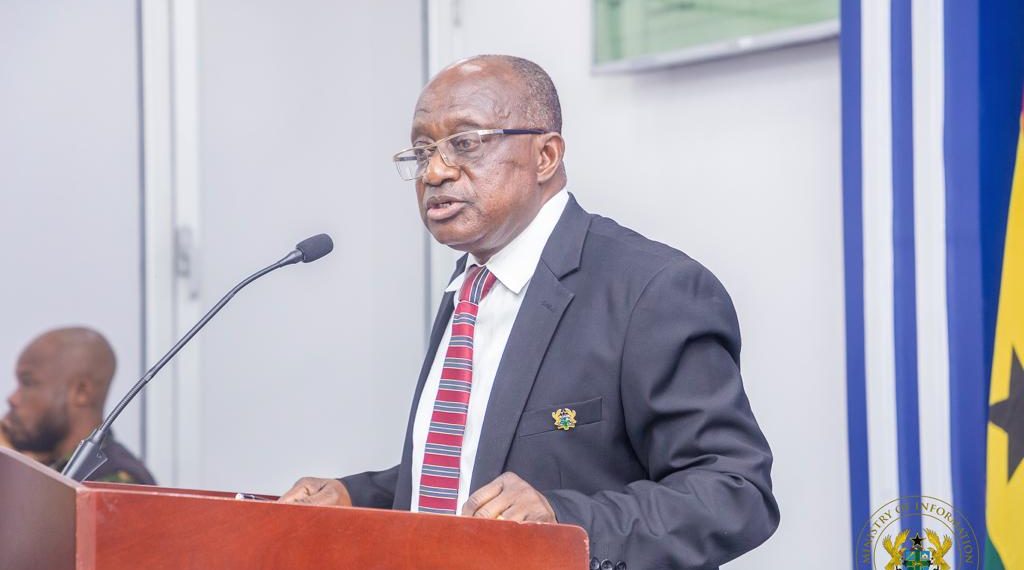
The National Petroleum Authority announced in May 2023 that the nation was progressing towards fuel self-sufficiency.
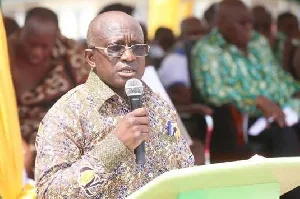
This declaration came from Dominic Aboagye, Head of Planning at the Authority, during an interview with the media in Ho.
Read the full story originally published on May 10, 2023
The National Petroleum Authority (NPA) has highlighted Ghana’s strides toward achieving fuel sufficiency. Dominic Aboagye, Head of Planning at the Authority, emphasized that strategic measures, including the innovative Gold for Oil Policy, have bolstered Ghana’s position as a fuel supply hub in the sub-region.
Speaking to the media in Ho, covering the Volta and Oti Regions, Aboagye underscored the significance of initiatives like special international oil trading licenses, forex auctions, and the Gold for Oil Policy in ensuring a steady oil supply.
He also noted ongoing efforts to expand the nation’s oil refining capacity.
Under the Gold for Oil Program, ten shipments of oil have been received, aimed at alleviating forex demands and supporting the sector’s sustainability.
Additionally, the NPA has been facilitating the construction of a new oil refinery expected to meet half of the nation’s demand.
Aboagye expressed the Authority’s advocacy for the revival of the Tema Oil Refinery, signaling progress towards fuel sufficiency.
The NPA’s Lycan Allocation Program ensures fuel availability, monitoring distribution and consumption trends for timely supply, even extending to West African countries.
A mix of policies and interventions has enabled the downstream petroleum sector to navigate challenges such as geopolitics, climate action policies, and forex liquidity risks. Through the Gold for Oil Program and Bank of Ghana interventions, along with vigilant monitoring, threats to supply are being managed effectively.
Edwin Yaw Konu, Volta Regional Manager of the NPA, highlighted challenges like fuel smuggling from neighboring Togo, affecting industry integrity and state revenue.
The NPA is collaborating with Togolese authorities and security agencies to address this issue.
The annual media engagement serves to keep stakeholders informed about developments in the downstream petroleum sector.
The consumer management team of the Authority is set to educate the public in the Region on fuel consumption patterns during this period.
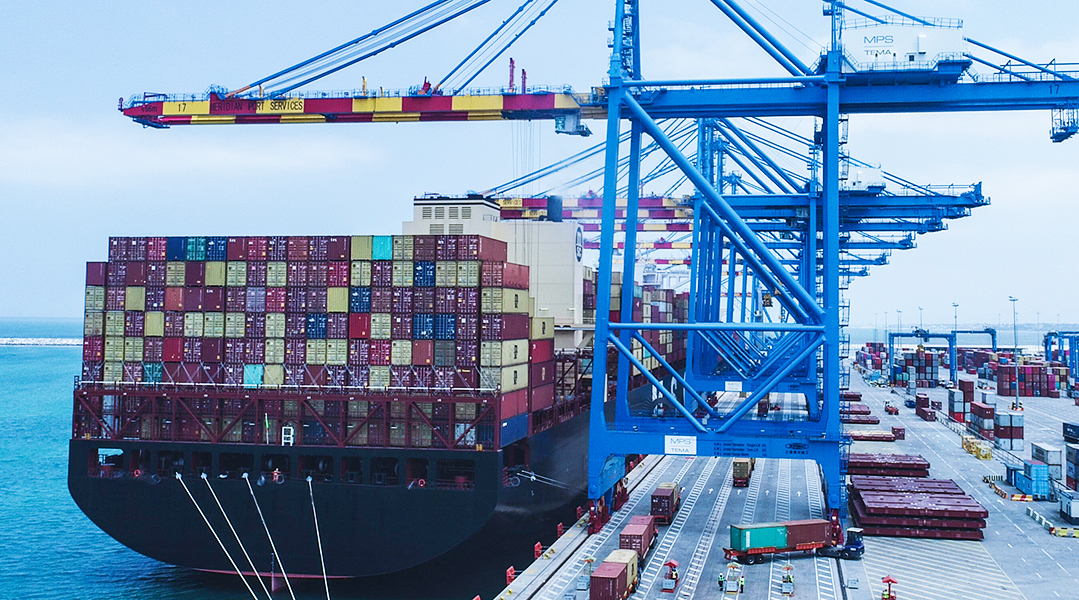
The Customs division of the Ghana Revenue Authority (GRA) has refuted rumors suggesting that Ghana is losing transit cargoes to neighboring countries like Togo and Ivory Coast.
Gerald Agbettor, Chief Revenue Officer and Officer in Charge of Transit at the Customs division of GRA, dismissed these claims during an appearance on the Eye on Port show on Metropolitan Television, based in Accra.
Agbettor emphasized that Ghana is not experiencing losses in transit cargoes, citing data from customs declarations to support his assertion. He highlighted that the volume of transit trade in the country has shown growth.
He elaborated that from January to March 2024, the transit trade witnessed a significant increase of 136,000 metric tons compared to the same period in 2023, rising from 308,000,000 metric tons to 444,000,000 metric tons in 2024.
“Some time ago, I joined the chorus, especially transit business from the ports to the hinterlands, they say that Ghana is losing the transit trade to other places. By my background, I was able to have access to the data manifest and when I went through it, I saw transshipment to Benin, transshipment to Togo, and it became alarming. But the fact that it is transshipment on the manifest to Togo and Benin does not mean we are losing transit trade to them,” he explained.
Mr. Agbettor also revealed that the diversion rate in Ghana is minimal. Nonetheless, he emphasized the importance of enhancing security measures at ports and transit terminals to promote equitable trade.
Moreover, he commended the Ghana Ports and Harbour’s Authority for helping the Customs division of GRA save GH¢90 million in efforts to reduce diversion rates at the port.
He noted that Ghana Link contributed significantly by installing dedicated monitoring devices on house-to-house containers moving from transit terminals to transit parks.
“It is not really rampant, but it does not mean security should be relaxed, it should rather be tightened. A meeting was recently held with stakeholders to gather data from them so it can be used to best serve customers,” he said.
Eric Adiamah, a Council member of the Ghana Institute of Freight Forwarders (GIFF) and a panelist on the show, echoed the sentiments of the Chief Revenue Officer regarding the flourishing state of transit in Ghana.
Adiamah affirmed that the Port of Tema stands out as the top choice among landlocked countries along the West African coast. However, he disclosed that Ghana is experiencing some loss of transit volume to neighboring countries due to regulatory constraints and the high cost associated with transit operations, despite the Port of Tema’s commendable safety and security standards.
“Transit business is thriving well. Only problem we see as operators of transit business is the cost of doing the business. The volumes as my brother has said are from data I have no access to, but on the ground what we know is that we are losing some volumes to neighbouring countries like Lomé. Meanwhile, between Togo port and Tema Port, when it comes to security and quality of service, the Port of Tema is way ahead,” he said.
Mr. Adiamah said the regulations governing transit trade are sufficient to control the diversion of transit cargo at the ports and encouraged the GRA, Customs division to bolster its operational collaborations with freight forwarders in order to discourage them from participating in transit diversion.
As a further disincentive to others, he urged that those apprehended for transit diversion offences must be made to face the full rigours of the law.
“If the rules provided by the books are followed to the latter, monitored by customs and all the authorities, the rules as they stand now are enough to do the business. The new things they are bringing up, will not improve anything, they will not stop diversion, it will only worry people who do legitimate business,” he averred.
The Officer in charge of transit explained that section 95, ACT 891, 2015, (6) of the Customs Act allowed for escorts for high risked goods under transit when the Commissioner deems it so.
“There were suspicions that some high risk goods were likely to be diverted and because of that, we have to place escorts on them. So, it is not the entirety of the whole transit trade. High risk goods like rice, tomato paste, cooking oil, vegetable oil, ethanol, alcohol, diapers are being brought in more, hence, the directives from the Commissioner and Commissioner General that we should ensure that we put escort on them,” he explained.
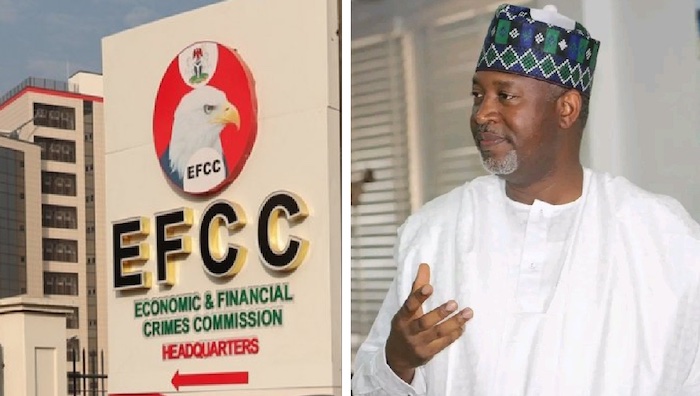
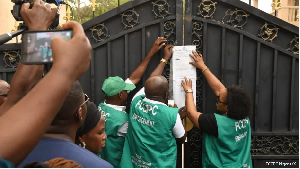
The Economic and Financial Crimes Commission (EFCC) apprehended Hadi Sirika, former Minister of Aviation, as part of an ongoing investigation into alleged money laundering totaling N8,069,176,864.00.
Sirika, the implicated former minister, arrived at the EFCC’s Federal Capital Territory Command around 1:00 pm on Tuesday, as confirmed by The PUNCH.
Witnesses at the EFCC’s Wuse office observed Sirika’s arrival for questioning regarding purportedly fraudulent contracts awarded to Engirios Nigeria Limited, a company owned by his younger sibling, Abubakar Sirika.
Unnamed sources within the anti-graft agency, speaking anonymously due to lack of authorization, corroborated these developments on Tuesday.
“Yes, that was Hadi Sirika who was taken into our FCT custody. He is currently meeting with EFCC investigators over the alleged N8,069,176,864.00 aviation ministry contract fraud,” a source revealed.
Another source noted, “The N8,069,176,864.00 aviation ministry contract fraud was carried out in connivance with his younger brother, Abubakar Sirika, through the latter’s company.”
In February, The PUNCH exclusively disclosed that the EFCC was probing the Aviation Ministry’s activities during former Minister Sirika’s tenure for conspiracy, abuse of office, misappropriation of public funds, and contract inflation.
A reliable source, speaking with our correspondent on Tuesday, disclosed that the anti-graft commission’s investigation encompasses conspiracy, abuse of office, misappropriation of public funds, and contract inflation within the Aviation Ministry.
Additionally, the probe includes allegations of criminal breaches of trust and money laundering amounting to N8,069,176,864.00 during Sirika’s term in office.
These funds purportedly relate to four aviation contracts awarded by the former minister to Engirios Nigeria Limited, a company owned by his younger sibling, Abubakar Sirika.
Abubakar, listed as the company’s Managing Director and Chief Executive Officer, is reportedly the sole signatory to its accounts held in Zenith and Union Banks.
Furthermore, it was disclosed that Abubakar Sirika, the ex-minister’s younger brother, has been detained by the commission in connection with N3,212,258,930.18 transferred to Engirios Nigeria Limited’s bank account by his brother.
Notably, there’s no evidence of work being carried out on any of the contract assignments to date.
The source revealed that Abubakar Sirika, arrested on Sunday, February 4, is cooperating with the commission in its investigation of the Aviation Ministry’s financial transactions during Mr. Sirika’s tenure.
The EFCC investigator said, “We’re investigating an N8,069,176,864.00 money laundering case linked to former Aviation Minister Hadi Sirika.
“Hadi awarded contracts to his brother Abubakar, knowing that the latter is a civil servant, a deputy director on Level 16 in the Federal Ministry of Water Resources, where he has been working since 2000 till date.
“The first of the contracts from the former minister to Engirios Nigeria Limited was on August 18, 2022, for the construction of the Terminal Building in Katsina Airport, at a cost of N1,345,586,500.00. The second was awarded on November 3, 2022, for the establishment of the Fire Truck Maintenance and Refurbishment Center in Katsina Airport, valued at N3, 811,497,685.00.
“The third contract was on February 3, 2023, for the procurement and installation of lifts, air conditioners, and a power generator’s house in Aviation House, Abuja, at the cost of N615,195,275.000, while the fourth was awarded on May 5, 2023, for the procurement of Magnus aircraft and a simulator for the Nigerian College of Aviation Technology, Zaria, at the cost of N2, 296,897,404.00.
“Out of the total contract sum, the ex-minister paid out N3,212,258,930.18 to his younger brother’s Engirios Nigerian Limited, who, upon receipt of the payment, transferred it to different companies and individuals. There is no trace of work done on any of the contract items to date.
“Abubakar Sirika is currently in our custody at the Headquarters, and he is providing us with more useful information on the financial activities of the Aviation Ministry under the supervision of his older brother, Hadi Sirika.”
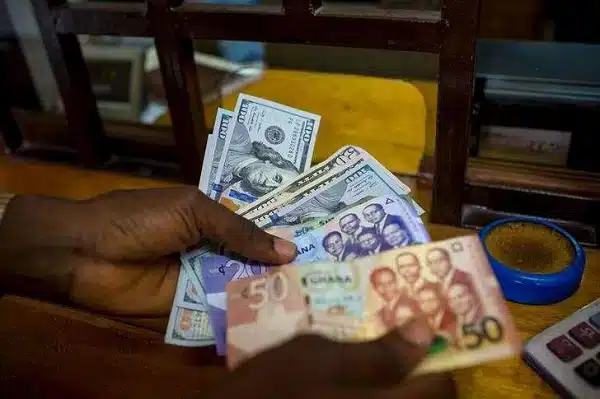
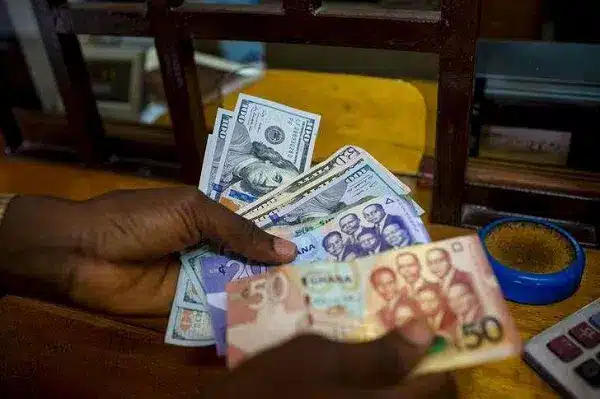
Today, April 25, 2024, the Interbank forex rates released by the Bank of Ghana reveal the trading dynamics of various currencies against the Ghana Cedi. The dollar is valued at a buying rate of 13.1355 and a selling rate of 13.1487.
Meanwhile, in Accra’s Forex bureaus, the dollar is bought at 13.70 and sold at 14.05. Against the Pound Sterling, the Cedi’s exchange rate stands at 16.3275 for buying and 16.3451 for selling.
In the same vein, the Euro is bought at 14.0343 and sold at 14.0482. The South African Rand’s rates are 0.6830 for buying and 0.6834 for selling.
Interestingly, at Accra’s forex bureaus, the rates vary slightly. For instance, the Euro is bought at 14.35 and sold at 14.85. Similarly, the South African Rand is bought at 0.40 and sold at 1.10.
Furthermore, the Nigerian Naira is bought at 97.3155 and sold at 98.0772 according to the Interbank rates, while in Accra, it’s bought at 9.00 Naira per 1 Cedi and sold at 14.00.
Lastly, the CFA Franc is bought at 46.6933 and sold at 46.7396 in the Interbank market. However, in Accra’s forex bureaus, it’s exchanged at 20.50 CFA Francs per 1 Cedi for buying and 22.50 CFA Francs per 1 Cedi for selling.
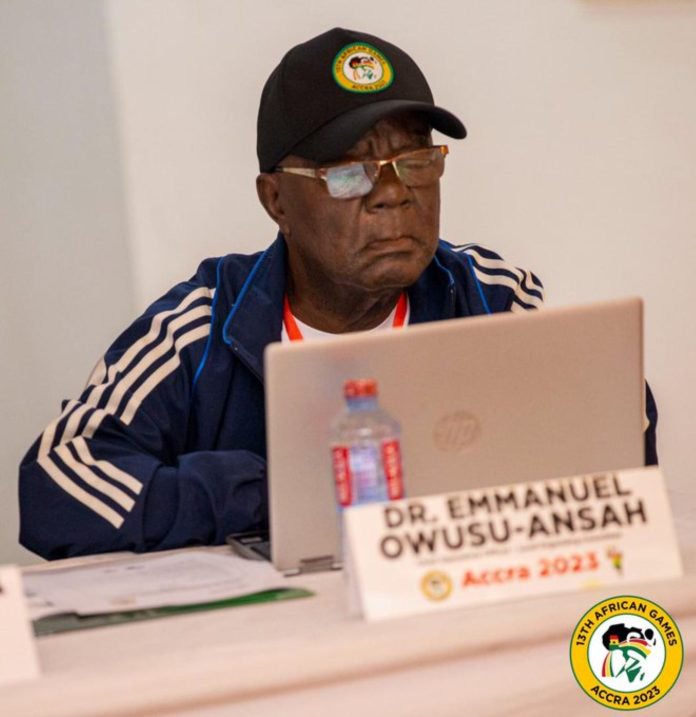
Esteemed Ghanaian Sports administrator Dr. Emmanuel Owusu-Ansah has passed away, leaving behind a legacy of remarkable contributions to the world of sports.
His untimely demise occurred on Monday, April 22 at the University of Ghana Medical Center following a brief illness. The sad news was announced on Tuesday, April 23, 2024, by Charles Osei Asibey, President of Ghana Armwrestling and General Secretary of the Sports Writers Association of Ghana (SWAG).
Dr. Owusu-Ansah held several esteemed positions throughout his career. He notably served as the Chief Coordinating Officer of the Accra 2023 13th African Games, which was successfully hosted in Ghana.
`Prior to this role, he distinguished himself as the Chief Executive of the National Sports Authority, demonstrating his exceptional leadership skills as a top sports administrator and coach. Additionally, he contributed his expertise as a special technical adviser at the Ministry of Youth and Sports.
His influence extended beyond the borders of Ghana, as he led sports delegations to over 50 countries across Africa, Asia, Australia, Europe, and North America. Dr. Owusu-Ansah’s passion for sports education was evident in his roles as Director of the Sports Directorate at the University of Ghana, Legon (UG), and former part-time Lecturer at the Department of Physical Education and Sports Studies within the School of Education and Leadership (SEL) at UG.
A true authority in the field of sports, Dr. Owusu-Ansah was known for his prolific writing, having authored numerous proposals, reports, and books that not only covered sports but also delved into various aspects of life.
As we mourn his loss, we remember Dr. Emmanuel Owusu-Ansah for his invaluable contributions to the world of sports and extend our heartfelt condolences to his family, friends, and colleagues. May his soul rest in peace.
The Ashanti Region branch of the Electricity Company of Ghana (ECG) is awaiting an apology from the Regional Minister.
Simon Osei Mensah, the Regional Minister, ordered the arrest of Michael Wiafe, the area’s General Manager, following a disconnection exercise at Kumasi Technical University.
Despite demands from the power distribution company for an apology for the perceived abuse of power, the Regional Minister has not issued one.
Bismark Adomah, National Vice Chairman of the Senior Staff Association for ECG, stated that the Minister’s failure to apologize and withdraw the case against Mr. Wiafe has led them to start hoisting red flags at their premises.
“Yes, we are requesting for apology from the minister and go ahead and withdraw the case from the police station from the police station.”
Mr. Adomah mentioned that after a meeting with the National Executive Council (NEC) on Monday, they initiated the display of red flags in all ECG offices nationwide.
He noted that the NEC also resolved that all four general managers in the region would abstain from attending any meetings convened by the Regional Minister.
Mr. Adomah reassured that despite the disagreement between the Minister and the ECG, service delivery to consumers would remain unaffected, as all employees are diligently fulfilling their respective duties.
“We are all at our offices working. Everybody is working. Those who are to go outside are outside working. Those at the offices are at the offices working and we are wearing our red, hoisting our red flag throughout our offices,” he said.
Furthermore, employees of ECG in the Ashanti Region have issued a cautionary message to the Regional Minister, Simon Osei-Mensah, urging prompt settlement of his overdue electricity charges.
Should the Minister disregard this warning, the workers have stated their intention to disconnect his private residences from the national power grid.
An increasing number of commercial drivers are enforcing a self-imposed 20% increase in transportation fares.
This decision comes amidst claims of prolonged delays by the Ghana Private Road Transport Union, the Ministry of Transport, and other involved parties in announcing revised fares, despite numerous meetings, as the costs of fuel and other essentials continue to escalate daily.
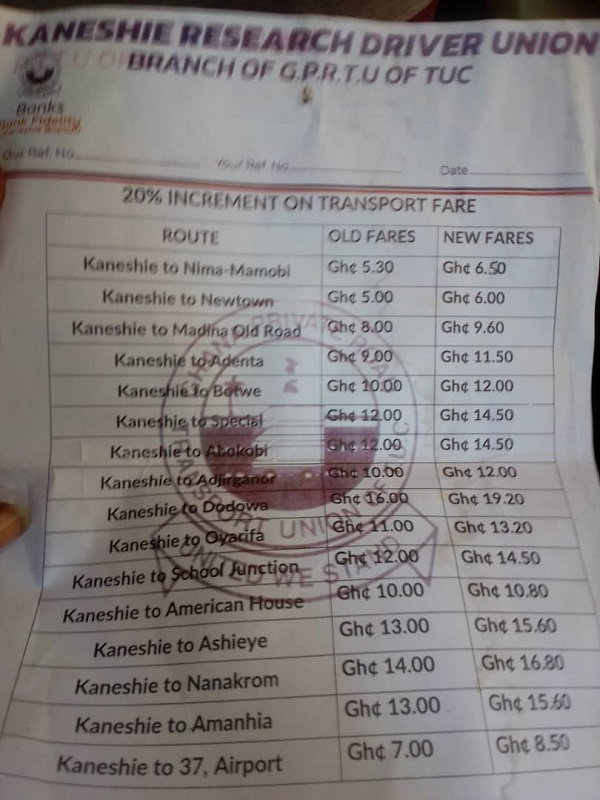
Online images depict fare hikes at the Kaneshie transport station for routes including Madina, New Town, 37 Military Hospital, Adenta, Botwe, Dodowa, Oyarifa, and others.
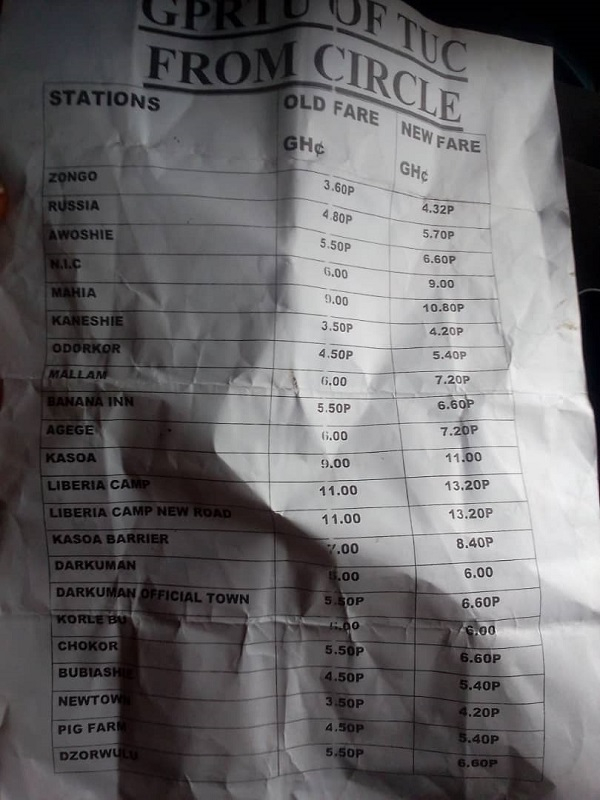
Journey within Accra Old Price New Price Kaneshie – Madina GH₵8.00 GH₵9.60 Kaneshie – New Town GH₵5.00 GH₵6.00 Kaneshie – Botwe GH₵10.00 GH₵12.00 Kaneshie – Dodowa GH₵16.00 GH₵19.20 Kaneshie – 37 Military Hospital GH₵7.00 GH₵8.50 Kaneshie – Adenta GH₵9.00 GH₵11.50 Kaneshie – Nima-Mamobi GH₵5.30 GH₵6.50 Also, the transport station at the Nkrumah Circle released its new list of fares for passengers.
Moreover, VIP JEOUN Transport has declared that starting from Friday, April 26, they will be raising their transportation rates.
Before this announcement, taxi stations in certain regions of the country, including the Greater Accra Region, had already initiated the 20% price hike.
Consequently, they have urged the Ghana Police Service and other security agencies to be vigilant for any driver violating the directive.
Additionally, the Ghana Private Road Transport Union (GPRTU), in collaboration with the Ghana Road Transport Coordinating Council (GRTCC), has cautioned commuters against paying any unauthorized increases in transportation fares, as they advocate for a 30% fare adjustment.
In an interview with Kwame Dadzie on Joy FM’s Showbiz A-Z, he underscores the importance of mutual support among theatre producers to enhance the industry’s prosperity.
“I’ve been asked many times why I share many people’s plays even when I am running my plays and I see other people’s plays, I still share. Why because we cannot compete. We need to collaborate. We cannot compete because we haven’t gotten to where the musicians have gotten to. Shatta Wale’s and Stonebwoy can compete. Sarkodie and Samini can compete. King Promise and KiDi, Kuami Eugene, they can all compete. They can because globally they have gotten the recognition,” he said.
He further noted that musical artists can command fees as high as 700 cedis, and their events will still draw crowds, unlike theatre.
George also pointed out that many Ghanaians perceive theatre as an art form that should be enjoyed without cost, which contributes to lower patronage.
“We need to elevate the thinking of people. And you cannot blame them. They consume theatre from a place of nothing and it was free. When all these music groups were going round the country. Osei Kofi’s band and others, they would have small theatre performance before the main concert. And that was free,” he said.
He further observed that the storytelling environments in traditional Ghanaian homes also reinforce the notion that theatre should be free.
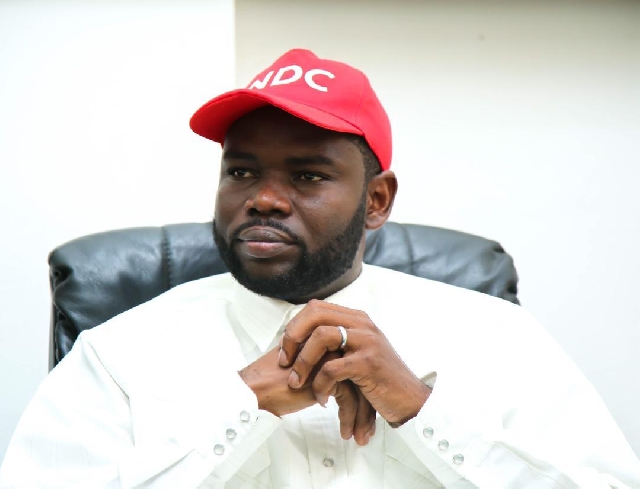
General Secretary of the National Democratic Congress (NDC), Fifi Kwetey, has lauded the integrity of Professor Naana Jane Opoku-Agyemang.
Kwetey, a former MP for Ketu South, emphasized Prof Naana Jane’s honesty as a trait that could bring back respect to the Vice President’s Office, which he claimed had been marred by Dr. Mahamudu Bawumia.
During the official introduction of Prof Opoku-Agyemang on Wednesday, April 24, at the Kofi Ohene Konadu Auditorium at the University of Professional Studies (UPSA), Kwetey expressed his confidence in her, asserting that Ghanaians have faith in her.
He urged her to stay true to herself and be transparent with the Ghanaian people should the NDC emerge victorious in the 2024 general elections.
“The country is in a state of collapse, not in the physical form, the real collapse of our country is a moral collapse we have seen nearly eight years. The state of this beautiful country is at an all-time low. The suffering Ghanaians are looking to breathe again.
“The people of Ghana cannot breathe. The level of pain, the suffering, the hardship, the lies, the dishonesty, corruption is choking Ghana to the maximum level.
“We believe she’s in a position to support our flagbearer to bring relief and hope to Ghanaians. In the last eight years, we have seen the office of she is going to assume brought to its lowest level.
“The office has become an office that is simply an epitome of deception, lack of credibility, lack of trustworthiness, corruption, taking this country to a level where governance has become a joke.
“In you, Naana Jane, we see an individual who is not just an integrity but an individual who will restore that office to a place it used to be. The office today has been degraded, we believe you will restore that office.”
Newmont’s African Business Unit reported that in the first quarter of 2024, its operations in Ghana (Ahafo South and Akyem mines) contributed a total of GH₵ 1.295 billion in taxes, royalties, levies, and carried interest to the Ghanaian government, facilitated through the Ghana Revenue Authority, Forestry Commission, and Ministry of Finance.
This follows the recent disclosure of its fiscal payments for the full year of 2023 to the Ghanaian government, amounting to GH₵ 3.965 billion from its Ghanaian operations.
This represents a 43.6% increase in fiscal payments compared to the same period in 2022.
In the first quarter of 2024, Newmont’s Ahafo South operation accounted for GH₵ 1.105 billion, while its Akyem operation contributed GH₵ 190 million.
Breakdown for January to March 2024 reveals GH₵ 672 million in Corporate Tax, GH₵ 291 million in Mineral Royalties, GH₵ 99 million in Pay-As-You-Earn, GH₵ 97 million in Withholding Tax, GH₵ 122 million in Carried Interest, and GH₵ 14 million in Forestry Levy.
Newmont is progressing its Ahafo North project in Ghana, expected to add approximately 300,000 ounces per year to its production.
With over 9,000 direct employees and contractors, Newmont prioritizes safety while creating long-term value for stakeholders, host communities, and the local economy.
As the world’s leading gold company, Newmont operates in favorable mining jurisdictions across North America, South America, Australia, and Africa.
Listed in the S&P 500 Index, Newmont is known for its commitment to environmental, social, and governance practices, supported by robust safety standards and technical expertise.
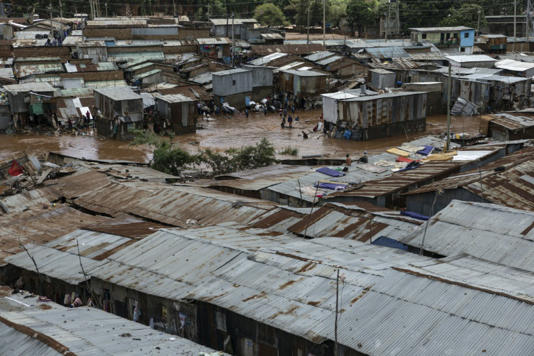
Torrential downpours transformed Nairobi’s streets into rushing streams and flooded homes with waist-high muddy waters, wreaking havoc in the Kenyan capital on Wednesday and resulting in at least four deaths.
The East Africa region has been enduring relentless heavy rains in recent weeks, with the El Nino weather pattern exacerbating the seasonal precipitation.
Images shared by Kenyan media showed vehicles stranded in floodwaters, including trucks, cars, and motorcycles, while residents in slum areas waded through the floods in search of safety.
According to the Nairobi county governor’s office, an estimated 60,000 people, mostly women and children, have been severely affected by the flash floods.
“Unfortunately we have lost four lives, and the search is on to locate six others who have been reported missing,” it said in a statement.
During one episode, law enforcement deployed tear gas to scatter irate locals who had obstructed a major highway with extensive lines of vehicles, demanding government intervention regarding the floods.
As a precautionary step, Kenya Railways declared the temporary suspension of commuter train operations, while the roads authority indicated that four roads in the capital had been partially shut down.
“The city is at a standstill because most roads are flooded,” said Uber driver Kelvin Mwangi.
“We are having to use longer routes and in some cases we can’t get to our destination.”
In the vast Mathare slum in Nairobi, homes were engulfed, forcing residents to seek refuge on rooftops overnight, according to local media reports.
The Kenya Red Cross stated that they rescued 18 people, including seven children, who were stranded in Mathare. A photo shared on X showed their workers navigating waist-high water during rescue efforts, with a man carrying a young child on his shoulders.
In a dramatic rescue on Tuesday, Kenyan police said they had saved a five-year-old boy who had been marooned alone by floods in Machakos County south of the capital.
The youngster had been left behind by his father as the waters rose and was airlifted to safety by chopper, the National Police Service said on X.
The Red Cross said the Athi River, the second longest in Kenya that runs south of Nairobi to the Indian Ocean, had burst its banks, blocking roads and leaving residents stranded.
“Our response teams are on the ground in most of these areas, evacuating families to safety and providing other life-saving interventions,” it added.
– ‘Extreme’ situation –
Prominent opposition senator Edwin Sifuna said the situation in Nairobi had “escalated to extreme levels” and that the county authorities were “clearly overwhelmed”.
“We need all national emergency services mobilised to save lives,” he said on X.
UN humanitarian response agency OCHA had said on Friday that rains and floods had claimed the lives of at least 32 people in Kenya and forced more than 40,000 from their homes in almost half the country’s counties.
Elsewhere in the region, nearly 100,000 people have been displaced in Burundi, while at least 58 people have died in Tanzania and several thousand made homeless.
El Nino frequently brings about catastrophic outcomes in East Africa. In late 2023, over 300 individuals lost their lives in Kenya, Somalia, and Ethiopia due to heavy rains and floods following the region’s severest drought in 40 years.
During October 1997 to January 1998, extensive floods resulted in over 6,000 fatalities across five countries in the region.
The Horn of Africa stands out as one of the areas most susceptible to climate change, despite Africa’s minimal contribution to global carbon emissions.
Africa, the world’s second-largest continent with 54 nations, boasts diverse cultures and histories. Unfortunately, many African nations grapple with poverty, leaving millions below the poverty line. Political instability, economic mismanagement, and environmental issues contribute to poverty across the continent.
Despite abundant natural resources, numerous African countries rank among the world’s poorest. According to the World Bank, 22 of the globe’s 26 low-income economies are in Africa. These nations struggle with low GDP per capita, high unemployment rates, and insufficient access to vital services like healthcare, education, and clean water. While progress has been made in some areas, many countries still confront substantial obstacles in alleviating poverty and enhancing living conditions for their populations.
Most Poorest African Countries
Overview of Poverty in Africa
Top 10 Poorest African Countries
Factors Contributing to Poverty
Efforts to Alleviate Poverty
Overview of Poverty in Africa
Africa is the poorest continent in the world, with over 40% of its population living in extreme poverty. The majority of African countries are classified as low-income economies by the World Bank, with a per capita income of less than $1,025 per year.
Poverty in Africa is a complex issue that is influenced by a variety of factors such as political instability, conflict, poor governance, lack of infrastructure, climate change, and economic inequality. These factors often interact with each other, exacerbating poverty and creating a vicious cycle of poverty and underdevelopment.
According to the World Bank, poverty in Africa is concentrated in rural areas, where the majority of the population relies on subsistence agriculture for their livelihoods. In addition, poverty is more prevalent in countries affected by conflict and political instability, such as Somalia, South Sudan, and the Central African Republic.
Despite efforts to reduce poverty in Africa, progress has been slow. While the poverty rate has declined from 56% in 1990 to 43% in 2012, the number of people living in poverty has increased due to population growth. Moreover, the COVID-19 pandemic has pushed an additional 40 million people into extreme poverty in Africa, according to the World Bank.
To address poverty in Africa, there is a need for comprehensive and sustainable solutions that address the root causes of poverty. These solutions should include investments in education, health, infrastructure, and social protection programs, as well as efforts to promote economic growth and reduce inequality.
Top 10 Poorest African Countries
Africa is a continent with vast resources and potential, yet many of its countries struggle with poverty. According to the World Bank, the poverty rate in sub-Saharan Africa is over 40%. This section will highlight the top 10 poorest countries in Africa based on their Gross Domestic Product (GDP) per capita.
Nigeria
Nigeria, located in West Africa, is the most populous country in Africa and has the largest economy on the continent. However, it is also one of the poorest countries in Africa, with a GDP per capita of $2,229. The country’s economy heavily relies on oil exports, which has led to a high level of corruption and income inequality.
Ethiopia
Ethiopia is a landlocked country in the Horn of Africa with a population of over 100 million people. Despite its rapid economic growth in recent years, it remains one of the poorest countries in Africa, with a GDP per capita of $875. The country faces challenges such as political instability, high levels of poverty, and a lack of infrastructure.
Democratic Republic of Congo
The Democratic Republic of Congo (DRC) is a country located in Central Africa with a population of over 85 million people. It is one of the richest countries in the world in terms of natural resources, yet it is also one of the poorest countries in Africa, with a GDP per capita of $551. The country has been plagued by conflict, political instability, and corruption.
Tanzania
Tanzania is a country located in East Africa with a population of over 60 million people. It is one of the poorest countries in Africa, with a GDP per capita of $1,039. The country faces challenges such as high levels of poverty, a lack of infrastructure, and a reliance on agriculture.
Mozambique
Mozambique is a country located in Southeast Africa with a population of over 31 million people. It is one of the poorest countries in Africa, with a GDP per capita of $620. The country faces challenges such as political instability, high levels of poverty, and a lack of infrastructure.
Madagascar
Madagascar is an island country located off the coast of East Africa with a population of over 27 million people. It is one of the poorest countries in Africa, with a GDP per capita of $520. The country faces challenges such as political instability, high levels of poverty, and a lack of infrastructure.
Chad
Chad is a landlocked country located in Central Africa with a population of over 16 million people. It is one of the poorest countries in Africa, with a GDP per capita of $663. The country faces challenges such as political instability, high levels of poverty, and a lack of infrastructure.
Niger
Niger is a landlocked country located in West Africa with a population of over 24 million people. It is one of the poorest countries in Africa, with a GDP per capita of $417. The country faces challenges such as political instability, high levels of poverty, and a lack of infrastructure.
South Sudan
South Sudan is a country located in East-Central Africa with a population of over 12 million people. It is one of the poorest countries in Africa, with a GDP per capita of $303. The country faces challenges such as political instability, high levels of poverty, and a lack of infrastructure.
Burundi
Burundi is a landlocked country located in East Africa with a population of over 11 million people. It is the poorest country in Africa, with a GDP per capita of $261. The country faces challenges such as political instability, high levels of poverty, and a lack of infrastructure.
Poverty is a complex issue that is caused by a variety of factors. In Africa, there are several factors that contribute to poverty, including political instability, economic challenges, social and health issues.
Political Instability
Political instability is one of the major factors contributing to poverty in Africa. Many African countries have experienced political instability due to civil wars, coups, and corruption. These political problems have led to a lack of investment in infrastructure and social services, which has resulted in high levels of poverty.
Economic Challenges
Economic challenges are another factor contributing to poverty in Africa. Many African countries are heavily dependent on a few export commodities, such as oil, minerals, and agricultural products. This dependence on a few commodities makes these countries vulnerable to fluctuations in global prices, which can lead to economic instability and poverty.
Social and Health Issues
Social and health issues are also major factors contributing to poverty in Africa. Many African countries have high rates of HIV/AIDS, malaria, and other diseases. These diseases not only cause suffering and death but also have a significant impact on the economy, as they lead to lost productivity and increased healthcare costs. Additionally, social issues such as gender inequality, lack of education, and discrimination against minorities can also contribute to poverty.
In conclusion, poverty in Africa is caused by a variety of factors, including political instability, economic challenges, and social and health issues. Addressing these issues will require a coordinated effort from governments, non-governmental organizations, and the international community.
Many African countries have received significant amounts of international aid to help alleviate poverty. The World Bank has been a major contributor to this effort, providing loans and grants to African countries to help fund development projects and support economic growth. In addition, many non-governmental organizations (NGOs) have also been active in providing aid to African countries. For example, the Bill and Melinda Gates Foundation has donated billions of dollars to support health and development programs in Africa.
Economic Reforms
In recent years, many African countries have implemented economic reforms aimed at reducing poverty. These reforms have included measures such as reducing trade barriers, deregulating markets, and implementing policies to attract foreign investment. While these measures have been controversial, they have also been credited with helping to spur economic growth and reduce poverty in some African countries.
Sustainable Development Initiatives
Sustainable development initiatives have also been a major focus of efforts to alleviate poverty in Africa. These initiatives aim to promote economic growth and development while also protecting the environment and promoting social equality. For example, the United Nations has launched the Sustainable Development Goals (SDGs), which include a number of targets related to poverty reduction in Africa. Many African countries have also launched their own sustainable development initiatives, such as the African Union’s Agenda 2063.
Overall, while poverty remains a significant challenge in many African countries, there have been significant efforts to alleviate poverty through international aid, economic reforms, and sustainable development initiatives.
Acting Director of the Certification Directorate at the Ghana Standards Authority (GSA), Joyce Okoreee, announced plans for the introduction of online standards purchasing.
Speaking at the UK-Ghana Chamber of Commerce’s webinar on “The Role of the Ghana Standards Authority in Promoting Local and International Trade,” Madam Okoree stated that the initiative is nearly 90% complete.
“We acknowledge that it (the inability to purchase standards online) is an issue and it’s being addressed. For now, you can pay via mobile money and bank transfers and receive your standards with all the security features.
“But very soon, you can make payment via VISA card or Mastercard. We will get there definitely this year.”
She further mentioned that digitizing the purchase of standards is essential to minimize human involvement and ensure a smooth process. This includes timely completion of services and payments, as well as prompt delivery of expected outcomes to the client.
What is the GSA?
The Ghana Standards Authority (GSA) serves as the National Statutory Body overseeing the National Quality Infrastructure (NQI). The NQI is built upon three primary pillars: Standardization, Metrology, and Conformity Assessment (Testing, Inspection, and Certification).
Enacted in 2022, the GSA Act (ACT 1078) founded the Ghana Standards Authority with the responsibility to establish, publish, and uphold standards. Its mandate includes ensuring the quality of goods and services for local consumption, export, or importation.
How does the GSA promote local and international trade?
Quality infrastructure plays a pivotal role in trade, innovation, and competitiveness, enabling increased market access, expanded exports, product diversification, and enhanced investment prospects.
Through stringent adherence to standards, the Ghana Standards Authority (GSA) ensures that Ghanaian products meet rigorous quality and safety standards.
This not only elevates the reputation of Ghanaian goods but also fosters trust among consumers and importers. Moreover, it enables exporters to showcase their dedication to delivering top-tier products, thereby bolstering their export capabilities.
Challenges in complying with GSA Standards
Basil Yaw Ampofo, Unilever’s Global Product Compliance Manager for Africa, highlights that adherence to standards empowers the industry to compete effectively and boosts product acceptance in international markets. Nonetheless, persistent challenges hinder the industry’s compliance efforts.
“Most of the time, some of the changes that the GSA will require of industry involve significant capital investment in technology and infrastructure, which can impact businesses’ operational costs. More often than not, the cost is transferred to the consumer, so goods become expensive”.
He also noted that it “takes quite a while for the GSA to certify products”.
Mr. Ampofo concluded that challenges have served as opportunities for innovation and process improvement within the industry. He, therefore, entreated the GSA to address these challenges by engaging in broad stakeholder conversations with the industry to explore solutions.
Addressing the issue of delays, Madam Okoree remarked that “we know that sometimes we have delays. This is sometimes due to defective equipment.”
She, however, assured businesses that the GSA will review its processes and explore how it can expedite their processes because “we need the business as well and if the industry is not happy, we need to take steps to meet their needs”.
To address delays, in the meantime, Madam Okoree mentioned that the GSA is currently building the capacity of some regional offices to lessen traffic at its head office. This is in addition to expedited services for certain products, and the existence of competent partner testing laboratories that assist the GSA.
The GSA and SME education
Panelists agreed that the GSA could do more to educate the public on its role, especially how it differs from the Food and Drugs Authority, as well as educating SMEs on its role and encouraging them to comply with Standards.
According to Madam Okoree, the GSA has simplified technical Standards, called pictorial Standards, and handbooks on the implementation of Standards, available at its library, to enhance SME education.
A strong believer that “SMEs are the engine of growth”, Madam Okoree passionately encouraged SMEs to engage the GSA on their Standards needs, and issues to enable the Authority to develop bespoke solutions to spur their growth.
“Our joy would be that we have many SMEs on board our scheme. If you have issues, you should write to the Director General informing him of your concerns. Formalizing the process with a letter ensures that you will get results.
“Take advantage of our library and you can access many standards. GSA is here to build SMEs to grow. Our doors are always open, and we will discuss all issues with you.
Panelists also discussed related topics including the GSA Mark of Conformity, its role in the AfCFTA, the product certification process, and how the GSA ensures that substandard goods do not cause public harm.
Theophilus Tawiah, UKGCC Executive Council Member and Managing Partner, WTS Nobisfields, moderated the webinar.
Public transportation costs have surged by a minimum of 20 percent in certain regions, defying government advisories against fare hikes.
The Ministry of Transport, in a directive released on Sunday, April 14, 2024, instructed the Ghana Police Service and other security agencies to detain any driver violating established fare regulations.
Drivers were urged by the ministry to maintain the current fares set by the Ghana Private Road Transport Union (GPRTU) of the TUC and the Ghana Road Transport Coordinating Council (GRTCC) during ongoing negotiations for revised public transportation fares, attributed to recent spikes in fuel prices and operational expenses.
Despite this, drivers have apparently disregarded the government’s stance by implementing fare increases without any official announcement of a ministry-approved agreement.
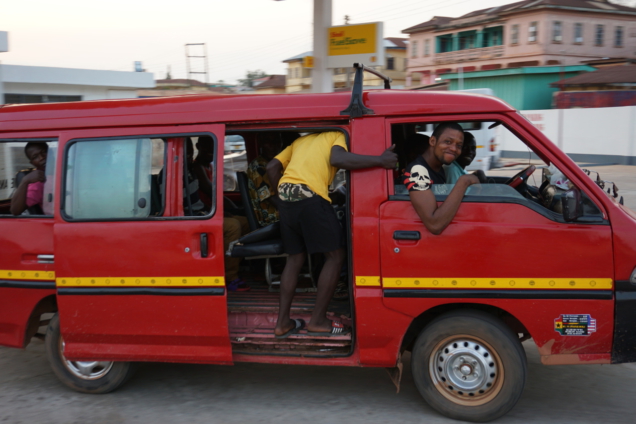
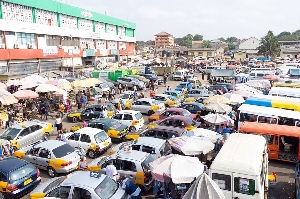
In Accra, the capital city, a majority of commercial public transportation operators, known as “trotro” drivers, have begun imposing new fares reflecting a 20 percent rise across all routes.
GhanaWeb has acquired documentation illustrating the updated fares being paid by commuters within Accra.
For instance, commuters traveling from the Kaneshie “trotro” station towards the 37 Military Hospital, Madina, and Adenta, who previously paid GH¢7, GH¢8, and GH¢9, respectively, are now charged GH¢8.50, GH¢9.60, and GH¢11.60.
Similarly, passengers departing from the Circle “trotro” station to Odorkor, Dzorwulu, and Kasoa have observed fare hikes from GH¢4.50, GH¢5.50, and GH¢9 to GH¢5.40, GH¢6.60, and GH¢11 correspondingly.
Here’s the comprehensive list of Accra’s fare adjustments:
Responding to demands for a load-shedding schedule from ECG, former Chairman of Parliament’s Committee on Roads and Transport, stated that the intermittent power outages will cease by May this year.
He emphasized that the government is diligently addressing challenges in the energy sector.
Speaking on Joy Prime Morning, Mr. Ayeh-Paye assured Ghanaians that the current outages are temporary, with plans for resolution by the end of May.
Ayeh-Paye revealed the completion of the Twin City Energy power project, set to bolster national electricity generation and distribution upon connection to the grid.
Notably, parts of Ghana have endured sporadic power cuts, commonly referred to as ‘dumsor,’ in recent months.
While ECG attributes these outages to technical issues, some Ghanaians and institutions, including the PURC, disagree.
The PURC directed ECG to provide a load management schedule by April, 2024.
ECG’s management refuted claims of intentional load-shedding, citing technical challenges as the root cause.
Subsequently, ECG board members were fined by the PURC for power cut violations.
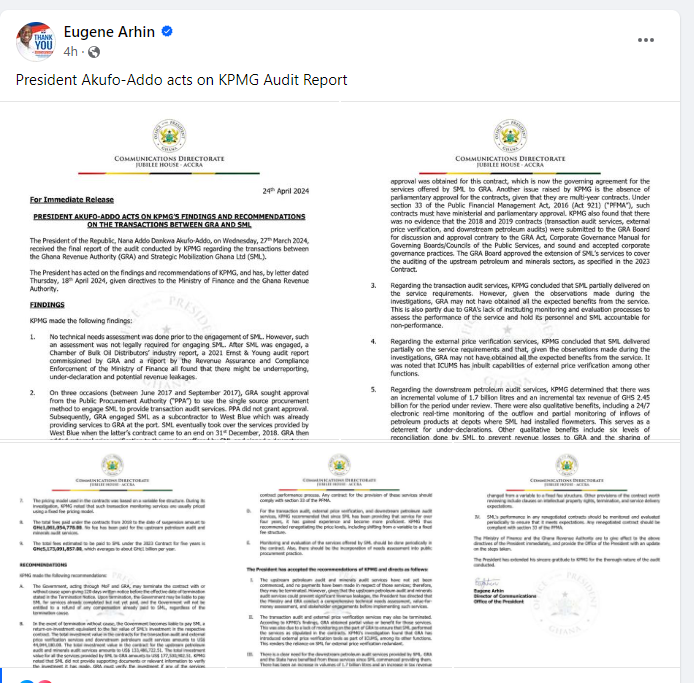
President Nana Addo Dankwa Akufo-Addo has directed the Ghana Revenue Authority (GRA) and the Ministry of Finance to initiate negotiations for the revenue assurance contract with Strategic Mobilisation Limited (SML).
The president stressed the importance of closely monitoring and periodically evaluating the renegotiation to ensure it aligns with expectations.
This instruction was conveyed through a press statement issued by Eugene Arhin, the Communications Director of the Presidency, on Facebook.
“There is a clear need for the downstream petroleum audit services provided by SML. GRA and the State have benefited from these services since SML commenced providing them. There has been an increase in volumes of 1.7 billion litres and an increase in tax revenue to the State of GHS 2.45 billion. KPMG also observed that there were qualitative benefits, including a 24/7 electronic real-time monitoring of outflow and partial monitoring of inflows of petroleum products at depots where SML had installed flowmeters and six levels of reconciliation done by SML.
“This minimises the occurrence of under-declarations. However, it is important to review the contract for downstream petroleum audit services, particularly the fee structure. Given the experience and proficiency of SML over the last four years of providing this service, the President has directed that the fee structure be changed from a variable to a fixed fee structure. Other provisions of the contract worth reviewing include clauses on intellectual property rights, termination, and service delivery expectations,” he wrote.
The decision to renegotiate the contract follows the president’s acceptance of the recommendation by KPMG after its audit of the deal.
The examination discoveries instigated the necessity for a reassessment of the revenue assurance agreement, underscoring areas where enhancements are required to boost its efficiency.
On January 2, 2024, President Nana Akufo-Addo authorized KPMG to scrutinize the pact between SML and GRA, incited by an exposé from media entity, the Fourth Estate.
President Nana Addo Dankwa Akufo-Addo has subsequently obtained the KPMG audit findings concerning the revenue mobilization pact between GRA and SML.
The findings were presented to him on Wednesday, March 27, as declared in a Facebook post by Eugene Arhin, the Director of Communications at the Presidency, on Wednesday, April 3.
Read the full contents of the statement from the presidency below:
Today, on April 24, 2024, the Bank of Ghana’s Interbank forex rates reveal that the Ghana Cedi is valued against the dollar at a buying rate of 13.0693 and a selling rate of 13.0823.
In Accra’s Forex bureau, the dollar is exchanged at 13.60 for purchase and 13.95 for sale.
The Ghana Cedi’s exchange rate against the Pound Sterling stands at a buying rate of 16.2542 and a selling rate of 16.2718.
At the Accra Forex Bureau, the Pound Sterling is bought at 16.65 and sold at 17.15. The Euro is traded at a buying rate of 13.9809 and a selling rate of 13.9936.
In Accra’s Forex Bureau, the Euro is purchased at 14.15 and sold at 14.65. The South African Rand’s exchange rate is 0.6837 for buying and 0.6841 for selling.
At the Accra Forex bureau, the South African Rand is bought at 0.40 and sold at 1.10. The Nigerian Naira’s exchange rate stands at 95.3158 for buying and 95.6232 for selling.
In Accra’s Forex Bureau, the Nigerian Naira is bought at 9.00 Naira for every 1 Cedi and sold at 14.00.
For the CFA, the exchange rate is 46.8755 for buying and 46.9181 for selling. At the Accra Forex Bureau, the CFA is bought at 20.50 for every 1 Cedi and sold at 22.50 for every 1 Cedi.
Note that these rates may differ at a forex bureau near you. Our forex bureau rates are provided by Afriswap Bureau De Change in Osu, Accra.
Our forex bureau rates are provided by Afriswap Bureau De Change in Osu, Accra.
Member of Parliament’s Mines and Energy Committee, Dr. Rashid Pelpuo, has stated that the recent erratic power supply is due to government’s failure to settle the accumulating debts owed to Independent Power Producers (IPPs).
He emphasized that the country’s power source is driven by the private sector and that resolving all outstanding debts with power generators would result in a stable power supply.
Speaking to Citi News, Dr. Rashid Pelpuo attributed the current energy sector crisis to mismanagement by the government.
He said “It [dumsor] is not because we have not privatised [ECG] that is why the challenge is coming. It is because the government has mismanaged its responsibility to the power agencies. The government is failing to pay the private sector that is providing the light because the source of power is private sector-driven.”
“The Independent Power Producers, the government is unable to pay them their debts. ECG is unable to pay them. So I don’t think that the issue now is about ECG not being privatised,” he added.
Dr Pelpuo further said, “We have managed it from independence to now. The challenge is the irresponsibility of the government and the poor management of the governance system of power supply and power generation. So we have a problem, and the heart of the problem is the governance of this country.”
In recent months, certain regions of the country have been grappling with sporadic power outages, commonly referred to as ‘dumsor’.
While the Electricity Company of Ghana (ECG) has attributed these intermittent power disruptions to technical issues, some Ghanaians and entities, including the Public Utilities Regulatory Commission (PURC), hold a different view.
In March, the Public Utilities Regulatory Commission (PURC) directed the Electricity Company of Ghana to provide a load management timetable by April 2, 2024.
In response, ECG’s management reiterated that the power outages are primarily due to technical challenges and stated that no formal load-shedding schedule would be implemented.
As a consequence of the power cut violations, PURC imposed a fine of GH¢5.8 million on ECG board members.
KPMG’s audit report has unveiled the positive impact of the revenue assurance contract between the Ghana Revenue Authority (GRA) and Strategic Mobilisation Limited (SML), showcasing a notable increase in state tax revenue.
According to the report, the contract has led to a substantial surge in volumes, marked by a recorded rise of 1.7 billion litres, consequently resulting in a tax revenue increase to the State totaling GH¢ 2.45 billion.
Furthermore, the report highlights qualitative advantages, including the implementation of 24/7 electronic real-time monitoring of outflow and partial monitoring of inflows of petroleum products at depots where SML has installed flowmeters.
The report also underscores SML’s performance in conducting six levels of reconciliation, which has further bolstered the monitoring process.
These revelations were disclosed in a press statement issued on Wednesday, April 24, 2024, by Eugene Arhin, the Communications Director of the Presidency.
However, the report also recommends a review of the contract for downstream petroleum audit services, particularly focusing on the fee structure. This indicates that while the contract has yielded significant improvements in revenue generation, there are aspects requiring further examination and adjustments to ensure fairness and efficiency.
“There is a clear need for the downstream petroleum audit services provided by SML. GRA and the State have benefited from these services since SML commenced providing them. There has been an increase in volumes of 1.7 billion litres and an increase in tax revenue to the State of GHS 2.45 billion. KPMG also observed that there were qualitative benefits, including a 24/7 electronic real-time monitoring of outflow and partial monitoring of inflows of petroleum products at depots where SML had installed flowmeters and six levels of reconciliation done by SML.”
“This minimises the occurrence of under-declarations.However, it is important to review the contract for downstream petroleum audit services, particularly the fee structure. Given the experience and proficiency of SML over the last four years of providing this service, the President has directed that the fee structure be changed from a variable to a fixed fee structure. Other provisions of the contract worth reviewing include clauses on intellectual property rights, termination, and service delivery expectations.”
President Nana Addo Dankwa Akufo-Addo took action on January 2, 2024, by commissioning KPMG to investigate the contract between SML and GRA following an exposé by the Fourth Estate.
Subsequently, President Akufo-Addo has been briefed on the findings of the KPMG audit report concerning the revenue mobilisation contract between GRA and SML.
The report was officially presented to him on Wednesday, March 27, as revealed in a Facebook post by Eugene Arhin, the Director of Communications at the Presidency, on Wednesday, April 3.
In Yatta, approximately 120km (75 miles) from Nairobi, Kenya’s capital, a dramatic rescue unfolded on Tuesday as a police helicopter swooped in to save a five-year-old boy stranded by flooding.
According to authorities, the boy had been abandoned by his father as the water levels surged. The International Centre for Humanitarian Affairs, a non-profit organization, utilized drones to pinpoint the child’s location.
Upon receiving the alert, the police dispatched a rescue helicopter from Nairobi.
Initial efforts to reach the child by boat were thwarted by adverse weather conditions, as reported by the Kenya Red Cross.
“The child, visibly shaken by the ordeal after being stranded for quite a long period, was safely rescued and taken to a nearby hospital for care,” it added.
Recent heavy rains have unleashed havoc across Kenya and the broader East Africa region, resulting in extensive flooding and devastation.
In Kenya alone, flooding has affected 23 out of the country’s 47 counties, leaving numerous individuals trapped in perilous situations.
According to the Kenya Red Cross, over 188 people have been rescued since the onset of the floods, as of Tuesday. Additionally, the flooding has led to the displacement of more than 11,200 households, submerged 27,716 acres of land, and resulted in the tragic loss of over 4,800 farm animals.
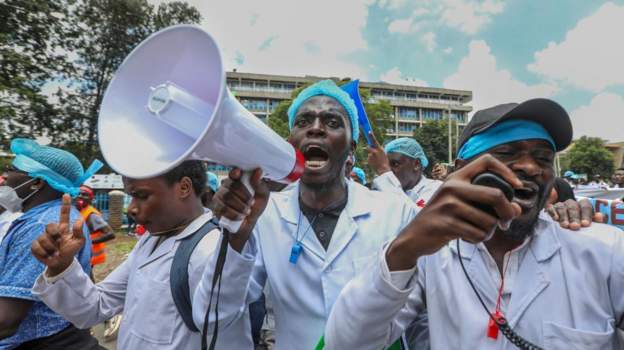
Talks between the government and striking doctors have collapsed, exacerbating the plight of Kenyans seeking healthcare in public hospitals.
The strike, orchestrated by the Kenya Medical Practitioners, Pharmacists, and Dentists Union (KMPDU), is now in its second month.
Among the union’s grievances are salary disputes and the failure to recruit trainee doctors.
Despite days of negotiations, KMPDU officials failed to attend a crucial meeting convened by Kenyan Head of Public Service Felix Koskei on Tuesday.
Following a cabinet session chaired by President William Ruto, the government announced that it had addressed most of the doctors’ concerns, except for the disagreement over intern doctors’ salaries.
Labeling the demand to pay intern doctors $1,500 (£1200) as “unsustainable,” the government maintained its offer of a $520 monthly stipend for interns.
However, the doctors’ union rejected the proposed return-to-work offer, asserting that the issue of internship compensation was non-negotiable.
Mr. Koskei accused the doctors of disregarding court orders and reneging on agreements made during the negotiations.
In addition to salary concerns, the striking doctors are advocating for the Kenyan government to fully cover their medical insurance, uphold agreements on promotions, and enhance their working conditions.
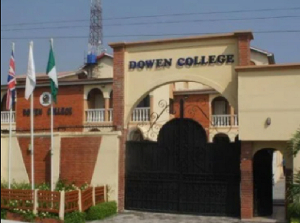
Local media sources have reported that Nigerian authorities have shuttered a prestigious school in Abuja, the capital, following incidents of bullying involving some of its students.
On Monday, several videos depicting students from the Lead British International School engaging in acts of aggression against their peers circulated widely on social media platforms, eliciting strong condemnation online and prompting irate parents to protest at the school premises.
In response to the outcry, the school administration announced a temporary closure of three days to conduct an investigation into the matter.
According to Kabiru Musa, a senior education official, the Minister of Women Affairs, Uju Kennedy-Ohaneye, mandated the closure of the school.
In a statement addressing the issue, the school expressed deep concern over the reported bullying incidents and committed to conducting a comprehensive inquiry.
Established in 2007, the school offers a curriculum blending British and Nigerian educational standards. It has gained a reputation as one of the most expensive educational institutions in Nigeria, as per local media reports.
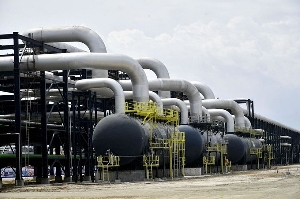
Nigeria’s recently inaugurated mega refinery has announced a further reduction in the prices of diesel and aviation fuel within the domestic market, marking the third such adjustment since its commencement of product delivery in March.
According to an emailed statement from Dangote Industries Ltd., the refinery will slash the price of diesel by 6%, now selling at 940 naira ($0.76) per liter, while aviation fuel will be priced at 980 naira.
These revised prices are applicable to marketers purchasing over 5 million liters of fuel.
Nigeria’s persistent issues with inadequate power supply have led to significant reliance on diesel-powered generators by large businesses for electricity.
At the outset of March, diesel was retailing for as high as 1,600 naira per liter. Prior to Dangote’s entry into the market last month, Nigeria primarily depended on imported refined fuel.
Initially priced at 1,200 naira per liter, Dangote has progressively reduced the price, reaching 1,000 naira two weeks ago.
“The new price is in consonance with the company’s commitment to cushion the effect of economic hardship in Nigeria,” Dangote Group spokesman Anthony Chiejina said.
Analysts suggest that the Dangote plant, with a capacity of 650,000 barrels per day located outside Lagos, is preparing two units to facilitate gasoline production, a development poised to significantly impact the fuel market in Nigeria and the surrounding region.
Currently operating at approximately 300,000 barrels per day, roughly half of its designated capacity, the refinery has commenced the shipment of jet fuel, gasoil, and naphtha as it expands its product offerings to encompass a full range of products.
The government has announced its intention to dispose of over 50,000 unclaimed passports, valued at Shs12.5 billion, in order to free up storage space.
The Directorate of Citizenship and Immigration Control revealed that a significant portion of these unclaimed passports belong to individuals, mainly maids, who had sought employment opportunities in the Middle East.
Mr. Simon Mundeyi, spokesperson for the Ministry of Internal Affairs, highlighted that many of these passports have been left unclaimed for over six years.
Moreover, the situation has been compounded by an additional 2,000 passports that have gone unclaimed between January and April of this year.
“We now have about 50,000 passports in our stores across the country, which have not been claimed by the owners. Since every day we have new applicants, having so many uncollected passports poses a challenge to our stores,” he said.
Uganda offers three passport types: ordinary, official, and diplomatic, distinguished by their respective colors of light blue, green, and red. Nevertheless, the Directorate encountered difficulty in promptly categorizing the unclaimed travel documents.
But Mr Mundeyi said: “Most of these passports belong to girls who were supposed to be taken to the Middle East and since the labour export activities have drastically reduced, they lost interest in the documents as they returned to their villages.”
Application for an ordinary passport booklet costs Shs250,000, while the official passports (also called service passports) are charged Shs400,000, and the diplomatic acquired at Shs500,000. It costs Shs400,000 to process an express ordinary passport in three days.
Most of the maids who seek jobs in the Middle East pay Shs250,000 for an ordinary passport, which would amount to nearly Shs12.5 billion when the bulk of 50,000 unclaimed passports are considered as those of maids. However, some of the applicants opt for express processing, which means the cost would climb higher even for this category of domestic workers.
“The ministry is, therefore, planning to destroy passports which have spent years in the store because we don’t have where to keep them. These passports have been unclaimed since 2018,” Mr Mundeyi told Monitor.
The Ministry said the buildup of uncollected passports is partly due to applicants not being able to receive messages asking them to collect their travel documents.
“In some rare cases, the passports are ready, messages are sent to them [applicants] to collect but their phones are often off or they just don’t have a network. If a message is sent and the phone is off or doesn’t have a network, it will bounce and will never be re-sent,” Mr Mundeyi said. In an effort to offset the logjam and streamline the processing of new applications, the ministry has asked people who applied for a passport to promptly pick them up or check with the ministry’s website to find out the status of their documents.
Passport issuance Passports allow for exit from and re-entry into a country and also enable citizens to travel in a foreign country in line with visa requirements, and request protection for the citizen while abroad. Regulations governing the issuance of passports in Uganda stipulate that express passports can be obtained in four days while ordinary passports take two weeks.
Uganda’s labour export Data from the Ministry of Gender, Labour, and Social Development shows that at least 120,459 workers left Uganda between January 2022 and December 2023 in search of employment.
The figures indicate that women dominated with 109,773 compared to 10,686 male. The Middle East, in the 10 last years, remained the destination of choice, taking in 107,448 workers.
Chartered economist Bernard Oduro Takyi has raised doubts about the accuracy of the cedi-dollar exchange rate presented by the Finance Minister to the International Monetary Fund (IMF).
At the Annual IMF/World Bank spring meetings in Washington DC, USA, Finance Minister Dr. Amin Adam expressed optimism about Ghana’s economic outlook, stating that all necessary agreements had been made with the IMF.
Dr. Adam cited a cedi-dollar exchange rate of GHS11 to USD1, indicating the cedi’s strong performance against the dollar. However, Mr. Oduro Takyi, also a member of the opposition National Democratic Congress (NDC), contested this claim.
He argued that the actual exchange rate was GHS13.5 to USD1, accusing the Minister of providing misleading information to the IMF to portray the government in a more favorable light.
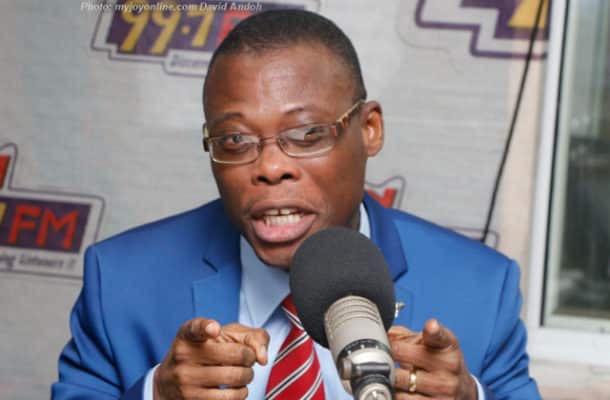
Speaking on Accra 100.5 FM’s evening news, Mr. Oduro Takyi urged the minister not to underestimate the public’s intelligence with vague economic explanations. He highlighted concerns about rising inflation, particularly in food prices, contradicting the government’s projections.
While the government projected an inflation rate of 25.8 percent, Mr. Oduro Takyi insisted that the actual rate was 28.6 percent. He emphasized that despite positive indicators in some areas, the government had failed to address key economic challenges such as debt-to-GDP ratio, exchange rates, inflation, and international reserves.
Mr. Oduro Takyi concluded by calling for a more comprehensive approach to economic management, suggesting that the economy had not fully recovered.
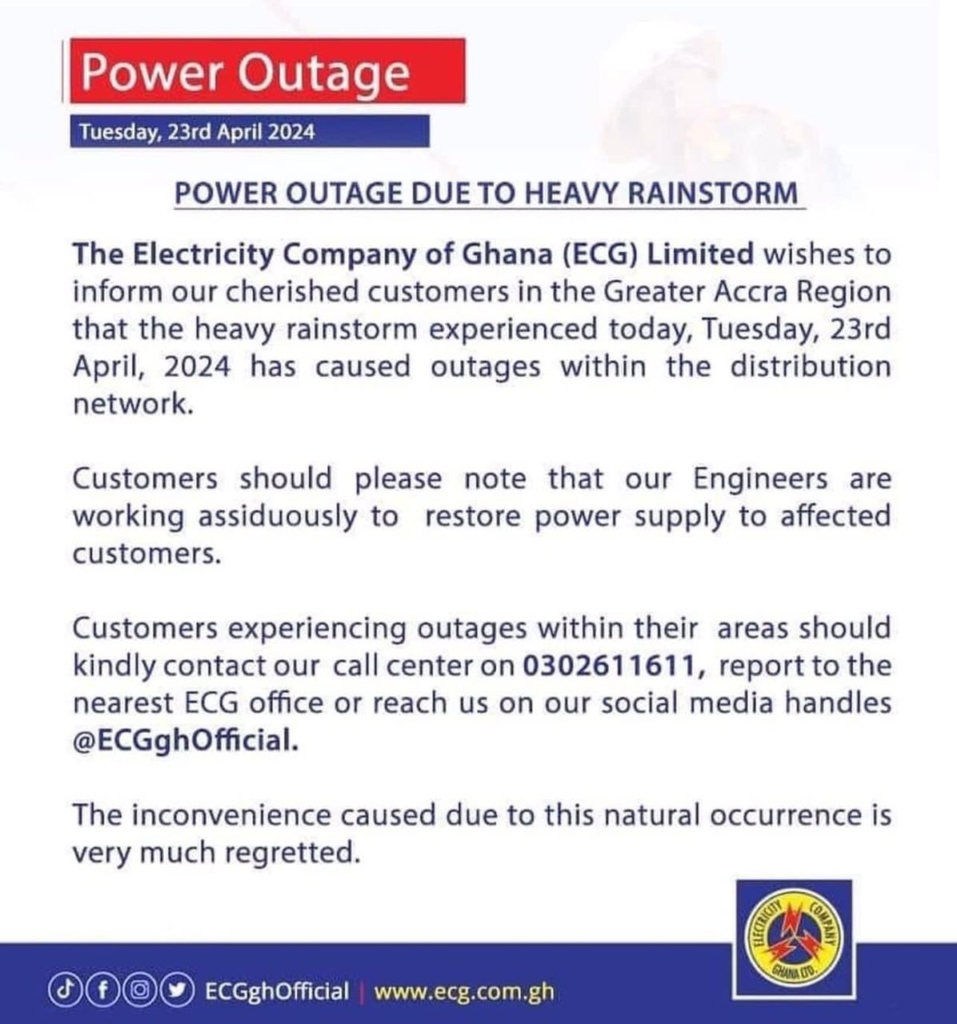
The Electricity Company of Ghana (ECG) has notified its customers in the Greater Accra Region that recent power outages reported in the area were due to a severe rainstorm on Tuesday, April 23.
In a statement, ECG assured customers of their efforts to swiftly restore power supply.
“Our engineers are diligently working to restore power to affected areas,” stated ECG.
The company urged affected customers to report outages by contacting the ECG call centre at 0302611611, visiting the nearest ECG office, or reaching out through the official social media handles @ECGghOfficial.
ECG expressed regret for the inconvenience caused by the outages and apologized for the situation.
The family of the late Gospel musician, Augustine Kofi Owusu Dua Anto, known asKODA, expresses profound sadness and devastation following his passing.
They are grappling with the shocking loss and are still trying to comprehend it.
In a statement on KODA’s official website, the family expresses gratitude to fans, well-wishers, and the public for their support during this difficult time.
However, they kindly request privacy as they mourn and begin the healing process.
“The sudden departure of KODA has left us sorrowful and devastated; and we deeply appreciate the outpouring of love and support from contemporaries, friends, fans, and loved ones,” the statement read.
“As we grapple with the shock and grief of this loss, we humbly request privacy during this profoundly challenging time to heal and mourn as a family,” they added.
The family stated that all information regarding KODA’s memorial service, funeral rites, and other related events will be communicated to the public via the website.
“KODA’s legacy will endure, resonating throughout eternity,” they added.
KODA passed away in the early hours of Sunday, April 21, 2024.
Although the exact cause of his death was not disclosed, the family noted that he passed away following a brief illness.
The 45-year-old left behind his wife and three children
Read the full statement below:
“The Dua-Anto Family, Ewurama Dua-Anto with the Osae and Dankwa Families, and ALL the Allied Families solemnly announce the sudden passing of their son, brother, nephew and Husband.
Kofi Owusu Dua-Anto (KODA) on Sunday, April 21, 2024, following a brief illness.
The sudden departure of KODA has left us sorrowful and devastated; and we deeply appreciate the outpouring of love and support from contemporaries, friends, fans, and loved ones.
As we grapple with the shock and grief of this loss, we humbly request privacy during this profoundly challenging time to heal and mourn as a family.
We kindly invite you to visit www.kodasmemorial.com which will be accessible shortly with information on his memorial and funeral arrangements.
KODA’s legacy will endure, resonating throughout eternity.
“Blessed are those who die in the LORD from henceforth: Yea, saith the SPIRIT, that they may rest from their Labours, and their Works do follow them.” (Revelation 14:13). AMEN (sic).”
The Member of Parliament for South Dayi has claimed that the Nana Addo Dankwa Akufo-Addo-led government is deliberately ignoring the return of erratic power supply (dumsor) because it fears its impact on the 2024 general elections.
During an interview on GhanaWeb TV’s The Lowdown, Rockson-Nelson Dafeamekpor stated that the NPP extensively used the term ‘dumsor’ during the power supply challenges under John Dramani Mahama’s government, but they are now avoiding it.
He pointed out that the NPP popularized the term ‘dumsor’ to such an extent that it was even included in Wikipedia for global understanding.
“The game is over but the score is remembered… The people who made dumsor a campaign message, today are afraid of dumsor being a campaign topic.
“Nobody is saying there is dumsor, it is the nature in which the lights are flicking off and on. When JM was in power, we could have said there was no dumsor conveniently but the reality was that we had instability in the supply of power.”
He added, “It was hyped so much so that dumsor found its way to Wikipedia. Today, if you google dumsor, google is able to tell you what it means in respect to Ghana. The people who did that are afraid of being measured to the same standards.”
A member of the New Patriotic Party’s (NPP) communication team, Saaka Salia, provided reasoning behind President Nana Addo Dankwa Akufo-Addo’s decision to relocate and rename the African and Middle East Resources Investment Group Plant (AMERI Plant).
During an interview on GHOne TV on April 22, 2024, Salia asserted that although the AMERI plant was established and inaugurated during the John Dramani Mahama administration, it was the Akufo-Addo government that primarily financed the plant.
He stated that while the Mahama government contributed only 10% of the plant’s cost, the Akufo-Addo administration covered approximately 90% of the project’s expenses, eventually leading to the country’s full ownership of the plant.
“… Let Ghanaians understand that Nana Addo Dankwa Akufo-Addo paid for the AMERI. John Mahama didn’t use his money to pay for it and Nana Addo didn’t also use his money to pay for it. But the NPP government paid 90% of the AMERI deal because it was BOOT (Build, Operates, Own and Transfer).
“So, the AMERI that they said is their project… at the end of the day, you went and hired it and the Nana Addo Dankwa Akufo-Addo government paid 90% of the AMERI price. Because it was commissioned in 2016, you only paid for one year, the rest of the four years were paid by the Akufo-Addo regime,” he said.
The NPP communicator mentioned that the Akufo-Addo government chose to relocate the AMERI plant for strategic advantages.
“Once it is the property of Ghana, we should not let it be here and rot. Let us make the maximum use of it. Then we decided to take six of the turbines and then we sent them to Kumasi. And that is the first time that we have such a plant in Kumasi.”
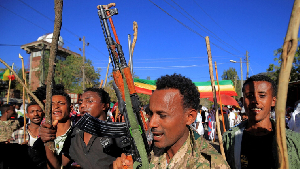
Local authorities and the UN Office for the Coordination of Humanitarian Affairs (Ocha) reported that the number of people displaced by armed clashes in rural areas of northern Ethiopia has surpassed 50,000 since April 13.
In its situation report released on Monday, UN Ocha revealed that the majority of the displaced individuals, predominantly comprising women, children, and the elderly, are currently seeking refuge in the towns of Kobo and Sekota located in the Amhara region.
The humanitarian situation is critical, with thousands of women and children requiring extensive humanitarian assistance to ensure their survival.
Although the government and humanitarian partners have initiated efforts to provide food and health services, the resources available remain insufficient to meet the growing needs of the displaced population.
The armed clashes that occurred on April 13 and 14 in Alamata town, Northern Ethiopia, resulted in an unspecified number of casualties, prompting numerous civilians to flee towards neighboring Kobo and Sekota, according to a previous report by UN Ocha.
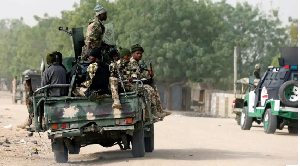
The Nigerian army has pledged retaliation for the deaths of six soldiers who were ambushed during a peace mission in Niger’s central state last week.
The soldiers were conducting a “fighting patrol” in Karaga village, Shiroro area, when they were attacked by what the army described as “terrorists”.
An army statement reported the killing of several attackers and ongoing pursuit of others.
The army asserted that the soldiers would avenge the “regrettable setback”.
Among the deceased were two senior officers and four other personnel, the army revealed.
Two officers sustained injuries in the assault.
While local reports suggest one officer was kidnapped, the army has not confirmed this.
The perpetrators of the ambush remain unidentified, although local armed gangs, referred to as bandits, are often held responsible for targeting security forces.
The attack coincides with Nigeria hosting a two-day high-level African counter-terrorism summit in Abuja.
This ambush follows closely after the deaths of 16 soldiers in clashes between rival communities in the oil-rich southern Delta state a few weeks ago.
Nigeria continues to grapple with a surge in kidnappings for ransom and confronts various jihadist groups.
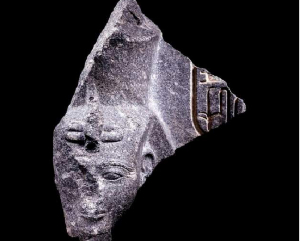
Egyptian authorities have announced the return of an ancient statue, which is more than 3,000 years old, to its homeland after being stolen and smuggled out of the country over three decades ago.
The statue portrays the head of the ancient Egyptian King Ramses II, one of Egypt’s most influential rulers.
According to the Ministry of Tourism and Antiquities, the statue is a fragment of a larger sculpture depicting King Ramses II seated alongside several Egyptian gods.
This artefact, dating back over 3,400 years, was originally taken from the Ramses II temple in the ancient city of Abydos.
In 2013, Egyptian authorities identified the statue when it was put up for sale at a gallery in London. It then traveled through multiple countries before reaching Switzerland, where it was recovered in collaboration with Swiss authorities.
The antiquities ministry asserted Egypt’s rightful ownership of the piece, highlighting that it had been unlawfully removed from the country.
The statue will undergo restoration and preservation at the Egyptian Museum in Cairo.
A Chinese-owned supermarket in Nigeria’s capital, Abuja, has been shuttered by authorities following accusations of refusing entry to African shoppers.
The allegations surfaced after Nigeria’s consumer protection watchdog reported that the supermarket exclusively allowed individuals of Chinese descent to enter.
The owner of the supermarket has been summoned by the authorities to address the issue.
The Chinese Chamber of Commerce in Nigeria has refuted the racism accusations.
Situated in a building managed by the China General Chamber of Commerce (CGCC), the supermarket is a tenant.
Boladale Adeyinka, an official at Nigeria’s Federal Competition and Consumer Protection Commission (FCCPC), confirmed that an investigation into the matter has been initiated.
This move comes after widespread outrage on social media, with several Nigerians sharing accounts of being denied entry by security personnel when attempting to visit the supermarket.
In one video circulating online, a man expressed frustration after discovering the supermarket online but being prevented from entering the premises by security personnel.
“At the gate, the security people told me that the supermarket is strictly for Chinese people. If you are a Nigerian, you can’t go inside or buy anything,” he said in the clip posted on X, formerly Twitter.
In another video on X, a group of Nigerians are seen visiting a building to verify the reports that non-Chinese shoppers were being turned away.
A security guard outside the entrance appears to tell them that the supermarket had cut off access to Nigerians since January.
Several Nigerians have demanded the closure of the supermarket, including former senator Shehu Sani, who said that any store in Nigeria that was not accessible to citizens “should be forcibly opened or be pulled down”.
In a statement quoted by local media, the CGCC said it stood for “equality and inclusiveness”.
“Our principles are to enhance friendship between the people of both countries and promote economic development,” it added.
According to the FCCPC, an administrator at the building, Sanusi Shuabiu, explained that the supermarket primarily offers Chinese groceries. Although it was originally intended to cater to the building’s tenants, it also welcomes external shoppers, including non-Chinese visitors.
The owner of the supermarket has not provided any comment regarding the situation.
She has been called upon to appear before the consumer protection agency by Wednesday.
The watchdog has declared that the supermarket will remain closed until the owner complies with the summons.
Statista reports that Nigeria’s Chinese population is less than 10,000.
Former Director of Operations at the Forestry Commission, Charles Owusu has criticized the actions of a truck driver who left his faulty vehicle obstructing a railway line, resulting in the destruction of a newly imported train from Poland.
The government had imported the train with the aim of revitalizing the railway sector and promoting business.
The Diesel Multiple Unit (DMU) train was undergoing a test drive when it collided with the abandoned Hyundai truck on Thursday, April 18.
Speaking on Peace FM’s “Kokrokoo” morning show, Charles Owusu likened the truck driver’s behavior to a suicide bombing.
He expressed disbelief at the thought of someone parking a vehicle in the middle of a railway line, especially in a location where there is no road for vehicular movement.
To him, “this is beyond madness” and called for stricter punishment for the offender.
“He is like a suicide bomber. What he (driver) did is equal to suicide bombing,” the parliamentary aspirant for Nkoranza North rebuked the driver.
He further labeled this action as “foolishness,” emphasizing that “God doesn’t cure foolishness.”
On Thursday, the Ghana Police Service apprehended the driver, disclosing in an official statement that their investigation revealed the suspect had abandoned the vehicle on the railway line.
The driver, Abel Dzidotor, has purportedly been sentenced to a six-month imprisonment.
He confessed to three of the four charges against him, which comprised inconsiderate driving and causing unlawful damage.
In the aftermath of the one year and eleven months trial, the former Chief Executive Officer (CEO) of the Public Procurement Authority (PPA), Adjenim Boateng Adjei, and his brother-in-law, Francis Kwaku Arhin, have been discharged by the High Court in Accra.
The discharge comes after Principal Prosecutor Adelaide Obiri Wood from the Office of the Special Prosecutor notified the court of her intention to withdraw the case. The case involved 18 counts of using public office for profit and nine counts of directly and indirectly influencing the procurement process to gain an unfair advantage in the award of a procurement contract against the two defendants.
During proceedings presided over by Justice Mary Maame Ekue Yanzuh on April 22, the prosecutor announced the withdrawal, stating that fresh charges had been filed at a different court. She clarified that Mr. Arhin would not be prosecuted in the new case.
The former PPA CEO is anticipated to enter his plea later in the day on the new charges, which include eight counts of using public office for profit and indirectly influencing procurement processes to obtain an unfair advantage in the award of procurement contracts.
Adjei served as the CEO of PPA from March 2017 to August 2019. He was dismissed from his position by President Nana Addo Dankwa Akufo-Addo following a recommendation from the Commission on Human Rights and Administrative Justice (CHRAJ) after being featured in a video documentary titled “Contract for Sale.”
The withdrawn charges were filed in May 2022.
Before his discharge, the prosecution’s key witness, investigative journalist Manasseh Azure Awuni, underwent cross-examination by lawyers representing the accused.
Kwame Acheampong Boateng, the former PPA CEO’s lawyer, expressed disappointment at the decision made by the Special Prosecutor.
Former Deputy Transport Minister Joyce Bawah Mogtari has lauded the National Democratic Congress (NDC)’s choice for vice-presidential candidate in the upcoming December 2024 elections.
She praised Professor Naana Jane Opoku Agyeman as the ideal candidate, considering the current circumstances in the country.
In a press release issued on Tuesday, April 23, Mogtari emphasized that Prof. Naana Jane embodies both authority and authenticity, making her well-suited for the position.
Expressing confidence in John Dramani Mahama’s decision to select Prof. Naana Jane as his running mate, Mahama’s Special Aide highlighted the significance of her selection for the country’s progress, asserting that there is no better individual for the role.
She stressed the importance of strong leadership, particularly during such critical times, and emphasized that Prof. Naana Jane’s selection sends a compelling message of empowerment and women’s representation.
Addressing concerns that Prof. Naana Jane’s selection might cost the party votes, Mogtari dismissed such criticisms as unfounded, arguing that her qualities and credentials speak for themselves, transcending any potential voter concerns.
Mogtari concluded by reaffirming her support for Prof. Naana Jane as the NDC’s vice-presidential candidate, highlighting the strength and depth of her candidacy.
“As rumours and whispers of political alliances swirl, John Dramani Mahama has chosen to renominate Naana Jane as his running mate for the upcoming election. Naana Jane embodies both authority and authenticity. She has credibility in a field often plagued by scepticism and suspicion.”
“Her record is impressive, and she exudes a refreshing air of confidence. She avoids divisive tendencies and instead focuses on the task at hand. In addition to her personal qualities, Naana Jane is a fierce advocate for the voiceless, especially women.”
“In a country where gender equality remains a distant dream for many, her rise to political prominence sends a powerful message of empowerment and representation. As the first female Vice Chancellor of a Ghanaian institution, she broke down many barriers, paving the way for many more,” an excerpt of the release stated.
A troubled Ghanaian fish farmer expressed his distress over the adverse effects of the country’s unreliable power supply on his business.
During an emotional testimony, he highlighted the devastating impact of extended power outages, recounting the loss of an $8,000 machine crucial to his aquaculture operations.
In a heartfelt plea to Accra-based Joy FM’s Super Morning Show, the farmer, his voice filled with despair, described how recent power fluctuations caused severe damage to his oxygen-generating machine, vital for sustaining the health of his fish stock.
“The business I ran is being grounded,” he lamented, citing the compounding challenges of currency depreciation and capital depletion exacerbated by the ongoing power crisis.
“Apart from the cedi-dolar rate depreciation that is depleting my capital, I have been losing a lot of stuff because of this load-shedding. My $8,000 machine which I use to generate oxygen for my fishes just blew up 3 days ago. I have to try to be changing water for the fishes day-in-day-out to raise the oxygen level,” he lamented. “What kind of wickedness is this?”
Expressing frustration at the lack of accountability, the farmer criticized both government inaction and media oversight. He bemoaned the authorities’ failure to address the crisis promptly, juxtaposing it with the swift response to seemingly trivial matters. “Curse will be on those who are supposed to act and they are not acting,” he declared, urging for prioritization of national interests over political campaigns.
“… but look at the whole country is being taken to ransom and no ministry is taking responsibility. And I am blaming some of the media. We need to hold these people by their balls. They are causing people’s businesses, they are causing people’s lives. I’m speaking out of grief. I’ve lost $8,500 machine because of somebody’s incompetence and we have a vice president going round and campaigning to be elected and we don’t have people to stand before him and tell to go and fix the problems and get out of here with your campaign,” he added. “What kind of country are we running?”
The fisherman’s plight reflects the challenges experienced by numerous Ghanaians amid the ongoing power outages afflicting the country.
Despite directives from the Public Utilities Regulatory Commission (PURC) and the Parliament’s Energy Committee, the government has declined to issue a detailed timetable for electricity distribution via the Electricity Company of Ghana (ECG), exacerbating public frustration and economic hardship.
The Coalition of Unemployed Trained Teachers (CUTT) has issued a strong ultimatum to the government, demanding immediate employment or facing mass street demonstrations by the end of April.
Comprising individuals who have completed their four-year Bachelor of Education (B.Ed) program, mandatory one-year National Service, and passed licensure exams, the group expressed frustration over the lack of job opportunities despite their qualifications.
At a press conference organized by the group, Lead Convener Murtala Mohammed highlighted the challenges faced by unemployed teachers.
He emphasized that despite receiving licenses from the National Teaching Council (NTC) set to expire in 2025, they remained without employment.
Mohammed criticized the situation as unjust and unfortunate, especially considering they were part of the pioneer batch of teachers trained under the new B.Ed program and the Common Core Program, aimed at improving education quality nationwide.
The group reiterated their readiness to take to the streets in protest if the government fails to address their grievances before the end of April.
Henley & Partners’ 2024 Africa Wealth Report has it that, Africa is home to 135,200 high-net-worth individuals (HNWIs) with liquid investable wealth surpassing USD 1 million.
Additionally, there are 342 centi-millionaires with assets valued at USD 100 million or more, and 21 billionaires.
The report highlights Africa’s top wealth markets, known as the ‘Big 5’ — South Africa, Egypt, Nigeria, Kenya, and Morocco — which collectively account for 56% of the continent’s millionaires and over 90% of its billionaires.
At the city level, Johannesburg remains Africa’s wealthiest city, boasting 12,300 millionaires, 25 centi-millionaires, and 2 billionaires.
Cape Town closely follows with 7,400 millionaires, 28 centi-millionaires, and 1 billionaire. Other notable urban wealth hubs include Cairo (7,200 millionaires), Nairobi (4,400), and Lagos (4,200).
Looking ahead, Andrew Amoils, head of research at New World Wealth, identifies several cities and regions expected to attract a significant influx of millionaires over the next decade.
These include Cape Town, South Africa’s Whale Coast, Kigali, Windhoek, Swakopmund, Nairobi, Tangier, and Marrakech, all projected to experience a growth of over 85% in millionaire population.
The Forum for Public Sector Associations and Unions has indicated potential plans for a nationwide strike if the government does not address all concerns regarding the implementation of pensions for public sector employees.
In a notice, the Forum stated that its members would initiate a strike starting from Thursday, May 2, 2024, if the issues surrounding the implementation of pensions for public sector workers remain unresolved by Tuesday, April 30.
“Notice is hereby served,” the Forum indicated.
The Forum comprises the Ghana Registered Nurses and Midwives Association (GRNMA), Ghana Medical Association (GMA), Government Hospital Pharmacists’ Association (GHOSPA), Ghana Association of Certified Registered Anesthetists (GACRA), Ghana National Association of Teachers (GNAT), National Association of Graduate Teachers (NAGRAT), Coalition of Concerned Teachers, Ghana (CCT), Judicial Service Staff Association of Ghana (JUSAG), and Civil and Local Government Association, Ghana (CLOGSAG).
Director of Communications for the New Patriotic Party (NPP), Richard Ahiagbah, has acknowledged the frustrating nature of current power outage, but has assured Ghanaians that it will soon come to an end.
He explained that maintenance works in the energy sector were nearing completion, and Ghanaians would soon benefit from uninterrupted power supply.
In a post on X sighted by the media, Richard Ahiagbah said, “The recent power outages have been understandably frustrating. However, there is an end in sight. The maintenance works are almost complete, and we can soon expect access to an uninterrupted power supply around the clock, as we have become accustomed to under the Akufo-Addo-Bawumia administration. The NDC is the last political organization to point fingers because Ghana has not forgotten the hurts of the ‘real dumsor’, suffered under H.E. Mahama.”
Meanwhile he referred to ‘dumsor’, during the NDC government as among others, “A sting in the tale. A nail in the casket. A dirge of failure. An irrefutable lived experience.”
Read his post below:
The recent power outages have been understandably frustrating. However, there is an end in sight. The maintenance works are almost complete, and we can soon expect access to an uninterrupted power supply around the clock, as we have become accustomed to under the…
Executive Director of Educate Africa Institute (EAI), William Boadi, has urged the government to tax commercial churches and remove taxes on sanitary products.
The petition focuses on two main issues: taxing churches involved in commercial activities and eliminating taxes on sanitary pads.
Boadi highlights that as of March 15, 2024, Ghana has over 3,500 churches, many of which engage in profit-making ventures like consultancy services and selling beverages like Sobolo, which they market with religious symbolism.
In an open letter to the government, he points out that despite these profitable activities, churches evade taxation, depriving the government of revenue for development projects.
Boadi, speaking on behalf of concerned citizens, stresses the importance of holding religious institutions accountable for their commercial activities.
“We, the undersigned citizens of Ghana, write to you with a plea for fairness and justice in our nation’s taxation policies.
“As of March 15, 2024, there are reportedly 3511 churches operating within our borders, many of which engage in commercial activities such as consultations for a fee and the sale of local drinks like Sobolo, often marketed as symbolic of Jesus’s blood. Despite these profitable ventures, these churches evade taxation, depriving our government of much-needed revenue for development initiatives,” part of the latter said.
Boadi contends that fair taxation policies for churches would ensure their equitable contribution to national development efforts.
The petition also raises alarm over the government’s decision to tax sanitary pads, essential products for women’s health and hygiene. Describing menstruation as a natural biological process, Boadi argues that taxing sanitary pads places an unjust financial burden on women, particularly disadvantaged groups who struggle to afford these necessities.
“Furthermore, we are deeply troubled by the government’s decision to impose taxes on sanitary pads, essential products for women’s health and hygiene. Menstruation is a natural biological occurrence, not a luxury or a business opportunity.
“Yet, by taxing sanitary pads, the government places an unfair financial burden on women, particularly unemployed young women, who struggle to afford these necessities. This economic strain contributes to widespread challenges such as teenage pregnancies, perpetuating cycles of poverty and inequality,” the letter added.
Read the full statement below:
We, the undersigned citizens of Ghana, write to you with a plea for fairness and justice in our nation’s taxation policies. As of March 15, 2024, there are reportedly 3511 churches operating within our borders, many of which engage in commercial activities such as consultations for a fee and the sale of local drinks like Sobolo, often marketed as symbolic of Jesus’s blood. Despite these profitable ventures, these churches evade taxation, depriving our government of much-needed revenue for development initiatives.
Furthermore, we are deeply troubled by the government’s decision to impose taxes on sanitary pads, essential products for women’s health and hygiene. Menstruation is a natural biological occurrence, not a luxury or a business opportunity. Yet, by taxing sanitary pads, the government places an unfair financial burden on women, particularly unemployed young women, who struggle to afford these necessities. This economic strain contributes to widespread challenges such as teenage pregnancies, perpetuating cycles of poverty and inequality.
We urgently call upon the government to take the following actions:
1. Taxation of Churches: It is high time for churches and religious institutions to be held accountable for their commercial activities. By engaging in consultations for profit and selling beverages like Sobolo without contributing taxes, these establishments are exploiting loopholes in our taxation system. Implementing fair taxation policies for churches would ensure that they contribute their fair share to national development efforts.
2. Removal of Taxes on Sanitary Pads: Menstrual hygiene products are essential for women’s health and well-being. Taxing these products not only exacerbates gender inequalities but also undermines efforts to promote women’s health and dignity. Removing taxes on sanitary pads is a crucial step toward ensuring menstrual equity and alleviating the financial burden on women, particularly those who are unemployed or economically disadvantaged.
3. Addressing Socioeconomic Impacts: The intersectionality of taxation policies and social issues cannot be ignored. High taxes on sanitary pads disproportionately affect women’s access to education, employment, and health care, perpetuating cycles of poverty and inequality. By implementing fair taxation policies and investing in menstrual health education and accessibility programs, the government can empower women and promote gender equality.
In conclusion, we urge the government of Ghana to prioritize fairness, equity, and justice in its taxation policies by taxing churches appropriately and scrapping taxes on sanitary pads. These measures are essential for building a more equitable society where all citizens have equal access to the resources and support they need to thrive.
We stand united in our call for action, and we implore the government to heed our petition for the betterment of our nation and its people.
Sincerely,
William Boadi
Executive Director of Educate Africa Institute (EAI) and Educationist.
Fitch Solutions, an international rating agency, has projected a forthcoming appreciation in the value of the Ghanaian cedi.
The agency attributed this optimistic outlook to several factors, particularly the government’s progress in restructuring its commercial debt, which is expected to bolster the cedi’s strength.
Anticipating that these advancements would enhance investor confidence in Ghana’s economy and policymaking, Fitch Solutions foresees increased foreign exchange inflows, thereby strengthening the cedi in the latter part of 2024.
Additionally, the agency predicts a partial recovery for the Ghanaian cedi in the coming months, forecasting its year-end value to reach USD 12.25.
Fitch Solutions highlighted that the cedi had depreciated by 11 percent against the US dollar since the beginning of the year, ranking it among the worst-performing currencies globally. It also noted the concerning decline in reserves, resulting in diminished import cover.
“Solid growth of over 80%+ is also projected in Lusaka and Mombasa. Cape Town is on track to overtake Johannesburg to become Africa’s wealthiest city by 2030. We expect several major Johannesburg-based companies to move their head offices to Cape Town over the next decade, which should help to drive wealth growth in the city,” he stated.
Today, April 23, 2024, the Bank of Ghana’s Interbank forex rates reveal that the Ghana Cedi is exchanging against the US Dollar at a buying rate of 13.0601 and a selling rate of 13.0731.
In Accra’s Forex bureau, the Dollar is purchased at 13.60 Cedis and sold at 13.95 Cedis.
Against the Pound Sterling, the Cedi is traded at a buying rate of 16.1109 and a selling rate of 16.1296.
In an Accra Forex Bureau, the Pound Sterling is bought at 16.60 Cedis and sold at 17.10 Cedis.
The Euro is quoted at a buying rate of 13.9007 and a selling rate of 13.9145.
At an Accra Forex Bureau, the Euro is bought at 14.15 Cedis and sold at 14.65 Cedis.
The South African Rand has a buying rate of 0.6818 and a selling rate of 0.6822.
In Accra’s forex bureaus, the South African Rand is purchased at 0.40 Cedis and sold at 1.10 Cedis.
The Nigerian Naira’s buying rate is 81.6655 and a selling rate of 83.4953.
In Accra, the Nigerian Naira is bought at 9.00 Naira for every 1 Cedi and sold at 14.00 Naira.
For the CFA Franc, the buying rate is 47.1420 and the selling rate is 47.1888.
In Accra’s forex bureaus, the CFA is bought at 20.50 CFA for every 1 Cedi and sold at 22.50 CFA for every 1 Cedi.
The Ghana Revenue Authority (GRA) has offered clarification regarding the tax status of individuals earning incomes abroad and whether they are classified as “resident individuals” according to tax laws.
In a statement released by the Authority on April 22, 2024, it explained that the legal definition of a resident individual for tax purposes is established in the Income Tax Act 2015 (Act 896), specifically in Sections 3 (2) (a), 103, and 111.
Additionally, the statement outlined the individuals recognized as resident for tax purposes.
1. Are citizens with a permanent home in Ghana residing in the country throughout the year.
2. Are present in Ghana for at least 183 days in any 12-month period that begins or ends within the year.
3. Include government employees or officials posted abroad.
4. Are citizens temporarily absent from Ghana for not more than 365 continuous days who maintain a permanent home in Ghana.
The Ghana Revenue Authority (GRA) has offered clarification regarding the tax status of individuals earning incomes abroad and whether they are classified as “resident individuals” according to tax laws.
“All eligible individuals are strongly encouraged to utilize this opportunity to regularize their tax affairs,” the GRA noted.
The government, in partnership with the Ministry of Finance and GRA, has decided to fully enforce existing tax compliance measures as part of its endeavors to address the country’s long-term fiscal requirements, particularly in revenue generation.
This action aims to effectively substitute the anticipated GH¢1.8 billion revenue target, signifying a notable transformation in the nation’s tax policy framework.
Executive Secretary of the Cote d’Ivoire Ghana Cocoa Initiative (CGCI), Mr. Alex Asanvo, has confronted major cocoa marketing corporations on their reluctance to offer fair prices to farmers and producers.
Speaking during a panel discussion at the ongoing World Cocoa Conference in Brussels, Mr. Asanvo questioned why purchasers of cocoa have consistently failed to honor prevailing market prices often reported by global news outlets.
According to the Executive Secretary of the CGCI, global cocoa buyers have habitually exploited the market for their own gain, leaving farmers and producing nations at a disadvantage within an unjust trading system.
Amidst the rising cocoa prices on the global market, farmers and civil society organizations in producing nations are advocating for buyers to adopt a base price of $10,000 as a reflection of current market trends.
Mr. Asanvo believes that this demand is exerting pressure on governments in terms of domestic pricing but is not being reflected in the market.
“Today, all the global news cables are quoting $10,000 Dollars as price for cocoa on the international markets; this has put pressure on governments of producing countries as farmers and civil society groups push for local prices to be set at prevailing figures on the international markets but let’s ask ourselves if buyers are willing to pay same” Mr. Asanvo observed as he joined panelists on Monday to discuss the topic “The quest for the living income of smallholder farmers: why are we stuck and how can we fix it?”
Mr. Asanvo highlighted that there is an imbalance between the demands imposed on producing countries by buyers and the actions taken by market players themselves. He emphasized the lack of trust, consistency, and stability across all aspects of arrangements among the key stakeholders in the global cocoa value chain. This lack of cohesion has hindered the effective implementation of policies and programs, including the Living Income Differentials (LID), designed to benefit farmers.
While acknowledging significant progress in advocating for a living income for farmers, with the introduction of the LID being a notable achievement in the past five years, the Executive Director of CGCI emphasized that more efforts are needed to ensure farmers receive fair compensation for their labor and dedication.
“We all know, that from whatever position we’re seeing it from, we owe farmers a living income. We cannot shun our responsibilities and capabilities – because we know we can make it. So yes, things have changed tremendously, hence my nuance on “why we are stuck”. We are not stuck. We are in a dynamic process. The peripherical idea of a living income for farmers – has come to the center of the conversation. And this panel is illustrative of that” he emphasized.
On the question of whether the LID has failed its intended purpose or not, Mr. Asanvo likened the policy to pointing to a moon and actually reaching it, arguing on the affirmative that despite the criticisms, “the circumvention and the weaknesses encountered as a results of origin differential downsides, the policy has still survived and continues to target a floor price to enable farmers get a living income”
Mr. Asanvo suggests that to foster trust, all stakeholders must prioritize accountability and transparency. He points out that producing countries have already taken steps in this direction by regularly publishing the average achieved forward sale price and implementing traceability systems to track not only volumes but also prices.
He argues that companies, like producing countries, should also embrace greater accountability and transparency.
“This, they can do Disclosing how much they source at country level every year; how many farmers are in their sustainability programmes and how much they’re earning. We need some data to get to the moon. What cannot be measured cannot be fixed”. he said.
The Executive Director of the CGCI further emphasized the importance of consistency regarding sustainability, highlighting that the concept of a living income should be integrated into the sustainability standards of both exporting and importing countries.
He suggested that voluntary sustainability programs should incentivize farmers with a living income or a price equivalent to a living income. According to him, achieving sustainable cocoa production is impossible without ensuring that farmers receive a living income.
Mr. Asanvo advocated for a stable and predictable market forces to help shape expectations towards an ambitious plan that guarantees a living income for farmers, asserting that “producing need a predictable floor price, with a dedicated mechanism to deliver it irrespective of terminal market prices since history shows that commodity markets are prone to price falls as sudden as price rises – and sadly for farmers, falls are way longer than rises.”
The Engineering Council of Ghana has raised significant concerns regarding the recent arrest of Mr. Michael Wiafe, the General Manager of the Ashanti East Office of the Electricity Company of Ghana (ECG).
Mr. Wiafe was detained on April 10, 2024, after overseeing a power disconnection operation at Kumasi Technical University due to non-payment.
This action went against the wishes of Regional Minister Simon Osei-Mensah, leading to his call for Mr. Wiafe’s arrest.
In a statement released by the council, it emphasized that Mr. Wiafe was simply fulfilling his regular responsibilities related to power distribution and payment recovery.
The council expressed distress over the situation faced by an engineering professional carrying out his standard duties.
Such incidents, the statement highlighted, not only demoralize other engineering professionals but also have the potential to disrupt the work of professionals across various organizations.
Advocating for an immediate and thorough investigation, the Engineering Council aims to understand the circumstances surrounding the arrest and prevent any future unwarranted interference in the professional duties of engineers.
“The Engineering Council is troubled by the fact that an engineering practitioner, who was carrying out his regular duties of ensuring power distribution and recovery of payments, has to face such a harrowing experience”, the statement said.
It added: “Such a development not only serves as a disincentive to other engineering practitioners but could, potentially, interfere with the work of other professionals in their respective organisations.”
“The Engineering Council is calling for an immediate investigation into the matter. It is necessary to take all the required steps to prevent any similar unwarranted interference in the diligent discharge of duty by professionals”.
“The council is urging all engineering practitioners across the country to exercise restraint while appropriate state agencies deal with the matter,” it added.
Executive Director of the Institute for Energy Security (IES), has voiced concerns over the lack of effective leadership in the energy sector.
He emphasized that the sector’s issues are not being properly addressed due to the absence of a capable leader.
During an appearance on Citi FM’s Eyewitness News on Monday, April 22, 2024, Nana Amoasi VII highlighted the apparent lack of guidance within the energy sector.
He called upon the government to urgently replace the current Minister of Energy, Dr. Matthew Opoku Prempeh, with someone more efficient and effective in tackling the sector’s challenges.
“Today the power sector or the energy sector appears shepherdless. You don’t see a leader who is standing up to the issues, accepting them as they are and seeking to address them while calling for cooperation from Ghanaians,” the IES Executive Director stated.
“Today it is very unfortunate, and I think it is time we have a new leader probably for the energy sector. But as we speak there is no shepherd….He [Energy Minister] must be relieved to concentrate on any agenda he is bidding for. He must be relieved of his post. It is becoming too much,” he stated.
His statement follows the intermittent power supply, which is adversely affecting both individuals and businesses.
“We have been asking for a timetable for quite a long time. The PURC intervened as an arbiter between the utilities and consumers and asking the ECG to provide one, unfortunately, the Minister of Energy [tells] all of us including the PURC to produce a timetable if we need one and why will we wish the country evil by asking for a load shedding timetable,” he bemoaned.
It should be remembered that the Public Utilities Regulatory Commission instructed the Electricity Company of Ghana to provide a load management schedule by April 2, 2024.
Amid increasing worries regarding the persistent power interruptions nationwide, some Ghanaians urged the power distribution company to publish a load-shedding timetable, but their calls went unanswered.
ECG’s administration insisted that the power cuts were due to technical issues, and no formal load-shedding plan would be enforced.
In a letter dated Thursday, March 28, 2024, GRIDCo highlighted that ECG’s disregard for load management directives was a clear violation of its regulations and posed a significant risk to the power grid’s stability.
Consequently, GRIDCo submitted a complaint against the Electricity Company of Ghana to the Minister of Energy, Dr. Matthew Opoku Prempeh, regarding the latter’s refusal to provide a load-shedding timetable amidst the intermittent power outages, commonly referred to as ‘dumsor’.
In recent months, the country has grappled with frequent power outages, commonly referred to as ‘dumsor’. While the Electricity Company of Ghana (ECG) attributes these disruptions to technical issues, there are dissenting voices, including the Public Utilities Regulatory Commission (PURC), suggesting otherwise.
Amidst the worsening situation, Governance Expert Professor Baffuor Agyeman-Duah has urged the government to provide a schedule for power cuts, allowing Ghanaians to better plan their activities. He believes that the government’s response to resolving the power crisis has been lacking in proactivity.
During an appearance on TV3’s Ghana Tonight program on Monday, April 22, 2024, Professor Agyeman-Duah emphasized the need for the government to take immediate action to alleviate the situation, suggesting “The wise thing to do is to issue a timetable. The government hasn’t been too active in seeking solutions to problems,” he stated.
In March, the Public Utilities Regulatory Commission instructed the Electricity Company of Ghana to provide a load management schedule by April 2, 2024.
Responding to this directive, ECG’s management reiterated that the power interruptions are due to technical issues and stated that they would not implement a formal load-shedding timetable.
As a consequence of this stance, the PURC levied fines totaling GH¢5.8 million against ECG board members for violations related to power cuts.