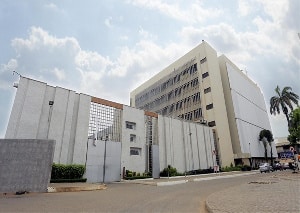
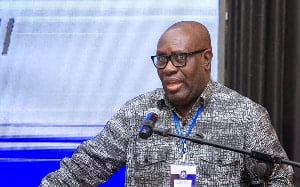
Bank of Ghana (BoG), has indicated that the rate of increase in credit given to the private sector has slowed as a combination of factors, including a tight monetary policy stance, bank portfolio rebalancing, and a reduction in economic activity, have taken their toll.
Private sector credit (PSC), in nominal terms, reached GH¢64.9billion at the end of April this year – a 19.74 percent increase over the GH¢54.2billion recorded at the same time in 2022. However, the growth rate was lower than the 26.5 percent recorded during same period of the previous year.
A perusal of the data shows that, in nominal terms, the quantum of PSC stood at GH¢72.9billion, GH¢73.7billion and GH¢63.8billion in October, November and December of 2022. In the first quarter of this year, it reached GH¢67.6billion in January, GH¢65.5billion in February and GH¢65.7billion in March.
The central bank’s data further revealed that, in real terms, PSC has contracted by 15.2 percent compared to 2.4 percent growth recorded during the same comparative period.
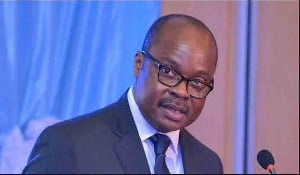
“Private sector credit generally slowed in line with the tight monetary policy stance, banks’ portfolio rebalancing after the domestic debt exchange, and moderation in economic activity,” Governor Ernest Addison said during a press engagement at the conclusion of the most recent Monetary Policy Committee meeting.
While average lending rates of banks have retreated marginally – at 31.66 percent in April 2023, it remains more than 1,000 basis points (bps) above the comparable period in 2022, when it was 21.61 percent; and banks have turned their attention to shorter-term Treasury instruments on account of the Domestic Debt Exchange Programme (DDEP) and elevated yields.
Moreover, the apex bank has raised its key rate by a cumulative increase of 1,450 basis points since late 2021, even as the moderation in economic activity has played a role in the decline of PSC. The overall slowdown in economic growth has led to reduced demand for credit, as businesses become more cautious about borrowing and investing in such an environment.
Already, Fitch Solutions in a commentary published in March this year predicted a slowdown in the banking industry as client loan growth is expected to ease to 18 percent in 2023 from 30.2 percent in 2022, citing the aforementioned factors.
Fitch Solutions’ forecast suggests that while nominal client loan growth will still be in double digits this year, real client loan growth will be significantly weaker – anticipated to be -7.7 percent by end of the year.
While Fitch anticipates excess liquidity in the system as deposits outstrip loans, it believes this will be channeled to low-risk businesses in sectors such as mining.
“Households and firms are expected to face challenges in borrowing due to rising interest rates, but Fitch Solutions anticipates that corporate credit will grow at a faster pace than household credit. The transparency and follow-up from banks regarding firms’ performance contribute to their relatively stronger creditworthiness compared to households,” Fitch Solution noted.
Alli Nansolo debated whether or not to clip his son’s dreadlocks for years. Although it is not a legal requirement in Malawi, an informal policy that was implemented across government schools meant that his son was denied entrance due to his hair.
Nansolo’s could not pay for private education for his son Ishmael from his modest dressmaking income and cutting his hair, an important symbol of their Rastafari religion, was inconceivable to him.
“Rastafari is a spiritual way of life. Keeping dreadlocks is like we are committing ourselves to a vow before the most high creator that we will serve him in our life without denying his laws or commandments,” Nansolo told CNN.
The 48-year-old makes between 200,000 to 300,000 Malawian Kwacha (around $194 to $291) monthly, while his wife Empress supplements the family’s income by selling secondhand clothes.
Jamaica’s high court ruled a school was legally right in banning a child with dreadlocks
“I felt oppressed,” Nansolo said as he recalled the staff of a state-run secondary school in Zomba, southern Malawi. refusing to register Ishmael because of his hair.
Nansolo said he contacted an officer at the Ministry of Education who advised him to cut his son’s hair so that he could go to school.
Nansolo found himself caught up in the discriminatory policies of Malawian public schools and decided to take legal action against the Ministry of Education, along with a group of parents.
“I went to the Women Lawyers Association of Malawi to ask for help. The association accepted and we went to court in November 2017,” he said.
A temporary relief For three years, Ishmael, then 15, would remain out of school as the court case dragged on.
Then, in 2020, the Malawi High Court placed an interim order compelling public schools to enroll Ishmael and other Rastafari children until a final ruling was reached.
It was a legal victory that marked a significant milestone for the estimated 15,000 Rastafarian community in Malawi, according to Nansolo, who is also a community elder.
However, the temporary relief did not address the broader issue of discrimination that around 1,200 affected students face, their lawyer Chikondi Chijozi told CNN.
“We saw a number of Rastafari children being admitted into government schools but there were still reported cases of children of [the] Rastafari community being denied admission into government schools, and their parents were forced to take the court injunction to the school to compel them to admit them,” Chijozi said.
‘Free’ at last, but challenges remain After a six-year legal challenge, the Malawian High Court delivered a landmark ruling on May 8.
The court ruled that it was unlawful to require learners, including Rastafarian kids, to cut their hair before they are enrolled into public schools.
The ruling came into immediate effect but the government has until June 30 to issue a nationwide statement mandating acceptance of all dreadlocked children into school.
Chijoki told CNN: “We got a judgment from the court which essentially upheld the rights of the Rastafari children and abolished the policy that requires all learners, including Rastafari children, to cut off their dreadlocks for them to be admitted into government schools.”
Nansolo expressed his community’s jubilation that their children could now finally continue their education.
“The judgment means that we are now free because most of us in [the] Rastafarian community don’t earn much, so we couldn’t manage to send our children to private schools,” Nansolo said.
“We are happy seeing that our children will now be going to public schools without being sent back or denied their right to education.”
CNN has contacted the education ministry for comment on the ruling.
Despite this victory, Malawi’s Rastafarian community still faces numerous challenges. Unemployment, poverty, and corporate discrimination persistently plague the community. Data on the community is hard to come by but the US State Department says around 5.6 percent of Malawi’s nearly 21 million population is formed of other religions including Hindus, Baha’is, Rastafarians, Jews, and Sikhs.
“Most of us rely on business to survive. Lack of jobs is a big challenge for the Rastafarian community because those in offices are reluctant to employ Rastas,” Nansolo said.
“The corporate world feels that being Rastafari is associated with criminality, but we are not like that.”
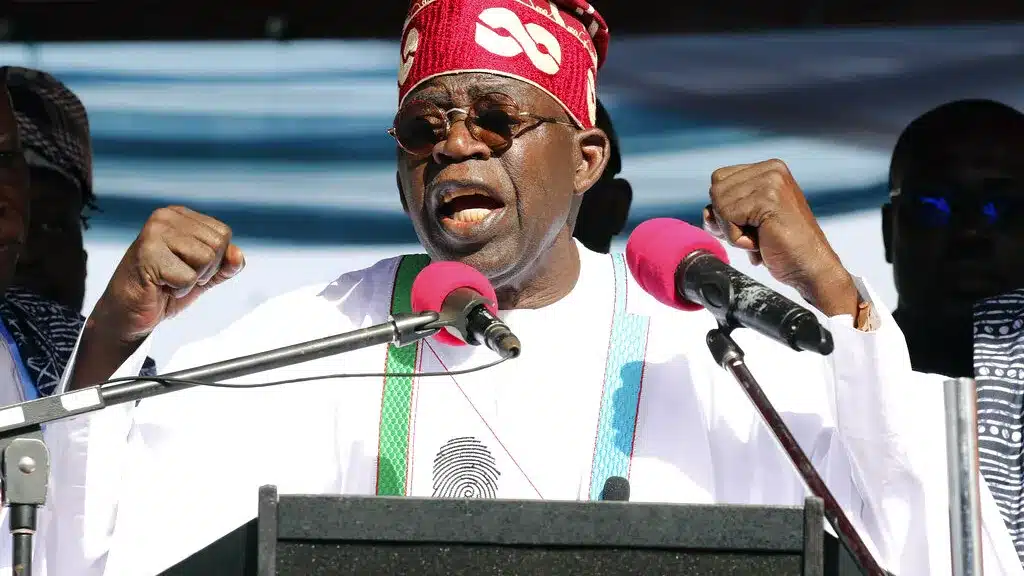
Many of the presidents from Africa other foreign dignitaries have settled in Nigeria for the inauguration of Bola Tinubu as the continent’s 16th president.
Movements around Eagle Square in Abuja, the venue of the handover and inauguration parade, have been restricted until Tuesday.
Local media say about 20 African leaders are expected in Abuja.
Rwanda’s President Paul Kagame, Cyril Ramaphosa of South Africa and Algerian President Abdelmadjid Tebboune are among leaders who arrived on Sunday.
Also in Abuja is the president of Tanzania, Samia Suluhu Hassan, the president of the Republic of Congo Brazzaville, Denis Sassou Nguesso, the president of Guinea Bissau, Umaro Sissoco Embaló and Sierra Leone’s President Julius Maada Bio.
The president of Burundi, Évariste Ndayishimiye, the transitional President of Chad Mahamat Déby, the president of Niger Republic, Mohamed Bazoum and President Nana Akufo-Ado of Ghana are also in Nigeria for the ceremony.
The prime cabinet secretary of Kenya, Musalia Mudavadi, will be representing President William Ruto.
A nine-member delegation from the US and Chinese officials led by a Communist Party senior member have also arrived for the event.
Mr Tinubu’s electoral victory is being challenged by opposition rivals.
On Tuesday, a tribunal will begin to hear the main arguments in the election petition.
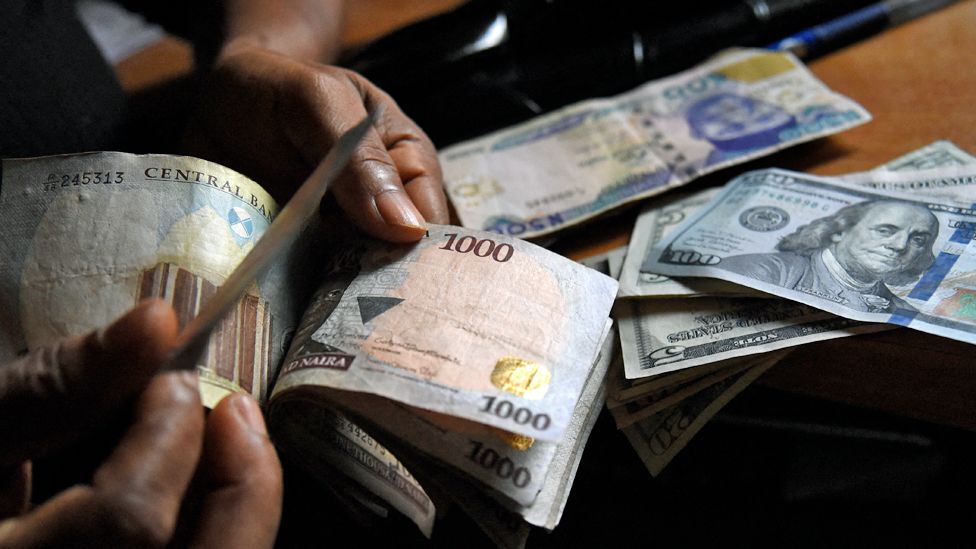
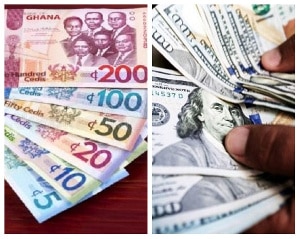
The Bank of Ghana’s interbank forex rates for today, May 29, 2023, show that the Ghana Cedi is trading versus the dollar at a purchasing price of 10.9700 and a selling price of 10.9810.
At a forex bureau in Accra, the dollar is being bought at a rate of 11.30 and sold at a rate of 12.00.
Against the Pound Sterling, the Cedi is trading at a buying price of 13.3314 and a selling price of 13.3459.
At a forex bureau in Accra, the pound sterling is being bought at a rate of 13.70 and sold at a rate of 14.70.
The Euro is trading at a buying price of 11.5905 and a selling price of 11.6021.
At a forex bureau in Accra, Euro is being bought at a rate of 11.75 and sold at a rate of 12.55.
The South African Rand is trading at a buying price of 0.5594 and a selling price of 0.5599.
At a forex bureau in Accra, South African Rand is being bought at a rate of 0.30 and sold at a rate of 0.90.
The Nigerian Naira is trading at a buying price of 42.8768 and a selling price of 42.9816.
At a forex bureau in Accra, Nigerian Naira is being bought at a rate of 13.00 Naira for every 1 Cedi and sold at a rate of 18.00.
For the CFA, it is trading at a buying price of 56.5378 and a selling price of 56.5944.
At a forex bureau in Accra, CFA is being bought at a rate of 17.00 CFA for every 1 Cedi and sold at a rate of 21.00 CFA for every 1 Cedi.
Our forex bureau rates are provided by Afriswap Bureau De Change in Osu, Accra.
Note that these rates may be different at a forex bureau near you. Our forex bureau rates are provided by Afriswap Bureau De Change in Osu, Accra.
Former Deputy National Chairman of the Peoples Democratic Party, PDP, Bode George, has called President Muhammadu Buhari’s eight years in office a failure.
George said Buhari did not live up to the expectations of Nigerians in the last eight years.
Addressing journalists in Lagos on Saturday, the PDP chieftain said history will judge Buhari’s government because it failed to impact Nigerians positively.
He lamented that Buhari failed to ensure the security of Nigerians.
He berated Buhari for failing to deliver on his electoral promises of fighting corruption among other things.
According to George: “My personal assessment is that he failed, not completely in every sector, but if you do an examination and say you must have a minimum of 33%, then you can go to the next class, but they did not attain that 33%.
“I can give them maybe about 5%, even the 5% requires a lot of retrospection.
“So it is very very disheartening and heartbreaking that he failed in his number one job, which is to guarantee security of lives and property.
“So let’s put those promises now into his departure because that’s what will be written on the pages of history. Whatever a leader does during his time, it is on the pages of history.”
Meet Hasnaa Doumi, 29, the first female coach of a men’s football team in Morocco, L’Ittihad Riadi Fkih Ben Salah Club.
Doumi is a former football player who played for the Atlas Lioness and ended her career in football at age 25 despite being told by many that she had great prospects before her. She aspired to switch lanes from playing football to pursue her career as a coach.
When she joined the L’Ittihad Riadi Fkih Ben Salah Club three months ago, it was 13th in position and kept sinking still, however, the team has been revived in Doumi’s hands and has attained seven wins and two draws, making a total of 23 points, a record in the amateur league, according to Africa News.
Doumi’s appointment is a gateway for women’s involvement in football and a great feat for females who are aspiring to be like her one day, in a totally dominated male sport.
Although this strong woman is visibly changing her team’s narrative and is helping them soar, she still says she feels society’s criticism of her gender and her position. “The only difficulty for me now is how society views me,” she said, noting that no one says it to her face, but she sees the backlash mostly on social networks.
She further explained that “Football is for men, they say, I had only the support of my relatives and my family because they know my experience in football and for me, I do not pay attention to criticism from society. I have the support of my parents and that has helped me in my career.”
Morocco is still celebrating its victory for women in football as the national women’s football team qualified for its first-ever FIFA World Cup.
Doumi expressed that her appointment to the men’s club is an honor, especially since she is the first of her kind. She asserted that she will use the opportunity given to her to make a point to the local team managers that women are as capable to coach and have to be given more opportunities.
Before her current position as the coach of the men’s team, Doumi’s coaching expertise had led her to the Asbat Tadla women’s football team. She also worked as an assistant coach for the Olympique Fakih Bansalah team in the Beni Mellal Khenifra regional football league, according to Morroco World News.
Captain of the club, Abdelhadi Bennane, said that Doumi arrived at a critical moment. According to him, the team worked hand in hand with the female coach to overcome the team’s difficulties, even though they first found her appointment surprising.
The 28-year-old added that “She has a strong personality. She listens and finally the fact that she is a woman has changed a lot of looks. Whether she is a woman or a man does not make a big difference,” according to dayFREURO.
Advising young women who aspire to be footballers, Doumi said, “I have noticed an increasing number of women who want to get involved in football. If you have a goal in mind, you have to fight for it. Reach with desire and determination, you will get there.”
The World Bank has granted government with an additional $150 million in finance to strengthen flood risk management and solid waste management for over 2.5 million people in the Odaw River Basin of the Greater Accra Region.
In a press release copied to Ghana Business News, the World Bank said the Greater Accra Region accounts for over 40 percent of non-oil GDP and faces increased flood risks that may reduce the economic and social development potential of the country.
The Bank indicated that urban floods have become more frequent and of higher intensity due to fast-growing development and occupation of flood risk areas, inadequate and unmaintained drainage systems, and solid waste accumulation along waterways.
The flood event of June 3, 2015, affected 53,000 people and caused major damage and losses in the housing, transport, water, and sanitation sectors amounting to $55 million, with an estimated $105 million reconstruction cost. At the time, the GARID project – a dedicated programme of interventions – was designed to address these challenges, it said.
Pierre Laporte, the World Bank Country Director for Ghana, Liberia, and Sierra Leone, said: “The World Bank is happy to support Ghana in these times of macroeconomic challenges and to help contribute to a holistic flood management approach through this additional financing of GARID. This is critical to achieving the World Bank’s twin goals of ending extreme poverty and boosting shared prosperity, as well as increasing the resilience of African cities.
“This additional support fills a financing gap resulting from the triggering of the Contingency Emergency Response Component (CERC) in 2020 due to the COVID-19 pandemic and the inclusion of resettlement compensation for approximately 2,800 project affected persons. It also addresses cost overruns for major infrastructure investments due to inflation and engineering requirements,” he said.
The Bank states that the project will continue to prioritize investments that enhance resilience to flood risks and improve solid waste management systems in targeted communities of the Odaw River Basin area.
“The planned flood mitigation infrastructure investments under GARID will directly reduce the flooding risks for urbanizing and economically productive areas of the Greater Accra Region, limiting the direct flood hazards on more than 138,000 people” said Catherine Lynch, Senior Urban Specialist and Task Team Leader for GARID project.
Many people queued at the King Mohammed V Theatre in Rabat, Morocco, to sample Ghana’s indigenous dishes and beverages as part of the commemoration of “Africa Day” in Rabat, Morocco.
Ghana’s ‘Waakye’ and ‘Jollo’, served with indigenous pepper sauce and spicy beverages known as ‘Sobolo’ attracted many participants at the exhibition coordinated by Ghana’s Embassy in Morocco.
The swift manner in, which some patrons completed their first course and opted for another turn was indicative that their tongues had had a memorable encounter with a good meal.
“This is very good. I’ll taste it again. We also prepare jollof in our country but this is more spicy,” Philip, a participant from Cameroon, said.
Fasouma, a Nigerien student in Morocco, told the Ghana News Agency that: “I have heard about Ghana’s Jollof so I wanted to have a taste of it. This is really good and I wish your people can teach me how to prepare it.”
Nasiru, a Nigerian journalist, revived the Ghana-Nigeria jollof debate, but admitted in the end that “Ghana’s jollof is almost as good as that of Nigeria”.
Earlier, some Ghanaian students in Morocco performed Ghanaian cultural dances at a ceremony that preceded the food exhibition.
The Kingdom of Morocco on Thursday held a series of events to mark the establishment of the Organisation of African Unity (OAU), now African Union (AU) in 1963.
In an interview with the GNA, Mr Samuel Jojo Effah-Broni, Ghana’s Ambassador to Morocco, said the country’s rich local meals demonstrated its unique culture and identity.
He said many Moroccans and other foreign nationals were in love with Ghana’s local dishes and beverages.
“Everybody enjoys the taste of Ghanaian food. Ours is unique. Other countries prepare waakye and jollof, but they are not smooth like ours,” Mr Effah-Broni said.
He said the country must package and market its local dishes well to drive cultural export and to reap benefits for the country in the area of tourism.
The Electricity Company of Ghana has warned customers to be wary of fraudsters who call ECG users and ask them to make payments to specific mobile money accounts in order to access ECG services.
The power operator asked customers to ensure that they go through the appropriate channels to make any form of payment to the ECG.
“Customers should please note that ECG staff do not demand payments for services through phone calls. Customers are strongly advised to personally initiate transactions through ECG POWER (Mobile App and short code*226# for all payments,” it said in a statement on May 27, 2023.
“The ECG Mobile App (ECG POWER) can be downloaded from the ECG website (https://www.ecg.com.gh), Play Store, or App Store for convenience in transacting business with ECG. Customers can also visit any ECG office for assistance to access the ECG Mobile App and other ECG services,” he added.
The Management of ECG, therefore, “urged all customers to beware of these fraudsters and report such incidents to the security agencies or the nearest ECG office to assist ECG to track and bring these fraudsters to book.”
The African Development Bank (AfDB) has cautioned Ghana not to rely too much on loans for long-term national growth.
Professor Kevin Chika Urama, Chief Economist of AfDB, said that relying on loans, especially from the capital market, risked not yielding the needed revenue in a short-to-medium term, making repayment difficult.
The AfDB Vice President for Economic Governance and Knowledge Management said this in an interview with the Ghana News Agency at the just ended annual meetings of the Bank in Sharm El Sheikh, Egypt.
He noted that borrowings to fund long-tern development-oriented programmes and projects often resulted in the accumulation of debt, which put economies into crisis.
“When you depend on borrowing for investing in long-term infrastructure, you have a mismatch because development projects normally take about 30 years or more to offer revenues or dividends or to be able to break even,” he said.
Prof Urama said when borrowings were done, particularly at high coupon rates, it sets a country up off for failure, “because the projects you’re putting the resources will not mature when the duration of paying back the loans fall due.
“You’re then forced to look for money elsewhere, which is challenging for most African countries because of the fiscal constraints,” the AfDB Chief Economist added.
On Ghana’s debt treatment and the recently approved International Monetary Fund (IMF) loan-support programme, he said AfDB was working with Ghana to provide technical and policy support to the country to address the debt challenges.
“We’ve had meetings with the Finance Minister, both during the IMF/Bank World spring meetings and had a special high-level delegation that went to Ghana to work with the technical teams,” he said.
“Discussions are ongoing and we’ll be providing technical assistance and policy-based operations, and we’re doing this together with our partners to coordinate support for the country,” Prof Urama told the GNA.
Ghana has been locked out of the capital market for more than a year, with an accumulated public debt of GHS434.6 billion (72.2 per cent of Gross Domestic Product – GDP) as of December 2022.
Meanwhile the Government is optimistic that with the $3bn IMF loan programme, Ghana would be able to return to the market.
“We have positioned ourselves to be able to go back into the International market which had been a source of funding for us during the first three or four years of our government,” President Akufo-Addo said recently.
The president who was speaking at the Qatar-Africa Economic Forum in Doha, added that: “There is no rush but obviously why not take advantage of global savings, it makes a lot of sense to me.
Mr Ken Ofori-Atta, Finance Minister at a press briefing after securing the IMF programme also said that “Working towards the capital market is important because we then get our ratings up and make the country more attractive for foreign investors, especially [getting] FDI.”
“Going forward, we’ll find ways of ensuring that we’re efficient in our deployment [of the $3bn funds] …and ensure efficiency in providing services to the people,” he said.
Chris Bryant, leader of parliament’s standards committee and Labour MP for Rhondda, told Sophy Ridge on Sunday that MPs should not claim the cost of fines on expenses.
It comes as it has emerged today a Tory minister and three other MPs claimed hundreds of pounds of driving fines on expenses.
Mr Bryant says the standards committee, which he chairs, has “no power” to investigate rule breaches related to expenses.
The Independent Parliamentary Standards Authority (IPSA) is the body that would do that, and it has said that it will be asking the MPs concerned to repay the money “where appropriate”.
But Mr Bryant added his own, saying: “To my mind, it is manifestly wrong. I don’t care whether it breaches a rule – it is manifestly wrong.”
He says that members of the public cannot claim expenses for parking fines, adding: “I don’t see why MPs should be any different.”
Turks are voting in a historic presidential run-off election to determine if Recep Tayyip Erdogan should continue in power after 20 years.
His challenger Kemal Kilicdaroglu, backed by a broad opposition alliance, has billed the vote as a referendum on Turkey’s future direction.
The president, who is favourite to win, promises a new era uniting the country around a “Turkish century”.
But the more pressing issue is rampant inflation and a cost-of-living crisis.
Voters have nine hours to cast their ballots before 17:00 (14:00 GMT) and many were already waiting outside a polling station in central Ankara before the doors opened. One woman of 80 had set her alarm for 05:00 to be sure of arriving on time.
Turnout in the first round was an impressive 88.8%, and Mr Erdogan’s lead was 2.5 million votes. That is why both candidates have their eye on the eight million who did not vote – but could this time.
Ahead of the run-off Mr Kilicdaroglu accused his rival of foul play, by blocking his text messages to voters while the president’s messages went through.
Opposition parties are deploying an army of some 400,000 volunteers in a bid to ensure no vote-rigging takes place, both at polling stations and later at the election authority. But among the volunteers, they need lawyers such as Sena to accompany the ballot boxes.
International observers spoke of an uneven playing field after the first round. But there was no suggestion that any irregularities in voting would have changed the result.
Mr Kilicdaroglu promised a very different style of presidency on his final day of campaigning: “I have no interest in living in palaces. I will live like you, modestly… and solve your problems.”
It was a swipe at Mr Erdogan’s enormous palatial complex on the edge of Ankara which he moved to when he switched from prime minister to president in 2014. After surviving a failed coup in 2016 he took on extensive powers, detained tens of thousands of people and took control of the media.
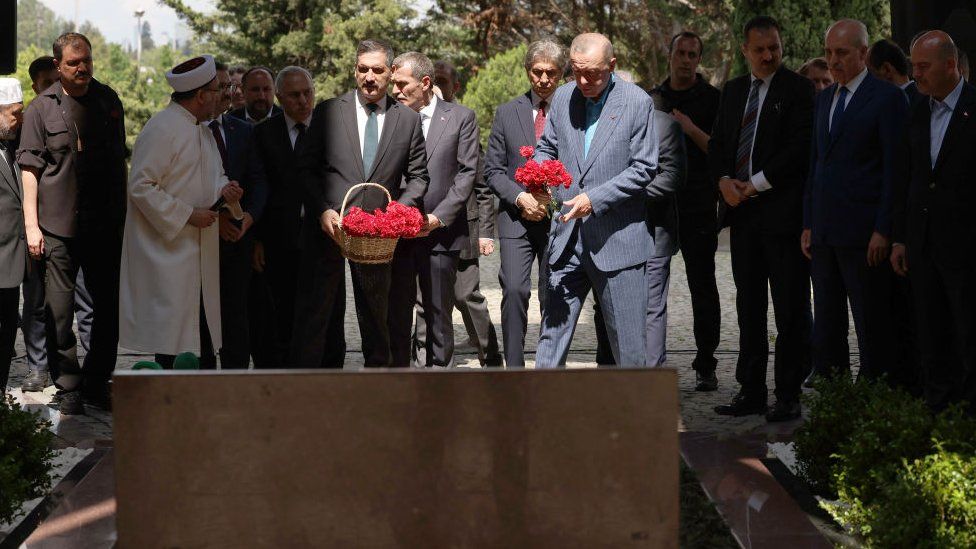
So it was laden with symbolism when he paid a campaign visit on Saturday to the mausoleum of a prime minister executed by the military after a coup in 1960.
Image caption,One of President Erdogan’s final acts before the vote was to lay carnations at a mausoleum
“The era of coups and juntas is over,” he declared, linking Turkey’s current stability to his own authoritarian rule.
Turkey, however, is deeply polarised, with the president reliant on a support base of religious conservatives and nationalists, while his opposite number’s supporters are mainly secular – but many of them are nationalist too.
For days the two men traded insults. Mr Kilicdaroglu accused the president of cowardice and hiding from a fair election; Mr Erdogan said his rival was on the side of “terrorists”, referring to Kurdish militants.
But after days of inflammatory rhetoric about sending millions of Syrian refugees home, the opposition candidate returned to Turkey’s number-one issue – the economic crisis, and in particular its effect on poorer households.
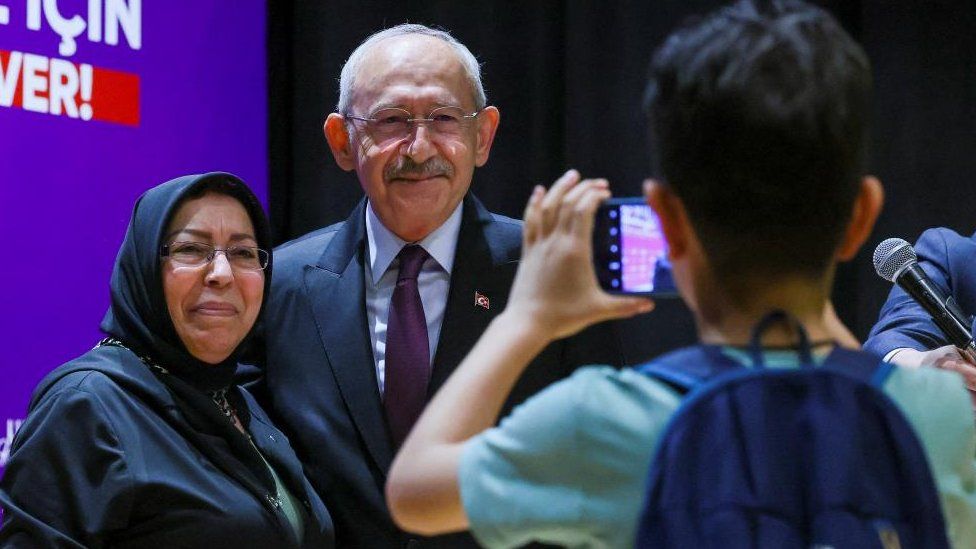
A 59-year-old woman and her grandson joined him on stage to explain how her monthly salary of 5,000 lira (£200; $250) was now impossible to live on as her rent had shot up to 4,000 lira (£160; $200).
Image caption,A boy takes a picture of his grandmother, 59, with Kemal Kilicdaroglu
It may have been staged, but this is the story across Turkey, with inflation at almost 44% and salaries and state help failing to keep pace.
Economists say the Erdogan policy of cutting interest rates rather than raising them has only made matters worse.
The Turkish lira has hit record lows, demand for foreign currency has surged and the central bank’s net foreign currency reserves are in negative territory for the first time since 2002.
“The central bank has no foreign currency to sell,” says Selva Demiralp, professor of economics at Koc University. “There are already some sort of capital controls – we all know it’s hard to buy dollars. If they continue with low interest rates, as Erdogan has signalled, the only other option is stricter controls.”
East of Ankara, gleaming tower blocks have been springing up in Kirikkale. It looks like boom-time for this city, run by the president’s party.
But many people here are struggling.
Fatma has run a hairdresser’s for 13 years but for the past two, work has dried up, and the cost of rent and hair products has soared.
She voted for an ultranationalist candidate who came third, and does not trust the two men left in the race.
A few doors up the street, Binnaz is working a sewing machine at a shop for mending clothes.
People cannot afford new dresses so she is earning much more, even if her monthly rent has trebled to to 4,000 lira. Despite Turkey’s stricken economy, she is putting her faith in the president.
BBC
I believe [Erdogan] can fix it because he’s been in power for 21 years and he has all the power. It’s his last term [in office] so he’ll do all he can for usBinnaz Seamstress in Kirikkale
Outside a supermarket, Emrah Turgut says he is also sticking with Mr Erdogan because he has no faith in the other option, and believes the president’s unfounded allegations that the biggest opposition party co-operates with terrorists.
Turkey’s second-biggest opposition party, the HDP, denies any link to the militant PKK, but President Erdogan has used their backing for the rival candidate to suggest a link to terrorists.
Whoever wins on Sunday, Turkey’s parliament is already firmly in the grip of Mr Erdogan’s Islamist-rooted AK Party and its far-right nationalist ally, the MHP.
The AKP also has the youngest MP, who arrived in parliament on the eve of the presidential vote.
Zehranur Aydemir, 24, believes if Mr Erdogan wins then he will lay the foundations for a century in which Turkey will become a global power: “Now Turkey has a bigger vision it can dream bigger.”
It is another grandiose Erdogan project, but Turkey’s economy is likely to prove a more pressing task, whoever wins the run-off.
Local officials have reported that Russia carried out a new major overnight drone attack on Ukraine’s capital, Kyiv, killing at least one person.
Kyiv’s mayor Vitaliy Klitschko said a man died when drone wreckage fell near a petrol station. A woman was injured.
Overall, Russia launched a record 54 so-called kamikaze drones on Ukrainian targets, 52 of which were shot down, Ukraine’s Air Force reported.
In Kyiv alone, more than 40 drones were downed, officials said.
This information has not been independently verified.
Russia – which launched its full-scale invasion in February 2022 – has in recent weeks stepped up its attacks on Kyiv, seeking to overwhelm the capital’s defences.
Earlier on Sunday, air raid alerts were activated in 12 regions of Ukraine, from Volyn in the north-west to Dnipropetrovsk in the south-east.
In a post on social media, Mr Klitschko urged Kyiv residents to “stay in shelters”, warning of waves of drone attacks and a “difficult” night ahead.
He said at least two high-rising buildings in different districts of the capital were on fire after being hit by falling drone fragments.
Kyiv officials also reported that warehouses in the southern Holosiyivsky district were ablaze.
Some officials accused Russia of targeting Kyiv deliberately as residents prepared to celebrate Kyiv Day – the anniversary of the city’s foundation 1500 years ago and a popular holiday before the war.
There were also reports of explosions in the city of Zhytomyr, west of Kyiv.
The air alert was later lifted in the capital and across the country.
In its recent attacks, Russia has been using so-called kamikaze drones as well as a range of cruise and ballistic missiles.
The attacks come ahead of a widely expected Ukrainian counter-offensive.
On Saturday, one of Ukraine’s most senior security officials told the BBC the country was ready to launch such an operation.
Oleksiy Danilov, secretary of the powerful National Security and Defence Council of Ukraine, said an assault to retake territory from President Vladimir Putin’s occupying forces could begin “tomorrow, the day after tomorrow or in a week”.
‘We’re ready to begin counter-offensive’ – Ukraine
Ukraine has been planning a counter-offensive for months. But it has wanted as much time as possible to train troops and to receive military equipment from Western allies.
In the meantime, Russian forces have been preparing their defences in the seized regions of south-eastern Ukraine.
Speaking to the BBC, Andrei Kelin, Russia’s ambassador to the UK, said his country had “enormous resources” and it was yet to “act very seriously”.
Warning that supplies of weapons to Ukraine risk escalating the war to levels not seen so far, he added: “Sooner or later, of course, this escalation may get a new dimension which we do not need and we do not want.”
Mr. Steve Barclay, Boris Johnson’s health secretary, tells Trevor Phillips that he had a “very constructive meeting this week” with RCN union president Pat Cullen.
Asked if the doors are open to meeting the RCN’s demand for a 10% pay rise or more, Mr Barclay says the existing pay offer from the government should be enough: “What Pat [Cullen] said at the time the deal went to members was exactly the same as what I said and what the rest of the NHS staff council said, which was it was a fair and final settlement.”
He says the pay offer recognises the “huge, valuable contribution” of NHS staff.
He also says it is not “legally possible” to give a bespoke deal to NHS staff on different pay bands, which he says is what the RCN is asking.
But pushed on whether the government would go back to the negotiating table, Mr Barclay says: “Not on the amount of pay.”
He says there is “further work” to be done with NHS unions around pensions, pay progression, and tackling violence against staff, but he says that the pay offer was accepted by other unions, and therefore will be implemented.
He said a long-promised long-term NHS workforce plan will be brought forward soon – but did not commit to a date.
“It is a complex piece of work. It’s right we take our time to get it as it should be, but we will bring that out very soon.”
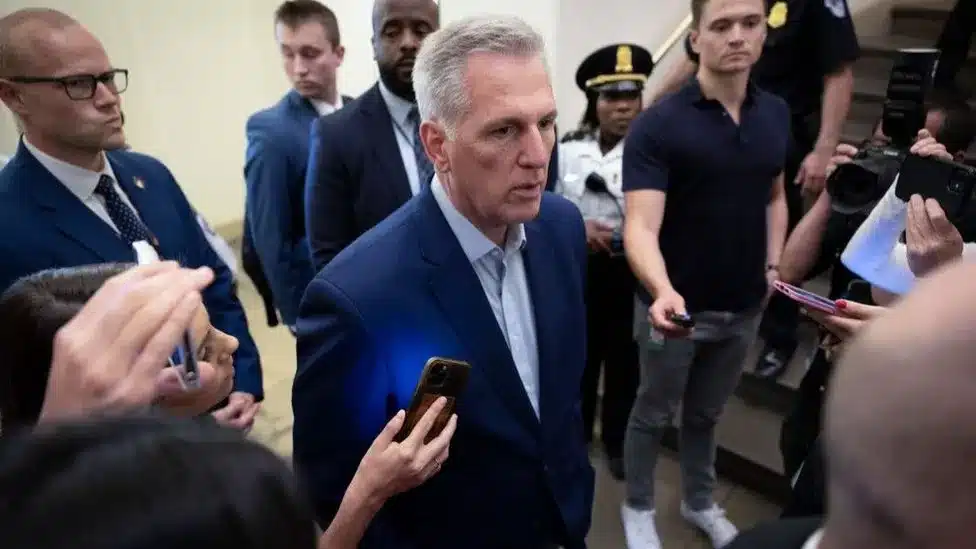
President Joe Biden and his Republican opponents have made an announcement on an agreement in principle to lift the US debt ceiling and avoid a default.
President Joe Biden described the agreement as a “compromise”, while House Speaker Kevin McCarthy said it “was worthy of the American people”.
The deal, after weeks of bitter negotiations, still needs to be approved by a divided Congress.
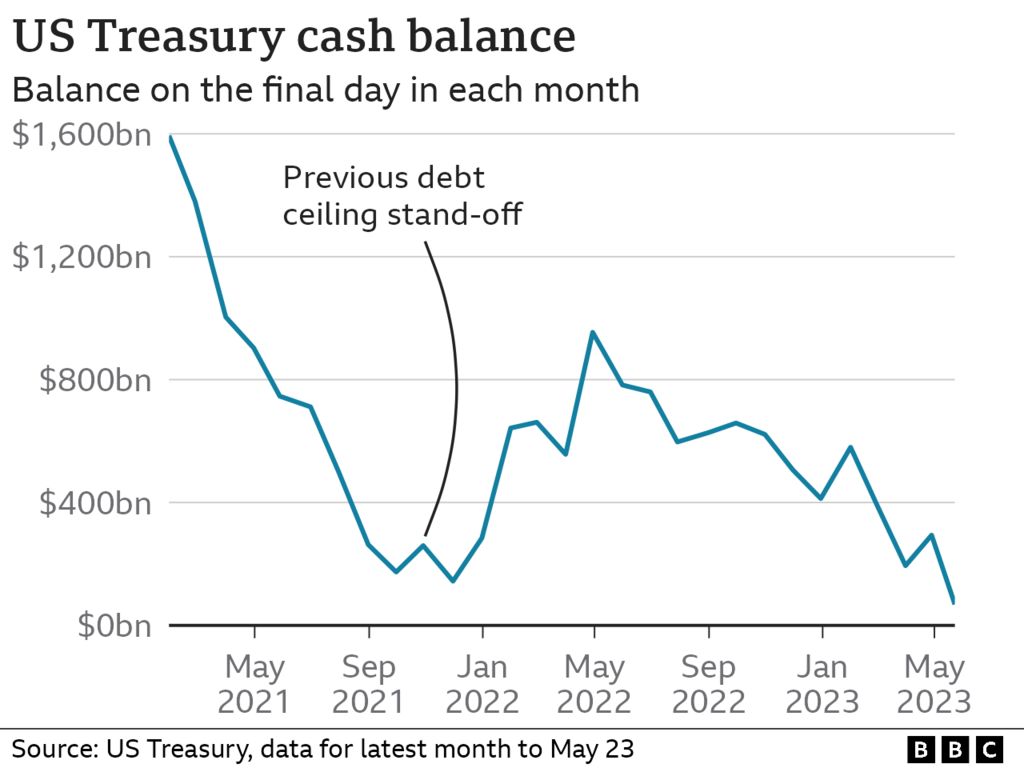
The Treasury has warned the US will run out of money on 5 June without a deal.
The US must borrow money to fund the government because it spends more than it raises in taxes.
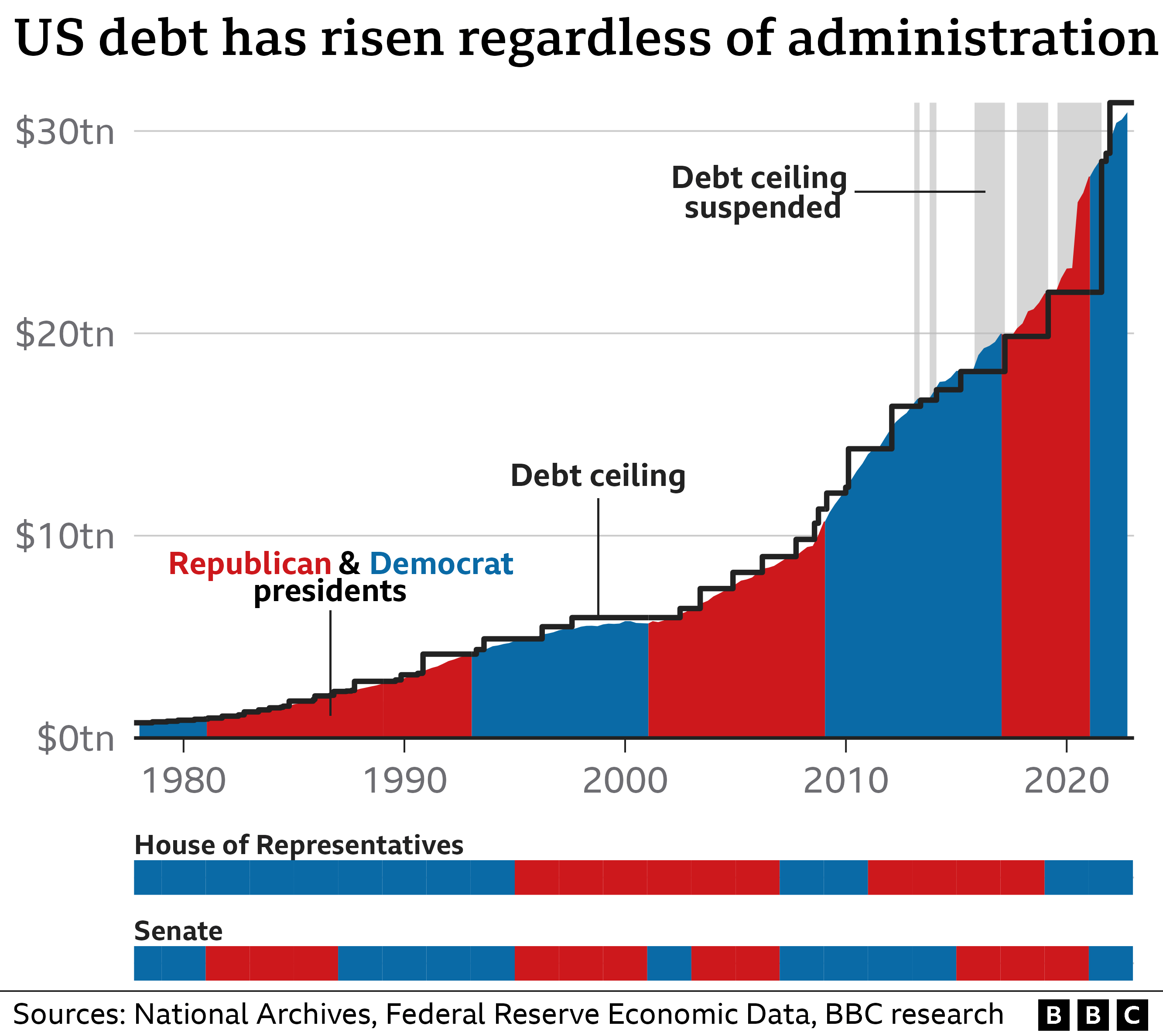
Republicans have been seeking spending cuts in areas such as education and other social programmes in exchange for raising the $31.4tn (£25tn) debt limit.
Details of the tentative deal have not officially been released – but CBS, the BBC’s partner in the US, reported that non-defence government spending would be kept flat for two years and then rise by 1% in 2025.
It was unclear how exactly a government programme that provides food-purchasing assistance for people on low or no incomes would change.
In a statement, President Biden described the agreement as a compromise which was good for the country “because it prevents what could have been a catastrophic default and would have led to an economic recession, retirement accounts devastated, and millions of jobs lost”.
Mr McCarthy, for his part, referred to “historic reductions in spending, consequential reforms that will lift people out of poverty into the workforce”.
“There are no new taxes, no new government programs,” he said.
Mr McCarthy added that he planned to finish writing the bill on Sunday, before having a vote in Congress on Wednesday.
A US default would upend the US economy and disrupt global markets.
In the US, the immediate effect would be that the government would quickly run out of funds to pay for welfare benefits and other support programmes, for instance.
Over a long period, the crisis would top the US economy into recession – and this would result in unemployment rising.
A US recession would have big knock-on effects for many countries around the world, for which the US is a key trading partner – they would not be able to sell to an economy that does not buy as much.
And because the US dollar is the reserve currency of the world, a default would send panic across the world, eventually leading to prices of many commodities rising.
President Joe Biden and his Republican opponents have announced they have agreed in principle to raise the US debt ceiling and avert a default.
President Joe Biden described the agreement as a “compromise”, while House Speaker Kevin McCarthy said it “was worthy of the American people”.
The deal, after weeks of bitter negotiations, still needs to be approved by a divided Congress.
The Treasury has warned the US will run out of money on 5 June without a deal.
The US must borrow money to fund the government because it spends more than it raises in taxes.
Republicans have been seeking spending cuts in areas such as education and other social programmes in exchange for raising the $31.4tn (£25tn) debt limit.
Details of the tentative deal have not officially been released – but CBS, the BBC’s partner in the US, reported that non-defence government spending would be kept flat for two years and then rise by 1% in 2025.
It was unclear how exactly a government programme that provides food-purchasing assistance for people on low or no incomes would change.
In a statement, President Biden described the agreement as a compromise which was good for the country “because it prevents what could have been a catastrophic default and would have led to an economic recession, retirement accounts devastated, and millions of jobs lost”.
Mr McCarthy, for his part, referred to “historic reductions in spending, consequential reforms that will lift people out of poverty into the workforce”.
“There are no new taxes, no new government programs,” he said.
Mr McCarthy added that he planned to finish writing the bill on Sunday, before having a vote in Congress on Wednesday.
A US default would upend the US economy and disrupt global markets.
In the US, the immediate effect would be that the government would quickly run out of funds to pay for welfare benefits and other support programmes, for instance.
Over a long period, the crisis would top the US economy into recession – and this would result in unemployment rising.
A US recession would have big knock-on effects for many countries around the world, for which the US is a key trading partner – they would not be able to sell to an economy that does not buy as much.
And because the US dollar is the reserve currency of the world, a default would send panic across the world, eventually leading to prices of many commodities rising.
A government official in India who drained a reservoir to retrieve a phone he dropped while taking a selfie has been suspended from his job.
More than 2 million liters of water were pumped out of the Paralkot reservoir, over a period of four days, in an effort to retrieve the Samsung handset belonging to Rajesh Vishwas, a local food inspector.
Vishwas had been out with friends last Sunday afternoon when it slipped from his grasp at the scenic spot in the central Indian state of Chhattisgarhwith.
In a video statement shared by the Indian Express, Vishwas said he rented a diesel pump to “drain some water into a nearby canal” in an effort to retrieve the phone and that he did this after asking for permission from a sub-divisional officer.
He also said that he had asked others at the reservoir to try to retrieve the phone, but they had been unable to reach it as there was too much water.
His version of events is at odds with that of his employer, who suspended him on the grounds of misusing his position – noting he had wasted millions of liters of water at a time of severe heat.
His suspension order, seen by CNN, also claims that Vishwas did not receive permission to drain the water.
In his video statement, however, Vishwas insists the water he drained was from the overflow section of the dam and “not in usable condition” anyway.
Tens of thousands of people are fleeing to South Sudan to escape the conflict between Sudan’s military and a rival militia, which has so far killed at least 863 civilians.
Last Monday a 7-day ceasefire was agreed.
Many took the opportunity to head to the border with the world’s youngest nation.
“We fled because of the war and we came here and there was violence again. We don’t understand what’s happening. We’re hungry and thirsty and the rain is coming and we don’t have plastic sheets. We’re tired and we don’t know how our problems will be solved”, said Alwel Ngok, a South Sudanese who was living in Sudan’s capital, Khartoum, with her family until the violence erupted.
Aid agencies are struggling to cope with the influx of people. Even before this crisis, 70% of the population in Sudan needed humanitarian assistance.
“They are very hungry, and they are thirsty and they are very tired. So they need help, they need food, they need water, they need for healthy, they need everything”, appealed Mary Otwong, a border monitor with the United Nations International Organization for Migration.
United Nations World Food Program regional director for East Africa, Michael Dunford, added:
“My biggest concern is the implications that this crisis in Sudan will have across the region, particularly in South Sudan. Even before this crisis, 70% of the population needed humanitarian assistance and at the moment WFP can’t meet their needs, we’re going to struggle to meet any increased needs at this stage”.
On Friday, Sudan’s army appealed for reservists and retired soldiers to re-enlist and asked the United Nations to change its envoy to the country.
Due to a widespread issue with e-gates at ports and airports, there are huge lines and “scenes of utter chaos” at the UK border.
Due to a technical issue, electronic gates stopped working late on Friday, forcing all passengers to be processed through staffed airport desks.
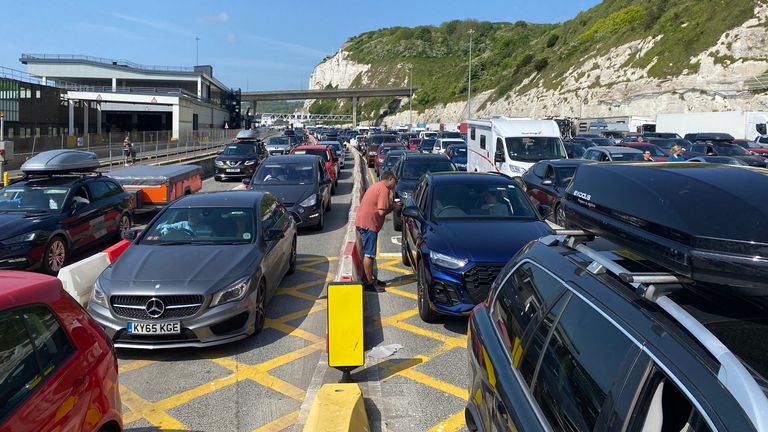
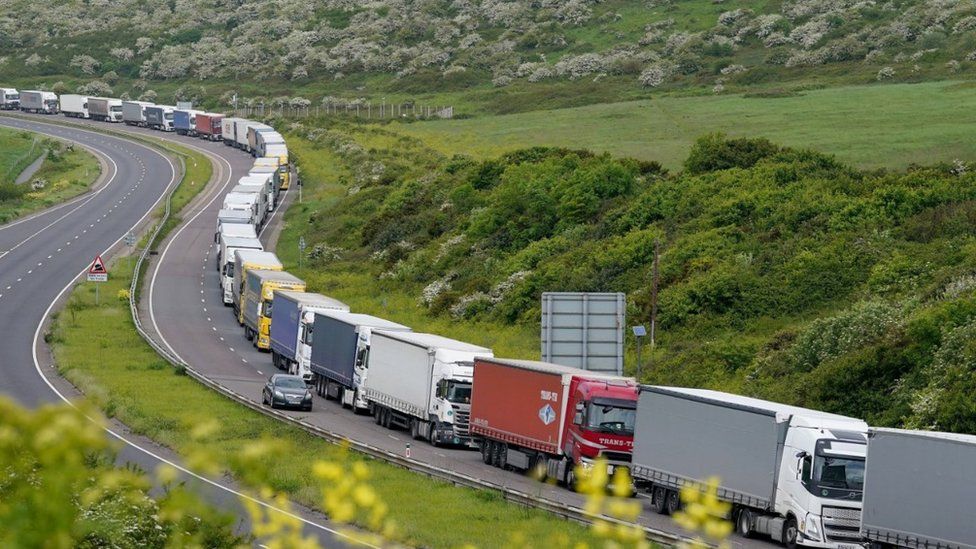
It comes as traffic builds on motorways and queues grow at Dover due to the bank holiday getaway.
Heathrow Airport said it was aware of the problem affecting its passengers.
The e-gates are operated by Border Force, the airport said, adding that the problem was widespread across airports and ports.
It said: “Our teams are working closely with Border Force to help resolve the problem as quickly as possible and we have additional colleagues on hand to manage queues and provide passenger welfare.
“We apologise for any impact this is having to passenger journeys.”
The Home Office also confirmed the delays for arrivals in the UK.
A spokesperson said: “We are aware of a nationwide border system issue affecting arrivals into the UK.
“We are working to resolve the issue as soon as possible and are liaising with port operators and airlines to minimise disruption for travellers.”
One traveller at Heathrow said on Twitter they had been waiting in a queue for four hours.
Another said they were met with the “mother of queues” for manual passport checks.
Another person at Heathrow tweeted: “Just landed to scenes of utter chaos. 2 hour queues just to get to the real queue. Gates broken.”
There are more than 270 eGates at the UK border.
They can be used by British and EU citizens over the age of 12, as well as people from several other countries including Australia, Canada, the US, Japan and New Zealand.
Returning from Dubai overnight to this mother of queues. Apparently national outage in border control machines 🤷🏼♀️so manual passport checks. Moreso ridiculous when paying ££ extra for the privilege of travelling through @HeathrowAirport pic.twitter.com/pcPCkoxdVy— Lina Tayara (@FabLoulou) May 27, 2023
Twitter Due to your consent preferences, you’re not able to view this. Open Privacy Options
Travellers on the roads also face the prospect of long queues throughout the weekend.
Journeys on some stretches of the M25 could take up to three times longer than normal, transport data company Inrix has warned.
Long delays are also expected on the M5 in Somerset and the M6 in Cheshire and Greater Manchester.
Drivers across the UK will make 19.2 million leisure car trips between Friday and Monday, according to estimates from the RAC, with the hottest day of the year so far forecast on Sunday.
Ferry passengers through Dover were advised to allow two hours to complete border controls and check-in – even before the e-gate problems.
DFDS ferry company tweeted: “Please be prepared with refreshments & use facilities before arriving at the port.”
The Port of Dover said delays at French border control were due to “IT issues” with “high volumes of tourist and freight traffic on Port approaches”.
Image: Queues for the ferry at Dover on Saturday morning
People queuing at Dover told Sky News they had missed their ferry because of the queues and were “about to find out” whether they could get on a later sailing.
“It’s frustrating, but it is what is,” they said.
The resigned attitude was shared by other travellers, who said they had come expecting delays after seeing long queues on previous bank holiday weekends.
At Easter, passengers faced waits of up to 14 hours.
One couple in the queue of cars today told Sky News they had travelled half a mile in 35 minutes.
They said they had left three hours instead of 90 minutes but had still missed their check-in time.
The RAC said it was expecting the busiest weekend of traffic since before the pandemic.
“Getting away early in the morning or delaying trips until the evening are the best way to avoid the inevitable delays,” spokesman Rod Dennis said.
While holidaymakers face the prospect of long queues, those staying at home for the long weekend should enjoy some of the hottest weather of the year.
Southeast Wales and around the Bristol Channel will get the best of the weather, with temperatures up to 24C on Saturday and Sunday.
Other parts of the UK could see temperatures reaching the high teens and low 20s.
The dry and bright weather is likely to continue for most with little rain expected throughout next week during half term.
Minister of Fisheries and Aquaculture, Mrs Mavis Hawa Koomson, has stated on Friday May that Ghana will earn approximately $254 million from the export of fish and fishery products in 2022.
She stated at the commissioning of the Elmina Fishing Port Rehabilitation and Expansion project that if efficiently managed, the industry would contribute considerably to the country’s socioeconomic development.
More than three million people are employed along the value chain of the fisheries sector, which contributes 1.2 percent of the Gross Domestic Product (GDP), and accounts for over 60 percent of animal protein intake by the population.
Per capita consumption of fish was 26kg, contributing hugely to national food security in Ghana, the Minister said.
She, however, pointed out that the sector was saddled with challenges such as sea surface temperature and rising sea levels, which increased occurrences of sea surge due to climate change and global warming.
This phenomenon had resulted in coastal sea erosion and destruction of landing sites, affecting the livelihoods of artisanal fishermen.
The project would, therefore, address the challenges facing the sector with regards to safe landing for fishermen after fishing expedition and the hygienic handling of fish.
Additionally, the fishing port was evidence of the Government’s commitment to the growth and development of the sector.
She advised fishermen to stop illegal fishing activities to facilitate the recovery and rebuilding of the fisheries resources.
“The development of landing sites and fishing harbours will be of no use if the fisheries resources are depleted because of illegal, unreported and unregulated fishing practices.”
The Sector Minister called on the fisher-folks to work together to harness the full potential of the Elmina Fishing Port to become a catalyst for sustainable growth, increased job creation and improved livelihoods.
A man is in police grips after opening a door on an Asiana Airlines jet as it landed in South Korea.
The flight’s 194 passengers all survived after it landed safely but with the door remained open at Daegu International Airport on Friday.
According to local media, some passengers fainted, while others suffered breathing problems and were brought to the hospital.
The man in his 30s said he was feeling suffocated and wanted to get off quickly, Yonhap news agency reported.
Police said the man claimed during questioning that he was stressed after losing his job, according to the report.
“He is mentally struggling right now and losing his footing. We could not investigate him properly due to his state,” a local police officer told reporters, adding that the man could not be asked any questions as he was not “in a normal state”.
Flight OZ8124, an Airbus A321-200 jet, had taken off from Jeju Island on Friday about 11:45 local time (03:45 GMT).
As it was landing about an hour later, a male passenger opened the emergency door while the plane was still 250m from ground.
A passenger’s video shared on social media shows the gap in the left hand side of the plane and winds buffeting rows of seated passengers.
Flight attendants had not been able to stop him because the plane was about to land, witnesses recounted to local media.
They said the man had also tried to jump out of the plane after opening the door.
Passengers have described the panic on board.
“It was chaos with people close to the door appearing to faint one by one and flight attendants calling out for doctors on board through broadcasting,” one 44-year-old passenger told Yonhap.
“I thought the plane was blowing up. I thought I was going to die like this,” he added.
Image caption,The Asiana Airlines plane landed at Daegu with its door open
Several school age children had also been on board, on their way to a weekend sporting event.
The mother of one of the students told Yonhap: “The children were shaking, crying, and frightened.”
The president of Sainsbury’s has told the BBC that supermarkets have not used high inflation rates to justify bigger profits.
When asked if the UK’s second largest supermarket had profited, Simon Roberts responded, “Absolutely not.”
Food sellers have been accused of “greedflation” – raising prices to increase profits.
The competition watchdog has said it will look at how the grocery market is operating.
As well as the new focus on high food prices from the Competition and Markets Authority, some politicians have called for action on food prices.
But Mr Roberts told the BBC that Sainsbury’s and other grocery chains had spent money to “battle inflation” and avoid passing all of the rising costs onto consumers.
“We made less profit year-on-year and that’s because we made really conscious decisions to keep our prices as low as we could,” Mr Roberts said.
Sainsbury’s made £690m in pre-tax profit in the year to March, a fall from £730m the previous year.
There have been growing calls for more clarity over how food prices are set.
General inflation has fallen to 8.7%, and energy prices and some wholesale food prices have started to fall back. But food price inflation remains stubbornly high at 19%.
The latest official retail sales figures showed volumes rebounded in April after trading in March was hit by the wet weather.
Sales volumes rose 0.5% last month, the Office for National Statistics (ONS) said, with supermarkets seeing higher sales.
However, the ONS figures show the impact of higher prices over the past year, with people buying fewer items but spending more money. Sales volumes in April were 3% lower than at the same point last year, while the amount spent by shoppers was up 4.7%.
How can I save money on my food shop?
Look at your cupboards so you know what you have already
Head to the reduced section first to see if it has anything you need
Buy things close to their sell-by-date which will be cheaper and use your freezer
Jewellers, sports retailers and department stores all had a good month and, despite high food prices, supermarkets also recovered from the fall in March.
The British Retail Consortium (BRC) said the figures were being driven by price and that consumers were shifting their spending patterns and “trading down”, looking for cheaper, value brands.
And with the economic outlook still uncertain chief executive of the BRC Helen Dickinson said: “Treats, smaller items that make us feel better, they will continue to do well.”
No evidence of profiteering
Ged Futter, a former senior buyer at supermarket Asda and now a retail analyst, said suggestions that supermarkets were “raking in” profits were misplaced, pointing to lower profits across the sector.
“There is no evidence from a single supermarket that this is profiteering,” he said. “What they are doing is absorbing some of the higher costs.”
The large supermarkets all made lower profits or losses in the last year, he said. Tesco, the UK’s largest supermarket chain, earned pre-tax profits of £1bn, half of what they earned the previous year.
Profit margins in the industry were below 5%, Mr Futter said, much lower than in food manufacturing. Costs in the agricultural sector have risen by 30%, he added, suggesting farmers and retailers were absorbing some of the price rises.
In recent days, several supermarkets have announced lower prices for some basics that are common to most shopping baskets: bread, milk and butter.
“We invested over £560m in the last year, others have done similarly,” Mr Roberts said.
Mr Roberts said pay rises for Sainsbury’s staff of more than 10% last year had contributed to rising prices, but were “locked in”, while he hoped the cost of other inputs such as energy and food commodities would continue to fall.
Tesco, Morrisons and Asda have also raised staff wages in recent months, as have budget retailers Aldi and Lidl.
While the headline rate of food inflation was around 19%, that didn’t mean households were spending 19% more on their food, Mr Roberts added, since most shoppers had decided to buy less, trade down to less expensive choices, or shop more frequently to avoid waste.
Shoppers were increasingly turning to own-label products, Mr Roberts added.
Sainsbury’s has relaunched its own-label value range under a new brand name, Stamford Street, to help shoppers find the cheaper options quickly, he said.
The range will include 200 products, and will include new staples such as king prawns and cheese tortelloni pasta.
It is named after the spot near Blackfriars in London where Sainsbury’s had its head office for over a century, but which has now been demolished.
However, the Unite union disputed Mr Roberts’ comments that the supermarket had absorbed higher costs, adding that the “scandal of greedflation continues”.
“Ordinary people are paying the price at the tills and no PR offensive by the supermarket giants can cover that,” said Unite general secretary Sharon Graham.
Image caption,Sainsbury’s is rebranding its own-label range
Sainsbury’s is not the only grocer hitting back at criticism over profiteering.
On Wednesday, Marks & Spencer chief executive Stuart Machin also denied the sector was guilty of “greedflation” and said his company had also invested to protect customers from the full force of inflation, impacting its profit margin because it was “the right thing to do”
There are structural reasons why prices may not fall rapidly even when energy and wholesale and commodity prices fall, the industry has pointed out.
Many retailers sign long-term contracts for products and so will have baked in some of the higher prices, the BRC said.
Unilever boss Alan Jope has also dismissed accusations of greedflation, saying the company was only passing on three-quarters of the higher costs it was facing.
Authorities in the United States and Mexico are requesting the World Health Organization (WHO) to declare a public health emergency in response to a fungus outbreak connected to cosmetic operations in Mexico.
The Centers for Disease Control and Prevention (CDC) said two people who got surgeries involving epidural anaesthesia have died of meningitis.
Almost 400 people in the US and Mexico are being monitored.
Two cosmetic clinics in the Mexican city of Matamoros have been shut.
Authorities in both the US and Mexico have urged people who had surgeries involving epidural anaesthesia at either the River Side Surgical Center or Clinica K-3 since January to get evaluated, even if they are currently asymptomatic.
The CDC said it had already identified 25 people in the US with “suspected” or “probable” cases of fungal meningitis.
Many US citizens travel to Mexico for cosmetic procedures such as liposuction, breast augmentation and Brazilian butt lifts, which all require the injection of an anaesthetic into the area around the spinal column.
The CDC’s Dallas Smith said that medications used during anaesthesia in the current outbreak may have been contaminated either in the epidural itself or in other medications that are added in conjunction during the surgeries like morphine.
“There’s a shortage currently in Mexico, and there could be potential for a black market that could have contaminated medicine,” said Mr Smith.
Last October, a batch of a local anaesthetic commonly used for operations such as Caesarean births was found to have been infected by the same fungus, leading to the death of 39 people in the Mexican state of Durango.
The most common early symptom of fungal meningitis is headaches, followed by symptoms like fever, vomiting, neck pain, and blurred vision.
Fungal meningitis is not contagious and can be treated with antifungal medicines – but it can can quickly become life-threatening once symptoms begin.
Americans often travel to Mexico for low-cost medical services.
The WHO declares a public health emergency when a disease spreads between countries and may a co-ordinated international response may be required to bring it under control.
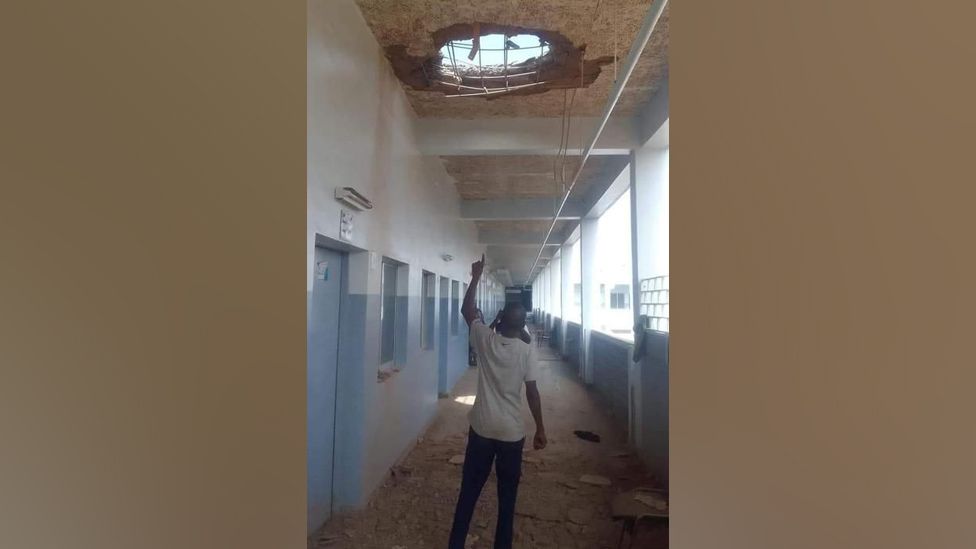
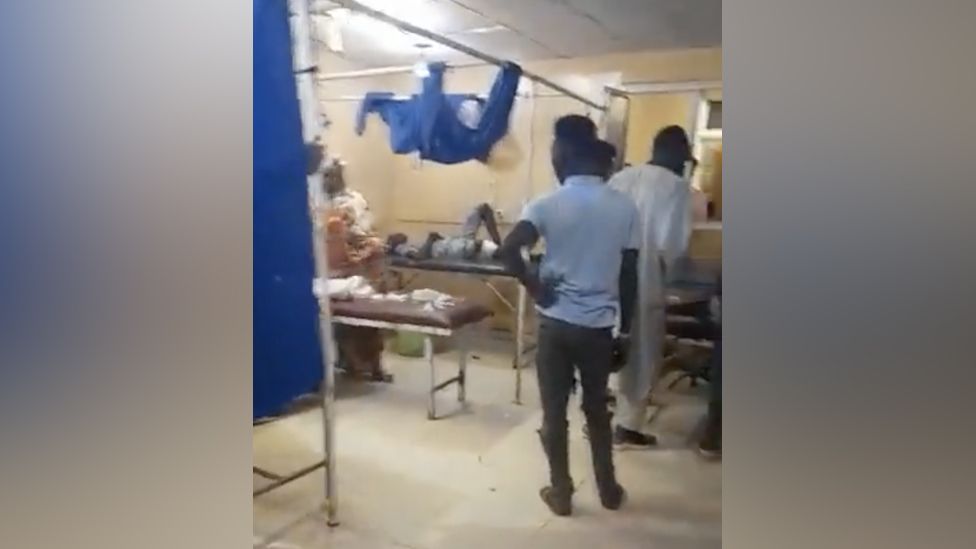
Data obtained by BBC News Arabic, has it that both parties in Sudan’s conflict may be committing war crimes against medical facilities and personnel.
Hospitals have been hit by airstrikes and artillery fire while patients were still in the building and doctors have also been singled out for attack – all of which are potential war crimes.
Only a handful of the 88 hospitals in the capital, Khartoum, remain open after weeks of fighting, according to Sudan’s Doctors Union.
The BBC team used satellite data and mapping tools, analysed user-generated content on a huge scale, and spoke to dozens of doctors, to build a picture of how hospitals and clinics are being affected.
The World Health Organization (WHO) called the attacks “a flagrant violation of international humanitarian law” adding that they “must stop now”.
The fighting in Sudan began on 15 April and was triggered by a power struggle between former allies – the leaders of the regular army and the paramilitary Rapid Support Forces (RSF).
Khartoum’s Ibn Sina hospital is one of a number the BBC has identified as having been targeted in an airstrike or by artillery fire when medics were treating civilian patients.
Dr Alaa is a surgeon at the hospital and was present when the attack happened on 19 April.
“There wasn’t any warning. Ibn Sina hospital where I worked was hit by three bombs, while a fourth bomb hit the nurses’ house which was entirely set on fire,” he said.
Image caption,An image from inside Ibn Sina hospital shows the damage there after an attack
Christian de Vos, an international criminal law expert with NGO Physicians for Human Rights, says this could be classed as a war crime.
“The duty to warn of any impending airstrike to ensure… that all civilians are able to evacuate a hospital prior to an airstrike – that is very clear under the laws of war,” he said.
Looking at the images of the attack, forensic weapons expert Chris Cobb-Smith said it could have been caused by artillery fire.
Uncertainty over the kind of weapon used means it is hard to be sure which side was responsible, or whether this was a targeted attack.
Image caption,A still taken from a video appears to show RSF fighters entering Khartoum’s Al Saha hospital
Another medical facility hit was the East Nile hospital – one of the last operating in that part of the capital.
The BBC has seen evidence of RSF fighters surrounding it with their vehicles and anti-aircraft weapons.
There have been reports of patients being forcibly evacuated from the building. But we have also spoken to witnesses who say civilians continued to be treated alongside the RSF soldiers.
On 1 May, a public area next to the East Nile hospital was hit by a Sudanese army airstrike. There was no warning, according to sources the BBC has spoken to.
Five civilians died in that attack.
There was a further airstrike two weeks later but there has been no independent confirmation of the number of injured.
The WHO has reported that nine hospitals have been taken over by fighters from one side or the other.
“The preferential treatment of soldiers over civilians [is] not an appropriate use of a medical facility and it may well constitute a violation of the laws of war,” Mr De Vos said.
A political advisor to the RSF, Mostafa Mohamed Ibrahim, denied that they were preventing the treatment of civilians. He told the BBC: “Our forces are just spreading… they are not occupying and don’t stop civilians from being treated in these hospitals.”
Image caption,The fighting has made it increasingly difficult for civilian patients to be treated
The Sudanese army did not provide a response to this investigation’s findings.
There is also evidence of another potential war crime – the targeting of doctors.
The BBC has seen social media messages threatening doctors by name, even sharing their ID number. The messages accuse them of supporting the RSF and receiving money from abroad.
In a widely circulated video, Major-General Tarek al-Hadi Kejab from the Sudanese army said: “The so-called central committee of doctors, should be named the committee of rebels!”
Sudanese doctors’ organisations have been monitoring threats which they say are coming from both sides and the BBC has spoken to doctors who have gone into hiding.
“We know that this is a tactic that is used in wars, for pressure, that is illegal in all international laws. Unfortunately, this has pushed medical staff into a propaganda war – between the RSF and the Sudanese army,” said Dr Mohamed Eisa from the Sudanese American Physicians Association.
Doctors around the world have been calling for an end to the targeting of their colleagues.
At a conference in London last week, Sudan’s Doctors for Human Rights said medical staff had been killed, ambulances targeted and hospitals forced to close their doors.
Dr Ahmed Abbas said: “We’re gathering all the evidence of these transgressions, which are crimes against humanity and war crimes, and this could be presented to international judicial authorities, or national authorities in Sudan.”
Nvidia shares jumped this week, bringing the company’s valuation close to the trillion dollar threshold.
The increase was triggered by the company’s latest quarterly results, which were revealed late on Wednesday. The business stated that it was increasing chip output to fulfill “surging demand.”
Nvidia has come to dominate the market for artificial intelligence (AI) chips.
Interest in that sector reached frenzied levels after ChatGPT went public last November, which sent a jolt well beyond the technology industry.
From helping with speeches, to computer coding and cooking, ChatGPT has proved to be a wildly popular application of AI.
What is ChatGPT?
But all that would not be possible without powerful computer hardware – in particular computer chips from California-based Nvidia.
Originally known for making the type of computer chips that process graphics, particularly for computer games, Nvidia hardware underpins most AI applications today.
“It is the leading technology player enabling this new thing called artificial intelligence,” says Alan Priestley, a semiconductor industry analyst at Gartner.
“What Nvidia is to AI is almost like what Intel was to PCs,” adds Dan Hutcheson, an analyst at TechInsights.
ChatGPT was trained using 10,000 of Nvidia’s graphics processing units (GPUs) clustered together in a supercomputer belonging to Microsoft.
Image caption,The widely used A100 GPU costs upwards of $10,000
“It is one of many supercomputers – some known publicly, some not – that have been built with Nvidia GPUs for a variety of scientific as well as AI use cases,” says Ian Buck, general manager and vice president of accelerated computing at Nvidia.
Nvidia has about 95% of the GPU market for machine learning, noted a recent report from CB Insights.
Its AI chips, which it also sells in systems designed for data centres, cost roughly $10,000 (£8,000) each, though its latest and most powerful version sells for far more.
So how did Nvidia become such a central player in the AI revolution?
In short, a bold bet on its own technology plus some good timing.
Image caption,In 2006 Nvidia chief executive Jensen Huang made the company’s chips programmable
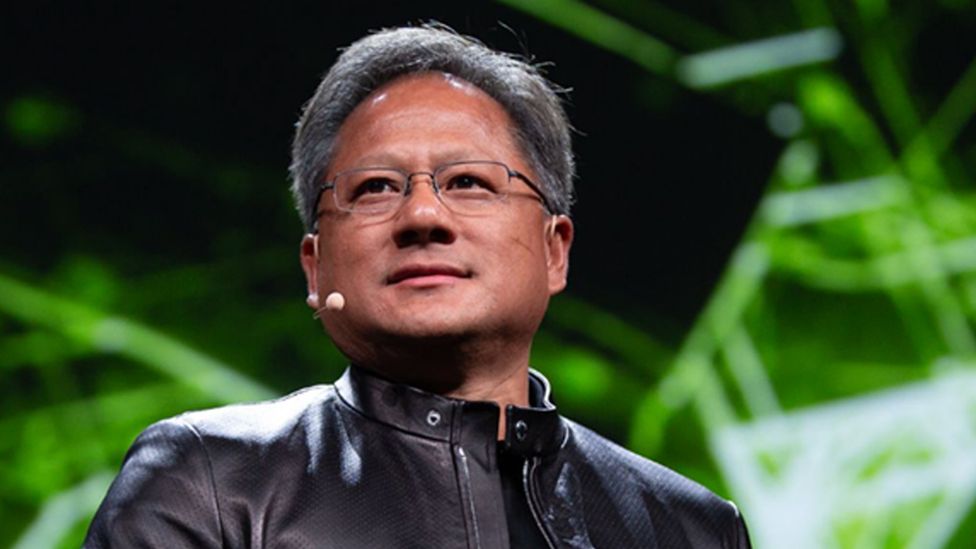
Jensen Huang, now the chief executive of Nvidia, was one of its founders back in 1993. Then, Nvidia was focused on making graphics better for gaming and other applications.
In 1999 it developed GPUs to enhance image display for computers.
GPUs excel at processing many small tasks simultaneously (for example handling millions of pixels on a screen) – a procedure known as parallel processing.
In 2006, researchers at Stanford University discovered GPUs had another use – they could accelerate maths operations, in a way that regular processing chips could not.
It was at that moment that Mr Huang took a decision crucial to the development of AI as we know it.
He invested Nvidia’s resources in creating a tool to make GPUs programmable, thereby opening up their parallel processing capabilities for uses beyond graphics.
That tool was added to Nvida’s computer chips. For computer games players it was a capability they didn’t need, and probably weren’t even aware of, but for researchers it was a new way of doing high performance computing on consumer hardware.
It was that capability that helped sparked early breakthroughs in modern AI.
In 2012 Alexnet was unveiled – an AI that could classify images. Alexnet was trained using just two of Nvidia’s programmable GPUs.
The training process took only a few days, rather than the months it could have taken on a much larger number of regular processing chips.
The discovery – that GPUs could massively accelerate neural network processing – began to spread among computer scientists, who started buying them to run this new type of workload.
“AI found us,” says Mr Buck.
Nvidia pressed its advantage by investing in developing new kinds of GPUs more suited to AI, as well as more software to make it easy to use the technology.
A decade, and billions of dollars later, ChatGPT emerged – an AI that can give eerily human responses to questions.
Image caption,In 2021 Metaphysic made headlines with its Tom Cruise deep fakes
AI start-up Metaphysic creates photorealistic videos of celebrities and others using AI techniques. Its Tom Cruise deep fakes created a stir in 2021.
To both train and then run its models it uses hundreds of Nvidia GPUs, some purchased from Nvidia and others accessed through a cloud computing service.
“There are no alternatives to Nvidia for doing what we do,” says Tom Graham, its co-founder and chief executive. “It is so far ahead of the curve.”
Yet while Nvidia’s dominance looks assured for now, the longer term is harder to predict. “Nvidia is the one with the target on its back that everybody is trying to take down,” notes Kevin Krewell, another industry analyst at TIRIAS Research.
Other big semiconductor companies provide some competition. AMD and Intel are both better known for making central processing units (CPUs), but they also make dedicated GPUs for AI applications (Intel only recently joined the fray).
Google has its tensor processing units (TPUs), used not only for search results but also for certain machine-learning tasks, while Amazon has a custom-built chip for training AI models.
In addition, for the first time in decades, there are also computer chip start-ups emerging, including Cerebras, SambaNova Systems and Habana (bought by Intel). They are intent on making better alternatives to GPUs for AI by starting from a clean slate.
UK-based Graphcore makes general purpose AI chips it calls intelligence processing units (IPUs), which it says have more computational power and are cheaper than GPUs.
Founded in 2016, Graphcore has received almost $700m (£560m) in funding.
Its customers include four US Department of Energy national labs and it has been pressing the UK government to use its chips in a new supercomputer project.
“[Graphcore] has built a processor to do AI as it exists today and as it will evolve over time,” says Nigel Toon, the company’s co-founder and chief executive.
He acknowledges going up against a giant like Nvidia is challenging. While Graphcore too has software to make its technology accessible, it is hard to orchestrate a switch when the world has built its AI products to run on Nvidia GPUs.
Mr Toon hopes that over time, as AI moves away from cutting-edge experimentation to commercial deployment, cost-efficient computation will start to become more important.
Back at Nvidia, Ian Buck is not overly concerned about the competition.
“Everyone has the need for AI now,” he says. “It is up to others to work out where they are going to make a contribution.”
Lawmakers in Connecticut have agreed to exonerate 12 persons who were convicted of witchcraft in colonial America more than 370 years ago.
Eleven of the 12 were hanged after trials that the state Senate now acknowledges were a “miscarriage of justice”.
It follows a long-running campaign by descendants to clear the names of those wrongfully accused of being witches.
Dozens were executed for witchcraft in the US in the 17th Century.
On Thursday, Connecticut’s Senate voted 33-1 to exonerate those convicted in trials that took place in the state in the mid-to-late 1600s.
The senator who voted against the move, Rob Sampson, said that he believed it was wrong to “dictate what was right or wrong about periods in the past that we have no knowledge of”.
“I don’t want to see bills that rightfully or wrongfully attempt to paint America as a bad place with a bad history,” he was quoted as saying by the Associated Press.
“I want us to focus on where we’re going, which is a brighter and better future.”
The resolution had already passed in Connecticut’s House of Representatives, with 121 votes in favour and 30 against.
The resolution follows nearly two decades of lobbying by the CT Witch Trial Exoneration Project, a group set up in 2005 by descendants of the accused.
The group said they are “ecstatic, pleased, and appreciative” especially as the decision comes on the eve of the 376th anniversary of the first witch-hanging in New England – that of Alice Young.
“We are grateful to descendants, advocates, historians, legislators of both parties and many others who made this official resolution possible.”
They added that they “will continue to advocate for historical education and memorialisation of the witch trial victims“.
Some members of the organisation discovered their family links using genealogy tests.
The family members and their supporters argue that the exonerations are an important step to learning from the mistakes of the past.
Saud Anwar, a state senator who took an interest after a constituent discovered their ancestor was a witch accuser, told the AP that witchcraft trials still take place around the world.
“It’s relevant, even to this time as well,” he said.
The Witch Trial Exoneration Project hopes that in addition to correcting past wrongs, that this will bring awareness to “deadly witch hunts still happening in many parts of the world due to fear, misogyny and superstition”.
At least 45 people were accused of witchcraft in colonial Connecticut, although the Witch Trial Exoneration Project believes the record is likely incomplete.
In the more widely-known Salem Witch Trials in nearby Massachusetts, about 200 people were accused, leading to the deaths of 25 people.
Last August, Massachusetts formally exonerated Elizabeth Johnson, the last person to be convicted during the Salem Witch Trials.
While initially sentenced to death, she was granted a reprieve and lived to be 77. Historians now believe she suffered from a mental disability.
Other countries have also sought to recognise people that were unfairly persecuted for witchcraft in the past.
Last year, then-First Minister of Scotland Nicola Sturgeon offered a formal apology to 4,000 Scots, mostly women, who were accused of witchcraft between 1563 and 1736.
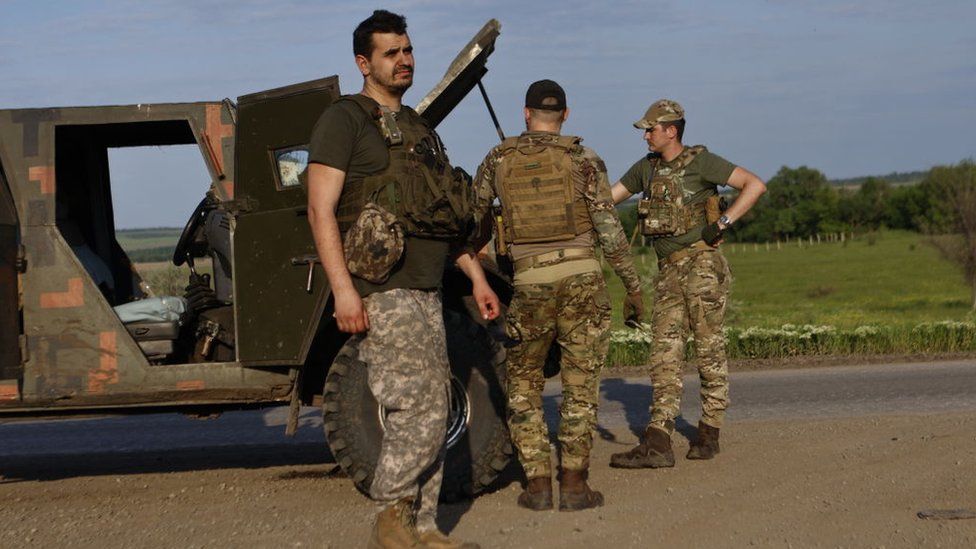
Ukraine is preparing to begin a long-anticipated counter-offensive against Russian forces, according to one of the country’s top security leaders.
Oleksiy Danilov would not name a date but said an assault to retake territory from President Vladimir Putin’s occupying forces could begin “tomorrow, the day after tomorrow or in a week”.
He warned that Ukraine’s government had “no right to make a mistake” on the decision because this was an “historic opportunity” that “we cannot lose”.
As secretary of the National Security and Defence Council of Ukraine, Mr Danilov is at the heart of President Volodymyr Zelensky’s de facto war cabinet.
His rare interview with the BBC was interrupted by a phone message from President Zelensky summoning him to a meeting to discuss the counter-offensive.
During the interview, he also confirmed that some Wagner mercenary forces were withdrawing from the city of Bakhmut, the site of the bloodiest battle of the war so far – but he added they were “regrouping to another three locations” and “it doesn’t mean that they will stop fighting with us”.
Mr Danilov also said he was “absolutely calm” about Russia beginning to deploy nuclear weapons to Belarus, saying: “To us, it’s not some kind of news.”
Ukraine has been planning a counter-offensive for months. But it has wanted as much time as possible to train troops and to receive military equipment from Western allies.
In the meantime, Russian forces have been preparing their defences.
Much is at stake because the government in Kyiv needs to show the people of Ukraine – and Western allies – that it can break through Russian lines, end the effective military deadlock and recapture some of its sovereign territory.
UK sending long-range missiles to Ukraine
Mr Danilov said the armed forces would begin the assault when commanders calculated “we can have the best result at that point of the war”.
Asked if Ukrainian armed forces were ready for the offensive, he replied: “We are always ready. The same as we were ready to defend our country at any time. And it is not a question of time.
“We have to understand that that historic opportunity that is given to us – by God – to our country we cannot lose, so we can truly become an independent, big European country.”
He added: “It could happen tomorrow, the day after tomorrow or in a week.
“It would be weird if I were to name dates of the start of that or those events. That cannot be done…. We have a very responsible task before our country. And we understand that we have no right to make a mistake.”
Image caption,Ukrainian troops have spent months training on Western equipment ahead of the expected attack
Mr Danilov dismissed suggestions the counter-offensive had already begun, saying that “demolishing Russian control centres and Russian military equipment” had been the task of Ukrainian armed forces since 24 February last year – the date Russia launched the invasion.
“We have no days off during this war,” he said.
He defended the decision by Ukraine’s army to fight in Bakhmut for so many months, a battle that has cost the lives of many of its soldiers.
Bakhmut not occupied by Russia, says defiant Zelensky
“Bakhmut is our land, our territory, and we must defend it,” he said. “If we start leaving every settlement, that could get us to our western border as Putin wanted from the first days of the war.”
He said that “we control only a small part of the city, and we admit to that. But you have to keep in mind that Bakhmut has played a big role in this war.”
Asked if Wagner mercenaries were leaving, he replied: “Yes, that is happening. But it doesn’t mean that they will stop fighting with us. They are going to concentrate more on other fronts… they are regrouping to other three locations.”
The US Treasury Secretary has stated that if lawmakers do not extend the debt ceiling by June 5, the US will run out of money to pay its debts.
The new deadline allows Republicans and the White House a little more time even as President Joe Biden expressed hope for reaching a deal quickly.
An emerging agreement would limit most spending for two years, exempting military and veterans programmes.
Issues such as tougher eligibility for government aid are a sticking point.
Mr Biden told reporters on Friday: “I’m hopeful we’ll know by tonight whether we are going to be able to have a deal.” Midnight passed without any word of an agreement.
US Treasury Secretary Janet Yellen said without a deal the projected resources of the US would be inadequate to meet the country’s spending commitments during the week of 5 June, 10 days away.
Such a default would upend the economy and have global impact.
Republicans have been seeking spending cuts in exchange for raising the $31.4tn (£25tn) debt limit, a law which caps how much debt the US government can accrue.
The US Treasury had previously warned the US could run out of money to pay all of its bills as soon as 1 June, unless Congress lifted the limit to allow the government to borrow more.
‘Crunch time’
Kevin McCarthy, who leads Republicans in the House as Speaker, said on Friday that he thought the two sides had “made progress” after working into the night on Thursday.
“We know it’s crunch time,” he said. “I thought we made progress yesterday. I want to make progress again today and I want to be able to solve this problem.”
A day earlier, President Joe Biden also said the negotiations were moving forward, though the White House on Friday afternoon said talks could spill into the weekend.
US media have reported that the emerging deal would raise the debt limit for two years – removing it as a political issue until after the 2024 presidential election.
It could also strip $10bn from the Internal Revenue Service, scaling back the $80bn boost approved last year – despite Republican objections – for the tax collection agency to hire more auditors.
Republican efforts to impose tougher work requirements for recipients of certain government benefits remained a sticking point, however.
Congressional lawmakers have largely returned to their constituencies ahead of the Memorial Day weekend in the US – but have been told to be ready to return in the event of a deal.
The brinksmanship has rattled many observers, who say it erodes confidence in US governance and injects uncertainty into the global financial system.
Earlier this week one of the big credit ratings firms, Fitch Ratings, warned it was considering stripping the US of its top-notch rating, pointing to the fight – a version of which has recurred numerous times over the last decade.
In an assessment of the US economy on Friday, the International Monetary Fund said the US needed to do more to reduce its public debt load, which has increased rapidly in recent decades.
But it urged the country to change its laws to avoid debt-ceiling stand-offs, which it said create an “entirely avoidable systemic risk to both the US and the global economy”.
It said the debt cap should be automatically increased when Congress approves spending.
“To avoid exacerbating downside risks, the debt ceiling should be immediately raised or suspended by Congress, allowing negotiations over the FY2024 budget to begin in earnest,” it added.
The US must borrow money to fund the government because it spends more than it raises in taxes.
Republicans have said they will not raise the debt ceiling unless the government reduces its spending in the years ahead. They are seeking cuts in areas such as education and other social programmes.
Democrats have countered with proposals to raise certain taxes.
The three major US stock indexes jumped on Friday on hopes a deal would be presented soon.
But worries about the impact of a possible default helped drive up US mortgage rates this week and investors are also demanding higher payments in return for some kinds of government bonds.
Any agreement formed between the two sides will need to be turned into a legislative text to be approved by Congress.
Mr McCarthy has promised to give lawmakers 72 hours to review the bill, and at least 24 hours’ notice if they have to return to Washington early. If a deal is reached, a vote could happen early next week.
Some Republicans have already said the potential spending limits appear too modest, while some Democrats have raised opposing concerns.
With Congress already broken up for Memorial Day, there is little wiggle room for objections.
The Senate would also have to vote on the bill, which would then go to the White House for signing.
Lawmakers could also temporarily lift the debt cap to give the talks more time.
Nigeria is often referred to as the “giant of Africa”, given its huge population and economic potential, but it has some gigantic problems too – and these will confront Bola Tinubu as he takes over as president on Monday.
The 71-year-old is unlikely to be fazed by the challenges. As a two-time governor of Lagos, he revitalised Nigeria’s commercial hub – no easy task – and is well aware of the issues.
But Nigerians, even those who did not vote for him, will want to see early results from Mr Tinubu. Here are some of the major hurdles he faces and how he may tackle them.
Ending the fuel subsidy
This challenge has been kicked down the road by successive governments since its introduction in the 1970s.
Despite its oil riches, Nigeria is unable to refine enough crude to meet local demands so it imports petroleum products, which are then sold at a government-set price. As this is usually lower than the import price, the government pays the difference.
Image caption,Cheap fuel is seen by many Nigerians as their right given the country’s oil wealth
But this subsidy is taking a huge toll on dwindling public finances. Last year it guzzled 4.3trn naira ($9.3bn; £7.5bn) and for the first half of this year, 3.36trn naira was budgeted.
These payments come at the expense of development goals such as building schools or hospitals, but removing the subsidy will not be easy as it will lead to an increase in prices.
The last attempt to do so in 2012 ended in widespread protests.
Many struggling Nigerians, used to seeing politicians mismanaging the country’s oil wealth, believe cheap petrol is their share of what has been described as the “national cake”.
But Mr Tinubu has firmly repeated that the subsidy has to go, and his associates insist he has the political will to do it.
“He has a capacity to listen and to consult widely before making tough decisions,” Housing Minister Babatunde Fashola, a close colleague who succeeded Mr Tinubu as Lagos governor in 2007, told the BBC.
One area he may explore to lessen the impact is to subsidise and improve public transport – something he has experience in after implementing a massive public transport scheme in Lagos that put in place fast bus links.
The outgoing government has also managed to secure an $800m World Bank loan, intended to beef up its welfare scheme for vulnerable Nigerians who will be most affected by the loss of the subsidy. However, lawmakers still have to approve the package – so it is not a done deal.
Lack of popular support
Only 37% of voters backed Mr Tinubu, making him the Nigerian president elected with the least vote-share since 1999.
He won a tightly contested election that was not only rancorous, but exposed ethnic and religious divisions that have lingered even in Nigeria’s most cosmopolitan cities.
He will have to perform a balancing act when it comes to choosing his government to build bridges across these divides.
There are signs he is already doing so, reportedly meeting two opposition politicians since winning February’s vote:
Musa Kwankwaso, a powerful rival from the north, who was third runner-up
Nyesom Wike, the influential and outgoing governor of Rivers state.
As governor of Lagos, Mr Tinubu probably had the most ethnically diverse cabinet in Nigeria, appointing non-Lagosians into key positions, which is still a rarity.
“He is more interested in technocrats who are thinkers and researchers,” his friend Seye Oyetade told the BBC.
But politicians, often with common interests, may be easier to placate than the millions of young Nigerians who did not vote for him – especially those who supported Peter Obi of the Labour Party.
Many of them consider the vote flawed, though the electoral commission denies this – and an election challenge is still pending in court.
Close allies say by making jobs available and getting young people involved in governance, Mr Tinubu may win over some of them.
“You will see a government that will embrace new ideas and technology and by extension, you will see a lot of young people around him,” Mr Fashola explained.
Fixing the economy
Most agree that as a trained accountant, this is Mr Tinubu’s area of expertise – but things have never looked worse for Nigeria:
One in three are unemployed
Inflation is at a record 22%
96 million live below the poverty line of $1.90 per day
GDP per head (the economic output produced in a year by the average person) was $2,065 for 2021 (compared to $70,248 for the US and $46,510 for the UK)
Low revenues from declining oil sales.
Mr Oyetade bats away such statistics: “These are not too dissimilar to what he met in Lagos in 1999.”
This may be hyperbole, but Mr Tinubu’s use of technology to improve tax collection in Lagos was remarkable, increasing revenue by more than 400% in eight years.
Image caption,It can be hard to get hold of foreign currency, which has led to a widening gap between the official and black market rates
He has spoken several times of his ambition to widen the tax net, but this might be harder to replicate at a national level given high inflation, rising poverty and widespread insecurity that often stops people from working.
Mr Tinubu also favours a more private-sector led approach, in contrast to his predecessor, Muhammadu Buhari, who aimed to bolster national welfare safety nets.
But it his relationship with Godwin Emefiele, the central bank governor, that will be key.
The incoming president has criticised the bank’s policy of using multiple exchange rates.
This keeps the naira artificially high – the official exchange rate is 460 naira: $1, available to different categories of people who have to apply and wait till it is available.
Everyone else who wants forex must use the parallel rate – currently 760 naira: $1, meaning there is a widening gap between the official and black market.
For any review to happen, Mr Tinubu will need to work with Mr Emefiele, who has another year left to serve as governor.
The two have a fractious relationship following the central bank’s move to redesign the local currency – leading to huge cash shortages – just before the election. This was seen by some as a ploy to scupper the ruling party’s chances of winning the vote – allegations Mr Emefiele denies.
Kidnapping and insecurity
Mr Tinubu will want to get a grip on this quickly, given the scale of problem. His administration will be confronting armed criminals on motorcycles in the north-west, countrywide kidnapping and a violent secessionist group in the south-east. Deadly clashes between farmers and herders also continue in the central states.
During the election campaign, Mr Tinubu’s deputy, incoming Vice-President Kashim Shettima, said this would be his remit – touting his experience as governor of north-eastern Borno state, home to many Islamist militant groups and the Boko Haram insurgency.
Image caption,Relatives of those kidnapped have been left distraught and desperate to raise money for ransoms
But Nigeria’s security challenges have evolved since he left office in 2019 and President Buhari, a former army general, failed dismally to find an answer during his eight years in power – instead insecurity has escalated nationwide.
The Tinubu-Shettima plan includes using anti-terrorist battalions with special forces to go after the kidnappers and extremist groups.
More importantly, they have proposed freeing police personnel from VIP security and guard duties, which could see more officers on the streets fighting crime.
Staying fit – and other distractions
Opponents of the incoming president say he has lost the vitality he used to forcefully modernise Lagos.
Since the election, he has travelled abroad twice, raising questions about his health. In 2021 he spent months in London being treated for an undisclosed illness.
He has brushed off the criticism, saying the job does not require the fitness of an Olympic athlete and his associates are quick to remind everyone that US President Joe Biden is older, at 80.
But Nigerians are weary of seeing presidents spend considerable time in hospitals abroad, leading to government in-fighting for control. This happened under both Mr Buhari and Umaru Yar’Adua, who died in office in 2010.
They are also worried about potential controversies. Before the vote Mr Tinubu denied various allegations of links to narcotics and corruption.
Since his victory, it has been revealed that he was once issued with a Guinean diplomatic passport – which is not illegal but was not previously disclosed. While a Bloomberg investigation said his son owns an £11m mansion in London. Neither Mr Tinubu, his son, nor his allies have commented on the report, and it has not been confirmed that Mr Tinubu was involved in the purchase.
Allies of Mr Tinubu will be concerned that any further allegations could distract him from the massive job he is about to undertake.
Lazarus Shiimi, also known as Gazza, is one of Namibia’s most successful performers.
He is also one of the driving forces behind the development of Namibia’s music industry.
His sound is influenced by kwaito, dancehall, hip-hop, reggae and Afrobeats.
He’s won over 30 music awards and has 13 albums under his belt.
But he’s preparing to get out of his comfort zone with his next big project.
He is about to perform his music with over 100 others on stage with a symphony orchestra, a 40-strong choir and around 60 musicians from the Alabama School of Fine Arts who are flying in to Windhoek especially.
And yet he told me he still suffers from shyness.
“I don’t think that will ever go away. When I’m alone I still have to record myself in the dark because I’m still not comfortable until I hear what I’ve recorded and if it sounds good, that’s when I switch on the lights.”
He is doing the concert in order to appeal to the government and businesses to put more infrastructure in place for the creative industries.
“The unemployment rate is so high, the youth are trying to do a few things with their talents, but there are no proper platforms and sometimes they become frustrated and resort to criminal activities and stuff like that.
“I’m just saying to the government and private sector: ‘Can we please try and see what we can do for the youth in Namibia to thrive?’
“I want to be able to deliver something that’s going to be remembered for a long time and something that’s going to bring about change,” he said.
The concerts of hope take place on 2 and 3 June at the National Theatre of Namibia.
Washington made known a series of economic restrictions on Thursday against Ivan Maslov, the head of the Russian paramilitary group Wagner in Mali, accusing him of attempting to collect military supplies for use in the Ukrainian conflict.
These sanctions “against the most important person in charge of the Wagner group in Mali aim to put an end to essential operations of support for the world activity of the group”, justified the under-secretary of the Treasury in charge of terrorism and financial intelligence, Brian Nelson, quoted in the release.
These sanctions involve the seizure of all of Ivan Maslov’s assets in the United States, financial and real estate, as well as companies having a direct capital link with Mr. Maslov, and prohibit American companies or companies present on American territory from carry out the slightest transaction with Mr. Maslov or companies that he controls.
“The presence of the Wagner group on the African continent is a destabilizing force for any country that allows its deployment on its territory,” Nelson added.
This is not the first time that sanctions have targeted the Wagner group or some of its members for its actions in Mali. The European Union had thus announced at the end of February a series of sanctions targeting a dozen people, including Mr. Maslov, because of the “violations of human rights” attributed to the paramilitary company on the spot.
Wagner, a paramilitary group founded in 2014, is considered by the United States to be an international terrorist organization. The United States, which has been trying for several years to thwart Russian influence in Africa, accuses the Wagner group of “committing human rights violations and extorting natural resources in Africa”.
The group has established itself as a major player in the conflict in Ukraine, particularly in the battle around the city of Bakhmout, and its mercenaries have also been seen in Syria or Libya and more recently in the Central African Republic and, therefore, in Mali.
In Kinshasa, police deployed tear gas to block opposition leaders and supporters from entering the electoral commission’s offices in a demonstration against what they call the Democratic Republic of Congo’s impending electoral disaster.
The opposition further lamented on the action taken by the police to deny them their democratic right to protest as they call for fair elections in the forthcoming polls.
“The police are being used by the power (authorities) to curb our freedoms and we don’t accept that. The police are not our interlocutor, our interlocutor, our interlocutors are the public authorities, it is the CENI that must organise free, democratic and transparent elections, and not the rest,” said Delly Sesanga, an opposition leader.
Elections in DRC have never been a smooth process as they are smeared with violent protests especially from the opposition and religious group calling for transparency in the process.
Martin Fayulu who is the main opposition also echoed the same sentiments by calling for a fair and transparent election.
“We are within our rights. We cannot, under any circumstances, surrender ourselves like beasts of burden, be taken to rigged elections and then afterwards the Westerners, everyone will say “we have taken note”, no. We are demanding our rights, the rights of the Congolese, the rights of Congolese who have not yet been born,” said Martin Fayulu.
Current president, Felix Tshisekedi, who succeeded Joseph Kabila in January 2019 in a controversial election, has already expressed his intention to run again.
Tshisekedi may be running against Martin Fayulu, who continues to claim that he won the 2018 election and was denied victory.
Former Prime Minister Augustin Matata Ponyo (2012-2016) has also announced his intention to run.
According to the electoral authorities, insecurity remains the main challenge.
The Ugandan parliament has approved legislation to increase paternity leave from four to seven days. This adjustment intends to provide male employees more time to support their spouses through difficult times.
According to BBC.com, Flavia Kabahenda, the chairperson of the parliament’s gender committee, emphasized the importance of granting male employees more time to assist their spouses.
She stated, “It is important that more time be accorded to male employees to help their spouses if we wish to have a society where men play an increased supportive role.”
The bill, sponsored by the government, took inspiration from neighbouring Kenya, where male working employees are granted a two-week paternity leave, according to reports from state-owned New Vision.
However, the parliament rejected a proposal to extend the leave period from 60 to 90 days for female employees who give birth to multiple children simultaneously. Attorney General Kiryowa Kiwanuka argued that the proposal was too extreme for employers to implement.
The bill now awaits the approval of President Yoweri Museveni, who local media suggests is likely to sign it into law.
The passing of this bill reflects Uganda’s commitment to fostering gender equality and encouraging the active participation of men in supporting their families during significant life events.
A former presidential contender in the 2019 election, A Nigerian court fined Ambrose Owuru, for launching a complaint to prevent President-elect Bola Tinubu’s inauguration on May 29.
The court has ordered Mr. Owuru, who is also a lawyer, to pay a sum of $87,000 (£80,000) for pursuing what was deemed a “strange” and “frivolous” lawsuit.
In his suit, Mr. Owuru, who contested but lost in the 2019 presidential election, had urged the court to declare him as the rightful president instead of Mr. Tinubu.
Despite not participating in the 2023 presidential election, the lawyer claimed that he had won the 2019 presidential poll but was unfairly denied his victory.
In October 2019, the Supreme Court dismissed the suit, describing it as an abuse of the court process.
Following the announcement of Mr. Tinubu as the winner of the 2023 presidential election, Mr. Owuru filed another suit based on the facts of his previous case.
On Thursday, a three-member panel of the Court of Appeal in Abuja unanimously dismissed the suit.
The fine imposed on Mr. Owuru serves as a deterrent against filing frivolous lawsuits and abusing the judicial system.
This development showcases the Nigerian judiciary’s commitment to upholding the integrity of legal proceedings and ensuring that legitimate cases are given due attention.
Conakry resident Mariame Diallo pointed to blood splatters on a wall where she said her adolescent brother was shot at close range during a rally against Guinea’s military administration on May 11.
“I will never forgive those who killed him,” she said between bouts of quiet crying.
Clutching a bag of blood-soaked clothes that she hopes will be used for a police investigation that has yet to begin, she recalled how her apprentice brother, Boubacar, fearing the anti-government demonstrations, stayed at home, only to be shot dead by police in front of the family house.
A spokesman for the Guinean government did not respond to Al Jazeera’s request for comments on Thursday.
Boubacar was one of the seven people killed that day in the West African nation as anti-government protests and violent clashes with security forces gain momentum over frustrations with military leaders overseeing a promised return to democratic rule.
Smoke billowing from burning tyres and other debris has become a common sight in Conakry since fuel price hikes triggered the first major protest against the military government last June.
Many more protests have followed. At least 32 were injured in unrest this month, and the army was deployed to quell planned demonstrations in the capital last week.
It was the latest clampdown as anger mounts against military governments that seized power in a series of coups in the West and Central Africa region since 2020, with frustrations growing over the slow pace of a planned return to constitutional rule.
Transitional authorities in Burkina Faso and Mali have also grown increasingly hostile towards critics who have highlighted their failures to protect citizens from armed groups – a factor that helped spur the military takeovers.
In Guinea, opposition political parties had at first cautiously welcomed the September 2021 coup that removed long-serving President Alpha Conde, who sparked anger for changing the constitution to allow him to run for a third term.
But relations with interim government leader Colonel Mamady Doumbouya soured after main opposition parties rejected a 36-month transition to elections approved by the interim parliament last May.
Doumbouya’s government banned all public demonstrations in response and has since cracked down on the string of street protests that followed, drawing rebuke from rights groups and the United Nations.
At least 24 people have been killed since June and dozens arrested, including high-profile activists, opposition parties and civil society groups say.
Authorities have acknowledged “victims” but not given a figure.
“The military junta can’t give us hope and then act even worse than the regime it replaced,” said Conakry resident Souleymane Bah, 34, adding that people wanted the military to organise elections.
Last October, the government cut its transition timeline to two years after the Economic Commission for West African States (ECOWAS) rejected its three-year transitional plan and imposed sanctions.
“We plan to respect all the deadlines,” said Guinea spokesman Ousmane Gaoual Diallo.
This has failed to appease opposition parties.
“Three feelings dominate Guineans: weariness, disappointment and disgust at the perjury of Mamadi Doumbouya,” Nadia Nahman, spokesperson to Cellou Diallo, leader of the main opposition party, UFDG, told Al Jazeera.
“[Doumbouya] was sworn in as president of the transition and pledged to “consolidate democratic gains” while committing Guinea to its “national and international commitments” but he has betrayed all of his commitments with the bloody repression of peaceful demonstrations,” she added.
Diallo fled the country to Senegal last year after Guinean authorities accused him of corruption.
Last week, angry crowds gathered around the grieving relatives and friends of people killed in the latest unrest. Many were crying and holding up pictures of their loved ones on their phones.
Kenya has denied reports that it was hacked by the Chinese after a Reuters report said that the attacks targeted Kenyan government departments for three years.
In a statement released on Thursday evening by Interior Principle Secretary Raymond Omollo, the government said the allegations presented in the article were not subjected to authoritative proof of existence by the relevant persons from both the Kenyan and the Chinese governments.
“In the absence of the above, the alleged motive behind the said attacks cannot be subsequently established beyond doubt,” said Omollo.
The report claimed that the hacks went on for three years targeting eight of Kenya’s ministries and government departments including the office of the president and the National Intelligence Service (NIS).
It then linked the attacks to Kenya’s debts with China claiming that they sought to gain information on debt owed to Beijing as a strategic link in the Belt and Road Initiative – President Xi Jinping’s plan for a global infrastructure network.
The report further claimed that further compromises may occur as the requirement for understanding upcoming repayment strategies becomes needed citing a July 2021 research report written by a defence contractor.
However, Omollo termed the report as a deliberate attempt at stoking panic and mistrust.
“The article should be viewed as sponsored propaganda. The wide circulation and the alacrity for its attribution by other foreign media with well-known inclinations further hint at a choreographed and concerted attack against Kenya’s sovereignty,” added Omollo.
Yesterday, the Chinese Embassy in Nairobi also disproved the claims made by the report terming them an attempt to sow discord between Nairobi and Beijing.
“The said false report is groundless, far-fetched and sheer nonsense. Hacking is a common threat to all countries and China is also a victim of cyber-attack. China consistently and firmly opposes and combats cyber-attacks and cyber theft in all forms. Tracing the source of cyber-attacks is a complex technical issue,” the statement from the embassy read in part.
Omollo further questioned why China would opt to hack systems that it installed for the government.
“The bulk of the critical networking infrastructure deployed by the government of Kenya is sourced from the People’s Republic of China. It is reasonable, therefore, to contemplate that if the country of origin desired to infiltrate the same systems it has helped install, it would unlikely engage third-party hackers,” he added.
He also said that just like in many other countries across the globe, Kenya’s cybersecurity infrastructure is formative, and this portends inherent high-risk exposure to cyber threats noting that the government will continuously strengthen the security and resilience of all its Critical Information Infrastructure Systems (CIIS) through requisite laws and regulations and investments in stronger cyber security systems.
Explosions occur as Ugandan forces combat militas.On Friday morning, the extremist al-Shabab organization launched an attack on a Ugandan soldier post of the African Union Transition Mission (ATMIS) in Bulla Mareer district, Lower Shabelle region, Somalia.The attack began immediately after morning prayers.
It started with a large explosion, believed to be an explosives-laden vehicle.Buulo Mareer is about 110km (68 miles) from the capital, Mogadishu.
Residents reported that after the big explosion, two more explosions occurred in the camp, before a fight started between the Ugandan troops and the attackers.Al-Shabab said they captured the camp and killed dozens of ATMIS soldiers, but there has been no independent confirmation of the group’s claim.
ATMIS says its forces are currently assessing the security situation in the area but no word yet from the Somali government regarding the attack.Ugandan army spokesperson Felix Kulayigye told Kenya’s Daily Nation that the military was probing the attack. He blamed “foreign insurgents” for the raid without giving further details.
The actual damage caused by the attack is not yet known. Civilians have remained inside their houses and though some of the bullets being fired hit their houses, no damage has been reported.
Some residents in Bulo Mareer told the BBC that they could hear the sound of helicopters hovering over.
Thousands of passengers were stranded at London Heathrow for a second day after British Airways (BA) cancelled at least 42 more flights due to an IT breakdown.
BA said cancellations are still happening due to the “knock-on effect of a technical issue” resulting in staff being in the wrong location.
Around 16,000 passengers have been affected by the cancellations.
It comes on the busiest day for UK air travel since 2019.
Most of the affected flights are departing from or arriving at Heathrow.
But there have also been delays to other flights, while some passengers have been unable to check in online.
On Thursday, BA apologised for cancelling dozens of flights at Heathrow. The airline said it was related to “technical problems” causing difficulties with online check-in, delaying flights.
“While the vast majority of our flights continue to operate today, we have cancelled some of our short-haul flights from Heathrow due to the knock-on effect of a technical issue that we experienced yesterday,” BA said in a statement on Friday.
Those affected have been offered the option to rebook an alternative flight or request a refund, BA added.
The Independent’s travel correspondent Simon Calder calculated that at least 156 flights, mainly domestic and European, have been cancelled.
Aviation analytics company Cirium said Friday was expected to see the most departures from UK airports since before the Covid pandemic, with more than 3,000 flights planned.
This is partly down to families heading on holiday for the half-term break.
The issues started as security guards at Heathrow Airport belonging to the Unite union began a three-day strike over pay. The airport has said operations will not be affected.
BA has been hit by other IT problems in recent years including a major breakdown in 2017 that stranded 75,000 passengers over a holiday weekend.
The incident sparked a customer backlash with pledges from the carrier that it would do better in future.
Passengers also faced delays due to an IT issue in February, days after flights had been cancelled due to Storm Eunice.
Image caption,Dover has been dogged by long tailbacks of vehicles during busy holiday periods
Meanwhile traffic has started building up at Dover as people embark on cross-Channel ferry trips.
Ferry operator DFDS said shortly before 08:30 BST that there was a wait of around an hour at border control for travellers in cars, while coach traffic was “free-flowing”.
The Port of Dover tweeted that traffic is “currently processing well with no wait time for coaches, less than an hour wait for cars”.
Dover has been dogged by long tailbacks of vehicles during busy holiday periods. In the lead up to Easter some coach passengers faced 15-hour delays to board ferries to France from the Kent port.
Dover’s boss said this week it has done “everything we can” to prevent travel delays over the upcoming bank holiday and school half-term break.
Elsewhere, Eurotunnel reported its cross-Channel vehicle services were busy, but trains were departing on time.
On the railway, a fault with the signalling system between East Croydon and Gatwick Airport is expected to cause disruption until around 15:00.
Experts have cautioned that despite a price decrease in July, energy bills are likely to remain high.
A typical household will pay £2,074 a year for gas and electricity from July, £426 a year less than currently, after the regulator cut the energy price cap for England, Scotland and Wales.
Government help in recent months has limited bills to £2,500.
However, prices are not expected to fall much further over the rest of the year, and could edge up in winter.
MoneySavingExpert’s Martin Lewis said that later on in 2023 bills would be similar to last winter because, although prices are cheaper, households will not get the same £400 discount from the government they previously received.
“People will still be paying double what they used to pay before the energy crisis hit,” he added.
Kate Mulvany, from energy analysis firm Cornwall Insight, also said further substantial falls in bills would be unlikely particularly if there was a cold winter across Europe with the UK competing to buy energy with other countries.
“Our forecasts suggest until the end of this decade, higher and more volatile prices are going to be seen, and that includes the impact they’re going to have on domestic bills unfortunately,” she told the BBC’s Today programme.
Earlier this week, Qatar’s energy minister warned the “worst is yet to come” for gas shortages in Europe, suggesting prices could rise again.
In an interview with Sky News, Chancellor Jeremy Hunt was asked if he would take action to support households if energy bills started to rise again.
He said the government’s actions over the past few months demonstrated that it was “willing to do what it takes”.
“We are very aware of the pressures that families are facing, and we want to do what we can to support them”, he said.
There are hopes that the fall of the price cap below the government’s guaranteed level could lead to the return of competition in the market, with people able to shop around for the best deal.
But Mr Lewis said that he did not expect to see firms publicising new offers immediately, with energy firms instead offering existing customers bespoke offers, with no new deals across the market.
The boss of energy regulator Ofgem Jonathan Brearley urged people to contact their supplier if they were struggling to pay their bill.
“In the medium term, we’re unlikely to see prices return to the levels we saw before the energy crisis,” he added.
Image caption,Michael Houghton is worried he will struggle again with bills this winter
Michael Houghton says the Emmaus charity in Ipswich helped him apply for grants to pay his soaring energy bill last winter.
He says his gas bill rose to almost £30 per week, forcing him to cut down on food shopping and entertainment.
But Mr Houghton says that prices remaining high is a concern in the long term. Without more support he worries he will not be able to afford to pay his energy bills if they remain at a similar price this coming winter.
Labour unions across the African continent have expressed disappointment over the lack of their participation in the Africa African Continental Free Trade Area (AfCFTA) agreement.
According to the unions, it more concerning that the agreement as of yet does not include labour provisions.
“It is a question of not being involved at all, the question of not being so much doesn’t even arise. So we were not involved. But we thought that trade is an important component of our daily lives, it also affects employment. It has impact on our members across all sectors of our economy; textiles, poultry production, farmers and others.
So far as the policy stance of government or specific lay the African Continental Free Trade has impact on our members, we thought that it was only a matter of necessity that the unions should have been involved, the unions should have been asked to share their perspectives. It is not simply stopping the process, it is actually sharing our perspectives and ensuring that the process is fair, it is inclusive and eventually inures to the benefit of the country including its workers.
“So we are extremely disappointed that such a mammoth, very monumental initiative could go on across the continent without the involvement of unions,” the Director of Labour Research and Policy at the Trade Union Congress TUC, Dr. Kwabena Nyarko Otoo remarked to the media at a Consultative Dialogue on AfCFTA held in Accra on Thursday, May 25, 2023.
The Social Partners Consultative Dialouge on the African Continental Free Trad Area (AfCFTA) was hosted by the Ghana Trades Unions Congress in collaboration with the International Labour Organisation (ILO) to deliberate on labour issues on relative to the free trade agreement.
Senior Technical Specialist at International Labour Organisation (ILO), Bureau for Worker Activities – Abuja, Madam Inviolata Chinyangarara, said the aim of the workshop to was to bring labour unions to the table for discussions on the implementation of the AfCFTA agreement.
“This very discussion is coming at the right time and we have the right people at the table. The address by a representative from the secretariat has been very insightful to reinforce our strategies going forward.
She added that going forward, the ILO would like to see provisions being made in the AfCFTA agreement to ensure decent work and conditions that respects the rights of workers in a fair manner.
The meeting received addresses from the ministry of employment and labour relations as well as various labour unions in the country.
A senior advisor to the Secretary-General of AfCFTA, Peter Joy Sewornoo made a presentation in which he shared the progresses made in the implementation of the AfCFTA agreement.
Among other things, he noted that 54 out of the 55 African Countries have signed the AfCFTA agreement while 47 out of the number have since gone ahead to ratify the agreement.
Congress recesses for the holiday weekend while US President Joe Biden claims progress has been made in negotiations with leading Republican Kevin McCarthy over the US debt ceiling.
The pair aim to reach a deal on raising the government borrowing limit for two years so it can keep paying its bills.
Investors’ fears of the US defaulting on its debts have grown – despite assurances that talks are progressing.
Mr Biden spoke of “several productive conversations” with Mr McCarthy.
During a White House event on Thursday, the president said his staff remained in conversation with the team of Mr McCarthy, the House speaker – and that the two sides were “making progress”.
He added: “I made clear time and again defaulting on our nation debt is not an option.” He said Americans deserved certainty over issues such as social security payments.
The debt ceiling is a spending limit set by Congress which determines how much money the government can borrow – an issue on which Democrats and Republicans disagree.
With no deal yet struck, the Treasury has warned that the US will not have enough money to pay all of its bills as soon as 1 June.
Analysts say there could be severe economic consequences if the US fails to honour its obligations.
‘Two-year deal’ Details of a potential pact – outlined by Reuters and the New York Times – could allow Republicans to say they cut spending, while Democrats could say they defended domestic programmes.
A US official told Reuters that the White House was considering scaling back an increase of the Internal Revenue Service to hire more auditors, which was intended to target wealthy Americans.
The Times reported negotiators were closing in on a deal that would raise the debt limit for two years while imposing strict caps on spending besides military or veterans for the same period.
Republicans are seeking spending cuts to government programmes, in exchange for raising the $31.4tn (£25tn) cap on government borrowing.
Is there enough time for a US debt ceiling deal? Could a US debt default unleash global chaos? The 14th amendment explained Mr Biden said the two sides had different visions for how to get America’s “fiscal house in order”, but added that all leaders involved agreed that default was not an option.
Mr McCarthy – who leads Republicans in the House and has been the most high-profile public face of the talks for his party – earlier said Democrats and Republicans had worked past midnight on Wednesday and would continue to negotiate.
“There’s a couple of issues still hanging out there that we’ve got to get done,” he said. “We’re gonna work 24/7 to try to make that happen.”
Another key Republican said he believed a deal to raise the nation’s debt-ceiling deal was “likely” by Friday afternoon.
“We are inching closer to a deal. I think it’s some of the finer points they are working on right now,” Rep Kevin Hern told Reuters news agency. “You are likely to see a deal by tomorrow afternoon.”
“Neither side is going to get exactly what they want,” White House press secretary Karine Jean-Pierre said.
A very simple guide to the debt ceiling? Four sticking points holding up debt ceiling deal Could a US debt default unleash global chaos? The S&P 500 and the Nasdaq were trading higher at midday on Thursday, lifted by positive updates on earnings from some companies, while the Dow Jones Industrial Average was down about 0.6%.
That followed several days of declines.
Fitch Ratings, one of the big three credit ratings agencies, on Wednesday said it had put the US on “negative watch” – the first step toward lowering the country’s credit rating.
It cited “increased political partisanship” and weak governance compared to other countries that hold its top rating.
“The brinkmanship over the debt ceiling, failure of the US authorities to meaningfully tackle medium-term fiscal challenges that will lead to rising budget deficits, and a growing debt burden signal downside risks to US creditworthiness,” the company said.
Graphic shows rising US debt Any agreement formed between the two sides will need to be turned into a legislative text to be approved by Congress.
Mr McCarthy has promised to give lawmakers 72 hours to review the bill, and at least 24 hours’ notice if they have to return to Washington early. If a deal is reached this week, a vote could happen early next week.
There is little wiggle room for objections to be raised, as the Senate would also have to vote on the bill, which would then go to the White House for signing.
Lawmakers could also temporarily lift the debt cap to give the talks more time.
Following Ghana National Petroleum Corporation’s (GNPC) unsuccessful attempt to acquire shares in two offshore petroleum blocks owned by Aker Energy for US$1.65 billion two years ago, Aker has now entered into an agreement with a subsidiary of its primary creditors. Under this new arrangement, Aker will receive a mere upfront payment of US$1 for one of the blocks. This development raises concerns about GNPC’s earlier expressed intention to purchase the blocks.
It will be recalled that government and the GNPC mounted a ‘spirited’ bid for the Aker Energy-controlled offshore blocks, South Deepwater Tano and the Deepwater Tano Cape Three Points (DWT/CTP).
The parliament of Ghana was convinced to grant authorisation for the GNPC to spend a maximum of US$1.1billion – which was to be borrowed in the name of Ghana – on the blocks. Including its plan of development, Aker demanded US$1.65billion from GNPC.
The development led to some civil society organisations (CSOs), committed to accountability in the energy sector, forming a coalition to block the transaction. They argued that based on available data, the two oil blocks had been ridiculously overpriced.
Two years later, the SWDT was returned to Ghana for free. However, DWT/CTP – where the Pecan field is located – is said to be now controlled by AFC Equity Investment, a subsidiary of Africa Finance Corporation (AFC). This follows Aker Energy’s default on its commitment with AFC.
“Aker Norway has more or less defaulted on the loan of US$200million they were given to invest in Pecan, and handed over the asset in a face-saving ‘sale’ for US$1,” said the Civil Society Organisations (CSOs) Coalition on Extractive Governance.
“Aker will only recoup some of its earlier investment if AFC succeeds in developing the field to the point where it can produce and sell oil to recoup its investment and make some money,” the coalition explained in a statement.
They said: “The same blocks that barely two years ago were worth more than half the IMF money this country has sweated blood for nearly a year to secure, have either been abandoned or pawned for scraps”.
The 32-member strong coalition of CSOs, during a press conference in Accra, noted that the sale of Aker’s interest to AFC and subsequent submission of the Plan of Development (PoD) to government raises more questions.
They alleged that: “Even though Aker has sold their interest in Ghana, they are scheming to stay on the Pecan development through surrogates and Ghanaian collaborators across segments of our society to amass ridiculous benefits from the Pecan field development”.
Meanwhile, in what is an even more puzzling development, the coalition said Aker Energy in 2021 purchased an FPSO for US$35million: but in its Plan of Development submitted to government, Aker’s previous owners intended to bill Ghana US$1.7billion for the FPSO.
“We admit that the energy ministry has raised a preliminary objection to the FPSO’s cost. But there is no proposal on what the ministry considers fair value for the FPSO,” they said.
Also, they indicated that while some technocrats have expressed concerns about the FPSO’s age and recommended caution, there is political pressure to proceed with the deal. “Typically, FPSOs have an average payback period of 5-7 years, varying based on size and configuration. The lease period for rented options is commonly ten years.”
The CSOs said they are monitoring this keenly and will demand transparency on the ministry’s judgment before the approval is granted: “We demand complete information on the AFC transaction and the actual amount that will constitute petroleum cost… and further demand a full audit of the US$200million expenditure deemed recoverable at the start of production”.
Furthermore, they also charged GNPC to state its position on the Aker and AFC transaction, particularly explaining why it did not pre-empt sale of the asset for an upfront payment of US$1 – since they were willing to pay US$1.3billion upfront, which parliament reduced to US$1.1 in 2021.
They also asked for disclosure of the justification to use a 14 year-old FPSO in a field with a minimum production period of 25 years; and the Aker PoD from the Petroleum Commission and government.
The Norwegian government, they said, should take particular interest in the behaviour of Aker in Ghana to forestall a negative image for the country which hosts a global transparency initiative – the Extractive Industries Transparency Initiative (EITI).
The Investigation Unit of the Ghana Revenue Authority (GRA) has detained seven people in an ongoing VAT compliance action for allegedly neglecting to produce VAT receipts to clients who use their goods and services.
The accused persons include four Lebanese business owners and three Ghanaian business managers operating at North Industrial area and North Kaneshie in Accra.
The seven business operators, MS Thakkar Overseas Limited, Sika Kobrea, Best Five Company Limited and City Appliances, dealers in the wholesale of beverages, rice and home appliances were picked up by the VAT Investigation Taskforce of the Ghana Revenue Authority for non-issuance of VAT receipts to customers who purchase their products.
The rest are Ad Pharmacy, Panacea Pharmacy as well as BB Laud Plumbing Limited located at North Kaneshie.
The exercise was however not without apprehension from the accused business operators who were unwilling to cooperate with the authorities.
Joseph Annan, the Accra Central Area Enforcement Officer at GRA and Coordinator for the exercise, says the non-issuance of the approved Commissioner-General VAT receipts is an infraction contrary to the VAT Act and the law must be applied.
Meanwhile, over 90 business operators have been arrested and are to be prosecuted for non-issuance and selective issuance of VAT invoices for goods sold to customers.
The nationwide VAT invigilation exercise is to ensure tax compliance and retrieve taxes due the State.
The Bank of Ghana’s interbank forex rates for today, May 26, 2023, show that the Ghana Cedi is trading versus the dollar at a purchasing price of 10.7747 and a selling price of 10.7855.
At a forex bureau in Accra, the dollar is being bought at a rate of 11.30 and sold at a rate of 12.00.
Against the Pound Sterling, the Cedi is trading at a buying price of 13.2938 and a selling price of 13.3082.
At a forex bureau in Accra, the pound sterling is being bought at a rate of 13.80 and sold at a rate of 14.80.
The Euro is trading at a buying price of 11.5589 and a selling price of 11.5693.
At a forex bureau in Accra, Euro is being bought at a rate of 11.80 and sold at a rate of 12.60.
The South African Rand is trading at a buying price of 0.5456 and a selling price of 0.5462.
At a forex bureau in Accra, South African Rand is being bought at a rate of 0.30 and sold at a rate of 0.90.
The Nigerian Naira is trading at a buying price of 43.0961 and a selling price of 43.1323 .
At a forex bureau in Accra, Nigerian Naira is being bought at a rate of 13.00 Naira for every 1 Cedi and sold at a rate of 18.00.
For the CFA, it is trading at a buying price of 56.6981 and a selling price of 56.7491.
At a forex bureau in Accra, CFA is being bought at a rate of 17.00 CFA for every 1 Cedi and sold at a rate of 21.00 CFA for every 1 Cedi.
Our forex bureau rates are provided by Afriswap Bureau De Change in Osu, Accra.
Note that these rates may be different at a forex bureau near you. Our forex bureau rates are provided by Afriswap Bureau De Change in Osu, Accra.
Governor of the Bank of Ghana (BoG), Dr. Ernest Addison, has revealed plans to reverse the foreign exchange (FX) control measures introduced last year in response to dwindling reserves at the time.
Those measures included the withdrawal of foreign exchange support for the importation of certain non-critical or essential goods – such as rice, poultry, vegetable oils, toothpicks, pasta, fruit-juice, bottled water and ceramic tiles. Going forward, the central bank will favour a unified FX market.
The decision to nullify those measures follows approval of a 36-month arrangement under the International Monetary Fund’s (IMF) US$3billion Extended Credit Facility (ECF), as stated in the IMF’s staff report. The Bank of Ghana is committed to implementing necessary actions and reforms to ensure a unified exchange rate market.
Speaking at a press briefing following the 112th meeting of the Monetary Policy Committee (MPC), Dr. Addison reaffirmed the central bank’s position on a unified foreign exchange (FX) market.
He explained: “When we implemented the foreign exchange control measures last year, to restrict access to FX for certain commodities, it disrupted the FX market’s unity. These measures were implemented as crisis management steps due to the environment we faced in 2022. However, as the situation normalises we do not anticipate continuing with these restrictions, as the constraint on FX resources is expected to ease”.
According to the central bank’s summary of economic and financial data, gross reserves experienced a slight increase in April – rising from US$5.1billion in March to US$5.2billion. The MPC statement acknowledged this progress and noted that by May 19 reserves had further risen to US$5.7billion, equivalent to 2.6 months of import cover. However, this figure falls short of the IMF’s recommended threshold of three months.
The decline of Ghana’s reserves by nearly 17 percent since beginning of the year can be attributed to central bank interventions in the foreign exchange market. Those measures were implemented to mitigate depreciation of the Ghanaian cedi amid challenging fiscal and macroeconomic circumstances, worsened by a growing scarcity of the US dollar.
The report emphasises that the Bank of Ghana will refrain from introducing policies which create market segmentation or multiple exchange rates. It highlights that FX auctions will be unified and serve as the primary mechanism for providing liquidity, with enhancements in design to support price discovery, efficient allocation, and deepening of the FX market.
“We will collaborate with Fund staff to achieve these objectives. We will phase-out the current temporary FX surrender requirement by mines to the central bank to facilitate deepening of the FX market. Meanwhile, the government of Ghana will engage key exporting companies to explore options for increasing voluntary domiciliation of export proceeds,” stated the report.
To manage exchange rate volatility effectively, the Bank of Ghana has committed to gradually limiting its FX interventions and adhering to a gross FX intervention budget aligned with reserve targets. The central bank also expressed its firm commitment to imposing a specified ceiling on monthly gross FX sales, providing FX liquidity at prevailing market exchange rates.
Dr. Addison emphasised the importance of unifying the FX market, stating: “As the situation normalises, we aim to achieve a unified FX market, as this will address the issue at hand”. The FX market’s unification aligns with BoG’s goal of enhancing transparency, efficiency and price discovery within the market, thereby supporting economic growth and fostering investor confidence.
The Bank of Ghana’s decision to reverse its foreign exchange controls measures represents a significant step toward economic recovery and the establishment of a unified foreign exchange market. As the country strives to stabilise its reserves and implement necessary reforms, stakeholders will closely monitor the impact of these changes on the Ghanaian economy.
Former President John Dramani Mahama has replied to a request for him to cease receiving monthly ex-gratia immediately if he wants to be trusted by promising to abolish the end-of-service lump sum payment if re-elected president.
The latest to make the call being Nana Akomea, a former lawmaker and current Managing Director of Intercity STC; who also alleged on radio that the former president was receiving monthly ex-gratia.
Mahama via a social media post lamented Akomea’s views stating thus: “Really sad what politics can do to a fine mind,” referring to Nana Akomea as “my friend.”
He clarified that as a former president he receives a monthly pension and not ex-gratia as Akomea had claimed.
“My friend Nana Akomea. Really sad what politics can do to a fine mind! I don’t take ex-gratia. I receive a monthly pension,” Mahama’s May 26, 2023 post read.
My friend Nana Akomea. Really sad what politics can do to a fine mind!
I don’t take ex-gratia. I receive a monthly pension.
Speaking recently on Peace FM’s Kokrokoo morning show, Akomea submitted: “Let me give him one challenge, just one challenge, Togbe Afede said that for him he doesn’t believe in ex-gratia as a Council of State member, so what did he do?
“The ex-gratia that they gave him, he returned them to the government…after returning the money to the government, President Mahama praised him for doing that, saying he is a man of principle…so it means that Togbe Afede has principles by returning the ex-gratia.
“President Mahama, today if you claim you don’t believe in the ex-gratia, the ones that you have taken, we know that you have spent it already, so, we can’t say that go and bring it…
“but the challenge I am giving to him is that the ones that he will be taking from this month May, he shouldn’t take it, he should stop taking the ex-gratia, the same way Togbe Afede stopped and returned his own, he should follow the same principle,” he said.
Founder and head of Perez Chapel International, Archbishop Charles Agyinasare, has come under fire after delivering a sermon to his audience on May 24, 2023.
The Archbishop on the third day of the Supernatural Summit held at the headquarters of Perez Chapel in Accra, preached about divine protection and the existence of evil forces where he cited several examples to support his teaching.
In the course of his preaching, Agyinasare recounted an incident where his team received spiritual attacks for hosting a crusade in the Volta Region.
“During this crusade in Aflao… we slept at Agbozume, that was where our hotel was and you have to go through Nogokpo. And Nogokpo is the demonic headquarters in the Volta Region. We only have not said it but the second night I made Bishop Yaw Adu talk about witchcraft and we disgraced the witches and wizards. When we were driving from Aflao to Agbozume, immediately we got to Nogokpo, Bishop Yaw Adu’s four-wheel drive, the tyre came out from under the car, “ he recounted.
Following the publication of the video online, the church leader has come under heavy criticism online including from the handlers of the Nogokpo shrine.
Reacting to the Archbishop’s post in a Facebook post shared on Thursday, May 25, 2023, the Nogokpo shrine warned the clergyman against making derogatory statements about their religion.
It said that some pastors of Agyinasare come to the place he is denigrating for powers to grow their churches.
“Dear Archbishop Charles Agyinasare our religion does not accept lies, fake prophecies, defrauding people under false pretence, extorting monies from people in the name of taking them to “heaven” which does not exist, taking taxpayers and innocent citizens money to build worthy homes, burry things or make sacrifices to get more members, we do not lose our focus to be preaching other religions rather than focusing on our ethics.
“We will rather advice you to focus on making your members understand your religion rather than attacking others. He who beats the war drum must be ready to dance accordingly. The same demonic headquarters are the places your pastors come to for more members and powers to do your ‘church businesses’,” parts of the post read.
“If you don’t have a topic to preach about then we will advise you close your church and come for proper education on our religion first. The last time we check, there’s freedom of religion and worship. For us, we will never say ill things about someone’s religion and see ourselves as holy. Your bible even says DO NOT JUDGE.,” it added.
‘Nogokpo is the demonic headquarters in the Volta Region’ – Agyinasare’s comment attracts massive backlash
???? Just watched the video of Archbishop @Cagyinasare declaring Nogokpo as the ‘demonic headquarters’ of the Volta Region. It’s disappointing to hear such baseless claims from a religious leader of his calibre. Emotional intelligence would call for an apology. @AnnyOsabuteypic.twitter.com/9PrgXQMyQR— MacJordan (@MacJordaN) May 25, 2023
The legendary rock and soul singer, Tina Turner, has died at the age of 83, according to several media outlets.
With her back-to-back hits in the 1960s and 1970s, the musician overcame adversity and abuse to become one of the most popular performers of all time.
Turner died Tuesday, after a long illness in her home in Küsnacht near Zurich, Switzerland, according to her manager. She became a Swiss citizen a decade ago, a Press Enterprise report noted.
One of her most popular tracks was ‘What’s love got to do with it,’ is a song written by Graham Lyle and Terry Britten, and recorded by Tina Turner for her fifth studio album, Private Dancer (1984).
Capitol Records released it as a single fromPrivate Dancer in May 1984 and became Turner’s biggest-selling single.
What Press Enterprise report added about Tina Turner
Few stars traveled so far — she was born Anna Mae Bullock in a segregated Tennessee hospital and spent her latter years on a 260,000 square foot estate on Lake Zurich — and overcame so much.
Physically battered, emotionally devastated and financially ruined by her 20-year relationship with Ike Turner, she became a superstar on her own in her 40s, at a time when most of her peers were on their way down, and remained a top concert draw for years after.https://www.youtube.com/embed/oGpFcHTxjZs
Her trademarks were her growling contralto, her bold smile and strong cheekbones, her palette of wigs and the muscular, quick-stepping legs she did not shy from showing off.
She sold more than 150 million records worldwide, won 12 Grammys, was voted along with Ike into the Rock and Roll Hall of Fame in 1991 (and on her own in 2021) and was honored at the Kennedy Center in 2005, with Beyoncé and Oprah Winfrey among those praising her.
Her life became the basis for a film, a Broadway musical and an HBO documentary in 2021 that she called her public farewell.
I used to think I was cursed. Or, maybe it was some kind of big, cruel, karmic joke. When I found out, over and over again, that my ex married his girlfriend after me. It had happened so many times that it stopped surprising me, and I came to expect it even.
My break-ups were followed by wedding announcements because all of my exes married the girls they dated after me. In a few cases, there was even some disturbing overlap… My exes ended up marrying the girls they dated while they were still with me. Like I said, cursed.
I spent the majority of my twenties engaged (ring and all) to a man who refused to set a date. He said that I pressured him into proposing and that he didn’t even believe in marriage anyway. Marriage was just a piece of paper and you could wipe your butt with a piece of paper.
Weddings were an idiotic waste of money, he said. Eventually, we broke up and I was heartbroken, but not nearly as devastated as I was when a few months later I found out that he’d already married someone else and had a baby on the way! It turned out that he actually did believe in marriage… Just not with me, and that’s a tough blow to the ego.
Remember the scene in When Harry Met Sally when Sally calls Harry crying because her ex got engaged. “She’s supposed to be his transitional person. She’s not supposed to be the one!” Just like that!
In my case, it didn’t just happen once. It continued to happen, over and over again. Apparently, my exes didn’t have “transitional” people, and there was something about me that drove them straight into the arms of their soulmates.
Once, a man told me that he was in love with me (direct quote) and less than a week later, without telling me he was doing this, flew another woman to Paris where he proposed to her with a three-carat diamond that he obviously didn’t get at the last minute.
They are happily married to this day. I see them cavorting all over the world on Facebook on a daily basis and he still can’t understand why I was upset.
I also helped another ex — actually, now that I think of it, I helped two other exes — pick out an engagement ring for women who were definitely not me. One guy even used my finger to size the ring. True story. In that case, luckily, I wasn’t all that tore up about it because our breakup had been mutual and friendly and I really liked the new girl. But still!
I can’t even tell you how many emails and Facebook messages I have received over the years from guys I dated who wanted to share their good news with me. They all went something like this: “I just wanted to let you know that the (day, week, month) after we broke up, I met the most amazing woman, and after a whirlwind romance (completely unlike the one I had with you, obviously), we are getting married!” Then they’d toss in a line about how sweet I was, so they knew I’d be happy for them (Really? I’m not that sweet), and how I was a great catch and would eventually find someone, too. These emails made me want to go on some kind of a crime spree, and because I’m good at exercising self-control, I usually didn’t answer them back.
Eventually, I finally did find a man to marry me.
We’ve been together for fourteen years now, though I’m almost positive that if we divorced he’d remarry within six months, while I’d spend the rest of my life alone in a house full of cats. So I think I’d better stick with him. Still, I can’t help but wonder what was behind this bizarre phenomenon. At the time I didn’t feel very good about myself. I took my exes’ engagements as proof that I just wasn’t good enough for anyone. I thought I was a fat, ugly, uninteresting, a failure at life. I couldn’t not keep a man, or make a man fall in love with me enough to drop to one knee and beg to spend the rest of his life with me. Now I know better.
The fact that I was incompatible with these guys was in no way a statement about my own self-worth. Some people just aren’t right for each other. That doesn’t mean that either one of them is unlovable or defective. It just means we weren’t a match, or at least not the kind of match that should last a lifetime.
Besides that, I’ll admit that I wasn’t always the best at picking boyfriends. Some of these guys were straight-up jerks and would’ve made horrible husbands anyway because they were mean, shallow, and self-centered. I honestly pitied some of their fiancées.
Looking back, the fact that I didn’t end up with them was an enormous blessing. That still doesn’t explain the timing, however. It wasn’t like these guys were eventually getting married after dating me, as most people tend to do. They were literally marrying the first girls they dated after me, and there was a clear pattern going on, so what on earth was it about me that made them marry other women?
A few cases were probably just coincidences. Most of this happened in my late twenties and early thirties, which is the average age for people in my demographic to get married. But after all these years, I may have a better understanding of what was going on here.
I believed that the transitional woman was supposed to come after me, without realizing that, in fact, I was the transitional woman. The guys I dated, for the most part, were coming down from their college years, and the hard partying, playing days of their early and mid-twenties. They were finally getting ready to settle down and become established in careers, but they weren’t quite there yet.
With my gentle spirit (that sweetness they all referenced), I helped these men make the transition from sloppy-drunk, college girl hook-ups to a more sensible, domesticated life.
In other words, I guided my boyfriends through the transition into actual adulthood. Because I exerted a calming influence over their lives, I taught them to have more mature relationships. I got them ready to be halfway decent husbands (I hope, anyway). It wasn’t a job that I had knowingly signed up for, but in retrospect, I’m glad I could be of service, in spite of the occasional bouts of angst and heartache it caused me. I’m no longer sad that all of my exes married their next girlfriends.
I’m actually kind of glad they all managed to find someone, and so did I.
Parliamenthas been urged to investigate “damning evidence” that it may have been misled by the Bank of England over interest rate rigging.
Senior Conservative backbencher David Davis said new evidence cast doubt on statements to Parliament by its former deputy governor.
In a House of Commons debate he called for a renewed parliamentary inquiry into the scandal.
He was supported by former Labour shadow chancellor John McDonnell.
Mr Davis cited evidence given by the Bank of England’s former deputy governor, Paul Tucker, who told the Treasury in July 2012 he’d only come to learn about interest rate manipulation “in the last few weeks”.
“Yet there appears to be damning evidence this was untrue, including meetings, phone calls, and sworn testimony to US authorities,” Mr Davis said.
“It was also claimed that there were no Bank of England instructions to change Libor submissions,” he added. “But evidence uncovered by Mr Verity suggests this is also untrue.”
The evidence cited by Mr Davis suggests that Mr Tucker was aware of the most serious form of manipulation, called “lowballing”, as early as August 2007.
Banks have been fined billions of dollars by US and UK regulators for this practice.
During the financial crisis of 2007-09 banks routinely understated the interest rates they were paying to borrow cash – “lowballing”.
They did so when publishing daily estimates of their borrowing costs for the purpose of setting Libor, the benchmark interest rate that tracks the cost of borrowing cash between the banks.
What does ‘rigging’ Libor or Euribor mean?
What the FTSE 100 is to share prices, Libor is to interest rates – an index that tracks the cost of borrowing cash. For most of the past 35 years, 16 banks have answered a question every morning at 11am: At what interest rate could you borrow money?
They submit their answers (e.g. RBS estimates 3.14%, Lloyds 3.13% etc) and an average is taken to get Libor, short for “London Interbank Offered Rate”. To set Euribor, the process is similar but with more banks involved.
The evidence against the traders jailed for rate “rigging” consisted entirely of requests they had made to colleagues to tweak those estimated interest rates up or down, typically by one hundredth of a percentage point (known on the money markets as a “basis point”).
The hope was that it might shift the Libor average marginally in the right direction to benefit the bank’s trades which went up or down linked to Libor.
In the other form of rate rigging, known as lowballing, banks pretend to be able to borrow cash much more cheaply than they really can. It is on a much larger scale.
The evidence, which emerged in the course of research for a book I have written, casts doubt on the prosecutions of 37 traders and brokers for “manipulating” Libor and Euribor, the equivalent of Libor for euros.
It includes an email chain reporting a meeting on 14 August 2007, where Mr Tucker is said to have sworn senior bank executives to silence as they discuss how banks’ Libor estimates of the cost of borrowing are too low.
In sworn testimony, given in February 2011 to the US Department of Justice, senior Barclays executive Jerry del Missier says Paul Tucker told him on 1 September 2007 that Barclays’ should get its Libor rates down.
When former deputy governor of the Bank of England Paul Tucker was interviewed by the Treasury committee of MPs on 9 July 2012, he was asked when lowballing was first raised.
‘I mean, I wasn’t aware of allegations of, of, lowballing until … the last few weeks,’ he said.
Mr Tucker has been asked by the BBC to comment on this but has repeatedly declined.
Speaking in parliament, David Davis also said there had been “serial miscarriages of justice where 37 traders were prosecuted, 19 convicted and nine jailed simply for doing their jobs”.
He called for the Treasury Select Committee to investigate whether they had been misled.
Former Labour shadow chancellor John McDonnell said: “It’s very clear that the House has been misled from the evidence we’ve seen.”
He added: “These were egregious miscarriages of justice” and called for the Treasury Select Committee to examine it.
Speaking for the government, junior Treasury minister Andrew Griffith said the issues were whether state authorities were involved in lowballing, and whether the Treasury Select Committee had been misled. He said: “I like [Mr Davis] look forward to hearing the response of the Treasury Select Committee chair”.
Mr Davis also cited former Lord Chancellor Lord Mackay of Clashfern, who has said there are “serious questions” that are “worthy of the Supreme Court” about the law used to convict traders, nine of whom went to jail for a much smaller form of interest rate “rigging”, now not regarded as a crime in any jurisdiction but the UK.
Convictions of traders in US courts have been overturned after a US appeal court ruled last year that prosecutors had failed to prove the former traders had made or procured any false or misleading statements.
The Bank of England has been asked repeatedly by the BBC about this evidence, declining to comment except to say any claims about its role were “unsubstantiated”.
An adjustment to growth figures shows that persistent inflation helped push Germany into recession in the first three months of the year.
Europe’s largest economy was also badly affected when Russian gas supplies dried up after the invasion of Ukraine, analysts said.
The economy contracted by 0.3% between January and March, the statistics office said.
That followed a 0.5% contraction in the last three months of last year.
A country is deemed to be in recession when its economy shrinks for two consecutive three-month periods, or quarters.
“Under the weight of immense inflation, the German consumer has fallen to his knees, dragging the entire economy down with him,” said Andreas Scheuerle, an analyst at DekaBank.
Germany’s inflation rate stood at 7.2% in April, above the euro area’s average but below the UK’s 8.7%.
Higher prices have weighed on household spending on things such as food, clothing and furniture. Industrial orders are also weaker, reflecting the impact of higher energy prices on businesses.
“The persistence of high price increases continued to be a burden on the German economy at the start of the year,” the federal statistics agency Destatis said in a statement.
Originally, the agency had estimated zero growth for the first quarter of this year, suggesting Germany would side-step a recession.
However, the revised figures showed household spending was 1.2% lower than in the previous quarter.
Government spending was 4.9% lower, and car sales also fell after government grants for electric and hybrid cars were scaled back.
The recession was less severe than some had predicted, given Germany’s heavy reliance on Russian energy. A mild winter and the reopening of China’s economy, helped ease the impact of higher energy prices.
Private sector investment and exports rose, but that was not enough to get Germany out of the “danger zone” for recession, analysts said.
“The early indicators suggest that things will continue to be similarly weak in the second quarter [of 2023],” said LBBW bank analyst Jens-Oliver Niklasch.
However, the German central bank, the Bundesbank, expects the economy to grow modestly in the April to June quarter, with a rebound in industry offsetting stagnating consumer spending.
The IMF has predicted that Germany will be the weakest of the world’s advanced economies, shrinking 0.1% this year, after it upgraded its forecast for the UK from minus 0.3% to growth of 0.4%.