Author: Amanda Cartey

  • Allow BoG to operate independently – IMF advises Gov’t

    Allow BoG to operate independently – IMF advises Gov’t

    The International Monetary Fund (IMF) urges the Cabinet to prioritize adopting the amendments to the Bank of Ghana Act to enhance the Central Bank’s independence.

    This recommendation comes in light of the Central Bank’s significant financial exposure to the Ghanaian government.

    The IMF emphasizes that recapitalizing the Bank of Ghana should be approached cautiously, considering the fiscal limitations under the Economic Credit Facility program.

    While the IMF acknowledges the Bank of Ghana’s dedication to a prudent monetary policy, it notes that further progress is required to implement the Fund’s safeguards assessment recommendations.

    “A tight policy stance—supported by robust liquidity absorption operations—is warranted until inflation approaches the target band. Against the backdrop of the recent currency depreciation, the BoG should remain prudent to ensure a reduction in the still high and volatile inflation and re-anchoring of inflation expectations. Continued progress in advancing Fund’s advice on safeguards is also warranted”.

    BoG should continue rebuilding international reserves

    It continued that the BoG should continue rebuilding international reserves and accelerate reforms to its foreign exchange intervention framework.

    While commending the large outperformance of reserves accumulation in 2023, the IMF noted that it is partially the result of temporary factors and that, going forward, limiting foreign interventions remains key to rebuilding external buffers.

    It urged the BoG to adopt a formal internal foreign exchange intervention policy framework, implement all FX interventions through an open and price-based FX auction mechanism; and reform the cedi reference rate.

    These measures, it believes, would better underpin exchange rate flexibility, and deepen the exchange rate market,

  • Solving Ghana’s financial problems is crucial to protecting the stability of its financial sector – IMF

    Solving Ghana’s financial problems is crucial to protecting the stability of its financial sector – IMF

    The International Monetary Fund has indicated that the continued progress in addressing Ghana’s financial sector challenges is essential to ringfence financial sector stability.

    In its second review of the Extended Credit Facility programme, the IMF said the Bank of Ghana has appropriately escalated punitive remedial and/or corrective measures to ensure that banks implement their recapitalization plans, and as such the Ministry of Finance has started to recapitalize state-owned banks.

    “Continued progress on these fronts is of the essence”, it added.

    Given the rise of Non-Performing Loans observed over the last year, the IMF advised that it is critical to ensure adequate reporting and provisioning of NPLs through enhanced supervision.

    “Addressing problems at Specialised Deposit Taking institutions and Non-Banking Financial Institutions is important but should be done in a cost-effective way. Looking ahead, the authorities should ensure the timely and full implementation of the recently approved strategy to resolve NIB’s financial and operational problems and use some of the lessons from NIB to address effectively long-term structural weaknesses in other state-owned banks, including through better enforcement of regulations and governance”, it added.

    Banking industry NPLs surged to 24.1%

    The banking sector’s Non-Performing Loans (NPLs) ratio rose to 24.1% in June 2024, an increase from 18.7% in June 2023.

    As reported by the Bank of Ghana, even with advancements in the banking sector’s performance, heightened credit risk threatens the sector’s recovery.

    Nevertheless, the Bank of Ghana maintains that the steady growth in profits, adherence to recapitalization strategies, and implementation of stringent credit underwriting standards will support banks in achieving complete recovery and resilience.

  • Cement sales drop despite indications of economic recovery – Report

    Cement sales drop despite indications of economic recovery – Report

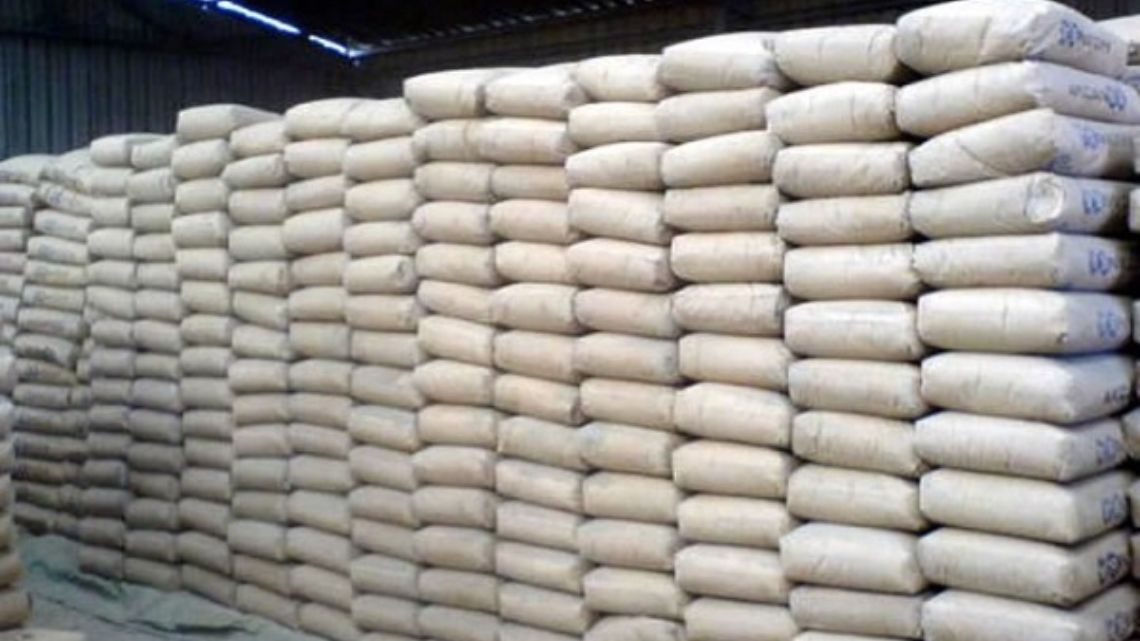
    Even though the economy is beginning to recover, cement sales have yet to see an increase. Recent data from the Bank of Ghana shows that the demand for cement remains far below expectations.

    In January 2022, cement sales in the country were about 300,000 metric tonnes. By May 2024, this number had fallen to roughly 235,000 metric tonnes, as reported by the Bank of Ghana.

    This significant decline over the past two years raises serious questions about the contributing factors, particularly in light of ongoing discussions about rising product costs.

    The specific reasons for this drop are still not fully understood.

    Investigations by Citi Business News at various retail outlets reveal that sales have noticeably decreased in recent months, with traders expressing their concerns about the situation.

    Some industry analysts attribute this decline to a reduction in construction activities, which has been worsened by delays in government projects linked to the state’s debt restructuring efforts.

    The government is actively seeking to control cement prices. The Minister of Trade has stated his commitment to withdrawing the Legislative Instrument currently before Parliament, despite opposition from certain industry groups.

    Additionally, industry stakeholders point to the depreciation of the cedi as a major factor behind the price increases, adding more complexity to the situation.

  • How Minority in Parliament obstructed approval of a $250m World Bank loan

    How Minority in Parliament obstructed approval of a $250m World Bank loan

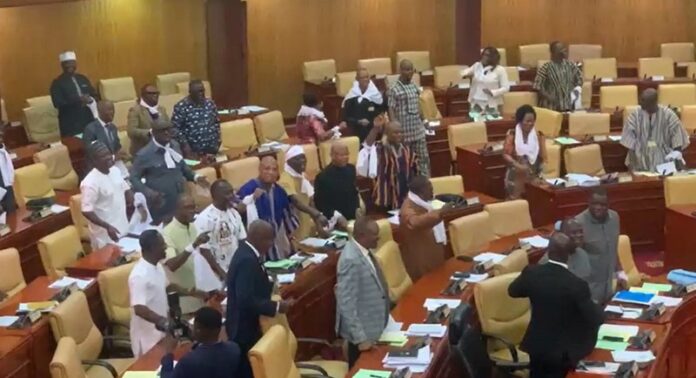
    The Minority in Parliament thwarted the approval of a $250 million loan from the World Bank by casting ‘no’ votes.

    The loan, intended for the Energy Sector Recovery Programme, was to be approved on the last day of the session based on the Finance Committee’s consensus.

    Isaac Adongo, the Finance Committee’s Ranking Member, noted that a large portion of the funds was earmarked for consultancy services, which he found concerning.

    He suggested that the House approve the loan only after amending the disbursement formula.

    Mohammed Muntaka Mubarak, the MP for Asawase, also questioned the loan’s allocation.

    He expressed confusion over why some of the funds were not designated to enable universities like KNUST in Ghana to manufacture their own meters.

    Patrick Boamah provided further details about the loan to the House.

    After these discussions, Speaker of Parliament Alban Bagbin called for a vote.

    He said, “Those in favor say ‘aye’ and those against say ‘no.’”

    For clarification, he put the question again before the House and concluded, “Well, definitely the nos have it. From the voice vote, the nos have it.”

    Following the verdict, Patrick Yaw Boamah, the Committee Chairman, expressed doubt that the opposition had sufficient support.

    The Speaker then inquired whether the Majority wished to proceed with a headcount or a division.

    The Deputy Majority Whip later explained that their members had not responded affirmatively to the motion due to confusion over the voice vote; he suggested that a new vote would resolve the issue.

    Before announcing his decision, the Speaker had previously mentioned that the House would adjourn on June 30, commenting on the numbers involved.

    “I have always drawn the attention of the leader of government business, who himself is not even now available. Because you always need numbers behind you when you are taking some stands on issues on the floor. Those numbers are not there, and those who support you to run your business, you will run at them, and so when they react, the result will not be in your favor. Clearly, this is what has happened, and there is no way the Speaker can preside and be pretending to be doing the right thing when everybody will see it so visibly that it is wrong for the Speaker. So, I will do what is right, and truly the nos had it, and the motion is accordingly rejected.”

    Patrick Boamah then rose again to challenge the decision of the Speaker.

    However, the Speaker said the best course of action was for the House to adjourn sine die, and that was what he proceeded to do.

  • First batch of broiler chickens ready for market under FSRP

    First batch of broiler chickens ready for market under FSRP

    The initial group of broiler chickens from the West Africa Food System Resilience Programme (FSRP) under the Ministry of Food & Agriculture (MoFA) is now available for market distribution, according to Osei Owusu Agyeman, the Project Coordinator of FSRP.

    He noted that these chickens have reached a maturity of seven weeks, with an average live weight ranging from 2.9 to 3 kilograms, and are prepared for processing into whole chickens and various cut parts for packaging and sale.

    “The basic requirement as it stands is for the farmers to leverage this opportunity and invite viable offtakers such as the fast food restaurants and shopping malls to deepen marketing channels for the product,” he said.

    He mentioned that one of the core themes of the project is public-private engagement, which promotes the idea that the private sector is more capable of implementing government policy effectively.

    “It is for this reason that such offtakers as restaurants and shopping malls are key in providing and stocking the processed poultry for consumers,” Mr. Agyeman reiterated.

    Fast-food chains such as KFC and Papaye, among others, require dressed chickens weighing between 1.1 and 1.3 kg, typically achieved at 4 to 5 weeks old with a live weight averaging 1.7 to 2.0 kg.

    With the above specifications, FSRP-MoFA said its locally produced poultry meets the requirements, adding: “Consumers can therefore obtain these homegrown, hygienically processed, fresh and nutritious broiler chicken in malls, restaurants and processing facilities”.

    These are being run under the ‘FSRP Poultry Intensification Scheme’ which commenced in June this year under the auspices of the Ministry of Food & Agriculture.

    Quality control

    A monitoring team from the West Africa Food System Resilience Programme (FSRP), along with officials from the Animal Production Directorate (APD) and the Veterinary Services Department (VSD), visited various poultry farms and processing facilities in the Ashanti Region. The purpose was to ensure compliance with industry standards, including feed quality, vaccinations, bio-security measures, required weights, and general bird health.

    The facilities visited included Rockland Farms (producers of Akoko Tasty Chicken), Asamoah and Yamoah Farms (producers of Gold Birds), Darko Farms (producers of Darko Farms Chicken), and Boris B Farms (producers of Boris B Chicken).

    Processing

    At Rockland Farms, FSRP and MOFA officials witnessed semi-automated processing methods, while Darko Farms and Asamoah & Yamoah Farms took FSRP officials through their fully automated processing methods – including slaughtering, dressing, cutting into parts, packaging, blast-freezing and transportation.

    MoFA-FSRP in other regions

    The current FSRP Poultry Intensification Scheme has been launched in the Eastern Region (with Fredna Farms), Central Region (with Judahson Farms), and Greater Accra Region (with Pap Farms). Farmers in Bono and other regions are slated to join the scheme next month.

    The MOFA-FSRP Poultry Intensification Scheme, funded by the World Bank, operates in phases. Beneficiaries receive input credit, including approximately 160,000 day-old chicks, 180,000 kilograms of feed, and necessary vaccines.

    Participants will receive training in modern best practices and climate-smart technologies for the poultry industry. Additionally, they will have access to matching grants for equipment that aids in post-production processing and cold storage.

    The scheme aims to produce around two million broiler birds annually, supported by a US$12.5 million World Bank facility. It assists eighteen commercial anchor farmers and their outgrowers nationwide in producing, processing, and marketing two million birds each year for the next three years.

    In Ghana, FSRP is implemented by the Ministry of Food & Agriculture, focusing on the intensified production, marketing, and consumption of rice, maize, broiler poultry, soybeans, and tomatoes.

  • Professor Agbloyor cautions that exchange rate volatility may increase foreign debt levels by 2027

    Professor Agbloyor cautions that exchange rate volatility may increase foreign debt levels by 2027

    An Associate Professor of Finance at the University of Ghana Business School, Elikplimi Komla Agbloyor, has warned that the country might face higher costs in repaying its external debt if the government resumes loan payments after 2026 due to exchange rate fluctuations.

    He noted that a significant portion of Ghana’s debt is denominated in foreign currencies, especially the U.S. dollar. This means that if the exchange rate continues to weaken, more Ghanaian cedis will be required to service this debt.

    In an interview on Joy FM’s Super Morning Show on July 31, 2024, Professor Agbloyor told host Winston Amoah that Ghana’s debt repayment prospects beyond the International Monetary Fund (IMF) program appear challenging, as the cedi has yet to demonstrate long-term stability.

    “There is a very high risk that in 2027, we will struggle to pay. We need to maintain exchange rate stability. Currently, about 61 percent of our borrowing is in foreign currency, only 39 percent is domestic currency. Consequently if the cedi keeps depreciating, we will struggle to pay the loans”, he cautioned.

    He pointed out that even though the foreign debt level may come down due to bilateral and the commercial debt restructuring exercises, the effect could be largely negated if more cedis are needed to pay the same debt in 2027 as result of poor exchange rate management.  

    Stressing on the need to keep a stable currency, Prof. Agbloyor advised that the fiscal space created by the debt restructuring now must not be abused, but properly utilized to create activities that can grow the economy to pay for the debt.

    “A lot of the payments are going to be made in 2027. We do have some fiscal space now. That makes things easier now. We have some reliefs now. That has provided some space to put our house in order”, he said.

    Providing some more solutions, he advocated an increase in revenue to improve interest payment on debt.

    According to Prof. Agbloyor a low revenue collection against high interest payment on loans could mean the country will still be debt distress by 2027 and 2028.

    This, he said could send the country back to begging for debt forgiveness if the economy does not grow to the predicted levels.

    He advised government to pursue prudent economic measures that will reduce corruption and not erode the gains that will be made from the debt restructuring.

    Prof. Agbloyor argued that more funds could be saved and channeled into economic expansion if corruption is largely reduced.  

    On the same programme, a finance and economics expert at the University of Ghana, Professor Godfred Bokpin, also questioned the government over the real magnitude and impact of the supposed economic recovery.

    According to him, the current economy has disproportionately affected the middle class, significantly reducing their purchasing power.

    He further highlighted the widening economic disparity accompanying the country’s growth.

    “The development we’ve seen from 2021 has actually impacted the middle class more and has dwarfed our purchasing power. If you measure 2017 purchasing power to this year there’s been an enormous difference. So a lot of upper and lower middle class are sliding down,” he said.

  • Govt’s acclaimed economic recovery has left millions of Ghanaians behind – Prof Bopkin

    Govt’s acclaimed economic recovery has left millions of Ghanaians behind – Prof Bopkin

    A finance and economics specialist at the University of Ghana, Professor Godfred Bokpin, has challenged the government regarding the true extent and effectiveness of the claimed economic recovery.

    He pointed out that the present economic conditions have heavily impacted the middle class, greatly diminishing their purchasing power.

    Additionally, he emphasized the increasing economic inequality that is emerging alongside the nation’s development

    “The development we’ve seen from 2021 has actually impacted the middle class more and has dwarfed our purchasing power. If you measure 2017 purchasing power to this year there’s been an enormous difference. So a lot of upper and lower middle class are sliding down,” he said.

    His comments follow the government’s continual assertions of economic recovery.

    In a media interview, Professor Bokpin pointed out that despite optimistic reports of economic progress, the actual situation for many Ghanaians is markedly different.

    He stressed that the recovery has been both expensive and uneven, leaving many citizens marginalized.

    “So even now that we are talking about economic growth and recovery, you can see it is costly. It is a recovery that has left millions of Ghanaians behind,” he noted.

    Professor Bokpin also cited the 2022 World Bank Report, which indicated that inflation had pushed more than 850,000 Ghanaians into extreme poverty.

    “So the question is this [economic] recovery we are celebrating, has it lifted those people out of extreme poverty?” he quizzed.

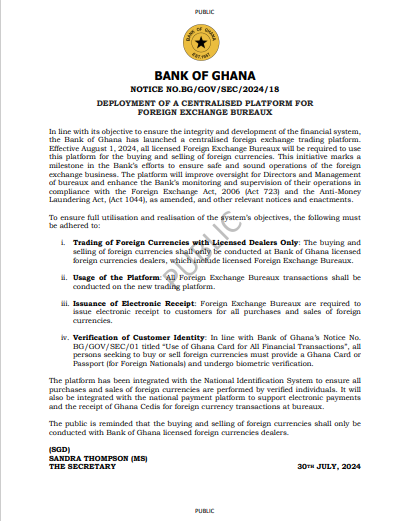
  • Bank of Ghana unveils unified foreign exchange platform

    Bank of Ghana unveils unified foreign exchange platform

    The Bank of Ghana (BoG) has introduced a centralized foreign exchange trading platform.

    In a statement issued by Sandra Thompson, Secretary to the Bank of Ghana, it was clarified that this initiative supports the bank’s objective of preserving the integrity and advancement of the financial system.

    Effective August 1, 2024, all licensed Foreign Exchange Bureaux must utilize this platform for handling foreign currency transactions.

    “This initiative marks a milestone in the Bank’s efforts to ensure safe and sound operations of the foreign exchange business. The platform will improve oversight for Directors and Management of bureaux and enhance the Bank’s monitoring and supervision of their operations in compliance with the Foreign Exchange Act, 2006 (Act 723) and the Anti-Money Laundering Act, (Act 1044), as amended, and other relevant notices and enactments,” the BoG stated.

    The statement emphasised that all foreign currency transactions must be conducted through Bank of Ghana licensed dealers, including licensed Foreign Exchange Bureaux, and must be carried out on the new trading platform.

    Read the statement below:

  • This is a demonstration that Ghana has judges with integrity – Richard Jakpa

    This is a demonstration that Ghana has judges with integrity – Richard Jakpa

    Richard Jakpa, a defendant in the ambulance case with Cassiel Ato Forson, expressed his certainty that the case would be dismissed.

    He stated that he was confident from the beginning that he had committed no wrongdoing and believed the charges were politically motivated.

    “I knew from the onset that I had done nothing wrong, and this was just political witch-hunting, and the court has vindicated me. We still have judges of integrity in our legal system in this country.”

    Background

    In March 2023, the High Court ordered Dr. Cassiel Ato Forson to present his defense after the Attorney General’s office established a prima facie case against the former deputy finance minister in the 2.37 million Euro ambulance case.

    Seth Anemana, a former Chief Director at the Ministry of Health, and businessman Richard Jakpa, who were co-defendants with Dr. Forson, were also instructed to present their defense.

    The Minority Leader and the two co-defendants were charged with willfully causing financial loss of 2.37 million Euros to the state through the purchase of ambulances that were unsuitable for their intended purpose.

    Despite the defense lawyers filing a submission of no case after the prosecution concluded its case, Justice Afia Serwah Asare Botwe ruled on March 30, 2023, that the accused must present their defense.

    But a ruling on July 30, 2024, indicated that the High Court’s decision should be set aside since “the prosecution failed to establish sufficient evidence. The trial judge erred in calling on A1 (Dr. Cassiel Ato Forson) to open his defence. No positively proven facts.”

  • All licensed forex bureaux should inspect Ghana Card for all transaction from August 1 – BoG

    All licensed forex bureaux should inspect Ghana Card for all transaction from August 1 – BoG

    The Bank of Ghana (BoG) has announced that starting August 1, 2024, all licensed Foreign Exchange Bureaux will need to verify the Ghana Card before conducting any transactions with customers.

    This requirement follows the launch of a centralized foreign exchange trading platform, aimed at upholding the integrity and progress of the financial system.

    “Beginning August 1, 2024, all licensed Foreign Exchange Bureaux will be mandated to utilize this platform for buying and selling foreign currencies. This initiative represents a significant step in the Bank’s efforts to ensure secure and sound operations in the foreign exchange sector,” stated a release from the BoG.

    The statement further explained that the platform will enhance oversight capabilities for the Directors and Management of bureaux and improve the Bank’s ability to monitor and supervise their activities in accordance with the Foreign Exchange Act, 2006 (Act 723), the Anti-Money Laundering Act, (Act 1044), as amended, and other relevant regulations and enactments.

    To achieve the full implementation and objectives of the system, the following guidelines must be followed:

    1. Trading of Foreign Currencies with Licensed Dealers Only: The buying and selling of foreign currencies shall only be conducted at Bank of Ghana licensed foreign currencies dealers, which include licensed Foreign Exchange Bureaux.
    2.  Usage of the Platform: All Foreign Exchange Bureaux transactions shall be conducted on the new trading platform.
    3. Issuance of Electronic Receipt: Foreign Exchange Bureaux are required to issue electronic receipt to customers for all purchases and sales of foreign currencies.
    4. Verification of Customer Identity: In line with Bank of Ghana’s Notice No. BG/GOV/SEC/01 titled “Use of Ghana Card for All Financial Transactions”, all persons seeking to buy or sell foreign currencies must provide a Ghana Card or Passport (for Foreign Nationals) and undergo biometric verification.

    The statement mentioned that the platform is linked with the National Identification System to guarantee that all foreign currency transactions are conducted by verified individuals.

    Additionally, it stated that this platform will be connected to the national payment system to facilitate electronic payments and the receipt of Ghana Cedis for foreign currency transactions at bureaux.

    “The public is reminded that the buying and selling of foreign currencies shall only be conducted with Bank of Ghana licensed foreign currencies dealers”, the statement concluded.

  • 5,000 construction jobs to be created through DRIP – Akufo-Addo

    5,000 construction jobs to be created through DRIP – Akufo-Addo

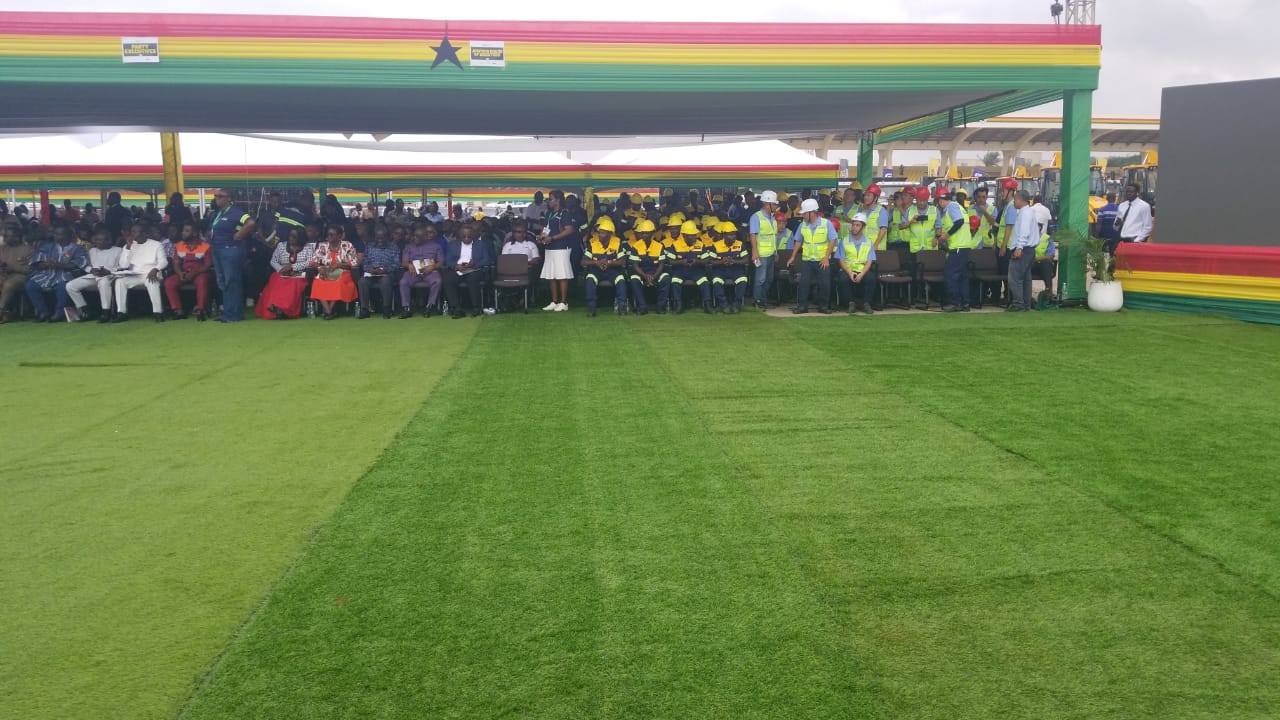
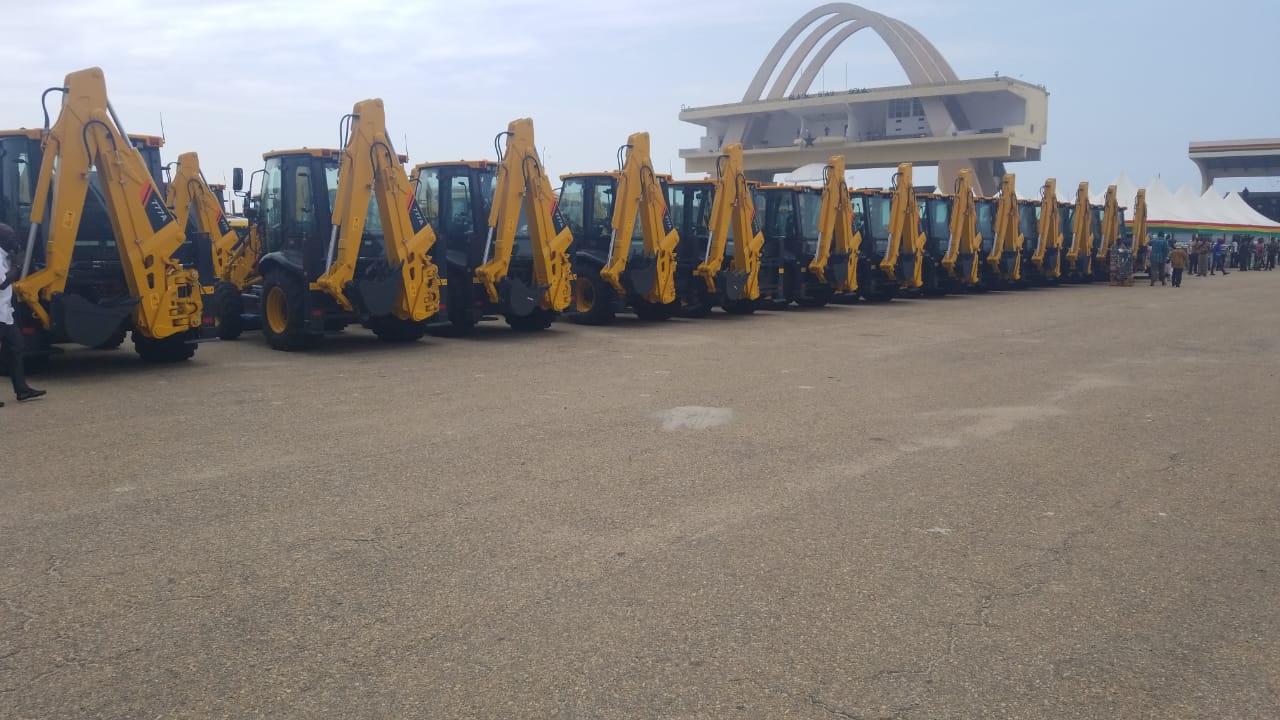
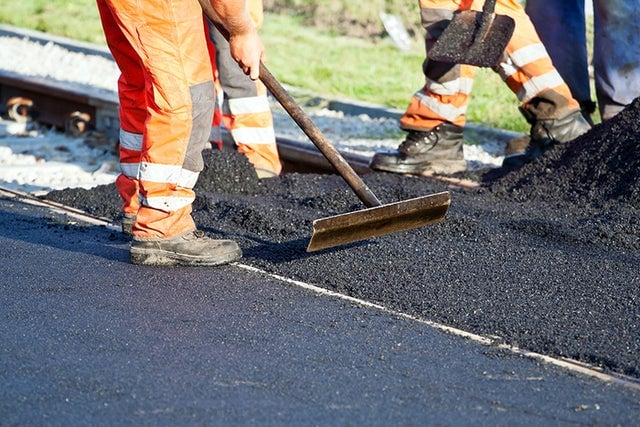
    Approximately 5,000 Ghanaian construction workers are anticipated to secure direct employment through the government’s expedited road construction initiative, known as the District Road Improvement Programme (DRIP).

    This project, set to commence shortly, is primarily financed by the District Assembly Common Fund.

    Its goal is to repair and improve deteriorating roads throughout the nation.

    While speaking to dignitaries at the launch, President Akufo-Addo stated that this initiative demonstrates his administration’s dedication to enhancing road infrastructure in Ghana.

    “I stand before you today with considerable pride to launch the District Road Improvement Programme (DRIP) and commission essential equipment which use will be crucial in transforming road networks across the country.

    “This event marks an important milestone in our pursuit of infrastructural development and I am honored to commemorate this momentous occasion with you all. This ceremony is proof of the determination of the Akufo-Addo-Bawumia government to decentralize development and ensure that every corner of Ghana benefits from the progress and prosperity we strive to achieve,” the President said.

    The recently introduced District Road Improvement Programme (DRIP) intends to rejuvenate road infrastructure across the nation by distributing earth-moving machinery to Metropolitan, Municipal, and District Assemblies (MMDAs).

    Funded by the District Assembly Common Fund and bolstered by donor partners, DRIP will equip MMDAs with vital machinery, including Caterpillars, Bulldozers, and Concrete Mixers.

    These assets are designed to support road-building activities and tackle persistent infrastructure issues throughout Ghana.

    The program seeks to speed up the completion of road projects and boost agricultural activities in farming areas by improving market access and lowering transportation expenses.

    Enhanced rural road systems are anticipated to reduce post-harvest losses for farmers, promoting economic stability and ensuring food security.

    During a media briefing, Martin Adjei Mensah Korsah, Minister for Local Government, Decentralisation, and Rural Development, emphasised DRIP’s transformative impact.

    “The District Road Improvement Programme is a crucial initiative aimed at enhancing road infrastructure in rural areas,” Minister Korsah stated.

    “The programme will foster sustainable development, improve connectivity, and elevate living standards by equipping local authorities with necessary tools and resources,” he stressed.

  • Lawyer sues Police, AG over Akufo-Addo’s Deputy IGP appointment

    Lawyer sues Police, AG over Akufo-Addo’s Deputy IGP appointment

    A private lawyer has challenged the Attorney General (AG) and the Ghana Police Service (GPS) regarding the appointment of a Deputy Inspector General of Police (IGP).

    Mr Justice Abdulai argues that the selection of COP Christian Tetteh Yohuno is unconstitutional.

    He presented this argument in a legal document dated July 30, 2024.

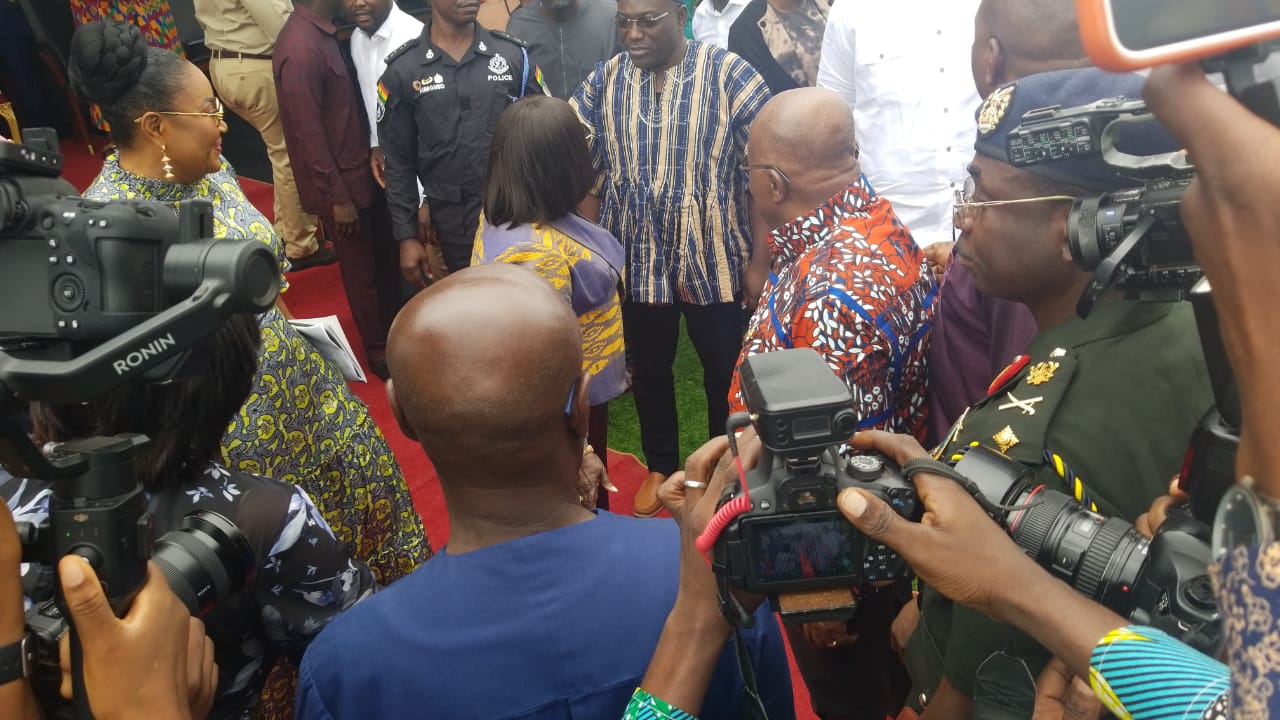
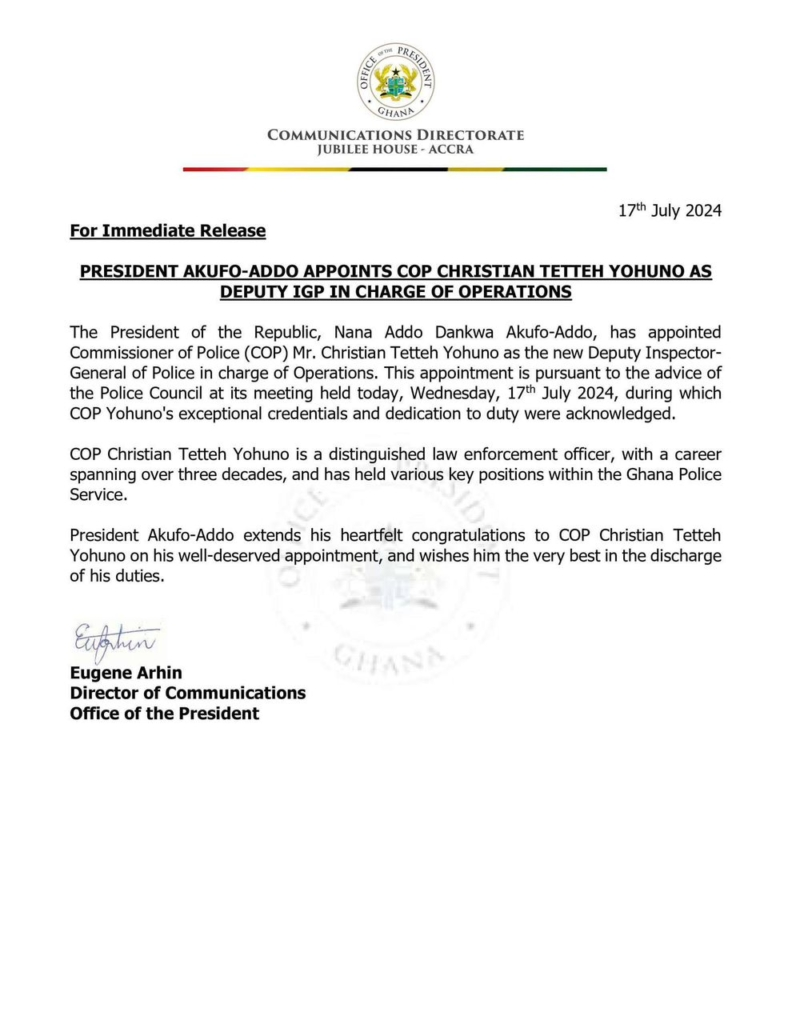
    On July 17, President Akufo-Addo appointed Commissioner of Police (COP) Christian Tetteh Yohuno to the role of Deputy IGP, overseeing operations.

    But the lawyer is praying the court to restrain COP Christian Tetteh Yohuno “from acting or purporting to act as Deputy Inspector-General of Police in charge of operations.”

    “A further order restraining the Inspector General of Police or any command under him from accepting, relating to and/or issuing instructions or commands to COP Mr Christian Tetteh Yohuno in his assumed capacity as Deputy Inspector-General of Police in Charge of Operation.”

    The Jubilee House stated that the appointment was made based on the recommendations of the Police Council during its meeting today, which highlighted COP Yohuno’s outstanding qualifications and commitment to his role.

    The statement characterized the Commissioner as a distinguished law enforcement professional with a career exceeding thirty years and significant experience in pivotal roles within the Service.

  • Fuel prices to decrease in August by 2% to 4%

    Fuel prices to decrease in August by 2% to 4%

    Petroleum product prices are anticipated to decrease by 2% to 4% for petrol, diesel, and Liquefied Petroleum Gas starting August 1, 2024.

    This reduction is attributed to the slowdown in the Ghana cedi’s depreciation in the latter part of July 2024 and favorable conditions in the global market.

    The Institute for Energy Security (IES) reports that, in the latter half of July 2024, petrol and diesel prices dropped by 2.99% and 4.59% respectively, while LPG decreased by 1.10%.

    “Precisely, the price of gasoline [petrol] fell by 2.99%, gasoil [diesel] by 4.59%, and LPG by 1.10% in the second half of July 2024.  The Ghana cedi also recorded slowed depreciation (0.52%), the lowest since February 2024.

    “Following the positive realised on the foreign fuel market coupled with the slowed depreciation of Ghana Cedi recorded on the domestic forex market, the Institute for Energy Security (IES) projects a fall in fuel prices in the coming days”.

    World Oil Market

    In the second pricing window for July 2024, Brent crude futures fell below $80 per barrel for the first time since the post-OPEC+ meeting.

    This decline was prompted by weak global demand, with Chinese imports in July 2024 reaching their lowest level in two years.

    Brent Crude was priced at $78.70 per barrel, down from $83.03 per barrel at the beginning of the pricing period.

    Local Fuel Market Performance

    In the second pricing window of July 2024, liquid fuel prices saw a significant increase at local fuel stations.

    Oil Marketing Companies (OMCs) raised the per litre price of petrol by GH¢0.30 and diesel by GH¢0.20.

    According to IES calculations, the national average price for the three refined petroleum products in the first pricing window of July 2024 showed petrol and diesel at GH¢14.23 and GH¢14.70 per litre respectively, while LPG was priced at GH¢15.22 per kilogram.

  • INTERPOL reports daily transfer of thousands of dollars from Nigeria to other African nations

    INTERPOL reports daily transfer of thousands of dollars from Nigeria to other African nations

    The International Police Organisation (INTERPOL) has reported that large sums of money, amounting to hundreds of thousands of dollars, are being transferred out of Nigeria to other African nations and globally on an hourly basis.

    Garba Baba Umar, INTERPOL Vice President for Africa, revealed this information during a speech at the EFCC Academy in Abuja, where he inaugurated a four-day workshop for Nigerian law enforcement agencies.

    He highlighted that evidence indicates substantial amounts of money are being moved out of Nigeria every hour, with funds being laundered before reaching criminals, who then enjoy the ill-gotten gains, while honest Nigerians bear the consequences of these crimes.

    The organization also pointed out that money laundering has become a troubling global issue, affecting both Africa and the world at large.

    Umar urged for a unified approach by all security agencies in Nigeria and beyond to tackle this growing problem.

    The INTERPOL official, however, said the organisation has launched what he described as “Silver Notices Against Money Laundering”, saying it is in a bid to frontally tackle the scourge of money laundering and illicit financial flows across the world, especially Africa.

    “With every successful laundering of criminal money, our country becomes more prone to crime. More drugs, more fraud, more corruption and more violence. Every time criminal money is successfully laundered, our financial institutions take an additional blow…” Umar said.

    He stressed that hard times await money launderers as the Initiative “Silver Notices” would make illicit funds more difficult to launder in any part of the world.

    Speaking on the theme of the workshop: “Strengthening Capacity and Coordination against Financial Crimes” Umar noted that financial crimes had become transnational and law enforcement agencies needed regular training for their workforce to be ahead of fraudsters.

    At the event, the Executive Chairman of the EFCC, Ola Olukoyede, harped on the need for enhanced collaboration in tackling financial crimes.

    Olukoyede, who spoke through the Director, Fraud Risk Assessment and Control of the EFCC, Francis Usani, said the complex nature of corruption across the world could only be broken by the might of collaborative actions by every stakeholder.

    “The daunting nature of the fight against corruption in Nigeria and the world at large deserve serious collaboration among organisations saddled with the responsibility of fighting corruption”, he said.

    Corruption has been identified as the major stumbling block to Nigeria’s development with stakeholders calling for more stringent resolve to fight against corruption.

  • Bawumia to boost NPP enthusiasm with ‘Mega Ofie Walk’ in Akuapim North

    Bawumia to boost NPP enthusiasm with ‘Mega Ofie Walk’ in Akuapim North

    The New Patriotic Party (NPP) presidential candidate, Dr. Mahamudu Bawumia, will spearhead a significant event titled “The Mega Ofie Walk” in the Akuapim North constituency of the Eastern Region.

    This walk is intended to mobilize party members and supporters, invigorating them to break the eight-year governance pattern.

    Scheduled for Saturday, August 3, 2024, the event aims to draw over 5,000 participants.

    Sammi Awuku, the parliamentary candidate for Akuapim North and Director General of the National Lottery Authority, will lead the walk.

    The 6-kilometer journey will commence at Mamfe and conclude at Mampong Coronation Park.

    The event will also mark the official launch of Awuku’s campaign, highlighting the NPP’s strategy to gain a significant advantage over the NDC in the constituency.

    Dr. Bawumia will be accompanied by other notable NPP leaders, including Kennedy Ohene Agyapong, Justin Frimpong Kodua, Henry Nana Boakye, Eric Nana Agyemang Prempeh, Kwabena Agyepong, Nana Akomea, and Anthony Karbo.

    The Eastern Regional Chairman, along with regional and constituency executives, will attend the event.

    There will be a grand celebration featuring popular musicians such as Guru, Edem, Praye, and Andy Dosty.

    Former Black Stars captain Asamoah Gyan will also make a special appearance.

    Dr. Bawumia is anticipated to deliver a speech emphasizing the importance of continuing with the NPP government to build upon its accomplishments.

  • I would be speaking very little if I were in your shoes – Suhuyini to Yeboah Dame

    I would be speaking very little if I were in your shoes – Suhuyini to Yeboah Dame

    Member of Parliament for Tamale North, Alhassan Suhuyini, has taken aim at Attorney-General and Minister for Justice Godfred Yeboah Dame.

    His comments followed the Court of Appeal’s decision on Tuesday, July 30, which acquitted and discharged the defendants in a prominent case.

    The ruling reversed a previous trial court directive requiring Dr. Cassiel Ato Forson and Richard Jakpa to present their defense.

    The two individuals had been accused of causing a €2.37 million financial loss to the state through an ambulance procurement deal with the Government of Ghana.

    While Justice Alex Poku Acheampong dissented, Justices Kweku Tawiah Ackah-Boafo and Philip Bright Mensah ruled in favor of the accused.

    In response to the ruling, Attorney-General Godfred Dame condemned the decision, calling it flawed and inconsistent with the substantial evidence provided by the prosecution. He argued that it undermines both public accountability and the rule of law.

    In an interview with TV3 on Wednesday, July 31, Mr. Suhuyini suggested that the AG should refrain from further comments to avoid additional embarrassment.

    He implied that Dame has compromised both his own integrity and the credibility of his office with his reaction to the court’s ruling.

    “This case has not just been lost but his integrity has also been lost and if I were in his shoes, I would be speaking very little at this moment because he has not only disgraced him but he has disgraced the office of the Attorney General.”

    “It was a case that shouldn’t have happened. It is a classical example of political persecution. Even before we heard what was contained in the leaked tape, most Ghanaians knew this was a witch hunt and a classical case of political persecution,” he said.

  • My client will be vindicated even if AG appeals to ‘Atoa’ or ‘Nogokpo – Edudzi Tameklo

    My client will be vindicated even if AG appeals to ‘Atoa’ or ‘Nogokpo – Edudzi Tameklo

    Legal representative for Minority Leader Dr. Cassiel Ato Forson, Edudzi Tameklo, has affirmed his belief in Dr. Forson’s innocence, asserting that he has always viewed the case as a matter of persecution rather than prosecution.

    The Court of Appeal has reversed a prior judgment, acquitting and discharging Dr. Cassiel Ato Forson and Richard Jakpa of charges related to the Ambulance Case.

    The charges against them involved allegedly causing a €2.37 million financial loss to the state through a deal for procuring ambulances for the Government of Ghana.

    The Court of Appeal’s 2-1 ruling, with Justices Kweku Tawiah Ackah-Boafo and Philip Bright Mensah in favor, overturned the trial court’s previous directive that required Dr. Forson and Jakpa to present their defense.

    Justice Alex Poku Acheampong, however, dissented from the majority opinion.

    Following the ruling, Attorney General Godfred Dame expressed his dissent, arguing that the decision contradicts the substantial evidence provided by the prosecution.

    Despite this, Edudzi Tameklo is optimistic that if the AG contests the ruling, Dr. Forson will ultimately be exonerated.

    The acquittal concludes the Ambulance Case, which had been highly contentious.

    In an interview with the media on Tuesday, Mr. Tameklo reiterated his client’s innocence and expressed relief that the Court of Appeal has upheld their rights.

    “I’ve always believed in the innocence of my client [Dr Cassiel Ato Forson] and I can tell you, whether Supreme Court or Antoa or Nogokpo, my client will he vindicated,” he insisted.

  • Ato Forson’s acquittal in ambulance case highlights political persecution – Mahama

    Ato Forson’s acquittal in ambulance case highlights political persecution – Mahama

    Flagbearer of the National Democratic Congress (NDC), John Mahama, has praised the Court of Appeal’s decision to acquit and discharge Minority Leader Dr. Cassiel Ato Forson in the ambulance procurement case.

    He stated that this outcome strengthens his belief that the trial, led by Attorney General Godfred Dame, was politically motivated.

    This follows the acquittal and discharge of the third accused, Richard Jakpa, and Minority Leader Cassiel Ato Forson on Tuesday, who were previously charged with causing financial loss to the state.

    Describing it as good news, he explained that “this is a victory for the rule of law and confirms my long-held view that the whole case was political persecution.”

    The appeal was filed some time ago after the High Court dismissed a no-case petition.

    The former President expressed his pleasant surprise at the verdict, viewing it as evidence that justice still prevails in the country.

    “It shows that we still have justice in this country, and we can work to make the judiciary what we want it to be,” Mr Mahama stated in a social media post.

    He reiterated his dedication to judicial reforms, promising to appoint an impartial Minister for Justice.

    “I pledge to appoint a fair minded Minister for Justice who will work with the legal fraternity and the Judicial Council to carry out reforms to ensure we have a truly independent judiciary we can all be proud of.”

  • Finance Minister to attend first-ever national sales executives summit in Accra

    Finance Minister to attend first-ever national sales executives summit in Accra

    Finance Minister Dr. Mohammed Amin Adam will attend the first-ever National Sales Leaders Conference (NSLC) as the special guest of honor on August 14th and 15th.

    This event, to be held at the Accra International Conference Centre, will also include Deputy Minister for Trade and Industry Michael Kofi Okyere Baafi; CEO of MGA Consulting Ghana Limited, Michael Abbiw; President of the Chartered Institute of Marketing Ghana, Dr. Daniel Kasser Tee; along with various business executives and industry leaders.

    The NSLC will highlight innovations in sales, strategies for revenue growth, sustainable sales practices, and sales leadership.

    Participants will engage in keynote sessions, seminars, panel discussions, and workshops addressing critical sales challenges across different sectors.

    These activities are intended to help sales leaders remain competitive, expand their professional networks, and boost their organization’s brand recognition and credibility, ultimately driving revenue growth.

    Organized by CorEvents Solutions and MGA Consulting Ghana Limited in collaboration with the Chartered Institute of Marketing Ghana, the NSLC aims to ignite a national conversation on the crucial role of sales within organizations and its impact on the Ghanaian economy.

    The conference, themed “Sales Unbleached: The Role of Sales in Sustained Organizational Revenue Growth and Economic Development,” emphasizes the importance of effective sales strategies in achieving economic success.

    Organizations are urged to take advantage of this conference to equip their sales teams with modern technologies and strategies that can revolutionize their operations.

  • AG can’t address lawyers at this year’s Bar Conference – Edudzi Tamekloe

    AG can’t address lawyers at this year’s Bar Conference – Edudzi Tamekloe

    Legal counsel to the Minority Leader, Dr. Cassiel Ato Forson, Edudzi Tameklo, has made claims that Attorney General Godfred Yeboah Dame is unsuitable to speak at this year’s Ghana Bar Association (GBA) Conference.

    Mr Tameklo expressed strong belief in Dr. Forson’s innocence and questioned the AG’s credibility to address the conference.

    He accused the AG of targeting Dr. Forson, emphasizing that this persecution stemmed from Dr. Forson’s opposition to the government’s Electronic Levy Bill in 2019.

    Tameklo recounted that the Economic and Organised Crime Office (EOCO) initially instructed them to take the police statement home and return with it completed, suggesting that there was no wrongdoing from the start.

    In an interview with the media on Tuesday, Tameklo argued that the AG’s actions have undermined his integrity and made him unfit to speak at the 2024 Ghana Bar Conference.

    “When the Attorney-General goes to the point of meeting an accused person and first of all, anybody that has criminal charges against him, he is deemed vulnerable and especially with the counts that can get you 10 years in imprisonment, you are dealing with a vulnerable person and per the professional etiquette rules you are not permitted to deal with an accused person when that accused person is represented by a lawyer directly, you deal with him through his lawyer because of the vulnerable position he finds himself in.”

    “On April 9, 2024, the AG placed a call to Jakpa at 7:am telling him to go and secure a medical excuse report and present it to a trial judge as though he was sick when you are not. I want to submit that at this year’s Ghana Bar Conference, the Attorney-General is not worthy to speak to lawyers,” he said.

    Background

    On Tuesday, the Court of Appeal, by a 2-1 majority, acquitted and discharged Dr. Ato Forson and Richard Jakpa in the ambulance case.

    The decision reversed a trial court directive that required them to mount a defense against charges of causing €2.37 million in financial loss to the state through ambulance procurement.

    Justice Alex Poku Acheampong dissented, while Justices Kweku Tawiah Ackah-Boafo and Philip Bright Mensah supported the acquittal.

    In response to the ruling, Attorney General Godfred Dame released a statement condemning the verdict as flawed and contrary to the substantial evidence presented by the prosecution.

    He contended that the decision undermines both public accountability and the rule of law.

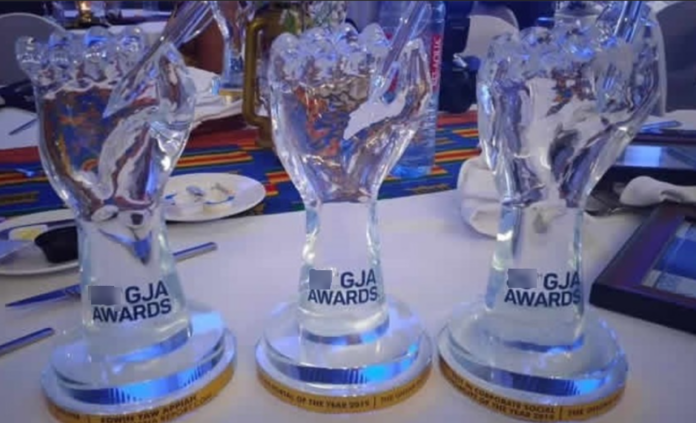
  • GJA announces 9-member committee to handle its 28th annual media awards

    GJA announces 9-member committee to handle its 28th annual media awards

    The Ghana Journalists Association (GJA) has formed a nine-member committee to manage the vetting of submissions and the selection of winners for the 28th Annual GJA Media Awards. The committee will be led by George-Ramsey Benamba, Chief Editor at the Ghana News Agency (GNA).

    The committee members are:

    – Jamila Akweley Okertchiri, Editor, Daily Guide Network
    – Loretta Vanderpuye, Regional Director, Ghana Broadcasting Corporation Obonu FM / TV
    – Joana Afua Mensah, News Editor, United Television (UTV)
    – Isaac Yeboah, Editor, Myjoyonline.com
    – William A. Asiedu, Head of News, 3FM and Co-host, Sunrise Morning Show on TV3
    – Nana Kofi Acquah, International Photojournalist
    – Michael Quaye, Deputy News Editor, Daily Graphic
    – Isaac Nuamah Yeboah, News Director, Atinka Media Village

    The committee is responsible for choosing winners in 36 categories for this year’s awards ceremony, scheduled to be held at the Accra International Conference Centre (AICC) on September 28, 2024.

    For the first time, the Akoto Ampaw Award for Democracy & Good Governance will be given, in honor of the late legal practitioner’s dedication to media freedom.

    Notable awards include the prestigious P. A. V. Ansah Journalist of the Year, Best Female Journalist of the Year, Most Promising Journalist of the Year, and Best Student Journalist of the Year.

    This year’s awards will culminate the GJA’s 75th Anniversary, promising a spectacular event attended by national and international dignitaries.

  • Good news from the Court of Appeal – John Mahama after Ato Forson’s acquittal

    Good news from the Court of Appeal – John Mahama after Ato Forson’s acquittal

    On July 30, 2024, the Court of Appeal acquitted and discharged Dr. Cassiel Ato Forson, the Minority Leader in Parliament and former Deputy Minister of Finance, in the trial over the purchase of ambulances for the country.

    Following the court’s decision, former President John Dramani Mahama expressed his satisfaction with the ruling on Twitter.

    He called the acquittal “good news” and a triumph for the rule of law.

    Mahama reiterated his view that the case was an instance of political persecution.

    He stressed the need for an independent judiciary and pledged to appoint a fair-minded Minister for Justice to implement necessary reforms.

    “Good news from the Court of Appeal, acquitting and discharging former deputy finance minister Cassiel Ato Forson in the ambulance case. This is a victory for the rule of law and confirms my long-held view that the whole case was political persecution.

    “This appeal was made some time ago when they filed a no-case petition before the court and the High Court rejected it so they went to appeal.

    “So, it came as quite a pleasant surprise. But it shows that we still have justice in this country, we can work to make the judiciary what we want it to be. I pledge to appoint a fair-minded Minister for Justice who will work with the legal fraternity and the Judicial Council to carry out reforms to ensure we have a truly independent judiciary we can all be proud of,” he said in his Twitter post on July 30, 2024.

    The three-member Court of Appeal panel, with a 2-1 majority, decided to acquit Dr. Ato Forson. The panel determined that the trial court’s instruction for Dr. Ato Forson to begin his defense was mistaken, thus overturning the previous ruling.


  • FULL TEXT: Court of Appeal’s ruling acquitting Ato Forson, Jakpa in ambulance case

    FULL TEXT: Court of Appeal’s ruling acquitting Ato Forson, Jakpa in ambulance case

    The Court of Appeal cleared Minority Leader Dr. Cassiel Ato Forson and Richard Jakpa, the third accused, in the Ambulance Case.

    This 2:1 ruling reversed an earlier decision by the trial court that had mandated Dr. Forson and Jakpa to present their defense.

    The charges against them involved allegedly causing a financial loss of €2.37 million to the state through a deal for procuring ambulances for the Government of Ghana.

    In the 2:1 verdict, Justice Alex Poku Acheampong, who presided, was in dissent, while Justices Kweku Tawiah ACKAH-Boafo and Philip Bright Mensah supported the accused’s pleas.

    Attached is a certified copy of the Court of Appeal’s judgment. The Attorney General has announced plans to appeal the court’s decision.

  • Tutuka residents demonstrates against  Newmont over failed resettlement fund payment

    Tutuka residents demonstrates against Newmont over failed resettlement fund payment

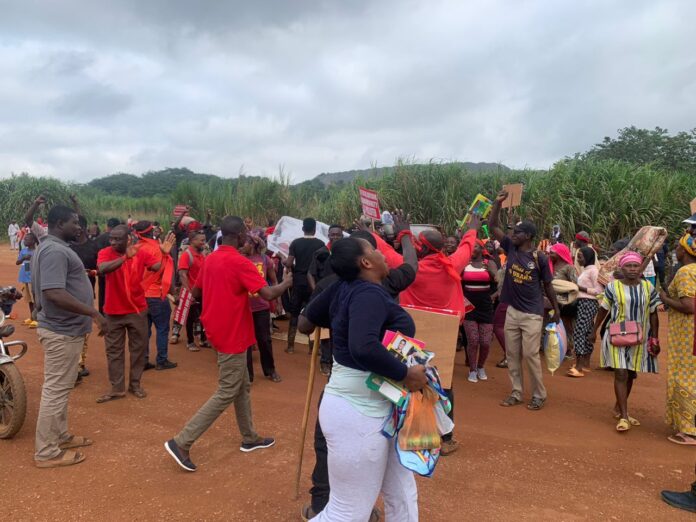
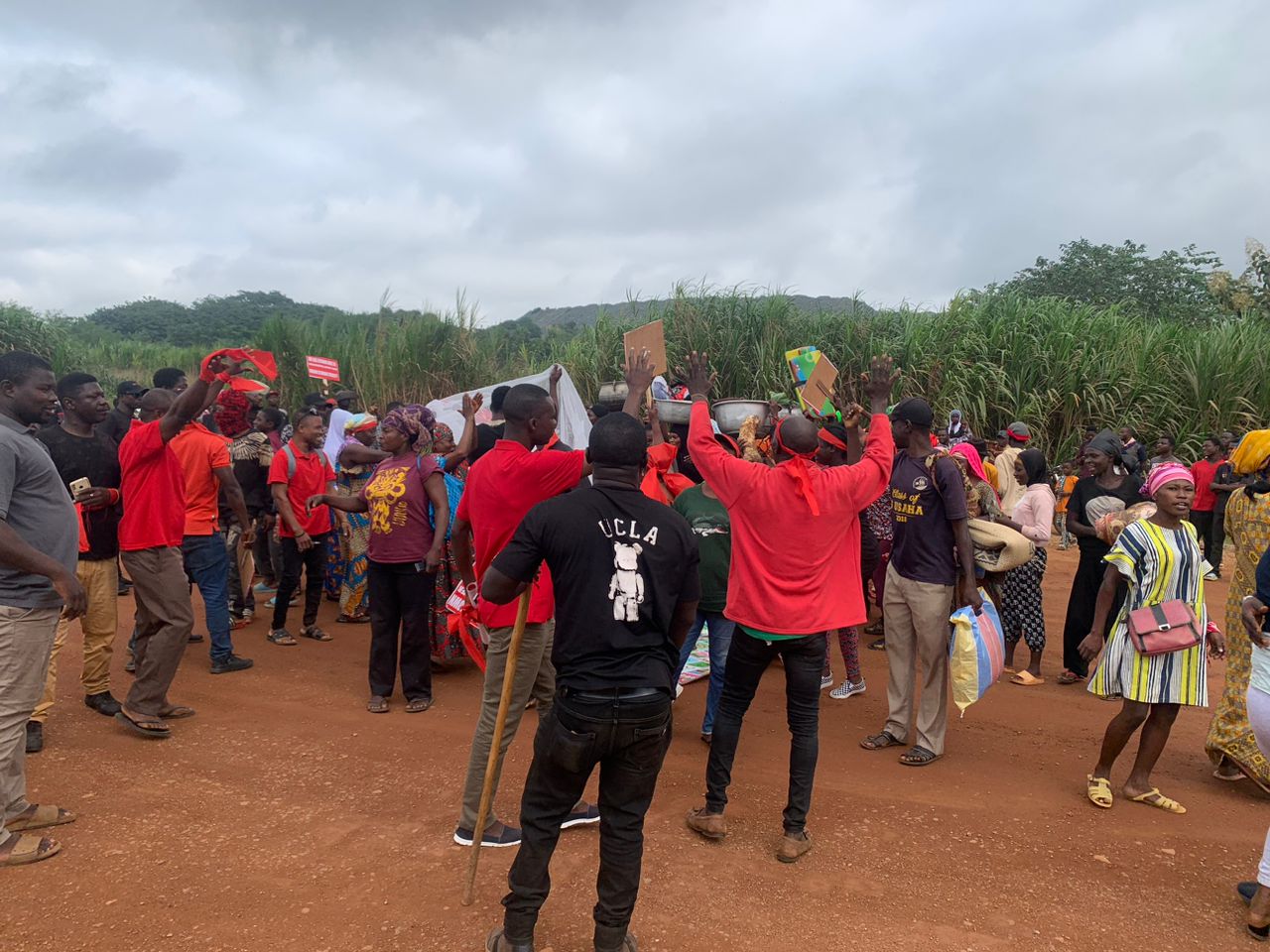
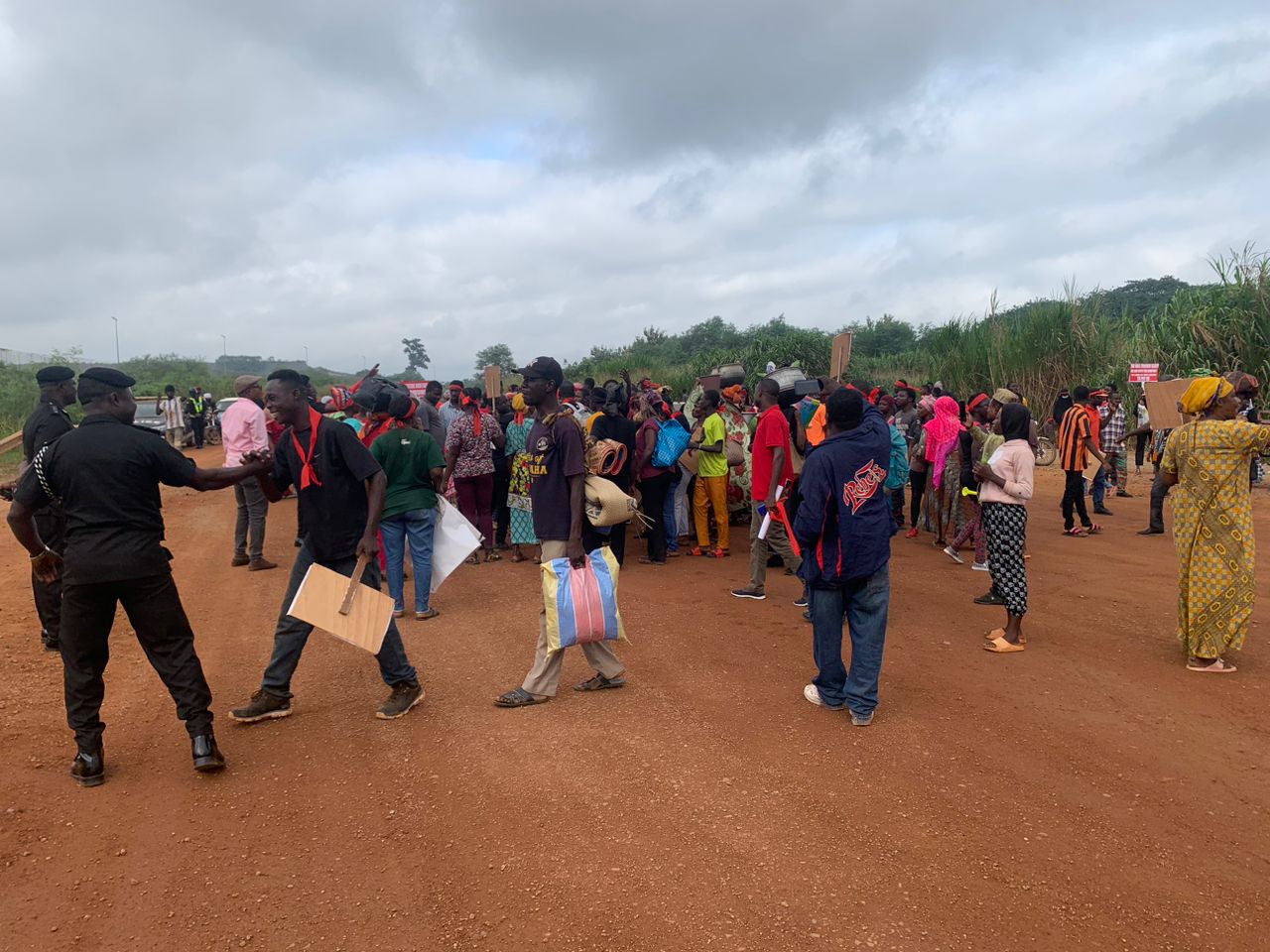
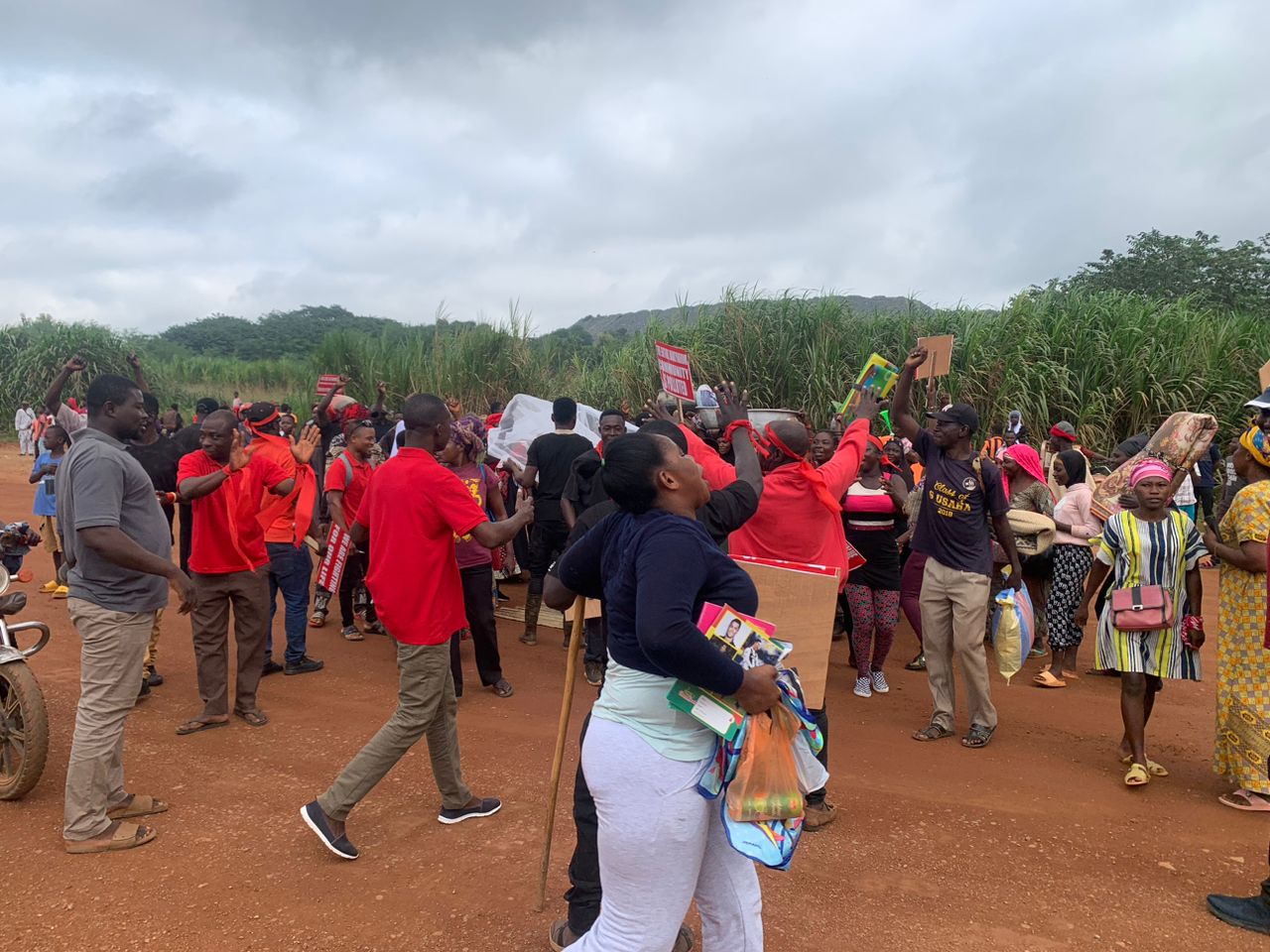
    Residents of Tutuka in the Asutifi North District of the Ahafo region have embarked on a demonstration against Newmont regarding outstanding resettlement payments.

    Community leaders, Johnson Owusu Prempeh and Nana Kwabena Amoateng, stated that Newmont had pledged to pay resettlement funds as agreed with the EPA and local chiefs.

    However, the company has not yet fulfilled this commitment, leading residents to persist in their protest until the payments are made.

    Tensions rose when police used tear gas to break up the crowd, resulting in one protestor collapsing.

    In response, Emmanuel Ato Aubeng, the Community Relations Manager for Newmont Ahafo South Mines, urged the residents to stop their demonstrations.

    He guaranteed them that all parties involved would convene in Accra within the week to address the matter.

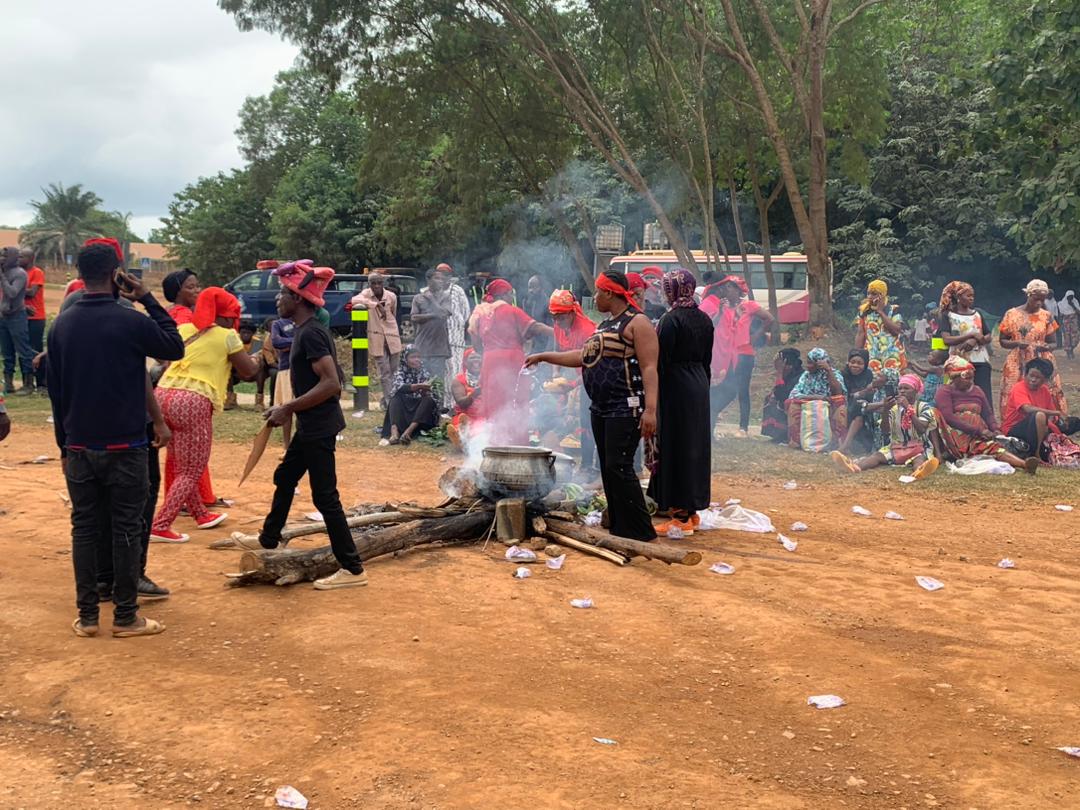
    Nevertheless, the hundreds of protestors have remained steadfast, demanding that their demonstrations will persist until they receive concrete proof of the payment.

    They have brought kitchen utensils and are cooking on the protest grounds, with many ready to spend the night there.

    In the meantime, a strong police presence is in the area to ensure order.

  • Minority jubilates over Court of Appeal’s decision to acquit Ato Forson

    Minority jubilates over Court of Appeal’s decision to acquit Ato Forson

    The Minority in Parliament rejoiced over the Court of Appeal’s decision to acquit their leader, Dr. Cassiel Ato Forson, in the progressive ambulance case, in the aftermath of a 2-1 verdict.

    This ruling, which came after an appeal concerning the no-case submission by Dr. Forson’s legal team, brings to a close a nearly two-year-long legal battle.

    According to Parliamentary Affairs correspondent Ohene Ampomsah, the Minority cheered as Dr. Forson made his entrance into the Chamber.

    Former Minority Leader Haruna Iddrisu commended the judiciary for their work and advised the Attorney General against pursuing further appeals.

    Majority Leader Alexander Afenyo Markin also celebrated the outcome, underscoring the importance of judicial neutrality and urging against political influence to ensure effective justice.

  • Let AG do whatever he wants to do – Ato Forson’s lawyer on court’s ambulance case ruling

    Let AG do whatever he wants to do – Ato Forson’s lawyer on court’s ambulance case ruling

    The lawyer representing the first defendant in the ambulance procurement case, Godwin Edudzi Tamakloe, has criticized Attorney General Godfred Dame for his reaction to the Court of Appeal’s ruling.

    The court acquitted and released Minority Leader Cassiel Ato Forson and businessman Richard Jakpa, who had been accused of causing a €2.37 million loss to the State through a deal to acquire 200 ambulances between 2014 and 2016.

    The Appeal Court’s decision overturned an earlier ruling by the High Court, stating that the defendants had no case to answer.

    Following the ruling, the Attorney General condemned the decision as “perverse” and “highly unjust to the nation,” arguing that it undermines public accountability and the rule of law. He has announced his intention to appeal the verdict.

    However, in an interview with the media on Tuesday, Mr. Tamakloe argued that challenging the court’s decision is unjustified.

    He said, “If the Attorney General disagrees with the judgment, he should file an appeal and argue it in court.”

    Mr. Tamakloe recommended that Mr. Dame should offer an apology to Dr. Ato Forson instead of lodging complaints.

    “Whatever he wants to do, let him go ahead and do it. We are ready. What Godfred Dame doesn’t know is that Cassiel Ato Forson is not a coward; he is willing to stand up to anything. Nobody is afraid of Godfred Dame’s threat”.

    Mr. Tamakloe also raised concerns about whether the Attorney General might have a personal agenda.

    “I even asked Ato Forson if he has not gone for Godfred’s girlfriend because the hatred against Dr Forson is too much. He should do his worse” he dared.

  • 15-year-old boy allegedly killed in Kasoa over  GHS80 theft

    15-year-old boy allegedly killed in Kasoa over GHS80 theft

    A 15-year-old boy has lost his life in Kasoa American Town following an alleged beating by his mother over a missing GH¢80.00.

    Reports indicate that the boy’s mother, who runs a well-known bakery in American Town, discovered her GH¢80.00 was missing and accused her son of taking it over the weekend.

    She is said to have beaten him and threatened to turn him in to the Police if he did not admit to the theft.

    Tragically, the boy passed away in a taxi while being transported to the Police station.

    On Monday, GNA visited the boy’s home and found family members in mourning attire gathered there.

    Though they chose not to comment, they confirmed that the incident had been reported to the Kasoa Divisional Police Command.

    However, a follow-up at the Police station showed no report had been filed.

    When GNA visited the mother’s bakery, it was found closed.

    The deceased’s body has been taken to the Mother and Child Hospital in CP, a Kasoa suburb.

  • Deputy Lands Minister calls on stakeholders to ensure Atlantic Lithium operation’s sustainability

    Deputy Lands Minister calls on stakeholders to ensure Atlantic Lithium operation’s sustainability

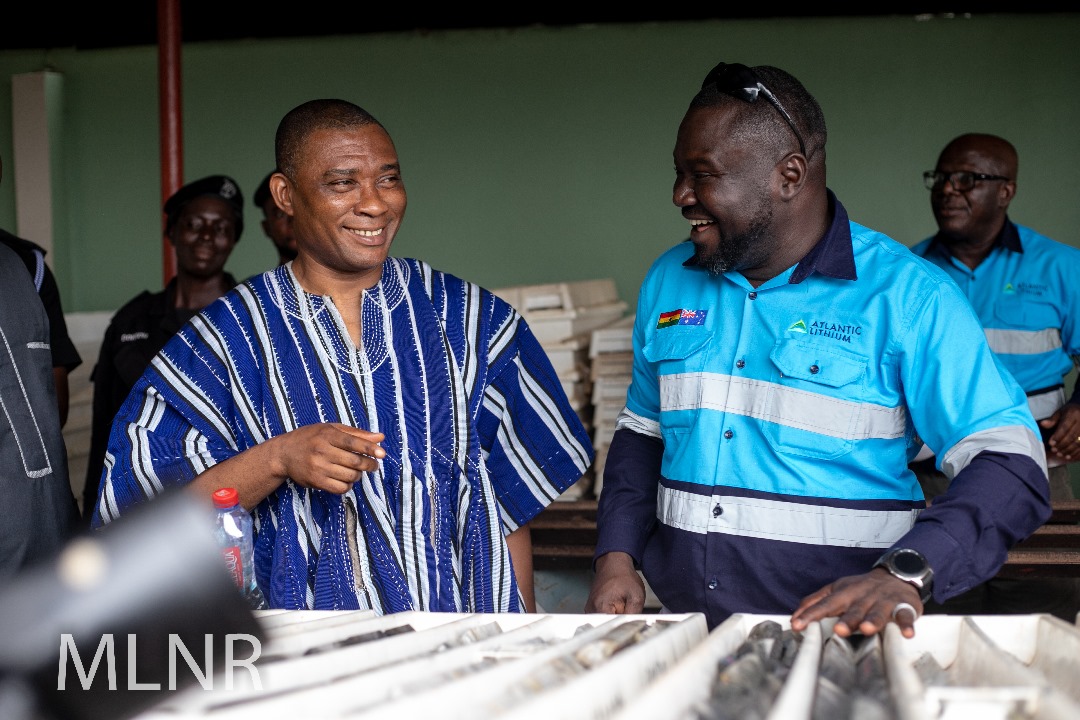
    The Deputy Minister for Lands and Natural Resources, George Mireku Duker, has urged mining stakeholders and traditional authorities to actively support Atlantic Lithium Limited’s sustainability in Ghana.

    He mentioned that their backing would not only spur economic growth in the Central Region but also benefit the local youth and the nation as a whole.

    The Deputy Minister made this appeal during a visit to the Atlantic Lithium site on Tuesday, July 30th, 2024, in the Mankessim Municipality of the Central Region, accompanied by a delegation from the Ministry and the Minerals Commission.

    Mr. Duker highlighted that the terms of Atlantic Lithium’s mining lease are among the best globally and would bring significant prosperity to Ghana.

    He pointed out that the 13% state carried interest in the company’s mining lease is exceptional on a global scale.

    Additionally, he noted that by increasing the royalty rate from 5% to 10%, Atlantic Lithium’s operations would greatly benefit the country compared to other leases.

    Mr. Duker praised Atlantic Lithium for adhering to the local content policy, ensuring that its managerial workforce is predominantly Ghanaian.

    The Deputy Minister’s delegation included the Advisor on Mines to the Minister, Technical Director of Mines at the Ministry, Mr. Peter Awuah, and other officials from the Ministry and Minerals Commission.

    In a presentation, the General Manager of Atlantic Lithium, Mr. Ahmed Salim, updated the visiting team on the company’s operations and urged the government to facilitate parliamentary ratification of the lease agreement for commercial operations to commence next year.

    The team, led by the Deputy Minister, also visited the family of a recent accident victim from the mine, presenting items and assuring them of the government’s support and the company’s commitment to implementing measures to prevent future incidents.

  • Boost financial literacy to avoid losses in investments – Trader’s psychologist

    Boost financial literacy to avoid losses in investments – Trader’s psychologist

    A trader’s psychologist, Clifford Cheqona, has urged financial institutions to ramp up financial literacy initiatives to address the troubling frequency of Ghanaian traders being deceived by unlicensed investment firms.

    In response to the recent shutdown of Dek-Nock Investment Firm by the Bank of Ghana for illicit deposit-taking activities, Clifford highlighted that prioritizing financial education could have prevented such incidents.

    He stressed that enhancing financial literacy among traders can greatly diminish the chances of them falling prey to unauthorized investment scams.

    “With a solid understanding of the investment sector, traders can recognize legitimate investment products, avoid suspicious ones, and check for regulatory warnings before making investments,” he said.

    Clifford Cheqona noted that traders with financial literacy are more capable of recognizing scams, including promises of unrealistic returns, unregistered investment opportunities, or high-pressure tactics to invest quickly.

    He further mentioned that financially educated traders are better prepared to spot fraudulent schemes, such as offers of too-good-to-be-true returns, investments lacking proper registration, or urgent demands to invest immediately.

    “The government’s decision to shut down this firm is a positive step toward protecting investors. However, the critical question remains: what measures are being implemented to help people access this vital information before they become victims? The priority for the government in safeguarding traders should be education—specifically, educating them on how to identify fraudulent investment activities,” he stated. 

    It is worth noting that the Bank of Ghana, in collaboration with the Ghana Police Service, has closed down Dek-Nock Investments, located in Nungua and Ashaiman in the Greater Accra Region.

    This action was taken under Section 20(2)(g) of the Banks and Specialized Deposit-Taking Institutions Act, 2016 (Act 930).

    A statement signed by Central Bank Secretary Sandra Thompson indicated that Dek-Nock Investments was engaged in unauthorized deposit-taking, violating Section 6(1) of Act 930. 

    The statement further noted that the Ghana Police Service is conducting ongoing investigations into the operations of Dek-Nock Investments and urged all customers to remain calm during the process. 

    The Bank assures the general public of its commitment to promoting the integrity and stability of the financial system.

  • 7 surprising facts about Binance you probably didn’t know

    7 surprising facts about Binance you probably didn’t know

    Binance isn’t just another name in cryptocurrency—it’s a powerhouse with a story that’s as surprising as it is impressive.

    As the largest cryptocurrency exchange in the world, Binance has not only reshaped the financial landscape but has also quietly pioneered several industry-firsts that are often overlooked. Here are seven intriguing facts that paint a fuller picture of Binance’s revolutionary role in the crypto space.

    Binance became the world’s largest crypto exchange within 165 days of launch. it grew from 2 million to over 200 million users in just seven years.

    Binance Pay, with zero fees, has processed over $120 billion globally, the Secure Asset Fund for Users (SAFU) now holds over $1 billion to protect against breaches. Binance assisted in over 62,000 law enforcement, requests in 2023, recovering $55 million in user funds. Binance’s customer support averages under one minute per response. It has operated remotely long before it became a trend, managing a global team of over 5,000

     Main Takeaways

    Just a few months after its launch, Binance has taken the world by storm as the largest cryptocurrency exchange in the world, growing at lightning speed.

    When people think of Binance, they think of cryptocurrency trading and transactions, its flagship products, from Binance Earn to Web3 wallet, and perhaps its memorable campaigns and collaborations.

    However, Binance is much more than all of that. Here are seven interesting facts about Binance that may not be always obvious to the public.

    Over the past seven years, Binance has grown from a fledgling startup into a global powerhouse, revolutionizing the way we think about finance, trading, and the future of money. Beyond the headlines and market charts, there are stories and facts that define our uniquely Binancian journey and identity.

    Here are short descriptions of seven of them. Whether you’re a seasoned trader, a crypto enthusiast, or just curious about the buzz, these seven facts will give you a fresh perspective on the world’s leading cryptocurrency exchange.

      1. Zero to Hero in 165 Days

     Binance was launched on 14th of July 2017, and within merely 165 days, Binance became the largest cryptocurrency exchange in the world by trading volume.  What has contributed to such explosive growth within a short period of time?

     According to one of Binance’s co-founders, there were a number of internal and external factors that launched Binance to stardom. Yes, timing and luck were among them, yet more important was Binance’s ability to fill some gaping needs in the crypto market of the day, which was a testament to its visionary founders’ user focus, sharp instinct, and judgment.

     At that time, the crypto industry had seen several bull and bear markets already, yet there was barely any cryptocurrency exchange that dedicated itself fully to the user experience. Systems were slow and customer service teams were often not responsive enough. Binance decided to do better. From early on, Binance launched an institutional-grade trading engine and a dedicated customer service team, and offered an innovative suite of cryptocurrency products geared to match users’ most immediate needs.

     During Binance’s first crypto winter, several of its Initial Coin Offering (ICO) projects dropped sharply in prices, and investors asked for the return of their money. The founding team quickly decided to use the company’s treasury to return all investors’ funds and buy back the tokens at market prices, even though it dealt a serious blow to the firm’s treasury.

     This was a commendable move that had never been done by any other crypto exchange before. It showed Binance’s commitment to serve its valued users. This episode became one of the most positive PR narratives in the history of Binance. Along with this positive buzz and the issues that other exchanges faced, users in Asia and elsewhere started migrating to Binance en masse.

     2. From 2 to 200 Million Users in 7 Years

     Binance attracted over two million users within its first six months of operation. Today, it serves more than 200 million registered users. This continuous growth is proof that Binance had gotten several things right from the get-go. Since day one, Binance has focused on user-centric approach, offering low fees and high liquidity, supporting a wide range of cryptocurrencies, strong security measures, large-scale marketing campaigns (Binance’s affiliate marketing program awards up to 50% commission fees, referral bonuses and promotion), and proactive community engagement by Binance’s leadership on social media.

     Binance is nimble and adaptive enough to evolve quickly along the ever-changing regulatory landscape of cryptocurrency for the past seven years, as well as continuously innovating with its products and services.

     3. Binance Pay Is the Number One Off-Chain Crypto Payment Service

     Binance Pay is a revolutionary payment feature that allows users to send money globally within seconds. With fees starting from zero, Binance Pay is both cost-effective and efficient. This service underscores Binance’s commitment to making financial transactions as seamless and accessible as possible.

     Binance Pay is an off-chain wallet, but it is now among the top crypto payment methods, along with the Bitcoin and Ethereum networks. Since 2021, Binance Pay’s total volume has crossed $120 billion.

     4. SAFU: It Started with Binance

     SAFU is an acronym for Secure Asset Fund for Users, the term has become part of the crypto lexicon. Did you know how it came about?In 2018, a creator named Bizonacci uploaded a tongue-in-cheek YouTube music video entitled Funds Are Safu, referencing the ex-Binance CEO, Changpeng Zhao, or CZ’s, now-iconic tweet during unscheduled maintenance at Binance – “Funds are safe” – to come up with the term SAFU.

     The video became viral, and “SAFU” caught on, echoed by projects large and small following a security incident or any type of uncertainty.

     To safeguard user funds from security breaches that plagued the cryptocurrency industry at the time, Binance established the Secure Asset Fund for Users (SAFU) in July 2018.

     Currently, SAFU holds more than $1 billion in reserve to cover any potential losses in case of a security breach. This initiative not only provides a safety net for users but also instills confidence in the security measures implemented by Binance.

     Source: Bizonacci’s video.

     5. Binance Is a Key Player in Protecting the Crypto Ecosystem

     Perhaps it is not always evident to the public, but Binance is continuously aiding regulators and law enforcement agencies in the fight against crypto-related crime.

     Many times, Binance stood at the side of justice in order to bring the greater good to the cryptocurrency ecosystem. Binance regularly collaborates with law enforcement agencies worldwide, processing over 62,000 in 2023 alone. This equates to about 170 requests per day or 7 per hour. Also in 2023, in addition to operational assistance, Binance’s Law Enforcement Training Program delivered over 120 onsite and online training sessions to law enforcers globally. Meanwhile, by the year’s end, the security team recovered about 55 million USD total in user funds after coordinated efforts. Whenever there is any security breach in the cryptocurrency world, Binance would always be ready to lend a helping hand. For example, recently, on June 22 2024, the Turkish crypto exchange BTC Turk was compromised. Binance’s security team acted swiftly and froze over 5.3 million of funds from that attack.

     6. Binance Is Really Fast

     In an industry where timely support can make a significant difference, Binance leads the market with one of the fastest customer support response times, clocking in at less than one minute. Today, most user requests are picked up within 1 minute and resolved within the first CS chat, representing a dramatic improvement from waiting for hours in the early days of the industry.

     The Customer Service (CS) team is Binance’s largest department, handling a range of responsibilities from immediate user inquiries, training, quality assurance, real-time user feedback analysis to token recovery. The CS department supports 17 languages and covers dozens of business sectors, ensuring global reach.

     Binance has developed an advanced AI bot, integrated into the Binance Customer Support Chat, which intelligently provides suggested solutions based on user-provided information. This front-line application of AI significantly expedites issue resolution, resulting in a faster and more efficient response on the first contact.

     If you look at the speed of Binance’s system, it is also quite impressive: the platform handles up to a whopping 2.58 million user queries per second.

     User queries are automated signals sent from user browsers or apps to the Binance platform to perform various actions, such as placing an order, posting on Square, or withdrawing funds. These queries operate behind the scenes and are not visible to users. For instance, when you select the option to sell a certain amount of BTC on your interface, your app sends an automated query to Binance’s servers.

     As user activity on the platform increases, Binance continues to upgrade its systems to ensure smooth and efficient operations. This ability to manage a high volume of queries positions Binance at the forefront of the cryptocurrency industry as it rides the global wave of adoption toward the one-billion users mark.

     7. Binance Pioneered Remote-First Culture

       Yes, believe it or not, in seven years of existence, Binance has supported tens of trillions in trading volume over group chats and online documents!

     The term “work from home” and “remote-first” became truly popular in the wake of the Covid-19 pandemic, but even before it began, Binance had pioneered a remote-first culture. Binance sees remote working as one of the manifestations of its core value of freedom.

     What is impressive to note is that despite growing from 30 members to over 5 000 of employees spread across the globe, Binance keeps its remote mode of operation intact. Today, Binance has a team of thousands of talented employees that collaborate daily across Europe, the Americas, the Middle East, Africa, and Asia Pacific.

     Hence, Binance is one of the biggest companies in the world that successfully practices a fully remote work culture. It has now become a model for any company that wants to follow in these footsteps.

  • PWC recommends transitioning to a digital method for collecting road tolls

    PWC recommends transitioning to a digital method for collecting road tolls

    In the 2024 mid-year budget review, PricewaterhouseCoopers (PWC) advocates for adopting a digital method for reintroducing road and bridge tolls.

    The firm highlighted that adopting digital technologies, similar to those used in other revenue collection areas, could notably decrease revenue loss and corruption.

    PWC suggested that the government should introduce a system where drivers utilize prepaid swipe cards connected to their Ghana Card, the national ID.

    “Our recommendation is that government goes digital as they have done in other aspects of revenue collection. We believe providing drivers with prepaid swipe cards which are linked with their identity card (Ghana Card) will prevent revenue leakage and corruption, and also make the toll collection seamless,” the firm stated in its digest.

    Moreover, PWC emphasized that the revenue from tolls should be allocated specifically for the construction and upkeep of highways and bridges, ensuring that the funds are used as intended.

    The government’s proposal to reinstate road and bridge tolls in 2025 has generated significant debate. Road tolls were suspended in 2022 and replaced by the electronic transactions levy (E-levy). Although the E-Levy initially faced opposition, it managed to generate GH¢1.19 billion in 2023. However, its effectiveness may be jeopardized by recent trends in the mobile money (MoMo) sector.

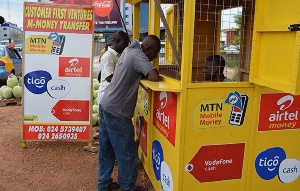
    Data from the Bank of Ghana (BoG) shows a noticeable decrease in mobile money transactions. In June 2024, the total number of MoMo transactions dropped to 644 million, down from 668 million in May 2024.

    This decline also affected the total transaction value, which fell from GH¢234.3 billion to GH¢224 billion. Despite the overall decrease, the float balance—representing funds held in mobile money accounts—slightly increased from GH¢21.1 billion to GH¢22.2 billion.

    The sharp reduction in MoMo transactions could undermine the effectiveness of the E-Levy, a vital revenue source for the government. In light of these developments, PWC’s recommendation for a comprehensive digital toll collection system appears particularly timely.

    “We expect that the new framework will be as robust as possible, incorporating digitalisation in this space of revenue generation,” PWC mentioned.

    This comes as concerns over the cost and reliability of mobile money (MoMo) appear to be on the rise. Over the past two weeks, several social media commentators have expressed dissatisfaction with MoMo, highlighting issues such as high transaction fees and frequent network downtimes.

    These concerns were echoed in an interview with Nana Kwabena Barimah, a seller of building materials who shared his experiences and growing frustrations with the mobile money service. Barimah explained that he has increasingly turned to traditional banking services, including the use of Automated Teller Machine (ATM) cards and bank cheques, to manage his transactions.

    “I use a bank that’s close to my shop, and it has served me well. The costs associated with MoMo and occasional network downtimes are becoming too much for us,” he said.

    “It’s not just about the fees; it’s also about the reliability. There have been times when I couldn’t complete transactions due to network issues, which affects my business operations. With my bank, I have more consistent access to my funds and the transaction fees are more predictable,” he added.

  • Explosive! – Manasseh Azure launches new book on Akufo-Addo

    Explosive! – Manasseh Azure launches new book on Akufo-Addo

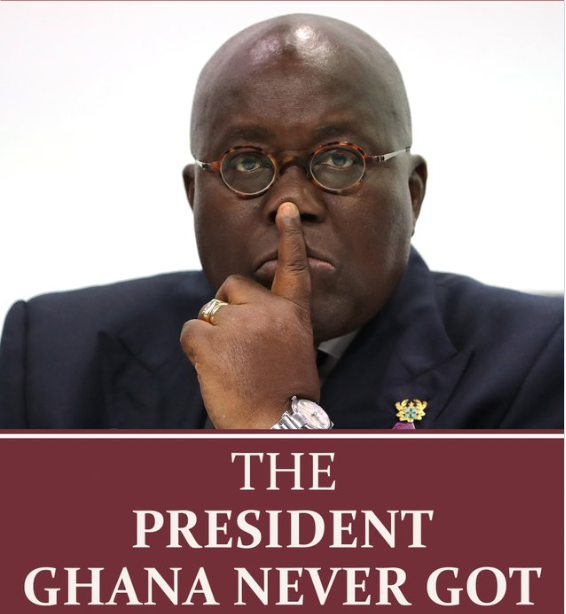
    Investigative journalist Manasseh Awuni Azure has revealed his intention to publish a new explosive book titled “THE PRESIDENT GHANA NEVER GOT,” which centers on President Nana Addo Danquah Akufo-Addo.

    The acclaimed journalist announced via a post on X that the book will be officially launched on August 8, 2024, at the Christ the King Parish Hall, located next to the Jubilee House.

    To this end, he has invited everyone to attend the forthcoming event.

    “Ladies and Gentlemen, The Book is here. Over 40 Chapters In Over 400 Pages Of revealing and riveting content, which some will find explosive Launching: August 8, 2024 At Christ the King Parish Hall, Opp. Jubilee House You are all cordially invited,” Mr Azure wrote.

    Read post below:

  • Auditor General advocates for private involvement in unprofitable regional Airports

    Auditor General advocates for private involvement in unprofitable regional Airports

    aGhana’s Auditor General has suggested involving the private sector in certain operations of five unprofitable regional airports to optimize returns on these investments.

    “Furthermore, the Commercial Service Department of the Ghana Airports Company Limited (GACL) should identify potential concessionaires to occupy idle spaces to generate more revenue through rent and royalties,” the Auditor General suggested in the recently published 2023 report.

    This suggestion comes after a comprehensive audit of the activities of five regional airports in Ghana, highlighting their lack of financial sustainability.

    The Kumasi Airport, now renamed Prempeh I International Airport in the Ashanti Region, along with Tamale Airport, Wa Airport, Sunyani Airport, and Ho Airport, were all assessed as commercially unsustainable by the Auditor General.

    “We conducted an analysis on the operations of five regional airports in terms of their commercial viability and noted that all five regional airports were not commercially viable,” the report stated.

  • Customers protest in Accra, demand release of locked funds from Legacy Fund Management

    Customers protest in Accra, demand release of locked funds from Legacy Fund Management

    Hundreds of frustrated customers of Legacy Fund Management from Tarkwa have marched through the streets of Accra, demanding the return of their trapped funds.

    The demonstration at the company’s headquarters featured customers chanting slogans and calling on authorities to help them retrieve their investments.

    This protest comes after months of rising tension between Legacy Fund Management and its customers, who claim the company has not honored its commitments, leaving them without access to their savings.

    Protesters, including retirees, students, and small business owners, voiced their worries about the financial difficulties they face due to their inaccessible funds.

    The upset customers accused Legacy Fund Management of poor management and a lack of transparency.

    Many customers reported a lack of clear communication from the company about their investments’ status, causing widespread fear and mistrust.

    During the protest, leader Stanley Yeboah stated that they had submitted a petition to Ghana’s Securities and Exchange Commission (SEC), demanding immediate action.

    In response, the SEC ordered Legacy Fund Management in a letter to return the customers’ funds without further delay.

    Stanley Yeboah noted that Legacy Fund Management has not complied with the SEC’s directive.

    As the impasse continues, the determined customers have pledged to keep fighting until their funds are returned.

  • Critics of SSNIT’s 60% hotel diversification call for feasible alternatives

    Critics of SSNIT’s 60% hotel diversification call for feasible alternatives

    In the aftermath the Board and Management of the Social Security and National Insurance Trust (SSNIT) decided to find a strategic investor for its hotels, a variety of media commentaries and articles have emerged regarding this move.

    Some of these perspectives aim to clarify why SSNIT needs to sell 60 percent of its hotel shares to a private investor for management and dividends, while others seem to intentionally damage the institution’s reputation.

    Despite these criticisms, it is crucial for the public, especially workers, to recognize that the SSNIT scheme is stable and that pensions for retirees accurately reflect their earnings during active service. In fact, the same scheme criticized for low pensions is providing monthly pensions of GH¢25,000, GH¢50,000, GH¢93,000, and even over GH¢186,000 to its beneficiaries.

    It is noteworthy that the effort to divest SSNIT’s 60 percent share in the hotels began in 2010. It wasn’t until 2017-2018 that the current Board endorsed a Competitive Tendering process to appoint a transactional advisor and select a strategic investor, in line with the Procurement Act. Thus, this process is neither recent nor secretive.

    Since SSNIT transitioned from a Provident Fund to a Pension Fund in 1991, it has reliably fulfilled its financial duties, ensuring the prompt payment of monthly pensions and benefits to eligible recipients. Its strong financial standing guarantees that all legitimate claims are processed and settled without delay.

    Given this, it is perplexing that some would question SSNIT’s ability to meet its financial commitments based on recent events, such as the proposed sale of a 60 percent stake in SSNIT hotels and concerns raised by the Labour Union. These doubts seem to be driven by malice and lack merit. Similarly, accusations of mismanagement, poor investment, and questionable decisions leading to financial and operational issues are unsupported by the current evidence.

    This article will address various comments and articles that were written with the intent to undermine the institution, and I will provide my honest perspective on them.

    Financial/operational performance & benefits payment

    Some critics have noted that SSNIT experienced a major drop in total income in 2021, primarily due to an 18% decrease in net contributions, which fell from GH¢4,106,623,000 in 2020 to GH¢3,368,335,000. They argue that this decline reflects poor management decisions in handling and expanding the Scheme’s main revenue source.

    Additionally, they claim that the issue stems from political appointees running SSNIT who lack the necessary expertise in finance and social security management.

    Upon reviewing SSNIT’s 2021 Annual Report, it is clear that these criticisms are inaccurate and misleading. The actual total operating income for SSNIT in the 2021 financial year was GH¢3,903,635,000, not GH¢3,368,335,000. While the figure cited (GH¢3,368,335,000) is correct, it represents the net contributions received, not the total income.

    Although SSNIT’s total operating income decreased from GH¢4,664,768,000 in 2020 to GH¢3,903,635,000 in 2021, this reduction is not due to mismanagement as suggested. The claims of mismanagement are fundamentally incorrect, misguided, and seem to be driven by ill intent.

    Why the decrease?

    The Bank of Ghana (BoG) in 2021 directed banks and Specialised Deposit-Taking Institutions (SDI) not to pay dividend to shareholders for the 2020/21 financial year. According to the central bank, this directive was to ensure that the banking sector generally remained robust and resilient in the era of Covid-19 Pandemic. As the largest investor in Ghana’s financial sector (SSNIT) and having invested in 22 out of 36 stocks under the Ghana Stock Exchange, these investee banks did not pay dividends to SSNIT because of the directive from BoG.

    Again, reports gathered suggest that in 2020, SSNIT received GH¢2.6bn from the Controller and Accountant General’s (CAGD). This payment consists of GH¢1 billion in Government of Ghana (GoG) bonds as part payment of CAGD’s indebtedness to SSNIT and the remaining GH¢1.6 billion paid in cash to settle legacy debts – which dates back to past governments. Whereas in 2021, SSNIT received only a cash amount of GH¢1.39 billion from the CAGD without any bonds.

    Therefore, the decrease in total operating income cannot be classified as poor management decision, political interference, mismanagement nor a lack of requisite expertise. However, government’s dynamics regarding payment of contributions of public sector workers plays a crucial role in shoring up the total income of SSNIT.

    Already, SSNIT has noted it will continue to engage with the Government to settle the remaining arrears (principal) of its indebtedness, as well as penalties and accrued interests. Sources close to SSNIT have confirmed that these ongoing engagements have recently resulted in a positive outcome, with the Government settling approximately GH¢2.5 billion owed SSNIT.

    In terms of benefits paid to beneficiaries, more than GH¢3.6 billion was paid out as benefits for 2021 as compared to GH¢3.3 billion paid in 2020, representing an increase of 9.86percent. This demonstrates SSNIT’s commitment to honour its financial obligations to its beneficiaries coupled with the fact that the average processing time for pensions improved from 12 days in 2020 to 10 days in 2021. This indicates that the current Management of SSNIT has significantly improved on their operations and service delivery.

    Investment, expenditure and political interference

    As of December 31, 2021, the total investment portfolio of the Trust had increased by 12.13percent from GH¢10,084.36 million in 2020 to GH¢11,307.75 million which shows prudent investment strategies. The significant improvement in returns is mainly due to the excellent performance of listed equities under the Ghana Stock Exchange.

    So, for someone to suggest mismanagement and questionable decision on the part of current Management of SSNIT in this regard, this evidence cited above points that their claim of mismanagement and political interference is ambiguous, vague and “outmoded at birth.”

    Over the past years, SSNIT’s Investment Portfolio has grown by 21.31 percent, from GH¢9,321.45 million in 2017 to GH¢11,307.75 million in 2021, representing a compounded annual growth of 4.95percent over the five-year period under review.

    To address the issue of a surge in total expenditure, it is important to consider both direct costs and operational &administrative costs. SSNIT is mandated by Article 80 of the National Pensions Act, 2008 (Act 766) to annually review and index pension payments. As long as it adheres to this mandate, coupled with the increasing number of retirees on a daily basis, it is expected that the SSNIT’s direct costs and expenditures will rise.

    The increase in expenditure cannot be attributed to mismanagement, questionable decisions, or political interference by the Government, but to improve the lot of pensioners as SSNIT seeks to maintain the Pensioners’ purchasing power.

    Position of the trust/contributor base

    The active contributor population increased from 1,633,505 in 2020 to 1,734,168 in 2021, representing a modest growth of 6.16percent. The current number of active contributors is more than 1.9 million, information available on SSNIT website suggests.

    In addition, the number of pensioners also decreased from 227,407 to 225,768, representing a dip of 0.72percent. This decrease was as a result of the mass deactivation of the names of 22,920 pensioners from the Pension Payroll for the non-renewal of their Pensioner Certificates. At any point when a deactivated pensioner resurfaces, they are reactivated on the Scheme and paid what is due them.

    Following the recent External Actuarial Valuation Report by the International Labour Organisation (ILO), SSNIT noted that theScheme receives contributions and has enough funds to pay accruing benefits due members. Indeed, the Scheme is partially funded and that pensions and its related benefits are funded from contributions and returns from investments. Over the past years, there has been steady growth in contributions and investment returns. This growth is well supported by the current demographics and the SSNIT’s resilience in enrolling new workers, particularly the self-employed, and encouraging them to contribute to the Scheme.

    Recently, it was reported that over 100,000 self-employed individuals have joined SSNIT and are actively contributing. This is certainly a good step by Management in their attempt to provide income security for workers and ensure that all workers get pension upon retirement. People cannot underestimate these achievements for political gains.

    Portfolio performance

    It should be noted that SSNIT does not make investments without guidance. All investment decisions are made in accordance with its Investment Policy & Guidelines and approved by the sector regulator, the National Pensions Regulatory Authority (NPRA). According to SSNIT’s Annual Report for the period ended 2021, Gross Investment Income recorded in 2021 amounted toGH¢495.54 million. This amount represents an increase of 0.79percent compared to the 2020 figure of GH¢491.64 million.

    SSNIT has indicated that it will continue to appraise and restructure its investment portfolio in accordance with their Investment Policy & Guidelines to achieve short-to-medium term investment objectives. The move goes to suggest that the organisation is well positioned to withstand any economic downturn as it did when the Covid-19 Pandemic struck. When companies were laying off employees and/or downsizing, SSNIT paid over 200,000 Pensioners on its pension payroll throughout the Covid period.

    These points demonstrate SSNIT’s commitment to financial prudence, investment growth, and operational efficiency amidst challenging conditions as against the call by some social commentators that SSNIT is in operational crisis, necessitating urgent restructuring. Such calls cannot be substantiated with facts and should be ignored.

    Sale of 60 percent shares and conflict of interest

    Reports reveal that more than GH¢200 million has been invested in hotels, yet SSNIT has not received any dividends in return. Those who oppose the Trust’s decision to divest a 60percent stake in the hotels to a private investor should propose viable alternatives to revive these properties. Definitely, SSNIT should not continue investing workers‘ contributions and pensioners’ fund into underperforming assets.

    Importantly, both the SSNIT Board and Management have been proactive in safeguarding the Scheme, stating their commitment to ongoing engagements with stakeholders, particularly Labor Unions, to chart the way forward. Regarding conflict of interest that has been widely talked about, I would want to hold on and defer my submission until the Commissioner on Human Rights and Administrative Justice (CHRAJ) completes their investigation, releases their findings before expressing my candid opinion.

    Conclusion/SSNIT’s value proposition

    A value proposition demonstrates the uniqueness of a product a brand offers to members, clients, and the public that no other competitor provides. The SSNIT Scheme, for example, offers unique value and pays benefits promptly. For instance, SSNIT pensioners, including my father, will attest that they receive payment alerts every third Thursday of the month.

    It is instructive to note that the SSNIT Scheme pays monthly pension until death if one contributes for the minimum 180 months and more. Thus Pensioners get peace of mind knowing that every month, their account will be credited. The Scheme also provides disability insurance to contributors in the event of accident or permanent illness that prevents a contributor from working again. This implies that if a member cannot work again due to accident or illness, SSNIT steps in to pay monthly pension to qualified beneficiaries regardless of age.

    Also, the Scheme provides life insurance to Members through the payment of Survivors’ Benefits to the nominated dependants. This gives assurance to members that should they pass on, their survivors would be paid a lump sum by SSNIT.
  • Mahama’s 24-hour economy plan could resolve Ghana’s economic crisis

    Mahama’s 24-hour economy plan could resolve Ghana’s economic crisis

    The Minority in Parliament has declared that the National Democratic Congress (NDC) is proposing a 24-hour economy plan to address the economic difficulties caused by the ruling New Patriotic Party (NPP).
    The caucus contends that the Akufo-Addo administration’s irresponsible borrowing has increased Ghana’s debt to over GHC740 billion without yielding significant results.

    Eric Opoku, Ranking Member of the Food, Agriculture, and Cocoa Affairs Committee, highlighted the seriousness of the issue during a recent press conference.

    “We have been reckless and irresponsible in the last seven years in our borrowing as a nation. From March 6, 1957, to January 7, 2017, Ghana was 60 years old, and our total debt was GHC120 billion.”

    “Now, within the last seven years, we have increased our debt stock to GHC742 billion. This indicates that in the last seven years, we have borrowed GHC622 billion, unprecedented in the history of our country,” Mr. Opoku stated.

    He emphasized that the NDC’s 24-hour economy plan is the necessary remedy for the current economic turmoil.

    “To get us out of this mess, what we have to do is work hard.”

    “We used to work for 8 hours. What we’re saying is that we’re not going to rest for the remaining 16 hours. Let’s make economic use of all these hours,” Mr. Opoku explained.

  • Accelerating sustainable development: The crucial role of microfinance and micro insurance institutions

    Accelerating sustainable development: The crucial role of microfinance and micro insurance institutions

    As Ghana strives to achieve the United Nations’ Sustainable Development Goals (SDGs), microfinance and micro insurance institutions have become indispensable in making a participatory economic growth and reduction of poverty possible.

    These institutions are central in financial inclusion, capacity building through entrepreneurship promotion as well as fostering resilience within vulnerable populations by extending credit to them.

    Promotion of financial inclusion

    One of the key challenges in attaining SDGs is ensuring that everyone has access to financial services. Microfinance establishments (MFEs) have been up front in this endeavor with offers of small loans, savings accounts and other financial products to people who are usually outside the reach of traditional banking mechanisms.

    MFEs provide opportunities for low-income families and small-scale entrepreneurs to invest in income generating activities hence improving their economic prospects and ending poverty.

    Supplementing this effort, micro insurance institutions extend affordable insurance products exclusive to low-income earners. Institutions like this offer an array of insurance products such as life, health and even crop coverage products which offer relief to policy holders when an insured event occurs.

    The risks micro-insurance addresses have been known to hinder the economic security forcing low-income individuals and small-scale businesses into destitution and a vicious cycle of poverty.

    Empowering women and promoting gender equality

    Achieving gender equality is one of the most important components of SDGs with MFIs having played a vital role in empowering women economically. Arguably, a significant number of beneficiaries from microfinance programs in Ghana are women.

    By getting access to microloans, women can start or expand their businesses for purposes of boosting their incomes and socio-economic wellbeing. Women reinvest their resources earned into their families thus securing better health care, improved education for children meant for enhanced living standards in society.

    Micro-insurance also promotes gender equality by focusing their coverage on women’s needs for example maternal health insurance. This ensures women have access to financial products that enable them to stay physically and economically healthy whilst continuing to thrive in their livelihoods.

    Supporting Small Businesses and Entrepreneurship

    Small businesses and entrepreneurs are the backbone of Ghana’s economy in terms of growth and job creation. However, many prospective entrepreneurs face financing constraints. Microfinance institutions fill this void by providing start-up and expansion capital for businesses. This is made possible through MFIs who foster entrepreneurship that in turn creates jobs, diversifies the economy as well as develops local industries.

    Furthermore, micro insurance products provide financial relief when small businesses suffer unforeseen circumstances. An example is a business interruption coverage that supports entrepreneurs in recovering their losses from calamities and other unforeseen occurrences. It ensures business continuity and stability thus enabling enterprises owners to concentrate on development and innovation.

    Enhancing agricultural productivity

    Agriculture is one of Ghana’s leading economic sectors, employing a large portion of the country’s population. Microfinance organizations (MFOs) alongside micro insurance agencies support agricultural productivity and sustainability.

    For instance, farmers can use micro loans to invest in quality seeds, fertilizers or irrigation systems thereby increasing crop yields therefore guaranteeing food security within their communities.

    Micro-insurance policies that cover crops help guard against weather risks such as pests or diseases involving them among others. Such an action promotes sustainable agricultural practices while at the same time reducing vulnerability to climate change through encouraging investment into modern farming techniques.

    Building resilient communities

    Microfinance institutions and micro-insurance organizations’ products and services combine to form resilient communities, which can better deal with economic and natural shocks. These establishments boost the survival ability of people as well as entire societies by granting them entry to financial services and exposure to policies covering risks faced.

    Microfinance and microinsurance will play a crucial role in ensuring that no one is left behind on the path to a bright and sustainable future as Ghana moves closer to its sustainability goals.

    Hilda (MBA, MSc, PMP) is a Senior Analyst, Sustainable Finance, GreenFintech Group.

    Email: h.amenyo@greenfintechgroup.com or info@greenfintechgroup.com

    Source: thebftonline.com

  • Ghana ranked as Africa’s second most attractive investment destination

    Ghana ranked as Africa’s second most attractive investment destination

    Deloitte’s 2022 Africa Investment Attractiveness Index, has ranked Ghana as the second most appealing investment destination in Africa.

    This ranking follows improvements in the country’s tax environment, which have made it more inviting to businesses and investors.

    Speaking at the Ghana Club 100 CEO’s Breakfast Meeting in Accra on July 30, 2024, Yofi Grant, the Chief Executive Officer of the Ghana Investment Promotion Centre (GIPC), affirmed his commitment to maintaining Ghana’s attractiveness for foreign direct investment.

    He highlighted that efforts such as streamlining the business registration process, increasing transparency, and reducing bureaucratic obstacles were implemented to create a more business-friendly environment.

    “In line with our commitment to making Ghana an attractive destination for investment, the GIPC and government in general have implemented a series of reforms aimed at simplifying the business registration process, enhancing transparency, and reducing bureaucratic hurdles. Additionally, it is our desire to make Ghana much more attractive and ensure that we are able to fuel our own indigenous businesses in partnership with foreign direct investments, and we are seeing some positivity there as well,” Yofi Grant said.

    He added that, “These efforts have seen Ghana ranked as the most appealing destination for investments in West Africa, according to the Deloitte 2022 Africa Investment Attractiveness Index, highlighting our dedication to creating a business-friendly environment…it is not just West Africa. It indicated that we are the second most appealing destination for investment in Africa.”

    On Foreign Direct Investment, the GIPC CEO said about US$123 million was raked in as FDIs from January to March this year.

    “Ghana has demonstrated relative resilience to an average Foreign Direct Investment (FDI) of approximately 1.5 billion from 2020 to 2023. From January to March this year, total FDI has been in the region of about US$123 million. When you compare that to the fact that global FDI is decreasing…I believe that the country still holds a lot of interest for Foreign Direct Investors,” Yofi Grant said.

    He stated that GIPC, in collaboration with the government, was prepared to address global shocks, ensure stability, achieve debt sustainability, and restore Ghana’s economy.

  • Contractor requests one-year extension to finish Ofankor-Nsawam road project

    Contractor requests one-year extension to finish Ofankor-Nsawam road project

    The company handling the Ofankor-Nsawam dual carriageway construction, Maripoma Enterprise Limited, has requested an additional year to finish the project.

    As a result, the project’s completion is now anticipated for July of the following year.

    The $346.5 million road improvement project is co-financed by the government and Maripoma Enterprise Limited, a fully Ghanaian-owned firm, which is undertaking the project under a Design and Build Contract with Associated Consultants Limited overseeing the work.

    The 33.4-kilometre road project commenced in July 2022 with an original completion target of July this year.

    However, with the July deadline approaching, just over 60 percent of the physical work has been completed.

    In an exclusive interview with the Ghanaian Times on Friday, Chief Resident Engineer Kwabena Bimpong revealed that the contractor had requested a one-year extension.

    Mr. Bimpong mentioned that his office had asked the contractor for detailed information about the extension request to guide their recommendations to the Ministry of Roads and Highways, the project’s employer.

    Although the extension request has yet to be approved, Mr. Bimpong assured that work on the project would proceed until its completion.

    He noted that land disputes and utility line relocations had impacted the work pace, but the contractor must officially justify the need for an extension.

    Mr. Bimpong explained that legal challenges arose when individuals affected by utility line relocations filed lawsuits to halt the process.

    He added that the segment of the project from Ofankor to China Mall is now expected to finish by September 2024.

    Currently, asphalting has begun on the section from “Festus” to Amasaman.

    Additionally, Mr. Bimpong noted that the contractor had accelerated the work rate, employing day and night shifts to expedite the project’s completion.

    He highlighted that most of the challenging and time-consuming parts of the project have been completed.

    He noted that the bridges made up of the Ofankor railway, Kpobiman, and Medie were far advanced and the Amasaman interchange was impacted by many structures within “the right of way.”

    Mr. Bimpong also noted that the Nsawam underpass has yet to commence due to similar issues, particularly with utilities, though the completion of drainage and footbridges is progressing well.

    The 33.4-kilometre road project is part of the Accra-Kumasi route within the National Road Six (N6) network.

    The development encompasses the creation of interchanges, flyovers, footbridges, and bridges at locations including Amasaman, Kpobiman, Medie, and Nsawam Junction.

    Additionally, the project involves building eight lanes of road from Ofankor to the Pokuase Interchange, and ten lanes from the Pokuase footbridge to the Nsawam Bypass.

    Once completed, the road is expected to alleviate traffic congestion on the Accra-Nsawam corridor and enhance socio-economic activities along the route.

    Furthermore, the road will support trade between Ghana and its neighboring Sahelian countries such as Burkina Faso, Mali, and Niger.

  • NDC’s proposal for Women’s Development Bank will be a game changer – Prof John Gatsi

    NDC’s proposal for Women’s Development Bank will be a game changer – Prof John Gatsi

    A Finance professor and Dean of the University of Cape Coast School of Business, John Gartchie Gatsi, has endorsed the National Democratic Congress flagbearer’s promise to create a Women’s Development Bank (WDB), calling it timely and insightful.

    In a social media post, Professor Gatsi explained the differences between commercial banks and women’s development banks, emphasizing that the WDB aims to foster economic growth for women.

    He noted that if the Mahama administration establishes the WDB upon winning the elections, it would be transformative in promoting economic empowerment and increasing productivity among women.

    Read the full statement below:

    The concept of a Women Development Bank is not new globally. It has been established in countries such as India to internationally support women entrepreneurs to create and sustain enterprises and to deal with poverty. It has been established that generally, micro, small, and medium-sized enterprises (MSMEs) established and managed by women have a higher chance of survival, growth, and job creation.

    As part of growing the participation of women in enterprise and scaling up their contribution to economic growth and increasing job creation opportunities to tackle the security-laden unemployment, the promise by John Mahama and Jane Opoku Agyemang to establish a Women Development Bank is timely and thoughtful. A Women Development Bank is an intentional strategy to economically empower women in the country to get access to long-term credits at either zero interest or lower interest rates than commercial banks.

    Development banks, in general, are different from commercial banks. The latter grants mostly short-term loans with high interest rates, putting a burden on recipients. This creates a great interest burden and difficulty for the growth of businesses.

    The best way to reduce poverty drastically is through the provision of development credits to women entrepreneurs.

    Normally, since a Women Development Bank is a special class of development bank, it receives seed money from international development and financial institutions, domestic governments, foreign governments, foundations, and NGOs. There are people who are concerned about the zero interest or low interest charge, indicating concern about the survival of the bank. We have even seen some on-lending development facilities in agriculture and other sectors through the normal commercial banks. In such cases, the interest rates are very low. So the setup and operation of a development bank are different from that of a commercial bank. The zero-interest loan portfolios of the development bank will attract interest from the Islamic Development Bank.

    Some people also ask, why women? Is it not discriminatory? We have been dealing with women’s empowerment, equality, and inclusion in leadership for a long time. This was given a boost by Beijing 1995. Truth be told, we still have a long way to support our women to fight poverty and enhance their entrepreneurial opportunities. We do all these for ourselves. When a woman is able to develop an enterprise, she doesn’t use the benefit alone; children, husbands, and other family members are the real beneficiaries.

    A Women Development Bank creates the opportunity to increase the productivity of women.

  • Cedi falls by 19.5% against dollar as of July 2024

    Cedi falls by 19.5% against dollar as of July 2024

    The Ghanaian cedi has weakened by approximately 19.6% against the US dollar on the interbank forex market as of July 2024, according to the Bank of Ghana.

    This decline is less severe compared to the roughly 21% drop in value against the dollar observed on the retail market.

    The Central Bank’s July 2024 Summary of Financial and Economic Data reveals that the cedi depreciated by 7.7% against the dollar in March 2024, and by 10.5% in April 2024. It further declined by 15.9% in June 2024 and 18.6% in July 2024.

    Currently, the cedi is trading at an average rate of GH¢15.60 per dollar on the retail market, while the Bank of Ghana lists the rate at GH¢14.78 per dollar.

    Against the British pound, the cedi has depreciated by 20.8%, trading at GH¢19.10.

    It has also decreased by 18.4% against the euro, with a current rate of GH¢16.09.

    Cedi stabilised against dollar

    Last week, the Ghanaian cedi continued its upward trend against the US dollar due to increasing corporate demand.

    Market speculation about a possible rate cut by the US Federal Reserve contributed to the weakening of the American dollar.

    Consequently, the local currency appreciated by 0.29% week-on-week against the dollar, concluding the week with a mid-rate of GH¢15.64/$ on the retail market.

    This marked the second consecutive week of gains for the cedi against the world’s most influential currency.

  • Ghanaian cedi faces losses amid renewed corporate demand pressures

    Ghanaian cedi faces losses amid renewed corporate demand pressures

    In the aftermath of a steady performance the week before, the Ghanaian cedi experienced declines last week due to renewed corporate demand pressures.

    The local currency fell by 1.48% week-on-week against the US dollar, ending at a bid to offer rate of GH¢15.75/16.00 on the retail market.

    The cedi also weakened by 2.80% against the British pound and 2.18% against the euro.

    Increased demand from oil importers led to a rise in refined oil imports, reaching US$428.3 million in June 2024, up from US$422.6 million in May 2024.

    The Bank of Ghana sold US$40 million to oil importers through the Bulk Oil Distributors Foreign Exchange (FX) auction to address this demand. However, ongoing demand from oil importers resulted in a 4.46% month-on-month depreciation of the cedi against the US dollar in June 2024.

    Analysts view the higher oil import bill and increased FX demand as threats to net foreign reserves, with short-term pressure likely on the cedi.

    They anticipate the currency will continue to weaken this week due to rising corporate demand pressures. Currently, the cedi is trading at GH¢15.88 to the US dollar on the retail market.

    The Bank of Ghana reports that the cedi has depreciated by approximately 19.6% against the US dollar on the interbank forex market as of July 2024, compared to about a 21% decline on the retail market.

    The Central Bank’s July 2024 Summary of Financial and Economic Data indicates that the cedi lost 7.7% of its value against the dollar in March 2024, 10.5% in April 2024, 15.9% in June 2024, and 18.6% in July 2024.

  • AU backs Akufo-Addo’s plan for enhanced mobile money interoperability in Africa

    AU backs Akufo-Addo’s plan for enhanced mobile money interoperability in Africa

    The African Union (AU) has approved President Nana Addo Dankwa Akufo-Addo’s initiative for mobile money interoperability across the African continent.

    This initiative, deemed essential for Africa’s economic integration, aims to streamline economic transactions and boost intra-African trade and development.

    The AU Heads of State and Government reached this decision after President Akufo-Addo submitted two reports for review at the Union’s Sixth Mid-Year Coordination Meeting of Regional Economic Communities in Accra last weekend.

    The recommendations in the two reports, “Establishment of the African Union Financial Institutions (AUFIs)” or “Scaling up Interoperability for Economic Integration: Using Mobile Money to Buy and Sell Across Africa,” were endorsed unanimously by meeting. The meeting also endorsed that the reports be tabled for consideration by the 79th Session of the United Nations General Assembly later in September 2024.

    The gathering was held to review the progress of the continental integration agenda and to assess the effectiveness of policy harmonization between the AU and the regional economic communities.

    President Akufo-Addo, who also holds the position of AU Champion on African Union Financial Institutions, highlighted during the session that mobile money interoperability would not only further Africa’s integration goals but also enhance financial inclusion for its most disadvantaged populations.

    He stressed the transformative impact of mobile money interoperability, particularly for small businesses and informal sector traders, who are the backbone of many African economies.

    This initiative is expected to revolutionize business practices in Africa, create jobs for young people, and stimulate economic activity, as the continent already accounts for over 70% of global mobile money transactions.

    “By leveraging mobile money technology, we can break down barriers to trade and boost and boost economic activities to empower millions of Africans in the continental and global economy.

    “Our continent is home to a vibrant market of nearly 1.4 billion people, with majority being the youth; what they call Generation Z, with the Alpha Generation in tow…It is in our collective interest as today’s leaders to offer the youth of our continent the freedom to express their creativity economically and without border constrains and earn from their enterprise.

    “Give the youth of Africa the freedom to aspire, and they shall be inspired to lead in creating the Africa we want, the Africa we desire, and the Africa they deserve.

    “Let us leave Accra knowing we have committed our union, our Regional Communities, and our Member States to allowing our people the opportunity to buy and sell anywhere in Africa, using just their hand-held mobile device. Let us leave this room committing all our relevant institutions to fast-tracking the process.

    “By championing interoperability, we are taking a decisive step towards realising the Africa that our freedom fighters dreamed of, which today is in our hands to bring about—a prosperous, integrated, and globally competitive continent,” President Akufo-Addo said, and urged his counterparts to demonstrate the will and commitment required to enable the ambitious agenda work for Africa.

    The AU has called on member states, regional economic communities, and other stakeholders to commit to achieving mobile money interoperability by 2027.

    This involves incorporating all member countries into the Pan-African Payment and Settlement System (PAPSS), enabling cross-border mobile money transactions, and establishing a continental regulatory framework for mobile money activities.

    Africa’s mobile money transactions are valued at over $1.26 trillion, representing nearly 40 percent of the continent’s GDP.

    Financial inclusion in West Africa has surged due to mobile money, reaching 71 percent and increasing.

    East Africa boasts a 73 percent mobile money penetration rate, while Southern Africa stands at 45 percent and is on the rise.

    The adoption of mobile money interoperability is a crucial step toward the African Union’s objective of creating a single, unified market for Africa.

    It is expected to stimulate economic growth, reduce transaction costs, and enhance continental economic integration.

    Mohammed Cheikh El Ghazouani, Chairperson of the African Union and President of Mauritania, stressed the importance of aligning national and regional policies to foster socioeconomic development on the continent.

    The mobile money interoperability initiative is consistent with the AU’s aim of fostering economic stability and enhancing connections among member states.

  • Savings and loans sector assets reach GHS7.6 billion – GHASALC

    Savings and loans sector assets reach GHS7.6 billion – GHASALC

    Total assets in the savings and loans (S&L) sector increased to GH¢7.6 billion by the end of 2023, up from GH¢5.7 billion the previous year.

    This increase, according to Kwame Owusu-Boateng, Chairman of the Ghana Association of Savings and Loans Companies (GHASALC), is largely driven by growth in loans and advances to customers funded by customer deposits.

    The year ended with 25 companies as members of the association.

    In his address at GHASALC’s 14th annual general meeting in Accra, he detailed that by the end of 2023, the Association’s members collectively served over 5.5 million customers with more than 7.7 million accounts.

    Furthermore, the Chairman stated that the sector’s total loan portfolio reached about GH¢5.4 billion, with the services sector leading at over GH¢3 billion, followed by commerce/trading, agriculture/fishing, and manufacturing.

    “There has been an improvement in the 2023 deposit mix compared to 2022, indicating that member companies are increasingly growing their deposits through Current Accounts and Savings Accounts (CASA), which have traditionally been cheaper sources of funds for the sector,” he stated.

    The 14th annual general meeting was themed ‘Advancing financial inclusion for all: The role of savings and loans companies’.

    Mr. Owusu-Boateng emphasized the importance of savings and loans companies in enhancing financial inclusion in Ghana.

    He stated that financial inclusion is not just an objective but a fundamental aspect of sustainable economic growth, enabling individuals and communities by offering the tools and resources needed to enhance their livelihoods and secure a more stable future.

    Central to this effort, he highlighted, are savings and loans companies, which play a crucial role in connecting traditional banking services with unbanked or underbanked populations.

    “Savings and loans companies have a unique ability to reach segments of society that are often overlooked by traditional financial institutions. By offering tailored savings products, micro-loans and other financial services, individuals are empowered to save, invest and secure loans for entrepreneurial ventures or personal development.

    “As a sector, our dedication to broadening access to financial services across most, if not all, sectors of society remains significant in the financial inclusion agenda during these challenging times,” he explained.

    He reiterated the sector’s dedication to advancing financial inclusion, calling on stakeholders such as shareholders, regulators, employees, and development partners to support the initiative.

    “Together, we can build a more inclusive financial ecosystem where every individual can prosper. Surely, the number of unbanked and underbanked clients is many; and we have to continue finding innovative strategies and solutions to bank those at the pyramid’s base who have been left out of the formal financial services sector.

    “To government, development partners and other donors, we seek your support and increased attention toward non-bank financial institutions, particularly Savings and Loans Companies. As a critical sector driving financial inclusion, we actively support youth, women, MSME entrepreneurs and farmers. We call for more collaborative efforts to strengthen our sector, ensuring we continue to serve as agents for inclusive finance across Ghana,” he added.

    Delivering his report at the AGM, Tweneboah Kodua Boakye – Executive Secretary, GHASALC, also urged savings and loans companies to adopt more innovative strategies to ensure resilience given the current economic situation.

    “Considering the current economic situation, it is important that Savings and Loans Companies implement more adaptive strategies to ensure resilience.”

    He implored members to prioritise, among others, strengthening regulatory compliance, particularly ensuring timely reporting; innovating and differentiating products; exploring opportunities in climate and green financing; as well as enhancing cybersecurity systems to safeguard operations and customer data.

    Also, improving risk management frameworks and internal controls to mitigate uncertainties; optimising operational efficiency by controlling costs effectively; and deepening market engagement and understanding customer needs.

    Challenges

    Despite the progress recorded in 2024, he cited the regulatory landscape adopting innovative technologies and continuously enhancing operational efficiencies to better serve customers and clients as a challenge.

  • GRA Chief discloses govt’s readiness to settle GHS95m debt to West Blue after contract termination

    GRA Chief discloses govt’s readiness to settle GHS95m debt to West Blue after contract termination

    Government is set to pay a GH¢95 million settlement to the IT consulting company, West Blue Consulting, after ending its agreement with the firm.

    This resolution follows West Blue Consulting’s provision of technical and support services to the Ghana Revenue Authority (GRA) from 2015 to 2020, coordinated by the Ministry of Finance.

    The sudden cancellation of the contract led West Blue Consulting to file a lawsuit against the government, claiming compensation for a debt totaling GH¢289 million.

    After court proceedings, GH¢95 million was awarded to West Blue.

    The Commissioner General of the GRA, Julie Essiam, confirmed the settlement during a session of the Public Accounts Committee on Monday, July 29.

    She outlined the legal and financial consequences of the contract termination and the resulting judgment debt.

    Ms. Essiam also noted that the payment plan has been divided into three installments, as agreed with the court.

    “Indeed, the judgement debt is GH¢95 million. We will not to be able to pay all GH¢95 million and therefore the agreement with the court is to pay these in three instalments,” she stated.

  • Exploit the Russia-Ukraine crisis to broaden gas supply to Europe – Ghana Gas CEO

    Exploit the Russia-Ukraine crisis to broaden gas supply to Europe – Ghana Gas CEO

    CEO of Ghana Gas Company Limited, Dr. Benjamin K.D. Asante, has called on African leaders to take advantage of the Russia-Ukraine conflict to increase gas exports to Europe.

    While addressing a public lecture at Kwame Nkrumah University of Science and Technology’s College of Engineering, themed “Gas Commercialization: Fostering a Sustainable Petroleum Economy, Opportunities and Setbacks,” in the Ashanti Region Dr. Asante emphasised the need for investment in strategic proposals to achieve this goal.

    “Africa contributes about 10-15% of the total world gas production but uses only 5-6% throughout the continent,” Dr. Asante noted.

    “West Africa is better positioned to lead Africa in the effort to replace the Russian gas supply in Europe based on its proximity and collective resources.”

    “Dr. Asante proposed that Africa establish integrated and sustainable gas supply centers or hubs, supported by dependable and secure infrastructure for handling and transportation.

    He also highlighted the need for favorable fiscal and tax policies to draw both local and international investments essential for building the necessary infrastructure.

    Furthermore, Dr. Asante underscored the importance of enhancing local skills and crafting effective policies to ensure a sustainable gas sector in Africa.

    “While we work to develop a master plan or roadmap for guiding the development of these sectors, let’s ensure there is a clear and appropriate institutional and regulatory framework,” he added.

  • Govt abandons $60m invested project meant to become West Africa’s largest multi-purpose complex

    Govt abandons $60m invested project meant to become West Africa’s largest multi-purpose complex

    An abandoned construction site on the Airport Bypass Road in Accra has garnered the attention of the IMANI Africa Vice President, Bright Simons, due to its intriguing project history.

    According to him, the project was conceived in 2011 by the founder of the major import company Forewin Ghana Limited.

    He said the site was intended to become the largest mixed-use complex in West Africa by 2018.

    Thus, the project saw involvement from global investor Actis and received significant financial backing, including a $60 million loan from the International Finance Corporation (IFC).

    Unfortunately, the development appears to have been stalled and abandoned.

    Mr Simon took to X and wrote. “Seen this abandoned site on the Airport Bypass Road in Accra? What a fascinating project history! It was conceived in 2011 by the founder of imports giant, Forewin, to become the largest mixed-use complex in West Africa by 2018. Actis came on board & IFC issued a $60m loan.”

    The future of this grand initiative remains uncertain as the site continues to stand idle.

    Read the post below for more details…

  • Cross-border trade predominantly led by women in Ghana – Deputy Minister

    Cross-border trade predominantly led by women in Ghana – Deputy Minister

    Deputy Minister for International Trade, Nana Ama Dokua Asiamah-Adjei, revealed that women are more active in trading within the ECOWAS region compared to their male counterparts.

    These female traders, like others in the sector, encounter challenges such as accessing trade finance and managing their cash flows.

    In response, the Ministry of Trade and Industry, with support from the Economic Community of West African States (ECOWAS), has provided tablets to 20 importers to enhance their operations in the digital age.

    This initiative represents the initial stage of a project by the Ministry of Trade and Industry in collaboration with ECOWAS.

    Asiamah-Adjei noted that this pilot phase aims to help traders operate more formally.

    She urged traders to utilize various social media platforms to market their products, manage resources, and boost sales.

    “We know that for every economy to drive and drive well, it means the private sector is doing well and today, one sector of the private sector that we are taking care of is the importers…there are a lot of products that they import onto our market and the majority of these micro, small, and medium importers are women and they usually go through vast challenges to ensure that their operations are smooth enough.”

    “ECOWAS today supported us to be able to support our micro traders, importers with these gadgets to enable them to take advantage of the new era. In the past, we supported traders with bookkeeping and other things but today, we want them to also take advantage of the digitalized era and we want them to be able to have contact. They wouldn’t need to travel all the way to where they import their cargo from and with these gadgets, hopefully, they will be able to operate in a more formal way than they usually were operating,” she added.

    Nana Ama Dokua Asiamah-Adjei further said, “This is a pilot and the pilot has 20 of these importers and we took time to pick the 20 randomly from various sectors within the entire union.”

    She highlighted that this initiative is a key component of the Ministry of Trade and Industry’s responsibility to develop policies and programs aimed at assisting the private sector’s operations and businesses.

  • MTN sees MoMo transactions decline in June despite increase in account registrations

    MTN sees MoMo transactions decline in June despite increase in account registrations

    The Bank of Ghana (BoG) has indicated a notable decline in mobile money (MoMo) figures for June 2024.

    Data from the central bank shows that the total number of MoMo transactions fell to 644 million, down from 668 million in May 2024. This decline led to a decrease in the total transaction value, which dropped from GH¢234.3 billion to GH¢224 billion.

    Despite the overall decrease, the float balance, representing the funds held in mobile money accounts, saw a modest increase from GH¢21.1 billion to GH¢22.2 billion during the same timeframe.

    This reduction in mobile money activity may be linked to economic and regulatory factors affecting user behavior and market conditions, amid growing calls to reduce or eliminate the E-levy rate.

    In terms of mobile money interoperability, the total transaction value fell from GH¢2.8 billion to GH¢2.7 billion, and the total number of transactions decreased from 17.7 million to 16.9 million.

    Furthermore, the value of cheques cleared via mobile money dropped from GH¢33.5 billion to GH¢28.2 billion, with the number of transactions decreasing from 494,000 to 418,000.

    Interestingly, these declines occurred while the number of registered and active mobile money accounts was rising.

    Registered mobile money accounts increased from 68.7 million to 69.3 million, and active accounts grew slightly from 24.1 million to 24.4 million.

  • A-G orders BoG to recover COCOBOD’s GHS8.241bn debt

    A-G orders BoG to recover COCOBOD’s GHS8.241bn debt

    The Auditor-General’s 2023 report has urged the Bank of Ghana to take steps to recover GH¢8.241 billion that the Ghana Cocoa Board (COCOBOD) owes.

    The report highlights that COCOBOD has consistently failed to meet its loan repayment obligations to the central bank.

    By December 31, 2022, the outstanding principal amount had reached GH¢8.241 billion.

    It suggested that the central bank should adopt measures to reduce its risk exposure to quasi-government entities and set up clear repayment schedules for future loans.

    The report also recommended that the Bank of Ghana formalize its “Gold Purchase Programme” with the Precious Mineral Marketing Company (PMMC).

    The Auditor-General pointed out the lack of a formal agreement for these transactions, which has left key details, such as fees or commissions paid to PMMC, unconfirmed.

    It stressed the importance of having formal agreements for such transactions to ensure both transparency and accountability.