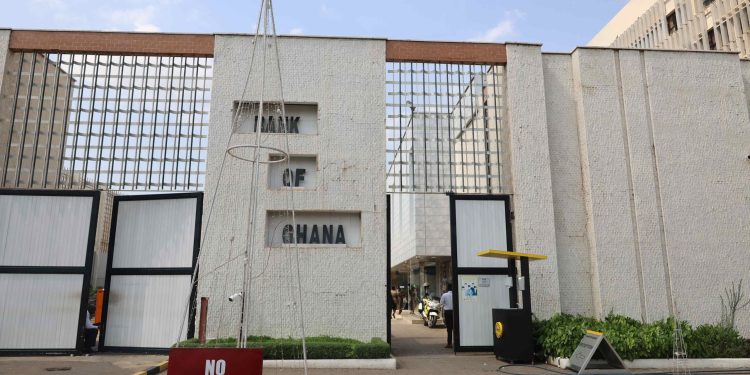
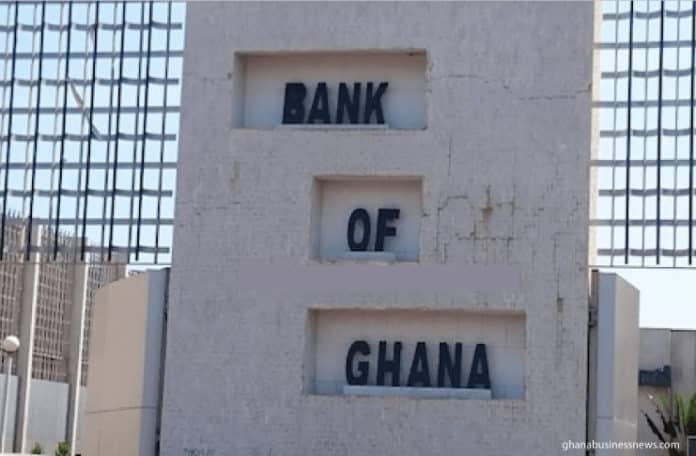
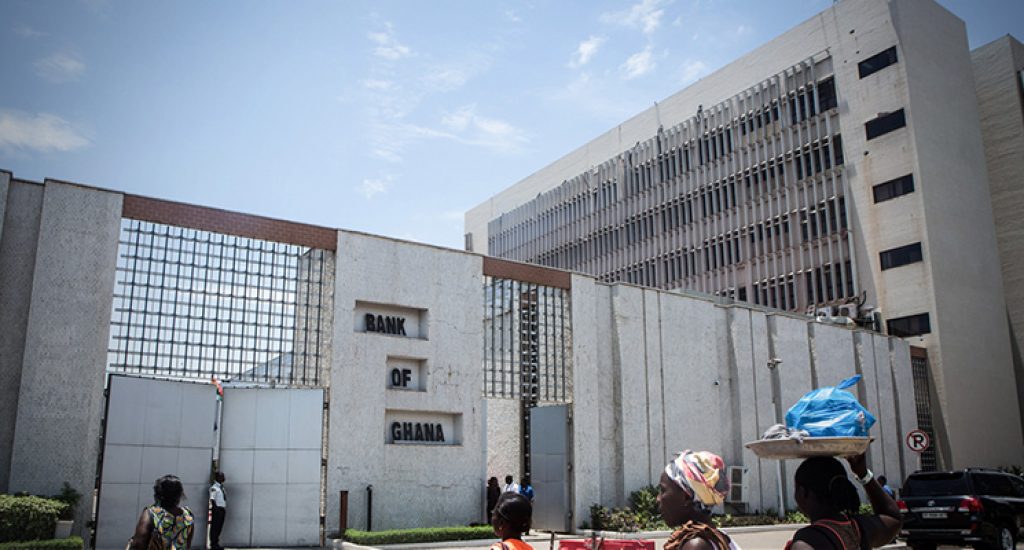
The revelation of a $250 million building project by the Bank of Ghana (BoG) has ignited a fiery response from the general public.
Citizens are expressing a mix of astonishment, concern, and demands for transparency regarding the significant financial commitment.
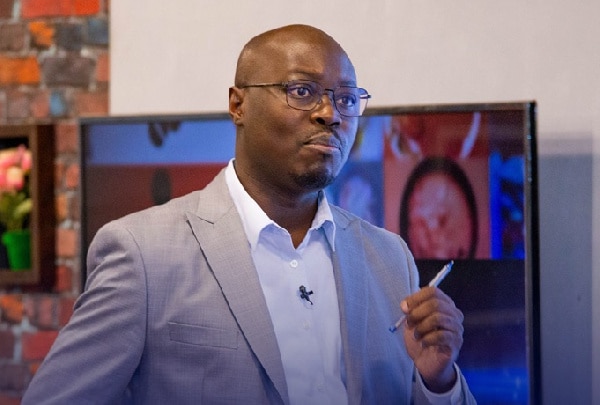
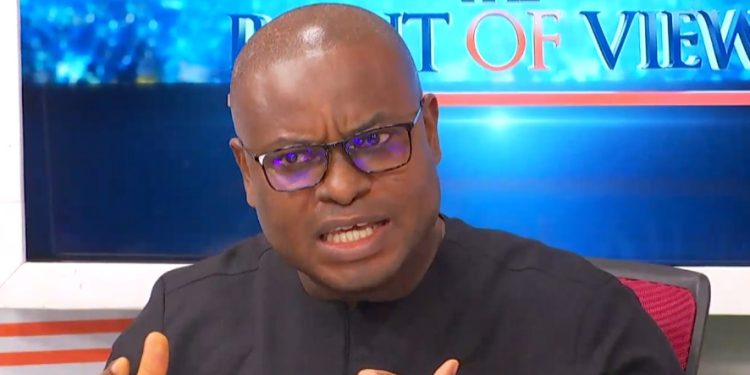
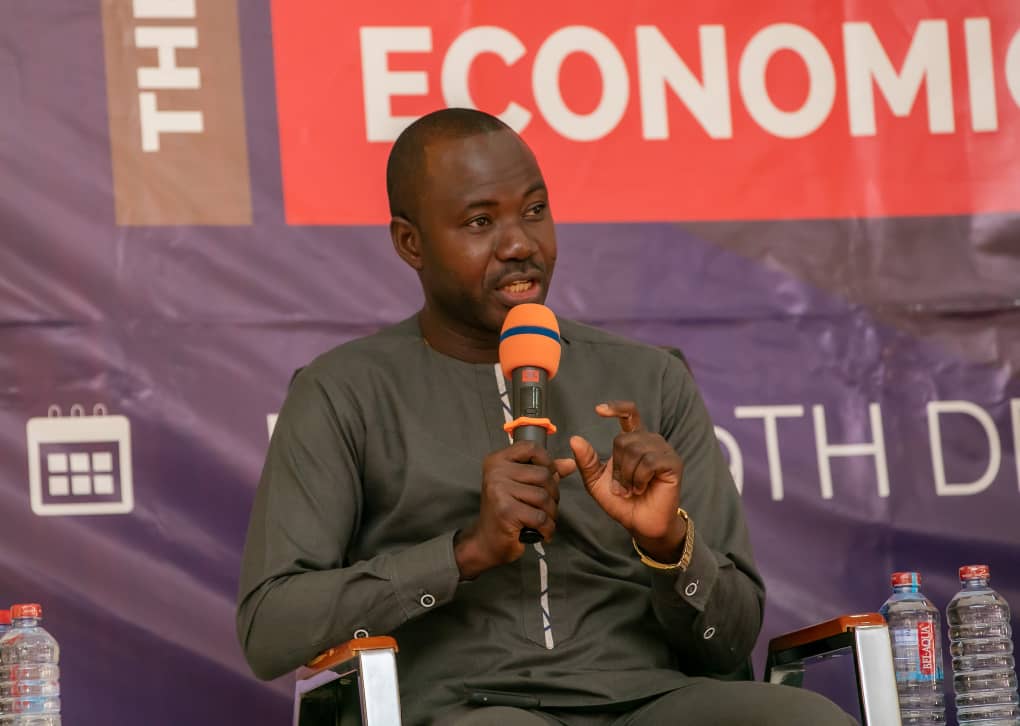
National Democratic Congress (NDC) National Communications Officer, Sammy Gyamfi, has also added his voice to the discourse, questioning the rationale behind the colossal expenditure of the project.
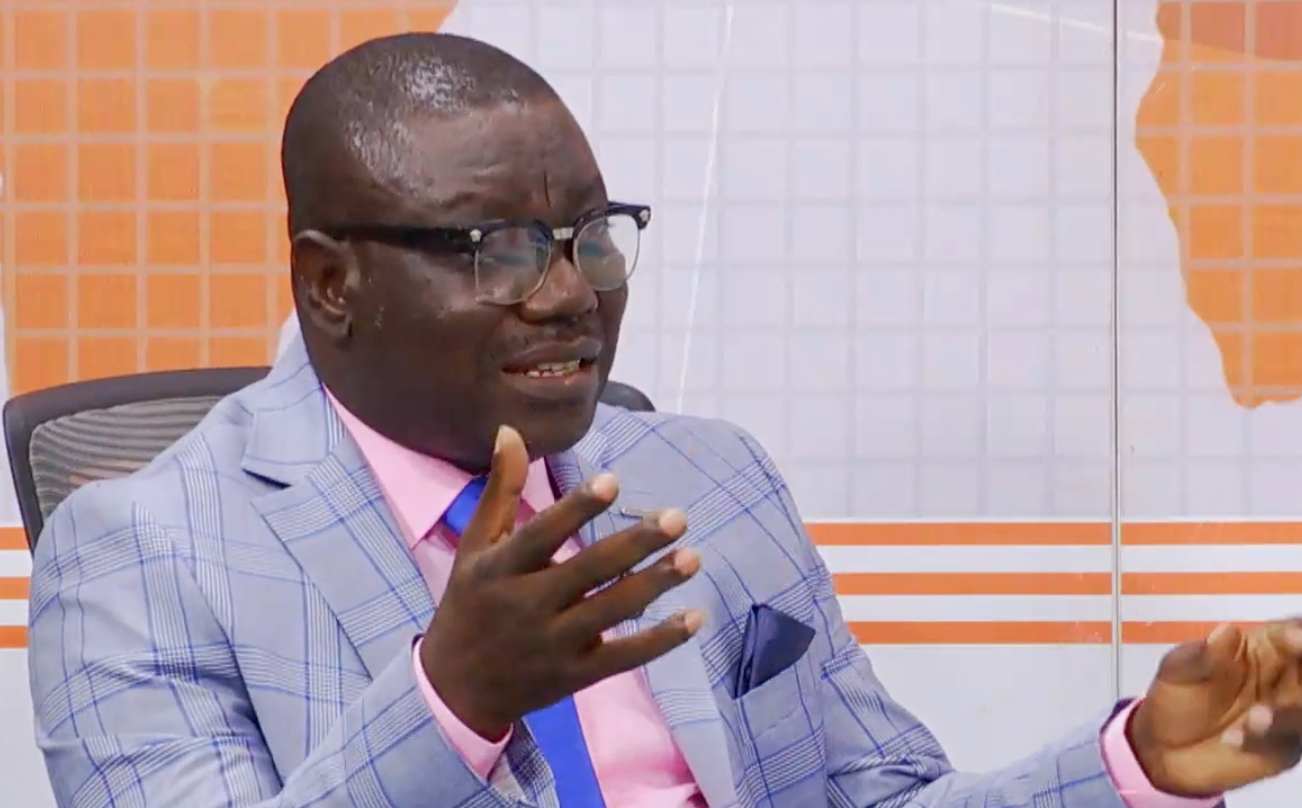
“US$250 million for one building, in a country like Ghana, in this critical time? Why, are you building a new Heaven?” he asked on UTV’s Mpu ne Mpu show.
$250 million for one building, a country like Ghana, in this critical time!!! Are they building heaven? – Sammy Gyamfi#UTVGhanapic.twitter.com/TuSbIVLJEg
The staggering cost associated with the Bank of Ghana’s new building venture has raised eyebrows and sparked a nationwide debate over fiscal prudence and resource allocation. Sammy Gyamfi, known for his vocal stance on political and economic matters, seized the opportunity to express his incredulity over the project’s price tag.
“In these difficult times, when we are supposed to take measures to mitigate the impact of the harsh economic conditions, they are making the construction of a building their priority. Even after recording huge losses the previous year?” a baffled Sammy Gyamfi contended.
“This is the same building the governor under previous administrations since 1957, including Mahama’s administration have,” he added.
RE: RESPONSE TO PARLIAMENT’S MINORITY GROUP ON BANK OF GHANA’S 2022 PUBLISHED ANNUAL REPORT AND FINANCIAL STATEMENTS
The NDC Caucus in Parliament has noted with dismay a press statement from the Bank of Ghana dated 9th August, 2023 which purports to respond to our press conference on the above-subject held on 8th August, 2023.
In the said press statement, the Bank of Ghana attempts to shamelessly justify its recklessness and mismanagement, which resulted in the huge losses of GHS60.8 billion and the negative equity of GHS55.1 billion it recorded in the year 2022.
As a matter of fact, the Bank of Ghana’s unsigned press statement, is full of deliberate distortions and flimsy justifications which do not address the serious matters that were raised in our Moment of Truth presser last Tuesday.
The Minority caucus hereby responds as follows:
The referenced Bank of Ghana’s statement does not address the most fundamental issue which has to do with the printing of money by BOG for the Akufo-Addo/Bawumia/NPP government in 2021 and 2022 in clear contravention of Section 30 of the Bank of Ghana (Amendment) Act, 2016 (ACT 918). Indeed, throughout the statement, BOG does not and could not have offered any reasonable justification for printing a whopping GHS35 billion in 2021 and GHS42 billion in 2022 to finance the Akufo-Addo/Bawumia/NPP government, in clear breach of their governing law.
It is an indisputable fact, that the amount of monies printed by BOG for the reckless Akufo-Addo/Bawumia government both in 2021 and 2022 far exceeds the legally acceptable threshold of 5% of the previous fiscal years’ total revenue.
This the Bank did without cognizance of the legal duty imposed on the Governor of BOG to inform the Minister of Finance, who is required upon notification from the Governor of BOG to notify Parliament of the attainment of the 5% threshold and/or the setting of a new limit of government’s borrowing.
Indeed, the facts show that BOG acted as law unto itself by willfully engaging in the illegal printing of monies to finance the recklessness of the Akufo-Addo/Bawumia/NPP government both in 2021 and 2022.
This illegal conduct of the Governor of BOG constitutes a criminal offense under section 67 of the Bank of Ghana Act and cannot be wished away by the flimsy justifications mounted by the Bank in the multiple press statements they have issued in the last couple of days.
As a matter of fact, contrary to claims by the Governor of the Central Bank and his deputies that they were committed to promoting a cash-lite economy, they have been printing higher denominations of new GHS100 and GHS200 notes.
This together with the large injections of money into the economy caused currency-outside-banks to increase from GH¢14 billion in 2019 to GHȼ31.4 billion by 2022, representing an increase of over 124%.
Strangely, while the BoG kept increasing its policy rate and undertaking these injections at the same time, they knew very well that their actions could spike inflation and result in the Bank incurring significant costs.
As a direct consequence of the illegal printing of monies by the Bank of Ghana, the rate of inflation in the country spiraled to hyper levels last year, when Ghana recorded a record-high inflation rate of 54.1% in December 2022.
It bears reminding the Bank of Ghana that according to a recent World Bank report, this hyperinflation which was mainly occasioned by their recklessness and mismanagement, pushed over 850,000 people into poverty.
It is therefore totally irresponsible for the managers of the Bank of Ghana to conveniently ignore these serious legal infractions which have brought untold hardships on Ghanaians and rather engage in flimsy justifications and needless equalizations.
Secondly, on the very important issue of the illegal write-off of about GHS48 billion debt owed by the government to the Bank of Ghana, the explanation canvassed by the Central Bank in its statement of 9th August, 2023 is untenable, as it has no legal basis whatsoever.
The Bank of Ghana ought to know, that the mere reference to Government’s intention to engage in a domestic debt exchange program (DDEP) as communicated by the Finance Minister in the 2023 budget statement to Parliament, does not and cannot justify the bank’s breach of section 53 of the Public Financial Management Act, 2016.
For emphasis, a mere declaration of intent to Parliament by the government to engage in debt restructuring does not amount to a resolution or approval by Parliament for BOG to write-off public funds. Neither does the IFRS accounting standard referred to by the Bank of Ghana permit the writing-off of public funds without Parliamentary approval.
We wish to state unequivocally for the records, that at no point has the Finance Minister presented a report to Parliament informing the house of the attainment of the 5% borrowing threshold or the setting of a new limit of government borrowing as required by section 30 of the Bank of Ghana Act. Nor has the Finance Minister sought the approval of Parliament for BOG to write-off any public funds, as required by section 53 of Public Financial Management Act 2016 (Act, 918).
The Bank of Ghana must do the needful by immediately reinstating the illegally written off liability of Government and stop the baseless justifications they are mounting.
It is instructive to note that, the Bank of Ghana has for the first time admitted that Ghana’s present economic malaise has been accessioned by a “culmination of fiscal overruns and debt distress” which resulted in Ghana losing access to both domestic and international markets, with its attendant credit rating downgrades, high currency depreciation, hyperinflation among others.
It is worthy of note, that for the first time, the Governor of the Bank of Ghana has effectively confessed, that COVID-19 and the Russia Ukraine war are not the main causes of our present economic woes as a country, but rather “fiscal overruns and debt distress” starting from 2019.
This confession by the Bank of Ghana, confirms the NDC’s long-held view that the economic mess we have on our hands is the product of the reckless borrowing and expenditures of the Akufo-Addo/Bawumia/NPP government.
Sadly, instead of advising the government to embark on the needed fiscal reforms and adjustments, the Bank of Ghana confesses that they decided to fund the recklessness of the government by engaging in the illegal printing of monies for the government, part of which they have illegally written off without recourse to Parliament.
The managers of the Bank of Ghana must recognise that the economic difficulties it alludes to in its statement of 9th August, 2023 are all self-inflicted and cannot be reasonable justification for the palpable illegalities they have engaged in and the unprecedented mess they have created.
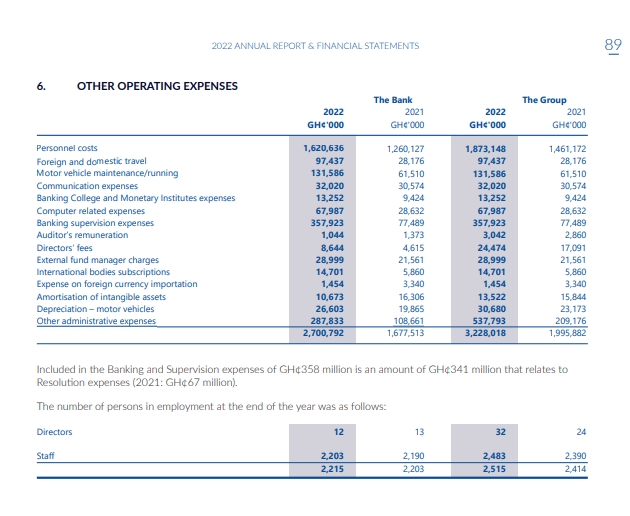
Additionally, we wish to make the point, that none of the explanations put forward by the Bank of Ghana in its press statement of 9th August, 2023 can rationalize or justify the outrageous operational expenditures they engaged in 2022, as reported by their Auditors in the 2022 Annual Report and Financial Statements of the Bank.
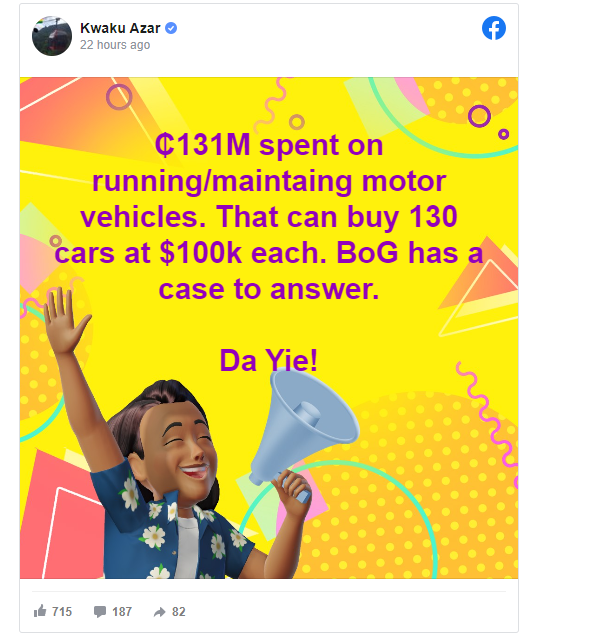
We maintain, that despite the high rate of inflation and currency depreciation recorded last year as a result of the recklessness of BOG and the Akufo-Addo/Bawumia/NPP government, it was unconscionable and unacceptable for BOG to have spent a staggering GHS131.6 million on vehicle maintenance; GHS67.9 million on computer-related expenses; GHS97.4 million on foreign and domestic travels; GHS32 million on communication expenses; and GHS357.9 million on banking supervision, in 2022 alone.
We say so because the severe economic difficulties the nation has been plunged into by the Akufo-Addo/Bawumia government with the abetment of BOG, calls for prudence and austerity by all state institutions including the Central Bank.
It is totally reprehensible, that the fees of the very Directors who have supervised this mess were increased by about 80% in the year 2022 alone.
Even more bizarre is the contrived justification for the new BOG head office which is costing the taxpayer a colossal $250 million (GHS3 billion) at this time of excruciating hardships for the nation.
The excuse that the current Bank of Ghana Head office is not earthquake resistant is most ridiculous to say the least.
We need not remind the Bank of Ghana that previous Governors and Directors of the bank maximized the operations and profit of the bank from that same old facility by deploying more reasonable options of relocating aspects of the bank’s operations to the Cedi House and another facility of the Bank on the Spintex Road.
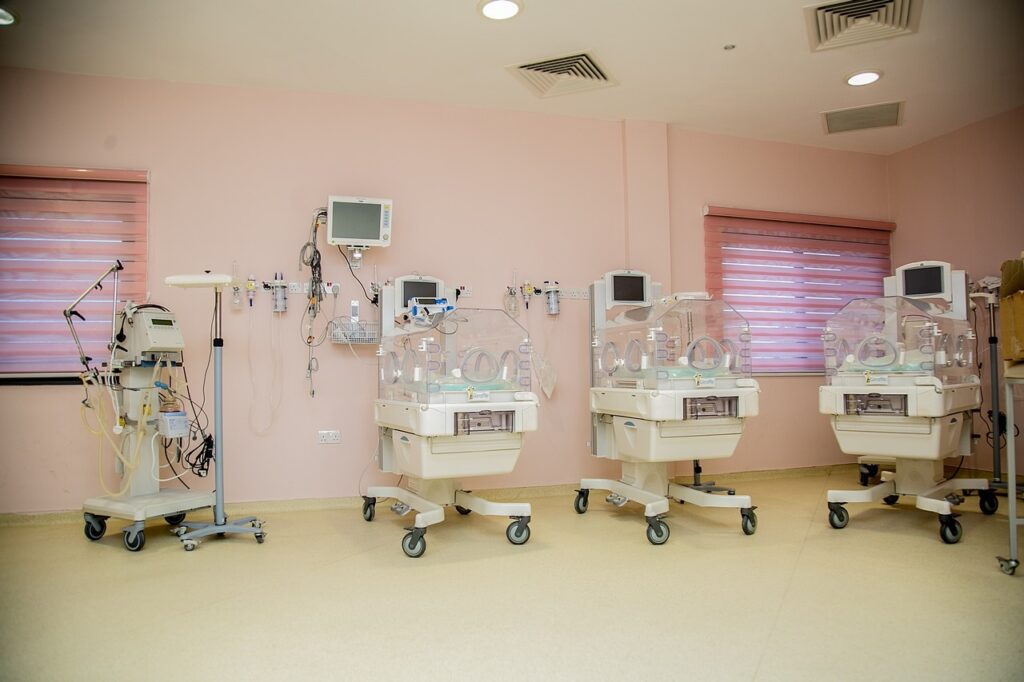
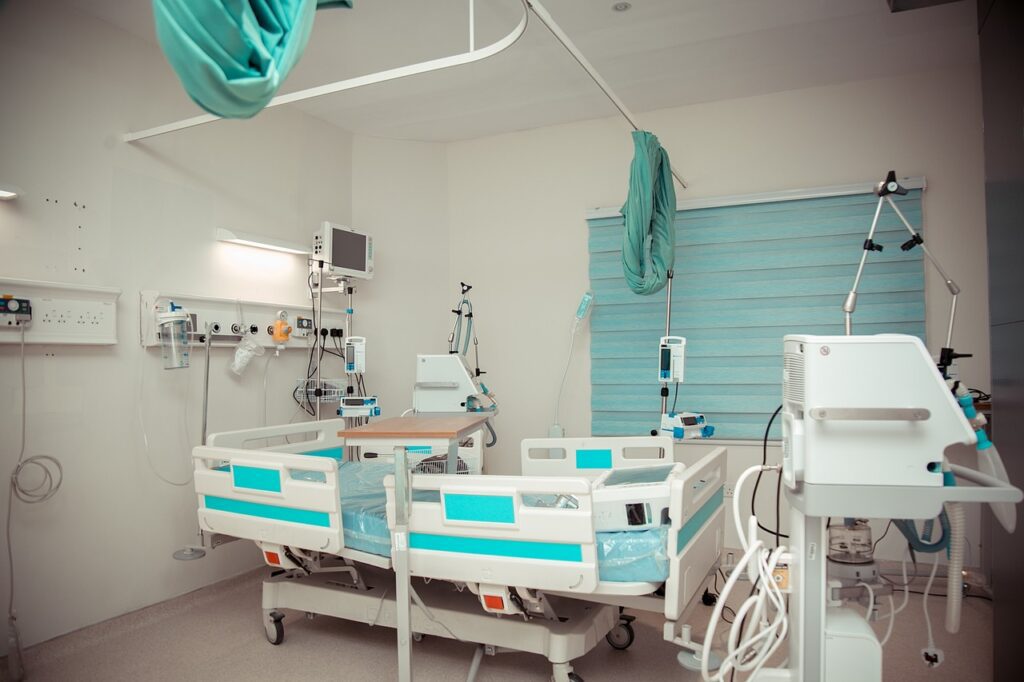
The question BOG must answer is that; if at the time the Bank of Ghana recorded successive years of profit under NDC/Mahama government (2012-2016), the managers of the bank did not consider a new office complex an urgent priority but rather invested in the construction of the BOG hospital to support the healthcare needs of the country, how can BOG prioritize a new $250 million dollar office complex at a time it has recorded an unprecedented loss of GHS60.8 billion and a negative equity of GHS55.1 billion?
It is instructive to note, that the cost of the ill-timed new head office complex the BOG is rapidly putting up is four times the cost of the ultramodern Ecobank Head Office building and six times the cost of Kempinski hotel in Accra.
In fact, our conservative estimates show that the cost of the new head office complex the BOG is putting up can build at least, 3,750 new six (6)-unit classroom blocks to expand access to education or at least 3,500 CHP compounds to improve the access to health care delivery in the country.
It is also instructive to note, that the cost of the new Bank of Ghana head office complex is more than the capital expenditure allocation of the Ministry of Roads and Highways and the Ministry of Transport put together.
Clearly, the outrageously expensive new head office complex of BOG is a misplaced priority. There can be absolutely no justification whatsoever for this profligacy at a time the Bank of Ghana must be concerned about its immediate recapitalization.
In the BOG press release dated August 9, 2023 the Governor stated that “ This financial outcome has very little implication for the operations of the Bank of Ghana as supported by evidence from other Central banks”.
This statement is completely erroneous and must be treated with utmost contempt. The truth of the matter is that the Central banks BOG is referring to, did not underwrite the insolvency or bankruptcy of their Governments. Neither did they violate their governing laws with impunity as BOG has done. Hence, they would have space to absorb temporary losses unlike BOG.
The unprecedented losses incurred by BOG counts for various reasons and must not be taken lightly at all.
The BOG must understand that losses can reduce its gravitas and authority in supervising the financial sector. Also, losses can limit its ability to engage in effective monetary operations and impair its ability to use moral suasion in the discharge of its mandate.
In their press statement of August 1, 2023, BOG referred to a statement by the external auditors that “even though BOG would have a significant negative equity based on the huge impairment from 2022, structures are in place to ensure that the BOG remains policy solvent and well able to deliver on its primary mandate”.
This is clearly a misleading statement because it assumes that government would be able to recapitalize BOG over time and that the achievement of macroeconomic stability would in turn restore policy solvency to BOG.
As BOG itself stated, “the inability to cover costs and build sufficient buffers over the long term may require capital injection from the government which can undermine its independence and credibility of monetary policy and also affect public confidence in the Central bank’s operations”.
We must be mindful of government’s fiscal difficulties, hence the possibility that it may now be able to recapitalize BOG any time soon.
Also, there could be exogenous shocks that can impact the economy going forward which can result in macroeconomic instability and a continued depreciation of the cedi, for which BOG could experience huge losses again.
Therefore, the assessment of the External Auditors that the Central Bank will continue to remain policy solvent and discharge its mandate effectively should not be taken as a guarantee at all.
Again, the impression should not be created as though BOG’s source of funding its operations is infinite. As BOG itself stated in its statement dated August 1, 2023, “a Central bank policy solvency is the ongoing ability to fund and implement operations in line with the policy aims for which it has independent responsibility without recourse to the government. Therefore, policy solvency requires sufficient realized revenues to cover costs and to build longer-term capital reserves allowing for independent and appropriate policy decisions”.
Again, in their press statement dated August 1, 2023, BOG engaged in some unnecessary equalization by referring to other Central banks (not its peers) that have operated with negative equity. It also raised the issue of whether there is a difference between insolvency and negative equity; and, whether other Central banks (again not its peers) made losses in 2022.
The fact remains that the countries cited by BOG are all advanced industrialized countries with different economic structures.
Moreover, those countries did not finance their respective governments excessively, as BOG has done since 2019. Nor did they underwrite the insolvency of their governments like BOG has done.
BOG should rather pay heed and listen to criticisms and stop the window dressing of the dire straits it finds itself in. BOG should accept that the Bank is at a historic low and request immediate help to coerce government to prioritize re-financing the Bank as a matter of urgency.
CONCLUSION There is no gainsaying the fact that, the Governor, his deputies and directors of BOG have compromised their independence and made their continuous stay in office untenable.
Their failed attempt to cite non-best practice as justification for their recklessness and mismanagement is most irresponsible to say the least, and yet another reason why they should pack out of the Bank of Ghana immediately
The fate of BOG now hangs solely on the ability of the bankrupt Akufo-Addo/Bawumia/NPP Government to recapitalize it.
In fact, it will take the nation more than 20 years to fix the mess that the current managers of BOG have created and move the bank from its current negative GHS55.1 billion equity to positive equity.
There is an urgent need for BOG’s internal operations to be reviewed to ensure that no losses would be posted or repeated this year.
The Governor, his deputies and entire Board have failed the nation and must resign without delay to begin the process of saving the BOG.
The International Monetary Fund (IMF) has taken action to allay concerns raised by the Bank of Ghana’s (BoG) significant GH60 billion loss recorded during the fiscal year of 2022 by explicitly stating that there is no immediate need for alarm, thereby attempting to allay any prevailing anxieties within the economic landscape.
The Bank of Ghana (BoG) has come under intensified examination from opposition political groups and civil society organizations as a consequence of the significant loss it experienced.
On Tuesday, Dr. Cassiel Ato Forson, the Minority Leader, firmly expressed his position by calling for the resignation of Governor Dr. Ernest Addison and his deputy officials, asserting that the losses were a result of negligence within the central bank—a claim that the Bank of Ghana promptly refuted.
The IMF has since posted a detailed explanation on its official website, shedding light on the BoG’s participation in the Domestic Debt Exchange Programme (DDEP), a critical facet of the government’s strategy to reestablish macroeconomic stability and public debt sustainability.
The IMF clarified that the BoG’s involvement in the DDEP was intended to distribute the burden of the program among various entities, including government debt holders, financial institutions, banks, pension funds, and individuals.
The incurred loss, as per the IMF, has played a role in diminishing the BoG’s net equity to a negative value.
However, the IMF underscored that this occurrence does not hinder the BoG’s ability to fulfill its policy mandates and execute measures to steer inflation gradually towards its 8-percent target.
The IMF expressed confidence that the central bank’s income is anticipated to be sufficient for covering operational costs related to monetary policy.
Consequently, the IMF expects the BoG’s net equity to witness significant improvement over time, eventually returning to positive territory.
Below is the IMF’s post about the BoG’s losses;
Why did the Bank of Ghana (BoG) incur losses from the authorities’ domestic debt exchange and what are their implications?
The Ghanaian authorities’ domestic debt exchange (DDE) is a key element of their plan to restore macroeconomic stability and public debt sustainability. The BoG is participating in the DDE to share some of the burden the DDE places on government debt holders, along with banks, other financial institutions, pension funds and individuals.
The loss the BoG incurred in the process has contributed to reducing its net equity to a negative value. Importantly, however, this does not prevent the BoG from fulfilling its policy mandates and ensuring inflation gradually returns toward its 8-percent target. Indeed, central bank income is expected to be sufficient to cover monetary policy operational costs. The BoG’s net equity is expected to improve significantly over time and eventually return to positive territory.
2024 flagbearer for the National Democratic Congress (NDC), John Dramani Mahama, has chided the Governor of the Bank of Ghana (BoG), Dr Ernest Addson, for failing to assume responsibility for the recent loss incurred by the institution.
The Annual Report and Financial Statement of the Bank of Ghana reveals that the institution incurred a loss of GH¢60.8 billion for the 2022 fiscal year.
The Central Bank explained that a significant portion of the overall GH₵60 billion loss, specifically GH₵53.1 billion, can be attributed to the government’s implementation of the Domestic Debt Exchange Programme (DDEP).
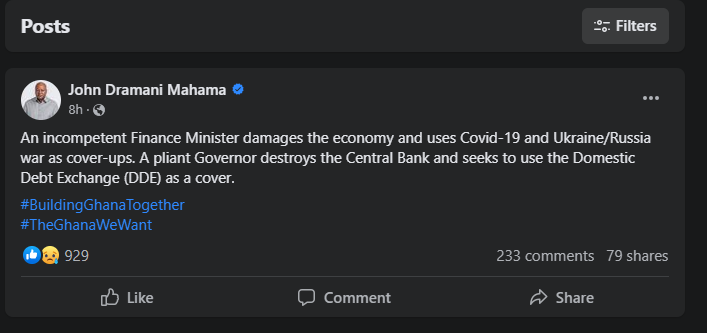
In response, former President John Mahama, noted that Dr Ernest Addson has decided to use the government’s Domestic Debt Exchange Programme (DDEP) as a cover to conceal his ineffectiveness.
In a Facebook post on August 10, he compared Dr Addsion, whom he alleges is being controlled by the government, to Finance Minister Ken Ofori-Atta, whom he also says has blamed Covid-19 and the Russia/Ukraine war for Ghana’s economic crisis due to his incompetence.
“An incompetent Finance Minister damages the economy and uses Covid-19 and Ukraine/Russia war as cover-ups. A pliant Governor destroys the Central Bank and seeks to use the Domestic Debt Exchange (DDE) as a cover,” he wrote.
The Bank of Ghana insists that it intervened to mitigate a substantial economic and societal predicament arising from the failure of the DDEP.
“The Bank of Ghana was used to close the gap to enable Ghana to meet the debt threshold that qualified Ghana for the IMF programme. The Bank of Ghana, therefore, acted as a loss absorber,” a statement from the Central Bank posted.
The Bank of Ghana further elaborated that a subsequent deterioration in Ghana’s sovereign debt rating, resulting in the restriction of the nation’s access to international capital market borrowing, was the catalyst for a liquidity crisis.
This crisis, in turn, had cascading effects, leading to a broader balance of payments crisis.
Meanwhile, the Minority in Parliament is demanding the immediate removal of Dr Ernest Addison over the “mismanagement” of the Central Bank.
Each independent director on the board of the Bank of Ghana is allegedly paid US$8,000 per month, according to Bright Simons of IMANI Africa.
According to the Bank’s 2022 annual report, there are thirteen directors total, including the governor, his two vice presidents, and the remaining 10 directors.
He points out that the number is higher than average compared to other African nations, particularly Kenya and Nigeria.
His message was sent at a time when the Minority in Parliament is pressuring the bank’s leadership to leave due to a loss that, according to the most recent report, is equal to $6 billion USD.
“The Bank of Ghana has 10 independent Directors. It seems some people, esp in the Political Opposition, are not happy that they are paid ~$8,000 a month (~86,000 GHS).
Given the calibre of people needed to helm a central bank board, what would folks be comfortable with?” he quizzed.
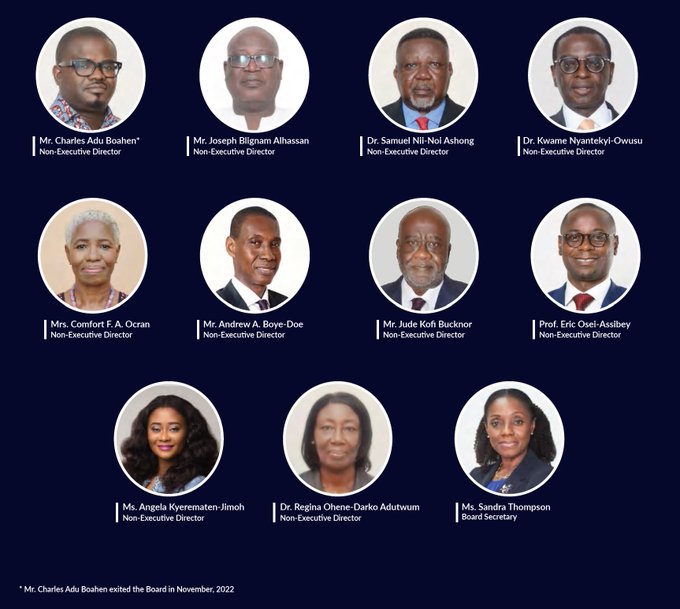
The ten independent directors are as follows:
Dr. Samuel Nii-Noi Ashong – Non-Executive Director Mr. Joseph B. Alhassan – Non-Executive Director Dr. Kwame Owusu-Nyantekyi – Non-Executive Director Mr. Andrew Boye-Doe – Non-Executive Director Mrs. Comfort F. Ocran – Non-Executive Director Mr. Jude Kofi Bucknor – Non-Executive Director Dr. Regina Ohene-Darko Adutwum – Non-Executive Director Mr. Charles Adu Boahen – Non-Executive Director (Till 24/11/2022) Ms. Angela Kyerematen Jimoh – Non-Executive Director Prof. Eric Osei-Assibey – Non-Executive Director
Deputy Minister for Finance, Dr. John Ampontuah Kumah, has defended the Governor of the Bank of Ghana (BoG), Dr Ernest Addison and his two deputies in response to the National Democratic Congress (NDC)’s call for their resignations.
On August 8, the Minority Leader, Dr Cassiel Ato Forson, accused Dr Ernest Addison of reckless mismanagement of the Central Bank as it incurred a loss of GH¢60.8 billion from its audited financial statement for the 2022 fiscal year.
The Minority therefore issued a 21-day ultimatum for the resignation of the governor of the Bank of Ghana.
But Dr. Kumah has urged the public to disregard what he labeled as “funny propaganda” against both the central bank’s leadership and the entire government.
In a Facebook update on Wednesday, August 9, the Member of Parliament for Ejisu emphasized that the BoG is in a stable condition and is far from facing any potential collapse.
He explained that the primary revenue source for the BoG comes from government transactions. As a result, any reduction in such transactions would naturally impact the central bank’s income.
“Ignore this funny NDC Propaganda about the collapse of the Bank of Ghana (BoG). BoG is Solid!”
“The NDC is funny! It’s not true that a recapitalization levy is to be introduced for BoG, the Central Bank hasn’t collapsed.”
“The main source of income to the Bank is from government transactions i.e. fees on all government transfers, the bank’s investments in marketable instruments and also earnings from non-marketable holdings of the Bank.”
“Given that government transactions have gone down, naturally, the income of the bank will go down. Also, because of the debt restructuring, earnings on their holdings on markable and non-marketable bonds will go down,” he posited.
He added that “Beyond this, the Bank is solid and is capable of performing its core function. Article 183 clause 2 (c) of the 1992 constitution enjoins the Bank of Ghana to promote and encourage economic development in the country, hence there is nothing untoward in the actions of the Central Bank to support the state in its economic recovery efforts.”
The Deputy Minister also implied that the losses incurred by the central bank are not uncommon, as many central banks globally experience similar situations while pursuing economic stabilization goals.
Bank of Ghana’s response
The substantial loss of GH₵60 billion included a significant portion of GH₵53.1 billion attributed to the government’s Domestic Debt Exchange Programme (DDEP), as per a Bank of Ghana’s report.
The Bank’s statement clarified that its intervention was necessary to avert a significant economic and societal crisis due to the failure of the domestic auction process.
Furthermore, the Bank of Ghana outlined that a deeper decline in Ghana’s sovereign debt rating resulted in the restriction of the country’s access to international capital market borrowing. This, in turn, triggered a liquidity crisis, which subsequently escalated into a balance of payments crisis.
It added that “In 2 months, the Bank of Ghana lost $500 million in reserves and built significant overdraft with the government as a result of the auction failures.
“It became clear that Ghana was on an unsustainable path, and the Government had to approach the IMF for support in July 2022.
“The IMF process included putting into place a credible programme of reform, which included restructuring the total government debt to sustainable levels.
“Until the Staff Level Agreement with the IMF was reached in December 2022, the Bank of Ghana had to continue to provide the necessary support to keep the economy running.”
Deputy Director of Communications for the New Patriotic Party (NPP), Jennifer Queen, has advised the Communications Director for the National Democratic Congress (NDC), Sammy Gyamfi, to file a class action lawsuit against the Bank of Ghana over the loss of GH¢60.8 billion.
The Annual Report and Financial Statement of the Bank of Ghana reveals that the institution incurred a loss of GH¢60.8 billion from its audited financial statement for the 2022 fiscal year.
This loss, according to the Bank of Ghana, is largely due to the government’s debt restructuring activities.
In response, Sammy Gyamfi noted that such a colossal loss can be attributed to the Central Bank’s Directors’ “criminality and recklessness.”
NDC National Communications Officer, Sammy Gyamfi
Speaking in an interview with Citi FM on Tuesday, August 8, he said the NDC will build forces together to bring sufficient pressure on “these wreckers.”
“And we will be occupying the BoG together with the media to bring to bear sufficient pressure on these wreckers. Until they resign, they will have no peace of mind,” he added.
Taking an opposing stance, Jennifer Queen noted that such a radical approach is not the way to go and urged for a diplomatic measure.
In an interview on Okay FM’s Ade Kyea Bia on August 9, 2023, she said: “ if Sammy Gyamfi feels like things are not going on well and he doesn’t understand, he is a lawyer who practices democracy so there is nothing that stops him from taking the issue to court and sue the Bank of Ghana.”
“Ignore this funny NDC Propaganda about the collapse of the Bank of Ghana (BoG). BoG is Solid!”
“The NDC is funny! It’s not true that a recapitalization levy is to be introduced for BoG, the Central Bank hasn’t collapsed.”
“The main source of income to the Bank is from government transactions i.e. fees on all government transfers, the bank’s investments in marketable instruments and also earnings from non-marketable holdings of the Bank.”
“Given that government transactions have gone down, naturally, the income of the bank will go down. Also, because of the debt restructuring, earnings on their holdings on markable and non-marketable bonds will go down,” he posited.
He added that “Beyond this, the Bank is solid and is capable of performing its core function. Article 183 clause 2 (c) of the 1992 constitution enjoins the Bank of Ghana to promote and encourage economic development in the country, hence there is nothing untoward in the actions of the Central Bank to support the state in its economic recovery efforts.”
Meanwhile, Sammy Gyamfi, has accused the Bank of Ghana of printing an amount of GHC80 billion for the government of Ghana.
In an interview on Onua TV, he noted that despite the “unlawful” funding to the government, there is currently nothing to show.
“More than 50 percent of the total revenue. They are living like there is no law. The impunity. After supplying the government over GHS80 billion, let’s ask ourselves what government used the money for,” he said,
He noted that the amount of money printed by the Central Bank for the Akufo-Addo-led government comes nowhere close to the loans that were taken by the erstwhile Mahama government.
“He (John Mahama) borrowed GHS54 billion. This does not even include the accumulated debt of this government,” he added.
The Central Bank of Ghana has provided justification as to why the institution is investing $250 million in a new headquarters amidst an economic crisis.
In a press statement, the Bank of Ghana explained that the need to construct a new headquarters stems from earthquake threats.
According to the Central Bank, its current structure, built in the 1960s, lacks structural integrity, and is therefore incapable of withstanding an earthquake.
“A structural integrity assessment conducted by the BoG revealed that the current BoG Head Office building, built by the Nkrumah Government in the early 1960s, is no longer fit for purpose and could not stand any major earth tremors.”
“The outcome of the structural integrity work was that the main building does not satisfy the full complement of excess strength required for a building to be considered safe for usage. This means that in the case of a worst-case gravity and wind loading scenario, for example, unusually strong wind, the building may be significantly affected.”
This comes after the Minority questioned the investment being made by the Bank of Ghana under the supervision of Governor Dr Ernest Addison.
Minority Leader, Dr Cassiel Ato Forson at a National Democratic Congress (NDC) press conference on Tuesday, August 8, accused the Bank of Ghana of building a new head office at an alleged amount of $250 million.
“Perhaps the more troubling fact is that, having brought the Bank of Ghana to this terrible financial state, the Governor and his deputies, have found it prudent and expedient to invest $250 million (GHC2.8 billion) on another Head Office building somewhere at Ridge. In our circumstances, this is the height of insensitivity in the management of the finances of a troubled country,” he said.
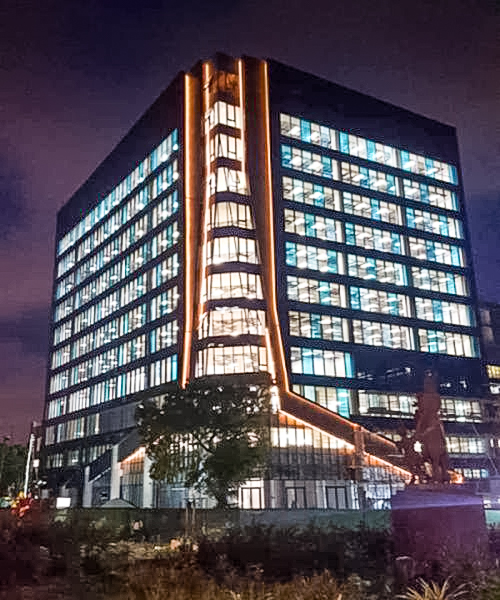
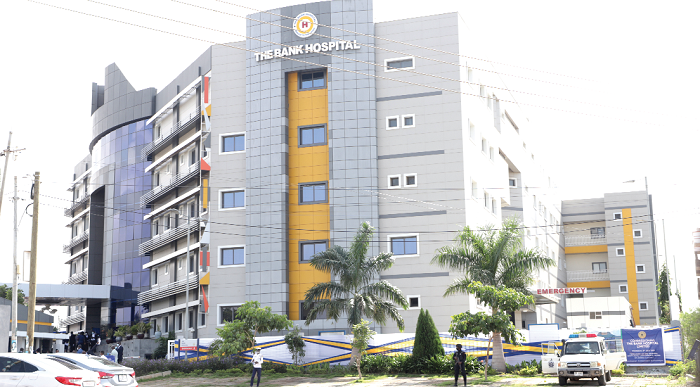
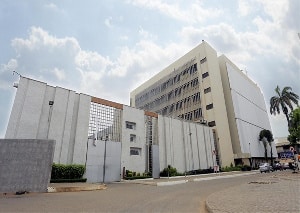
The $250 million project which is a 21-storey facility, is specifically in Ridge in the Greater Accra Region, adjacent the Greater Accra Regional Hospital, Ridge.
Currently, under construction, the project, which is reportedly 50% complete, has been awarded to De Simone Limited.
The Bank of Ghana’s loss of Gh60.8 billion has been brought into question, and Rev. Dr. Samuel Worlanyo Mensah, an economist and lecturer at Wisconsin International University College, has urged Parliament to look into it.
Despite the loss being attributed by the Central Bank to the domestic debt restructuring program in its 2022 annual report, he claimed that a Parliamentary committee should be established to look into possible inconsistencies and illegalities.
“Is it not frightening that the Bank of Ghana would superintend over this huge loss? I believe there were irregularities and illegalities and a Parliamentary committee must investigate the Gh¢ 60.8 billion loss and any wrongdoing found must be punished,” Dr Mensah said.
He suggested that the investigation should encompass other statutory transactions that the Bank had engaged in over the past 8 to 10 years.
The Bank of Ghana clarified the reason for the loss as being due to the impairment of marketable government stocks and non-marketable government instruments held in their records.
The accumulation of government instrument stocks had occurred over the years, with these holdings and COCOBOD exposures being part of the debt exchange in which the Bank of Ghana acted as the loss absorber for the entire debt exchange program.
This led to the central bank assuming a 50 percent principal reduction on the total principal, which amounted to Gh¢ 64.5 billion at the time of the exchange.
In an interview with the Ghana News Agency, he remarked that the government didn’t spend extensively on those transactions, hence the program shouldn’t be categorized as an expenditure attributable to the Bank of Ghana’stransactions.
He emphasized that the same rationale used for revoking licenses of certain financial institutions during the banking sector cleanup should be applied to investigating the central bank for any irregularities.
“As a crucial regulator and a huge industry player, you can’t do things haphazardly. The Bank of Ghana had not given the breakdown of how it incurred the loss, raising a concern for interrogation,” the Lecturer said.
He said if the details had been provided and cost-benefit analysis and investigation had proven that the Bank was complicit, then those who oversaw activities leading to the loss should be charged for mismanagement, misappropriation and misapplication of public funds.
Dr Mensah said Ghanaian had been going through a serious socioeconomic turmoill and the loss of such a colossal amount of money (Gh¢ 60.8 billion) which is equivalent to about $5.4 billion, more than the $3 billion IMF bailout be “swept under the carpet.”
“The Gh¢ 60.8 billion could be used to champion the industrialisation drive, that is the One District One Factory. The money could build all the factories for us in all the districts across the country,” he added.
A whopping $250 million is being expended by the cto construct a new Headquarters in the heart of Ghana’s Capital, Accra.
The project, which is a 21-story facility, is specifically in Ridge in the Greater Accra Region, adjacent to the Greater Accra Regional Hospital, Ridge.
Currently under construction, the project, which is reportedly 50% complete, was awarded to De Simone Limited
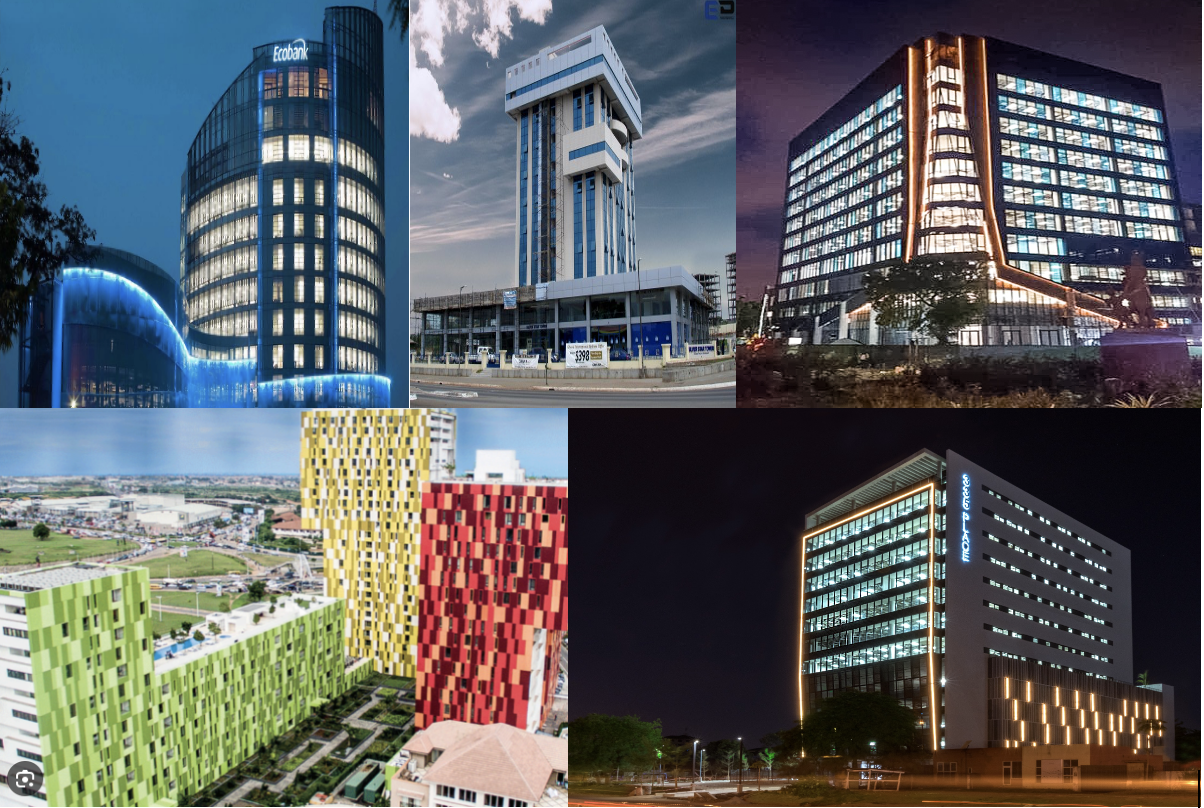
Here are some iconic building whos’ combined cost is still cheaper than Bank of Ghana new head office
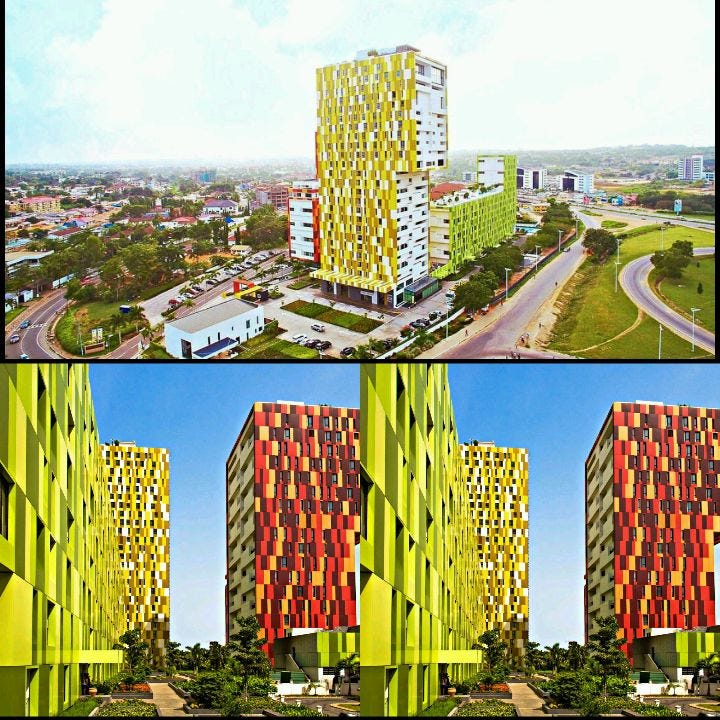
Villagio Vistas Alto
The yellow coloured Villagio Vistas Alto is currently the tallest building in Ghana at 30 storeys and an estimated height of 93 metres (about the length of a football field).The red coloured Villagio Azure is the second tallest building in Ghana at 17 storeys and an estimated height of 71 metres. The green coloured Villagio Aqua is the shortest of the three structures at 7 storeys. The project was completed in phases between 2011 to 2014, and was reported to cost an estimated £80 million.
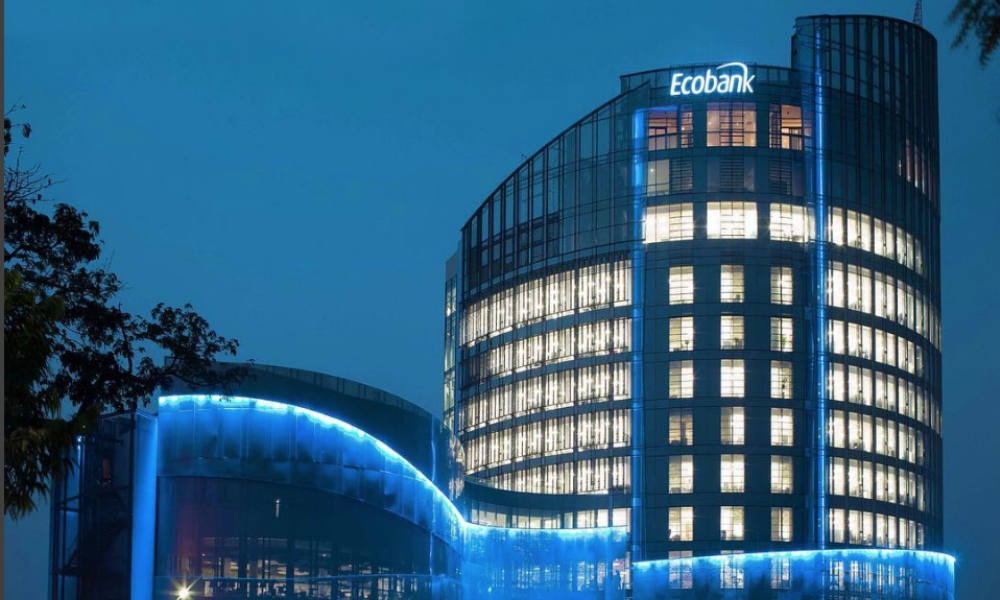
Head Office of Ecobank
The new Head Office of Ecobank Ghana cost $60 million dollars.
This building is a customer centric ultramodern edifice with 2 towers sitting on a podium and 2 levels underground. The property covers a 27000 square meter area. The 1st Tower (A) is a 14-floor block of Corporate Offices, board rooms, meeting room, executive dining area and a rooftop executive cocktail lounge.
There are 27 meeting rooms and 2 executive board rooms, a staff gym and a media room. The second Tower (B) is a 5 floors block with a 2 level Banking Hall facility, Ultramodern Auditorium, a coffee lounge, a Staff Clubhouse and 2 canteens. There is also a wide ATM arena for personal banking transactions.
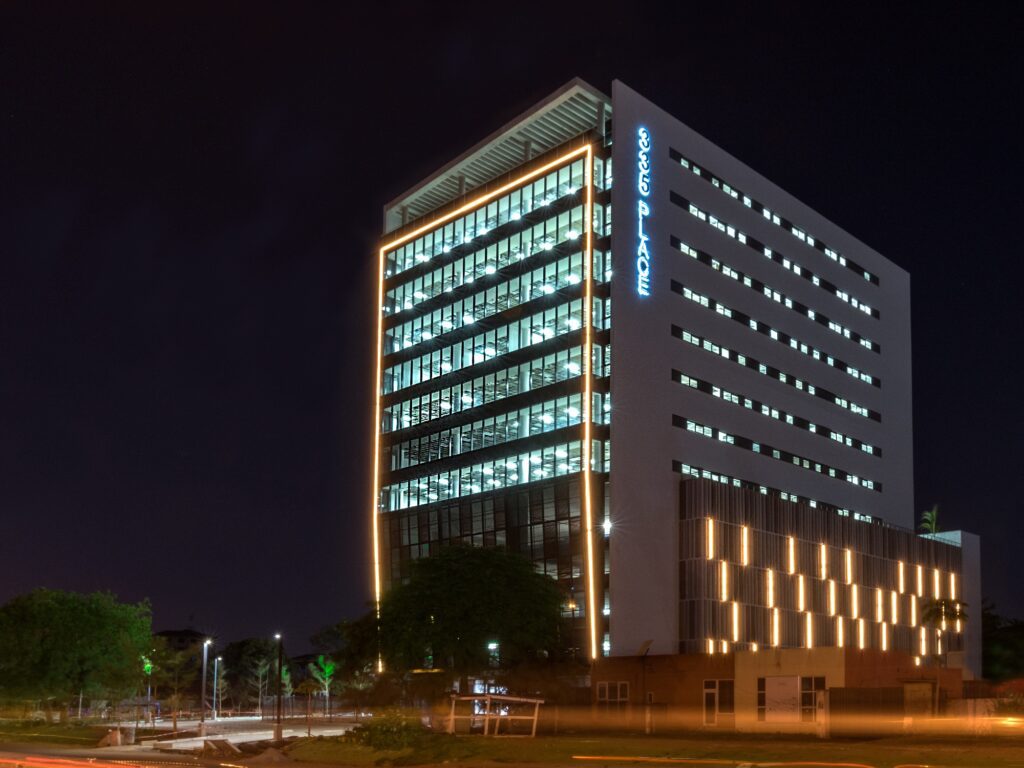
SU Tower and 335 Place
SU Tower and 335 Place is a new A-Grade offices developed by Eris Property Group in Accra Ghana setting a new benchmark for developments in the country. These two properties namely 335 Place and SU Tower offering first of its kind office buildings for Ghana are being developed at a combined cost of $83,2 Million.
335 Place is a 12-Level 9,985square meter office tower and The SU Tower is a 14-storey 12,835 square meter office tower.
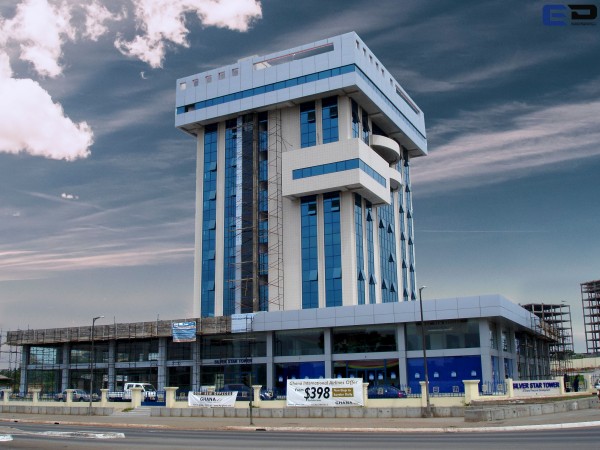
Silver Tower
The project which cost $8 million involved local Architectural support at Post Contract.
Brief description – 9-storey Motor Showrooms, offices and Bank. Client – Japan Motors Trading Company Limited.
Brief description – 9 storeys Office Block with basement parking and a modern Shopping Mall with internal Plaza. Client – State Insurance Company Limited. (SIC) / THORPE ROAD PROJECT.
Communications Officer for the National Democratic Congress (NDC), Sammy Gyamfi, has accused the Bank of Ghana of printing an amount of GHC80 billion for the government of Ghana.
In an interview on Onua TV, he noted that despite the “unlawful” funding to the government, there is currently nothing to show.
“More than 50 percent of the total revenue. They are living like there is no law. The impunity. After supplying the government over GHS80 billion, let’s ask ourselves what government used the money for,” he said,
He noted that the amount of money printed by the Central Bank for the Akufo-Addo-led government comes nowhere close to the loans that were taken by the erstwhile Mahama government.
“He (John Mahama) borrowed GHS54 billion. This does not even include the accumulated debt of this government,” he added.
The Bank of Ghana has recently come under intense scrutiny after it posted a loss of GH¢60.8 billion in its audited financial statement for the 2022 fiscal year.
This loss, according to the Bank of Ghana, is largely due to the government’s debt restructuring activities.
Speaking at a press briefing in Accra on August 8, 2023, the NDC leveled a series of allegations against Dr Addison, including claims that his actions and inactions have amounted to significant financial loss to the state.
In view of this, Minority Leader Dr Cassiel Ato Forson notes that Dr Ernest Addison ,whom he claims has recklessly mismanaged the Central Bank and brought it to its knees, cannot remain at the helm of affairs of the bank without being held accountable.
The Minority has therefore issued a 21-day ultimatum for the resignation of the governor of the Bank of Ghana.
More than US$2 million was spent by the Bank of Ghana in purchasing two gold watches, the National Democratic Congress (NDC) has said.
According to the Minority Leader, Dr Cassiel Ato Forson this information was contained in the recently released Bank of Ghana (BoG) Annual report and Financial Statement.
The Member of Parliament (MP) for the Ajumako Enyan Esiam Constituency noted that: “We also saw in the report that the Bank of Ghana indeed spent an amount of US$2million on gold watches.”
He made the remarks during a press conference on Tuesday, August 8, 2023, at the NDC headquarters in Accra.
During the presser, he leveled various allegations against the Bank of Ghana Governor Ernest Addison, whom he accused of supervising gross mismanagement of funds at the Central Bank.
“After this dastardly act of over-lending to the government by the Central Bank, they then proceeded to do the unthinkable – to write-off a whooping GHC 48.4 billion, about half of Ghana Government’s indebtedness to the Central Bank, without parliamentary approval. This is illegal and criminal and the NDC Members of Parliament will not allow this to pass.
“Beyond the mismanagement of the economy and our finances, the spectacular recklessness and ineptitude of the Governor and his team has called into question the wisdom of leaving him at the helm of affairs of the Central Bank,” Dr Ato Forson said.
He further accused the governor of supervising the loss of huge sums of money which cannot be accounted for.
“The Report revealed that millions of Ghana Cedis have been wasted on frivolous administrative
expenditures. The Bank of Ghana spent a whopping GHC131.6 million on Motor vehicle maintenance and running in 2022 alone – a 114% increase over the previous year’s expenditure.
“Similarly, foreign and domestic travels of the Bank of Ghana cost the Ghanaian tax payer a staggering GHC97.4 million, which is about 246% increase over the previous year,” he said.
The Minority Leader further indicated that the Bank of Ghana dissipated another GHC8.6 million on Director’s remuneration alone.
“This represents about 87% increase over the previous year’s expenditure. This simply means that Ghanaians were charged a “Mismanagement Fee” to deliver the collapse of the Bank. The Bank further claimed to have spent a colossal GHC357.9 million on Banking Supervision Expenses. The report disclosed that the bank spent a whopping GHC67.9 million on computer expenses while communication expenses amounted to GHC32 million.
Additionally, “the Report disclosed ‘other’ undisclosed expenses amounted to GHS287.8 million of the taxpayer’s money. Perhaps the more troubling fact is that, having brought the Bank of Ghana to this terrible financial state, the Governor and his deputies have found it prudent and expedient to invest $250 million (GHC2.8 billion) on another Head Office building somewhere at Ridge,” Dr Forson said.
It is in view of this and other claims that the CDC has issued a 21 day ultimatum to the governor of the Bank of Ghana or face their wrath.
“In our circumstances, this is the height of insensitivity in the management of the finances of a troubled country. The BOG’s illegal printing of money is responsible for the depletion of Ghana’s external reserves which resulted in the unprecedented depreciation of the Cedi, the main cause
of hyperinflation in 2022. It is important to state that the Governor breached section 30 (7) of the Bank of Ghana Act, 2012 (Act 612 ) and Section 60 of the Bank of Ghana Amendment Act, 2016 (Act 918). An estimated 850,000 people were further reported to have been pushed down the poverty line as a result of the hyperinflation in 2022.
“In this regard, we call for the resignation of the Governor of the Central Bank and his deputies within 21 days from today. We are resolved to embark on popular action to occupy the Central Bank and drive out the team of inept, callous and criminal mismanagers of the finances of this country and Save the Bank of Ghana. The March to Ensure Accountability will begin in 21 days if the Governor of the Bank of Ghana does not do the needful and pack bags and baggage out of that sacred institution that he has so desecrated. Dr Ernest Addisson Must Go! There has to be an end to impunity and it is NOW!” he said.
The Bank of Ghana (BoG) is well-respected outside of Ghana but has been making a number of errors, according to famous economist Kwame Pianim.
Mr. Pianim believes that Bank representatives ought to have met with members of the Finance Committee of Parliament to explain the catastrophic situation the nation was in and to provide them with information on the suggested course of action.
He claimed that if this meeting had taken place, the controversy surrounding the Bank’s assistance to the government would not have existed.
“The Bank of Ghana is respected outside but they are making mistakes,” he said.
He added, “They should have alerted the entire committee of the chair about the challenges and that we are going to print money.”
Mr Pianim further indicated that Ghana is in a deep crisis.
“Where we are now is difficult, we have never been there before, we need to sit up now and, we are not on the road yet we haven’t turned the corner,” he said.
It is noted that Ken Ofori-Atta, the finance minister, assured Parliament that the administration had overcome its economic difficulties.
On Monday, July 31, he stated during the presentation of the 2023 mid-year budget review that the government had made great efforts to prevent empty store shelves for medicines and other necessities, and that there had been no food shortages in the nation.
“We have been spared the frustrating spectre of long queues for fuel at our filling stations; and, we have managed, in spite of all the challenges, to keep the lights on,” he said.
“Indeed, as the Psalmist said (in Psalm 118:23) this is the LORD’s doing; and it is marvellous in our eyes.
“This ‘turning the corner’ is underpinned by the investments and sacrifices we have collectively made during this difficult period since March 2020,” he added.
It is claimed that the Central Bank spent a total of GHS287.833 million in 2022 and is currently unable to show what the money was spent on.
Minority Leader, Dr Cassiel Ato Forson, made this claim on August 8, while addressing the press from the headquarters of the National Democratic Congress (NDC).
He cited the 2022 Annual Report and Financial Statement of the Bank as the basis for his assertion.
According to Dr Ato Forson, the report manifests “mismanagement, ineptitude and potential corruption at the Bank of Ghana.”
In the said report, the Central Bank noted that GHS287.833 million was spent on “Other administrative expenses,” for which it failed to provide specifics.
In 2021, “Other administrative expenses” cost the Bank of Ghana GHS108,661 million. This is a difference of GHS179,172 million.
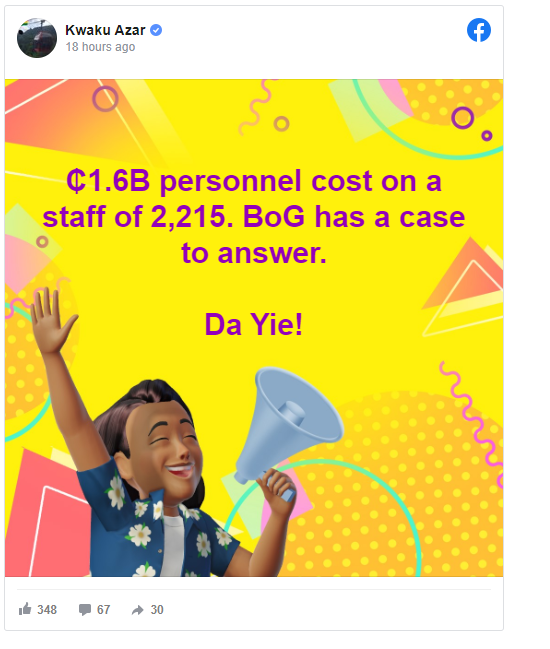
Per the 2022 Annual Report and Financial Statement of the Bank, the Central Bank incurred GHS1,620,636 as personnel costs; GHS97,437 million on foreign and domestic travel, spent GHS131,586 million on Motor vehicle maintenance/running.
Following the unexplained expenditure, coupled with the loss of GH¢60.8 billion, the Minority in Parliament has called for the removal of Governor Dr Ernest Addison and his deputies; Dr. Maxwell Opoku-Afari (1st Deputy Governor) and Mrs. Elsie Addo Awadzi. (2nd Deputy Governor.)
A Finance expert holding the position of Associate Professor at the University of Ghana Business School (UGBS) has raised concerns about the lack of transparency in the activities of the Bank of Ghana (BoG).
Professor Lord Mensah has personally voiced his reservations about the performance of the Governor of the central bank, Ernest Addison, suggesting that the institution may be misusing its operational independence.
In relation to the recently disclosed balance sheet of the BoG, which unveiled a substantial loss of GH¢60.8 billion in the year 2022, Professor Mensah expressed suspicion of potential irregularities within the Bank’s operations.
He criticized the perceived opacity in the Bank’s actions, remarking that the published balance sheet, along with the associated numbers, provides significant insight.
According to him, various aspects of these increments indicate an abuse of their operational autonomy.
Speaking to media , Professor Mensah highlighted that the Bank of Ghana’s autonomy in governance is compromised due to the presence of presidential representatives as board members. This, he argued, contradicts the concept of true operational autonomy.
“They [BoG) seem to be too opaque in their dealings. From where I sit, publishing your balance sheet and then looking at these numbers coming up, it tells you so many things.
“There are so many attributes to those increments…they’re abusing the operational autonomy that they have,” he said.
Addressing the causes behind the substantial losses, the finance expert outlined established procedures for the central bank’s intervention during economic challenges.
He pointed out that the Bank seemed to have deviated from these protocols.
Professor Mensah further explained that while central banks are authorized to intervene during economic downturns, they should not funnel money through government channels. He emphasized that the Bank of Ghana is meant to stimulate the economy through monetary channels, not fiscal ones.
The reported loss of GH¢60.8 billion by the BoG can be attributed to the following components:
Non-Marketable Instruments: GH¢32.3 billion Marketable Instruments: GH¢16.1 billion COCOBOD: GH¢4.7 billion Price and Exchange Rate Valuation: GH¢5.2 billion Interest Expense on Monetary Policy: GH¢3.3 billion In addition to these losses, it has been disclosed that the Bank spent $250 million on constructing its new headquarters.
In response to these developments, the Minority Caucus in Parliament has expressed outrage and demanded the immediate resignation of Governor Ernest Addison for overseeing such a significant loss.
However, Economist Dr. Patrick Assuming believes that the Bank of Ghana should be given an opportunity to provide a detailed explanation regarding the losses and does not advocate for the governor’s resignation.
Minority Leader in Parliament, Dr Cassiel Ato Forson, has accused the Bank of Ghana of spending a total of GHS8.6 million on salaries for its Directors.
According to him, this represents about 87 percent increase in expenditure incurred by the Central Bank in a year.
Dr Ato Forson while engaging the press on August 8, expressed disappointment in the Central Bank, noting that such a huge amount could not motivate the leaders to prevent the colossal loss recorded by the institution.
The Annual Report and Financial Statement of the Bank of Ghana reveals that the institution incurred a loss of GH¢60.8 billion from its audited financial statement for the 2022 fiscal year.
This loss according to the Bank of Ghana is largely due to the government’s debt restructuring activities.
For the Minority Leader, “Ghanaians were charged a ‘Mismanagement Fee” to deliver the collapse of the Bank.”
He also claimed that the Central Bank spent a colossal GHS357.9 million on Banking Supervision Expenses; a whooping GHS67.9 million on computer expenses while communication expenses amounted to GHS32 million.
Undisclosed expenses, Dr Ato Forson said, amounted to GHS287.8 million of the taxpayer’s money.
A whopping $250 million is being expended by the Bank of Ghana to construct a new Headquarters in the heart of Ghana’s Capital, Accra.
The project, which is a 21-story facility, is specifically in Ridge in the Greater Accra Region, adjacent to the Greater Accra Regional Hospital, Ridge.
Currently under construction, the project, which is reportedly 50% complete, was awarded to De Simone Limited
Meanwhile, the Bank of Ghana recorded a loss of ¢60.8 Billion Ghana cedis in 2022, its Annual Report and Financial Statements has revealed.
The Central Bank’s record loss comes after it posted a ¢1.2 billion profit in 2021.
According to the Annual Report and Financial Statements, the loss is attributed to a decline in the Group’s net worth position due to the impact of the Domestic Debt Exchange Programme (DDEP) and the impairment of some assets.
Again, its total liabilities and subsidiaries exceeded its total assets by ¢54.52 billion.
In 2021, the Central Bank recorded a surplus of ¢5.72 billion.
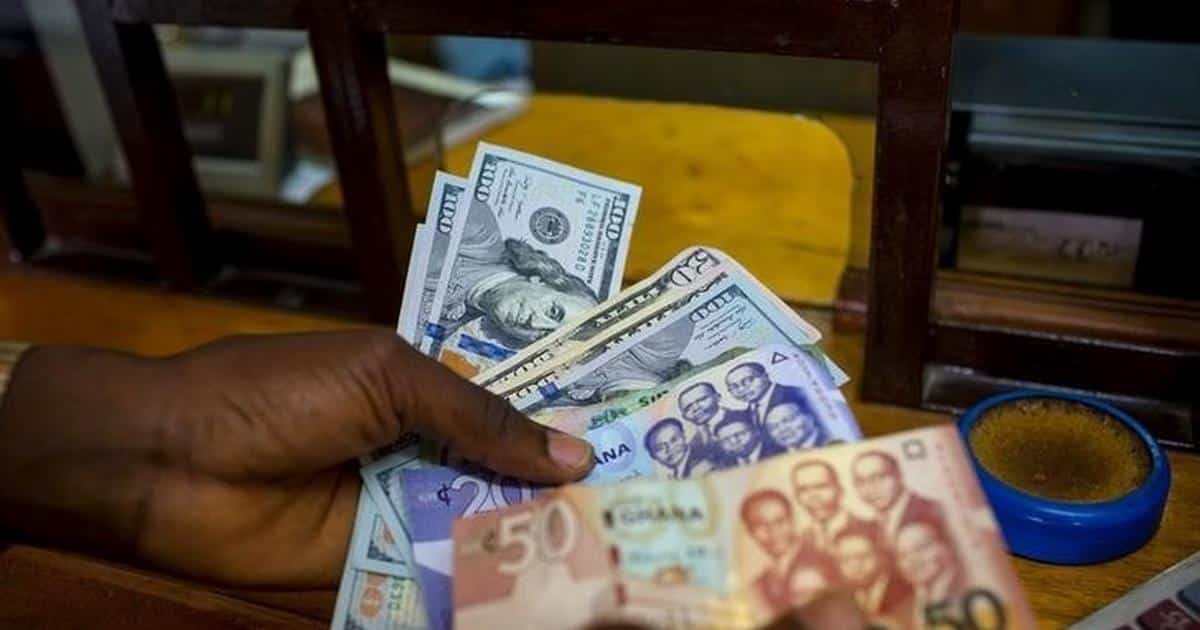
On August 9, 2023, the Bank of Ghana’s Interbank forex rates indicate that the Ghana Cedi is trading against the US Dollar at a buying price of 10.9967 and a selling price of 11.0077.
In Accra, at a Forex bureau, the US Dollar is being bought at a rate of 11.00 and sold at a rate of 11.50.
Against the Pound Sterling, the Ghana Cedi is trading at a buying price of 13.9922 and a selling price of 14.0073.
At a forex bureau in Accra, the Pound Sterling is being bought at a rate of 14.20 and sold at a rate of 14.90.
The Euro is trading at a buying price of 12.0415 and a selling price of 12.0534.
At a forex bureau in Accra, the Euro is being bought at a rate of 12.00 and sold at a rate of 12.70.
The South African Rand is trading at a buying price of 0.5803 and a selling price of 0.5803.
At a forex bureau in Accra, the South African Rand is being bought at a rate of 0.30 and sold at a rate of 0.90.
The Nigerian Naira is trading at a buying price of 69.2989 and a selling price of 70.5059.
At a forex bureau in Accra, the Nigerian Naira is being bought at a rate of 11.00 Naira for every 1 Cedi and sold at a rate of 16.00 Naira for every 1 Cedi.
For the CFA Franc, it is trading at a buying price of 54.4209 and a selling price of 54.4747.
At a forex bureau in Accra, the CFA Franc is being bought at a rate of 17.00 CFA for every 1 Cedi and sold at a rate of 21.00 CFA for every 1 Cedi.
The New Patriotic Party (NPP) has labeled the National Democratic Congress’ (NDC) demand for the resignation of Bank of Ghana Governor, Dr. Ernest Addison, and his deputies as a reflection of the NDC’s lack of constructive solutions for economic stabilization.
The NDC had threatened to march to the Bank of Ghana’s premises and force Dr. Addison and his deputies to resign within 21 days, citing what it calls reckless management of the bank.
But speaking to the media, NPP’s Director of Communications, Richard Ahiagbah, dismissed the NDC’s stance as propaganda, asserting that the NDC was attempting to interfere with the central bank’s decisions.
Ahiagbah questioned, “Is the NDC trying to run the Bank of Ghana now? Is that the point they want to communicate to us, that the Bank of Ghana cannot make a decision until they refer to the NDC?”
He urged the NDC to focus on constructive matters, emphasizing the need to strengthen the ongoing economic recovery and growth trajectory.
Furthermore, Ahiagbah highlighted that the Bank of Ghana’s losses in its 2022 fiscal year are not unique to Ghana, citing similar occurrences in other central banks worldwide. He attributed these challenges to the global economic impact of events like COVID-19 and the Russian-Ukraine conflict.
Member of Parliament for the Ningo Prampram Constituency, Sam Nartey George, has accused the current governor of the Bank of Ghana, Ernest Addison of converting the Apex Bank into “a crime scene.”
His accusations follow what he terms as unlawful borrowing of money to the current administration by the Central Bank over the past few years.
The Bank of Ghana is now a crime scene. You have a governor, Ernest Addison, who knows that the Bank of Ghana Act as revised by Parliament, says that you cannot borrow more than 5% of the government’s previous year’s earnings to the government .
“And that the moment you hit the 5%, in borrowings to the government, you as Bank of Ghana governor must notify Parliament, then the Minister of Finance must also write to Parliament explaining and notifying Parliament that he has hit the 5% and anything beyond the 5% you must inform the government.
He cited for instance that in 2021, the Bank borrowed more to the government than it was supposed to contrary to the laws of the state.
“In 2021, how much did they [BoG] borrow from the government, 35 billion. In 2022 they borrowed 45 billion. Now, you ask yourself, if the law says 5% of the previous year, in 2020 how much was the government’s total earnings? It was 55 billion. So the 5% of the 55 billion would have been 2.8 billion. So your sealing as a Bank of Ghana Governor to borrow to the Bank of Ghana per the law is 2.8 billion. Yet you sit aloof and borrow them 35 billion instead of 2.8 and you don’t even notify Parliament,” the MP said in an interview on JoyNews on August 8, 2023.
After his remarks, the opposition National Democratic Congress (NDC) held a press conference to demand the dismissal of the Bank of Ghana Governor.
At the press brief conveyed in Accra on August 8, 2023, the party leveled a series of allegations against Mr Addison, including claims that his actions and inactions have amounted to substantial mismanagement within the Central Bank.
The NDC asserted that this has contributed to the institution’s financial distress, leading to its purported bankruptcy and potential insolvency.
Minority Leader and Member of Parliament for the Ajumako Enyan Esiam, Dr Cassiel Ato Forson, who addressed the press said: “The Bank of Ghana, which is our Central Bank and lender of last resort, has been dealt a catastrophic blow by the reckless, clueless and criminally-minded NPP mis-managers of our economy and this has necessitated an urgent call for action to Save Our Central Bank.”
Dr Ato Forson’s remark was in reaction to a recent report released by the Apex Bank. Portions of the report indicated that the Central Bank made a loss of over GHC60 billion. The Minority firmly stated that such a huge loss recorded cannot be countenanced, thus, their call for the BoG governor.
“GH¢60.8 billion, is equivalent to $6 billion. This is twice the amount we are to receive from our recent IMF bailout. This means the recklessness and mismanagement of the Governor of the Bank of Ghana has cost the nation twice what we are struggling and sacrificing to receive from the IMF amid major conditionalities,” he lamented.
He further noted that: “It is however our position that those who have so recklessly mismanaged the Central Bank and brought it to its knees cannot remain at the helm of affairs of the bank without being held accountable.”
“We in the NDC will continue to explore ways of rescuing this country to prevent it from the doom that has befallen several West African countries. The March to Ensure accountability will begin in 21 days if the Governor of the Bank of Ghana does not do the needful and pack bag and baggage out of that sacred institution that he has so desecrated.
“Dr Ernest Addisson Must Go! There has to be an end to impunity and it is NOW!” Dr Forson noted.
Since encountering a downturn in 2020, the local economy has been experiencing instability, despite the government’s endeavors to establish a solid foundation.
Conversely,inflation continues to surge, prompting the Bank of Ghana’s Monetary Policy Committee to raise the policy rate.
This rate adjustment subsequently affects the interest rates placed on loans by financial institutions.
Businesses securing loans at these elevated interest rates find themselves incorporating these expenses into the pricing of their products and services. Consequently, consumers bear the weight of these escalated costs when shopping in markets or stores.
In light of the challenging economic circumstances, Joe Jackson, a financial analyst, has outlined five essential guidelines for Ghanaians to save money.
These directives were shared in a Twitter post and spotted by GhanaWeb Business.
Furthermore, for individuals contemplating leaving their jobs, Jackson advised them to retain their positions to continue receiving their salaries.
He emphasized the value of diversifying income streams to supplement earnings.
While cultivating a culture of savings, it is prudent to abstain from acquiring loans or engaging in activities that could lead to debt accumulation.
In addition, unnecessary expenditures should be curtailed to prevent financial strain. Prioritizing essential items or necessities while discontinuing impulsive purchases is recommended.
The Ghanaian economy faces huge risks in the short term. Protect yourself by: 1. Reduce expenses – cut unnecessary spending 2. Hold on to your job and income 3. Find alternative sources of income 4. Keep saving 5. Avoid taking on debt#BrokeGhanahttps://t.co/61vzQMRSfs
The Minority in Parliament has demanded the immediate removal of the Central Bank Governor, Dr Ernest Addison.
Engaging the press on Tuesday, Minority Leader, Dr Ato Forson accused Dr Addison of economic mismanagement and financial recklessness.
He blamed the Central Bank Governor for the staggering loss of GHS60.8 billion, equivalent to $6 billion in the financial sector.
He also held Dr Addison responsible for the writing-off of a whooping GHC 48.4 billion, about half of the Ghana Government’s indebtedness to the Central Bank, without parliamentary approval.
According to the Minority Leader, this is illegal and criminal, and the NDC Members of Parliament will not allow this to pass.
In this regard, the Minority wants Dr Addison and his deputies out of office in the next 21 days.
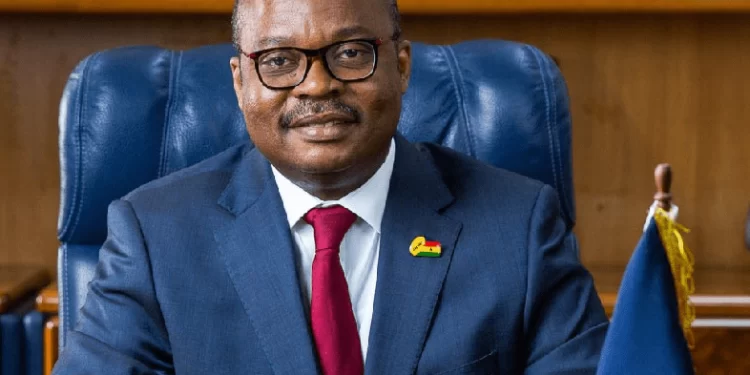
Governor of the Bank of Ghana (BoG), Dr Ernest Addison
“We call for the resignation of the Governor of the Central Bank and his deputies within 21 days from today,” he said.
According to Dr Ato Forson, the Minority MPs are resolved to embark on popular action to occupy the Central Bank and drive out the “team of inept, callous and criminal mismanagers of the finances of this country and save the Bank of Ghana.”
“The March to Ensure Accountability will begin in 21 days if the Governor of the Bank of Ghana does not do the needful and pack bag and baggage out of that sacred institution that he has so desecrated.
Dr Ernest Addisson Must Go! There has to be an end to impunity and it is NOW!”, he added.
Minority Leader in Parliament, Dr Cassiel Ato Forson has slammed the Bank of Ghana for its decision to invest in the construction of a new head office at a time when it has plunged the financial sector into severe crisis.
Per reports, the Central Bank is set to spend an amount of $250 million (GHC2.8 billion) on another Head Office building at Ridge.
Engaging the press on Tuesday, August 8, Dr Ato Forson described this action as the height of insensitivity in the management of the finances of a troubled country.
He noted that it is unacceptable for such a project to take place when the Bank of Ghana recorded a staggering loss of GHS60.8 billion, equivalent to $6 billion.
“This is twice the amount we are to receive from our recent IMF bailout. This means the recklessness and mismanagement of the Governor of the Bank of Ghana has cost the nation twice what we are struggling and sacrificing to receive from the IMF amid major conditionalities,” he said.
The Central Bank has been accused of writing-off a whooping GHC 48.4 billion, about half of Ghana Government’s indebtedness to the Central Bank, without parliamentary approval.
According to the Minority Leader, this is illegal and criminal, and the NDC Members of Parliament will not allow this to pass.
Following the trend of issues, the Minority in Parliament has called for the removal of the Central Bank Governor, Dr Ernest Addison.
Meanwhile, Dr Ato Forson has issued a 21-day ultimatum for the removal of the BoG Governor.
“In this regard, we call for the resignation of the Governor of the Central Bank and his deputies within 21 days from today.”
“We are resolved to embark on popular action to occupy the Central Bank and drive out the team of inept, callous, and criminal mismanagers of the finances of this country and Save the Bank of Ghana,” he said.
“The March to Ensure Accountability will begin in 21 days if the Governor of the Bank of Ghana does not do the needful and pack bag and baggage out of that sacred institution that he has so desecrated. Dr Ernest Addisson Must Go! There has to be an end to impunity, ” he added.
A whopping $250 million is being expended by the Bank of Ghana to construct a new Headquarters in the heart of Ghana’s Capital, Accra.
The project, which is a 21-story facility, is specifically in Ridge in the Greater Accra Region, adjacent to the Greater Accra Regional Hospital, Ridge.
Currently under construction, the project, which is reportedly 50% complete, was awarded to De Simone Limited
Meanwhile, the Bank of Ghana recorded a loss of ¢60.8 Billion Ghana cedis in 2022, its Annual Report and Financial Statements has revealed.
The Central Bank’s record loss comes after it posted a ¢1.2 billion profit in 2021.
According to the Annual Report and Financial Statements, the loss is attributed to a decline in the Group’s net worth position due to the impact of the Domestic Debt Exchange Programme (DDEP) and the impairment of some assets.
Again, its total liabilities and subsidiaries exceeded its total assets by ¢54.52 billion.
In 2021, the Central Bank recorded a surplus of ¢5.72 billion.
An Accra Circuit Court has sentenced to eight years a 34-year-old man for forging a Bank of Ghana (BoG) license to operate a microfinance company at Suhum in the Eastern region and its environs.
Kofi Asante pleaded guilty to operating a microfinance company without a license, receiving a four-year sentence, and also to forging an official document, resulting in an eight-year sentence.
Both sentences will be served concurrently, as determined by Judge Joojo Amoah Hagan.
The prosecution, led by Assistant Superintendent of Police (ASP) Emmanuel Haligah, revealed that Asante had fraudulently established microfinance business centers named KM Community Bank and Prym Capital in Suhum and surrounding areas.
He illicitly collected deposits from individuals without the necessary licenses.
KM Community Bank reportedly had branches in Anum Apapam, Akorabo, and Amanase, while Prym Capital was headquartered in Suhum.
On June 30, 2023, Asante was apprehended for investigation. During a search of his offices, copies of documents claiming to be issued by the Bank of Ghana under the name of KM Community Bank were discovered.
Subsequent investigations disclosed that Asante had forged the Bank of Ghana license, creating fake documents between April and January 2023.
He had employed approximately 24 individuals to operate within Suhum and its surroundings.
A 34-year-old man has been sentenced to eight years in prison by an Accra Circuit Court for forging a Bank of Ghana (BoG) license to operate a microfinance company in Suhum, Eastern region, and nearby areas.
The man, known as Kofi Asante or Davis, admitted guilt to engaging in deposit-taking without a license, leading to a four-year prison term. He also pleaded guilty to forgery of an official document, resulting in an additional eight-year prison sentence.
The court, presided over by Joojo Amoah Hagan, ordered that the sentences should be served concurrently. The prosecution, led by Assistant Superintendent of Police (ASP) Emmanuel Haligah, explained that the police received information that the now-convicted individual had set up microfinance business centers under the names KM Community Bank and Prym Capital in the Suhum area and its surroundings.
It said the convict, after establishing the business, went ahead to collect deposits from people without license.
The prosecution said intelligence indicated that the KM Community Bank had branches in Anum Apapam, Akorabo, and Amanase, while Prym Capital had its headquarters in Suhum.
The prosecution said on June 30, 2023, Asante was arrested for investigations and when his offices were searched, copies of documents purported to be issued by the Bank of Ghana in the name of KM Community Bank were found and retrieved for investigations.
It said investigations revealed that Asante had forged the Bank of Ghana License between April and January 2023 and had about 24 youths working as representatives within Suhum and its environs.
During this timeframe, Asante managed to persuade approximately 950 individuals to deposit a daily total of GHc56,000 into his business.
According to the prosecution, during questioning, Asante acknowledged that both KM Community Bank and PRYM Capital were not registered with the Office of the Registrar of Companies nor licensed by the Bank of Ghana to engage in deposit-taking activities.
Asante admitted to forging the Bank of Ghana license, which was found in his office.
Finance Minister Ken Ofori-Atta has confirmed reports that the Central Bank registered a loss of GH¢60.8 billion in its audited financial statement for the fiscal year 2022.
However, the Finance Minister noted that the loss recorded is technical, as “it is not monies that was given that will never be paid.”
Mr Ofori-Atta made this known during an appearance on GBC’s Talking Point programme over the weekend.
He further explained that these losses were accrued after the Central Bank failed to balance its assets, liabilities, and shareholders’ equity. According to the Finance Minister, some revenue as interest that should have been generated by the Central Bank could not come through.
“The issue of debt exchange, in which certain interest was expected to be paid had been cut, resulting in those type of losses. Then you’ll have to impair the balance sheet because of expected revenue that was coming will not come. So that is what is happening”, he further explained.
The BoG attributes this substantial loss primarily to the government’s actions in debt restructuring.
Meanwhile, the Finance Minister, has expressed confidence in BoG’s ability to reclaim all its losses.
“As I told you, the impairment on the banks was also quite dramatic. The first half year, we have seen a strong response from them. It’s the same way in which the balance sheet of restructuring is also occurring at the Central Bank and will build up towards reclaiming where we should be”, he concluded.
The Bank of Ghana has announced its resolution to cease all financing to the government of Ghana from now on.
This decision, according to Dr. Philip Abradu-Otoo, the Director of Research at the apex bank, is one of the four critical steps being implemented to address the current financial distress faced by the Central Bank.
“Those steps that are put in place will ensure that we get out of this place quickly and if you read the governors foreword in our annual report, four steps have been outlined; one, is to try as much as possible not to lend to government again.
“Which in the IMF program we have logged that in as zero financing because it is part of the problem,” he told JoyNews in an interview.
According to the Bank of Ghana’s 2022 annual financial report, there was a significant loss of over GH¢60 billion.
Critics attribute this loss primarily to the government’s excessive borrowing and lack of financial discipline.
In an interview with Joynews, Dr. Abradu-Otoo explained that the Bank of Ghana is currently implementing its zero financing strategy as a measure to restore the bank’s financial stability.
However, the government’s decision to write off debts owed to the Central Bank has faced strong opposition from the parliamentary minority.
Isaac Adongo, the Minority spokesperson on Finance, addressed the media in Parliament, arguing that the debt write-off without parliamentary approval violates the Public Financial Management Act and, therefore, should be considered invalid.
The minority has demanded that the government reinstate the debt, which resulted from a Debt Exchange Program implemented by the government.
The Minority in Parliament has expressed its intention to subject recent expenditures by the Bank of Ghana (BoG) to a value-for-money audit.
The Central Bank’s 2022 statement revealed significant losses amounting to over GHȼ60 billion.
Some of the expenses that the Minority plans to scrutinize include the BoG’s spending of almost GHȼ70 million on computer-related expenses, GHȼ131 million for motor and vehicle maintenance, and GHȼ97 million for foreign and domestic travel, among other items.
The acting Ranking Member on the Finance Committee, Isaac Adongo, stated that a future NDC government will investigate these expenditures to understand the reasoning behind such allocations.
He questioned the appropriateness of spending GHȼ33 million on communication and GHȼ97 million on travel expenses, indicating that a value-for-money audit would shed light on these financial decisions.
“I want to tell Dr Addison that in the future, we will subject these numbers to value-for-money audit. We will understand how it is that it is reasonable to spend 33 million cedis on communication. How reasonable it is for you to spend 97 million on travels? We will perform a value-for-money audit, of the finances of the Bank of Ghana,” he said.
Furthermore, Mr. Adongo called on Parliament to assert its influence and carry out its supervisory role effectively. He also raised concerns about a reported write-off of debt owed by the government, asserting that such an action should only take place with the approval of Parliament through a resolution.
The MP for Bolgatanga Central emphasized that the Bank of Ghana must be held accountable under section 53 of the Public Financial Management Act.
The Minority’s position is based on their belief that the central bank’s actions have been evading parliamentary oversight over the country’s public finances, potentially affecting fiscal and monetary policies.
The Minority Leader, Dr. Cassiel Ato Forson, has made serious allegations against the Bank of Ghana, accusing it of being responsible for the depletion of Ghana’s external reserves.
During the presentation of the Minority’s response to the 2023 mid-year budget review in Parliament, Dr. Forson asserted that the Bank of Ghana’s practice of printing money led to the unprecedented depreciation of the Cedi in 2022, resulting in hyperinflation.
According to Dr. Forson, the Cedi depreciated from GHC6:$1 to over GHC15:$1 in 2022, representing a straight-line calculation of over 100% depreciation.
He claimed that this depreciation, along with inflation, has adversely affected the financial status of citizens, with the rich slipping into the middle class and poverty worsening for the poor.
He cited a World Bank report stating that around 850,000 people were pushed further below the poverty line due to inflation alone in 2022.
The Minority Leader accused the government and the Bank of Ghana of initially denying the act of printing money to finance bloated government expenditures in 2022 but later admitting to the practice.
“Paragraph 8 of the IMF Staff Report gives further detail that the Bank of Ghana illegally printed over GHC45 billion representing 7.2% of GDP in 2022 alone, and GHC35 billion in 2021. This is the first in the history of Ghana”, he said.
He cited the IMF Staff Report, which detailed that the Bank of Ghana illegally printed over GHC45 billion in 2022, representing 7.2% of GDP, and GHC35 billion in 2021 – the first such occurrence in Ghana’s history.
Describing the Central Bank as a “crime scene,” Dr. Ato Forson blamed the government and its economic managers, led by Mr. Strategist, for aiding and abetting this economic crime. He pointed out that under the current economic managers, Ghana’s public debt surged from GHC120 billion in 2016 to GHC600 billion by the end of 2022, indicating an increase of about 400%. This high level of debt resulted in Ghana defaulting on repayment obligations to both local and foreign debtors for the first time in its history.
Dr. Forson also raised concerns about the collapse of Ghana’s financial sector, with all 23 banks recording massive impairment losses of over GHC18 billion in 2022.
He stressed that this financial mismanagement by the government has had unprecedented consequences, and he believes the Bank of Ghana requires urgent attention due to its major financial distress and bankruptcy.
The accusations by the Minority Leader highlight the economic challenges facing Ghana and the need for transparent and prudent financial management to address the issues at hand.
Member of Parliament for Bawku Central, Isaac Adongo, has asserted that the Bank of Ghana (BoG) printed an amount surpassing the GH¢44 billion recently disclosed as the government’s budget financing.
During a Good Morning Ghana interview on Monday, February 13, 2023, the MP stated that the figure mentioned by the BoG does not account for the additional money printed for the government in 2021.
According to him, the central bank has printed nearly GH¢80 billion to fund the budget of the Nana Addo Dankwa Akufo-Addo government.
“The situation is even worse than the GH¢44 billion, you know why. They use this method of securitisation. What they do is that at the end of the year instead of doing an overdraft that will be accumulating, they will violate the law by not repaying the money but rather transform it into a loan that will sit on the books in the name of the government.
“We end 2021 will GH¢35 billion of central bank lending, so that is already sitting on the books of Bank of Ghana as total exposure to government at the end of 2021.
“Then they start from zero in 2022 and it was GH¢44 billion at the end of the year. That one too will now be scrutinised to add to the GH¢35 that is already sitting there and it will now be almost GH¢80 billion that the government has borrowed from the Bank of Ghana,” he said.
Isaac Adongo highlighted that despite the government injecting more money into the system, the economy is not improving due to the alleged embezzlement of funds by government officials.
His remarks were in response to the central bank’s justification for printing over GH¢44 billion to finance the government’s 2022 budget, which exceeds the required threshold and necessitates parliamentary approval.
The Bank of Ghana (BoG) claimed it had no choice but to support the government as its access to the International Capital Market was closed, and the domestic market was also facing challenges.
In a statement issued on Thursday, February 9, 2023, the central bank stated that its actions were not in violation, as the Fiscal Responsibility Act, 2018, which had been suspended by the Ghanaian Parliament, had not been reinstated.
The BoG’s statement came after facing heavy criticism from some Ghanaians following a Bloomberg report indicating that it printed GH¢41.9 billion for the government in 2022.
Broadcaster Dr. Randy Abbey, in response to the Bloomberg report, expressed concern over the BoG’s conduct, stating that as the regulator of the country’s financial sector, it appears to be disregarding all the rules within the sector.
“The level of seeming recklessness and lawlessness, and irresponsibility when it comes to the operation of the central bank and the lack of transparency is getting worrying,” he said.
The Bank of Ghana‘s health facility, Bank Hospital, has met stern criticism by social media users over their services said to come at alleged exorbitant prices.
In a post shared by @StatsGH, the hospital was accused of charging an amount of GHS20,000 for a caesarean section – a surgical procedure in which a baby is delivered through an incision made in the mother’s abdomen and uterus.
The Independent Ghana is currently unable to verify this claim but several individuals have reacted to the matter and are concerned.
Some users noted that they did not need confirmation as the status of the facility speaks volume. Bank Hospital is located at Cantonment and according to some, such an area is known to be for the elite.
Others noted that it is not out of place for the hospital to charge above the average as it provides patients the best services and top-notch professionals.
“The location should tell you that, jokes aside it’s one of the best facilities in the area besides Euracare,” a user indicated.
But some social media users noted that despite the healthcare provided, such an amount is expensive.
Per reports, the average cost of caesarean section ranges from GHS2,500 – GHS5,000.
In July 2021, the Bank Hospital was opened to the public, with a pledge to provide quality service for clients, in line with best practices.
Constructed by the Bank of Ghana (BoG) at a cost of €80 million, the 65-bed facility, which is located at Cantonments in Accra, comes with a state-of-the-art intensive care unit, general wards and exclusive executive suites, a paediatric ward, maternity and nursery and neonatal intensive care units.
Bank of Ghana (BoG)’s audited financial statement for 2022 mentions the Domestic Debt Exchange Program (DDEP) and COCOBOD loans as the main causes of loss.
As opposed to 2021, when the bank gained GH$1.23 billion in profit, this year’s loss is shocking.
The central bank’s director of research, Dr. Philip Abradu-Otoo, explained in an interview with Citi FM that the losses were mostly caused by shocks caused by the government’s domestic debt restructuring and depreciation of the local currency.
He emphasised that a loss of this magnitude has never been experienced by the bank before.
“The reason for the loss is primarily due to the Domestic Debt Exchange Programme. Just like banks suffered losses on their holdings of government instruments, the BoG also suffered a loss on its holdings of government instruments—both marketable and non-marketable,” Dr. Abradu-Otoo stated.
He continued by saying that some loans to COCOBOD were impaired as a result of the restructuring programme, which caused a negative swing in their balance sheet, and that the impact of the DDEP resulted in a loss of GH48.1 billion.
“The impact of the DDEP on these two items, we incurred a loss of GH¢48.1 billion, we also had some loans to COCOBOD which were impaired as a result of the DDEP. DDEP impact that has swung our balanced sheet into negative territories”.
Despite the challenging situation, Dr. Abradu-Otoo expressed optimism that the government would provide capitalization to facilitate the central bank’s recovery from the losses. He reassured Ghanaians, especially financial institutions, that their funds deposited with the BoG are safe, emphasizing that the loss was not a result of bad decisions or reckless policies, but a direct impact of the DDEP.
“What were are seeing on the balance sheets of BoG is not as a result of reckless policy, or bad decisions but the direct impact from DDEP. All is safe, carry on with your normal businesses,” he assured.
The Bank of Ghana’s audited financial statement for 2022 was released on July 28, revealing that as of December 31, 2022, the total liabilities of the central bank and its subsidiaries exceeded its total assets by GH¢54.52 billion. The institution is now seeking measures to stabilize its financial position and ensure the safety of its operations moving forward.
An economist at the University of Ghana, Dr Adu Sarkodie, has come forward to support the Bank of Ghana’s management in the face of the GHC60.81 billion loss incurred by the apex bank during the 2022 fiscal year.
In an interview on the Citi Breakfast Show, Dr Sarkodie emphasised that during the period under scrutiny, the Bank fulfilled its constitutional mandate effectively and should not be criticized harshly.
“The central bank is mandated to regulate the financial sector and influence GDP and employment, and they have done well on that level but the losses they made came from the fiscal side and were not the same as in the process of undertaking their core mandate and I don’t think we should entirely blame the BoG for undertaking their mandate.”
Dr. Sarkodie also expressed concern over the independence of the Bank of Ghana which he said can also be blamed for the lax provisions by management which made it possible for the government to borrow beyond 5 percent of its revenue in the year preceding 2022.
“Let’s take a look at the 5 percent financing balancing…their [BoG] independence is not there and that is something that will be worrying to any governor of the Bank of Ghana.”
“Part of the blame should be placed on foreign investors in selling government bonds and also independence of the Bank is key because it is baffling how the Bank suspended the 5 percent finance balancing that allowed the government to over-borrow,” Dr. Sarkodie added.
Renowned economist professor, Prof Godfred Alufar Bokpin has called for the resignation of the Governor of the Bank of Ghana (BoG) in the wake of revelations of alleged GH¢60 billion losses incurred under his watch.
The Professor in an interview pulled no punches in expressing his concern over the dire financial situation. He accused the BoG Governor of failing in his duties, leading to staggering financial losses that have sent ripples of panic and uncertainty across the nation.
“Perhaps I have not studied and gathered situations enough, but to the best of my knowledge, what is happening is legendary. In any serious society, I don’t think the governor will need somebody to advise him to resign. This (GHC60 billion losses) is not something you would want to be on your CV,” he noted.
The disclosure of the massive losses recorded at the Bank of Ghana has left citizens bewildered.
In its audited financial statement for 2022 which was released on July 28, 2023, the bank indicated that as at December 31, 2022, the total liabilities of the central bank and its subsidiaries exceeded its total assets by GHC54.52 billion.
The losses were attributed to the government’s domestic debt restructuring activities and the depreciation of the local currency, among other factors.
Nonetheless, the bank recorded a profit of GH¢1.23 billion in the 2021 financial year.
The Bank of Ghana’s (BoG) 2022 annual report, indicates that the currency in circulation saw substantial growth, with a total of ¢35.584 billion in notes and ¢494.173 million in coins.
The 200 cedi note dominated the currency landscape, with about ¢9.8 billion in circulation during 2022, a notable increase from the ¢6.55 billion in 2021.
The 100 cedi note also experienced a surge, reaching ¢8.69 billion in circulation, compared to ¢4.31 billion in 2021.
Similarly, the 50 cedi note witnessed significant growth, totaling ¢7.70 billion in 2022, compared to ¢4.89 billion the previous year.
As for the 20 and 10 cedi notes, there were ¢5.13 billion and ¢2.69 billion respectively in circulation during 2021, showing a slight increase from ¢4.89 billion and ¢2.44 billion in the preceding year.
Regarding lower denominations, the 5, 2, and 1 cedi notes amounted to ¢1.32 billion, ¢7.6 million, and ¢141 million respectively.
In the coin category, the total amount in circulation was ¢494.17 million during 2022, representing a rise from the ¢365.11 million recorded in 2021.
The 50 Ghana pesewa coin led the way with the highest circulation at ¢199.81 million, closely followed by the 20 Ghana pesewa coin at ¢119.85 million.
The considerable growth in the currency during 2022 indicates that the government increased money printing during the year under review.
Lawyer and Senior Vice President of IMANI Center for Policy & Education (Imani Africa) Kofi Bentil has expressed his curiosity regarding the Bank of Ghana’s (BoG) substantial losses, as the bank, in its announcement, stated that it does not engage in trading activities like commercial banks.
In 2022, the Bank of Ghana disclosed a loss of GHC 55.12 billion, primarily attributed to the implementation of the Domestic Debt Exchange Programme (DDEP). The program was initiated to restructure the Government’s domestic debt during an economic crisis, aiming to achieve debt sustainability and fulfill the conditions set by the International Monetary Fund (IMF) for a bailout.
As an example, the bank reported experiencing a 50% reduction in the value of Government financial instruments, including long-term stocks, COVID-19 bonds, and overdrafts.
“I’m having a hard time understanding how you can make such losses when you don’t trade like a commercial bank, please explain again slowly so I can understand,” he demanded on social media.
“Of course central can run into ‘profit’ and ‘loss’. Central banks can earn income from various sources, such as the interest earned from holding government securities or income generated from foreign exchange reserves.
Nonetheless, any income generated by a central bank usually goes toward supporting its stated objectives and maintaining its operations, rather than being distributed as profits to shareholders or investors.
‘In the case of Ghana, your reserves are in the negatives and government securities are used in paying debts. So what do you expect from the BoG? Loss?” Fidelis Abagulum replied.
The announcement of the Bank of Ghana (BoG) on the losses it made in 2022 continues to generate discussions on both social media and mainstream media.
A whooping GHC 131.586 million was spent on motor vehicle maintenance last year by the Bank of Ghana, a report released by the Apex Bank has said.
In the previous year, a total of GHC 61.510 million was used to cover the same expenses.
Additionally, the report said personnel costs were GHC 1.620 billion, as compared to GHC 1.260 billion recorded in 2021.
For foreign and domestic travel, the Central Bank spent GH¢97.437 million. This indicated over a 300% increase in the GH¢28.176 million recorded in 2021.
Communication expenses and banking college and Monetary Institutes expenses were GH¢32.020 million and GH¢13.252 million respectively.
Computer-related expenses and banking supervision expenses were GH¢ 67.987 million and 357.923 million respectively.
A general analysis of the balance sheet indicated that there was a more than 100% increase in most of the Bank’s expenditures in 2022 as compared to the previous year.
A report released by the Bank of Ghana indicates that the institution runs its operations with over 2,000 staff.
The details in the recently released 2022 Report and Financial Statement covered its staff population at the year was a whopping 2,215.
In the 181-page document, the Bank of Ghana revealed that GH¢131.586 million was spent on motor vehicle maintenance/running as of December 2022.
This is away from the GH¢61.510 million spent over the same period in 2021.
The report also noted that personnel costs were GH¢1.620 billion away from the GH¢1.260 billion recorded in 2021.
For foreign and domestic travel, the Central Bank spent GH¢97.437 million. This indicated over a 300% increase in the GH¢28.176 million recorded in 2021.
Communication expenses and banking college and Monetary Institutes expenses were GH¢32.020 million and GH¢13.252 million respectively.
Computer-related expenses and banking supervision expenses were GH¢ 67.987 million and 357.923 million respectively.
In the breakdown of who and who makes up the staff of the BoG, the statement listed the members of the bank who make up the various levels of management, including its Board Members, those on the organisational structure, management of the bank, and regional managers.
Board Members:
The Board of the Bank of Ghana is made up of 14 members, including its Chairman, Dr. Ernest Addison, who is also the Governor of the Bank.
The others are Dr. Maxwell Opoku-Afari, Executive Director, First Deputy Governor; Mrs. Elsie Addo Awadzi, Executive Director, Second Deputy Governor; Mr. Charles Adu Boahen*, Non-Executive Director; Mr. Joseph Blignam Alhassan, Non-Executive Director; Dr. Samuel Nii-Noi Ashong, Non-Executive Director; Dr. Kwame Nyantekyi-Owusu, Non-Executive Director; Mrs. Comfort F. A. Ocran, Non-Executive Director; and Mr. Andrew A. Boye-Doe, Non-Executive Director.
The rest are Mr. Jude Kofi Bucknor, Non-Executive Director; Prof. Eric Osei-Assibey, Non-Executive Director; Ms. Angela Kyerematen-Jimoh, Non-Executive Director; Dr. Regina Ohene-Darko Adutwum, Non-Executive Director; Dr. Regina Ohene-Darko Adutwum, Non-Executive Director.
Organisational Structure:
This is made up of the:
– Board of Directors
– Governor
– Monetary Policy Committee
– First Deputy Governor
Research, Payment Systems, Risk Management, Currency Management, Human Resource & Capacity Development, Corporate Management & Services, Information & Communication Technology, FinTech & Innovation Office
Bank of Ghana’s Annual Report for 2022 has revealed a significant loss of GHC 60.8 billion, marking a stark contrast from the GHC 1.2 Billion profit it achieved in 2021.
As per the 2022 Financial Accounts, the Bank of Ghana‘s loss can be attributed to a decline in the Group’s net worth position, mainly caused by the impact of the Domestic Debt Exchange Programme (DDEP) and the impairment of certain assets within the Group.
The Bank stated that its total liabilities, combined with those of its subsidiaries, surpassed its total assets by GHC54.52 billion. In contrast, the Bank had recorded a surplus of GHC5.72 billion in 2021.
Breakdown of Loss Positions
The impairment of Government of Ghana securities holdings amounted to GHC48.45 billion, resulting from the Government of Ghana Domestic Debt Exchange Programme. Additionally, there was an impairment of loans and advances granted to quasi-government and financial institutions, totaling GHC6.12 billion.
The devaluation of the local currency led to a net exchange loss of GHC5.27 billion, in contrast to a gain of GHC1.07 billion in 2021.
Impact of Loss on Operations
According to the Bank of Ghana, the Board of Directors and Management of the Bank have assessed the policy solvency implications arising out of the negative net worth position and the Group’s ability to continue to generate enough income to cover its monetary policy operations and other operational costs. In the view of the Directors, the Bank will continue to operate on a going concern basis due to a variety of factors underpinned by expectations of an improved macroeconomic situation and policy actions specifically targeted at improving the balance sheet of the Bank of Ghana.
Steps taken to recover from the losses
The Bank of Ghana in its Annual report outlined these measures which they believed that it will aid to their recovery. These include:
Retention of profits to help rebuild capital until equity firmly returns to positive region.
Refraining from monetary financing of the Government of Ghana’s budget. In this respect, action has already been taken with a Memorandum of Understanding on zero financing of the budget signed between the Bank of Ghana and the Ministry of Finance on 26 April, 2023;
Taking immediate steps to optimize Bank of Ghana’s investment portfolio and operating cost mix to bolster efficiency and profits; and
• Assessing the potential need for recapitalisation support by the government in the medium-to-long term.
The Board of Directors and Management are of the view that “ continued efforts at restoring macroeconomic stability and debt sustainability in addition to long-term efforts at building reserves, provide enough basis for continued operational policy efficiency existence for the foreseeable future”.
Impact of the Domestic Debt Exchange Programme on the Banking Sector and Bank of Ghana Interventions
All 23 Banks signed on to Government’s DDEP by the settlement date of 21 February 2023. The Bank of Ghana conducted stress tests on banks, which showed elevated risk exposures of the DDEP on banks’ solvency, liquidity, and profitability. Thus, to manage the potential impact of the debt exchange and preserve financial stability, the Bank announced some policy and regulatory reliefs for Banks that fully participated in the DDEP.
The Bank rolled out these reliefs for the commercial Banks to deal with expected shocks.
Reduction of the Cash Reserve Ratio (CRR) from thirteen percent (13%) to twelve percent (12%) on foreign currency deposits to be held in foreign currency;
Reduction of the Capital Conservation Buffer from three percent (3%) to zero, effectively reducing the minimum Capital Adequacy Ratio (CAR) from thirteen percent (13%) to ten percent (10%), intended to provide capital relief to banks after the implementation of the Debt Exchange;
According to the Bank of Ghana it is fully equipped to provide liquidity support to banks and banks can access the Bank of Ghana’s Emergency Liquidity Assistance (ELA) Funds using the new bonds as collateral. The Bank of Ghana has also enhanced its supervisory surveillance systems with banks.
Banks are required to report more frequently, such as daily submissions of balance sheet as well as liquidity reports including interbank market activities and cost of financing.
Additional reporting requirements have been developed for banks to report on the performance of the new bonds. The enhanced monitoring mechanism is to ensure timely supervisory intervention, if needed.
The Bank of Ghana maintains that these reliefs are designed to minimise the potential impact of the domestic debt exchange on the financial sector and to preserve financial stability.
Bank of Ghana’s Gold Purchase programme
The Bank of Ghana commenced the Domestic Gold Purchase (DGP) programme and a Gold for Reserve Programme in June 2021 with the objective of increasing its foreign reserves. The Bank did this by purchasing refined gold from certified domestic gold mining firms using local currency. The refined gold is then shipped to the Bank’s offshore gold custodians, and it becomes part of the Bank’s reserves.
The Bank also purchases dore gold from local gold mines using aggregators. The price of the dore gold is determined using market prices adjusted for the gold content (estimated to be ninety-three percent (93%).
The Bank of Ghana maintains that these reliefs are designed to minimise the potential impact of the domestic debt exchange on the financial sector and to preserve financial stability.
Governor of the Bank of Ghana, Dr. Ernest Addison, has provided reassurance that the second round of the Domestic Debt Exchange Programme (DDEP) will not significantly impact the fortunes of banks.
The government is presently carrying out this program to restructure the domestic dollar bonds and cocoa bills. Some concerns have been raised that this exercise might affect the positive performance of banks, which recorded half-year profits exceeding ¢5 billion.
Nevertheless, Dr. Addison, addressing journalists after the Monetary Policy Committee Meeting of the Bank of Ghana, expressed confidence that the banks’ performance would remain sustainable despite the ongoing debt exchange programme.
“We don’t expect any negative impact on the books of the bank with this next exercise. The data submitted by banks for the first half of 2023 reflected the lingering effects of the DDEP, notwithstanding the strong rebound in profitability following significant losses incurred at year end 2022 on account of impairments of holdings in GoG bonds”, he said.
He added that the banking industry’s total assets as at June 2023 was ¢242.4 billion, showed a moderation in growth of 21.2 percent from 22.8 percent in June 2022.
“Total deposits grew significantly by 42.8 percent to ¢187.6 billion in June 2023, relative to ¢131.3 billion, representing 19.1 percent growth in June 2022. Total borrowings however contracted by 39.1 percent to GH¢16.0 billion compared with ¢26.4 billion a year earlier”.
The Governor of the Bank of Ghana announced that the banking industry witnessed a significant increase in investments, mainly driven by substantial growth in deposits.
Total investments surged to ¢89.9 billion in June 2023, up from ¢81.0 billion in June 2022.
This increase comprised short-term investments, which experienced a remarkable growth of 149.6 percent, reaching ¢39.9 billion compared to ¢15.9 billion the previous year.
However, medium-to-long-term investments declined to GH¢50.1 billion from ¢65.0 billion due to portfolio rebalancing following the DDEP (Domestic Debt Exchange Programme).
Furthermore, the banking sector’s profitability showed improvement in the first half of 2023.
Net interest income saw a significant increase of 41.4 percent, amounting to ¢9.9 billion, compared to a 12.4 percent increase recorded a year ago. Net fees and commissions also grew by 30.6 percent to ¢2.2 billion, compared to 27.0 percent growth over the same period last year.
Consequently, the operating income surged sharply by 46.1 percent, surpassing the 22.6 percent growth recorded in the previous period.
A Banking and Finance Expert has told an Accra Economic and Financial Court that a letter signed by former Deputy Finance Minister, Dr Cassiel Ato Forson requesting for letters of credit to be established by the Bank of Ghana (BoG) in favour of Big Sea Trading LLC of Dubai, is not an application for an LC (Letter of Credit).
Alexander Kofi Mensah Mould who testified as an expert witness on Thursday, July 27, in a case of causing financial loss to the state brought against Minority leader Dr Forson, explained under cross examination by the Attorney General, Godfred Dame, that whereas the Ministry of Finance needed write to the BoG requesting for LCs to be established, that letter alone cannot trigger the establishment of an LC unless there is a proper application from the MDA ( Ministries, Departments and Agencies) on for whom the LC is to be established.
Former Chief Executive Officer of Ghana National Petroleum Corporation (GNPC), Alexander Kofi-Mensah Mould had told the Court during cross examination at the last sitting that letters signed on behalf of then Finance Minister by Dr Cassiel Ato Forson, requesting for the establishment of letters of credit in favour of Big Sea General Trading LLC of Dubai, was only a first step in the process of establishing of the LCs and cannot constitute payment.
Mr Mould added that there was no way the Bank of Ghana or any other bank would set up an LC on the basis of the letters written by Dr Forson.
He further explained that the only document required in the establishment of such an LC would be the application forms filled by the applicant for the LC which in this case was the Ministry of Health.
The witness who has extensive experience in Trade Finance and the establishment of LCs due to his many years of work at the Union Bank of Switzerland and Standard Chattered Bank in the United States of America, further stated that LCs in themselves were not payment and that they constituted a guarantee of payment upon the occurence of a very specific event.
Mr Mould stressed that his review of the documents presented in evidence by the prosecution showed that it was “fallacious” to allege that by merely signing a letter on behalf of the Minister of Finance requesting for the establishment of an LC in favour of Big Sea, Dr Forson had caused financial loss.
The witness also indicated,that based on his knowledge of Ghana’s financial management laws,only the Finance Minister could authorise a request for the establishment of the letters of credit in question.
He said it was not unusual for Deputy Ministers to sign letters on behalf of their Ministers.
Dr Cassiel Ato Forson has been accused of causing financial loss to the state for allegedly causing an LC to be established in favour of Big sea for the supply of 30 ambulances without authorisation.
As per the Petroleum Holding Fund report by the Bank of Ghana (BoG), Ghana recorded a total of $540 million in petroleum receipts during the first half of 2023.
This figure marks a decrease compared to the $731 million earned during the same period in 2022.
The report, in compliance with the petroleum revenue management act, Act 815, provides insights into Ghana’s crude oil liftings and allocation to the Ghana Petroleum Funds.
The semiannual report from the BoG revealed a shortfall of $191 million (about 26% less) in earnings during the first six months of 2023 compared to the same period last year.
The total petroleum revenue receipts include proceeds from oil liftings, Corporate Tax, Surface Rental, and interest on the Petroleum Fund account.
For the period ending June 30, 2023, oil liftings contributed $370 million, corporate tax accounted for $166 million, and surface rental amounted to $3 million.
In terms of distribution, the Ghana Stabilization Fund received $71 million, and the Ghana Heritage Fund received $30 million, totaling about $101 million during the same period.
As per the law, the Bank of Ghana is responsible for receiving and disbursing petroleum revenue for the country. Furthermore, the Annual Budget Funding Amount receives not more than 70 percent of the benchmark revenue, while not less than 30 percent is allocated to the Ghana Petroleum Funds.
From the transferable funds into the Petroleum Funds, the Ghana Heritage Fund receives not less than 30 percent, with the remaining amount transferred to the Ghana Stabilization Fund.
Governor of the Bank of Ghana (BoG), Dr. Ernest Addison, has reiterated the bank’s commitment to maintaining a managed floating exchange rate regime with minimal interventions. He emphasized that this framework is considered the most ideal for the domestic economy’s growth and stability needs at its current stage of development.
Under a managed floating exchange rate regime, a country’s currency is allowed to fluctuate in the foreign exchange (FX) market, with occasional interventions by the central bank to stabilize its value. In contrast, a fixed exchange rate regime (monetary unification) sets the currency’s value at a specific rate and requires continuous central bank intervention to maintain it.
Conversely, a free-floating exchange rate regime (complete monetary autonomy) allows the currency’s value to be determined solely by market forces without any government or central bank interventions.
“The Bank remains committed to maintaining a flexible exchange rate regime with minimal interventions, and has taken innovative measures such as the ‘gold for reserves’ and ‘gold for oil’ programmes to accrete the country’s external reserves,” he said in a keynote address at the opening ceremony of a Regional Course on Exchange Rate Regimes and Policies organised by the West African Institute for Financial and Economic Management (WAIFEM) in Accra.
Dr. Addison stated that the FX rate serves as a crucial monetary policy tool for managing the economy, particularly during periods of domestic and external shocks.
He continued, “The Bank continues to support the foreign exchange market, particularly during market stress, to ensure its smooth functioning,” praising the relative success of the country’s exchange rate policy since it moved away from a fixed system.
Describing the evolution of the local exchange rate framework, the head of the central bank highlighted that Ghana has maintained a liberal foreign exchange system without restrictions on payments for imported goods and services since enacting the Foreign Exchange Act, 2006 (Act 723).
A significant change occurred in July 2016 when the Bank of Ghana (BoG) decided that exporters were no longer required to surrender their export earnings to the central bank. Instead, they were mandated to sell the surrender portion of their export receipts directly to commercial banks, which in turn increased forex liquidity. These banks are now obligated to report all foreign exchange transactions to the apex bank.
Furthermore, to improve price discovery and the depth of the foreign exchange market while reducing uncertainty, the BoG introduced the multiple-price forward foreign exchange auction. This initiative has been successful in easing pressure on the spot market and minimizing front-loading of forex purchases by economic agents.
However, some critics have expressed concerns about the extent of foreign exchange interventions made by the BoG, given a combination of factors such as the pandemic, conflict between Russia and Ukraine, supply chain bottlenecks, global central bank rate hikes, and investor-flight to safety.
In a discussion paper titled ‘Rethinking Inflation Management in Ghana in the Wake of Covid-19 and Russia-Ukraine War,’ Dr. John Kwakye, Director of Research at the Institute of Economic Affairs (IEA), commended the BoG’s approach while also raising certain considerations.
“The BoG should continue conducting measured market interventions to counter extreme exchange rate volatilities,” he said.
“While Ghana operates a flexible exchange rate regime, flexibility is limited by active BoG interventions to stem inordinate depreciations. The BoG’s inclination to stem exchange rate depreciation renders the exchange rate a de facto secondary target of monetary policy, which is thereby somewhat undermined,” the economist added.
Dr. Kwakye however called for urgency in addressing lingering structural challenges as the perennial depreciation of the exchange rate – caused by the ongoing imbalance between foreign exchange supply and demand – influences domestic prices through imports. Consequently, the BoG – relying on its limited reserves and occasional borrowing – can only intervene from time to time to curb rapid depreciations.
“The Banks’ interventions will remain palliatives, but cannot stabilise the exchange rate on a durable basis. Only transformative policies that substantially increase our foreign exchange earnings and reduce our demand for foreign exchange will ensure lasting stability of the exchange rate and stem its impact on inflation,” said the former Monetary Policy Committee member
In 2022, the cedi depreciated by 30 percent against the US dollar compared to 4.1 percent in 2021, data from the central bank released earlier this year showed. By January 26, 2023 it had cumulatively depreciated by 19.1 percent, 21.4 percent and 20.7 percent against the US dollar, pound and euro respectively.
At the end of December 2022, gross international reserves were US$6.2billion (2.7 months of import cover), down from US$9.7billion (4.4 months of import cover) in December 2021. The net international reserve position declined from US$6.1billion to US$2.4billion during the comparative period.
Dr. Ernest Addison, Governor of the Bank of Ghana, voiced confidence in the banking sector’s ability to quickly restore capital buffers with help from a capital infusion from shareholders, despite a considerable increase in industry earnings during the first half of 2023.
This expansion is anticipated to boost the real estate sector’s economic activity and increase the banking sector’s overall resilience.
In an interview with the media in Accra after the Monetary Policy Committee (MPC) meeting in July 2023, Dr. Addison emphasized the significant increase in profits during the first half of 2023, which followed the previous year’s sizable losses brought on by the domestic debt exchange programme (DDEP).
“If this trend persists we expect banks to rapidly rebuild capital reserves, with additional support from equity capital injections by shareholders,” he remarked,
To strengthen the stability of the banking industry, Dr. Addison highlighted the importance of activating the Financial Stability Fund, aimed at providing crucial recapitalization assistance to eligible banks.
In the first half of 2023, the banking sector experienced significant growth in profitability. Net interest income saw a remarkable surge of 41.4 percent, reaching GH¢9.9 billion, surpassing the 12.4 percent increase recorded during the same period the previous year.
Furthermore, net fees and commissions also witnessed substantial growth, rising by 30.6 percent to GH¢2.2 billion, compared to a 27 percent growth in the preceding year. This robust performance in operating income resulted in a sharp 46.1 percent increase, outperforming the 22.6 percent growth observed in 2022.
However, despite the strong rebound in profitability following losses incurred at the end of 2022 due to impairments of holdings in Treasury bonds, Dr. Addison noted that data provided by banks for the first half of 2023 indicated that lingering effects of the DDEP (Depository and Deposit Protection) persisted.
As of June 2023, the total assets of the banking industry reached GH¢242.4 billion, showing a moderated growth rate of 21.2 percent compared to 22.8 percent in June 2022. On a positive note, total deposits experienced significant growth, reaching GH¢187.6 billion in June 2023, representing a 42.8 percent increase from GH¢131.3 billion recorded in the same period in 2022. In contrast, total borrowings contracted by 39.1 percent to GH¢16 billion, down from GH¢26.4 billion a year earlier.
Dr. Addison disclosed that the banking industry’s investments witnessed a sharp increase, driven by significant deposit growth. Total investments rose to GH¢89.9 billion in June 2023, compared to GH¢81 billion in June 2022.
This growth was primarily propelled by a 149.6 percent increase in short-term investments to GH¢39.9 billion, while medium-to-long-term investments declined to GH¢50.1 billion due to portfolio rebalancing following the DDEP.
Despite the industry’s increased cost of operations, with operating expenses rising by 44.9 percent during the first half of 2023 compared to 22.9 percent growth in the same period of 2022, the overall effect resulted in a 51.2 percent increase in profit-before-tax in June 2023, far exceeding the 20.8 percent growth seen in June 2022.
The industry’s profit-after-tax stood at GH¢4.3 billion, reflecting a substantial 51.4 percent increase from GH¢2.8 billion in 2021. As a result, the banking sector saw a higher return-on-equity of 37.6 percent in June 2023, up from 21.9 percent in June 2022, as well as a higher return-on-assets of 5.5 percent compared to 4.6 percent in June 2022.
The Bank of Ghana (BoG) has indicated signs of recovery in the country’s economic activity, albeit at a slower pace.
According to the Central Bank, the updated real Composite Index of Economic Activity (CIEA) contracted by 3.7% in May 2023, compared to a contraction of 5.4% in April 2023, and a growth rate of 1.7% in the corresponding period of last year.
The Central Bank’s high-frequency real sector indicators showed that the main indicators that weighed down the index during the period were port activity, cement sales, credit to the private sector and imports.
Domestic Value Added Tax (VAT) collections, industrial consumption of electricity and exports, however, improved in the review period. Also, results from the Central Bank’s latest confidence surveys conducted in June 2023 reflected mixed sentiments.
While consumer confidence softened on account of an uptick in prices of goods and services, which also led to some concerns about future economic conditions, business sentiments, on the other hand, remained largely unchanged.
Businesses’ optimism about the impact of stable macroeconomic conditions on their operations was offset by concerns about the cost implications of recent tax and utility tariff increases.
Similarly, Ghana’s Purchasing Managers’ Index (PMI) dipped to 50.4 in June 2023 from 51.3 in the previous month. The index however remained above the 50.0 mark for the fifth successive month, signaling stable business conditions.
The Central Bank has indicated that from the beginning of the year to June 2023, it has built up US$1.0 billion in reserves.
According to the Bank of Ghana, this mainly came from the institution’s gold purchase programme, and settlement of short-term liabilities.
Gross International Reserves (excluding encumbered assets and petroleum funds) improved to US$2,353.95 million equivalent to 1.1 months of import cover, compared with US$1,440.0 million (0.6 months of import cover) recorded at the end of December 2022, the Bank announced in its Monetary Policy Committee Press Release dated 24th July, 2023
The Bank’s Domestic Gold Purchase Programme was launched in June 2021 with the key objective of shoring up the Bank of Ghana’s foreign reserves by purchasing domestically produced gold and converting same into foreign assets (monetary gold).
Since the inception of the programme, a total of 7.73 tons of monetary gold, valued at approximately US$480 million, has been added to reserves under the Gold for Reserves programme, well ahead of the target of doubling the gold holdings in 5 years.
Exchange market
The foreign exchange market has remained relatively stable for the first six months of 2023, supported by positive market sentiments derived from the IMF disbursement of the Extended Credit Facility (ECF) first tranche of US$600 million, forex purchases from the mining and oil sectors, and weakened demand.
The Ghana cedi depreciated by 20.6 percent against the US dollar in January 2023 and has remained generally stable since then with a cumulative depreciation of 1.8 percent between February and June 2023.
The Bank of Ghana has reported a contraction of total borrowing in the banking sector during the first half of the year.
In its Monetary Policy Committee Press Release dated 24th July, 2023, the Central Bank revealed that total borrowings declined by 39.1 percent to GH¢16.0 billion compared with GH¢26.4 billion a year earlier.
Total deposits on the other hand, grew significantly by 42.8 percent to GH¢187.6 billion in June 2023.
In the period under review last year, total deposits grew to GH¢131.3 billion, representing 19.1 percent growth.
The banking sector’s total assets as at June 2023 was GH¢242.4 billion, showing a moderation in growth of 21.2 percent from 22.8 percent in June 2022.
According to the Bank of Ghana, data submitted by banks for the first half of 2023 reflected the lingering effects of the Domestic Debt Exchange Programme (DDEP), notwithstanding the strong rebound in profitability following significant losses incurred at year end 2022 on account of impairments of holdings in government of Ghana bonds.
Meanwhile, the banking industry’s investments increased sharply, supported by significant growth in deposits.
Total investments rose to GH¢89.9 billion in June 2023 from GH¢ 81.0 billion in June 2022, made up of short-term investments which grew by 149.6 percent to GH¢39.9 billion, from GH¢15.9 billion last year, while medium-to-long term investments declined to GH¢50.1 billion from GH¢65.0 billion, as a result of portfolio rebalancing following the DDEP.