The Blu Penguin Wins Fastest Growing Fintech Award at Ghana Business Standards Awards
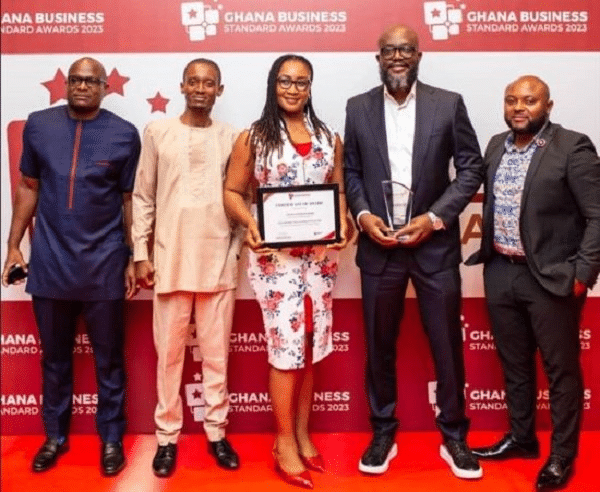
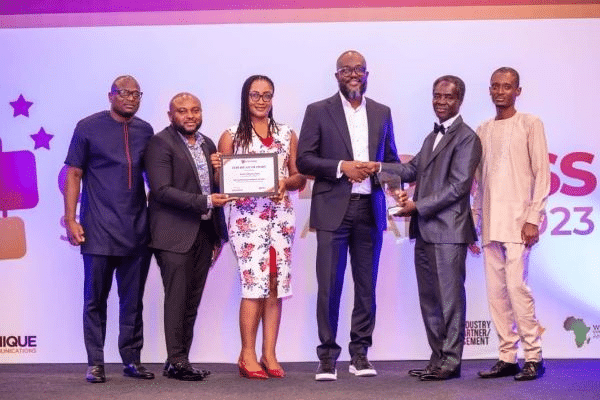
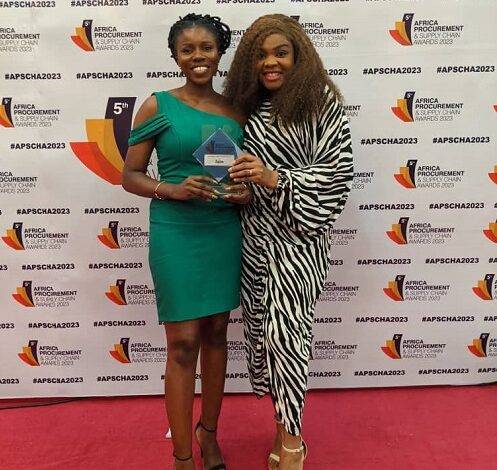
Ghana’s leading in-store payments service provider, The Blu Penguin has been adjudged the Fastest Growing Fintech in the country at this year’s Ghana Business Standards Awards.
The Ghana Business Standard Awards (GBSA), held on at the plush Movenpick Hotel under the theme “Celebrating Organizations Committed to Remarkable Business Standards Geared Towards Sustainable Growth”, was to celebrate organizations committed to remarkable business standards in their sectors and industry leaders breaking barriers of excellence across the Ghanaian business region and the world at large.
The Blu Penguin was among several firms and individuals who walked away with laurels on the night. Its award hinged largely on the performance of its flagship and game-changing in-store payments solution, BluPay, which is currently the most widely used and most recommended product by merchants and banks in the country.
The citation that came along with the award read that “This award is in recognition of BluPay’s widespread footprint nationwide and the mix of merchants from multi-national enterprises to local SMEs all of which are benefitting from BluPay in-store collection services.”
BluPay
BluPay is an application that empowers businesses/merchants to effortlessly accept payments through mobile money and cards from their valued customers.
The app has successfully integrated various local mobile money networks like MTN Momo, Vodafone Cash, AT Money, and even ZeePay to seamlessly enable payments to merchants. It also extends its functionality to accommodate Visa, Mastercard, and contactless (tap an pay) transactions, ensuring a wide range of payment options.
BluPay is designed for installation on POS devices or smartphones to streamline the payment process. The app is compatible with both iOS and Android devices, which ensures that no matter the platform, the app can provide all merchants with a seamless payment experience.
Currently, over three (3) million Ghanaians have transacted on The Blu Penguin’s platforms (particularly BluPay) representing 10% of Ghana’s population and growing.
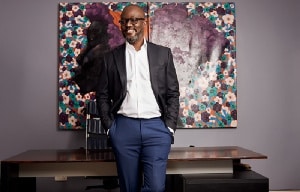
Founder and CEO of Blu Penguin, Tenu Awoonor said Blu Penguin’s exceptional growth, innovation, and substantial impact on merchant businesses over the past few years, particularly through BluPay, has been instrumental in its achievements.
“We truly understand the needs of business owners and how to solve their problems and safeguard their funds. With BluPay, our merchants “Never Miss a Sale” and that’s a mantra we live by,” he said.
Tenu Awoonor, affectionately called the BluMan, stated that the user-friendly nature of the BluPay App, enables cashiers to swiftly adopt the system and commence accepting payments without hassle, adding that the app’s remarkable capability to seamlessly integrate all payment channels into a single app makes it convenient for merchants.
Additionally, business owners utilizing the BluPay app enjoy access to a dedicated portal. The portal enables business owners to monitor transactions in real-time from anywhere in the world even if they are not in the store.
“Again, our merchants receive their transacted funds on time every day without fail, ensuring they have adequate capital to run their businesses without worries,” Awoonor said.
Payment links, APIs, ShopKeeper, Dashboard
In addition to BluPay, the company also provides payment links and API integration solutions tailored for online stores, enhancing their payment capabilities.
Again, the company has a sales and inventory management app known as ShopKeeper, which allows any seller to track all their sales and inventory in real-time right on their smartphone device.
“No need to purchase expensive systems, simply download it from the Play Store,” the CEO said.
The company also provides banks with a Transaction Management Dashboard, which allows them to monitor, control, and update the terminals within their network in real-time as well as identify and troubleshoot faulty terminals remotely.
Apart from Ghana, the company also has footprints in Cote d’Ivoire and DR Congo, where it is planning to start full operations soon.
The Future
In terms of what the future holds, Tenu Awoonor said “Our focus is directed towards strengthening our presence in Swipe4Cash within Ghana.”
He explained that “Swipe4Cash represents a service where we provide agents with the means to facilitate quick cash availability for individuals holding bank cards. It’s a way for agents to earn extra income and also provide convenience to areas where ATMs are not readily available.”
The CEO said the company is also planning to provide an open API that allows diverse B2B fintech services to seamlessly integrate, so companies can build their own customized financial solutions easily.
“As a company, it is our mission to see the businesses that use our services grow and scale. We are currently working on a credit financing scheme for merchants. With this, they can scale their businesses to the next level,” he stated.
The Blu Penguin is a Licensed Payment Services Provider (PSP) that specializes in providing in-store payment services such as POS, payment links, and USSD for merchants that simplify the collection of payments through a single App connected to all providers.
The company specializes in digital solutions that improve the sales and collection process for business owners so they can be reassured.
President of the Private Newspaper and Online News Publishers Association of Ghana (PRINPAG), Andrew Edwin Arthur, has praised the Bank of Ghana for its efforts on behalf of Ghana as a whole.
He claims that the Central Bank has taken steps to ensure that media representatives are adequately informed about its policies and measures for improving financial reporting on economic development, growth, and stability.
The PRINPAG president noted that although the Central Bank has received public criticism recently, he feels that its actions have been within the regulations controlling its mandate while speaking at the BoG’s annual financial literacy event organized for business and financial media.
“I applaud Bank of Ghana for forging a partnership and collaboration with the Ghanaian media to educate the public about the economy, echoing PRINPAG’s policy of encouraging its members to specialize in their chosen profession,” Mr Arthur said.
“This collaboration with the media is helping Ghanaians better understand economic issues, thus fostering greater interest in public discussions about the economy,” he added.
The annual financial literacy program, conducted under the theme “Restoring Confidence in the Economy: The Impact of Monetary Policy,” is an integral component of the Bank of Ghana’s dedication to implementing policies and initiatives that prioritize the well-being of the people, foster financial inclusion, and stimulate business growth within the country.
Dr. Philip Abradu-Otoo, the Director of Research at the Bank of Ghana, who stood in for Central Bank Governor Dr. Ernest Addison, conveyed appreciation for the media’s vital role in disseminating valuable information regarding economic policies. He emphasized that such efforts promote transparency and accountability in economic matters.
“We believe in the power of the media to educate and inform the public and we are committed to fostering this collaboration for the betterment of Ghana’s economy,” the BoG Director said.
“This positive collaboration has contributed significantly to the media’s ability to provide accurate and comprehensive reporting on financial matters, thereby enhancing public awareness and confidence in the financial sector,” he added.
The presidents of Journalists for Business Advocacy (JBA) and Institute for Financial and Economic Journalists (IFEJ), as well as other important business and financial journalists from across the nation, attended the training event.
The country’s economy has consistently been poor under the National Democratic Congress’ (NDC) rule, according to Richard Ahiagbah, national communications director of the government’s New Patriotic Party (NPP).
He noted that the NDC took over a rising economy in 2009, but failed to manage it well, which resulted in a slowdown in the country’s development.
On Sunday, August 20, 2023, Ahiagbah brought up this subject in Ho while speaking with the media over breakfast.
Richard said, “In 2009 when they (NDC) came to office they inherited a growing economy what were they able to do with that? They will tell you in 2011 they’ve achieved 14 percent GDP (Gross Domestic Product) growth yes that was on the back of the oil discovery that started production in 2010”.
The communications director further explained that “2012,2013,2014 and 2015 the economy of 14 percent deteriorated to 13.6 percent, no other point after 2011 was the NDC able to grow past 40 percent which was on the back of oil”.
Richard Ahiagbah, however, pronounced that “Any time the NDC is in power Ghana’s economy does worse and anytime NPP is in power the economy grows”.
He made references to the economy before the 2016 elections, saying “From 2011 to 2016 they (NDC) never grew the economy above what they’ve achieved but then immediately the management of the economy changed in 2017 this economy grew 8.2 percent from 3.4, just by merely changing those who are in charge from 2016 to 2017, we had almost about 5 percent growth”.
Patriotism has left the bloodstreams of Ghanaians. Every day on social media, at least five people on my feed type the words ‘I for lef Ghana’ (pidgin for I have to leave Ghana), simply because they don’t see a promising future here. There is very little to believe in, to hope for, to be proud of.
In 1994, my father booked a ticket from Germany all the way back to Ghana, with his family of three. Everyone thought he was mad – I was just a year shy of getting German citizenship, my sister had just been born, and he was living a comfortable, impactful life, working with the Ecumenical Mission.
‘Stay a little longer. At least give the children the option of getting another passport.’
But his mind had been made up. He left the very week his appointment ended. He wanted to come back home, where kwadaa and kani were easy to find. He wanted to wear his agbada and cloth everywhere, nod his head to the rhythm of highlife music, and contribute his quota to the development of his beloved Ghana.
For him, Ghana was home.
You see, he had broken bounds with his fellow Ɔdadeɛ to watch Nkrumah pronounce Ghana as ‘free forever’ in 1957. He had ardently followed the stories of all African leaders who were pushing for an authentically African rebirth. He gave his children authentic names that told the stories of their birth. Patriotism was oozing out of his veins. Daddy unfortunately passed away in 2012, but I can only imagine what he would have thought if he were alive today.
Today, people take more pride in associating with their tribes or the high schools they attended than the land of our birth. At least, those associations provide some sort of benefit. The same cannot be said for Ghana.
Every sector – education, health, transport, sports, arts, trade, tourism, and the Godfather of them all, finance – is riddled with a plethora of problems. There are the officials who have blocked the nerve endings of their consciences with corrupt money, a system that stifles and frustrates change, and a people who have reluctantly accepted and adjusted to the status quo.
Ghana should not be where it is. We have had several pivotal moments in history where people had hope in the future of the country – in recent times, when Mahama took over after Mills’ passing in 2012 because he did not have the burden of pleasing his kingmakers; the Occupy Ghana demonstration in 2014 because a movement of intentional citizens were rising and when Akufo-Addo won the 2016 elections, because the insensitivity of the then Mahama administration.
Time has shown that each time hope arose, it was deflated as quickly as it sprung up.
I recently saw a tweet about important first date questions, including how close you are to the national cake. It has become apparent that our leaders, irrespective of the colours of their party flags, are not thinking about the future of the country.
The focus seems to be on making as much money as soon as possible while in power. The closer you are to the national cake, the bigger the slice you get. Even if you are just a foot soldier, the crumbs will find their way to you.
This is why the fight to claim or retain power is a fierce one. No government can deny how being in power somehow insulates you from the problems of the ordinary Ghanaian.
I for lef Ghana.
We think it every time our cars struggle to claw their way out of potholes deep enough to pass for dams in pitch black darkness, only guided by our headlights and ‘pothole memory’.
When we turn on the radio and hear politicians defend the indefensible while we and our loved ones bear the brunt of their short-sighted decisions, we shake our heads and mutter it under our breath.
It crosses the mind of the doctor who has to use the torchlight from his phone to perform surgery.
The young man, whose salary can no longer support the very basic life he and his wife live, tunes into another YouTube video on how to immigrate to Canada before his first child is born.
The old woman who has saved and invested all her money in order to have a fairly decent life and pay for her medical check ups has lost all her money, with no remorse or empathy from those who lost it.
The business owner contemplates closing down a business that is suffocating under the weight of multiple taxes.
The average person is gradually being priced out of everyday things- a good meal, a cold drink.
The dreams of working hard to buy a house or piece of land for the average working professional look more and more unrealistic, with every wave of inflation.
The young professional who wants to enter politics to change the course of the nation is faced with unpalatable choices – work your way up the existing corrupt parties or suffer the heartbreak of watching citizens exchange their votes for a 200 cedi note and three cups of rice.
The regular citizen who is not interested in politics is even afraid to point out that the barest minimum that any self respecting government provide should not be a campaign point, for fear of being attacked by a legion of loyal foot soldiers.
The voices of those who constantly speak out are getting dimmer. They are getting tired of speaking to governments that refuse to be accountable to citizens, tired of pointing out the patterns of corruption and double standards, tired of the insensitivity and arrogance of those who can’t feel our suffering. They are tired of fellow citizens whose loyalty is based on tribe, personal benefit and tradition.
With every passing day, the people of Ghana bury that love under a rubble. They brush away that nudging feeling that the future looks bleak. Feelings of patriotism are no longer invoked when they hear the national anthem.
Some day soon, everyone who can, go lef Ghana.
‘Where are you going?’
‘This is your home. There is no place like home.’
My home wants to kill me. The house is on fire and the people who should be leading the fort to turn off the fire are fascinated by the flames and are dancing to songs of celebration, because somehow power makes our leaders blind, insensitive and obstinate.
Yen ara asaase ni.
With every passing day, this feels more like fiction for the ordinary Ghanaian.
–
Keni Ribeiro is a storyteller who has chronicled hundreds of Ghanaian experiences in short stories on her award winning blog, http://www.keniribeiro.com.
DISCLAIMER: Independentghana.com will not be liable for any inaccuracies contained in this article. The views expressed in the article are solely those of the author’s, and do not reflect those of The Independent Ghana
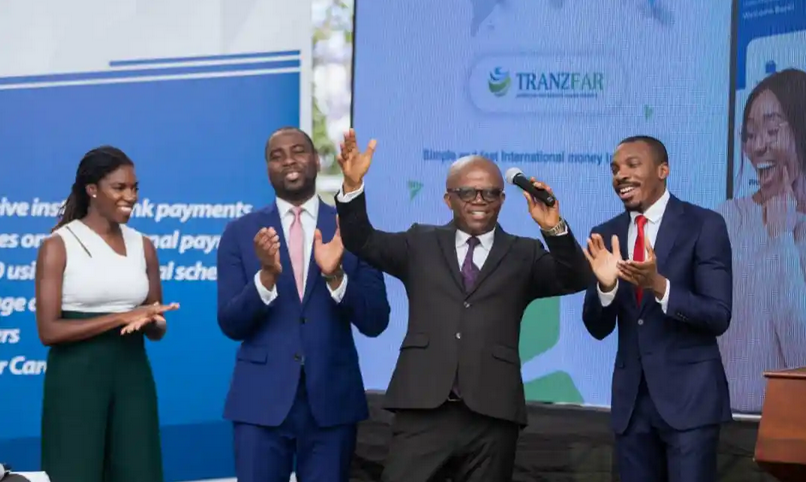
A UK fintech firm, Tranzfar, has introduced the groundbreaking Freedom Bank Account in Ghana.
This innovative digital banking product offers users versatile functionality, including instant money transfers, setting up standing orders and direct debits, and various banking operations.
This pioneering account, the first of its kind in Africa, empowers Ghanaian users to seamlessly send and receive funds internationally, spanning continents like Africa, Asia, and the Americas.
A distinctive feature of this digital banking service is its multi-currency support in pounds, dollars, and euros. Ghanaians, even those not residing in the UK, can now own UK-based bank accounts.
Deputy Minister for Trade and Industry, Dr. Stephen Amoah, commended Tranzfar for conceptualizing the Freedom Bank Account.
He anticipates this product to foster entrepreneurship, boost trade and industry, and contribute to the Ghanaian economy’s growth.
Mr. Ryan Romeo, Co-Founder and CEO of Tranzfar, highlights the account’s inclusivity.
It serves various segments, from students studying abroad to small businesses aiming to expand their global customer base.
Consultancy businesses, online enterprises, and individuals seeking foreign currency savings also benefit.
Accessible via mobile app or website, the Freedom Bank Account aligns with the quest for global connectivity and financial inclusivity.
Dr. Olusiji Sanya, Co-Founder and CFO of Tranzfar, emphasizes their belief in granting universal access to global banking services, regardless of location or origin.
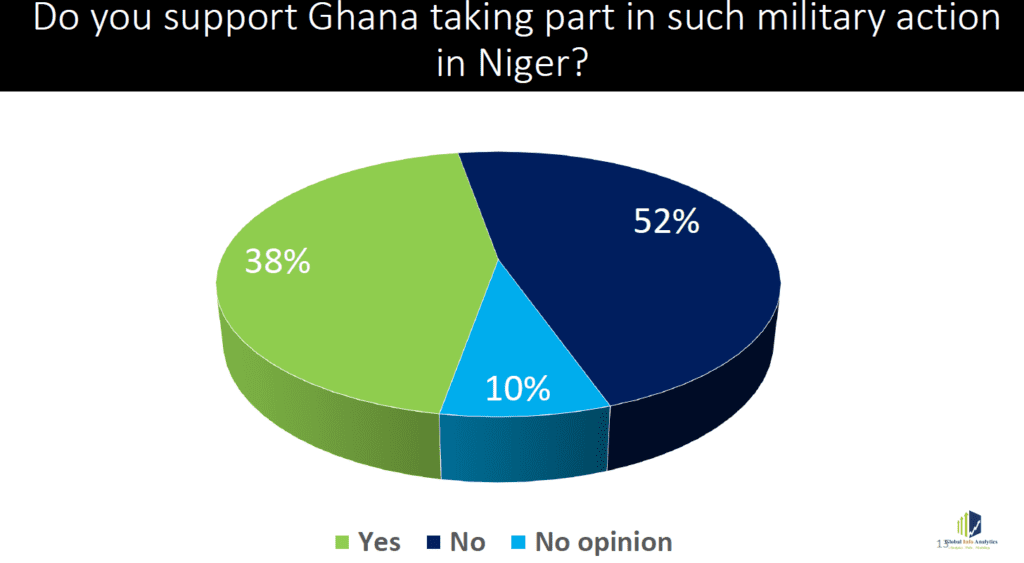
A two-day poll conducted by Global InfoAnalytics on August 18 and 19, approximately indicates that 52% of the Ghanaian population opposes Ghana’s participation in a military intervention aimed at restoring democracy in Niger.
This poll surveyed 1,618 respondents spanning all sixteen regions of Ghana. Among its findings, it revealed that nearly 76% of Ghanaians believe that coups in African countries stem from poor governance. Conversely, 17% do not share this perspective, and 7% expressed no opinion.
Furthermore, 49% of Ghanaians hold the view that coups do not provide a lasting solution to addressing governance issues, while 43% disagree, and 8% do not have a definite opinion on the matter.
The backdrop for this discussion is the recent ousting of Niger’s President, Mohamed Bazoum, leading the Economic Community of West African States (ECOWAS) to order the deployment of its standby force on August 10 to reinstate constitutional order in Niger.
The declaration was made by ECOWAS President Omar Alieu Touray during the ECOWAS Extraordinary meeting in Abuja.
Meanwhile, Commissioner of Political Affairs, Peace and Security for the Economic Community of West African State (ECOWAS), Abdel-Fatau Musah, has contested assertions that the bloc would require 50,000 troops in Niger for a potential deployment to remove the military junta.
He pointed out that Niger’s military has approximately 13,000 personnel, and if ECOWAS were to deploy its standby army to restore the ousted president, Mohamed Bazoum, it wouldn’t necessitate 50,000 troops to confront them.
The question of troop numbers was initially raised by Samuel Okudzeto Ablakwa, the Member of Parliament for North Tongu, who cited credible sources to support his claims.
During his appearance on JoyNews’ Newsfile on Saturday, August 19, he further revealed that, regrettably, only four countries within the bloc were likely to contribute troops to this mission.
“If you really look at ECOWAS today, it’s Nigeria, Ghana, Senegal and Ivory Coast. Nigeria is already stretched with Boko Haram. Tinubu [Nigeria’s President] doesn’t have support. Ivory Coast says they can do 1,000 [soldiers].
“Senegal, I know has received a juicy offer from America to send their troops to Haiti to support the American intervention there because Haiti is totally getting out of control. They are likely to accept that. We’re left with Ghana, how are we going to get those numbers?” he quizzed.
International research agency, Fitch Solutions has projected that Ghana will record a current account surplus in 2023.
It also noted that the country’s trade surplus will remain high however, the current account will run into a deficit in 2024.
Read Fitch’s full release on August 15, 2023, below
Key View
We forecast that Ghana will record a current account surplus of 1.3% of GDP in 2023, from a deficit of 2.1% of GDP in 2022.
The trade surplus will remain large by historical standards in H223, as imports will contract more sharply than exports due to weak domestic demand.
In 2024, we project that the current account balance will slip back into deficit, to a shortfall of 0.2% of GDP, as imports recover while exports will record sluggish growth due to a projected moderation in global gold and cocoa prices.
We forecast that Ghana will record a current account surplus of 1.3% of GDP in 2023, from a deficit of 2.1% of GDP in 2022. It will be the first time in 20 years that Ghana records a full-year current account surplus. Our 2023 forecast, which marks a revision from our previous projection that Ghana’s current account balance would post a deficit of 0.9% of GDP, follows weaker-than-anticipated import growth in H123.
Indeed, merchandise imports contracted by 13.0% y-o-y in H123 as a result of weak domestic demand and lower global commodity prices. Meanwhile, exports fell by 7.2%, pushing up the trade surplus to USD299.6mn, from USD245.7mn in H122. Data released by the Bank of Ghana (BoG) shows that the overall current account balance posted a surplus of USD0.8bn in H123, compared to a deficit of USD1.1bn in the corresponding period of 2022.
Current Account Set To Record First Surplus In 20 Years
Ghana – Current Account Balance, % Of GDP (LHS); Quarterly Current Account Balance, USDbn (RHS)
We expect that the trade surplus will remain large by historical standards in H223. Imports will continue to contract as domestic conditions remain weak. Indeed, inflation – which averaged 46.2% y-o-y in H123 – will remain elevated over the coming months, averaging 40.6% through 2023, the highest annual rate since 1996. This will weaken purchasing power of households and constrain demand for imported consumer products.
Meanwhile, restrictive monetary conditions will curtail the ability of businesses to fund their growth initiatives and will lead to a delay in corporate expansion plans, limiting demand for imported capital inputs. Furthermore, we believe that global oil prices will average roughly USD80 per barrel (/bbl) in H223, below the USD93/bbl in H222, deflating Ghana’s import bill (mineral fuels account for 5-10% of total imports). All told, we project imports to contract by 10.0% in 2023, from growth of 7.3% in 2022.
Weak Domestic Demand And Lower Oil Prices To Weigh On Imports
Ghana – Growth In Total Domestic Demand, % (LHS); Global – Brent Crude Price, USD/bbl (RHS)
While export growth will also remain in contractionary territory in H223, the decline will be less pronounced than imports. The moderation in global energy prices will weigh on Ghana’s crude exports (which account for roughly 30% of total exports), but this will be partially offset by healthy growth in gold and cocoa exports. Indeed, efforts to integrate artisanal miners into the official production figure as well as Asante Gold’s recommissioning of the Bibiani gold mine in mid-2022 will keep growth in gold production solid at a projected 8.1% in 2023, providing tailwinds to exports.
Meanwhile, the value of Ghana’s cocoa exports will be inflated by a significant rally in cocoa prices due to adverse weather conditions in neighbouring Côte d’Ivoire (the world’s largest cocoa producer) and concerns about El Niño, which is typically associated with drier weather conditions in West Africa and can weaken cocoa production. Taking these various dynamics into account, we project export growth to contract by 8.7% in 2023, from growth of 18.7% in 2022.
High Cocoa & Gold Prices Will Limit The Decline In Exports
A collapse in external interest payments will more than halve the primary income deficit in 2023. After Ghana defaulted on its external debt in December 2022, primary income outflows fell to USD0.7bn in Q123 (latest available data) from USD1.4bn in Q422. Given our expectation that Ghana will only reach a debt deal with its external creditors under the G20 Common Framework in H224, most external interest payments will remain on hold over the coming months. This informs our forecast that the primary income deficit will shrink to 2.8% of GDP in 2023, from 6.1% of GDP in 2022.
Income Balance Narrows On Suspension Of External Debt Servicing
Ghana – Primary Income Balance, USDbn
Current Account Deficit Returns In 2024
We believe that the current account balance will slip back into deficit in 2024, to a shortfall of 0.2% of GDP. This will be primarily driven by a sharply narrowing trade surplus.
Indeed, we expect that imports will start to recover in 2024. Inflation will continue on a downward trend to an average of 18.2% next year, gradually improving household spending and increasing demand for imported consumer items. Meanwhile, we expect that the Bank of Ghana will cut interest rates by 600 basis points to 22.00% through 2024. This will boost business activity from H224, and thus increase demand for imported capital products. Furthermore, our Oil & Gas team projects that the price of Brent crude will average USD83.0/bbl next year – from an average of USD80.0/bbl in 2023 – putting upside pressure on import growth. Overall, we forecast imports to expand by 12.0% in 2024.
The recovery in exports will be much slower. While we project healthy growth in hydrocarbon exports due to rising energy prices and increasing crude production, this will be offset by a weak outlook for gold and cocoa exports. As growth in developed markets picks up in 2024 and risk sentiment improves, our Commodities team projects gold prices to fall by 5.1%, weakening the value of Ghana’s gold exports next year. Meanwhile, as concerns surrounding El Niño fade through 2024, our Commodities team also forecasts a weakening of 7.4% in global cocoa prices, reducing the value of Ghana’s cocoa exports. All told, we forecast exports to grow by just 0.8% next year, and therefore expect the trade surplus to decline from 3.7% of GDP in 2023, to 1.4% in 2024.
Capital Inflows To Gradually Improve
Ghana – Capital & Financial Account Balance, USDbn (LHS) & Direct Investment, USDbn (RHS)
We expect that Ghana’s overall balance of payments will return to surplus in 2023 and 2024, following a record-wide deficit of USD4.6bn in 2022. In 2022, Ghana recorded its first full-year capital and financial account shortfall (of USD3.1bn) in 20 years, as a result of rising investor concerns about Ghana’s debt dynamics and monetary tightening in developed markets. However, the capital and financial account will likely turn positive again in 2023 as the country receives two IMF disbursements of USD0.6bn each under its Extended Credit Facility. The overall balance of payments will be strengthened in 2024 due to an expected improvement in investor sentiment as Ghana makes progress regarding the restructuring of its external debt. This will boost capital inflows and largely offset the small current-account deficit in 2024.
Risks to Ghana’s external position remain significant, however. If negotiations between Ghana and its external creditors stall, investor confidence would weaken, likely triggering another round of capital flight. This would lead to greater pressure on the country’s foreign exchange reserves and the Ghanaian cedi, keeping inflation higher for longer – which would have negative implications for economic growth and social stability.
Ghana is among the 25 nations earmarked to receive a share of £210 million in funding from the United Kingdom Government over the next three years to combat the critical issue of antimicrobial resistance (AMR).
The UK Government intends to collaborate closely with countries in Asia and Africa in a unified effort to address antimicrobial resistance and mitigate the menace it poses to both the UK and the global community.
This funding marks the most substantial investment ever made by any nation towards global AMR surveillance.
The Foreign, Commonwealth & Development Office of the UK High Commission in Ghana released a statement on Wednesday, conveying this information. The statement was also shared with the Ghana News Agency in Accra.
This announcement coincides with the UK’s Health Secretary of State, Steve Barclay, traveling to India for his inaugural participation in a G20 Health Ministers’ meeting.
The financial allocation from the UK Government’s aid budget will support the endeavors of the Fleming Fund in tackling AMR across various Asian and African countries. This support aims to alleviate the threat AMR poses to these nations.
The initiative will strengthen surveillance capabilities in approximately 25 countries with the highest levels of AMR impact and concern. These include countries such as Indonesia, Ghana, Kenya, and Papua New Guinea. The plan involves upgrading over 250 laboratories, equipping them with cutting-edge facilities.
The investment will encompass novel genome sequencing technology, aiding in the monitoring of bacterial transmission among humans, animals, and the environment, as mentioned in the statement.
“It will also strengthen the international health workforce by supporting 20,000 training sessions for laboratory staff, pharmacists and hospital staff, and over 200 Fleming Fund scholarships to boost expertise in microbiology, AMR policy and One Health – which recognises the connection between humans, animals and the environment.”
The UK’s Secretary of State for Health and Social Care, Steve Barclay, was quoted as saying: “Antimicrobial resistance is a silent killer, which poses a significant threat to people’s health around the world and here in the UK, and will be an important topic here at the G20 in India.”
“It’s vital it is stopped in its tracks and this record funding will allow countries most at risk to tackle it and prevent it from taking more lives across the world, ultimately making us safer at home.”
“It also builds on work the Government is doing to incentivise drug companies to develop new antibiotics – a model which some G20 countries are looking to implement.”
Antimicrobial resistance, in which bacteria have changed so much that antibiotics and other conventional treatments are no longer effective against infections, causes around 1.27 million fatalities worldwide annually, with one in five of these deaths occurring in children under the age of five.
Between 7,000 and 35,000 deaths were attributed to AMR in the UK alone in 2019.
The UK’s Special Envoy on AMR, Dame Sally Davies, said: “I am proud and delighted that the UK’s Fleming Fund will continue to create real impact to tackle AMR and build pandemic preparedness on the ground across the world, using data to drive action and catalyse investment.”
“This world-leading investment in AMR laboratories, workforce and systems is a vital contribution to realise our vision of a world free of drug-resistant infection.”
This investment is poised to usher in the second phase of the UK-India Fleming Fund collaboration, working in conjunction with India’s Ministry of Health and Family Welfare.
Valued at up to £3 million, this allocation will expedite cooperative efforts in antimicrobial resistance (AMR) surveillance across healthcare domains, aiding both nations in fulfilling their respective 2030 agendas.
As part of his official visit to India, the Secretary of State will visit India’s National Centre for Disease Control, where the Indian Government and the Fleming Fund are forging an alliance to combat antimicrobial resistance.
Additionally, he will participate in an exhibition showcasing cutting-edge health technology, featuring participants from artificial intelligence and digital health enterprises in both the UK and India. This exhibition is intended to further bolster the technological partnership, which is already revolutionizing healthcare in both nations.
A Nigerian preacher, Prophet Abel Boma, has invoked prayers against potential coups in West Africa, revealing that he received a revelation about a coup plot in Ghana.
In his prophetic message, he advised people across West Africa not to entertain thoughts of orchestrating coups against their governments.
In a TikTok video, he cautioned that a coup in Ghana would not be beneficial for the nation.
“Spread this message to the people of Ghana: a coup will not bring good results. Anyone considering a coup as a solution will experience continuous betrayal in that nation for generations,” Boma declared.
The recent coup in Niger has reignited discussions about the prevalence of military takeovers in Africa, particularly in West Africa.
Instances of military-led changes in government have occurred in countries like Mali, Burkina Faso, and Guinea.
Ghana’s President Akufo-Addo promptly condemned coups in the West African subregion following the Niger incident.
Speaking during Liberia’s Independence Day celebrations, he emphasized that ECOWAS must unite to eliminate coups in the region, aiming to eradicate widespread poverty.
Ghana also hosted a meeting of the ECOWAS Committee of Chiefs of Defence Staff on August 17, 2023, to address the Niger coup.
The meeting aimed to finalize plans for deploying a standby military force to Niger, with the objective of removing the junta that toppled the government.
This gathering followed the ECOWAS Authority of Heads of State and Government’s directive during an Extraordinary Summit on the political situation in Niger, held on August 10, 2023, in Abuja, Nigeria.
The Nigerian people, he added, would endure even more hardship as a result of last month’s coup, have drawn the utmost concern of the UN’s human rights chief.
Volker Türk urged the military leaders to reestablish the rule of law right away.
He claimed that with borders closed, trade at a halt, power outages, and rising food costs, the situation in a nation where over half of the population lives in abject poverty was getting worse.
His remarks come as West African army chiefs are gathering in Ghana for a second day to plan potential military action should diplomatic efforts to overthrow the coup prove unsuccessful.
The Christian Council of Ghana has issued a warning to President Akufo-Addo regarding the deployment of Ghanaian troops to aid in countering the coup in Niger.
This deployment forms part of the ECOWAS standby force’s endeavor to remove the recently established military leadership in Niger.
Addressing the media, General Secretary for the Council, Cyril G. K. Fayose, stressed the urgency for President Akufo-Addo to reconsider his current approach, urging him to halt and carefully consider the potential adverse consequences of the situation.
“The church is concerned because it a very delicate and complicated issue at this point. First of all any form of military intervension can have so many implications not only in Niger but the whole sub-regions. So it’s not only going to be go in there, get the military janta out and reinstating the president and then pack out,”he added.
Mr Fayose mentioned that proceeding without well-defined strategies could result in potential repercussions in the future.
The Council’s General Secretary emphasized their profound concern regarding the issue, highlighting its relevance to national interests.
“It is going to be a prolonged engagement, lives will be lost, there may be reprecurssions back here at home. People will flee the country and we will have to receive them etc. So I am in the opinion that we should explore all peaceful options before we can go in for a military intervention so the president…..”
He advocated for a renewed focus on peaceful approaches, acknowledging past unsuccessful attempts by the Economic Community of West African States (ECOWAS) to stabilize the situation.
Meanwhile, Parliament has reportedly summoned top military officials and heads of various security agencies within the country to address President Akufo-Addo‘s decision to deploy Ghanaian troops to Niger.
On August 10, 2023, ECOWAS held a meeting in Abuja, Nigeria, led by President of the Federal Republic of Nigeria, and Chair of the ECOWAS Authority, H.E. Bola Ahmed Tinubu.
This session was a continuation of a prior one on July 30, 2023, in response to the unlawful detention of President Mohamed Bazoum by the Presidential Guard in Niger on July 26, 2023.
During the meeting, ECOWAS reiterated its strong condemnation of the attempted coup d’état and the ongoing illegal detention of President Mohamed Bazoum, his family, and government officials.
The Assin Central Member of Parliament, Kennedy Agyapong, has unveiled his visionary agenda, aiming to reshape the mindsets of Ghanaians should he be elected as president.
Speaking to the media, Agyapong shared his strategy, which involves collaborating with musicians from all corners of Ghana to craft an inspiring collection of heroic songs.
These diverse songs, spanning genres like R&B, Highlife, Reggae, and Gospel, are intended to act as catalysts for positive change in the attitudes of the Ghanaian populace.
Agyapong outlined his plan: “I will bring all musicians together to let them come up with heroic songs, and we will organize a concert like ‘we are the world.’ We will all come together to play these songs, and then we will distribute them to the media and schools, fostering patriotism, honesty, and discipline among Ghanaians.”
Agyapong envisions his collaboration with musicians as a powerful means of instilling positive values, aligning with his goal of cultivating a more united and ethically conscious Ghana.
Addressing the deeply ingrained corruption challenges that prompted the establishment of the Office of the Special Prosecutor, Agyapong stressed the necessity of active Ghanaian involvement as partners in tandem with government initiatives to combat corruption.
He argued that launching an effective fight against corruption requires first changing the mindset of Ghanaians to recognize their stakeholder role in the country’s development.
He emphasized, “We made a mistake by not changing the mindset of Ghanaians. If you want to fight corruption in this country, Ghanaians should be your partners.
You should educate Ghanaians to let them know this has gone wrong, and we have to correct it. If we don’t, it is not good for our country and development.”
A founding member of the New Patriotic Party who was implicated in a GH187 million judgment debt issue responded to Samuel Okudzeto Ablakwa, a member of parliament for North Tongu.
Gabby Asare Otchere-Darko called the GhanaWeb article “Kitchen scandal: Government has backed down from paying GH 187m judgment debt – Ablakwa” ludicrous in a tweet on August 15.
He claimed that Ablakwa exposed a corruption inside his own party and also defended a client in relation to a contract that he now doubts.
His tweet read: “Laughable. You created a “scandal” against your own NDC! You’ve made Ken Ofori-Atta look good for “standing up” 2yrs against his “influential” cousin, representing a client with a good case over a contract President Mahama awarded, which you now question!”
On Friday, August 4, 2023, Gabby responded, stating that his company was carrying out a very legal task on behalf of their client.
According to him, his company has been hired by West Blue Ghana Limited since April 2021 to help the business recover GH187,356,969 in unpaid taxes it is owed by the Government of the Republic of Ghana under a contract that was signed between West Blue and the Ghana Revenue Authority (GRA) and the Ministry of Finance (MoF) on August 4, 2015.
Background
Samuel Okudzeto Ablakwa, the MP for North Tongu, released certain documents labeled “Kitchen Scandal” on August 1, 2023.
Ablakwa claimed in the magazine that Gabby Asare Otchere-Darko, the cousin of President Nana Addo Dankwa Akufo-Addo, was attempting to have his client, West Blue, pay a judgment debt of GH187.3 million even though the present administration had changed the terms of the contract.
According to him, the Nana Addo Dankwa Akufo-Addo administration conducted a value-for-money audit on the disputed deal and came to the conclusion that West Blue should actually be paying the Ghanaian government, not the other way around.
“The Kitchen Scandal is a tale of betrayal, bravado, double standards, influence peddling, dishonesty, greed, collusion, arm-twisting, naked nepotism and blatant rape of the public purse.
“The Kitchen Scandal will afford us a rare insight into how President Akufo-Addo’s “Kitchen Cabinet” operates and how destructive they have been to national progress,” the MP’s introductory paragraphs in the exposé read.
According to reports, the meeting is to talk about a potential intervention in Niger, where a junta staged a coup last month.
For technical reasons, this meeting had already been postponed.
Currently, regional democracies are open to discussing military intervention in Niger, which critics warn might destabilise a region that is already unstable.
After a meeting between the leader of the junta, Gen. Abdourahmane Tchiani, and a number of powerful Islamic clerics over the weekend, there was some optimism for a diplomatic settlement to the problem in Niger.
The coup’s planners changed their tone the following day, alleging that democratically elected President Mohamed Bazoum had committed crimes of treason and asserting that they had sufficient evidence to bring charges against him.
The UN and ECOWAS both criticised the action.
A more stable Sahel would result from a peaceful settlement to the conflict in Niger, according to the leader of neighbouring Mali’s interim military administration. Mr. Putin stressed the importance of this to him during their phone conversation.
Amid the realms of journalism and entertainment, Samara distinguishes herself. She has an ambition to contribute to the awareness of the West African state, Ghana, and Africa in general.
In her engagements with celebrities, she often imparts a few words in the local Twi language to them.
With a keen focus on the array of languages, the culinary delights appreciated by the locals, and the captivating tourist destinations, the Ghanaian-American girl leaves no aspect of Ghana unnoticed.
She has extended invitations to prominent figures including singer Usher, Black Panther actress Letitia Michelle Wright, American singer Erykah Badu, sensational vocalist Lauryn Hill, and renowned rappers Ice Cube and Snoop Dogg, among others, urging them to explore the wonders of Ghana.
Currently, Samara Osae-Asare is being encouraged by many, particulary Ghanaians to keep up the good work. Ghanaian rapper, Sarkodie, is of the view that her works are nothing short of beautiful.
Ghanaian economist and historian, Dr. Nii Moi Thompson, has disclosed that one of the Big Six figures in Ghana’s pre-independence era, Joseph Boakye (J.B) Danquah, along with his associates, opposed the late Dr. Nkrumah’s choice of the name Ghana.
This revelation follows assertions from certain members of the New Patriotic Party (NPP), including President Akufo-Addo, attributing undue credit to the Akyems within the United Gold Coast Convention for proposing the name Ghana.
Although it’s claimed that JB Danquah named the country, the economist refutes this, asserting that by 1957, Danquah’s political influence had diminished due to his electoral losses in 1954 and 1956 to the Conventional People’s Party (CPP).
Dr. Thompson contends that JB Danquah was indeed the most qualified person to decide on the nation’s name, but circumstances and timing didn’t align for him to do so.
“That was simply impossible, as by 1957 Danquah’s political career was effectively over (he and Ofori-Atta having lost their seats to the CPP in the 1954 and 1956 elections). Only Nkrumah as prime minister in 1957 was in a position to propose that name, and he did. Danquah and the others criticised Nkrumah for choosing the name Ghana, and in his autobiography Nkrumah was forced to defend his choice”.
This information was contained in Dr Nii Moi Thompson’s extensive in an article titled: ‘Beware, the tribal supremacists: Myths of J.B. Danquah and the Big Six.
Reports suggest that President Akufo-Addo intends to rename the University of Ghana (UG) in honor of J.B.Danquah, recognizing his unwavering dedication and pivotal role in inspiring the establishment of the university.
President Akufo-Addo conveyed this intention during the University of Ghana’s 75th Anniversary Thanksgiving Service.
However, some individuals have criticized the President’s motive to grant his predecessors a prominent spot in Ghana’s historical narrative during his tenure.
Read below full article:
Beware, the tribal supremacists: Myths of J.B. Danquah and the Big Six
As expected, the president’s recent suggestion that the University of Ghana might be renamed after his late uncle, Dr. J.B. Danquah, the Gold Coast lawyer and “nationalist,” has provoked a firestorm of criticism from a public that has clearly had enough of the tribal-supremacist agenda of the president and his kinsmen.
And none of them have articulated the rationale behind this agenda more brazenly than a relative of the president, lawyer Samuel Atta Akyea, who three years ago said the following on the television programme, Good Evening Ghana:
“If you remove the role of the Akyem people from the history of this country, we won’t have a history… The guy who named this country is from Akufo-Addo’s background. The one who wanted Ghana called Ghana… [was] J. B. Danquah….” Mr. Akyea went on to cite the Big Six, the leaders of the United Gold Coast Convention (UGCC) who were arrested by the British colonialists after the 1948 riots that accelerated the independence process, and reminded viewers that the president’s father, among the six, “was one of the individuals who are acclaimed as the pioneers of our independence.”
With this crude concoction of facts and fiction, they tend to believe that they own the country and can do as they please. Textbooks, for instance, have been doctored and Danquah given disproportionate prominence in Ghana’s history.
This peasant aristocracy sense of entitlement, especially among people occupying national offices, is a threat to social cohesion and national development. So let us demolish forthwith a few myths about J.B. Danquah and the Big Six, and tackle other aspects of Ghanaian history that the tribalists have bastardised to drive this dangerous ideology of tribal supremacy. (For the record, I condemn the term “Akyem mafia,” or any term that demonises an entire tribe for the folly of a few).
Myth No. 1: Danquah’s research linked the Akan of Ghana to the ancient Ghana Empire.
Fact: That credit goes to Rev. J. B. Anaman, of Anomabo and Sekondi, whose research took place in 1895, the year Danquah was born.
Myth No. 2: Danquah founded the United Gold Coast Convention (UGCC).
Fact: Danquah himself described George Alfred (Paa) Grant, the wealthy Gold Coast merchant, as the “architect and founder of the UGCC.”
Myth No. 3: UGCC was the first political party in the Gold Coast.
Fact: The earliest known political parties (for municipal, not national, elections) were mainly the Accra Rate Payers Association and the Ga Manbii (Ga Nationalist) Party of Kojo Thompson in the 1920s. Lesser-known parties, such as the Asene Koo Wulu Party, later emerged in Accra and other municipalities like Cape Coast and Sekondi in the 1930s; never in Abuakwa, Danquah’s hometown. By the time the UGCC was founded in Saltpond in 1947, there were already other (if generally inactive) parties, particularly, the Gold Coast People’s League and the Gold Coast National Party. As a result, the name originally proposed by the founders was changed from Gold Coast People’s Party (GCPP) to United Gold Coast Convention (UGCC), to rein in the other parties.
Myth No. 4: The Big Six were the architects of the 28th February 1948 demo that propelled Ghana’s independence movement.
Fact: George Padmore, Kwame Nkrumah’s political advisor, stated in his book, The Gold Coast Revolution, that the Big Six did “not” initiate the demonstration. Nkrumah was away from Accra on the 28th , and Danquah and the other four initially condemned the ex-service men for the violence that had been instigated by the reckless shooting of unarmed demonstrators by a trigger-happy British officer named Colin Imray. The British arrested the six politicians – Kwame Nkrumah, Ebenezer Ako-Adjei, Edward Akufo-Addo, J.B. Danquah, William Ofori-Atta, and Emmanuel Obetsebi-Lamptey – more for their UGCC work than any direct involvement in the events of 28th February.
Who then was the architect of 28th February? That credit goes mainly to Mr. B. E. A Tamakloe, general secretary of the Ex-servicemen’s Union, who negotiated the demonstration with the governor; to whom the governor addressed all letters; and in whose name the permit for the demonstration was issued. He was supported by five other people, according to the Watson Commission’s report, making them the Real Big Six, but the five were not named.
However, all eight executives of the Union who planned the demo were named, giving us the Big Eight: (1) B. E. A. Tamakloe; (2) S. A. Codjoe; (3) R. T. Dodoo; (4) J. S. Laryea; (5) R. P. Craig; (6) F. L. Adjei; (7) J. D. Ankrah; and (8) G. E. Lutterodt. We need a proper history of Ghana.
And then there were the 29 martyrs who died from the disturbances of the 28th and the days that followed, including Sgt. Cornelius Nii Adjetey; Corporal Patrick Attipoe, and Private Odartey Lamptey, who were murdered by Imray. The Big Six, as a group, were accidental beneficiaries of history, their individual contributions to the nationalist movement notwithstanding.
Myth No. 5: Ashantis did not play any role in the independence movement because they don’t appear in the Big Six.
Fact: Ghana’s history is bigger than the Big Six, despite efforts by Danquah’s descendants to make the Big Six (and, within the Big Six, their relatives) the alpha and omega of our history. Krobo Edusei of the Ashanti Youth Association (AYA) was the chairman of the Kumasi committee of the nation-wide Anti-Inflation Campaign that was organised by Mantse Nii Kwabena Bonne (a chief of both Osu and Techiman, then part of Ashanti) in 1948.
When the Big Six were incarcerated in Kumasi, AYA plotted to storm the prison and free them, prompting the governor to whisk them to the Northern Territories, under stricter security, for fear that the hard-nosed AYA members may still make their way up north. Edusei later served nine months in jail for his political activism alongside Nkrumah. The AYA, in its militancy, had also demanded “self-government within the next five years,” compared to the UGCC’s gradualist approach of self-government “in the shortest possible time”.
The AYA, the Osu Youth Association, and the Sekondi Youth Association were among the youth groups that dragged Nkrumah from the UGCC and forced him to form the Convention People’s Party (CPP), which led Ghana to independence. They were the original foot soldiers! The proposed name for their new party was Ghana People’s Party, but Nkrumah asked that “Ghana” be reserved for independence and replaced it with “Convention” to show continuity, at least in name, from the UGCC.
Myth No. 6: Danquah named the Gold Coast Ghana.
Fact: That was simply impossible, as by 1957 Danquah’s political career was effectively over (he and Ofori-Atta having lost their seats to the CPP in the 1954 and 1956 elections). Only Nkrumah as prime minister in 1957 was in a position to propose that name, and he did. Danquah and the others criticised Nkrumah for choosing the name Ghana, and in his autobiography Nkrumah was forced to defend his choice.
Danquah, however, had a weird obsession for naming places, like the president does today. He had proposed, without any consultations, that the Northern Territories be renamed Fergusonia, after Ekem Ferguson, the surveyor from Anomabo who had done much work in the North. The idea was rejected by the British, much like his previous suggestion to rename the Gold Coast Akanland, and later Akan-Ga, when he was reminded that there were more than Akans in the colony. (He, like the president today and his fellow tribalists, was married to a Ga woman).
His most “valiant” name-changing effort was his suggestion after the 1948 riots that he and his relatives be put in charge of the Gold Coast, under the name Ghanaland. The idea of course was laughed off by the British. He pioneered the tribalism that his inward-looking descendants are now perfecting with national resources. (Remember the president’s statement, “Yen Akanfo” during his desperate struggle to win power – and destroy the country?)
Myth No. 7: Danquah was the “doyen of Gold Coast politicians”.
Fact: The Watson Commission described him as such but suggested that this was before Nkrumah came on the scene. Thus, in the 1951 election, Nkrumah won over 95% of the votes (from prison!) whilst Danquah scraped through with only 53% (and Ofori-Atta with 51%) in Abuakwa. In the 1954 election, both Danquah and Ofori-Atta, running on Busia’s Ghana Congress Party (GCP) after the collapse of the UGCC in 1951, lost to CPP upstarts, despite threats from the Okyenhene to deport anyone who voted for the CPP. Of the 104 seats, the GCP won only one – by Busia, who squeezed through his Wenchi constituency with an 11-vote victory over his CPP rival.
Danquah and Ofori-Atta again lost the 1956 elections, exposing the limits of Danquah’s purported doyenness. He was a novice when it came to political organisation and electioneering, no match for Nkrumah, the consummate organiser, strategist, orator, and man of the people. Whilst Nkrumah wore batakari, Danquah preferred his three-piece suit in the hot African sun, making him a stranger to his own people.
Myth No. 8: Kwame Nkrumah hated Ashantis.
Fact: The opposite was true. Nkrumah loved Ashanti and Ashanti loved him (and the CPP) back. One of the most fanatical members of the CPP was an Asante woman from Bekwai (but lived in Kumasi) who named herself Ama Nkrumah (the female version of Kwame Nkrumah) and pledged support to Nkrumah and the CPP with her blood. The CPP swept five of the six seats in the 1950 Kumasi municipal elections (6,210 votes versus 50 for the opposition), and would have won the sixth seat had it not been for a technical disqualification.
Ashanti was the first to benefit from Nkrumah’s Accelerated Education Programme of 1951, with the establishment of the Kwame Nkrumah University of Science and Technology and Opoku Ware Secondary School in 1952, among others. Despite the terror attacks by the National Liberation Movement (NLM) in 1956 against CPP members, which led to an exodus of CPP refugees from Ashanti, the CPP won 8 seats in Ashanti, compared to 12 for the NLM in the 1956 election. The CPP won 43% of the total Ashanti vote and claimed NLM strongholds like Obuase and Asante Akyem hands down.
Suffice it to say that there is more to Ghana’s history than the Big Six, in whose shadow some now seek relevance and pre-eminence for their dead relatives. It appears that without the Big Six, they are nothing, unlike Nkrumah, whose legacy goes beyond the Big Six and stands on its own.
The public’s swift and no-nonsense rejection of the president’s loose talk about renaming UG after his uncle is a pointed reminder that Ghanaians would not tolerate the bastardisation of their history by any group or tribe, no matter how powerful or privileged they might feel.
Power, after all, in a democracy like Ghana’s, is fleeting. A word to the wise….
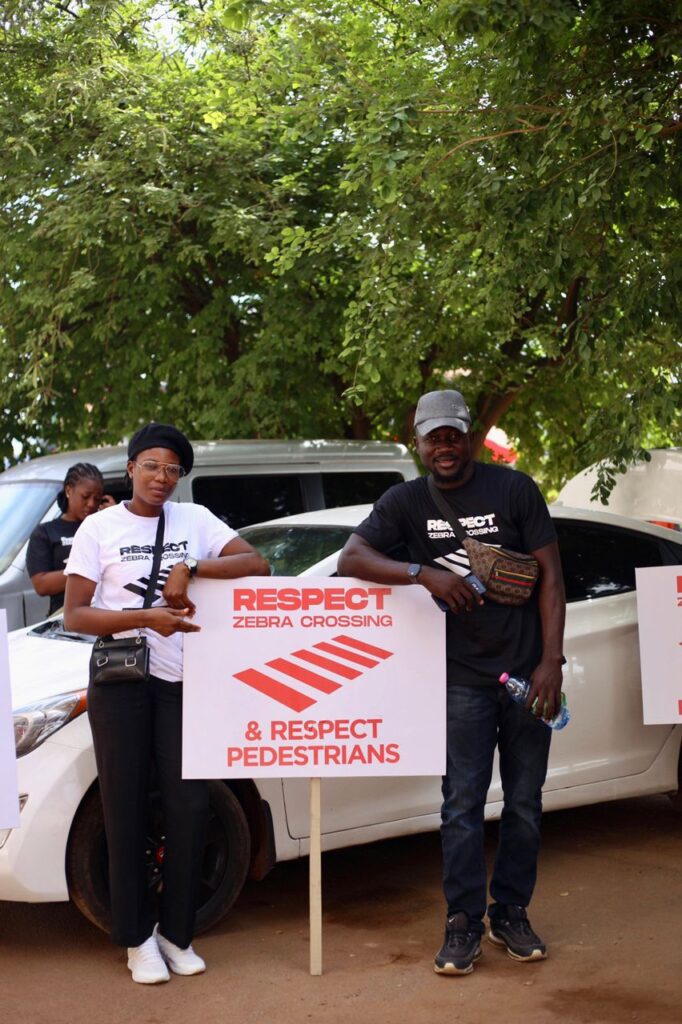
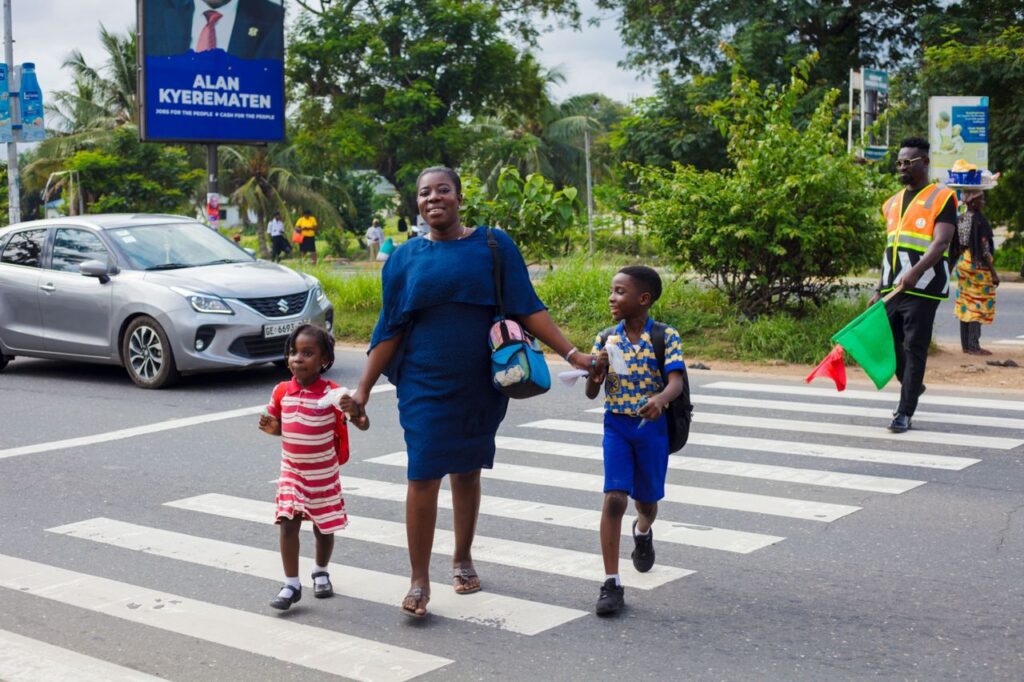
A zebra crossing is a road marking with white stripes resembling a zebra’s pattern. It allows pedestrians to cross safely, giving them priority over vehicles and preventing accidents.
According to the Road Traffic Act, 2004 (Act 683), drivers must stop when pedestrians want to cross the road using a zebra crossing. Overtaking near a zebra crossing within 30 meters is prohibited. Drivers must yield to pedestrians on the crossing.
But is this really the case in Ghana?
However, this is not always the case in Ghana. Zebra crossings across the country have over time lost their essence. There is little or no respect for zebra crossings by both drivers and pedestrians. While drivers often speed up when they see people using the zebra crossing, most pedestrians who are impatient for a “God-sent driver” to stop most often use illicit crossings.
This negligence has led to many crashes and deaths which could have simply been avoided if these crossings were respected. It is important to note that respecting zebra crossings is not the only way to avoid road crashes and accidents, but doing so can go a long way to help ensure safety on the road. For instance, findings have shown that about 336 pedestrian crashes were recorded between 2007 and 2016 in the Cape Coast metropolis, with 15.2% of the victims dying while about 328 pedestrian crashes were recorded in 2019 in the same metropolis.
For many years, there have been several advocacies and campaigns, particularly by the National Road Safety Authority, as well as lots of write-ups on the need for Ghanaians to respect zebra crossings.
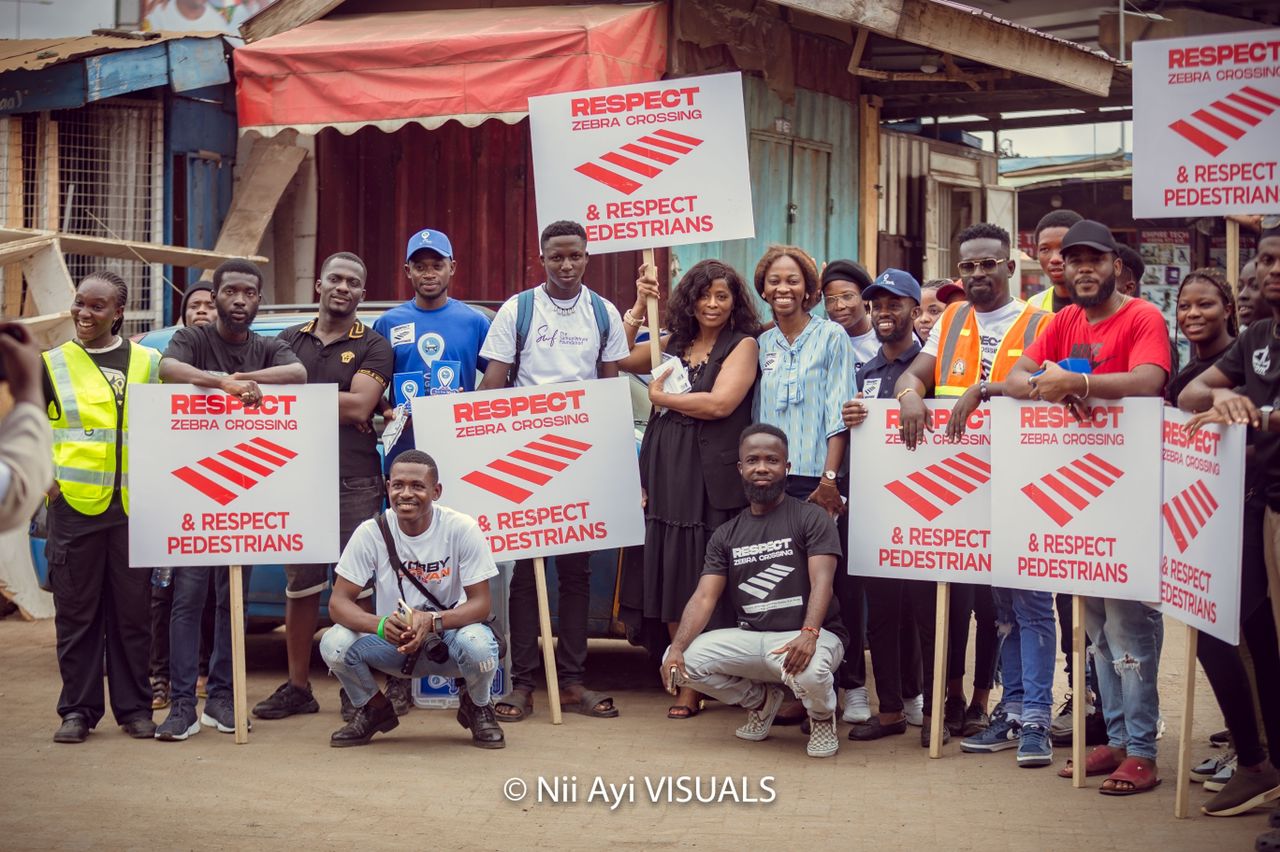
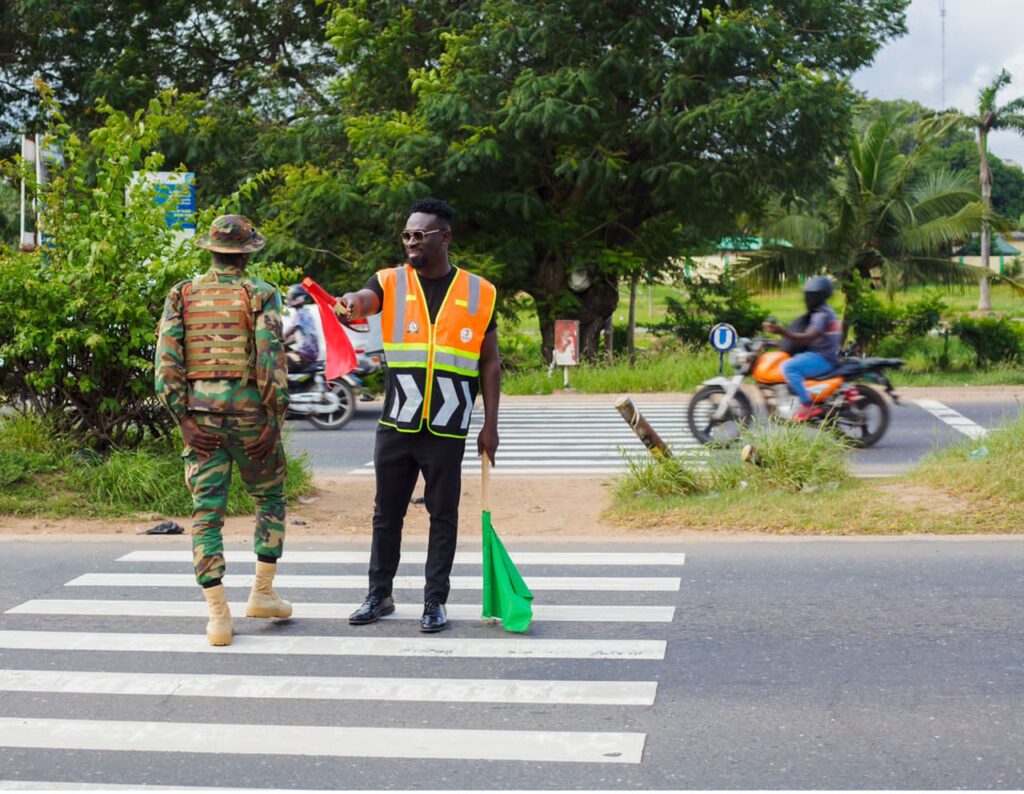
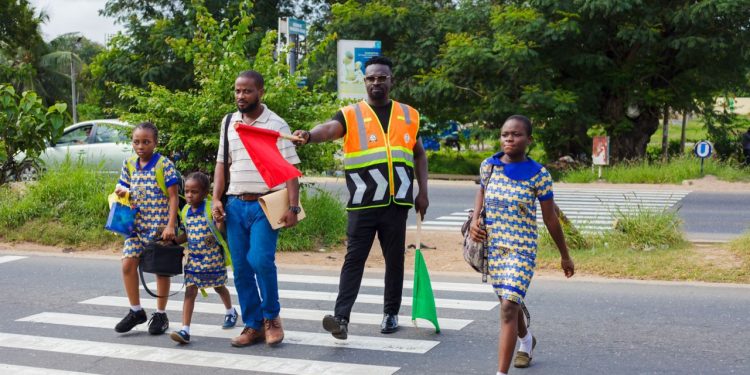
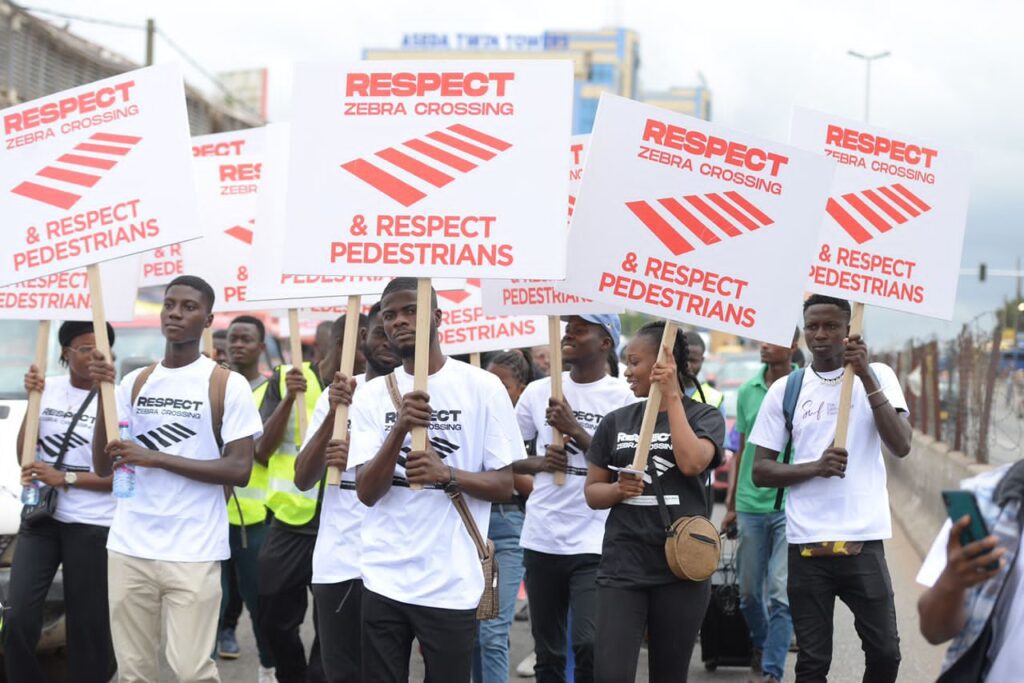
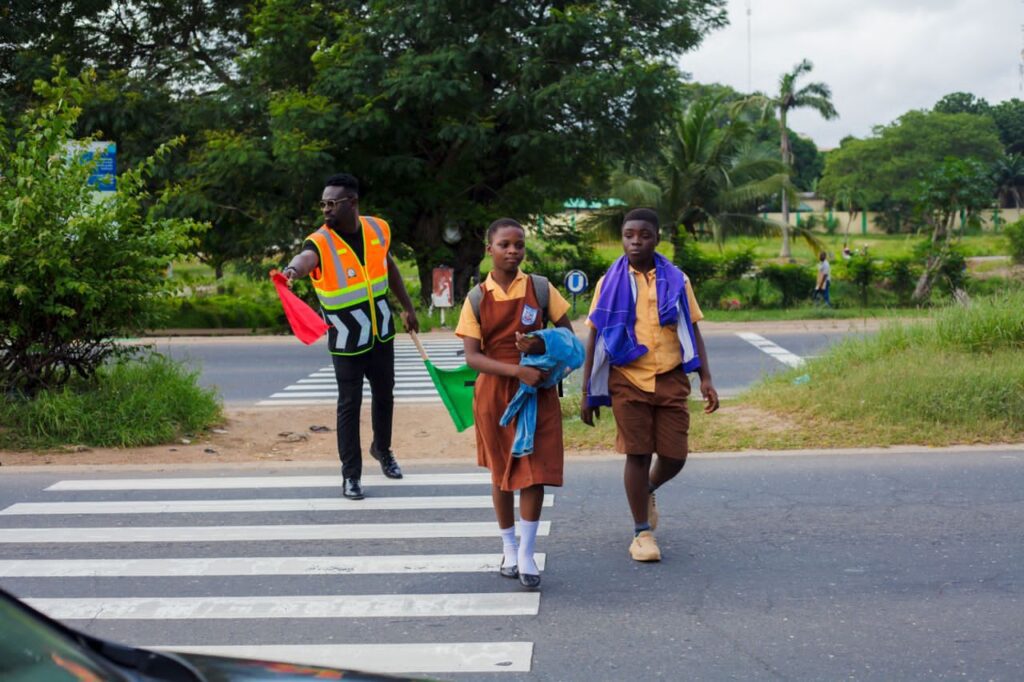
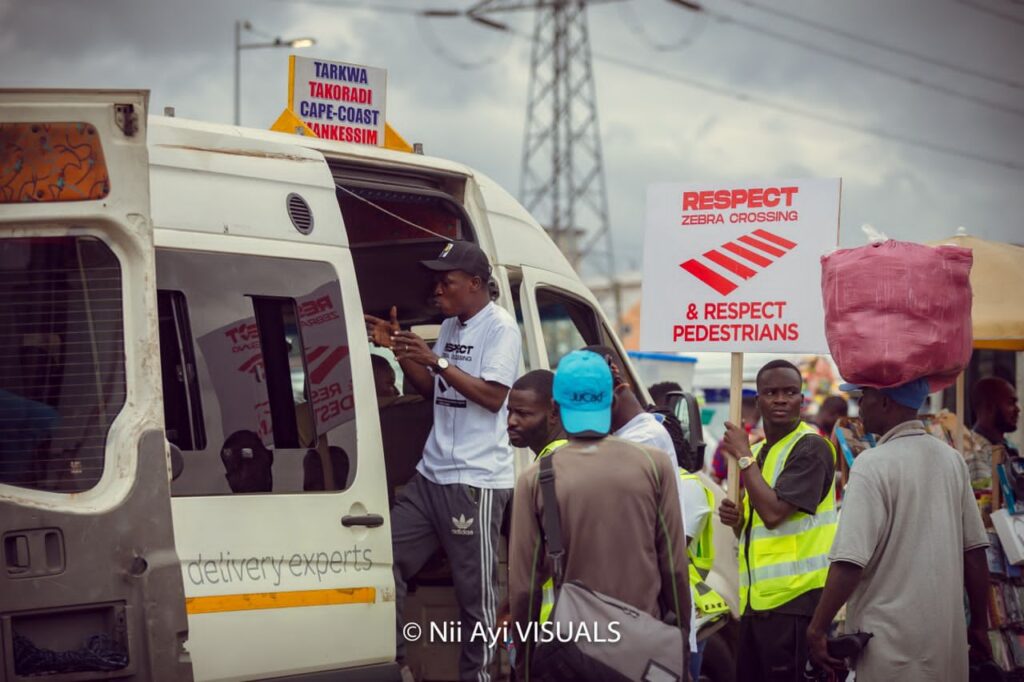
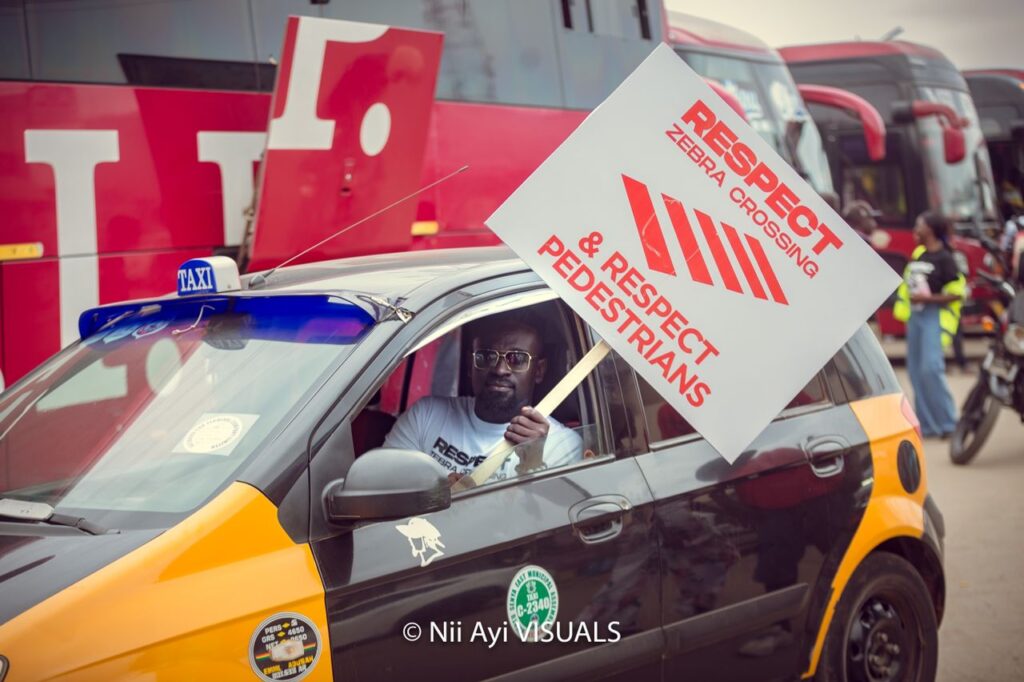
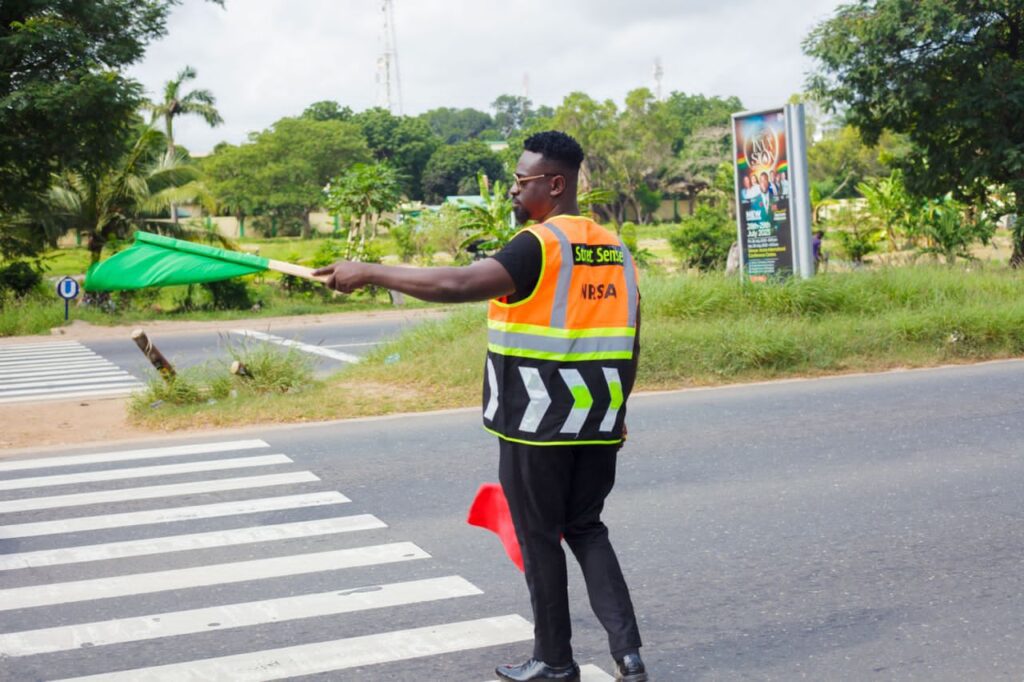
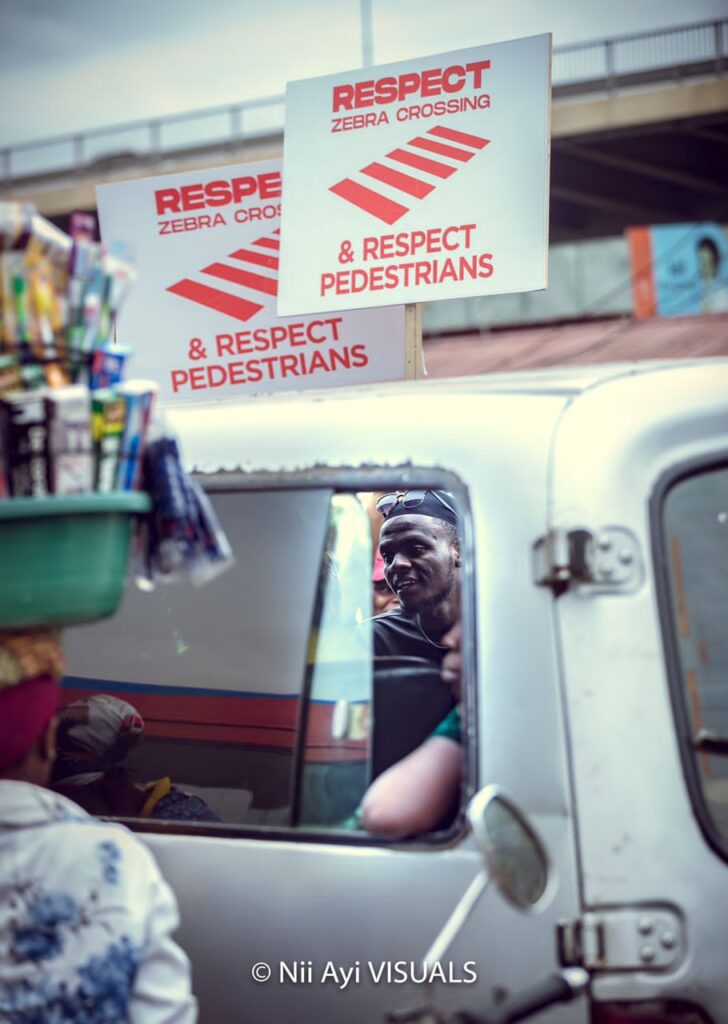
One of such recent campaigns is the “Respect Zebra Crossing” campaign being championed by blogger, Kobby Kyei.
According to Mr. Kyei, his observations on the disregard of zebra crossings pushed him to leverage his followership on his social media platforms to embark on the campaign.
With the help of some volunteers, Kobby Kyei has been to New Bortianor, Circle, Madina, and GBC to provide assistance to pedestrians using the zebra crossings and educated both pedestrians and drivers on the importance of respecting the zebra crossings.
In an interview with Citi News on Monday, Mr. Kyei said, “As a blogger who has amassed quite a number of followers on social media, I saw the need for me to use my platform to start an initiative to educate the followers and the masses who are out there. So I decided to come out with this Respect for Zebra Crossing campaign because I noticed that I am a driver myself but anytime I get to the zebra crossing, most drivers don’t respect it.”
“You will see pedestrians both old and young for hours with drivers not respecting or stopping for them to cross. Again, pedestrians themselves not using the Zebra crossing but trying to cross using other avenues and not even using the overpass.”
Mr. Kyei said the campaign has had some celebrities’ endorsement and urged all and sundry to also get on board in order to safeguard lives and ensure orderliness and discipline on the country’s roads.
“I have had celebrities coming on board to have an endorsement for me. I have had Joselyn Dumas endorsing it, I have had Ohemaa Mercy, I have had Adjetey Annan, I have had Medikal, I have had Martha Ankomah, I have had Peter Ritchie, I have a host of others who have come on board to endorse it and I am looking forward to drive this campaign to the end of the year.”
“I am also urging the authorities in charge of our roads, the Ministry of Roads and Highways, also to the Motor Transport and Traffic Directorate (MTTD), the Ghana Police Service (GPS) and all other departments that are making sure that the laws on our roads are being ensured can also be a part of this initiative,” he stated.
Recommendations/Way Forward
Mr. Kyei proposed that more public awareness campaigns be initiated to educate both drivers and pedestrians about the importance of zebra crossings and the right of way through posters, social media, and community events.
Again, he called for the stricter enforcement of traffic regulations by the MTTD and the police to discourage drivers from violating pedestrian rights and impose fines for violations.
“Ensure clear and visible zebra crossing markings with proper signage at strategic locations. Enhance visibility during low-light conditions through reflective materials. Invest in pedestrian-friendly infrastructure like sidewalks, crosswalks, and pedestrian islands to encourage safe crossing behaviour.”
“Involve local communities and organizations in promoting pedestrian safety and respecting zebra crossings. Collaborate with schools, businesses, and resident associations. Organize pedestrian safety workshops and involve citizens in suggesting improvements and solutions for safer crossings,” he stated.
Proposing the usage of smart traffic lights or pedestrian-activated signals to improve pedestrian safety and make drivers more aware of pedestrian crossings, Mr Kyei further recommended the implementation of reward programmes or incentives for drivers who consistently follow road safety rules, including respecting zebra crossings.
“Include pedestrian safety awareness in driving schools and license renewal programmes to reinforce the importance of zebra crossings. Work with public transport authorities to ensure drivers of buses and taxis are trained to respect pedestrian crossings,” he added.
Ghanaian historian and economist, Dr Nii Moi Thompson, has refuted the assertion that the Gold Coast was renamed Ghana by Joseph Boakye Danquah also known as JB Danquah, a member of the United Gold Coast Convention (UGCC).
In an article titled: ‘Beware, the tribal supremacists: Myths of J.B. Danquah and the Big Six’, Dr Thompson highlighted that the name change was brought up by Ghana’s first president, Dr Kwame Nkrumah, who was criticised by JB Danquah for coming up with such a name.
” Only Nkrumah as prime minister in 1957 was in a position to propose that name, and he did. Danquah and the others criticised Nkrumah for choosing the name Ghana, and in his autobiography Nkrumah was forced to defend his choice,” he said as “by 1957 Danquah’s political career was effectively over (he and Ofori-Atta having lost their seats to the CPP in the 1954 and 1956 elections)”
However, he revealed that JB Danquah made a number of proposals for the name change due to his “weird obsession for naming places” – a characteristic Dr Thompson says President Akufo-Addo possesses.
He noted that JB Danquah without any consultations or whatsoever, proposed that the then Northern Territories be renamed “Fergusonia” in honor of Ekem Ferguson, a surveyor from Anomabo, who is said to have done much work in the North. This, suggestion, JB Danquah said, was shot down by the British.
That was not the only thing the British rejected. According to Dr Nii Thomspon, they also rejected some proposed names to replace the Gold Coast.
JB Danquah, who was married to a Ga lady, is said to have sought to rename Gold Coast by “Akanland” and later “Akan-Ga” after he was reminded that “there were more Gas than Akans in the colony.”
“His most “valiant” name-changing effort was his suggestion after the 1948 riots that he and his relatives be put in charge of the Gold Coast, under the name Ghanaland.
The idea of course was laughed off by the British. He pioneered the tribalism that his inward-looking descendants are now perfecting with national resources. (Remember the president’s statement, “Yen Akanfo” during his desperate struggle to win power – and destroy the country?),” Dr Nii Thompson added.
The revelation by the historian stems from President’s Akufo-Addo’s decision to name the University of Ghana after JB Danquah some day. During the 75th Anniversary Thanksgiving Service of the University of Ghana, President Akufo-Addo made this known.
He described Joseph Boakye Danquah, as the founder of the university owing to some contributions he reportedly made prior to its formation.
“And for me, the most poignant of those memories is the inestimable work Dr. J. B. Danquah did to mobilize the Ghanaian people to insist on the building of this university. It was the inspired leadership vision of this great scholar and nationalist, who’s described in his lifetime as the doyen of Gold Coast politics, that following the establishment of the Elliot Commission, tasked by the colonial government, to inquire into the possibility of establishing a university in West Africa, enable the Ghanaian people to reject the original decision of the British-colonial government based on the majority recommendation of the Elliot Commission that a single university be established in Ibadan, in Nigeria, for the whole of the then British West Africa, and got it to agree, through a series of passionate interventions in the then legislative council.
“And with the enthusiastic support of the founders of Ghana to the creation of a separate university for our country, on the basis on his minority recommendation. How felicitous was that decision and how greatly it’s contributed to the growth of modern Ghana. It would be wholly-appropriate, and not at all far-fetched, to describe Joseph Boakye Danquah, as the founder of this university. A fact, which on the 75th anniversary of its existence, should be vividly recalled by all of us who have been, and are the beneficiaries of his work.
“Indeed, in many other jurisdictions where there is less heat in their politics, and more attachment to the historical records, it would not have been put of place to have this university named after him. Who knows, one day, it may well happen,” he said.
Climate change! Global warming, food insecurity, rising temperatures, melting glaciers, sea-level rise, more frequent, severe weather events (hurricanes, droughts, and heatwaves), and disruptions to ecosystems and biodiversity – I bet you thought of these too.
The discourse on climate change has rightly captured global attention, but the changing dynamics of our economic and political landscapes demand some attention. Previously, it would be herdsmen and migratory animals seeking greener fields to feed on, but today, the nation grapples with the challenge of losing skilled graduates, particularly nurses, to foreign lands in search of greener pastures. This development brings forward the need for the need for innovative strategies that encompass labor export, technological integration, and human security considerations.
Conversations are rife on traditional and social media about the many – both young and old – relocating to settle abroad. Everybody dey japa! The average young person today is thinking of “japaing”, an adopted term from our Nigerian neighbours that speaks of travelling to a Western country for greener pastures. Climate change enthusiasts speak passionately about the deletion of the earth, but after we have saved the earth and our environments, who will tend to it?
In my usual moments of reflection, my racing thoughts converged at the epicentre of developing a globally competitive workforce as a counter-mechanism for brain drain. After all, aren’t we taught to make good use of both the good and bad times.
It is worth noting that while the brain drain challenge is multifaceted, solutions that are likely to be proffered may in themselves be nuanced. cannot be discounted. For instance, despite the government’s investment in nursing and teacher trainee allowances, the allure of “greener pastures” overseas persists – moreso when these trainees have to struggle for jobs after studies. I’d want to reserve the discussion on the payment of allowances for another time. Meanwhile, there is the need to adopt a strategy that capitalizes on the global demand for skilled labor while addressing the root causes of emigration.
Labour export can become a strategic asset for Ghana. By identifying sectors with surpluses of trained professionals and forging partnerships with countries experiencing shortages, the country can create a virtuous cycle of economic growth and talent retention. Collaborative agreements can include skills development, mutual recognition of qualifications, and ethical labour migration policies.
We must not lose sight, however, of the fact that technology rules the world today. The globally-competitive workforce we seek to build must be tech-savvy. Experts and relevant stakeholders in education must begin to look at ways of incorporating AI and technological education through AI literacy, sector-specific AI applications, and hands-on projects that foster innovation and problem-solving skills to train students. Ghana could be known as a hub for cutting-edge skills and innovation.
Also, policymakers need to consider the broader implications of labour export and technological integration in education on citizens’ well-being, social cohesion, and access to basic services. We can begin to gather comprehensive data on emigration patterns, skills shortages, and global labour demands, and tailor our cultural and educational systems to suit them. While cultural integrity must be upheld, we cannot stand in deep waters and die thirsty. Isn’t culture in itself, dynamic?
Investment in skill development programs that align with both domestic needs and international labour demands is needed for this cause. There have been numerous concerns about the harsh conditions under which some Ghanaian migrant workers in some advanced countries work. Government must begin to think of crafting ethical migration policies that protect workers’ rights, ensure fair wages, and provide social support systems. A collaboration with destination countries can ensure migrants’ wellbeing, and give government the power to request taxes from migrant workers.
With the prevailing economic crisis, it’s about time our social justice advocates began raising awareness about the broader impact of talent migration and technological shifts on society. We must not, again, lose sight of the few patriotic ones who would want to stay and till the motherland, that it may bear fruits for all its citizens, home and abroad. A review of the current minimum wage, the establishment of robust social safety nets, and the regulatory mechanisms that ensure that businesses engage in ethical labour practices and responsible technological innovation that prioritize people’s well-being over profit could be useful in this regard.
We cannot stop young people from leaving, especially when they suffer hunger while at home. We can create an opportunity out of it though, for maximum benefit. Where are our leaders? Arise and do something.
DISCLAIMER: Independentghana.com will not be liable for any inaccuracies contained in this article. The views expressed in the article are solely those of the author’s, and do not reflect those of The Independent Ghana
An alarming corruption report from 2022 has brought attention to the pervasive issue of bribery within Ghana’s public sector.
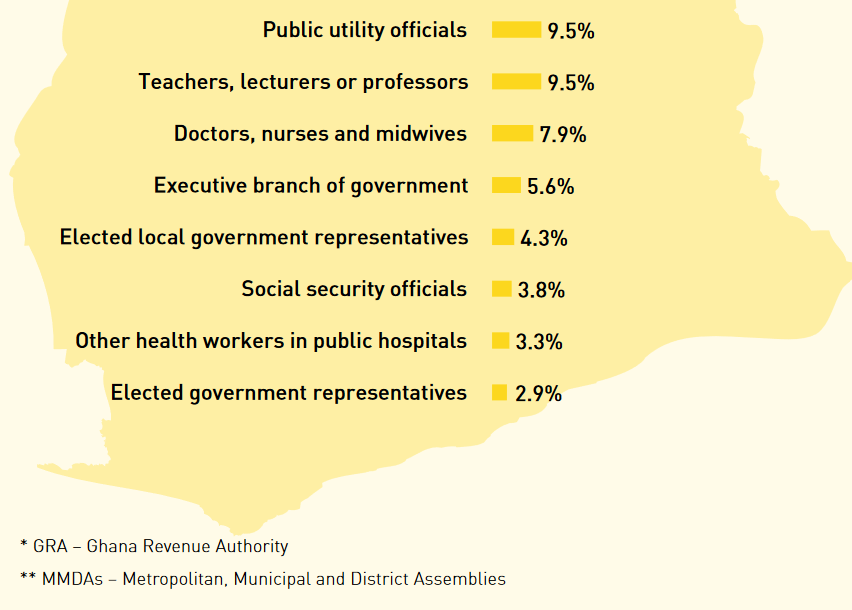
The findings reveal that police officers have shown the highest vulnerability to bribery among all public officials, with an alarming prevalence rate of 53.2 percent.
Conducted collaboratively by the United Nations Office on Drugs and Crime (UNODC), the Commission on Human Rights and Administrative Justice (CHRAJ), and the Ghana Statistical Service (GSS), the survey provides a troubling glimpse into the scope of corruption.
Ghana Immigration Service (GIS) Officers and Ghana Revenue Authority (GRA) customs officers also stand out with significant bribery rates of 37.4 percent and 33.6 percent, respectively.
Interestingly, elected government representatives exhibit notably lower involvement in bribery, registering a mere 2.9 percent.
Different forms of bribes are given to public officials. A striking 84.8 percent of bribes in Ghana are in the form of cash. While the exchange of a public service for another service and offering food and drink are less common, rural areas (17.8 percent) show a higher tendency to use food and drink bribes compared to urban areas (10.1 percent).
The cumulative value of cash bribes in Ghana nearly amounts to a third of the Ministry of Education’s 2021 budget.
Urban cash bribes are 1.5 times larger than rural ones, with the national average bribe standing at 348 Ghanaian cedi. Considering approximately 17.4 million bribes were paid in Ghana in 2021, the annual sum for cash bribes to public officials is around 5 billion Ghanaian cedi, equivalent to 32.9 percent of the Ministry of Education’s 2021 budget.
Borders are a fundamental aspect of any nation’s geography. They signify the point where one country’s expanse concludes and another’s begins.
These borders range from distinct lines to more ambiguous boundaries that might not be immediately evident.
Recently, Ghana and Cote d’Ivoire engaged in a legal process to define their maritime boundary, a case that saw Ghana emerging victorious.
Despite this legal tussle, the two nations have maintained a generally positive relationship over time.
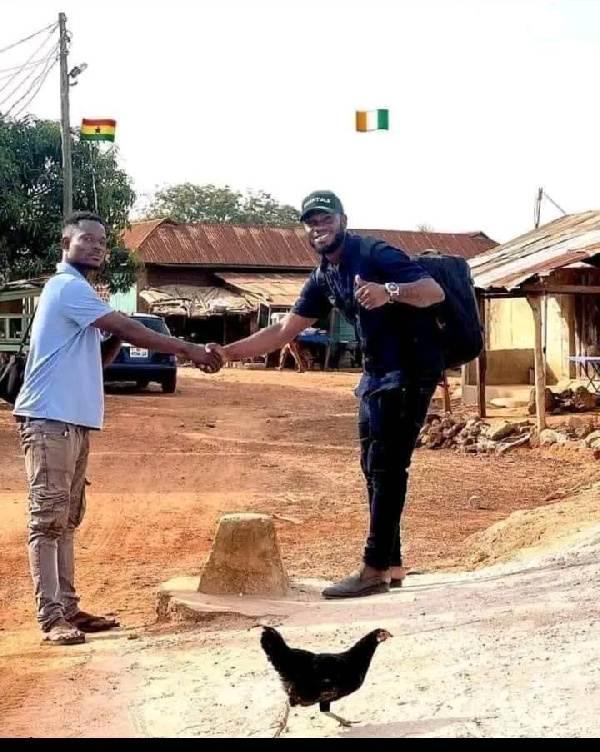
Interestingly, some of these borders are not distant frontiers but mere steps away from each other. An intriguing image circulating online captures this proximity, prompting numerous individuals to share it.
The photograph depicts two men stand on opposing sides of a modest concrete pillar, its height merely a few meters above the ground. In a symbolic gesture, they extend their hands to meet in a handshake, effectively highlighting the border’s demarcation.
This snapshot is gaining traction due to its portrayal of the boundary between these two countries. Notably, this is not the first instance where a simple act, like a short stroll or a few meters, serves as a delineation between Ghana and its neighboring nations.
Borders hold a unique significance in defining nations, and this image encapsulates the intriguing blend of geographical lines and diplomatic relations in an evolving global landscape.
The world is now a global village thanks to advancements in technology. Individuals from diverse backgrounds, be they religious, social, or political, are able to share a bit of who they are with the world.
However, despite the devices available, many in the Western world are quite oblivious to the existence of the numerous countries in Africa and what their beliefs and ways of living are.
Presently, a minor has taken it upon herself to contribute to the awareness of the West African state, Ghana, and Africa in general.
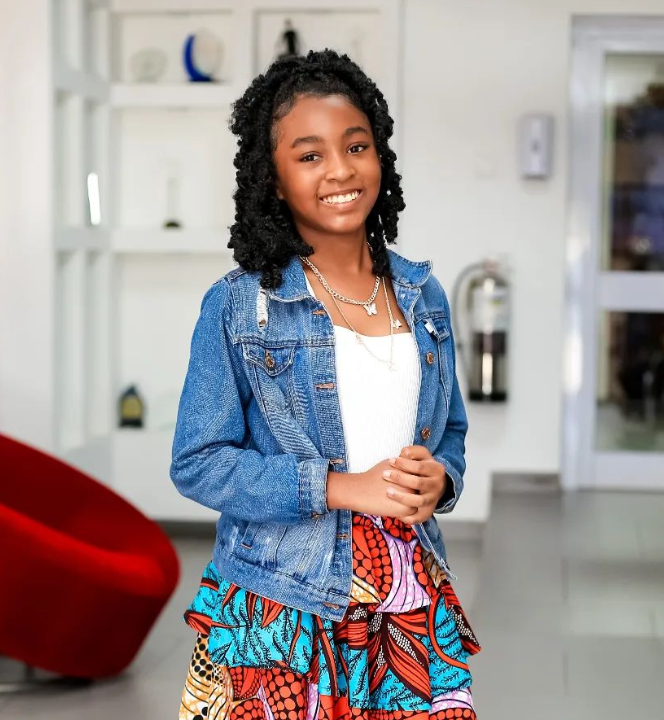
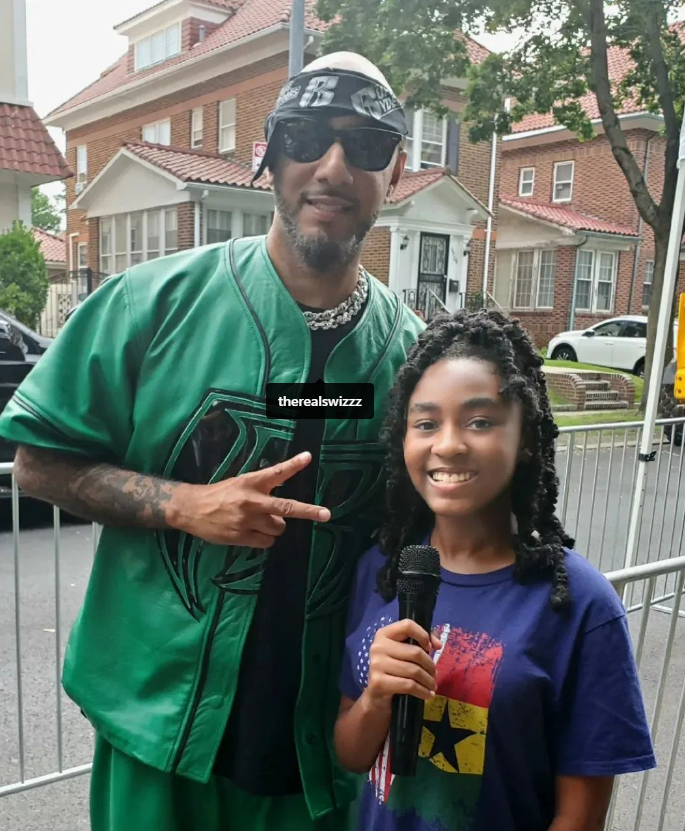
11-year-old Samara Osae-Asare is the name on the lips of most Ghanaians, as she devotes her time to promoting Ghana to the world.
From the diverse languages, the food mostly preferred by the locals, amazing tourist sites to behold, nothing skips the attention of the Ghanaian-American girl.
In most of her interactions with celebrities, she teaches them a few words in the local parlance known as Twi.
Swizz Beatz, the American record producer, rapper, DJ and songwriter, is one of her beneficiaries.
Swizz Beatz and Samara
She has encouraged the likes of singer Usher, Black Panther actress, Letitia Michelle Wright, Erykah Badu, an American singer, Lauryn Hill, a sensational singer, rappers Ice Cube and Snoop Dogg, and others to visit Ghana.
Usher has already had a taste of Ghana. Ahead of the Global Citizen Festival which took place on Saturday, September 24, 2022, he toured the country.
The popular American Pop and RnB superstar, visited several sites in the Chorkor community, meeting with local traders and fishermen in the Greater Accra region.
After the show, Usher promised to return to Ghana.
At just 11 years old, Samara Osae-Asare stands out from the crowd. As the vibrant host of TV3’s Kidz Arena, she takes center stage, engaging in insightful interviews with celebrities spanning the globe.
Her love for journalism and entertainment fuels her drive, setting her apart from her peers. Samara’s aspiration extends beyond her own achievements; she aims to ignite a spark of inspiration among fellow youngsters, encouraging them to fearlessly pursue their aspirations.
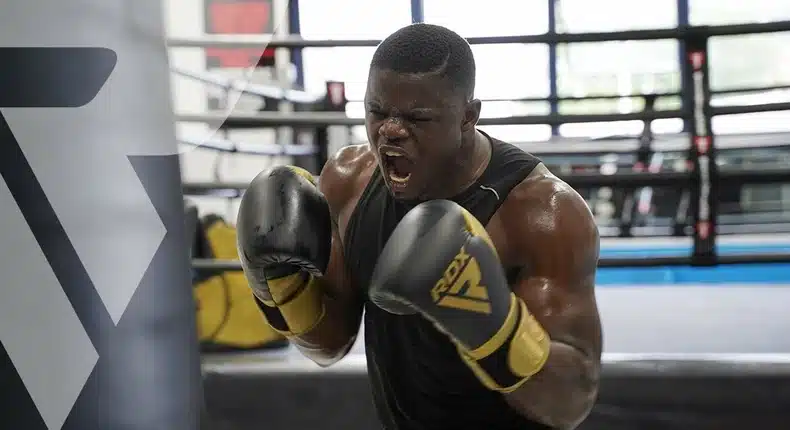
Ghanaian-British boxing sensation Seth Gyimah, widely known as‘Freezy Macbones’,has made a significant decision to support Ghana’s quest for qualification in the 2024 Paris Olympic Games.
‘Freezy Macbones’ gained prominence with his remarkable four-round knockout victory over a seasoned UK boxer at London’s Copper Box Arena.
Having faced a dilemma regarding which nation to represent at the international level since his move in 2012, the 33-year-old has ultimately chosen to compete for Ghana.
In an official statement released on Monday, August 14, the boxer confirmed his commitment to represent Ghana by joining the country’s amateur boxing team, commonly referred to as the Black Bombers.
“I have been called on to represent my country, Gahan, at the upcoming 2024 Olympic Games in Paris, France. This will commence after the African qualification bouts next month in Dakar, Senegal,” Freezy Macbones stated.
The boxer, who has commenced training ahead of the qualifiers, noted that it would be a dream come true if he could qualify for the Olympic Games and win gold for the country.
“I am currently training hard to make it past the qualifiers and bring back the Gold next year. This opportunity to represent my home country at the world’s biggest sporting event is a dream come true,” he added.
The path to becoming a boxer for Freezy Macbones started during his time as a mason in Ghana, and his story has served as a source of inspiration for numerous individuals in the nation.
Often likened to the iconic boxer Mike Tyson, Freezy Macbones has openly voiced his ambition to secure a world title in the near future.
The efforts undertaken by the governments ofGhana and the United States are anticipated to lead to an upsurge in trade volumes.
In 2022, the trade in goods between Ghana and the United States of America reached an unprecedented peak of $3.7 billion, showcasing a favourable trade balance, as outlined in a fact sheet from the US Embassy in Accra.
During that year, Ghana’s exports to the US totaled $2.7 billion, encompassing key commodities such as crude oil, cocoa (beans, paste, and butter), apparel, rubber, and cassava.
Imports from the US stood at $1 billion in 2022, comprising significant items like automobiles, machinery, paper products, plastics, medical devices, fertiliser, and agricultural goods.
Virginia E. Palmer, the US Ambassador to Ghana, stated that due to collaborative measures implemented by both the US Embassy and the Ghanaian government, trade volumes are projected to experience further growth in the forthcoming years.
She emphasised that promising indicators point to substantial growth in various sectors, contributing to job opportunities in both Ghana and the United States, thereby fostering prosperity in both nations.
“To give a straightforward answer, I would say trade volumes are expected to expand by billions. With US$3.7 billion in goods now, it is a lot,” she said when asked about Ghana-USA trade prospects.
She spoke at the US – Ghana Business Expo held under the theme ‘Leveraging US trade relations for growth and prosperity’. The event took place in Accra.
The Under-secretary of Commerce for International Trade of the United States of America, Marisa Lago, commenting on trade volumes between the two countries stated that: “Emerging from the pandemic, total USA-Ghana trade has been on an upward trajectory.
“As our trade and investment relationship matures and continues to grow, we look forward to broadening thetypes of goods and services that we exchange; such as personal care products and apparel.”
Ms. Lago urged participants to be open about challenges, as they are looking for opportunities as well as to identify inhibiting factors that hold businesses back from delivering greater trade and investment.
Given the current global crises, she said, it is important to ensure that the business environment continues to support and foster entrepreneurship, innovation, investment, and trade.
She mentioned that to further strengthen trade between both countries, she will hold discussions with counterparts in Ghana’s government and the private sector on how they can work together to achieve some shared objectives of improving the business environment and facilitating increased trade and investment.
The Minister of Trade and Industry, Kobina Tahir Hammond, said the government has stepped up support for the private sector, both domestic and foreign, to enhance production and export capacity – particularly in the manufacturing sector, with notable opportunities for export into the US market.
“We would like to see more export products from our shores into the US market, the most lucrative consumer market globally. We believe that this can be achieved through increased investment from the US, especially in respect of harnessing the considerable and largely untapped US market opportunities offered under the African Growth and Opportunity Act (AGOA) and the Prosper Africa Initiative of the US government.”
The objective of the 2023 US Ghana Business Expo is to establish a platform that facilitates the development of mutual trade partnerships and economic advancement between the United States and Ghana.
The event brought together prominent figures within various industries, entrepreneurs, government representatives, and business executives from both countries. The purpose was to uncover potential prospects, share insights, and cultivate alliances.
Trade interactions between Ghana and the United States (US) reached a remarkable sum of $3.7 billion in the year 2022, as highlighted in data divulged by the US Embassy situated in Ghana. This notable achievement solidified the US’s position as Ghana’s fourth most significant export destination, further affirming the substantial economic ties between the two nations.
Ghana’s exports to the US in 2022 amounted to $2.7 billion and the main exports from Ghana include crude oil, cocoa (bean, paste, and butter), apparel, rubber, and cassava.
Ghana’s imports from the US in 2022 amounted to $1 billion, and the major imports include cars, machinery, paper products, plastics, medical devices, fertilizers, and agricultural goods.
Ghana’s trade surplus with the US in 2022 was $1.8 billion, while trade in services is also growing strongly, the information said.
It also indicated that in that same year, US bilateral assistance to Ghana was over $150 million; and that went into financing health, economic growth, agriculture, education, human rights, governance, and security.
The US government in 2022 provided over $32 million in agricultural assistance to Ghana.
It stated that more recently, the US Development Finance Corporation announced new support for $25 million in financing for micro, small, and medium sized enterprises in the agricultural sector in Northern Ghana.
“Supporting digital economic development, the United States recently announced a $300 million investment in data centers in Africa, including Ghana,” it added. Ghana registered a total of $421 million in foreign direct investment (FDI) from the US in 2021.
Representatives from the Ghana Investment Promotion Centre (GIPC) and the Ghana Export Promotion Authority (GEPA) have initiated discussions with authorities from Trinidad and Tobago to explore the possibility of implementing Double Taxation and Bilateral Investment treaties.
The aim of these discussions is to bolster the trade exchange between the two nations.
These deliberations took place during a meeting between the delegation and members of Trinidad and Tobago’s Chamber of Industry and Commerce (TT Chamber) in the previous week.
The Ghanaian delegation also pinpointed key sectors within Trinidad and Tobago, particularly the manufacturing sector, as fertile ground for forging partnerships with Ghanaian small and medium-sized enterprises (SMEs).
During the meeting, Mr. Yofi Grant, the CEO of the GIPC, expressed the viewpoint that a collaborative effort between the two countries holds the potential for mutually advantageous outcomes.
He emphasized the significance of taking into account each nation’s economic circumstances and contributions.
“For us in Ghana, partnerships for linkages and trade are key because we do have significant raw material for which we want to add value and then export, and I believe that T&T is really the industrial powerhouse of the Caribbean so there is a lot to learn. But there is also a lot to trade not only in goods but services, particularly in the oil and gas sector where Trinidad and Tobago seem to have built some capacity and experience which they can leverage in Ghana,” he said.
The CEO of GEPA, Dr. Afua Asabea Asare also mentioned plans to establish a Ghana Trade House in Trinidad and Tobago “which will bring the cultural aspect, the trade aspect and everything together in a space where people can come in and see what Ghanaians offer”.
The TT Chamber announced that it will undertake an audit of its members who are already conducting business in Africa in order to facilitate the collaboration between the two nations. This audit will serve as the basis for further engagements.
The Chamber stated that in order to ensure efficient and successful collaboration, it will create a liaison with GIPC.
According to the TT Chamber president, Kiran Maharaj “the opportunities in Ghana are very promising, and it is apparent that they have built an economy and business environment that attract investment from committed partners such as TT’s business community. There are several synergies regarding our culture and the way in which we do business. I am certain there will be many benefits to both countries, not just from the exchange of knowledge and expertise but from investment opportunities, partnerships, and other significant pathways”.
The TT Chamber expressed interest and commitment in developing close relationships with Ghana and utilizing knowledge to advance manufacturing and economic development in both nations.
Meeting with T&T Trade Minister
The Ghanaian delegation furthered the conversations on exploring new trade and investment opportunities in a meeting with the Trade Minister of Trinidad and Tobago, Paula GopeeScoon, as well as other officials including; President of the Trinidad and Tobago Manufacturers’ Association (TTMA), Roger Roach, and CEO of the Trinidad and Tobago Chamber of Industry and Commerce, Stephen De Gannes.
Minister Gopee-Scoon acknowledged the many opportunities for trade and investment between Trinidad and Tobago and Ghana. She noted that the bilateral engagements will foster mutually beneficial partnerships, cultural exchanges and economic growth across both nations.
She reiterated T&T’s commitment to strengthening economic ties with Ghana, and by extension Africa.
At the meeting, the CEO of GEPA, Dr Afua Asabea Asare discussed plans to export Ghana’s native fabrics and prints into the Caribbean, where there is considerable demand. The Centre’s CEO, Yofi Grant also negotiated agreements to have a Trinidad and Tobago steelpan band and masquerades participate in this year’s edition of the Taste of Ghana.
Meanwhile, the TTMA, together with ExporTT, have committed to work towards a trade and investment mission to Ghana in early 2024.
Further, a commitment has been made by both parties to accelerate the ongoing negotiations for a Reciprocal Protection and Promotion of Investments Agreement (RIPPA), with the aim of reaching an agreement by the end of 2023.
The United States Ambassador to Ghana, Virginia Palmer, has issued a cautionary message to Ghana regarding the pending anti-gay bill currently under consideration in Parliament.
She emphasized that if the bill is approved, it could potentially deter investors, including those from the LGBTQI community and other American businesses, from engaging with Ghana.
Palmer praised Ghana as a nation known for its inclusivity, tolerance, and social harmony, factors that contribute to its stability and attractiveness for investments.
She expressed her hope that these qualities would continue to extend to the LGBTQI community.
Palmer stressed the financial opportunities that exist, noting that money knows no color but green or red, and any form of discrimination could adversely impact not only LGBTQI investors but also other American companies considering Ghana for investment.
In a recent interview on August 10th, Palmer shared her thoughts, stating, “Ghana’s strength lies in its welcoming and harmonious society. It would be advantageous for this stance to extend to the LGBTQI community. Discrimination or worse could deter not only LGBTQ investors but also other American enterprises.”
Palmer’s comments come in light of the World Bank’s recent decision to suspend new loans to Uganda due to the controversial anti-LGBTQ law implemented in the country. The World Bank cited a commitment to principles of inclusion and non-discrimination as reasons for their action.
One of the proponents of Ghana’s anti-gay bill, Rockson-Nelson Dafeamekpor, responded to the World Bank’s actions, asserting that Ghana would not be influenced by Uganda’s situation. Dafeamekpor stated that African countries cannot be coerced into accepting practices that are contrary to their values.
He underscored that Africa comprises 54 distinct nations and that attempts by the World Bank to pressure the continent regarding LGBTQ issues would not succeed.
Speaking on a televised news program on August 10th, Dafeamekpor commented, “Ghana remains steadfast and unaffected by recent events in Uganda.
The World Bank’s influence is global, encompassing a variety of nations, and their attempt to impose LGBTQ acceptance on Africa is misguided. We stand firm today and will do so tomorrow.”
It’s important to note that the wording has been adjusted to provide a more neutral and balanced tone while conveying the essence of the original message.
US ambassador to Ghana, Virginia Palmer, has commended the inclusivity of Ghana and its citizens while also warning about potential prejudice, particularly directed at the LGBTQ+ community.
She noted that the nation’s strength and attractiveness as an investment hub primarily stem from its strong interfaith and inter-ethnic harmony.
Nevertheless, Ambassador Palmer emphasized that any form of bias against LGBTQ+ individuals could convey an unfavorable message to American investors overall and should be prevented.
“Ghana is a very welcoming tolerant society, lots of inter-religious, inter-ethnic harmony and that is what makes Ghana strong and stable and attractive for investment. I hope it stays that way with regards to the LGBTQ+
community.
“And again, there is money to be made, if the colour of your money is green or red, it is Ghanaian but there if there is discrimination or worse, then that will send a signal to not just LGBT investors but other American investors that Ghana is less welcoming than I am telling people that it is now. So, I hope it will stay welcoming,” she told journalists.
She was speaking on the sidelines of the US-Ghana Business Expo which took place in Accra on August 10, 2023.
“I want to send a signal that Ghana is open for business and its economic recovery has began,” she added.
She revealed that the US group that had come to Ghana was a special trade delegation, the Global Diversity and Inclusion delegation that had reps from among others:
National Black Chamber
Women-owned businesses
LGBT-owned businesses
Native American owned businesses
Washington has openly spoken in favour of the LGBTQ community and have spoken against Ghana’s anti-LGBTQ Bill which is due to be passed into law by Parliament during its next sitting.
Each independent director on the board of the Bank of Ghana is allegedly paid US$8,000 per month, according to Bright Simons of IMANI Africa.
According to the Bank’s 2022 annual report, there are thirteen directors total, including the governor, his two vice presidents, and the remaining 10 directors.
He points out that the number is higher than average compared to other African nations, particularly Kenya and Nigeria.
His message was sent at a time when the Minority in Parliament is pressuring the bank’s leadership to leave due to a loss that, according to the most recent report, is equal to $6 billion USD.
“The Bank of Ghana has 10 independent Directors. It seems some people, esp in the Political Opposition, are not happy that they are paid ~$8,000 a month (~86,000 GHS).
Given the calibre of people needed to helm a central bank board, what would folks be comfortable with?” he quizzed.
The ten independent directors are as follows:
Dr. Samuel Nii-Noi Ashong – Non-Executive Director Mr. Joseph B. Alhassan – Non-Executive Director Dr. Kwame Owusu-Nyantekyi – Non-Executive Director Mr. Andrew Boye-Doe – Non-Executive Director Mrs. Comfort F. Ocran – Non-Executive Director Mr. Jude Kofi Bucknor – Non-Executive Director Dr. Regina Ohene-Darko Adutwum – Non-Executive Director Mr. Charles Adu Boahen – Non-Executive Director (Till 24/11/2022) Ms. Angela Kyerematen Jimoh – Non-Executive Director Prof. Eric Osei-Assibey – Non-Executive Director
Speaker of Parliament, Alban Sumana Kingsford Bagbin, has made a proposal that could reshape the linguistic landscape of the country, by calling for the adoption of a local dialect as the official language of Ghana.
The speaker made the call during a courtesy call on the Paramount Chief of Essikado, Nana Kobena Nketsia V, at his palace, at Essikado in the Western Region.
He justified his call with a claim that Ghana’s current official language – the English language belongs to another culture and that a society cannot progress using the language of another society.
“No society develops with the language of another society,” he maintained.
He, thus, has called on stakeholders to formulate a national policy to adopt a local language as the country’s official language.
“That is one of the challenges in Ghana, and we must get our language right as a country. For example, the Arabs are ahead of us in terms of development because they have adopted an official language of theirs which every citizen understands,” he stated.
Additionally, he noted that it would be wise for the nation to embrace a distinctive national identity that would promote harmonious interactions among its citizens, thereby expediting the country’s progress and development.
The Speaker’s visit constituted a portion of his interactions with essential stakeholders to garner their backing for the celebration of three decades of uninterrupted parliamentary democracy during the fourth republic.
Mr Bagbin emphasised that Ghana should draw inspiration from East and South African countries, which have chosen to use a local language, like Swahili, as their official language.
He mentioned that this approach would enhance inclusivity and involve all individuals in the nation’s endeavor to attain sustainable economic development.
He expressed that after three decades of practicing democracy as a nation, it was essential to review and reformulate certain facets of the country’s democratic principles to ensure their ongoing maintenance.
He pointed out that achieving this objective would require Parliament to actively interact with the public, understanding their perspectives and recommendations to shape policy revisions related to parliamentary affairs.
Mr Bagbin highlighted the importance of increased participation of traditional authorities in the governance process, emphasising their role as guardians of the land. He mentioned that traditional leaders were the authentic leaders of Ghana and Africa, as they held the trust and allegiance of their followers.
On his part, Nana Nketsia V commended the Speaker for his efforts to engage with stakeholders to consolidate and promote democracy in the country.
Mr Bagbin was in the company of Mr Kwabena Okyere Darko-Mensah, Western Regional Minister, and Member of Parliament (MP) for Takoradi Constituency, Mr Emmanuel Armah-Kofi Buah, MP for Ellembelle Constituency, Mr Joseph Cudjoe, MP for Effia Constituency and Mr Eric Afful, MP for Amenfi West Constituency among other dignitaries, when he called on the Chief.
Ghana has been listed among the top 10 countries globally experiencing the highest food inflation rates.
As indicated in the Food Security Report published by the World Bank, Ghana’s Nominal Food Inflation (year-on-year) of 54% positioned the country in the 8th rank.
However, its Real Food Inflation (year-on-year) of 12% positioned it at the 9th spot.
In the Nominal Food Inflation category, Venezuela claimed the first position with a year-on-year inflation rate of 414%. Following suit were Lebanon (280%), Zimbabwe (256%), Argentina (117%), Suriname (71%), Egypt (66%), and Sierra Leone (58%), in the 2nd to 7th rankings, respectively.
Regarding Real Food Inflation, Zimbabwe (80%), Egypt (30%), Lebanon (26%), Turkey (16%), Rwanda (15%), Burundi (14%), Lao (14%), and Sierra Leone (13%) captured the 1st to 8th positions respectively, representing the countries with the most pronounced food inflation rates.
According to the report, its latest data covering the period from February 2023 to May 2023, which includes food price inflation figures, reveals a notable surge in inflation across numerous low- and middle-income nations.
In fact, inflation rates surpassing 5% were observed in 63.2% of low-income countries, 79.5% of lower-middle-income countries, and 67.0% of upper-middle-income countries. Many of these countries are also grappling with double-digit inflation rates.
Furthermore, the report highlights that a substantial 78.9% of high-income countries are currently contending with elevated food price inflation. The regions most heavily affected by this trend span Africa, North America, Latin America, South Asia, Europe, and Central Asia.
From a genuine economic perspective, the inflation rates for food prices have outpaced the overall inflation rates (measured by the year-on-year change in the Consumer Price Index) in a significant 80.1% of the 166 countries where both food CPI and overall CPI indices are available.
Maize, wheat prices go up but rice price remains stable
The report also revealed an increase in maize and wheat prices, which closed 12% and 14% higher, respectively, after declining in the first half of July 2023. It consequently drove the increase in the cereal price index, whereas rice prices have remained stable.
On a year-on-year basis, maize and wheat prices are 15% and 17% lower, while rice prices are 16% higher. Maize, wheat, and rice prices are 8%, 11% and 3% higher, respectively, than in January 2021
The 2023 State of Food Insecurity and Nutrition in the World report highlights the state of global hunger and food insecurity and the challenges and opportunities that urbanization presents in the context of agrifood systems.
The report expressed concern about Russia’s withdrawal from the Black Sea Grain Initiative (BSGI) in global markets.
Wheat and maize prices rise, but rice prices stay the same
The report also unveiled a rise in the prices of maize and wheat, which rebounded by 12% and 14%, respectively, following a decline in the first half of July 2023. This upswing played a pivotal role in driving an increase in the cereal price index, whereas rice prices have maintained their stability.
In a year-on-year comparison, prices for maize and wheat have seen a decrease of 15% and 17% respectively, while rice prices have risen by 16%. Notably, current prices for maize, wheat, and rice are elevated by 8%, 11%, and 3% respectively compared to their levels in January 2021.
The 2023 State of Food Insecurity and Nutrition in the World report offers insights into the global landscape of hunger and food insecurity, shedding light on the challenges and opportunities that come with urbanization in the context of agrifood systems.
Of particular concern highlighted in the report is Russia’s withdrawal from the Black Sea Grain Initiative (BSGI) within the global markets.
President and Founder of IMANI Africa, Franklin Cudjoe, has highlighted that Ghana’s inflation rate for July 2023 is three times higher than the inflation rate in crisis-stricken Ukraine.
Cudjoe pointed out that as of July 2023, Ghana’s inflation had reached 43.1%, with interest rates edging close to 40%.
He further noted that Ukraine’s inflation rate for the same month, July 2023, was recorded at 11.3%, which is three times lower than Ghana’s inflation rate.
In a Facebook post dated Thursday, August 10, 2023, the President of IMANI Africa emphasized the alarming pace at which Ghana’s economic situation is deteriorating.
“Inflation is galloping… 43.1% interest rates inching towards 40%. Inflation in Ukraine is 11.3% in July,” he wrote on his Facebook page.
Background
As stated in its 2022 Annual Report and Financial Statement, the Bank of Ghana encountered a substantial loss primarily due to the Debt and Deficit Exchange Program (DDEP).
As outlined in the report, the central bank underwent a restructuring of its holdings of government debt, while its non-marketable holdings of Government of Ghana instruments, which included long-term stocks, a COVID-19 Bond, and overdrafts, underwent a haircut of 50 percent.
Similar terms were applied to the exchange of Bank of Ghana’s other claims (holdings of marketable instruments) as those of other financial institutions participating in the DDEP.
This restructuring resulted in an impairment of GH¢48.40 billion in the year 2022.
Additionally, the Central Bank experienced revaluation losses on its foreign assets and liabilities due to the depreciation of the exchange rate.
The combined impact of impairments and revaluation losses led to a negative equity position amounting to GH¢55.12 billion for the year 2022.
The report further indicated that despite a robust trade surplus, the balance of payments incurred a deficit of US$3.64 billion, attributed to significant net outflows in the capital and financial account.
This situation prompted a drawdown of US$3.46 billion in Gross International Reserves, causing a decline from US$9.70 billion at the end of December 2021 to US$6.24 billion at the end of December 2022. This amount provided a cover for 2.7 months of imports.
The substantial reduction in reserves exerted considerable pressure on the currency, leading to the reduction of the Common Equity Tier 1 capital ratio from 6.5 percent to 5.5 percent, and an increase in the maximum Tier 2 capital ratio from 2.0 percent to 3.0 percent of total risk-weighted assets.
Business partners Dr. Ernest Ofori Sarpong and Dr. Osei Kwame Despite intend to develop one of Ghana’s largest poultry farms, according to plans made public by the minister of food and agriculture, Bryan Acheampong.
The minister claimed that after hearing his persuasive case for agriculture, and particularly chicken farming as a business, during a meeting, the businesspeople accepted the concept.
“Your senior brothers, Despite and Ofori came to meet me that after our last meeting when we discussed something about the poultry industry, Ofori said myself and Despite can do poultry as a business and as means of feeding the country if this is what you are saying,” he told Kwame Sefa Kayi on Peace FM.
The minister claims that the two have committed to the project after receiving his promise that they will be able to acquire land for such a large undertaking.
“After showing them the numbers, they said I should give them land, so I am looking for a land for them at Dahwenya and they have assured me that they will build one of the biggest poultry farms in the country,” he stated.
The minister further stated that the government would soon introduce a new iteration of the Planting for Food and Jobs initiative, which would strengthen the nation’s agricultural industry.
In July 2023, Ghana’s inflation rate has risen to 43.1%, marking an increase from 42.3% observed in June of the same year.
Consequently, the cost of goods and services has seen a surge of 43% over this period.
As reported by the Ghana Statistical Service, the prime driver of inflation was food, contributing to a rate of 55%, while non-food items accounted for 33.8%.
In terms of inflation rates, locally produced goods experienced a rate of 37.5%, whereas imported items were subject to an inflation rate of 45.7%.
Looking at regional variations, the Greater Accra region registered the lowest inflation rate at 31.8%, while the North-East region saw the highest inflation rate at 64%.
Specifically, the categories of food and non-alcoholic beverages witnessed an inflation rate of 55%, whereas personal protection and miscellaneous goods and services recorded an inflation rate of 60.5%.
Zipline Ghana has received a prestigious recognition as the “Most Digitized Logistics Provider of the Year” at the Africa Procurement and Supply Chain Awards event held in Lagos, Nigeria.
This esteemed occasion, dedicated to acknowledging remarkable accomplishments within the logistics sector, witnessed Zipline’s remarkable ascent above its contemporaries, securing the highly coveted award in recognition of its unwavering commitment to innovation and operational efficiency.
Zipline Ghana’s General Manager, Mawuli Atiemo, expressed that this accolade stands as a testament to the relentless determination and collective efforts of the entire Zipline team.
He highlighted the company’s transformative impact on the logistics landscape through the implementation of digitization and cutting-edge technologies, which have significantly elevated the industry’s standards.
“At Zipline, we have consistently pushed the boundaries of logistical capabilities, spearheading the utilization of advanced drone technology to facilitate the delivery of essential supplies to communities. Our resolute dedication to embracing innovation and executing ingenious solutions has been pivotal in shaping our success,” Mawuli emphasized.
He further stated, “Our core belief centers on ensuring that logistics never hinder access to critical medical assistance and essential goods.
Thus, our services are meticulously crafted to surmount logistical challenges and create a meaningful positive influence in the lives of individuals throughout the nation.”
Having initiated its operations in Ghana in 2019, Zipline has emerged as a vital collaborator with the Government of Ghana, seamlessly complementing existing logistical pathways for the transportation of medical supplies, vaccines, and essential commodities to remote and underserved communities.
Ghana’s finance minister, Ken Ofori-Atta, has maintained that the country’s economy has “turned the corner” despite the country’s current economic difficulties.
He claims that the government has made significant progress, proving that the economy has passed a critical threshold and is now showing signs of improvement.
“We have seen progress, and for me, it’s marvellous in my own eyes where we are now as a country,” he made the remarks during an interview on GTV’s Talking Point segment on Sunday, August 6, 2023.
The opposition in Parliament as well as prominent Ghanaian economists have harshly criticized the remarks, which were made for the first time by the finance minister in Parliament, but Ofori-Atta has stuck to his guns.
However, according to a recent report by the World Bank, Ghana’s economy will return to normal levels by 2025.
“Growth will further decelerate in the short term (2023-24) before returning to its potential after 2025,” the World Bank said in its 7th Ghana Economic Update titled ‘Price Surge: Un-ravelling Inflation’s Toll on Poverty and Food Security’.
The annual analytical report, written by three World Bank economists—Kwabena Gyan Kwakye, economist; Paul Andres Corral Rodas, Senior Economist; and David Elmaleh, Senior Economist—examined Ghana’s prospects for economic growth.
The World Bank research, which also concentrated on the effects of inflation on households, showed that Ghana’s economy recovered from the 0.5 percent post-COVID-19 growth rate to 5.3 percent in 2021.
First Deputy Governor of the Bank of Ghana, Dr. Maxwell Opoku-Afari, is advocating for an enhancement in the country’s tax administration.
He pointed out that Ghana’s tax-to-GDP ratio ranks among the lowest when compared to its counterparts.
Using the example of 2020, Dr. Opoku-Afari highlighted that the ratio of tax revenue to GDP was 13.4%, whereas the African average was 16%, Asia and the Pacific region was at 19.1%, Latin America and the Caribbean stood at 21.9%, and the OECD region had a considerably higher ratio of 33.5%.
This discrepancy, he emphasized, underscores the necessity to broaden the tax base, upgrade tax policies, and refine revenue administration systems to boost revenue generation.
During his address at the National Development Conference organized by the Church of Pentecost, he noted that expanding the tax base entails encouraging more individuals to fulfill their tax obligations and reducing tax exemptions.
He also suggested introducing incentives for businesses that comply with tax requirements, thus fostering a culture of tax discipline. He asserted that the Revenue Assurance and Compliance Enforcement initiative would effectively reduce revenue leaks and augment domestic resource mobilization while ensuring adherence to tax obligations.
Furthermore, Dr. Opoku-Afari indicated that the recent introduction of the Ghana card provides data on a greater number of employees and entities falling within the tax bracket. This situation demands that the Ghana Revenue Authority actively engage and incorporate these potential taxpayers into the tax system. The increased enrollment, he noted, could potentially alleviate the per capita tax burden by eliminating superfluous taxes, while simultaneously bolstering the tax-to-GDP ratio from a broader base.
Addressing the efficiency of property tax collection, Dr. Opoku-Afari highlighted that Ghana has yet to fully exploit taxes such as property taxes. He opined that the rapidly growing real estate sector could significantly contribute to domestic revenue mobilization through efficient collection methods.
He urged the government to leverage digital technologies to improve fairness, efficiency, and accountability in tax collection.
Regarding taxation of the informal sector, the first deputy governor acknowledged that, akin to other African nations, Ghana faces uneven tax distribution due to a substantial informal sector that lies outside the tax net.
Citing a World Bank study, he pointed out that nearly 90% of the labor force in Sub-Saharan Africa operates in the informal economy, in contrast to the OECD countries where the figure is less than 15%. Furthermore, the informal economy constitutes almost 40% of GDP in Sub-Saharan Africa, as opposed to just 18% in OECD countries. This situation poses challenges to the efficiency and fairness of the tax system, ultimately affecting tax morale and revenue.
He stressed that a significant informal sector signifies that existing tax systems, inherited from Western countries, may not be effective in resource mobilization. Hence, he recommended introducing revenue administration reforms to improve tax collection.
Drawing inspiration from Georgia, Dr. Opoku-Afari cited the introduction of a simplified tax regime based on annual revenues for Micro, Small, and Medium Enterprises. Micro enterprises were exempted from income tax, and Small Enterprises could opt for revenue-based taxation at rates of 3% or 5%, rather than profit-based taxation. This was among several tax reforms in Georgia, including the elimination of ineffective “nuisance taxes,” the replacement of progressive income tax rates with a flat rate of 20%, and a reduction in corporate income tax to 15%.
He mentioned that the revenue lost due to lower tax rates was offset by a broader tax base, improved compliance, and stringent enforcement. While acknowledging that the specifics of the Georgia reforms might not be directly transferable to Ghana, he emphasized that tailored reforms could generate additional revenues to support government initiatives.
Finally, Dr. Opoku-Afari strongly recommended addressing the issue of tax exemptions. He highlighted the IMF’s suggestions, which encompassed eliminating VAT exemptions (estimated at nearly 2% of GDP), phasing out tax holidays and exemptions, strengthening measures against profit shifting, and reducing customs exemptions. He also advised reviewing generous tax incentives offered to multinational corporations to attract investments, with the aim of ensuring a sustainable increase in tax revenue.
Twelve-year-old Michaela Nana Yaa Sarpong Akuoko showcased exceptional intelligence across various aspects to secure the top position in season 3 of the Miss Kidi Ghana finals held at the Zenith University College auditorium on Saturday.
Defying stiff competition from nine other contestants, the student of Says International School claimed the ultimate title.
Her remarkable eloquence earned her the Miss Eloquent award, and her outstanding talent shone through in the Miss Talent category.
In recognition of her exceptional performance, she was presented with a crown, sashes, educational materials, a tablet, products from sponsors, and a round-trip ticket for an international journey.
Following closely behind was Muntom Ninsaw Lucita, a pupil of the Ministry of Health basic school, who also received a special cash prize, educational materials, a tablet, and a sash.
Valerie Malgor Nareyore and Princess Kofituo Xornam secured the second and third runner-up positions, while Lisa Naa Adjeley Sugar Sowah claimed the fourth runner-up position.
All of them were honored with sashes and special prizes for their remarkable efforts.
The event, filled with entertainment, was judged by Nana Tiaah Ampem Darkoa I, Afua Asantewaa O Aduonum, and musician Kwabena Kwabena. The excitement grew as the field of ten contestants was narrowed down to five.
The event was sponsored by Mcberry Biscuits, Flora Tissues, Top Choco, Angel Cola and Essential Cosmetics Patcy glam.
Final results have yet to be published by the election authority.
Dr. Lawrence Boakye, a senior lecturer at the University of Ghana (UoG), claims that the spirit of patriotism that inspired Ghanaians’ ancestors to battle for our freedom and the right to self determination has been lost and needs to be rekindled.
He made the comment while presenting a talk on “African Nationalism: A Road to Patriotism and the Attainment of Self-determination” as part of the Danquah Institute (DI) Founders’ Day lecture series today, August 4, 2023.
African Nationalism
Dr Boakye started his lecture by tracing the history of African Nationalism noting that it is “a subjective feeling of kinship or affinity shared by people of African descent. He explained further that Africa Nationalism “is a feeling based on shared cultural norms, traditional institutions, racial heritage, and a common historical experience”.
Dr Antoinette Tsiboe-Darko, the Executive Director of DI, in discussion with Dr Lawrence Boakye at the Founders Day lecture series
One enduring historical experience shared by nearly all Africans Dr Boakye said, “was colonial oppression”, stressing that “along with this sense of shared identity is a collective desire to maintain one’s own cultural, social, and political values independent of outside control”.
“It is worth stressing that African nationalism, like nationalism elsewhere in the world, is not new; it is as old as ancient times. In fact, in Africa, contrary to a common view in Western scholarship of Africa, African nationalism predates colonialism” Dr Lawrence Boakye stated.
Following his discussion on the continent of Africa’s struggle for independence, Dr. Boakye focused on Ghana and the “big six,” who are widely regarded as the founding fathers of the Republic of Ghana.
Rekindle spirit of patriotism
The UoG department for the study of religions lecturer in his presentation said “in our Gold Coast we discover the UGCC ( United Gold Coast Convention) we remember the six leaders (Kwame Nkrumah, Ebenezer Ako-Adjei, Edward Akufo-Addo, Joesph Boakye Danquah, Emmanuel Obetsebi-Lamptey, and William Ofori Atta).
“These founders of our dear nation understood that the continued existence of colonialism was going to prevent the development of international economic co-operation, impede the social, cultural, and economic development of our nation, and will militate against the ideals of universal peace.
“For these reasons these men and many others risked their lives for this country. Today (4 August) as we celebrate these courageous compatriots, we reflect on their heroism, sacrifice, leadership, the restoration of patriotism, and the establishment of the foundation of our democracy” Dr Boakye said.
“In our circumstances today, the only factor that can enkindle our passion to contribute magnanimously to the development and progress of our nation is our patriotic values. When we lack this quality, we throw our own destiny into chaos, dishonesty, apathy, and dismay, turning back our clock of development.
“Our founders Day celebration comes with a clarion call to ask ourselves some vital questions regarding our country Ghana. As a people what are our aspirations, what do we lack as a nation, what is our vision for Mother Ghana. May the resilience of our past leaders continue to enkindle and awaken the civil consciousness, the desire for identity, freedom, unity, self-determination, and the restoration of the spirit of patriotism” he further stated.
“Our Self-determination and our patriotism are integral to the realization of our freedoms. “It is only through the realization of this very basic right of people to determine, with no compulsion or coercion, holding onto their own future, political status and independence that we can begin to address other important factors such as dignity, justice, progress and equity,” Dr Lawrence Boakye added.
Danquah Institute
The Danquah Institute regards itself as guardians and ambassadors of the political and economic thought known as liberalism and how its promotion must benefit Africa and the African as members of the greater global community.
Dr Antoinette Tsiboe-Darko, the Executive Director of DI, reviewing a document with Dr Lawrence Boakye
DI seeks through its work to advance Danquah’s beliefs in individual freedom, rule of law, multiparty democracy, liberal economics and equality of opportunity and ensure they inform the actions of the democratically elected Government of Ghana and governments of other African states.
Through the examination, evaluation, publication and promotion of alternative and novel policy approaches based on these principles, together with a critical analysis of existing political prescriptions, DI aims to improve the quality of the decision-making process and the efficaciousness of social, political and economic policies in Ghana and other African states.
The Institute’s intention is to make a courageous, imaginative, constructive and coordinated contribution to nation-building and Africa’s development in general, with the purpose of enhancing the life of every individual citizen and, through this, the development of the Ghanaian, Ghana, the African and Africa.
DI actively seek to promote its ideas, principles, values and ideals within Ghana and the African continent. In subscribing diligently, explicitly and conscientiously to those values of democracy, rule of law, human rights, free movements of people, ideas, cultures, knowledge, technology, goods and services, the institute can strengthen the building up of the power of Africa as an economic and peaceful, self-disciplined and cooperative community of opportunities and individual liberties, a force of reason and initiative to be reckoned with and emulated in the global arena.
The institute aims to achieve this through public advocacy of the ideas and philosophy of J B Danquah, particularly among Ghana’s youth, as well as research into governance, the economy and the media.
It also undertakes publication of research papers, seminar proceedings and a periodic journal, the DI Quarterly, organises events to provide a forum to debate and evaluate policy prescriptions, and networks with like-minded think tanks and groups across the African continent.
DI has been a rich breeding ground for leaders of the New Patriotic Party (NPP), including its pioneers such as Nana Bediatuo Asante, Saratu Atta, Samuel Abu Jinapor, Dr Mustapha Hamid, Sophia Kokor, Eugene Arhin, Herbert Krapa, Dr Stephen Amoah, Annor Dompreh, and Ambassador Mike Oquaye Jr and many more.
John Ackah Blay-Miezah’s elaborate and deceitful scams gained international attention as he swindled high-profile personalities, including presidents, businessmen, politicians, and ordinary people.
His story, chronicled in the book titled “ANANSI’S GOLD: The Man Who Looted the West, Outfoxed Washington, and Swindled the World” by Yepoka Yeebo, unfolds in the backdrop of Ghana’s economic crisis in the 1970s, with soaring inflation and dwindling cocoa production.
Portraying himself as an affluent businessman with connections and vast wealth, Blay-Miezah lured victims with tales of hidden riches left behind by Ghana’s first president, Dr. Kwame Nkrumah.
He claimed that Nkrumah had entrusted him to access tens of thousands of gold bars and immense sums of cash stored in Swiss accounts under strict conditions set by a Trust.
Blay-Miezah’s narrative raised suspicions, leaving doubts about the authenticity of his tale. However, his ability to manipulate and read people, honed from a young age in a coastal village, helped him become a skilled con artist.
A stint in prison exposed him to powerful elites and a radical chaplain, from whom he learned the art of projecting authority and affluence in his speech and mannerisms.
Blay-Miezah’s audacious schemes extended beyond Ghana, attracting fraud accusations in Liberia and drawing the attention of U.S security operatives. Throughout his exploits, he sold the illusion of liberation and the chance to reclaim African ancestral wealth, while in reality, he was swindling and looting from unsuspecting investors.
Despite being wanted for fraud and facing legal scrutiny, John Ackah Blay-Miezah continued to deceive and evade authorities, leaving a trail of loss and deception in his wake.
“He’s full of lies,” a former Ghanaian diplomat said to U.S. prosecutors.
Not only were John Ackah Blay-Miezah’s investment schemes fake, but they were also incredibly intricate, leading his American victims to view them as speculative investments, and others realizing that any returns would likely take years to materialize.
Blay-Miezah was known for his lavish lifestyle, often seen wearing tailored suits, smoking cigars, and driving a white Rolls-Royce. He surrounded himself with a team of security personnel, reputedly former special forces soldiers.
Over a span of 15 years, Blay-Miezah executed these fraudulent schemes, deceiving numerous individuals and amassing millions of dollars. One of his American partners, for example, defrauded at least 300 people, resulting in a total scam of $15 million.
His crimes made him a fugitive, and at one point, a disgruntled investor even traveled to Accra in an attempt to personally confront and reclaim his investment, resorting to violence.
Blay-Miezah’s deceit eventually caught up with him, and he was indicted on multiple counts of wire fraud. While the Ghanaian government showed willingness to extradite him, he managed to escape from a prison in Pennsylvania.
In 1992, John Ackah Blay-Miezah passed away while under house arrest. Even in death, he caused confusion among his family members by convincing them of a non-existent $15 billion stashed in a foreign bank, further illustrating the depth of his deception and manipulation.
Enoch Nana Yaw Oduro-Agyei, known as Trigmatic, has emphasized the potential for Ghanaian artists to achieve international recognition and financial success by venturing beyond their local borders.
In an with the media, Trigmatic addressed the habit of comparing Ghanaian and Nigerian musicians, urging a shift towards global outreach instead.
He encourages Ghanaian artists to actively introduce their music to new audiences in countries like South Africa, Brazil, and Korea.
Trigmatic believes that targeting specific regions can lead to rapid success and prosperity, citing the affinity of South Americans for African music.
Trigmatic emphasizes the significance of collaborations with artists from these nations and the role of promoters in spreading Ghanaian music abroad.
While acknowledging the challenges, he stresses unity among Ghanaian musicians. Trigmatic calls for collective efforts to engage with the government, seeking support to promote the music industry. He suggests that a unified front can address concerns and rally for government backing, as seen in other countries.
Trigmatic’s advocacy underscores the potential of Ghanaian artists to thrive on the global stage through strategic expansion and collaborative efforts.
Deputy Minister of Transport, Hassan Tampuli, has revealed that data from the World Bank indicates that Ghana has one of the highest electricity penetrations in Africa.
The government is further dedicated to increasing this figure to 90% by the end of 2023.
Speaking at a stakeholder consultation on electric vehicle policy and implementation framework in Accra on Wednesday, August 2, 2023, the deputy transport minister highlighted that Ghana possesses substantial electricity reserve capacity, including hydro, thermal, and renewable sources, surpassing that of many other African countries.
Hassan Tampuli added that, “Really and truly, our reserve capacity is way more than a lot of countries even in Africa…A lot of these countries; Burkina Faso has 19% penetration, Liberia 29%, Niger 18.6% and so on and so forth. The closest you have is Côte d’Ivoire which is 71.1% so we have enough. Sometimes we don’t realize what we have in this country until we compare with other countries.”
“Almighty Rwanda is 48.7% and we sometimes hail Rwanda as the big boy of Africa but we have way more so we have more in terms of electricity capacity, hydro, thermal and renewables put together,” he stated.
In alignment with global commitments and the National Energy Transition Plan 2022, the government, through the Ministry of Transport, has crafted a draft policy on Electric Vehicles (EV) with the objective of decarbonizing the transport sector.
The policy’s primary aim is to establish standards, guidelines, and operational frameworks for managing the utilization of electric vehicles in the country.
The Deputy Minister of Transport emphasized that electric vehicles will soon become prevalent in the Ghanaian market. He encouraged Ghanaians to prepare themselves for this development and the increasing presence of EVs.
“A number of them are already in town, we do not have a policy yet so it’s very crucial that we run very fast.The electric vehicles will come whether we like it or not, so we better be prepared for it,” he said.
Mr. Hassan Tampuli added that there is an alternative for owners to replace their internal combustion engines (ICE) with conventional engines or electric motors that are powered by rechargeable batteries to power electric vehicles, thus all vehicles with ICEs will not be phased out.
The Speaker of Parliament, Mr. Alban Bagbin, has reaffirmed Parliament’s dedication to disability and inclusion in Ghana.
He emphasizes the importance of having physically challenged individuals as Members of Parliament and plans to establish a disability caucus by the end of the year.
“We need to have a number of physically challenged persons as Members of Parliament, it is one of the benchmarks for assessing parliaments in the world,” he said.
Members of the disability movement and the Ghana Federation of Disability Organisations (GFD) met with Mr. Bagbin to advocate for an official disability caucus in Parliament.
The GFD aims to enhance discussions on disability issues at the parliamentary level and promote the re-enactment of the disability law.
The GFD also highlights the need for Ghana to ratify the African Disability Protocol (ADP), a step toward addressing disability matters using African perspectives.
Dr. Emmanuel Marfo, Mr. Clement Apaak, and Ms. Darkoa Newman, interim leaders of the disability caucus of Parliament, pledge their unwavering support to the disability movement and advocate for the formalization of the disability caucus.
President Akufo-Addo has urged citizens to honour the ideals of Ghana’s forebears and work towards the nation’s rightful place.
Upholding the rule of law, individual liberties, human rights, and democratic accountability is crucial to realizing the vision for a free and independent nation.
On Founders’ Day, Friday, August 4, President Akufo-Addo underscored the importance of appreciating the essence of the day and the collective efforts that led to Ghana’s liberation from colonialism.
He acknowledged the sacrifices made by those who resisted oppressive legislation and the formation of the United Gold Coast Convention (UGCC) – the first political party advocating for independence.
Reflecting on historical events, President Akufo-Addo emphasized the significance of honoring patriots who safeguarded land ownership and championed Ghana’s path to independence.
He paid tribute to those who paved the way for Ghana’s democratic and stable identity in Africa.
A team in the South African Premier Soccer League, Stellenbosch FC, has officially announced the signing of Prince Annor Amponsah, a talented 18-year-old defender from Ghana. The club confirmed the long-term deal on its website.
Amponsah’s journey to this professional contract began with his youth development at Scores Football Academy in Ghana, followed by a short stint at the Ubuntu FC Academy. His impressive performances at these clubs caught the attention of Stellenbosch FC, leading to a professional trial with the team.
During his trial period, Amponsah showcased his skills and potential as a center-back. Notably, he was part of Stellenbosch FC’s U-21 squad that traveled to India to participate in the prestigious Premier League’s international NextGen tournament. There, he displayed excellent defensive abilities, helping the team secure a second-place finish.
Impressed by his performances, Stellenbosch FC offered Prince Annor Amponsah a professional contract, securing his position in the team’s ranks. With his promising talent and dedication, the young Ghanaian defender looks set to make a significant impact in the South African football scene.
“We are massively excited about the signing of Prince and his addition to our squad,” head coach Steve Barker said. He is a young player with huge potential,” the club wrote on its website after finalizing the deal.
Stellenbosch FC added, “He has immense ability with the ball at his feet, a great passing range, and is all-round a really good defender, so we are excited to see him grow and develop with us at the club.”
After signing a large contract with the club, Prince Annor Amponsah will be looking to make the first squad and establish himself as a regular.
Veteran Journalist, Kwesi Pratt has expressed his views on the state of elections in West Africa, stating that no country in the sub-region, including Ghana and Nigeria, has had a truly free and fair election in the past few decades.
According to Pratt, the concept of free and fair elections collapsed a long time ago in West Africa.
He pointed out that in the past 20 years, all elections held in the sub-region have been marred by rigging and other irregularities.
Pratt questioned how many countries in West Africa have been able to conduct genuinely free and fair elections over such a period.
Pratt further criticized the national elections in the sub-region, calling them a pretense of democratic elections. He described the electoral process as a farce and claimed that it lacks credibility.
The journalist highlighted various issues that plague elections in West Africa, including vote buying, influence peddling, violence against unarmed civilians, and the distribution of tempting offers to voters.
According to Pratt, these practices have become common in the region, undermining the credibility and integrity of the electoral process.
“How many countries in West Africa have over 20 years organized free and fair elections?”
“Elections have become a farce. Everybody is talking about it. Go to the streets. Take cameras to the street of Accra and asked people their opinion about elections. It’s a farce,” Kwesi Pratt added.
He urged people to take to the streets and inquire about citizens’ opinions on elections to understand the disillusionment and skepticism surrounding the process.
Overall, Pratt’s comments reflect his concerns about the state of democracy and electoral integrity in West Africa and the urgent need for meaningful reforms to restore public confidence in the electoral process.
Banks have shown their determination to rebuild the industry to its pre-Domestic Debt Exchange Programme (DDEP) level of financial soundness and regain a path of growth and profitability.
The 2023 PwC Ghana Banking Survey indicates that the financial performance data reported in the first quarter of 2023 partially confirms that this journey has commenced.
However, the banks acknowledge the need for internal improvements to strengthen their risk shields, enhance risk agility, and enable them to withstand potential future shocks similar to the impact of the DDEP.
As they consider investments to increase their resilience, bank executives have highlighted key actions they would like to see from the government, economic managers, and the industry’s regulator to complement their own efforts.
These actions include the government’s rapid implementation of the Ghana Financial Stability Fund and swift and rigorous policies to bring the country’s debt-to-GDP ratio to sustainable levels.
Additionally, good macroeconomic and macro-financial sector management is sought to bring down interest rates, inflation, and currency depreciation to levels that encourage bank lending to the real economy, thus fueling economic growth.
Lastly, apart from the Bank of Ghana, which is the industry’s regulator, the Ministry of Finance is urged to establish a permanent framework for regular or periodic dialogue with the banking sector.
The survey highlights the impact of the DDEP on the performance of Ghanaian banks in 2022, expresses optimism among bank executives about their future performance, and acknowledges the necessity for adopting different approaches in the future.
Ghana is leading efforts to transform the Climate Vulnerable Forum and the Vulnerable 20 Group (V20) of Finance Ministers into a permanent Inter-Governmental Organization.
The primary goal is to advocate for a “Fair Share” Agenda, seeking appropriate financing for 29 adaptation, mitigation, and loss and damage measures.
Additionally, the country aims to leverage its natural resources to raise carbon financing, accelerate climate action, and ensure that the 1.5-degree Celsius temperature threshold is not exceeded.
Finance Minister Ken Ofori-Atta shared these objectives while addressing Parliament during the 2023 Mid-Year Budget Review.
Currently, Ghana’s President chairs the Climate Vulnerable Forum, while the Finance Minister leads the V20 Group—an organization representing 58 countries with a combined population of 1.5 billion people, predominantly in climate-affected regions of the world.
Mr. Ofori-Atta revealed that Ghana has already formulated a framework for the V20 Climate Prosperity Plan, designed to attract climate investments from the private sector.
It is estimated that climate change could cost Ghana approximately 1.7 percent of its GDP annually by 2030 if not adequately addressed.
To attract foreign direct green investments and benefit local businesses, the government is actively working to secure carbon financing that will support its Nationally Determined Contributions (NDCs) and fulfill its commitments under the Paris Agreement.
“As part of our efforts to address loss and damage from climate change, Ghana, as one of the first pathfinder countries, launched the in-country process for Ghana’s participation in the Global Shield against Climate Risk and the Global Risk Modelling Alliance.
“These initiatives will enable us to assess quantitatively our climate risk, design solutions informed by the data and facilitate access to resources from the Global Shield,” noted Mr. Ofori-Atta.
The government, in partnership with the Green Climate Fund, has established the Ghana Shea Landscape Emission Reduction Project (GSLERP) at an estimated cost of US$54.5 million.
The Project will focus on the Shea Landscape and will address the country’s efforts to reduce emissions from deforestation and forest degradation (REDD+).
“Additionally, government is implementing the Ghana Cocoa Forest REDD+ Programme (GCFRP), which covers 5.9 million ha – 79% off-reserve, 21% on reserve – in seven regions. The programme will benefit 12 million urban and rural residents,” said Ken Ofori-Atta.
Ghana became the second African country after Mozambique to receive FCPF REDD+ payments in January 2023.
The recent decision by India, the world’s largest rice exporter, to ban rice exports is expected to have a significant impact on rice prices in Ghana.
This move by the Indian government, aimed at addressing domestic inflation concerns, has raised concerns about potential global food price increases.
India accounts for more than 40% of the world’s rice shipments, making it the leading rice exporter. As a result of the export ban, rice prices from various Asian nations have already risen in the global markets, and traders predict further substantial increases in the near future.
In 2022, Ghana imported rice worth $552 million, making it the 13th largest rice importer globally.
Rice was the third most imported commodity in Ghana during that year. Notably, Ghana imported rice worth over $100 million from India, according to data from the Observatory of Economic Complexity (OEC).
The repercussions of this export ban will soon impact Ghana, affecting not only the prices of non-basmati rice but also basmati rice varieties. Experts warn that this ban adds to the challenges faced by the global rice market, which has already experienced price hikes of 15%-20% since September 2022.
Based on current trends, the cost of a 50kg bag of non-basmati rice, typically priced between GHC750 and GHC800, is expected to surpass GHC1000 in the coming days. As India plays a significant role as a major rice supplier to important markets in Asia and Sub-Saharan Africa, these regions are particularly vulnerable to disruptions in the rice market.
Moreover, it is important to note that forty-two countries rely on India for over 50% of their total rice imports, making it difficult to easily substitute Indian imports with those from other major rice exporting nations like Vietnam, Thailand, or Pakistan. In Africa, India’s market share in 2022 surpassed 80% for several countries.
Ghana has once again captured the world’s attention as news emerged confirming the beginning of the story of slavery in Africa, particularly in Ghana.
Leading an archaeological team, Prof. Christopher DeCorse, an archaeologist from Syracuse University in the United States of America, successfully uncovered the exact location of what is believed to be the first English slave fort in Africa.
The team diligently worked under the ruins of Fort Amsterdam, carefully extracting remains of an older fort called Kormantine. Buried beneath the earth, the long-lost fort has kept the archaeologists busy as they methodically sift through distinct layers of soil, as reported by the BBC.
Among the ruins, the team discovered significant artifacts such as gunflints used in old-fashioned guns, tobacco pipes, broken pottery, and the jawbone of a goat. These findings provide evidence of “the first English outpost established anywhere in Africa.”
Prof. Christopher DeCorse expressed his excitement, stating that any archaeologist who claims not to be thrilled when making such discoveries is not entirely truthful. He announced this pivotal moment in the history of European involvement in Africa during the slave trade era with great enthusiasm.
This archaeological discovery may shed light on the lives of early traders and the activities that took place, as well as the experiences of those who were sold as slaves and the impact on the surrounding community.
According to the report, the slave trade began at the location of Fort Kormantine in 1663 when King Charles II granted a charter to the Company of Royal Adventurers of England Trading into Africa, later known as the Royal African Company. The company was given a monopoly on the trade of human beings.
Two years later, the Dutch seized the fort, but it does not diminish the fact that Fort Kormantine played a crucial role in the early stages of the slave trade.
“We don’t have that many details on exactly what these early outposts of the slave trade looked like, which is one of the things that make uncovering the foundations of Fort Kormantine interesting,” Prof DeCorse added.