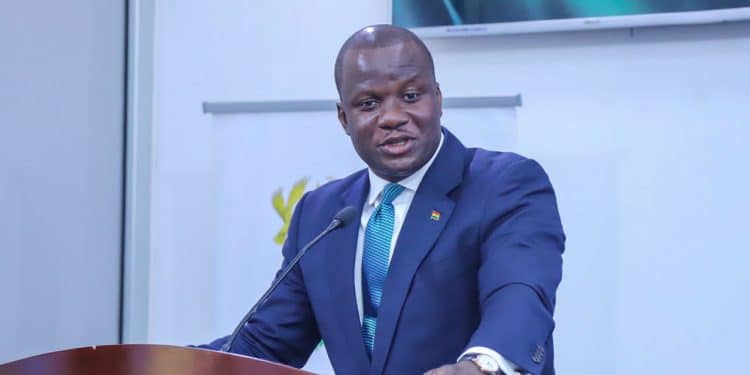
Deputy Energy Minister, Andrew Egyapa Mercer, has revealed that Ghana has successfully concluded the second phase of the Nuclear Power Project.
This initiative is a significant step towards attaining a zero-carbon energy status and enhancing climate resilience within the country.
He explained that the second phase of the project entails the approval of a site for the establishment of Ghana’s first nuclear power facility.
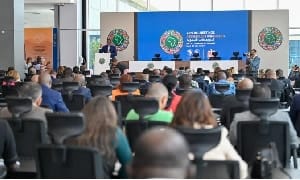
Speaking during a symposium held on nuclear power infrastructure development, the deputy minister underscored the importance of the nuclear power project and its benefits to industrial and economic growth.
“We have currently received approval for the acquisition of our preferred and backup nuclear to host Ghana’s first nuclear power plant. And meeting our energy demand is necessary to sustain our industrial and economic growth, which is required for a middle-income economy.”
He continued, “The world is migrating to cleaner sources of energy and nuclear is envisaged to be a critical source of energy. Ghana can therefore not be left out in this global search for energy security”.
Ghana’s quest to integrate nuclear technology into energy and power generation was announced in 2022 by President Nana Addo Dankwa Akufo-Addo.
He subsequently incorporated the inclusion of nuclear technology into the country’s power generation mix in September 2022.
President Akufo-Addo explained that the move falls in line with the global collective commitment to sustainable availability of power, successful exploitation of nuclear energy sources as part of measures to boost rapid industrialization and boost economic development.
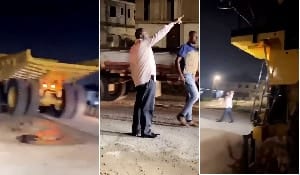
In a video, the CEO of Engineers and Planners, Ibrahim Mahama, has been spotted regulating traffic in the dark at an unidentified site in Ghana.
The 41-second video captures the younger brother of former president John Dramani Mahama, in the middle of a road with some persons believed to be his workers directing traffic along a stretch.
In the shot are giant trucks used for mining which according to the Twitter user who shared the video were being transported up north for mining operations.
GhanaWeb checks shows that an aide to Ibrahim, Rafik was the first to circulate the video of his boss undertaking traffic duties.
“This was 2am yesterday (May 28). Mr. Ibrahim Mahama supervised the transportation of newly acquired mining equipment from Tema to the new mining site, in the Upper East Region,” Rafik stated..
Ibrahim Mahama is reputed as one of Ghana’s biggest businessmen and is known to be into the construction industry, the cement manufacturing business (via Dzata Cement) as well as intomining.
He was recently crowned Ghana’s Mining and Engineering CEO Of The Year, at the 7th Ghana CEO Summit 2023.
Former Presidential Staffer,Stan Xoese Dogbe has provided evidence confirming the video’s claims, in contrast to a press release disputing the viral video’s claims that an ambulance owned by the government is being auctioned in Dubai.
The National Ambulance Service, in a release dated May 29, 2023, attempted to set the record straight regarding the viral video showing a government of Ghana-branded Toyota Hiace ambulance supposedly being sold in Dubai.
According to the service, “The ambulance in question is one of the 26 Toyota Hiace Ambulances being procured by the Government, through the Ministry of Health and funded by the World Bank.
“The said ambulance is located on the premises of the Company, which is manufacturing the ambulances. “It is therefore untrue that the ambulance is there for sale,” the service added. The service explained that the ambulances are awaiting shipment to Ghana after the completion of the manufacturing process.
However, in a Facebook post, Stan Dogbe shared a screenshot of a May 23, 2023, post by the manufacturing company SK Motors FZCO on Facebook, where the company was advertising the same ambulance for sale.
“SK Motors FZCO, the Dubai-based car dealer, whom the National Ambulance Serviceof the Republic of Ghana claimed in a statement on Monday to be the manufacturers of a set of ambulances being procured, had earlier on May 23, 2023, put up for sale on its Facebook page what it described as New Toyota Hiace GL 2024 Ambulances.
“The ambulance in the accompanying photo for the advert was none other than what appeared in an amateur video with the Republic of Ghana National Ambulance Service logo and details on them,” Stan Dogbe wrote.
He revealed that the company has since deleted the post following the statement released by the National Ambulance Service. He also pointed out that the company in question is a car dealership and not a manufacturer, as claimed by the service. “In an earlier PR statement regarding the viral video, the Service claimed that the ambulance is part of a fleet that has been procured and is due to be shipped to Ghana.
The Service also claimed that SK Motors FZCO is the manufacturer of the Toyota ambulance, a fact that I have challenged the Service to provide proof of. “SK Motors has this evening deleted the earlier Facebook advert of the GoG advert, but folks had saved the post before they were prompted to delete,” he said.
The former presidential staffer highlighted the contradictions in the statement and criticized the government’s attempts to dismiss the video as propaganda.
“Does the National Ambulance Service have more information to provide? “Government officials had earlier sought to deny the video, claiming it was just another propaganda against the government, before the Service embarrassed them with its faulty and deceptive PR goof,” Stan Dogbe added.
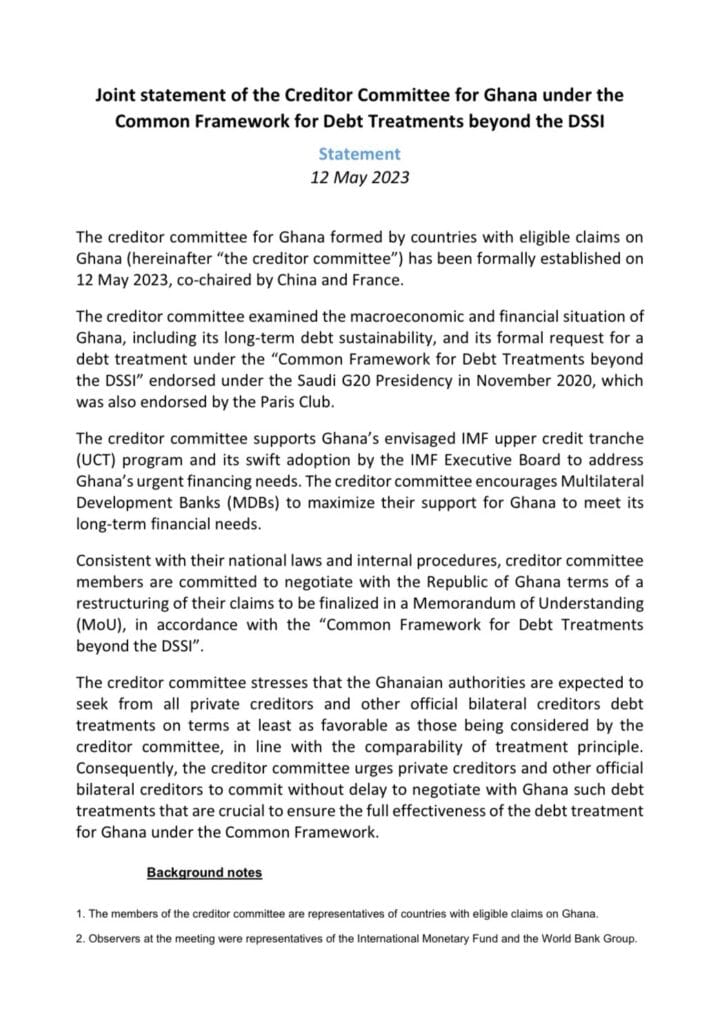
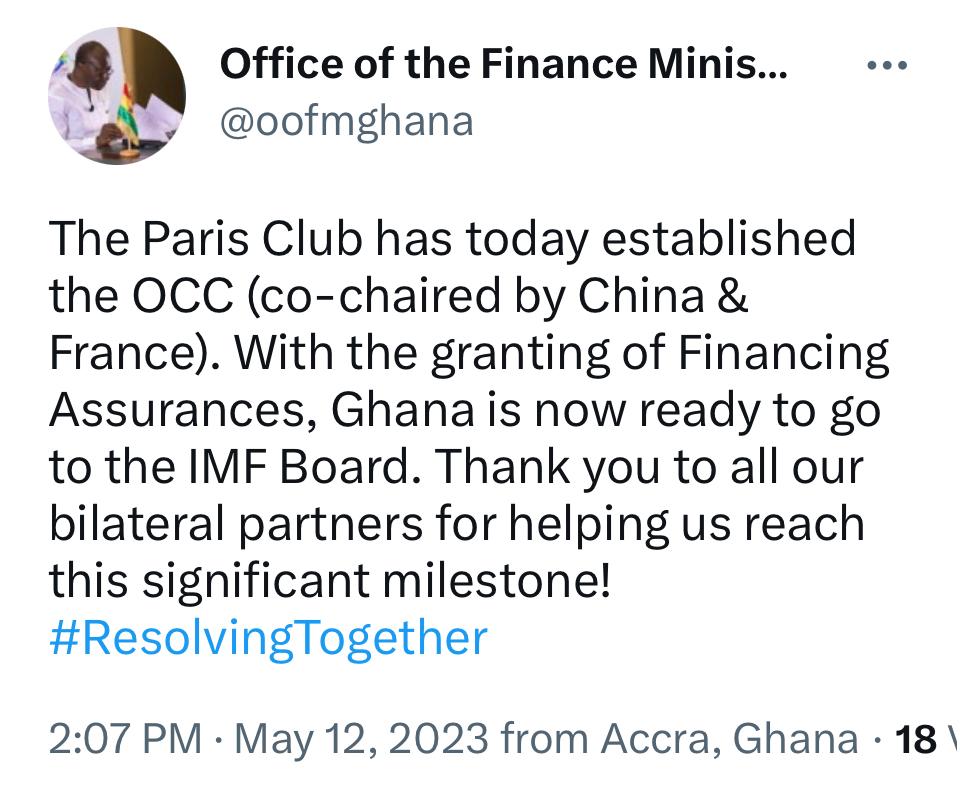
Following a staff-level agreement achieved on December 12, 2022, the Paris Club’s development of an Official Creditor Committee (OCC) has given impetus to the country’s efforts to restructure its debt and finally get a US$3 billion facility from the International Monetary Fund (IMF).
The OCC, which is composed of representatives from countries to which Ghana owes a debt, expressed support for the country’s proposed IMF upper credit tranche (UCT) programme and its swift adoption by the IMF Executive Board.
In a communique last Friday, the Committee – co-chaired by China and France – also encouraged multilateral development banks (MDBs) to provide maximum support for Ghana to meet its long-term financial needs.
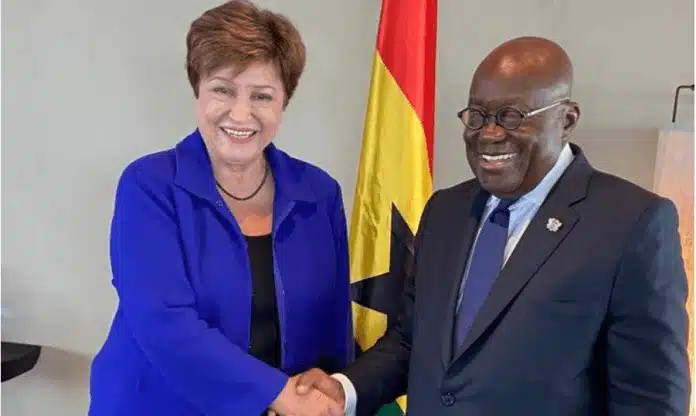
Reacting to the development, Managing Director of the Fund, Kristalina Georgieva, welcomed the OCC, expressing the importance of an IMF-supported economic programme and their commitment to negotiate debt restructuring terms accordingly.
“This statement provides the necessary financing assurances for the IMF Executive Board to consider the proposed Fund-supported programme and unlock much-needed financing from Ghana’s development partners,” she said.
She also endorsed a call by the Official Creditor Committee for private creditors and other official bilateral creditors to commit to comparable debt treatments.
“The Creditor Committee’s action recognises the Ghanaian authorities’ strong reform programme, which aims to restore macroeconomic stability and debt sustainability while laying the foundation for an inclusive recovery. It also signals that further progress is being made under the G20 Common Framework, demonstrating that international partners are ready to work together on helping countries resolve their debt issues. This is vital to enable countries such as Ghana to achieve sustainable growth and poverty reduction,” she added.
However, the Head of Insights at IC Group – a securities firm, Courage Martey, in a tweet cautioned that securing financing assurance from official creditors is not the final step in debt-restructuring. The next phase will involve critical negotiations with creditor committees, wherein Ghana will present its proposed terms to bring its debt and debt service metrics to IMF targets in present value terms. The creditors may agree or disagree, but a deal must be reached before the IMF can approve the next disbursements.
According to Martey, once financing assurance is secured and the IMF programme is approved to begin, the success of debt restructuring will determine progress on the programme and additional disbursements under the US$3billion facility. Martey added that debt restructuring is one of the torturous parts of the IMF deal and a crucial factor in Ghana’s ability to achieve debt sustainability.
“Securing financing assurance from official creditors is not a done deal for debt restructuring. It is not the only requirement for Ghana to secure IMF board approval for the programme to start. The next phase will be critical. Actual negotiations with creditor committees will begin with government presenting its proposed terms, which will ensure it brings debt and debt service metrics to the IMF targets in present value terms,” he explained.
“The creditors may agree or disagree but a deal needs to be agreed upon before IMF reviews can be approved for the next disbursements. Once financing assurance is secured and the IMF programme is approved to begin, the progress on the programme and additional disbursements under the US$3billion will depend on the success of debt restructuring, which is one of the torturous parts of the IMF programme based on debt restructuring,” the economist added.
The creditor committee noted that Ghana has taken steps to address its challenging macroeconomic and financial situation, including implementing a strong reform programme. The committee expressed confidence in Ghana’s ability to successfully implement its reform program and achieve debt sustainability.
It also urged private creditors and other official bilateral creditors to commit to negotiating such debt treatments with Ghana, which are crucial to ensure full effectiveness of the debt treatment for Ghana under the Common Framework for Debt Treatments beyond the DSSI.
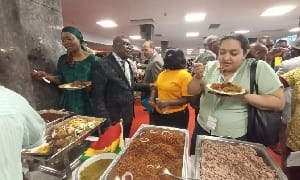
Many people queued at the King Mohammed V Theatre in Rabat, Morocco, to sample Ghana’s indigenous dishes and beverages as part of the commemoration of “Africa Day” in Rabat, Morocco.
Ghana’s ‘Waakye’ and ‘Jollo’, served with indigenous pepper sauce and spicy beverages known as ‘Sobolo’ attracted many participants at the exhibition coordinated by Ghana’s Embassy in Morocco.
The swift manner in, which some patrons completed their first course and opted for another turn was indicative that their tongues had had a memorable encounter with a good meal.
“This is very good. I’ll taste it again. We also prepare jollof in our country but this is more spicy,” Philip, a participant from Cameroon, said.
Fasouma, a Nigerien student in Morocco, told the Ghana News Agency that: “I have heard about Ghana’s Jollof so I wanted to have a taste of it. This is really good and I wish your people can teach me how to prepare it.”
Nasiru, a Nigerian journalist, revived the Ghana-Nigeria jollof debate, but admitted in the end that “Ghana’s jollof is almost as good as that of Nigeria”.
Earlier, some Ghanaian students in Morocco performed Ghanaian cultural dances at a ceremony that preceded the food exhibition.
The Kingdom of Morocco on Thursday held a series of events to mark the establishment of the Organisation of African Unity (OAU), now African Union (AU) in 1963.
In an interview with the GNA, Mr Samuel Jojo Effah-Broni, Ghana’s Ambassador to Morocco, said the country’s rich local meals demonstrated its unique culture and identity.
He said many Moroccans and other foreign nationals were in love with Ghana’s local dishes and beverages.
“Everybody enjoys the taste of Ghanaian food. Ours is unique. Other countries prepare waakye and jollof, but they are not smooth like ours,” Mr Effah-Broni said.
He said the country must package and market its local dishes well to drive cultural export and to reap benefits for the country in the area of tourism.
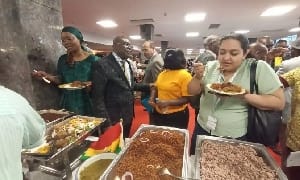
It was an intriguing sight to see as people lined up outside the King Mohammed V Theatre in Rabat, Morocco to taste Ghana’s regional foods and beverages that were being served as part of the celebration of “Africa Day“.
Ghana’s ‘Waakye’ and ‘Jollo’, served with indigenous pepper sauce and spicy beverages known as ‘Sobolo’ attracted many participants at the exhibition coordinated by Ghana’s Embassy in Morocco.
The swift manner in, which some patrons completed their first course and opted for another turn was indicative that their tongues had had a memorable encounter with a good meal.
“This is very good. I’ll taste it again. We also prepare jollof in our country but this is more spicy,” Philip, a participant from Cameroon, said.
Fasouma, a Nigerien student in Morocco, told the Ghana News Agency that: “I have heard about Ghana’s Jollof so I wanted to have a taste of it. This is really good and I wish your people can teach me how to prepare it.”
Nasiru, a Nigerian journalist, revived the Ghana-Nigeria jollof debate, but admitted in the end that “Ghana’s jollof is almost as good as that of Nigeria”.
Earlier, some Ghanaian students in Morocco performed Ghanaian cultural dances at a ceremony that preceded the food exhibition.
The Kingdom of Morocco on Thursday held a series of events to mark the establishment of the Organisation of African Unity (OAU), now African Union (AU) in 1963.
In an interview with the GNA, Mr Samuel Jojo Effah-Broni, Ghana’s Ambassador to Morocco, said the country’s rich local meals demonstrated its unique culture and identity.
He said many Moroccans and other foreign nationals were in love with Ghana’s local dishes and beverages.
“Everybody enjoys the taste of Ghanaian food. Ours is unique. Other countries prepare waakye and jollof, but they are not smooth like ours,” Mr Effah-Broni said.
He said the country must package and market its local dishes well to drive cultural export and to reap benefits for the country in the area of tourism.
The African Development Bank (AfDB) has cautioned Ghana not to rely too much on loans for long-term national growth.
Professor Kevin Chika Urama, Chief Economist of AfDB, said that relying on loans, especially from the capital market, risked not yielding the needed revenue in a short-to-medium term, making repayment difficult.
The AfDB Vice President for Economic Governance and Knowledge Management said this in an interview with the Ghana News Agency at the just ended annual meetings of the Bank in Sharm El Sheikh, Egypt.
He noted that borrowings to fund long-tern development-oriented programmes and projects often resulted in the accumulation of debt, which put economies into crisis.
“When you depend on borrowing for investing in long-term infrastructure, you have a mismatch because development projects normally take about 30 years or more to offer revenues or dividends or to be able to break even,” he said.
Prof Urama said when borrowings were done, particularly at high coupon rates, it sets a country up off for failure, “because the projects you’re putting the resources will not mature when the duration of paying back the loans fall due.
“You’re then forced to look for money elsewhere, which is challenging for most African countries because of the fiscal constraints,” the AfDB Chief Economist added.
On Ghana’s debt treatment and the recently approved International Monetary Fund (IMF) loan-support programme, he said AfDB was working with Ghana to provide technical and policy support to the country to address the debt challenges.
“We’ve had meetings with the Finance Minister, both during the IMF/Bank World spring meetings and had a special high-level delegation that went to Ghana to work with the technical teams,” he said.
“Discussions are ongoing and we’ll be providing technical assistance and policy-based operations, and we’re doing this together with our partners to coordinate support for the country,” Prof Urama told the GNA.
Ghana has been locked out of the capital market for more than a year, with an accumulated public debt of GHS434.6 billion (72.2 per cent of Gross Domestic Product – GDP) as of December 2022.
Meanwhile the Government is optimistic that with the $3bn IMF loan programme, Ghana would be able to return to the market.
“We have positioned ourselves to be able to go back into the International market which had been a source of funding for us during the first three or four years of our government,” President Akufo-Addo said recently.
The president who was speaking at the Qatar-Africa Economic Forum in Doha, added that: “There is no rush but obviously why not take advantage of global savings, it makes a lot of sense to me.
Mr Ken Ofori-Atta, Finance Minister at a press briefing after securing the IMF programme also said that “Working towards the capital market is important because we then get our ratings up and make the country more attractive for foreign investors, especially [getting] FDI.”
“Going forward, we’ll find ways of ensuring that we’re efficient in our deployment [of the $3bn funds] …and ensure efficiency in providing services to the people,” he said.
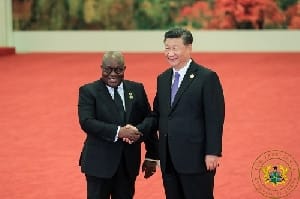
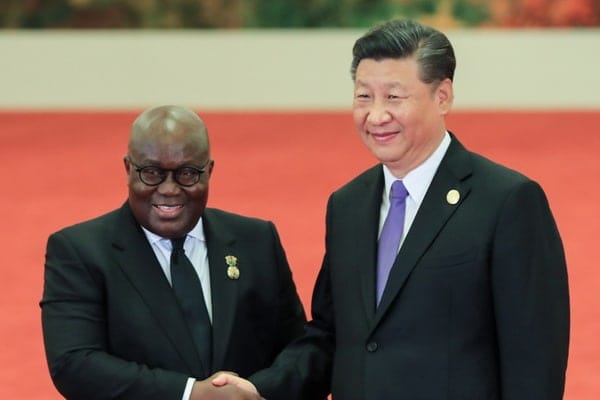
President Akufo-Addo has recently defended China overwhelming involvement and participation in Ghana’s economy, saying they have been “friends” and “strong partners” who have helped Ghana in difficult times.
He was speaking at the Qatar Economic Forum in Doha, where he also announced his intention to return to the international market to borrow for infrastructural projects.
There are several schools of thoughts about the president’s position on China -Ghana relations especially at a time when Ghana is high in debt and should be finding ways to sustain these debts and hopefully arrive at low level of debt or better still a solvent country.
However, for many that does not seem to be the case, as the President seems to keep playing into the hands of global monetary powers like China and the United States amongst others.
President Akufo-Addo’s remarks come amid concerns over a recent IMF report that has warned that Ghana could lose its mineral resources and electricity revenues to China if it defaults on repaying a $1.9 billion debt.
The debt is part of a $2 billion bauxite-for-infrastructure deal that Ghana signed with Chinese state-owned firm Sinohydro Corp in 2018. Under the deal, Sinohydro Corp would invest in Ghana’s infrastructure, such as roads, highways and power dams, and in return, Ghana would use the proceeds from the sale of bauxite, refined bauxite and aluminium to repay the loans.
In the past two decades, Ghana has been a significant recipient of Chinese loans, with approximately $5 billion borrowed for key infrastructure projects according to reports. Many Ghanaians are wondering how many projects China has funded in Ghana and the extent of Chinese influence on Ghana’s economy. To answer this, The Independent Ghana takes a look at about 20 major projects fully or partially funded by China that covers various sectors of the economy.
China has funded several major infrastructure projects in Ghana over the years. Some of the notable ones include:
The Bui Dam
The Bui Dam is a hydroelectric power project that was financed by the Chinese government. It has significantly contributed to Ghana’s electricity generation capacity, providing a stable source of power for both domestic and industrial use. The funding for the project was provided by China Exim Bank according to the project’s website, “through a concessional loan of $270m, a commercial loan of $292m, and $60m in funding from the Government of Ghana. The two loans were offered by China Ex-Im Bank, with a grace period of five years and an amortisation period of 20 years”.
The construction of the dam started in 2007 and was completed in 2013. The dam has a height of 108m and a length of 492m. It has three turbines with a total installed capacity of 400MW. The reservoir created by the dam has a capacity of 12.57 billion cubic metres. The project also involved the construction of two saddle dams and a transmission system. The project faced some environmental and social challenges, such as the flooding of part of the Bui National Park and the resettlement of 1,216 people.
The Kwame Nkrumah Interchange
The Kwame Nkrumah Interchange is located in the heart of Accra and was constructed to alleviate traffic congestion challenges that were becoming unbearable. It is one of the largest interchanges in West Africa and has significantly eased traffic congestion, improving transportation efficiency and connectivity in the capital city. The interchange was funded by China, and the China Development Bank provided a loan of $100 million. Construction started in 2013 and was completed in 2016.
The Eastern Corridor Road
The Eastern Corridor Road is a vital transportation route that connects various regions in Ghana, and China has provided funding for the construction and rehabilitation of this road, enhancing connectivity and facilitating trade and economic activities along the corridor. The China Development Bank provided a loan of $649 million, and construction began in 2012 and is still ongoing.
Atuabo Gas Processing Plant
The Atuabo Gas Processing Plant is a natural gas processing plant located in the Ellembele District of the Western Region in Ghana. It was developed as part of the Western Corridor Gas Infrastructure Development project, which aims to evacuate and process gas from offshore fields. The project includes the construction of an offshore raw natural gas pipeline, an onshore pipeline, processing plant, and an office complex.
The construction of the Atuabo Gas Processing Plant began in 2011 and was financed by a $3 billion Master Facility Agreement from the China Development Bank. The loan amount for the Atuabo Gas Processing Plant was $850 million and was part of the Western Corridor Gas Infrastructure Development Project. The Aboadze Thermal Plant is a separate facility that uses the gas processed at the Atuabo Gas Processing Plant to generate electricity. The Atuabo Gas Processing Plant has a design capacity of 150 MMScfd and a normal operating capacity of 120 MMScfd.
Tamale International Airport Expansion
The expansion project involved upgrading and expanding the airport’s capacity, improving facilities and accommodating larger aircraft. The project included runway extension, construction of a new terminal building, installation of modern navigation systems, and improvement of other airport infrastructure. The construction was undertaken by China Jiangsu International and financed through a $150m China Exim Bank loan. The airport expansion was funded by China Exim Bank, which provided a loan of $100 million.
Ridge Hospital Expansion Project
The Ridge Hospital, located in Accra, underwent a significant expansion and redevelopment. The project aimed to enhance healthcare services and increase the hospital’s capacity to serve the growing population. It included the construction of new buildings, expansion of existing facilities, installation of modern medical equipment, and improvement of infrastructure to provide quality healthcare services to the community. Funding: China Exim Bank provided a loan of $162 million.
Kasoa Interchange
The Kasoa Interchange project focused on the improvement of transportation infrastructure in the Kasoa area, a busy commercial hub near Accra. The project involved the construction of an interchange to ease traffic congestion, enhance road safety, and improve connectivity between different parts of the region. It aimed to facilitate smoother movement of vehicles, reduce travel time, and enhance economic activities in the area.Funding: China Exim Bank provided a loan of $82 million.
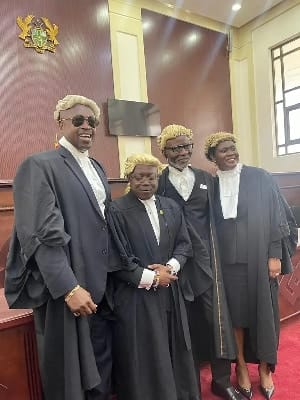
Justice Gertrude Torkornoo, who has been nominated by President Akufo-Addo to be the next Chief Justice of Ghana, has rejected the notion that judges are influenced by those who appoint them.
Addressing the issue during her vetting on May 26, 2023, she asserted that such a perception is incorrect and does not align with the reality of their work.
“I think if there’s such a perception, it is a wrong perception, because the load of our work with respect to the ordinary Ghanaian hardly has anything to do with appointing authorities, on a daily basis we are adjudicating tens and hundreds of cases involving the “ordinary joe”,” she said.
Justice Torkornoo expressed that most of the cases that judges handle on a daily basis have nothing to do with the appointing authority, but rather with the ordinary Ghanaian.
Highlighting the importance of independence in the judiciary, Justice Torkornoo underlined that their decisions are based on the law and by any external pressure or interference.
“Independence is always linked with law and as long as our decisions are premised on law, they must be presumed to have been arrived at independently,” she mentioned.
As the prospective leader of the judicial branch, Justice Torkornoo pledged to ensure that the public understands and respects the judicial process and the independence of judges through engagements with judges and judicial staff and the media.
“Consistent engagement with the community of Ghana, through the media regarding how the adjudication process functions and consistent engagement with judges themselves and with judicial service staff,” she explained.
Justice Torkornoo was nominated by President Akufo-Addo in April to succeed Chief Justice Kwasi Anin Yeboah, who retired in May.
Parliament today, Friday, May 26, vetted. Justice Gertrude Torkornoo for the post of Chief Justice.
If approved, she will be the third woman to hold the position of Chief Justice in Ghana, after Justices Georgina Theodora Wood and Sophia Akuffo.
The appointment of Justice Torkornoo represents a significant milestone in Ghana’s judicial system, underscoring the country’s commitment to upholding an independent and impartial judiciary for all.
President Akufo-Addo has indicated that he has no objections to Chinese engagement and involvement in country’s economy.
According to him, China has, through the years, become a reliable partner that has supported Ghana’s economy in very difficult and trying times.
He made the remarks following a recent IMF country report that indicated that Ghana will likely lose its mineral resources and electricity revenues to China should the country default on paying a $1.9 billion debt.
Speaking during a panel discussion at the Qatar Economic Forum in Doha, President Akufo-Addo said investments from China has been vital to Ghana’s economy growth and development.
“Well, I don’t have any criticisms about Chinese involvement in the Ghanaian economy. They have been very helpful, it’s a matter of controversy in the West. For us, they have been friends and in terms of difficulty they have proven to be a strong partner,” President Akufo-Addo said.
Since 2000, Ghana has been a major recipient of Chinese loans with the country borrowing close to $5 billion from the Asian country which has been spent on major infrastructure projects.
While majority of these loans have been expended on these projects, there are concerns that the terms of the loan have not been unfavourable to Ghana, leaving the country highly indebted.
Currently, the external debt component of Ghana has surpassed $30 billion, which has been described as unsustainable debt levels.
Unsuccessful parliamentary contender with the National Democratic Congress (NDC) and a University of Ghana lecturer, Prof. Michael Kpessa-Whyte, has explained a recent tweet that referred to a Supreme Court being turned into a Stupid Court.
The critical comments were posted on May 19, 2023 on Twitter lamenting generally the state of the particular judiciary and accusing it of partisanship and lack of common sense.
“They have succeeded in turning a. Commonsense is now a scare commodity. A major element in the death of democracies is partisanship in the delivery of justice. and ethics. Time will tell !” the tweet read.
Three days later, the academic cum politician posted two tweets pointing out that people had been reaching out to him over the content of his tweet apparently linking it to the Ghanaian judiciary.
His first clarification tweet read: “Thanks to all who have asked questions about my May 19th 2023 tweet. For the avoidance of doubt I follow judicial decisions in many countries and so the said tweet cannot be pinned to Ghana. It has more to with developments elsewhere including the US. We live in a global village.”
“Folks, a number of you have called to express concerns about my safety following my recent tweets. I want to make it clear that NONE of my recent tweets about judicial decisions are in reference to Ghana’s judiciary. My focus currently is on developments elsewhere outside Ghana,” he stressed.
His tweet had been published barely 24-hours after Ghana’s Supreme Court ordered Parliament to expunge the name of an NDC MP, James Gyakye Quayson from its records citing prodecural breaches during his nomination and election in 2020.
See his three tweets below:
Folks, a number of you have called to express concerns about my safety following my recent tweets. I want to make it clear that NONE of my recent tweets about judicial decisions are in reference to Ghana’s judiciary. My focus currently is on developments elsewhere outside Ghana.— Prof. Michael Kpessa-Whyte (@kpessawhyte) May 23, 2023
Thanks to all who have asked questions about my May 19th 2023 tweet. For the avoidance of doubt I follow judicial decisions in many countries and so the said tweet cannot be pinned to Ghana. It has more to with developments elsewhere including the US. We live in a global village.— Prof. Michael Kpessa-Whyte (@kpessawhyte) May 23, 2023
They have succeeded in turning a Supreme Court into a Stupid Court. Commonsense is now a scare commodity. A major element in the death of democracies is partisanship in the delivery of justice. Our judges need lessons in political philosophy and ethics.
Time will tell !
— Prof. Michael Kpessa-Whyte (@kpessawhyte) May 19, 2023
Newmont Africa has revealed that its Ghana operations (Ahafo South and Akyem mines) paid a total of GHS843.72 million in taxes, royalties, and levies to the Ghanaian government through the Ghana Revenue Authority (GRA), Forestry Commission, and Ministry of Finance in the first quarter of 2023.
This amount consists of corporate tax (GHS514.57 million), minerals royalties (GHS197.06 million), Pay As You Earn (GHS78.23 million), GHS42.31 million as withholding tax and GHS11.55 million as forestry levy.
“Fulfilling our obligations in terms of statutory payments, and being transparent about what we pay, are in line with our commitment to regulatory compliance and good corporate governance,” said Mr David Thornton, Regional Senior Vice President, Newmont Africa Operations, in a statement issued by the miner.
Newmont Africa’s operations in Ghana have a strong tax compliance history and the company has received multiple taxpayer recognitions from the GRA.
“It is important, especially in these challenging times, for companies to honour their obligations to the state, as well to their various stakeholders, through direct payment of their taxes and investment in social programmes,” Mr Thornton added.
Apart from the taxes, royalties, and levies that go directly to government towards the growth and stabilisation of the economy, Newmont Africa said it also focuses on stimulating economic development in the local communities that host the mining operations, through a range of programmes and projects that deliver measurable outcomes.
Being cognisant of the key role that road infrastructure plays, particularly in farming communities, Newmont Africa’s operations in Akyem and Ahafo have both funded critical road infrastructure, working through the Ministry of Roads and Highways.
Newmont’s investment in skills acquisition and sustainable livelihood programmes also ensure that local community residents are equipped with employable skills that are needed in the extractive and construction industries.
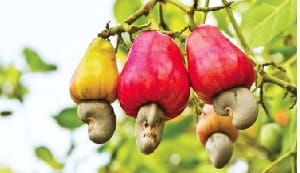
Ghana’s cashew export revenues in 2020 totaled US$340.7 million, with an estimated untapped potential of more than US$660 million.
Mr Raphael Ahenu, the National Convener of Cashew Watch Ghana, said the cashew sector had huge potential and prospects to transform the economy and called on the Government to prioritise the development of the industry.
He made the call at the launch of the “Amplifying the Voices of Cashew Farmers (AVFC)” project at Sampa in the Jaman North District of the Bono Region.
The AVFC is a 15-month project being implemented by Cashew Watch Ghana, with funding support from STAR Ghana Foundation.
It is to help empower cashew farmers to grow more by advocating better prices as well as removing bottlenecks in the growth and development of the sector.
There was the need for the Government to capitalise on the global prospects of the economic tree and put pragmatic measures in place to transform the cashew industry as a vehicle for socio-economic development, Mr Ahenu said.
“Ghana’s estimated annual production of between 110,000 and 130,000 tons of raw cashew nuts is not encouraging,” he said, and that more must be done for the industry to contribute significantly to economic growth, particularly in job creation and poverty reduction.
Mr Ahenu appealed to the government to increase technical and financial support for the Tree Crop Development Authority to effectively implement the 10-year National Cashew Development Plan.
Mr Victor Yao-Dablu, the Jaman North District Director of Agriculture, said cashew production in the area was encouraging and urged the Government to supply farmers with processors to add value to the nuts.
He commended STAR Ghana Foundation for funding the project and expressed the hope that its implementation would help fetch the farmers good price for their labour.
Cashew Watch Ghana is a civil society platform comprising cashew farmers, non-governmental organisations, media and local processors.
The Global cashew market size is projected to hit a value of US$10.5 billion by 2031, the CWG said.
Currently, the global market size is hovering around US$7 billion.
President Akufo-Addo has stated that Ghana’s International Monetary Fund (IMF) bailout prorgramme which took 10 months to be completed is one of the quickest to have happened to the country.
Speaking at the 3rd Qatar Economic Forum, the President said the country had to ensure data provided were accurate, whilst the macro indices were heading in the right direction.
“Usually, the negotiations with the IMF take time. In fact, the 10 months which have been involved in the Ghanaian programme is one of the fastest on record”.
“There is a whole lot of stuff that you had to go through in terms of change of data, negotiations, and making sure that the macro indices you are looking for are in the right direction. All of these may take time. Nevertheless, it is over”, he pointed out.
He furthered that the IMF support programme will reposition the economy to regain macro stability.
According to him, the economic indicators have started improving, citing examples such as inflation and the exchange rate.
“Now, we believe that it [IMF programme] is going to provide us with the foundation for redirecting the economy, repositioning the Ghanaian economy firstly, to regain the macro stability that has been lost”.
“Secondly, to be able to have better control over important details like the interest rate, inflation and then finally, also to position us to be able to be back to the international capital market which has been a source of funding for us for the first three or four years of our government”, he added.
Last week, the Executive Board of the IMF approved a $3 billion Extended Credit Facility for Ghana, which will end in 2027.
This was as result of assurances from country’s Creditors Committee under the G20 Common Framework last week, which includes China.
A Senior Lecturer at the University of Ghana’s Political Science Department has expressed disappointment with IMF’s conditionalities for Ghana regarding the $3 billion loan approval.
According to Prof. Ransford Yaw Gyampo, Ghana is a highly corrupt country and the institution has provided no substantial help to check the leakages and slippages.
Mr Gyampo thinks that an IMF that is no longer perturbed about curbing a country’s corruption cannot be taken seriously.
“Indeed, in the fight against corruption, the talk about the continuous implementation of a National Anti-Corruption Action Plan (NACAP) that exists merely in name by the document, shows that the IMF perhaps is no longer a serious institution.”
“This is because it doesn’t appear there will ever be serious efforts at implementing the NACAP and an IMF that does not know this is bogus,” he said.
He also indicated that the current IMF has lost its boldness and courage unlike previous times and thinks that the IMF in recent times is just tactically encouraging African dependence on the West.
“Otherwise, how and why were very low-hanging serious recommendations that would help us quickly turn things around, overlooked? Is the IMF ignorant that we earn just about only 5% of royalties from our gold?
“Is the IMF not aware that we produce oil and yet earn only just about 13% of the oil revenues? Why didn’t they talk about taxing the extractive sector adequately to raise more revenue for ourselves?”
“Why were they silent on what we must do to stop illicit financial flows? Do they come from countries whose sizes of government are as bloated as ours? Were they coerced to keep quiet about the local and international calls on our government to downsize?” Mr. Gyampo quizzed.
He continued that if the conditionalities do not answer the above questions then they are mere propaganda and only aim at inflicting hardships on deprived people.
“To make Africans dependent on the West; and cover up for leadership incompetence and unwillingness to sacrifice,” he lamented.
He finally cautioned government that Labour would resist any unnecessary imposition of hardships on poor people without an evident show of sacrifice on the part of political leadership.
“The IMF must know that the Ghanaian is intelligent enough to know when a cycle of dependence is being perpetuated and we will soon resist.”
“If the IMF truly wants to help us, then they must be bold in telling us nothing but the truth so we can wiggle ourselves out of imposed and our self-inflicted hardship,” he said.
A Certified Economist Dr. Samuel Ankrah, who is running for president of Ghana in 2024, claims that because of his training and expertise as an economist, he is the only one who is equipped to manage the nation’s unstable economy.
Dr. Ankrah, an Investment Banker, Global Business Strategist, and Development Economist explained that, the level of mismanagement of the economy by both successive NDC and NPP governments has resulted in the country running to the International Monetary Fund for a bad seventeenth time in search for a bailout.
He made this statement during a virtual leadership summit with the Ghana Universities Journal on Sunday, May 21, 2023. Dr. Ankrah, who seeks to become the first independent candidate to ascend the presidential seat of Ghana mentioned that, the best brains to manage the affairs of Ghana are currently sitting on the fringes and not in governance, therefore they need to be brought on board, which he will do when he becomes President of Ghana.
According to the 2024 Presidential Hopeful, Ghana needs a systematic and pragmatic approach in attaining the best for its citizens. Rule of law, efficient government structures, and a structured and firm fight against corruption are the best ways to have an enabling Ghanaian environment, according to Dr. Ankrah.
He further called on the youth not to lose hope in the country, even though the current government has not created any alternative change to bring hope to the youth. He also urged them to be creative in all their thoughts and throw their weight behind his ten-point plan which will break the duopoly of NPP and NDC in the political and governance history of Ghana.
In light of government’s inability to uphold its loan deal, the International Monetary Fund (IMF) has revealed that the Chinese government will probably be able to access Ghana’s mineral and electricity revenues.
According to a news report by myjoyonline.com, the fund indicated that this might happen because the government of Ghana is at risk of not being able to repay four loans it acquired from the Chinese government which it collateralised with Ghana’s mineral resources and electricity sales.
The report indicated that Ghana for the past decade acquired at least eight collateralized loans from China with different mineral resources as security against default.
It added that as at the end of 2022, collateralized loans amount to $619 million of the $1.9 billion loan agreements Ghana has with China.
The IMF indicated that $619 million in loans were acquired between 2007 and 2018 and they were collateralised with Ghana’s cocoa, bauxite and oil and electricity revenue.
“Collateralized debt is any contracted or guaranteed debt that gives the creditor the rights over an asset or revenue stream that would allow it, if the borrower defaults on its payment obligations, to rely on the asset or revenue stream to secure repayment of the debt,” the IMF was quoted by myjoyonline.com.
“Statutory funds will not be allowed to collateralize revenue streams and issue debt. No objection certificates will not be issued to any statutory fund by the governing authority in this regard,” it added.
In the event that Ghana defaults in the payment of some four loans to China, the country will lose its sales of electricity and the revenue accrued from the exportation of its minerals.
This is according to information provided by the International Monetary Fund (IMF) in its May 2023 report that touched on the request for an arrangement under the Extended Credit Facility, the Staff Report prepared by a staff team of the IMF for the Executive Board’s consideration on May 17, 2023, and a Debt Sustainability Analysis prepared by the staffs of the IMF and the Internal Development Association
Collateralized debt is any contracted or guaranteed debt that gives the creditor the rights over an asset or revenue stream that would allow it, if the borrower defaults on its payment obligations, to rely on the asset or revenue stream to secure repayment of the debt, the IMF defines.
The Fund revealed that collateralized debt, entirely held by China, accounts for only 2.0 percent of external debt. And this corresponds to 4 loan agreements signed in 2007-18 that amount to US$619 million (0.9 percent of GDP) to finance infrastructure projects.
“These are collateralized against commodity production (cocoa, bauxite and oil) and electricity sales,” the IMF report stated.
In 2007, Ghana under the leadership of former President John Agyekum Kufuor secured a loan valued at $306 million for a Bui Hydropower Project 400 MW (CL part) with a total cost of $749.6 million and used its cocoa exports as collateral.
Under the Mahama government in 2012, government received a loan worth $75 million and $76 million for Bui Hydropower Project 400MW Additional Finance Loan 1 and Bui Hydropower Project 400 MW Additional Finance Loan 2, respectively. Cocoa exports were used as collateral.
In 2013, Ghana was provided a $150 million loan for an Integrated National Security Communications Enhancement Network (ALPHA) Project – Phase I, as well as a $850 million loan for a Western Corridor Gas Infrastructure Project; Jubilee Oil Field. The government used its oil exports as resource security.
The West African country in 2019 under the leadership of President Akufo-Addo secured three loan deals – $186 million for the construction of Eleven Coastal Fishing Landing Sites Project, $211 million for an Accra Intelligent Traffic Management System and Road Completion with oil exports as collateral. Using Ghana’s bauxite exports as collateral, government secured $550 million for Construction/Rehabilitation of Selected Roads and Interchanges in Ghana- Phase 1. These details were provided by the China Africa Research Initiative.
The IMF has stressed that “statutory funds will not be allowed to collateralize revenue streams and issue debt. No objection certificates will not be issued to any statutory fund by the governing authority in this regard.”
As at the end of 2022, Ghana owed China $1.9 billion out of which $619 million were collateralized loans.
China’s loans to a number of African countries and other poor nations have caught the attention of the World Bank which finds it concerning.
President of the World Bank David Malpass says that the terms and conditions need to be “more transparent”.
“For governments in Africa, they shouldn’t be offering collateral as an inducement to make a loan, because it locks it up for generations. That’s been happening with China.”
Beijing has become one of the biggest sources for loans to developing economies in recent years. A new study led by the Kiel Institute for the World Economy shows that globally, China lent $185bn (£150bn) in bailouts to 22 countries between 2016 and 2021.
Also, the World Bank notes that the world’s poorest countries faced $35 billion in debt-service payments to official and private sector creditors in 2022, of which 40% was due to China alone.
Pakistan, Kenya, Zambia, Laos and Mongolia are just a few countries aside Ghana who are indebted to China.
In response to the concerns raised against it, Chinese Ministry of Foreign Affairs has stated that if it is to accede to IMF and World Bank demands to forgive a portion of its loans, so should multilateral lenders, which it views as U.S. proxies.
“We call on these institutions to actively participate in relevant actions in accordance with the principle of ‘joint action, fair burden’ and make greater contributions to help developing countries tide over the difficulties,” the ministry statement said.
A doctor who claimed that two babies had died at a hospital in the North after a state-owned energy company cut off their power earlier this month expressed joy over the restoration of electricity.
Dr Gbeadese Ahmed from St Anne’s Hospital in Damango told the BBC he was about to go into theatre to resume surgical operations put on hold seven days ago.
Local MP and Lands Minister Samuel Abdulai Jinapor had paid off part of the hospital’s debt to the Northern Electricity Distribution Company (Nedco), he said.
The politician’s intervention followed Dr Ahmed’s interview on Monday with Citi News about the effects of the power outage on the state-run hospital in the town, which is more than 630km (390 miles) by road from the capital, Accra.
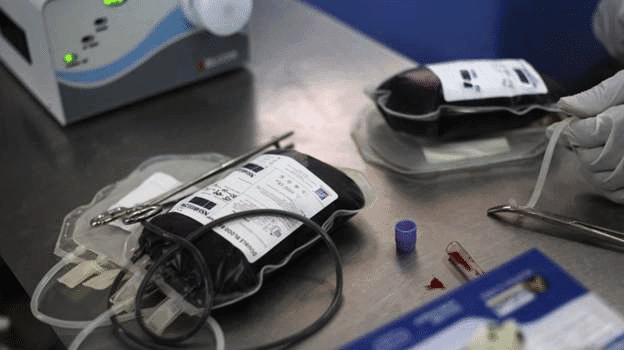
He explained that two babies had died and three others were in a critical condition because without electricity medics at St Anne’s have been unable to organise blood transfusions for the new-borns.
The problems began at the hospital on 4 May when the power was first cut over a debt of more than $370,000 (£342,000).
This is when the first baby died, according to Dr Ahmed.
The electricity was restored but Nedco warned if the bill was not settled in full it would again shut off power – and this happened on 16 May.
The second baby died over the last week.
Since the beginning of May Ghana’s state power firms have been cracking down on defaulters in an effort to claw back millions of dollars owed to them.
Several government institutions have found themselves cut off for failing to settle their bills.
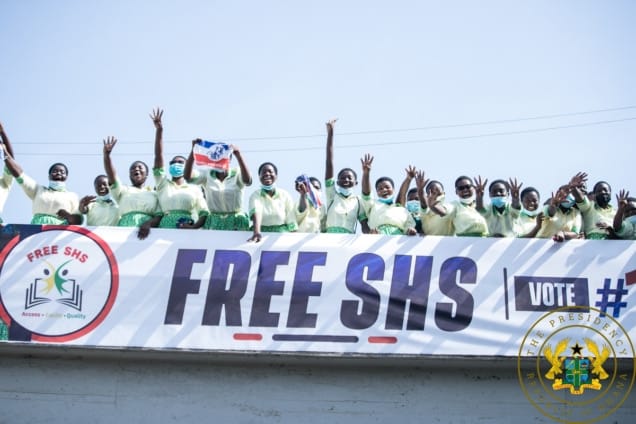
The International Monetary Fund(IMF) has labeled the government’s flagship Free SHS Senior High School (FSHS) program as inadequately designed.
The Fund made this observation in its latest country report on Ghana, whose request for a $3 billion bailout it recently approved.
According to the report, the Free SHS programme “which covers the full cost of secondary education, has helped increase enrollment but is poorly targeted.”
The IMF also disclosed that Ghana spends close to 4% of its GDP on education with good results in terms of enrollment but poor learning outcomes.
Key identified areas by the IMF which need potential improvement in education spending include strengthening primary education resources, better teacher training, and stronger performance-based funding practices.
JoyNews’ checks reveal the Free SHS programme has enjoyed a budgetary allocation of more than GH¢11.3 billion since 2019.
In the 2023 budget government demonstrated its commitment stating that the implementation of the Free SHS Programme remained unwavering.
It also mentioned that the “total number of beneficiaries currently stands at 1.3 million students for the 2021/22 academic year” and this year, “government will continue with the implementation of the Free SHS Programme and continue to facilitate access to various educational items.”
Meanwhile,President Akufo-Addo who spoke at a rally organised by the New Patriotic Party ahead of a bye-election in Kumawu on May 23, said President Mahama has been inconsistent in his position on the free SHS policy.
According to him, the NDC flagbearer has now shifted his argument from cancelling the program to expanding it to include private second-cycle schools.
The inconsistencies, he said, do not make former President Mahama trustworthy.
In July 2022, Finance Minister, Ken Ofori-Atta said a review of the Free Senior High School policy remains a constant possibility.
He explained that the Education Ministry continues to look at the policy with the aim of understanding how parents can be included in a manner that is not coercive.
“Review is constantly a possibility on the table. And it’s just to make sure that the appropriate education is given and that wastage is eliminated and it goes to give us value for money,” Mr. Ofori-Atta told Joy Business’ George Wiafe in an interview.
Mr Samuel Abu Jinapor, the Minister of Lands and Natural Resources has disclosed that the country made a whooping US $1.2 billion from illegal mining last year.
He said small-scale mining has been contributing increasingly to the nation’s gold output as the sector produced a total of 712,405 ounces of gold last year.
He said it brought to the nation almost US$1,200,000,000 in export receipts, adding that all diamonds produced in the country in 2022, which amounted to 82,251.99 carats and generated US$3,900,000 in revenue were from small-scale mining.
Mr Jinapor made the statement when he was speaking at the opening of a two-day transformational dialogue on artisanal and small-scale mining under the theme, “Sustaining Environmental Security and Human Rights in Small Scale Mining Operations in Ghana” at Fiapre in the Sunyani West Municipality.
The programme, initiated by the University of Energy and Natural Resources (UENR) aimed at bringing together various stakeholders to deliberate on the issue and jointly make efforts towards a common direction.
It was attended by politicians, traditional leaders, students, members, and staff of the UENR, artisans and small-scale miners, civil society actors, representatives of large-scale mining companies and the media.
Mr Jinapor said the small-scale mining sector had been the source of employment for thousands of people and supported the lives and livelihoods of millions of citizens.
But he added the increasing illegalities associated with the sector and resulting in the destruction of the environment remained a national challenge that required collaborative effort to end the menace.
Mr Jinapor said the government’s effort to clamp down on galamsey had been met with resistance because of the greedy and unscrupulous nation-wreckers destroying the environment for their personal interests.
He said the government in addressing the threat of illegal mining had introduced policies and measures under the National Alternative Employment and Livelihood Programme (NAELP) to provide alternative sources of income and livelihood to persons engaged in the menace.
In that regard several young men and women had been employed in the production of seedlings and reclamation of degraded mined lands in the Ashanti, Eastern and Western North Regions, the Minister added.
He said the Apprenticeship, Skills Training and Entrepreneurship module of the Programme was expected to be rolled out later this year to provide training for 5,000 youth in agriculture, technical, vocational, industrial, and mining skills.
Mr Jinapor , therefore, commended the UENR for introducing several novel programmes, including bachelor and graduate programmes in Sustainable Mining, Land Degradation Neutrality and Sustainable Land Management aimed at promoting sustainable mining and environmental protection.
The effort needed a hands-on-deck approach to promoting sustainable resources extraction practices and transforming mined lands into viable lands for agricultural purposes, he said and called for intensification of education on responsible and sustainable mining practices.
Minister of State in the Finance Ministry, Dr. Mohammed Amin Adam, says Ghana is far along in negotiations with the World Bank for a $900 million budget support facility.
According to him, the budget support facility will be disbursed over the next three years alongside the International Monetary Fund’s $3 billion facility.
Speaking on JoyNews’ PM Express Business Edition, he said, “Once we applied for the IMF supported programme, we also started engaging with the World Bank for budget support and I’m happy to report that we’re far advanced.
“We’re almost concluding the negotiation with the World Bank for a $900 million budget support which will be disbursed in equal installment of $300 million a year. And so for the next three year while the IMF is disbursing the $3billion the World Bank will also be disbursing $900 million, $300 million each year.”
Ghana will be unable to access the international capital market for budget support for at least three years after its debt levels were deemed unsustainable and in high distress.
Currently, the country has succeeded in securing an Executive Board approval from the IMF for a $3billion loan facility to be disbursed over three years.https://www.youtube.com/embed/7C5NlG20gps
The first tranche of disbursement is expected to hit the country’s account in the coming days.
According to D. Amin Adam, the World Bank has also committed to support the country’s Financial Stability Fund which was set up to support the local banking sector following a debt restructuring programme.
This is to prevent a collapse of the banking sector.
“The World Bank has also committed to support the Financial Stability Fund with $250 million and then also we’re talking to the African Development Bank to also support the fund up to about $100 million. We’re hoping that other development partners will come forth to support our economy, and not just through budget support but also the Financial Stability Fund so that we can make the domestic banking sector stronger,” he said.
Asantehene Otumfuo Osei Tutu II has announced that an agreement has been reached with King Charles III to reclaim lands in Ghana that have been destroyed by the activities of illegal miners.
According to the Asantehene, a conversation on Ghana’s destroyed lands surfaced while in a meeting with King Charles III whose coronation he had attended.
He noted that since the British monarch’s objectives includes preserving the forest reserves and the environment, he quickly jumped on board.
“As you know, a couple of days ago I returned from London, where I attended the coronation of King Charles III whose number one legacy, perhaps is his commitment to afforestation , reforestation and the fight against climate change.
Interestingly, my discussions with him were on land reclamation in Ghana and we had some private discussions that he has accepted to collaborate with me for us to do that,” he said.
Otumfuo Osei Tutu II made this revelation known while speaking at the launch of the Green Ghana Day held at the Kwame Nkrumah University of Science and Technology in Kumasi on May 17.
Technical teams on environment in the United Kingdom and Ghana are expected to hold a series of meetings on the matter, the Asantehene said.
This would see to the formulation of policies on ways to reclaim the lands.
Before the government’s agenda to plant trees in a bid to restore Ghana’s endangered lands and forest reserves, the Asantehene has committed to planting trees within the Ashanti region.
He reiterated his efforts to ensuring Ghana’s vegetation is protected at the launch. He called some initiatives done in the past.
According to him, 2.5 million trees were planted on a 4,000 hectare land in 2019 towards the protection of the Lake Bosomtwe.
Reiterating his commitment to tree planting and knowing the importance of trees, the overlord of Asante kingdom indicated that he has a teak plantation of about 640 acres in Kumawu.
“I am collaborating with the Forestry Commission to plant more trees in various compartments I have in the region,” he said.
The Ashanti region, despite planting over 7 million trees – highest of all regions – since the inception of the Green Ghana Day – is heavily riddled with illegal small-scale mining.
The Nkawie Forestry district in the Ashanti region is reported to have planted the highest number of seedlings on the 2022 edition of Green Ghana Day.
On his part, Chief Executive Officer of the Forestry Commission, John Allotey indicated that 81% and 72% of trees planted in 2021 and 2022 respectively survived.
He says more local trees were planted during the last edition.
“One unique feature of the 2022 edition of Green Ghana was that 35% of the seedlings were planted in Ghana’s forest reserves. A deliberate effort was made to plant more indigenous species. This help increase the percentage of economic timber species planted over the two years to 75%,” he said.
She achieved everything that there was to achieve and more. It is her work with the Volta Lake that is my abiding memory.
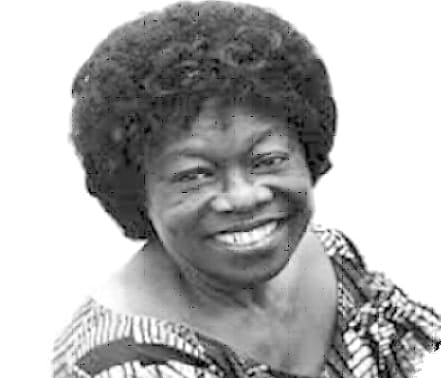
In paying my last respects to Dr Letitia Obeng, Ghana’s first female PhD holder in Science, I have gone back to her seminal autobiography, A Silent Heritage, and selected some passages from the book on different subjects to show what a thoroughly dynamic and forward-looking woman she has been.
Here she is, describing the home she lived in as a child in Afidwase:
The roof was of corrugated iron sheets.
All “respectable” houses were roofed with corrugated iron sheets.
The iron sheets had been introduced, (no doubt as part of a foreign export drive during colonial days) as an alternative to the African grass-thatch roof which was considered “primitive”.
The promotion had been vigorous, in spite of the fact that, in the climate of the country, the grass thatch roofs made rooms cool.
Granted, the corrugated iron sheets made rainwater harvesting feasible but they also heated rooms up and, with the rains, they soon became rusty, leaving roofs disgustingly ugly.
As I have travelled around the world, I have seen cottages and houses in several places including Europe, roofed with grass and they are highly rated.
I have seen attractive homes and hotels in Kenya, Lesotho, Burundi, as well as in Britain, France and other places, with safe, protective grass thatched roofs.
They were neither rusty nor disgustingly ugly.
Who knows what effective and pleasing roofing may have evolved from our kind of roofing if we had not been brainwashed into accepting that the grass-thatch roof was primitive?
And could the colonial masters not have organized the making of roofing tiles? We had the raw material and abundant labour.
But then, that might have caused the business of the foreign exporters and importers of the corrugated iron sheets to collapse!
Here she describes her Ntama Campaign.
I might add for the sake of the young people that back in those days, if you were an “educated” woman, you were not to be seen in cloth, “ntama”, you had to wear European dress:
I was still fired with nationalism and I continued to use ntama as my standard attire.
I remember we went in a group one evening to a popular night club in Kumasi.
At the entrance, although I had bought a ticket, the doorman would not let me in because I was wearing ntama.
The others in the group had European attire and they were let in.
George and I were left standing outside.
Just as my fury began to build up, the Proprietor happened to be visiting the club and when he saw what was happening, he apologized and invited us in.
I was the only one inside wearing ntama.
Thereafter, others wearing the traditional attire were also allowed in the club.
That strengthened my resolve to make the ntama acceptable and I started designing and sewing my kabas to look so attractive and different that at social functions, I stood out in my ntama.
The more conservative among the campus wives did not approve of me being in ntama at serious functions.
In fact one of them said to George, “Why does your fiancé continue to disgrace herself by wearing cloth all the time as if she does not know how to wear a dress.”
I decided to organize an Ntama Fashion Show to demonstrate how to be proud of wearing ntama for various occasions.
I had no problem with finding willing models from the Women’s Hall where I was Warden and had friends among the students.
I designed the ntama styles and sewed a variety of nicely fitted kaba for many occasions: sleeveless kaba with a little collar as a secretary’s outfit, a smart one with little straps, for early evening social events, an off-the-shoulder, strapless “will-power” for formal evenings, and others with overlapping peplum, short and long flared out sleeves.
All of them were designed to fit and show the curves of my lovely models.
The show took place in the College Assembly Hall and it was well applauded.
I followed the show-up with articles in a daily newspaper about how to sew and wear zip-fitted kabas and feel good in them.
Of course, I was only addressing a minority of literate women.
It was not the done thing to be a “cloth lady” at formal functions and there certainly were those ladies who, at that time, wouldn’t be caught dead in ntama in public!
Here she is on the subject of food:
Mama was an excellent cook.
Her local traditional dishes were really great.
Using vegetables, she would make a variety of soups and stews.
Then, there were all the dishes from ripe plantain and sweet potato and maize and yams that I hardly hear spoken about these days.
Obrodokono was a popular dish made from ripe plantain and ground, roasted maize.
The mixture, suitably seasoned with peppers and ginger and blended with a little palm oil was wrapped in green plantain leaves and steamed in a pot.
Then there were the rich and tasty soups, there was always a variety of them: palm soup, groundnut soup, garden egg soup and even plain soup – and they were all delicious.
There would be in the soups, a variety of meats including venison and smoked freshwater fish.
Papa was a hunter and quite often he would return from night hunting with large game.
Palm oil-based dishes were made with finely chopped spinach, garden eggs or different kinds of beans.
They were eaten with yam, plantain, cocoyam, cassava, cooked powdered maize and sometimes but rarely, rice.
l am glad that as a people, we in Ghana, even now, have a large stock of recipes and different ways of making delicious dishes from the same ingredients.
It is no exaggeration to say that there are enough varieties of local dishes for one to eat for many days without repeating a recipe.
Meal times when I was young were always great.
As I grew up, I used to hear quite a lot about how Africans do not eat “balanced diets”.
Thinking back, in my home, at any rate, I think the meals were reasonably balanced.
And here she is, reporting on her first trip to China in 1975 on a favourite subject, always the scientist, ever the pragmatist:
The safe management of human waste was strictly observed.
Traditionally, human waste had been used as manure on the farms.
The Chinese had devised a special three-chamber latrine which rendered parasite eggs infertile by the time the waste was scooped out to be used as manure.
They could also produce biogas from the latrine.
When we visited a house to inspect one of the latrines, there was a plastic hose through which biogas was being evacuated.
We followed the hose and it led us to a kitchen where the biogas was fed into a stove and used to boil water to make tea for us!
I was so impressed by this direct, no-nonsense utilization of human waste that I passionately rendered an account of it to my sister when I returned home.
Imagine my surprise when, instead of catching my excitement and showing the enthusiastic interest that I expected, her face went funny, as she asked, “And you drank the tea?” I got a similar reaction from other people, not only in Ghana, but also elsewhere, whenever I told my story.
Fare thee well, Dr Letitia Obeng, you were special, we haven’t got anyone like you.
The International Monetary Fund forecasts that economic growth will gradually return to its long-term potential of roughly 5% beginning in 2026.
In its country report after the board approval of an economic recovery programme of $3 billion, the fund stated that growth is expected to remain subdued in the coming years, while inflation gradually returns to target.
It noted that the implementation of the IMF program should help return inflation to single digits by 2025. The current account deficit would reach around 3 percent of GDP over the medium term.
“The current crisis, the envisaged fiscal consolidation path and domestic debt restructuring, as well as the difficult external environment is expected to lower growth to around 1.5 percent in 2023.
“This assumes expansion of 6.1 percent in extractive sectors (primarily oil, gas, and gold) supported by buoyant commodity prices, and 0.7 percent in non-extractive sectors—the lowest values since the 1980s,” parts of the report read.
On the other hand, the current growth in the country’s population which currently stands at more than 2% would imply a recession in per capita terms.
“The relatively strong performance in extractive activities (about 6 percent annual growth in 2023-26) reflects the opening of large new gold mines, the ongoing recovery in small-scale gold mines, as well as the planned expansion in oil and gas production,” the report said.
The International Monetary Fund (IMF) has proposed the scrapping of tax exemptions, adjustment of levies on fuel, and an increase in income tax as some measures the Ghanaian government could implement to boost revenue mobilization under its $3 billion support programme.
This is contained in IMF’s May 2023 country report on Ghana’s request for the $3 billion support programme.
Managing Director of the Fund, Kristalina Georgieva says the programme is only the first step towards restoring Ghana’s economic stability.
“Today’s decision is also a major milestone for the G-20 common framework. The commitment by the Official Creditors Committee to help make Ghana’s debt sustainable was essential for the approval of the Funds program and it signals important progress.
“The decision our board has taken is the beginning of the work we will do together with the authorities of Ghana for the implementation of the programme for the benefit of the people of Ghana.”
But the CEO of the Chamber of Commerce, Mark Badu-Aboagye, has raised concerns about the suggestions raised by the IMF.
According to Mr Badu- Aboagye, businesses in the country are already suffering, therefore should the conditionalities by the IMF be executed, it will worsen the struggles of businesses.
“When you introduce externalities like taxes, like high-interest rates, like levies, then you go to the bottom line and you realize that all of them are making losses, which means that this component needs to be managed.
“And that is where my concern is because these conditionalities will or may worsen that aspect of support that we need to give to businesses,” he emphasised.
Eventually, Mr Badu-Aboagye advised that, in the interest of both the country and businesses, Ghanaians should work together towards making the IMF deal a success.
Speaking on the same topic, an Economist, Professor Godfred Bokpin cautioned Ghanaians about a possible increase in taxes following the approval of Ghana’s bailout request by the IMF.
“It may not immediately take the form of new tax handles, but there’s going to be a lot of revisions to the existing tax measures that may result in you paying more taxes and a combination of that because the goal we have set for ourselves is to increase tax to GDP ratio,” he cautioned.
Meanwhile, the Finance Minister, Ken Ofori-Atta is pleading for support from Ghanaians to make the IMF programme implementation a success.
“I take this opportunity to call on all Ghanaians, investors, bilateral development partners to take up the course of Ghana and support the government in the implementation of the PC-PEG [Post-COVID-19 Program for Economic Growth] backed IMF ECF programme.”
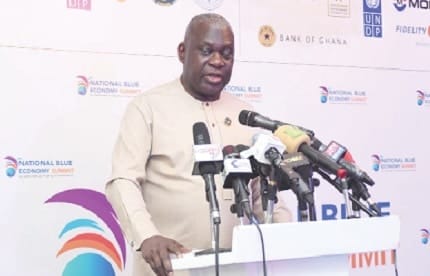
Ghana will host its inaugural National Blue Economy Summit, with the goal of reversing marine pollution and improving management and restoration of the country’s marine and coastal ecosystems on May 31.
Blue economy is a term that refers to the sustainable use of coastal and marine natural resources for economic growth and improved livelihoods and jobs.
It is linked to the exploitation and conservation of the maritime environment, while maintaining the integrity and health of the coastal and marine ecosystems.
The two-day summit, scheduled for May 31 and June 1, 2023, is expected to attract 300 participants, including policy makers, academia, development partners, and local and international champions in the fishing industry.
It will be hosted by the Sustainable Development Goals(SDGs) Advisory Unit at the Office of the President, in partnership with the Ministry of Environment, Science, Technology and Innovation (MESTI); the Ministry of Fisheries and Aquaculture Development, the Royal Norwegian Embassy and the United Nations Development Programme (UNDP).
Dubbed: “Our Ocean’s Health, Our Prosperity, Our Planet’s Security”, the summit will seek to mobilise collective action to raise awareness of the need to urgently address the critical challenges facing the ocean, and to highlight the opportunities that the ocean offers for the country’s economic transformation.
Activities
Activities during the summit will include high-level dialogues on seven key areas relating to the ocean and addressing of policy gaps.
It will also put a spotlight on plastic pollution, piracy, illegal fishing, innovative financing models and effective partnerships.
Launching the summit in Accra yesterday, the Special Advisor to the President on the SDGs and Ocean Action, Dr Eugene Owusu, said the ocean’s health and productivity were declining at an alarming rate, and posed a threat to humanity.
“The narrative that the ocean is too big to fail is, therefore, a misguided one.
The evidence is clear,” he stated.
Overfishing, climate change and plastic pollution were some of the major challenges of the ocean, he said.
Dr Owusu said the world needed a new ocean agenda anchored on the recognition that the blue economy should be a catalyst for sustainable development. Ocean importance
The Policy Analyst at the SDGs Advisory Unit, Dominic Opoku Manu Asante, said the ocean was important to human existence as the ocean covered 70 per cent of the earth’s surface, served as a vital food source and supported significant sectors.
He said it was essential to conserve the ocean and that if no actions were taken, it would lead to the loss of jobs, depletion of biodiversity and increased vulnerabilities of communities along the ocean.
The Resident Representative of the UNDP Ghana, Dr Angela Lusigi, said: “The threat is huge.
Sea levels are rising as a result of climate change which threatens lives and livelihoods, especially for coastal cities and communities around the world”.
The UNDP, Dr Lusigi said, was committed to partnerships that would spur concrete actions to sustainably utilise the vast resources and services that the ocean provided to transform Ghana’s economy.
The Director, Policy Planning Monitoring and Evaluation of the Ministry of Fisheries and Aquaculture Development, Doris Yeboah, said the ministry was partnering some agencies to work on marine debris.
“When our fishermen go to the ocean nowadays, they come back with their nets filled with plastics,” she said.
Ms Yeboah said the ministry would collaborate with its partners to promote sustainable practices and management of fishery resources to improve the ocean. Ghana’s marine
Ghana’s marine environment encompasses some 550 kilometres of coastline on the Gulf of Guinea, with over 10 per cent of the population depending on it.
The marine area has important resources, including fisheries, oil and gas reserves and precious minerals, and is an important global reservoir of marine biodiversity, providing important migration and nesting habitats for several marine species.
In recent years, the nation’s coastal wetlands are threatened by high volumes of plastic and metal waste that choke breeding habitats for fish, birds and other wildlife.
The global Ocean Health Index shows Ghana has performed above the global average in the areas of carbon storage, coastal protection, coastal livelihoods and economies, biodiversity and food provision, but that the country lags behind the global average in clean water.
Ghana’s IMF Chief, Stephane Roudet, and Finance Minister Ken Ofori-Ataa, along with other key participants are holding a press briefing to provide further insights into the $3 billion bailout deal.
The Executive Board of the International Monetary Fund (IMF) has approved a 36-month Extended Credit Facility (ECF) arrangement for Ghana amounting to approximately 3 billion US dollars.
The decision taken on May 17th, 2023, allowed for an immediate disbursement of about 600 million US dollars, with the remaining funds expected to be disbursed in installments every six months, subject to program reviews by the IMF Executive Board.
Ghana’s internet subscription has reached 22.8 million this year, an increase from the 16.99 million subscribers recorded in January last year.
This means the country’s internet penetration rate rose from 53.0 per cent to 71.94 per cent within a year.
The rise of internet connectivity has influenced online business transactions, with a large percentage of the population conducting businesses online and paying for goods and services using mobile money platforms, ushering in a cash-lite system envisaged by the government.
The Director-General of the National Communications Authority (NCA), Joe Anokye, who made this known, said the leap was a major boost in internet connectivity compared to previous years.
Mr Anokye was speaking at a ceremony to mark World Telecommunications and Information Society Day (WTISD) 2023 in Accra today (Wednesday).
It was held on the theme “Public -Private Partnership to improve connectivity”.
The WTISD was set aside by the International Telecommunication Union (ITU) in 1969 and is marked annually by the global telecommunications industry.
This year’s celebration is focused on empowering the least developed countries through information and communication technologies.
Present at the ceremony were the Deputy Minister of Communications and Digitalisation, Ama Pomaa Boateng, the Board Chairman of the NCA, Isaac Emmil Osei -Bonsu and the Chief Executive Officer of MTN, Selorm Adadevoh.
Also present were the Chief Executive Officer (CEO) of AirtelTigo, Leo Skarlatos, the Country Representative of UNESCO, Abdourahamane Diallo and the Head of the International Affairs Ministry of Communications and Digitalisation, Kwame Baah-Acheamfour.
While the increase in internet connectivity is an indicator of progress in the telecommunication sector, Mr Anokye said there was still room for improvement and called on the private sector to partner with the government to invest in the communications sector to achieve a digitally robust and secure economy.
He said the government recognised the need for such partnership and had, therefore, created an enabling environment for investment and for the private sector to thrive.
Key to the government’s intervention, he said, was the passage of the PPP Act 2020, Act 1039, which provided development through collaboration among public authorities and private parties for the provision of infrastructure and services.
“The government has over the years been pushing the digital agenda which aims at bridging the digital divide and improving digital literacy and access to connectivity,” he said.
Infrastructure expansion
To help position the sector for accelerated development, Ms Boateng said the government was making significant investments to connect the entire country to both voice and data service.
She said from 2020 to 2022, 1008 rural sites had been constructed for voice and data nationwide and that many communities had already benefited from the sites.
The government, she said, was optimistic that out of the 1008 remaining sites to be completed, 560 rural sites would be completed by the end of this year.
She explained that the provision of connectivity had an accompaniment of usage; hence, a need to expand connectivity to rope, every one, into the digital world.
“We must not lose sight of the fact that we need to close the technology usage gap, there is the need for more investments to ensure that everyone has access to Information Communication Technology tools.
“Citizens must have access devices to be able to interact meaningfully and also transact public and private services online without any barriers,” she said.
Investments
Ms Boateng said the government would not relent on its promise to ensure that no one was left behind in getting access to voice and data services.
Already, she said the government had committed $ 2.6 million to establish innovation centres and was training about 3,000 people by 2024 while the ministry also had an agreement with the Smart Africa Alliance through the Smart Africa Digital Academy to train up to 22,000 people by 2023.
Beyond that, she said the Universal Access Fund Administration operated over 220 community ICT centres across rural communities in the country that were used for capacity building, skills training and business advisory services.
Ghana has exceeded the thresholds set in the Debt Sustainability Analysis (DSA), resulting in the country experiencing debt distress, according to the International Monetary Fund (IMF).
In a statement titled “Request for an arrangement under the Extended Credit Facility Programme,” the IMF stated that Ghana’s debt level is not only unsustainable but also breaches the DSA thresholds.
“Given the ongoing debt restructuring and large and protracted breaches to the Debt Sustainability Analysis (DSA) thresholds, Ghana is in debt distress, and debt is assessed as unsustainable”.
By the end of 2022, the public debt in Ghana had risen to 88.1% of the Gross Domestic Product (GDP), with almost an equal distribution between external debt (42.4% of GDP) and domestic debt (45.7% of GDP). The International Monetary Fund (IMF) also noted that the country’s gross financing needs amounted to approximately 19% of GDP.
“Under the proposed programmes baseline projections, which do not consider the possible outcome of the ongoing debt restructuring, the ratios of present value of public and external debt to GDP, and the ratios of external debt service to revenues and exports are and would remain above their LIC-DSF thresholds over the medium and long term”, it added.
Additionally, the IMF has cautioned that the outlook carries significant downside risks.
The baseline projections rely on the successful execution of the programme and prompt implementation of the government’s comprehensive debt restructuring strategies and plans to tackle the substantial amount of domestic arrears, including those owed to independent power producers (IPPs).
Notwithstanding mitigation strategies, it said that the domestic debt exchange presents significant risks to domestic financial sector stability, adding “exchange rate, credit, and liquidity risks further add to the vulnerabilities”.
“The authorities’ debt restructuring plans still leave a substantial need for T-bill [Treasury bills] issuance in the near term and expose Ghana to the uncertainty in domestic market conditions, though programme implementation and outreach may help mitigate financing risks. Domestic policy slippages represent a significant downside risk to the projections, further compounded by risks associated to the end-2024 general elections.”
The Executive Board of the International Monetary Fund (IMF) approved a 36-month arrangement under the Extended Credit Facility (ECF) in an amount equivalent to SDR 2.242 billion (around US$3 billion, or 304 percent of quota).
The program is based on the government’s Post COVID-19 Program for Economic Growth (PC-PEG), which aims to restore macroeconomic stability and debt sustainability and includes wide-ranging reforms to build resilience and lay the foundation for stronger and more inclusive growth.
The Executive Board’s decision will enable an immediate disbursement to Ghana equivalent to SDR 451.4 million (about US$600 million).
Large external shocks in recent years have exacerbated Ghana’s pre-existing fiscal and debt vulnerabilities, resulting in a loss of international market access, increasingly constrained domestic financing, and reliance on monetary financing of the government. Decreasing international reserves, Cedi depreciation, rising inflation and plummeting domestic investor confidence, eventually triggered an acute crisis.
The authorities have taken bold steps to tackle these deep challenges, including by accelerating fiscal adjustment. The government has also launched a comprehensive debt restructuring to address severe financing constraints and the unsustainable public debt. Securing timely debt restructuring agreements with external creditors will be essential for the successful implementation of the new ECF arrangement.
Key policies under the authorities’ program include large and frontloaded fiscal consolidation to bring public finances back on a sustainable path, complemented by efforts to protect the vulnerable. The adjustment effort will be supported by ambitious structural reforms in the areas of tax policy, revenue administration, and public financial management, as well as steps to address weaknesses in the energy and cocoa sectors.
Appropriately tight monetary and flexible exchange rate policies will help bring inflation back to single digits and rebuild international reserves. The program also has a strong focus on preserving financial stability and encouraging private investment and growth.
The program will help Ghana overcome immediate policy and financing challenges, including through its catalytic effect in mobilizing external financing from development partners and providing a framework for the successful completion of the ongoing debt restructuring.
Following the Executive Board discussion on Ghana, Ms. Kristalina Georgieva, Managing Director, issued the following statement:
“The combination of large external shocks and preexisting fiscal and debt vulnerabilities precipitated a deep economic and financial crisis in Ghana. In response, the authorities have launched a comprehensive reform program, to be supported by the ECF-arrangement. It is focused on restoring macroeconomic stability and debt sustainability as well as implementing wide-ranging reforms to build resilience and lay the foundation for stronger and more inclusive growth. Capacity development and continued support by development partners would be critical for the successful implementation of the authorities’ program.
“Fiscal consolidation is a core element of the program. A substantial and front-loaded fiscal adjustment has started with the 2023 budget. Enhanced revenue and streamlined expenditure will be combined with policies to protect vulnerable households and create room for higher social and development spending in the medium term. With a view to fostering lasting fiscal discipline, the authorities are also advancing reforms to enhance domestic revenue mobilization, strengthen public financial management, and tackle the deep challenges in the energy and cocoa sectors. The government has also launched a comprehensive debt restructuring, including both domestic and external debt, to place debt on a sustainable path. Effective collaboration by all parties involved would be critical.
“Preserving financial sector stability is critical for the success of the program. Given the adverse impact of the domestic debt restructuring on balance sheets of financial institutions, the authorities will devise and implement a comprehensive strategy to rapidly rebuild financial institutions’ buffers and exit from temporary regulatory forbearance measures.
“Monetary and exchange rate policies under the program will focus on reining in inflation and rebuilding foreign reserve buffers. The Bank of Ghana will continue tightening monetary policy until inflation is on a firmly declining path and will eliminate monetary financing of the budget. The central bank will also enhance exchange rate flexibility and limit foreign exchange interventions to rebuild external buffers.
“An ambitious structural reform agenda is being put in place to reinvigorate private sector-led growth by improving the business environment, governance, and productivity.”
*The authorities’ economic program, supported by the ECF-arrangement, builds on the government’s Post COVID-19 Program for Economic Growth (PC-PEG), which aims to restore macroeconomic stability and debt sustainability and includes wide-ranging reforms to build resilience and lay the foundation for stronger and more inclusive growth.
*Securing timely debt restructuring agreements with external creditors will be essential for the successful implementation of the new ECF arrangement.
On May 17th, the IMF Executive Board gave its approval for a 36-month Extended Credit Facility (ECF) arrangement for Ghana, amounting to SDR 2.242 billion, which is equivalent to approximately US$3 billion.
This financial support from the IMF will provide Ghana with the necessary resources to address its economic challenges and implement reforms over the specified period.
The disbursement of funds will be carried out in stages, with an initial immediate disbursement of SDR 451.4 million (around US$600 million).
Objective of the deal
Ghana’s economic program has three key objectives: restoring macroeconomic stability, ensuring debt sustainability, and laying the foundations for higher and more inclusive growth.
Policy priorities
To reach Ghana’s economic program objectives a number of policy priorities have been laid out by the government:
First, large and frontloaded measures to bring public finances back on a sustainable path. This will be done through mobilizing more domestic revenue and improving the efficiency of public spending. Importantly, the program does – and will continue to – include efforts to protect the vulnerable.
The 2023 budget has for example doubled the benefits of the existing targeted cash transfer program, the Living Empowerment Against Poverty (LEAP) and boosted the allocations towards the school feeding program.
Second, to support the fiscal adjustment and enhance resilience to shocks, ambitious structural reforms will be implemented in the areas of tax policy, revenue administration, public financial management, as well as to address weaknesses in the energy and cocoa sectors.
Third, steps are being taken to bring inflation under control – for example with the Bank of Ghana raising interest rates and eliminating monetary financing of the budget. A flexible exchange rate policy will help rebuild international reserves.
Fourth, measures to preserve financial stability are very central to the program.
Finally, reforms are envisaged to encourage private investment, growth, and job creation.
Protecting the most vulnerable
To protect the most vulnerable from the immediate impact of the crisis, the 2023 budget has doubled the benefits of the existing cash transfer program, the Living Empowerment Against Poverty (LEAP).
In addition, the budgetary allocation of the Ghana School Feeding Program has been increased to compensate for the cost of inflation and make sure poor children continue to benefit from free meals at school. In the health sector, the financial resources for the National Health Insurance Scheme will be increased and made available on time to ensure the timely reimbursement of medical claims.
Spending toward key social program will be protected and monitored through an indicative target under the program.
Transparency and fight corruption
The Ghanaian authorities are committed to improve governance and transparency under the Fund-supported program. For example, the authorities have requested IMF technical assistance to conduct a Governance Corruption Diagnostic Assessment, which will be used as input into the ongoing efforts to update the National anticorruption Action Plan; they also will address weaknesses in the existing asset declaration system for public officials, by enacting a new Conduct of Public Officers Act.
Furthermore, GRA, with support from IMF technical assistance, is developing a plan with the aim to improve the professional standards of tax administration in Ghana.
Ghana’s next steps in the debt restructuring process
Regarding official bilateral debt, the next step is for the Official Creditor Committee for Ghana, under the G20 Common Framework, to agree with the authorities the specific modalities of how official creditors intend to deliver debt relief consistent with Fund-program parameters.
The authorities are also engaging with their private creditors to seek relief on their external debt.
The IMF Executive Board approved, on May 17th, an SDR 2.242 billion (about US$3 billion) 36-month Extended Credit Facility (ECF) arrangement for Ghana.
This decision enabled an immediate disbursement equivalent to SDR 451.4 million (about US$600 million).
The rest is expected to be disbursed in tranches every six months, following program reviews approved by the IMF Executive Board.
A press briefing scheduled to take place on Thursday, May 18, will provide the opportunity for IMF Chief for Ghana, Stephane Roudet and Finance Minister Ken Ofori-Ataa to share further details of the deal.
The press briefing will also feature key participants such as Dr Ernest Addison, Governor of the Bank of Ghana; and Tatiana Mossot, Senior Communications Officer at the IMF.
This development comes after Ghana received necessary debt assurances from the Paris Club and China to support its request for balance of payment assistance from the IMF.
The creditor committee, co-chaired by France and China, examined the macroeconomic and financial situation of Ghana, including its long-term debt sustainability, and endorsed its request for a debt treatment under the “Common Framework for Debt Treatments beyond the DSSI” endorsed by the Paris Club.
In a statement, the creditor committee encouraged multilateral development banks to maximize their support for Ghana to meet its long-term financial needs.
Kristalina Georgieva, Managing Director of the IMF welcomed the creditor’s assurances. She said, “This statement provides the necessary financing assurances for the IMF Executive Board to consider the proposed Fund-supported program and unlock much-needed financing from Ghana’s development partners.”
Ghana reached out to the IMF in July 2022 after several months of opposing a return to the Fund. Ghana seeks to restore its economy and to do that, needs assistance from the IMF.
Though government officials says the IMF bailout is not the panacea to the economy’s crisis, it however does form part of the measures to resolve the economic turmoil the West African country finds herself.
Ghanaian singer, Efya, has expressed her desire to set a world record for the longest song ever.
This follows Hilda Baci’s feat of breaking the Guinness World Record for the “longest cooking marathon”.
The Nigerian chef reached a 100-hour mark surpassing the record previously held by Lata Tondon, an Indian chef who achieved the feat in 2019.
Netizens online, particularly Nigerians, have since not kept calm over the development which has triggered discussions worldwide.
However, Efya, believes she could also set a world record for Ghana, but through singing.
“If I can break a record, it will be for the longest song. Sometimes you can do the longest song recorded. I don’t have to be on my feet singing continuously. I could sing for a couple of days; I could hold a note for long. These dirges we have in Ghana are an example, we have 15 minutes of such songs. I could sing for 30 hours if I want to break the record. Hilda recorded 100 hours because she was cooking,” she told Abeiku Santana.
The Ghanaian neo-soul singer said the only challenge, perhaps, is she might not be allowed to recruit other people to participate in it.
“The challenge is that you might have to be the only one to sing. Maybe we might not be allowed to tag other people in it, because it will seem easy and another country can beat us easily over it,” she added.
The government of Ghana has signed an agreement establishing a Joint Commission for Cooperation with Guinea-Bissau.
The document is to serve as the legal framework for addressing the trade and investment ambitions of the two countries.
This was signed during a two-day state visit by President Akufo-Addo to Guinea Bissau as part of efforts to further deepen strong relations.
This is in honour of an invitation by Guinea-Bissau’s President, His Excellency Umaru Sissoco Embalo, Chairperson of the Authority of Heads of State and Government of ECOWAS.
The two countries trade in plastic, furniture, vehicles, aluminum among others. Recent data shows that as of 2019, Ghana exports to Guinea Bissau stood at $441.41 (thousand).
President Akufo-Addo together with a delegation including Minister for Foreign Affairs, Hon. Shirley Ayorkor Botchway, and officials from the Presidency and Foreign Ministry left for Guinea Bissau on Sunday, May 14, 2023.
The two presidents, according to the Presidency, will “explore other areas of co-operation to their mutual benefit.”
As part of his visit, President Akufo-Addo will receive the Amilcar Cabral Medal, the highest national honour of Guinea-Bissau and deliver a lecture at the Law Faculty of the University of Amilcar Cabral.
Akufo-Addo welcomed by state officials in Guinea-Bissau
He will also interact with the contingent of Ghanaian soldiers stationed in Bissau, who are part of the ECOWAS Stabilisation Support Mission.
The President will return to Ghana on Tuesday, 16th May 2018, and in his absence, the Vice President, Alhaji Dr Mahamudu Bawumia, shall, in accordance with Article 60(8) of the Constitution, act in his stead.
On May 16, 2017, the country’s finance minister, Ken Ofori-Atta, has lamented on the rate at which the economy was spending more than it was bringing in.
He claimed that this was depriving the nation of essential advancement in the majority of economic sectors.
“We are spending more than we are generating and borrowing to finance those expenditures. Over the years, revenue generation has become stagnant due to many factors. In the meantime, we earmarked significant portion of the revenues. Added to that is an increasing expenditure especially in wages and salaries and interest payments,” Ken Ofori-Atta said.
The Finance Minister said this at the opening of the National Policy Summit in Accra.
Read the full story originally published on May 16, 2017 by peacefmonline.
Government has lamented the level at which the country’s economy is recording more expenditure than revenue saying such a trend has over the years succeeded in robbing the country of critical development in most sectors of the economy.
Speaking at the opening of the ongoing National Policy Summit yesterday in Accra, Ken Ofori-Atta, Minister of Finance, did not mince words: “We are spending more than we are generating and borrowing to finance those expenditures. Over the years, revenue generation has become stagnant due to many factors. In the meantime, we earmarked significant portion of the revenues. Added to that is an increasing expenditure especially in wages and salaries and interest payments.”
The Finance Minister continued that “this situation led to very limited investment in the critical sectors of the economy, the provision of needed infrastructure and investment in the real sector to generate and facilitate economic activity and create opportunities for people. What we saw was a persistent and consistent decline in economic activity and increased unemployment.”
Effects
Mr Ofori-Atta said the impact of such a situation was high inflation; high and unstable exchange rates, high interest rate as well as short, scarce and expensive credit for private sector to invest. He added that the situation was further compounded by poor service delivery and complex and unfriendly regulatory requirement with regards to business licensing and granting of permits adding that led to a loss of confidence by investors and private sector.
Gov’t determination
He said government was determined to change this narrative by working around some 5 key pillars. These include increasing revenue, controlling expenditure, ensuring sustainable debt, efficient wage management and capping earmarking funds.
Evidence already showing
With the ‘Asempa’ Budget, he said Government had changed the composition of expenditures, reduced wage as a percentage of public spending, and also interest payment as a percentage of public spending as well as increased capital spending to provide critical infrastructure like energy and transportation, among others.
“The results of such above noted measures are already showing and these include a stable exchange rate, reducing inflation, reducing interest rates, savings from debt profiling, increased credit to private sector and a renewed confidence by private sector and investors.”
New industrial parks
Alan Kwadwo Kyerematen, Minister for Trade & Industry, also in a speech, said Government has planned to anchor industrialization in the country with the establishment of some ten new industrial parks.
He said each of the ten regions would have one park with the requisite facilities and flexible land schemes to facilitate the establishment of industries.
Noting that such initiative drew heavily on similar models from Asia, he said it was expected to create thousands of jobs for Ghanaians.
“It takes us to the next component of our transformation agenda which is to establish at least one major industrial park in each of the ten regions. If we are talking about enhancement of industrial production then obviously access to lands and energy must be a critical factor. That is why these industrial parks are actually important. The magic of Asia, China Korea are all about the establishment of industrial parks and special economic zones.
Retired police chief, COP Nathan Kofi Boakye, has been sworn in as a notary public of the Supreme Court of Ghana.
Until his retirement on April 5, 2023, COP Kofi Boakye was Director-General in charge of legal and prosecution of the Ghana Police Service.
He was sworn in as a notary public together with about 90 other influential persons who are lawyers in private practice with at least 10 years of working experience with integrity.
A notary public is a person authorized by the State to, among other things, administer oaths, certify documents, attest to the authenticity of signatures and perform official acts in commercial matters, such as protecting negotiable instruments.
The popular COP Kofi Boakye was noted for his strong views on corruption and crime in Ghana while serving in office. He made several controversial arrests of public figures including musicians and politicians.
On his retirement, the Judicial Service of Ghana praised him for his dedicated and impactful service to the service through his work as a member of the Judicial Council.
Other influential persons who were sworn in by Chief Justice Anim Yeboah as notary’s public are Gabby Asare Otchere Darko of the New Patriotic Party, Prof. Kenneth Attefuah of the National Identification Authority and others.
Bright Adu Larbi, a 38-year-old security guard making 500 Ghanaian cedis (US$45) a month, didn’t need the ongoing economic crisis to feel overwhelmed by the cost of living in Ghana’s capital city, Accra. For Larbi, the financial strain that came with his growing family had already pushed him to the edge.
In 2021, stagnant wages coupled with increased family expenses meant that he could no longer afford the GHS180 (US$16) monthly rent on his small apartment in Adabraka, a suburb of Accra. With work hard to come by in the wake of the COVID-19 pandemic, Larbi also couldn’t afford to move out of Accra and sacrifice his security job within the city.
The only affordable housing available to him and his family of four was a small wooden kiosk, packed into an informal settlement called Ayigbe Town, built around high-tension electricity towers. These kiosks, built specifically as housing, range from about 16 to 20 square feet in size, with at least one window for ventilation. They rely on rudimentary connections for electricity, some of which are illegal, and with limited sanitation facilities, residents use makeshift baths and toilets.
“We didn’t have a choice. We can’t afford to rent,” Larbi tells Equal Times. But for GHS1000 (US$90), he was able to buy a small kiosk to live in.
Speaking to Equal Times while recuperating from appendix surgery, Larbi decries the high cost of living in Accra that has left him living from hand to mouth. Even though his employer pays for the health insurance that covered his surgery, he can’t shake off the fear that he may be laid off as he recovers. “I wouldn’t know what to do with my wife and two kids [if I lost my job]. It would be difficult.”
His priority remains his daughters, aged two and five. They are enrolled in a low-cost crèche costing him GHS 300 (US$24.78) per term so that both he and his wife can work. But there is nothing left at the end of the month. “I cannot buy clothes for myself. I cannot buy shoes…what can I save?” says the security guard. “When money comes at the end of the month, I pay for school fees, and it is done. We go back to square one and start the month again with nothing again.”
Innocent Tsey, a carpenter, was also forced by high rental prices in Accra to move his family into a kiosk about a kilometre away from Larbi’s. He says he lost his previous home, a boy’s quarters (stand-alone accommodation on the grounds of a bigger house, usually for domestic workers) on a residential property within Accra, without any warning. “One day our landlord came and told us that he had sold the place, so we had to move,” recalls Tsey.
The cheap accommodation in the kiosk estate was initially appealing. For someone who could make up to GHS1000 ($90) a month, the GHS600 (US$54) he pays yearly for his kiosk space was bearable. But he soon came to realise that where he currently lives is no place to raise two daughters.
“It is like a jungle. There is no authority here. No security,” says Tsey. “I feel very bad for moving my family over here. If I could leave here today, I would.”
Tsey’s kiosk is situated on land belonging to Ghana’s Rural Housing Department and the annual fee he pays for the land goes to the state. This means that he does not face the threat of having his kiosk demolished by the local government. Larbi’s family, on the other hand, is one of hundreds of low-income households in Ayigbe Town which occupies the land illegally, and he has had his kiosk demolished before.
These demolition exercises are the only time that Larbi feels the presence of the state in his life. He has never benefited from any welfare support despite his poverty. “Nobody is coming around to help anybody here, but every four years, they bring ballot boxes for us to vote,” fumes Larbi.
Searching for sustainable housing reforms
Ghana’s urban population increased from 50 per cent in 2010 to 56 per cent in 2021, with the Greater Accra and Ashanti regions accounting for 47 per cent of the increase. Research has shown that higher rates of rural-to-urban migration – caused by a lack of decent work in rural areas and a push for higher wages – is putting pressure on basic services such as education, health care, transport and housing.
Estimates put Ghana’s housing deficit at about 1.8 million units. This translates to about six million people out of a population of approximately 33 million in need of housing. However, these figures do not account for the quality of available housing. Ghana’s 2022 Voluntary National Review on the UN’s Sustainable Development Goals noted that there were 8.8 million Ghanaians living in slums, as of 2020, an increase from 5.5 million in 2017.
Successive governments have tried to implement affordable housing schemes to counter the country’s decent housing deficit and help relieve the financial constraints faced by home seekers. But the government’s credibility recently took a hit because of the mismanagement of a high-profile affordable housing project in Saglemi, on the outskirts of the Greater Accra Region, which is currently the subject of a corruption trial.
Divine Aggor, the CEO of the Rent Chamber Group, which advocates for innovative housing solutions, wants the government to step away from affordable housing projects because of such mismanagement and concentrate on the “simpler” option of fixing the rental regime, which is contributing to some Ghanaians being priced out of the country’s cities.
In Ghana, 46 per cent of households in urban areas occupy rented dwelling units, according to a 2021 Ghana Statistical Service report.
“Developing solutions that are rental-based could immediately wipe out 90 per cent of the challenges we have in this sector,” says Aggor. “[State-led] affordable housing projects are a complete waste of time and resources,” he adds, mainly because the majority of people wouldn’t be able to afford to buy due to high mortgage interest rates and the low numbers of people even eligible for a mortgage.
In January, the government introduced a National Rental Assistance Scheme, under which the state will give out rent loans to eligible Ghanaians to cover rent advances. But this does nothing to tackle the structural issues impacting Accra’s housing market, particularly for low-income workers: a massive shortage in housing supply and low wages that aren’t keeping up with the cost of living.
Aggor says the simplest solution is for the government to enforce existing land and rent laws, which would make it easier for prospective landlords to purchase land without the threat of multiple payments for the same piece of land, or for extortion, the cost of which are passed on to tenants.
But he says there is very little incentive for such moves. “In Ghana, we don’t enforce laws because the people who are supposed to [do this] are complicit in the very activities that the laws seek to regulate,” says Aggor.
Rental interventions are not new in Ghana. Rent controls were implemented in the 1970s through to the early 1980s with a view to making housing affordable. But it had unintended consequences, as it became a disincentive for the private sector to provide rental housing units.
Regulatory failings not helping situation
Currently, the national Rent Control Department – supposed regulators of the rental regime – are hampered by a severe lack of resources when it comes to adequately monitoring Ghana’s rental market. One of the more scrutinised infractions is the law that limits demand for rent advances to six months. However, due to the limited supply of housing, this regulation is openly flaunted and rent advances of two to three years are the norm. Rent and housing committees are also unable to properly assess and value properties to ensure that fair rents are being charged.
“We have our challenges. I must be frank. We have logistical challenges,” the Rent Control Department’s press officer, Emmanuel Kporsu, said during an online forum, revealing that the department’s 58 national offices only have access to four vehicles to carry out assessments and inspections.
Current comprehensive data on rent is hard to come by. The last holistic housing survey in Ghana came after the 2010 census. But 2014 data viewed through the lens of the current economic reality, with over 50 per cent inflation and one of the world’s worst performing currencies in 2022, shows that the cost of housing outpaces household incomes and is contributing to the average Ghanaian being priced out of Accra, as well as other big cities such as Kumasi and Takoradi.
In its 2014 Housing in Ghana report, the Ghanaian Statistical Service noted a ‘dollarisation’ of the middle-class rental space in Accra, partly due to Ghanaians returning from the diaspora. At the time, middle-class professionals could expect to pay between US$80 (GHS880) to US$450 (GHS4,950) a month in rent with tenants sometimes expected to pay advances of up to two years.
Increasingly, peri-urban areas have featured significant housing development because of the cost of housing within major cities. According to the African Cities Research consortium, the pattern of urban physical growth reflects the rapid move from coastal cities like Accra, towards the peri-urban areas inland because of cheaper price of land, and thus, rent. In the last decade alone, an estimated 89 per cent of new urban physical development in the Greater Accra Region has occurred outside of the Accra Metropolitan Area.
Dr. Kwabena Nyarko Otoo, chief economist at Ghana’s Trades Union Congress, is one of the many working Ghanaians who spends as much as four hours commuting to and from work every day because they opted for more affordable housing outside the city. He lives on the outskirts of Accra’s sister city, Tema. “It is really expensive to live in the real Tema itself,” he notes to Equal Times.
Ghana’s cost of living struggles have been a cause of concern for the union. Aside from its advocacy, the TUC has also tried to put in place interventions for its members like rental allowances to support struggling members. The union is also working to establish a Labour Bank to cater to union members by offering loans and mortgages.
But Otoo acknowledges that these interventions can only go so far to address a housing problem that “overwhelms everybody”. There are “serious governance challenges” that limit the effectiveness of the state in this regard, he notes. But the state cannot escape the ultimate responsibility of making it easier for all Ghanaians to afford decent homes.
“We will do our part. But what we do might not fully solve the problem,” concedes Otoo. “The housing problem is so big that we need a major government intervention, and we will continue to push for that.”
Ghana’s Finance Minister, Ken Ofori-Atta, stated exactly two years ago that the country was putting up a lot of effort to bring Amazon to Ghana.
He claimed that the action was taken to strengthen the entrepreneurial technological ecosystem for Ghanaian businesspeople.
Read the full story originally published on May 15, 2021 by Ghanaiantimes.
The Ghana Investment Promotion Centre (GIPC) is working assiduously to attract Amazon to Ghana, Finance Minister, Ken Ofori-Atta, has said.
According to the Finance Minister, the move was to deepen the technological entrepreneurial ecosystem for Ghanaian entrepreneurs.
Addressing the country on the measures being introduced by the government to prop up the economy and create jobs for the youth in line with social media campaign protest dubbed “FixTheCountry”, Mr Ofori-Atta said aside Google setting up its regional Artificial Intelligence Centre in Accra, Twitter recently announced to establish its Africa Headquarters in Accra.
He said the decision of such global tech giants to come to Ghana demonstrated the confidence investors had in the Ghanaian economy.
Mr Ofori-Atta said the presence of Amazon in Ghana would help create jobs for the youth and prop up the Ghanaian economy.
He said since assuming office, the government had worked hard to put the economy on a better footing and positioned it to be hub of trade in Africa.
Mr Ofori-Atta indicated that the country won the bid to host the Secretariat of the African Continental Free Trade Area (AfCFTA), positioning Ghana and Ghanaian businesses as the gateway partner and spearhead Ghana as a hub for the Africa region.
“Until we were hit by the COVID-19 pandemic in March 2020, we were on course to achieving the objective to stabilise and grow the economy, create jobs especially for the Youth, modernise, digitise and formalise the economy, provide social protection for the vulnerable and create a safe and secure environment for citizens and businesses to thrive,” the Finance Minister said.
Mr Ofori-Atta opined that the government implemented flagship initiatives such as 1 District 1 Factory, 1 Village 1 Dam, Planting for Food & Jobs, and IPEP in the Real Sector to accelerate economic activities and help create jobs.
The Finance Minister said the government as part of measures to transform the economy, implemented several initiatives to digitalize the economy.
“We implemented several digitalisation programmes to transform the economy, formalise the informal sector, and increase efficiency in public service delivery,” Mr Ofori-Atta stressed.
Finance Minister mentioned some of the initiatives as the issuance of over 15 million National ID Cards, the digital addressing system for over seven million homes, mobile money payment interoperability system, and the introduction of the paperless port system.
The others, Mr Ofori-Atta stated were the automation of driver’s license and vehicle registration, renewal of National Health Insurance Scheme registration, land records digitisation with block-chain technology, and automation of passport application,” Mr Ofori-Atta said.
“After four years of implementing these prudent measures, the Ghanaian economy witnessed a turnaround. Between 2017 and 2019, the economy grew by seven per cent on average in response to Government’s prudent management of the economy and implementation of government flagship programmes, being one of the highest and sustained growth periods,” the Finance Minister stressed.
That Mr Ofori-Atta observed culminated in a single-digit inflation of 7.9 percent, reduced fiscal deficits with three consecutive years of primary surpluses, relatively stable exchange rate, significant improvement in the current account with three successive years of trade surpluses, strong foreign exchange reserve buffers covering 4 months of import cover.
The Finance Minister pledged that government would continue to work to put the economy on a better footing and bring relief to the citizens.
The Managing Director of the International Monetary Fund (IMF), Kristalina Georgieva, has expressed her appreciation for the Official Creditor Committee for acknowledging the significance of an IMF-supported economic programme for Ghana.
She also commended their commitment to engaging in negotiations for debt restructuring terms.
In a positive development, Ghana’s official creditors, led by China and France, have established a committee to initiate discussions on debt restructuring. This development sets the stage for the approval of a $3 billion IMF loan for Ghana.
Following the financial crisis, Ghana defaulted on a significant portion of its external debt in December. In February, the country successfully completed a domestic debt exchange as part of its efforts to address the crisis.
Reacting to the creditor committee for Ghana under the G20 common framework for debt treatment, the IMF chief said, “I welcome the statement from the Official Creditor Committee for Ghana on the importance of an IMF-supported economic program, together with its commitment to negotiate debt restructuring terms accordingly.
“This statement provides the necessary financing assurances for the IMF Executive Board to consider the proposed Fund-supported program and unlock much-needed financing from Ghana’s development partners.
“I also strongly endorse the call by the Official Creditor Committee for private creditors and other official bilateral creditors to commit to comparable debt treatments.
“The Creditor Committee’s action recognizes the Ghanaian authorities’ strong reform program, which aims to restore macroeconomic stability and debt sustainability while laying the foundation for an inclusive recovery.
“It also signals that further progress is being made under the G20 Common Framework, demonstrating that international partners are ready to work together to help countries resolve their debt issues. This is vital to enable countries such as Ghana to achieve sustainable growth and poverty reduction.”
Ghana secured a staff-level agreement with the IMF for the $3 billion support package in December. But for the money to be disbursed, the IMF executive board must formally approve it – a step that required prior financing assurances from official creditors.
“Creditor committee members are committed to negotiating with the Republic of Ghana terms of a restructuring of their claims to be finalised in a Memorandum of Understanding,” the statement posted by the Paris Club of creditor nations on its website.
Ghana’s finance ministry said on Twitter the government was ready to go to the IMF board. Ghana is negotiating its international debt rework under the Group of 20’s Common Framework platform.
Its $5.4 billion debt book to official creditors has been earmarked for restructuring, according to government data. The nation is also in talks to rework $14.6 billion of debt to private overseas creditors.
The country faces a debt overhaul after its already strained finances buckled under the economic fallout from COVID-19 and Russia’s invasion of Ukraine.
On December 12, 2022, the IMF reached a staff-level agreement with the Ghanaian authorities on a new arrangement under the Extended Credit Facility. Board consideration of Ghana’s program request has been pending financing assurances from Ghana’s official bilateral creditors.
Ghana has cleared the final hurdle for accessing the $3 billion extended credit facility from the International Monetary Fund (IMF), according to President Nana Akufo-Addo.
This progress allows Ghana to obtain the necessary balance of payments support.
“Today, we were informed that the last hurdle toward our agreement with the IMF has been overcome,” Mr Akufo-Addo said.
“The Paris Club met today in Paris in a meeting co-chaired by China and France and have okayed and approved Ghana’s request for an IMF programme,” he said.
Earlier, the Finance Ministry announced the progress made in a post on Twitter.
“The Paris Club has, today, established the OCC (co-chaired by China & France). With the granting of financing assurances, Ghana is now ready to go to the IMF Board. Thank you to all our bilateral partners for helping us reach this significant milestone!” Ghana’s finance minister Ken Ofori-Atta tweeted.
Meanwhile, the managing director of the International Monetary Fund, Ms Kristalina Georgieva, has said: “I welcome the statement from the Official Creditor Committee for Ghana on the importance of an IMF-supported economic programme, together with its commitment to negotiate debt restructuring terms accordingly”.
“This statement provides the necessary financing assurances for the IMF Executive Board to consider the proposed Fund-supported programme and unlock much-needed financing from Ghana’s development partners,” she said in a statement.
Ms Georgieva noted: “I also strongly endorse the call by the Official Creditor Committee for private creditors and other official bilateral creditors to commit to comparable debt treatments.”
She added: “The Creditor Committee’s action recognises the Ghanaian authorities’ strong reform programme, which aims to restore macroeconomic stability and debt sustainability while laying the foundation for an inclusive recovery.”
“It also signals that further progress is being made under the G20 Common Framework, demonstrating that international partners are ready to work together to help countries resolve their debt issues.”
“This is vital to enable countries such as Ghana achieve sustainable growth and poverty reduction”, she acknowledged.
The IMF reached a staff-level agreement with Ghana in December last year.
Ghana undertook a domestic debt exchange programme followed by a restructuring of its external debts with China and the Paris Club.
The financing assurances from the Asian giant and the Club have been the only stumbling block to Ghana getting a Board approval from the IMF.
Ghana’s economy has been in the doldrums for the past two years.
The IMF’s extended credit facility is intended to give Ghana some credit worthiness so the country could return to the international capital market.
On Friday, May 12, the Paris Club announced that it has together with China agreed to provide the necessary debt assurances to support Ghana’s request for balance of payment assistance from the International Monetary Fund (IMF).
A committee that was co-chaired by France and China as bilateral lenders was set up.
The creditor committee examined the macroeconomic and financial situation of Ghana, including its long-term debt sustainability, and its formal request for a debt treatment under the “Common Framework for Debt Treatments beyond the DSSI” endorsed under the Saudi G20 Presidency in November 2020, which was also endorsed by the Paris Club.
“The creditor committee supports Ghana’s envisaged IMF upper credit tranche (UCT) program and its swift adoption by the IMF Executive Board to address Ghana’s urgent financing needs. The creditor committee encourages Multilateral Development Banks (MDBs) to maximize their support for Ghana to meet its long-term financial needs,” the statement said.
They have called upon private creditors and other official bilateral creditors to promptly commit to Ghana’s agreement without any further delays.
“Consequently, the creditor committee urges private creditors and other official bilateral creditors to commit without delay to negotiate with Ghana such debt treatments that are crucial to ensure the full effectiveness of the debt treatment for Ghana under the Common Framework,” excerpts of the statement added.
Consequently, the Finance Ministry has taken to Twitter to express gratitude to all who have supported Ghana’s cause.
“The Paris Club has today established the OCC (co-chaired by China & France). With the granting of Financing Assurances, Ghana is now ready to go to the IMF Board. Thank you to all our bilateral partners for helping us reach this significant milestone! #ResolvingTogether.”
Sources say Ghana’s official creditors are close to granting financial assurance to enable the West African country obtain a credit facility worth $3 billion from the International Monetary Fund (IMF).
Reports from Reuters indicate that a committee which will be co-chaired by France and China as bilateral lenders are expected to officially grant financing assurances as soon as Friday.
In a news briefing on Thursday, IMF spokesperson Julie Kozack said the Fund is hopeful its executive board can quickly consider the Ghana program once enough official bilateral creditor assurances have been secured.
“We have seen strong progress toward creditors delivering on these financing assurances and we’re hopeful that they can be delivered very rapidly,” Kozack said.
Earlier in April, Finance Minister, Ken Ofori-Atta revealed that Ghana was likely to receive the International Monetary Fund’s (IMF) Board approval for a $3 billion bailout by the close of May 2023.
As Ghana struggles through its economic crisis, defaulting on its debt in December and completing a debt restructuring in February, the IMF bailout is expected to ease her economic burdens.
Ghana is also in talks to rework $14.6 billion of debt to private overseas creditors.
On May 1, 2023, a family at Airport Residential Area woke up to a very devastating scene when the building that sits on their 1.34 acre of land was completely bulldozed to the ground.
The building, which has been home to the Eshun family for over five decades, is now a scene of ruins.
With all of their properties still inside, the merciless perpetrators of this action gave the family no opportunity to even salvage anything, at least not until after the roofs had come down on everything.
But Richard Eshun, a son of the owner of this property, the late Isaac Eshun, said although he and his family have gone through a lot of threats in the last month over this property, they are unfazed.
This, he added, is because all evidence, even at the Lands Commission of Ghana, shows clearly that his family owns that property and that there is no confusion or contention about it.
Speaking in an interview, the 68-year-old said that on the day of the demolition, things got so tensed that he was physically assaulted.
“On the first of May, as I tried to stop that bulldozer that got here, I was punched and kicked, so, I was physically-abused… and I don’t see where physical abuse comes in all of these,” he said.
Richard Eshun also narrated how his licensed shotgun was seized by the police, a situation he believes allowed the faceless persons behind the attempts to take over his land to confidently invade the property on May 1.
He also made allegations to the effect that it appears the other party attempting to take over his property have some police support.
“In many, many cases, the police have come ahead of Anane Daniels to clear the way for him. I have a licensed shotgun and I informed the police of that. They came here and took my weapon from me.
“That same night was the most brutal attack of these guys, where they pulled the roof off, et cetera. If I had my weapon, I don’t think they would have come in here, well, not with that kind of attitude they came in with,” he said.
The Health Minister, Kwaku Agyemang-Manu, has revealed that Ghana will be taken from the list of beneficiaries of the Global Alliance for Vaccine and Immunization (GAVI) to cease supplying free vaccine to Ghana – Agyemang-Manu in the coming days.
According to Mr. Agyemang-Manu, the GAVI initiative will not supply Ghana with free vaccines following its attainment of lower middle-income status.
Gavi, or the Vaccine Alliance, is an independent public-private partnership and multilateral finance structure that aims at increasing worldwide access to the use of vaccines, particularly among vulnerable children.
Speaking at the commissioning of a new office complex of the Ghana Vaccine Institute in Accra, Mr. Agyemang-Manu said Ghana needs to be self-sufficient in the production of vaccines.
“While the GAVI alliance support is about 80 percent of Ghana’s vaccine, our attainment of a lower middle-income status means we will have to transition from GAVI support by the year 2027.”
Mr Agyemang-Manu added that the government has since developed the national vaccine policy to translate President Akufo-Addo’s vision of making Ghana a vaccine manufacturing hub into a reality.
The upstream petroleum industry lost a total of 25.3 billion cubic feet (bcf) of natural gas worth around $169 million through flaring.
The 2022 Annual Public Interest Accountability Committee (PIAC) Report on Management and Use of Petroleum Revenue has revealed.
The volume of gas flared in 2022 increased by 19.3 per cent compared to a volume of 21.2 bcf recorded in 2021.
This constituted about 10 per cent of the total 253.56 bcf of both Associated Gas (AG) and Non-Associated Gas (NAG) produced from the three oil fields of Jubilee, Sankofa Gye-Nyame (SGN) and Tweneboa-Enyenra-Ntomme (TEN).
According to the energy think tank, African Centre for Energy Policy (ACEP) in a report titled ‘The state of the energy and extractive sectors of Ghana: Critical reforms required for sustainable economic recovery,’ about 47 billion cubic feet (bcf) valued at $300 million was lost to flaring between 2019 and 2021.
The Civil Society Organisation observed that the gas was flared at a time when domestic consumption of processed gas, known as liquefied petroleum gas (LPG), was growing exponentially, leading to increased imports.
Aside the economic loss of flaring, the activity is known to have a negative environmental impact and is a contributor to global warming.
Gas flaring is the burning of natural gas associated with oil extraction. It is regarded as a waste of a valuable natural resource that could either be used for productive purposes, such as generating power or conserved.
Meanwhile, the PIAC report, launched on April 20, 2023, noted that compared to the 2021 volume of 256.26 bcf of raw gas produced, the total production for 2022 represented a production decrease of 7.7 per cent.
Based on invoiced amounts on Gas from the Jubilee and TEN Fields, where the export volume of 31.6 bcf translated to US $211.5 million, it is estimated that flaring of 25.3 bcf of gas had resulted in a loss of about $169 million.
Speaking at the launch, Nasir Alfa Mohammed, the Vice Chair of PIAC, said the flaring of gas keeps occurring due to inadequate investment and lack of facilities to store and utilise the commodity.
The report further indicated that the SGN Field, relatively gas-concentrated, produced the highest volume of combined AG and NAG of 129.39 BCF while the Jubilee and TEN Fields produced 68.48 bcf and 55.68 bcf respectively.
A breakdown of the report revealed that gas production from the SGN field recorded an increase of 6.4 per cent from 121.6 bcf in 2021 to 129.39 bcf in 2022.
Meanwhile, the total gas flared for the period was 3.56 bcf, while a volume of 52.87 bcf was utilised as injected gas with a total of 67.9 bcf of gas exported to Ghana National Gas Company (GNGC) and 4.07 bcf used as fuel.
In the Jubilee fields, gas production decreased by 2.9 per cent from 70.53 bcf in 2021 to 68.48 bcf in 2022.
Also, a volume of 17.43 bcf representing 25 per cent of the total gas produced was injected for pressure support while a total volume of 3.76 bcf, representing 5 per cent of the total gas produced was used to power gas turbine generators.
A volume of 11.41 bcf, representing 17 per cent of the total gas produced was flared on the Kwame Nkrumah (KNK) Floating Production Storage Offloading Vessel (FPSO) while 35.88 bcf representing 52 per cent of gas produced was exported to GNGC.
It was also highlighted that gas production on the TEN Field declined by 13.2 per cent from 64.13 bcf in 2021 to 55.68 bcf in 2022.
About 68 per cent of gas produced in the field totalling 38.03 bcf was used as gas injection for pressure support while a volume of 10.33 bcf, representing 19 per cent of the total gas produced was flared.
A volume of 3.78 bcf of gas, representing 7 per cent of the produced gas was also exported to GNGC and a volume of 3.53 bcf, making up 6 per cent of produced gas was used for fuel.
The oppositionNational Democratic Congress(NDC) is convinced that the presidential and parliamentary elections slated for May 13, 2023 will take place as planned.
This comes on the back of Ghana’s Electoral Commission (EC) indicating that it cannot supervise the NDC’s Presidential and Parliamentary Primaries slated for Saturday May 13, 2023.
The EC says it’s unable to organize the polls because of injunction by one of the Presidential hopeful Dr. Kwabena Duffour.
The Former Finance Minister in his suit against the party says there are some discrepancies his team has identified in the party’s voters register to be used for the exercise.
According to the EC, until the legal issues are resolved it cannot be involved in the polls.
However, in a press statement signed by the General Secretary of the party, Fifi Kwetey urged the party members and the people of Ghana to remain calm as the Party, through its legal team, works to resolve the temporary challenge.
“The National Democratic Congress (NDC), further to a court action on the part of one of the presidential aspirants, wishes to assure presidential, parliamentary aspirants as well as members, supporters, and sympathizers, that the party is taking all legitimate and legal steps to pave way for the presidential and parliamentary primaries on Saturday, May 13, 2023.
“It will be recalled that Dr. Kwabena Duffuor, one of the three presidential aspirants, on Tuesday filed a suit against the party seeking to injunct the primaries,” Mr. Kwetey stated.
He continued: “While urging calm among our rank and file, we wish to assure that the party as at April 20th, 2023 had made available the full Delegates List to all presidential candidates in line with our commitment stated in our guidelines that, this Primary Document, would be furnished to all presidential candidates.
“The party is therefore confident that, this temporary challenge will be quickly overcome to pave way for the holding of the primaries on schedule.
“It is our expectation that we shall all put the larger interest of our great party ahead of all considerations, knowing that the good people of Ghana are eagerly looking up to our party, come December 7, 2024, to rescue this nation from the current national collapse.”
The Minister of Information, Kojo Oppong-Nkrumah has said that securing a deal with the International Monetary Fund (IMF) is not the only solution to the current economic issues.
Providing an update on the engagement with the IMF thus far, he said, “the Government of Ghana has had an enhanced programme which has been designed to help us recover from major shocks we are suffering. And to make that programme effectual, we will need some balance of payments support from the IMF. And that is what we have been working on, and all indications suggest to us that we should be bringing that to a closure pretty soon. But that is not all the panacea to our economic challenges, we have other programmes to help us to bring back growth, help private sector kicking and get cost of living under control”.
The government has since July last year engaged the fund for a $3 billion bailout to help restore the economy.
In addition to this, government has rolled out policies and programmes aimed at restoring macroeconomic stability and debt sustainability.
Industry players have been relentless in their opinions of government’s role in bringing relief to Ghanaians.
President Nana Addo Dankwa Akufo-Addo on May 2 courted the support of Japan to help Ghana reach an agreement with the International Monetary Fund (IMF) Board for the 3 billion dollar balance of payment support.
According to Akufo-Addo, Japan which is a member of the Paris Club has a major role to play in Ghana securing the IMF deal.
Speaking at a meeting with the Japanese Prime Minister, Fumio Kishida who made a stopover at the Jubilee House Tuesday evening, Mr Akufo-Addo said Ghana will repay Japan’s support.
“Ghana is also counting on the support of Japan in reaching a favourable agreement with the International Monetary Fund which will pave the way for the robust recovery of Ghana’s economy,” President Akufo-Addo said.
Dear Honorable Ghanaians, as a citizen, I want to take this opportunity to share my views with you. I should be very excited over your critiques and criticisms. And I would also be pleased to accept your opinions as well.
On 7th January 2025, Ghana shall be inaugurating a new president as the leader of our nation. And as a concerned Ghanaian, I would like to share my vision of the type of leader our motherland should hire to lead our great nation.
Ghana is now 66 years old. Unfortunately, we have very little to show for this old age even though our Almighty Father and Allah has blessed us with almost every type of mineral resources and great intellect.
Osagyefo Dr. Kwame Nkrumah, our first president, made tremendous strides. These included the establishment of the Akosombo dam, the Tema harbor, free education for the northern part of the country, mass education, free health care, and above all, a great step towards “The Ghana Young Pioneers, and the African Personality”.
The Young Pioneers and African Personality movements were basically aimed at making us know ourselves and to use this spirit to be able to galvanize ourselves as a people and as a nation. And with this identification of ourselves, we would have translated our knowledge, strength and resources into wealth.
Through Nkrumah’s vision, we realized that he was the true leader because he provided direction and guidance by inspiring people to stand for a cause. He was compassionate, competent, transformational and courageous.
Dr. Nkrumah was an exceptional leader because he served the best interests of the people and he possessed goals greater than achieving his personal glory.
I do believe that Ghana has had certain leaders that have alsodemonstrated various leadership qualities, such as selflessness, honesty, vision, integrity, compassion, and incorruptibility. These persons include Dr. James E. K. Aggrey, Dr. Kofi Abrefa Busia, Dr. Joseph Boakye Danquah, Mr. Simon Diedong Dombo, TettehQuarshie, Yaa Asantewaa (the Queenmother of Ejisu) and many others. These individuals were selfless and, more significantly, NOT CORRUPT!
Dr. Aggrey is recognized for educating and inspiring the black population and Africans through his words “ Nothing but the best is good enough for Africa”.
Dr. Kwame Nkrumah is recognized for his belief of a new Africa, independent and absolutely free from imperialism that was founded upon the conception of one and united Africa, drawing its strength from modern science and technology and from the traditional African values of egalitarianism.
Dr. Kofi Abrefa Busia is recognized for educating the people of Ghana on the paradigm of democracy, and on Civic Responsibility.
Dr. Joseph Boakye Danquah on the other hand, was a scholar, lawyer, statesman and a politician who is also credited with giving Ghana its current name.
Mr. S. D. Dombo was a chief, Douri-Na, and a teacher. He was reputed to be the first educated chieftain in the Upper West Region of Ghana. He formed and led the Northern People’s Party (NPP) in the Gold Coast which was aimed at protecting the interest of those in the Northern region of Ghana.
Tetteh Quarshie was a pre-independent Ghanaian agriculturist and the person directly responsible for the introduction of cocoa crops to Ghana, which today constitute the major export crops of the Ghanaian economy.
Yaa Asantewaa was the Queenmother of Ejisu and a mother. She was an intellectual, a politician, a human rights activist, a queen and a war leader. She became famous for commanding the Ashanti Kings in the War of the Golden Stool, against British colonial rule, to defend and protect the sovereign independence of the Golden Stool.
All these mentioned individuals in our history, depict leaders thatwere willing to accept responsibility and the ability to inspire their people. They exhibited honesty, love for their heritage, intellect, and above all, they were all transformational leaders.
It took a competent, visionary, mature, selfless, and incorruptible man, in the person of Deng Xiaoping, to transform China into a far-reaching market-economic reformed nation. And if one wants to achieve excellence, then it is advisable to emulate the examples of those who have already done so.
I have cited these personalities to demonstrate true Leadership because they never tried to control their people.
Instead, they inspired their people, encouraged them to understand matters at home, and used education to guide them towards success.
These personalities were true leaders because they were not afraid to make demands of the people they led. These leaders were true ones because they established flagship programs towards developments in the infrastructure, education, health, security, and the general economy of our great nation.
My most beloved Ghanaians, I propose that we look closely at those candidates vying for the presidency of Ghana to determine their integrity and how they can hold themselves accountable. Let us look out for the candidate who demonstrates honesty, has a vision, competency and among many other.
Let us refrain from looking for the candidate because of his tribe, religious affiliation and corruptive antics. Let us look for The President of Ghana that we can All be proud of.
Dear Ghanaians, kindly bear with me that the factors for The True Leader in Ghana from 7th January 2025 should be based on honesty, vision, incorruptibility, inspirational, and transformational.
This is my first epistle to you. I shall come back to you with my
second episode.
God bless our Homeland Ghana and make us great and strong!
Prof. Dr.-Ing. Eur Ing. Thompson Sarkodie-Gyan, D.Sc., VDI, FInstMC
Retired Tenured Professor of Electrical & Computer Engineering