Tag: IMF

  • IMF urged to maintain zero-interest-rate loans for Ghana, other low-income countries

    IMF urged to maintain zero-interest-rate loans for Ghana, other low-income countries

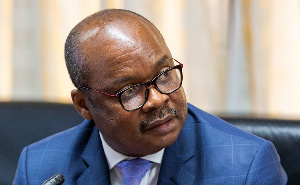
    Governor of the Bank of Ghana (BoG), Dr. Ernest Addison, has urged the International Monetary Fund (IMF) to maintain its zero-interest-rate loans for Ghana and other low-income countries (LICs) via the Poverty Reduction and Growth Trust (PRGT).

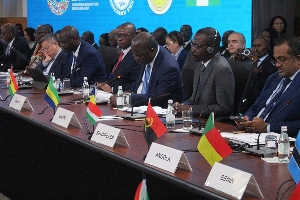
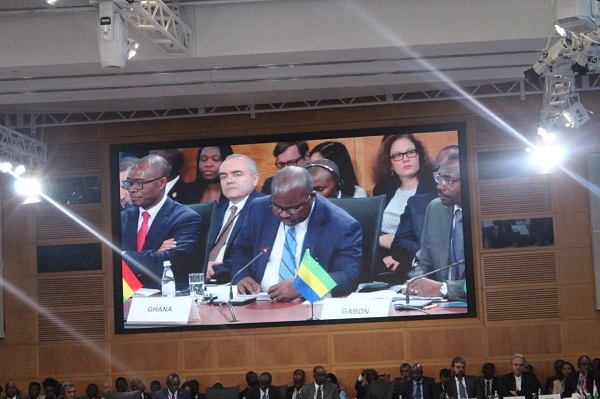
    During the 2024 African Consultative Group (ACG) meeting at the ongoing IMF/World Bank Group Spring Meetings in Washington, US, Dr. Addison stressed the necessity of continuing concessional financing for LICs.

    He emphasized that such financing would complement monetary policies, aiding in curbing inflationary pressures and bolstering economic recovery and resilience in low-income nations.

    Furthermore, Dr. Addison advocated for replenishing the Catastrophe Containment and Relief (CCRT) resources to provide grant support to vulnerable members in regions prone to shocks.

    He reiterated the call for improvements to the G20 Common Framework and utilizing the Global Sovereign Debt Roundtable (GSDR) to facilitate transparent and fair debt resolution, including debt cancellation for the most vulnerable members.

    Dr. Addison underscored the importance of better coordination between the IMF’s LICs facilities review and the World Bank’s IDA21 replenishment efforts to offer comprehensive support to LICs.

    Encouraging African governments to boost domestic financing, Dr. Addison highlighted its necessity amid ongoing economic recovery and resilience efforts on the continent.

    He stressed that while African countries confront multifaceted challenges and a sluggish post-pandemic recovery, relying solely on domestic adjustment policies without adequate financing would yield limited outcomes.

  • Continued drop expected in Ghana’s debt-to-GDP ratio through 2029

    Continued drop expected in Ghana’s debt-to-GDP ratio through 2029

    The IMF’s April 2024 Fiscal Monitor indicates Ghana’s Debt-to-GDP ratio will consistently decrease until 2029.

    Projections, as per a Joy Business report, foresee the ratio dropping to 69.7% by 2029, with estimates for preceding years: 83.6% in 2024, 80.9% in 2025, 77.9% in 2026, 74.9% in 2027, and 72.0% in 2028.

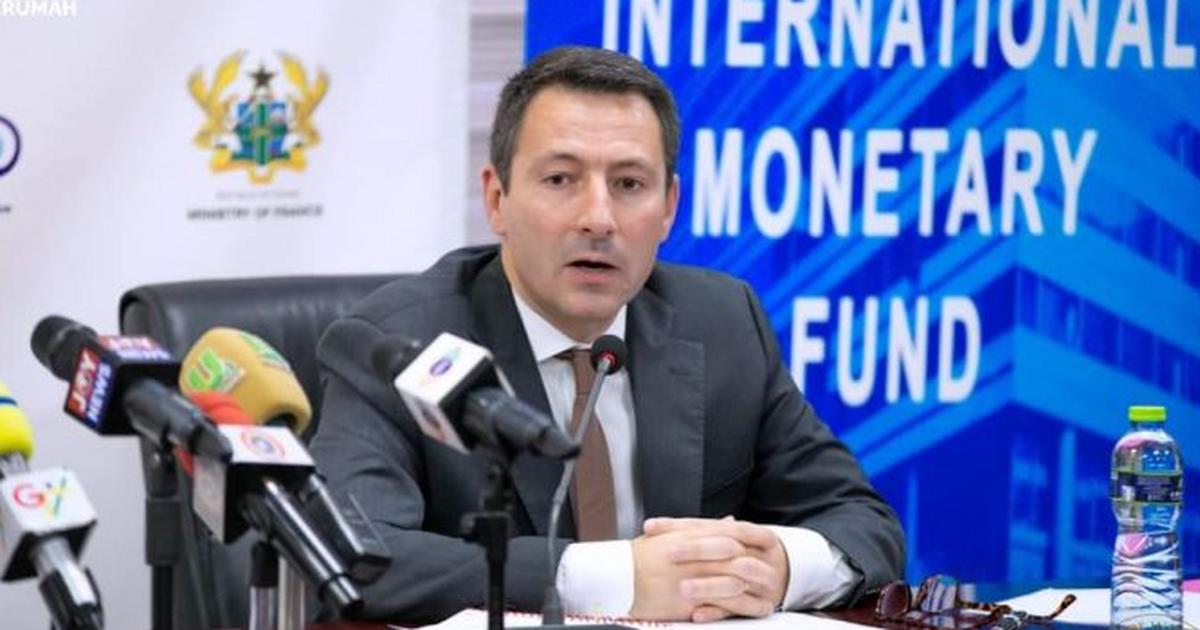
    Earlier IMF assessments highlighted Ghana’s improving fiscal economy, attributed to government policies focusing on stability, sustainability, and inclusive growth, as noted by Stephane Roudet, Mission Chief for Ghana.

    Roudet emphasized the government’s commitment to fiscal discipline, evidenced by improvements in the fiscal primary balance and expansion of social protection programs.

    Ghana also met non-oil revenue mobilization targets and implemented structural fiscal reforms to bolster domestic revenues and enhance transparency.

    Moreover, Ghana secured a Memorandum of Understanding (MoU) from bilateral creditors on debt restructuring, aiming to alleviate financial burdens and save costs alongside domestic debt restructuring efforts.

  • Ghana on track to reach 8% single-digit inflation rate by 2025 – IMF

    Ghana on track to reach 8% single-digit inflation rate by 2025 – IMF

    The International Monetary Fund (IMF) foresees Ghana ending 2025 with single-digit inflation, estimating it at 8%, in line with the government’s objectives.

    Ghana aims to reduce its end-year inflation from 23% to 15% in 2024, further plummeting to single digits by 2025.

    Although Ghana last achieved single-digit inflation in 2021, subsequent years witnessed a drastic rise, hitting a 22-year high of 54.1% despite a targeted rate of 31.9%.

    However, the IMF’s World Economic Outlook Report at the ongoing IMF/World Bank Spring Meetings paints a promising picture.

    This 8% projection credits the robust measures and progress achieved under the IMF program.

    The Bank of Ghana commits to staying within its 2024 end-year target band of 15%, plus or minus two percent, while expecting the disinflation trend to persist, mitigating underlying inflation risks through stringent monetary policies.

    Furthermore, the IMF predicts a robust 4.4% growth for Ghana in 2025, a marked improvement from the 2.8% forecast for 2024. Nevertheless, it anticipates a -2.2% decline in Ghana’s current account balance, reflecting trade and financial activities.

    Despite this setback, the IMF maintains an optimistic outlook, expecting a substantial economic rebound for Ghana in the coming years.

  • Ghana to end 2025 with 8% inflation rate – IMF projects

    Ghana to end 2025 with 8% inflation rate – IMF projects

    The International Monetary Fund (IMF) is projecting that Ghana will achieve single-digit inflation by the end of 2025, with an end-of-year inflation rate of 8 percent.

    The IMF’s Economic Outlook Report also forecasts an end-of-year inflation rate of 15 percent for 2024, which is consistent with the Bank of Ghana’s inflation projection for the same year, according to a JoyBusiness report.

    The projection is based on the measures implemented by the government under the IMF program and the Bank of Ghana’s commitment to maintaining tight monetary measures to address inflation pressures.

    However, there have been no official reasons provided by the IMF for this projection.

    The Bank of Ghana has set an inflation target of 15 percent “Plus 2 or Minus two” for 2024, meaning inflation could range from 13 percent to 17 percent by the end of the year.

    However, there are concerns about whether the government will meet its 15 percent target as projected in the 2024 Budget, especially with recent increases in the prices of petroleum products and the potential hike in transport fares.

    Despite these concerns, Bank of Ghana Governor Dr. Ernest Addison expects inflation to decrease in the coming months, stating that the Bank has no intention of revising its end-of-year target.

    Ghana last recorded single-digit inflation in July 2021. If the IMF’s projection is accurate, Ghana could return to single-digit inflation by the end of 2025.

    Before April 2020, inflation had remained stable at 7.8 percent for three months. However, the onset of the COVID-19 pandemic led to a spike in inflation, reaching 10.6 percent in April before declining to 9.8 percent in November 2020.

    As of March 2024, Ghana’s inflation stood at 25.8 percent, compared to 45.0 percent in March 2023.

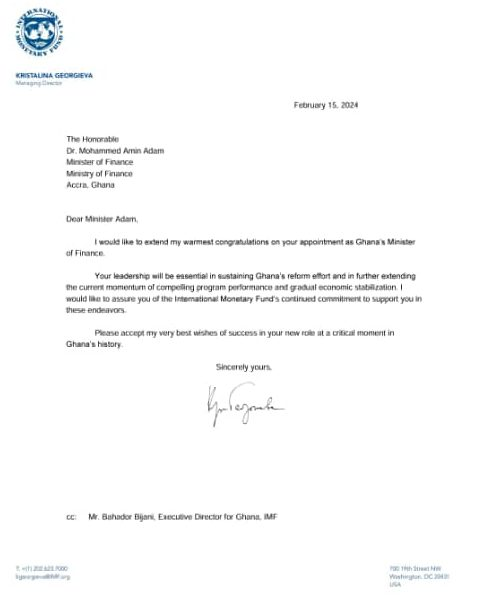
  • Ghanaians wish you well – Akufo-Addo congratulates IMF’s Kristalina for securing 2nd term

    Ghanaians wish you well – Akufo-Addo congratulates IMF’s Kristalina for securing 2nd term

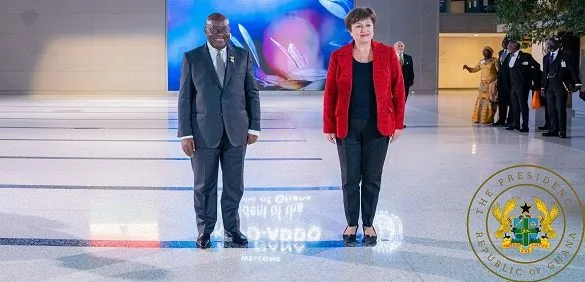
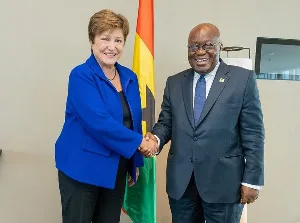
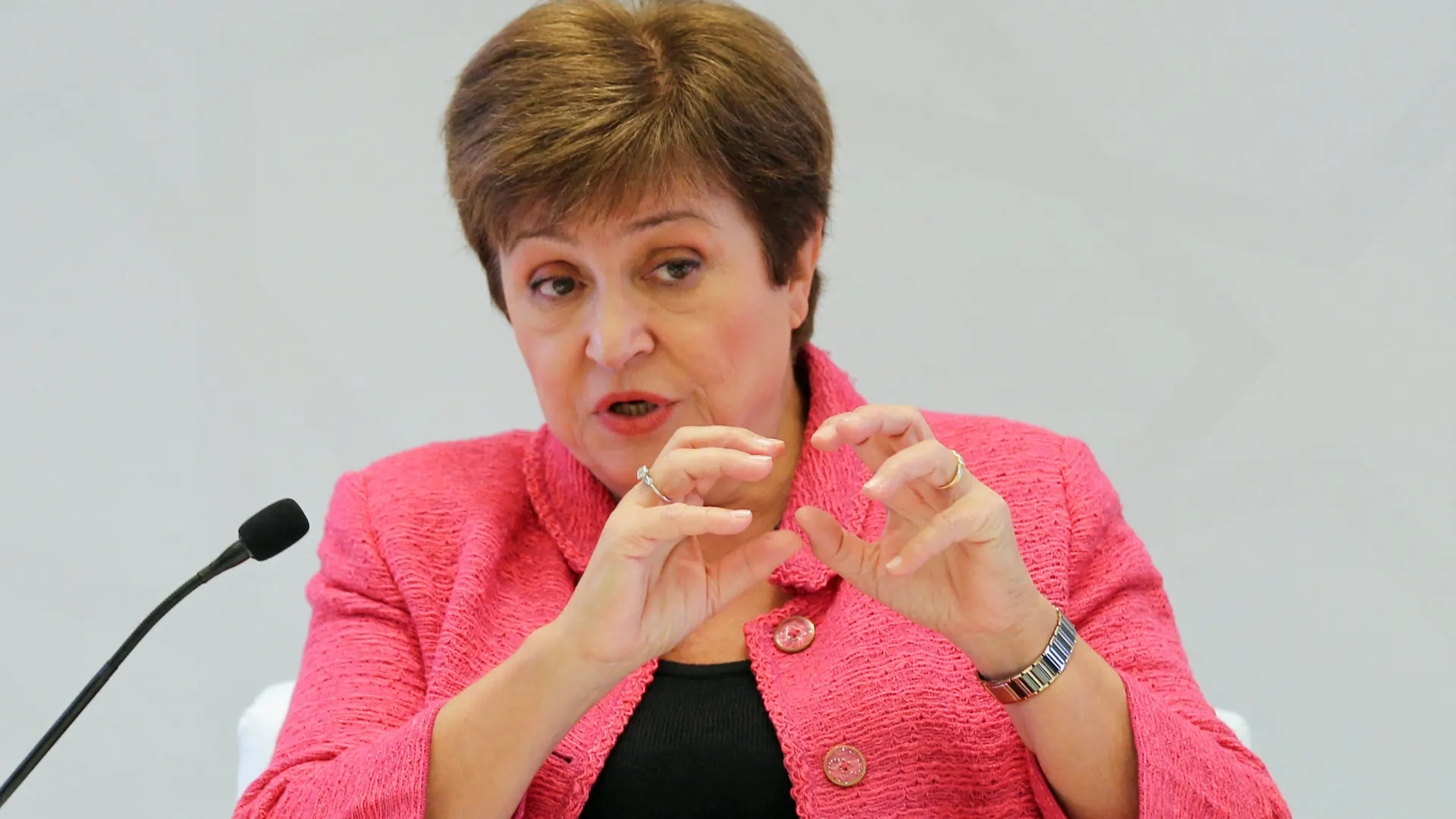
    President Akufo-Addo has extended congratulations to Kristalina Georgieva for securing a second five-year term as IMF Managing Director, commencing on October 1, 2024.

    Ms. Georgieva was the sole candidate nominated for the position, and the Board’s decision was reached following a series of discussions, including with Ms. Georgieva, as per the selection process established on March 13, 2024.

    In a post on social media, President Akufo-Addo expressed Ghana’s delight regarding her re-appointment.

    He noted that her role in ensuring global financial stability and development in general, particularly in Emerging Market and Developing Economies (EMDEs) and Low-Income-Countries (LICs), have impacted greatly lives and livelihoods.

    “We have no doubt that she will make an even greater impact in her second term in helping to eradicate poverty, with ample economic opportunities and jobs, especially for LICs.

    “We, in Ghana, recognise her admirable contributions to our nation’s turnaround to restoring macroeconomic stability and economic recovery, from the difficult economic circumstances of the last few years.

    “We expressed our appreciation directly to her during her recent visit to Ghana. On behalf of the Government and people of Ghana, I congratulate Kristalina Georgieva on her well-deserved re-appointment. We wish her well,” he added.

    Ms. Georgieva has been serving as Managing Director of the IMF since October 1, 2019. In this role, she is the head of the IMF’s operational staff and chairs the Executive Board.

    Ms. Georgieva is supported by four Deputy Managing Directors in overseeing the Fund’s operations, which involve approximately 3,100 staff members.

    A Bulgarian national, Ms. Georgieva has held various prominent positions prior to her role at the IMF. She was previously the Chief Executive Officer of the World Bank from January 2017.

    Additionally, she served as the Interim President for the World Bank Group from February 1, 2019, to April 8, 2019. Ms. Georgieva also has a background in the European Commission, where she held roles such as Commissioner for International Cooperation, Humanitarian Aid, and Crisis Response, as well as Vice President for Budget and Human Resources.

    Ms. Georgieva’s academic qualifications include a Ph.D. in Economic Science and a M.A. in Political Economy and Sociology from the University of National and World Economy in Bulgaria. She also taught at the same university from 1977 to 1991.

  • IMF forecasts Ghana’s economic growth rate to reach 4.4% in 2025

    IMF forecasts Ghana’s economic growth rate to reach 4.4% in 2025


    Ghana’s economic outlook for 2025 is promising, with a projected robust growth rate of 4.4 percent, as forecasted by the International Monetary Fund (IMF).

    This prediction marks a significant increase from the previously projected growth rate of 2.8 percent for 2024.

    The IMF announced this forecast during its latest April World Economic Outlook at the ongoing IMF-World Bank Spring Meetings in Washington DC, USA, underscoring growing optimism about Ghana’s economic trajectory.

    Notably, Ghana’s projected economic growth rate for 2025 surpasses that of some of its counterparts in Sub-Saharan Africa, signaling positive signs of recovery from the economic impacts of unsustainable debt levels, inflationary pressures, and currency volatility following the COVID-19 pandemic.

    However, the IMF anticipates a decline in Ghana’s current account balance, projected at -2.2 percent. Despite this, the IMF maintains a positive outlook for Ghana’s economy, anticipating a rebound in 2025.

    In December 2022, Ghana faced one of its severest economic downturns, defaulting on payments for most of its external debt totaling $30 billion. Consequently, the country was excluded from international capital markets and turned to domestic treasury bill markets for borrowing.

    Under its 17th IMF bailout program, Ghana recently reached a staff-level agreement with the IMF Mission team on April 13, 2024, for a second review, paving the way for a third installment of bailout funds amounting to $360 million.

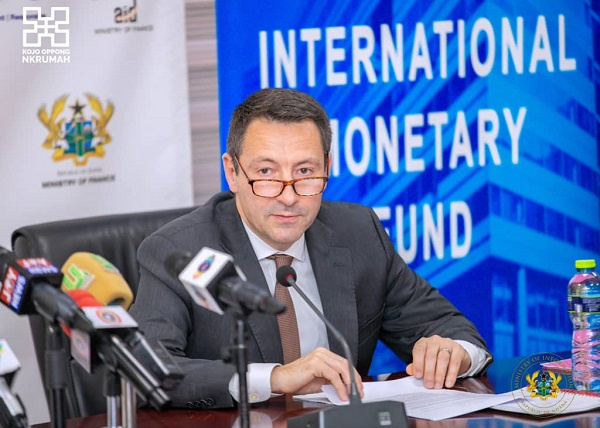
    During a joint press conference held in Accra, IMF Mission Chief to Ghana, Stephane Roudet, urged Ghanaian authorities to negotiate a deal with commercial and bilateral creditors for the IMF Management and Executive Board to approve the next disbursement.

  • Your contributions to Ghana’s economic recovery admirable – Akufo-Addo tells IMF Managing Director

    Your contributions to Ghana’s economic recovery admirable – Akufo-Addo tells IMF Managing Director

    President Akufo-Addo has congratulated Kristalina Georgieva for successfully securing a second five-year term as IMF Managing Director, starting October 1, 2024.

    Ms. Georgieva was the sole candidate nominated for the position.

    The Board’s decision followed a series of discussions, including with Ms. Georgieva, in accordance with the selection process established on March 13, 2024.

    In a post on X, President Akufo-Addo noted that Ghana is very delighted about her re-appointment.

    He noted that her role in ensuring global financial stability and development in general, particularly in Emerging Market and Developing Economies (EMDEs) and Low-Income-Countries (LICs), have impacted greatly lives and livelihoods.

    “We have no doubt that she will make an even greater impact in her second term in helping to eradicate poverty, with ample economic opportunities and jobs, especially for LICs.

    “We, in Ghana, recognise her admirable contributions to our nation’s turnaround to restoring macroeconomic stability and economic recovery, from the difficult economic circumstances of the last few years.

    “We expressed our appreciation directly to her during her recent visit to Ghana. On behalf of the Government and people of Ghana, I congratulate Kristalina Georgieva on her well-deserved re-appointment. We wish her well,” he added.

    Ms. Georgieva has been serving as Managing Director of the IMF since October 1, 2019. In this role, she is the head of the IMF’s operational staff and chairs the Executive Board.

    Ms. Georgieva is supported by four Deputy Managing Directors in overseeing the Fund’s operations, which involve approximately 3,100 staff members.

    A Bulgarian national, Ms. Georgieva has held various prominent positions prior to her role at the IMF. She was previously the Chief Executive Officer of the World Bank from January 2017.

    Additionally, she served as the Interim President for the World Bank Group from February 1, 2019, to April 8, 2019. Ms. Georgieva also has a background in the European Commission, where she held roles such as Commissioner for International Cooperation, Humanitarian Aid, and Crisis Response, as well as Vice President for Budget and Human Resources.

    Ms. Georgieva’s academic qualifications include a Ph.D. in Economic Science and a M.A. in Political Economy and Sociology from the University of National and World Economy in Bulgaria. She also taught at the same university from 1977 to 1991.

  • Kristalina Georgieva gets second term as Managing Director of IMF

    Kristalina Georgieva gets second term as Managing Director of IMF

    The International Monetary Fund (IMF) Executive Board has unanimously chosen Kristalina Georgieva to serve a second five-year term as IMF Managing Director, starting October 1, 2024.

    Ms. Georgieva was the sole candidate nominated for the position.

    The Board’s decision followed a series of discussions, including with Ms. Georgieva, in accordance with the selection process established on March 13, 2024.

    After the meeting, the Executive Board Coordinators, Mr. Afonso S. Bevilaqua and Mr. Abdullah F. BinZarah, issued a statement.

    “In taking this decision, the Board commended Ms. Georgieva’s strong and agile leadership during her term, navigating a series of major global shocks. Ms. Georgieva led the IMF’s unprecedented response to these shocks, including the approval of more than $360 billion in new financing since the start of the pandemic for 97 countries, debt service relief to the Fund’s poorest, most vulnerable members, and a historic Special Drawing Rights (SDR) allocation equivalent to $650 billion. Under her leadership, the Fund introduced innovative new financing facilities, including the Resilience and Sustainability Facility and the Food Shock Window. It replenished the Poverty Reduction and Growth Trust, with the capacity to mobilize concessional loans to its poorest members, and co-created the Global Sovereign Debt Roundtable. It also secured a 50 percent quota increase to bolster the Fund’s permanent resources and agreed to add a third Sub-Saharan African chair to the IMF Board.

    “Looking ahead, the Board welcomes Ms. Georgieva’s ongoing emphasis on issues of macroeconomic and financial stability, while also ensuring that the Fund continues to adapt and evolve to meet the needs of its entire membership. It recognizes her focus on strengthening the Fund’s support to its members through effective policy advice, capacity development and financing. The Board looks forward to continuing to work closely with the Managing Director.”

    Ms. Georgieva has been serving as Managing Director of the IMF since October 1, 2019. In this role, she is the head of the IMF’s operational staff and chairs the Executive Board.

    Ms. Georgieva is supported by four Deputy Managing Directors in overseeing the Fund’s operations, which involve approximately 3,100 staff members.

    A Bulgarian national, Ms. Georgieva has held various prominent positions prior to her role at the IMF. She was previously the Chief Executive Officer of the World Bank from January 2017.

    Additionally, she served as the Interim President for the World Bank Group from February 1, 2019, to April 8, 2019. Ms. Georgieva also has a background in the European Commission, where she held roles such as Commissioner for International Cooperation, Humanitarian Aid, and Crisis Response, as well as Vice President for Budget and Human Resources.

    Ms. Georgieva’s academic qualifications include a Ph.D. in Economic Science and a M.A. in Political Economy and Sociology from the University of National and World Economy in Bulgaria. She also taught at the same university from 1977 to 1991.

  • FULL TEXT: Dr. Ernest Addison’s presentation at 2024 ACG Meeting involving IMF Managing Director Kristalina Georgieva

    FULL TEXT: Dr. Ernest Addison’s presentation at 2024 ACG Meeting involving IMF Managing Director Kristalina Georgieva

    I appreciate the opportunity today to speak on behalf of my fellow Governors about “Bolstering Africa’s Financing through the Overlapping Crises and Beyond.”

    Let me first express my heartfelt gratitude to the Managing Director, Madam Kristalina Georgieva, for your excellent leadership, and your strong support for Africa. Madam MD, Africa continues to face complex challenges against the backdrop of successive shocks, manifesting in a subdued post-pandemic recovery, elevated debt distress, and a persistent funding squeeze, that have amplified income divergences and undermined the achievement of sustainable and inclusive growth.

    My colleague Governors, our domestic adjustment policy efforts without adequate financing can only yield limited results, in the context of the complex domestic and external environment.

    As such, stronger support from the development partners, including the IMF, remains paramount. Considering the low catalytic effect of Fund financing, many of our countries view the countercyclical role of Fund financing as indispensable.

    To this end, Madam Managing Director, we highlight the following points for your consideration:

    First, we view continued pragmatism and agility of IMF’s policies to changing global conditions as paramount to better serve its vulnerable members.

    To this end, we underline the necessity for the upcoming comprehensive review of LICs facilities to maintain the PRGT’s concessionality and promote higher access to reverse erosion amplified by the global inflationary episode. We also underscore the criticality of replenishing the CCRT resources envelope to offer grant support to our most vulnerable members in this shock-prone world.

    Considering the expiry of the Food Shock Window amidst a food crisis triggered by the El Nino phenomenon, Fund emergency financing alongside augmentations in program countries would be important to close climate induced financing gaps. In this regard, we call for intensified fundraising efforts under the second phase of the resource mobilization initiatives.

    Second, we call for meaningful collaboration between the IMF and the World Bank to better align their support to LICs. In this regard, we stress the need for coordination of the IMF’s LIC Facilities Review with the World Bank’s IDA21 replenishment efforts to support LICs in a holistic manner.

    Third, we stress the need to keep all financing options on the table, including the use of the Fund’s internal resources. In view of the recent multiple shocks and a crisis like no other, now is the opportune time for a modest gold sale, particularly when gold prices are still favorable.

    Finally, we restate our request for further enhancements to the G20 Common Framework while leveraging the Global Sovereign Debt Roundtable (GSDR) to promote rapid, transparent, and equitable resolution of debt as well as facilitate debt cancellation for the most vulnerable members. The review of the Fund’s internal debt policies is welcome, but we stress the need to ensure that the changes are impactful and achieve their intended purpose.

    Thank you, Chair and Madam Managing Director.

  • IMF anticipates Ghana to achieve close to a 5% growth rate in 2025

    IMF anticipates Ghana to achieve close to a 5% growth rate in 2025

    International Monetary Fund (IMF) has projected robust growth of 4.4% for Ghana in 2025, marking a significant increase from the 2.8% growth projected for 2024.

    This announcement was made during the IMF’s latest April World Economic Outlook at the ongoing spring meetings in Washington DC, highlighting growing optimism about Ghana’s economic trajectory.

    The IMF’s projection positions Ghana ahead of some major African economies in terms of growth rate for 2025, surpassing the World Bank’s projection of 3.3 percent for the same period.

    Despite facing various economic challenges post-COVID-19, including high debt levels, double-digit inflation rates, and currency volatility, Ghana’s economic prospects remain promising according to the IMF.

    This confidence in Ghana’s economy is attributed to the ongoing IMF program aimed at addressing pressing issues for overall economic recovery.

    Signs of a strong recovery have been noted following Ghana’s participation in the IMF program.

    The latest forecast reflects a 1.6 percent increase from the IMF’s 2024 projection of 2.8 percent, closely aligning with the government’s year-end target.

    However, the IMF anticipates a decline of -2.2 percent in Ghana’s current account balance.

    Despite this, the IMF maintains that the overall outlook for Ghana’s economic growth is set for a significant rebound from next year.

  • Bank of Ghana committed to IMF program amid election challenges

    Bank of Ghana committed to IMF program amid election challenges


    The Bank of Ghana reaffirms its dedication to executing a fruitful IMF-supported program, especially amidst an election period, without encountering setbacks.

    Dr. Ernest Addison, the Governor, acknowledged Ghana’s historical challenges in effectively implementing an IMF-ECF program during election years. However, both the government and the central bank are determined to alter this pattern.

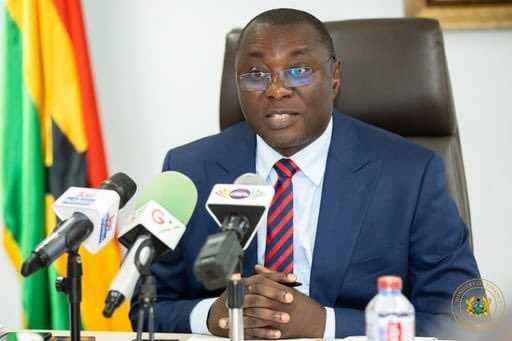
    During a joint press conference involving the IMF, the finance ministry, and the BoG on April 13, 2024, Dr. Addison emphasized this commitment.

    “We recognize the importance of continued macroeconomic stability and an early return to the capital markets, and we will remain committed to ensure that programme implementation stays firm.”

    Across Ghana’s history, election years have typically seen elevated spending as political parties vie for electoral success.

    However, this increased expenditure has notably affected the economy, leading to a downturn, particularly following the 2020 general election.

    Meanwhile, Minister of Finance, Dr. Amin Adam, has provided assurance that despite the current election year, the government remains committed to adhering to the International Monetary Fund’s Post-COVID-19 Programme for Economic Growth (PC-PEG) and the World Bank-supported Development Policy Operations.

  • Amin Adam announces energy sector audit and reforms aligning with IMF-supported program

    Amin Adam announces energy sector audit and reforms aligning with IMF-supported program

    Minister of Finance, Dr. Amin Adam, announced that the government will conduct a comprehensive audit of the energy sector, aligning with Ghana’s current IMF-supported program.

    He emphasized the importance of this audit to ensure regulatory compliance and improve the implementation of the cash waterfall mechanism, aimed at minimizing financial shortfalls.

    During a joint press conference involving the IMF, Bank of Ghana, and Finance Ministry on April 13, the finance minister stated that the government will also reassess the tariff-setting methodology of the Public Utilities Regulatory Commission (PURC) to minimize or eliminate discretionary practices.

    He underscored the significance of enhancing transparency in the tariff-setting process and formula.

    “For the energy sector, in particular, we have discussed the possibility of ensuring that the shortfall in the sector is reduced. The reforms we are pursuing as well as new ones will continue to be implemented.

    “We will, for example, conduct a sector-wide audit of the energy sector, strengthen the implementation of the cash waterfall mechanism, review the PURC tariff setting methodology to reduce or eliminate discretion and also to make the formula and the process of tariff setting more transparent,” the finance minister said.

    Regarding the cocoa sector, Dr. Amin Adam mentioned that the government will persist in overseeing COCOBOD’s cost-cutting reforms designed to enhance the sustainability of the cocoa regulator.

    “On the cocoa sector, we will continue to pay attention to the cost-cutting measures being implemented by COCOBOD as well as continue to rationalise the cocoa road sector to make more resources available to complete ongoing road projects,” Dr Amin Adam said.

    The finance minister affirmed the government’s dedication to executing the IMF-ECF program without deviation, even amidst an election year.

    He emphasized that the government’s objective is to reestablish macroeconomic stability and ensure the economy returns to a solid foundation.

  • IMF set to release $360M to Ghana under extended credit facility

    IMF set to release $360M to Ghana under extended credit facility

    Ghana has secured $360 million from the International Monetary Fund (IMF), pending approval by the Fund’s Board.

    This follows the country’s successful negotiation of a Staff-Level agreement for the second review of the extended credit facility.

    An IMF staff team, led by Stéphane Roudet, Mission Chief for Ghana, conducted meetings in Accra from April 2-12. The purpose of these meetings was to assess progress on reforms and discuss the authorities’ policy priorities within the framework of Ghana’s three-year program under the Extended Credit Facility.

    The IMF Executive Board had approved the arrangement for Ghana, totaling $3 billion, on May 17, 2023.

    At the end of the mission, Mr. Roudet who made the announcement said, “This staff-level agreement is subject to IMF Management approval and Executive Board consideration once the necessary financing assurances have been received.

    “An agreement between the Ghanaian authorities and their official creditors on an MoU for a debt treatment in line with program parameters would provide the needed financing assurances.

    “Upon completion of the Executive Board review, Ghana would have access to about $360 million, bringing the total IMF financial support disbursed under the arrangement since May 2023 to about $1,560 million.”

    The Mission Chief for Ghana added “Performance under the IMF-supported program has been generally strong, with most quantitative targets met. Good progress has also been made on the key structural reform milestones.

    “The authorities’ policies and reforms to restore macroeconomic stability and debt sustainability while laying the foundations for stronger and more inclusive growth are already generating positive results.”

    According to Mr Roudet, “Economic activity in 2023 was more robust than initially envisaged, and growth projections for 2024 will be revised upward. Monetary policy has remained appropriately tight, allowing for inflation to decline rapidly.”

    On the fiscal front, he said, “Consistent with the authorities’ commitments under the IMF-supported program, the fiscal primary balance on a commitment basis improved by over 4 percentage points of GDP in 2023 and is on track to achieve a fiscal primary surplus of ½ per cent of GDP in 2024.

    “Spending has remained within budget limits, while the authorities have significantly expanded social protection programs to help mitigate the impact of the crisis on the most vulnerable.

    “Ghana has met its non-oil revenue mobilisation target while making progress in implementing ambitious structural fiscal reforms to bolster domestic revenues, strengthen public financial and debt management, and enhance transparency.

    “The external sector has improved significantly, with international reserve accumulation ahead of program objectives. Financial stability has been preserved, with banks posting solid profits in 2023.

    The Mission Chief for Ghana stated that, “Given Ghana’s strong progress under the IMF-supported program, the next key step for the country is to reach an agreement with its official bilateral creditors on an MoU consistent with the terms agreed in January 2024.

    “We look forward to the authorities’ continued efforts to reach an agreement with all creditors in line with program parameters.”

    During their visit, the IMF staff held meetings with Finance Minister Dr. Amin Adam, Bank of Ghana Governor Dr. Ernest Addison, and their respective teams, as well as representatives from various government agencies. The team also engaged with other stakeholders.

    The IMF staff team expressed gratitude to the Ghanaian authorities and other counterparts for their ongoing open and constructive engagement.

  • Ghana’s IMF bailout program reaches Staff-Level Agreement for second review

    Ghana’s IMF bailout program reaches Staff-Level Agreement for second review

    IMF Mission staff and Ghanaian authorities have successfully reached a staff-level agreement on economic policies and reforms, marking the conclusion of the second review within the three-year ECF-supported program.

    This development signifies that Ghana is poised to access approximately US$360 million in financing once the review is sanctioned by IMF Management and formalized by the IMF Executive Board.

    The IMF, in a statement released on its website, commended Ghana’s robust policy framework, noting that performance under the program has been generally commendable, with significant achievements in meeting quantitative objectives and implementing pivotal reforms.

    The statement highlighted Ghana’s commendable economic strides, citing higher-than-expected economic growth, declining inflation rates, and notable improvements in fiscal and external positions throughout 2023.

    However, the IMF emphasized the importance of timely completion of the second review, stressing the necessity for Ghana and its official bilateral creditors to reach a consensus on a Memorandum of Understanding (MoU) for debt treatment, aligning with the principles established in January 2024.

    Read the full statement from the IMF below and Mission Head Stéphane Roudet:

    An International Monetary Fund (IMF) staff team, led by Mr. Stéphane Roudet, Mission Chief for Ghana, held meetings in Accra during April 2-12, 2024, to discuss progress on reforms and the authorities’ policy priorities in the context of the second review of Ghana’s three-year program under the Extended Credit Facility. The arrangement was approved by the IMF Executive Board for a total amount of SDR 2.242 billion (US$ 3 billion) on May 17, 2023.

    At the end of the mission, Mr. Roudet issued the following statement:

    “I am pleased to announce that IMF staff and the Ghanaian authorities have reached a staff-level agreement on the second review of Ghana’s economic program under the Extended Credit Facility arrangement. This staff-level agreement is subject to IMF Management approval and Executive Board consideration once the necessary financing assurances have been received. An agreement between the Ghanaian authorities and their official creditors on an MoU for a debt treatment in line with program parameters, would provide the needed financing assurances. Upon completion of the Executive Board review, Ghana would have access to SDR 269.1 million (about US$ 360 million), bringing the total IMF financial support disbursed under the arrangement since May 2023 to SDR 1,171.9 million (about US$ 1,560 million).

    “Performance under the IMF-supported program has been generally strong, with most quantitative targets met. Good progress has also been made on the key structural reform milestones. The authorities’ policies and reforms to restore macroeconomic stability and debt sustainability while laying the foundations for stronger and more inclusive growth are already generating positive results.

    “Economic activity in 2023 was more robust than initially envisaged, and growth projections for 2024 will be revised upward. Monetary policy has remained appropriately tight, allowing for inflation to decline rapidly.

    “On the fiscal front, consistent with the authorities’ commitments under the IMF-supported program, the fiscal primary balance on a commitment basis improved by over 4 percentage points of GDP in 2023 and is on track to achieve a fiscal primary surplus of ½ percent of GDP in 2024. Spending has remained within budget limits, while the authorities have significantly expanded social protection programs to help mitigate the impact of the crisis on the most vulnerable. Ghana has met its non-oil revenue mobilization target, while making progress in implementing ambitious structural fiscal reforms to bolster domestic revenues, strengthen public financial and debt management, and enhance transparency.

    “The external sector has improved significantly, with international reserve accumulation ahead of program objectives. Financial stability has been preserved, with banks posting solid profits in 2023.

    “Given Ghana’s strong progress under the IMF-supported program, the next key step for the country is to reach an agreement with its official bilateral creditors on an MoU consistent with the terms agreed in January 2024. We look forward to the authorities’ continued efforts to reach an agreement with all creditors in line with program parameters.”

    IMF staff held meetings with Finance Minister Adam, Bank of Ghana Governor Addison, and their teams, as well as representatives from various government agencies. The IMF team also engaged with other stakeholders. The IMF staff team would like to express their gratitude to the Ghanaian authorities and other counterparts for their continued open and constructive engagement.

  • 25.8% inflation rate in March won’t disrupt disinflation trend – Analyst

    25.8% inflation rate in March won’t disrupt disinflation trend – Analyst

    Head of Research at GBC Capital, Courage Boti, has described the recent surge in inflation in March as “not surprising” and assures that it does not pose a significant threat to the ongoing trend of disinflation.

    Data from the Ghana Statistical Services (GSS) indicates that consumer inflation soared to 25.8 percent in March 2024, the highest level since November of the previous year.

    This increase, up from 23.2 percent in February 2024, is attributed largely to base drift effects resulting from a sharp price decline in March 2023.

    Despite the uptick, Mr Boti remains unfazed, stating, “It is an increase but I am not surprised. My expectation was 26 percent. Will this be a trend that continues? Admittedly, there are upside risks to inflation, but from April we should begin to see a return to the path of disinflation. The exchange rate, petroleum price and impending transportation price hikes will serve to moderate the pace of disinflation but we expect that without any significant shocks. The general trend is that there will be a continuous decline in inflation”.

    He anticipates a return to the disinflation path from April onwards, citing factors such as exchange rate stability, petroleum price moderation, and anticipated transportation price adjustments.

    Boti projects that inflation will close the year at under 20 percent, attributing this to factors such as adherence to fiscal discipline under the International Monetary Fund (IMF) program and a potential decrease in liquidity and Treasury bill yields due to recent cash reserve requirements by the Bank of Ghana.

    Government Statistician, Professor Samuel Kobbina Annim, while acknowledging the broad-based nature of the inflation surge, particularly in food prices, emphasizes that the increase cannot solely be attributed to imported food.

    Both food and non-food prices experienced a 2.6 percentage point increase in March, indicating widespread inflationary pressures.

    Market analysts had anticipated the rise in inflation, citing ongoing cedi weakness and recent hikes in ex-pump petroleum prices as contributing factors. Despite this, the month-on-month inflation rate declined from 1.6 percent in February to 0.8 percent in March, suggesting potential easing of underlying inflationary pressures.

    GCB Capital maintains its end-2024 inflation forecast at 16.5 percent ±1 percent, expecting the disinflation trend to resume from April 2024.

    “If you look at the food that is imported, out of the 176 items that recorded price changes higher than 25.8 percent, we had 15.9 percent of the food that is imported relative to food that is local, which constituted 23.3 percent.

    “So one cannot argue that imported food is driving the 29.6 percent that we are seeing in March 2024, because we are equally seeing that local food constituted about 41 of the 176 items that recorded price changes higher than 25.8 percent,” he said.

    “What is coming to us for the first time in a while is a division like health that hitherto we would hardly find it as a division that will record a rate of inflation higher than the overall rate of inflation,” Prof. Annim observed.

    “But we are now seeing health coming up as one of the six divisions that are pointing to the higher rate of inflation.”

    “We, however, flag the simmering cedi depreciation amid immediate liquidity concerns and its potential pass through to ex-pump fuel prices in the wake of the lingering crude oil supply concerns due to geopolitics as an immediate upside risk to inflation through the transport channel and general market prices,” said GCB Capital in its March review of the inflation data.

    “What we need to pay emphasis, what we need to pay attention to is year-on-year and month-on-month inflation moving in different directions as we rightly saw for the second time; we are seeing a dip in month-on-month inflation,” Prof. Annim explained.

    “All this would have implications in the coming months in terms of how the month-on-month inflation would feed into the year-on-year inflation.”

    The data revealed that both food and non-food prices saw a 2.6 percentage point increase in March, suggesting broad-based inflationary pressures. Notably, the health sector emerged as one of the six divisions recording inflation rates higher than the national average.

    However, analysts remain cautious about potential fiscal overruns leading up to the 2024 election, which could pose an upside risk to inflation in the latter part of the year.
  • A ‘lazy man’s approach – IEA Director blasts Ghana’s reliance on IMF, World Bank to fortify the Cedi

    Director of Research at the Institute of Economic Affairs (IEA),Dr. John Kwakye, criticised the government’s heavy reliance on foreign aid to support the local currency during a press briefing at the IEA headquarters.

    He raised concerns about the sustainability of Ghana’s economic strategy, particularly its dependence on funds from institutions like the International Monetary Fund (IMF) and the World Bank, labeling this approach as a “lazy man’s approach.”

    Dr. Kwakye highlighted the risks associated with such borrowing, including Eurobonds and cocoa syndicated loans, and warned of increased pressure on the Ghanaian cedi when these loans come due for repayment.

    Citing statistics from the recent Monetary Policy Committee meeting of the Bank of Ghana (BoG), he noted that the Cedi depreciated by 6.8 percent against the US dollar in the year leading up to March 20, 2024.

    “The Governor admitted that the foreign exchange market came under some pressure, both seasonal and non-seasonal, in February and early March. He reported that in the year to March 20, 2024, the Ghana cedi recorded a depreciation of 6.8 percent against the US dollar. He, however, stated that the cedi “continues to recover its value.” But the question is, by what measure?

    “Certainly, not in nominal terms, because since he spoke on 25th March, the cedi has continued to depreciate, reaching nearly GH¢13 to the dollar. Let us repeat right here that relying on funds from the IMF, World Bank, Eurobonds, cocoa syndicated loans, etc. to bolster the cedi, as we have been doing, is not only a lazy man’s approach. To say the least but also clearly unsustainable, as the pressure would be back on when the loans fall due for repayment.”

    “The way to stabilise the cedi on a durable basis is to increase our FX earnings through greater ownership of, and value addition to, our natural resources, to reduce our import demand through domestic industrialization and to entrench fiscal and monetary discipline,” citinewsroom.com quoted him to have said during the press briefing.

  • IMF staff arrives in Ghana for 2nd review of $3bn economic recovery program

    IMF staff arrives in Ghana for 2nd review of $3bn economic recovery program

    Ghana is under the IMF’s scrutiny as its team commences the second review of the $3 billion economic recovery program post-COVID-19, starting April 2, 2024, following the successful completion of the first review in January.

    Over the next two weeks, the IMF staff will evaluate Ghana’s progress towards program goals, particularly focusing on economic recovery, fiscal management, and reforms.

    The outcome of this review holds significant importance for Ghana’s economy and its relationship with global financial institutions. The government is optimistic about passing the review to unlock the third tranche of IMF funds worth $360 million by June.

    This marks the second review since the program’s inception and the first of two expected this year, with the next review scheduled for November 2024.

    Despite challenges in debt restructuring with creditors, Ghana is making strides, aiming to secure the third tranche of $360 million, adding to the $1.56 billion disbursed so far.

    During their visit, the IMF team will engage with the President, government officials, the Central Bank, and civil society groups. Both the Finance Minister and the Bank of Ghana Governor have affirmed the government’s unwavering commitment to the program.

    The IMF mission will conclude on April 12, 2024, following which the team will return to Washington DC. The report will then undergo review by the IMF Board for approval.

  • IMF staff in Ghana to discuss second review of programme, release of 3rd tranche

    IMF staff in Ghana to discuss second review of programme, release of 3rd tranche

    Ghana is undergoing its second review of the three-year, $3 billion IMF-supported post-COVID-19 Programme for Economic Growth (PC-PEG).

    Starting on Tuesday, April 2, 2024, this review follows the successful completion of the first review in January.

    Over the weekend, IMF mission staff arrived in the country to assess Ghana’s performance against the program’s objectives. This evaluation will last for two weeks.

    During this period, Ghana’s adherence to the prescribed programme objectives will be closely scrutinized, focusing on areas such as economic recovery, fiscal management, and structural reforms.

    The outcome of this review will significantly impact Ghana’s economic trajectory and its relationship with international financial institutions.

    The government has expressed confidence in passing this review, hoping to meet all structural targets to unlock the third tranche of IMF cash of $360 million by the end of June.

    This round of assessment by the IMF is the second programme review after the bailout was finalized, and the first of the two reviews expected this year.

    The next review for 2024 is scheduled for November.

    The IMF team will assess the qualitative and quantitative targets after the second tranche facility was released to the country for budgetary support.

    However, this is happening despite the challenges the government faces in reaching an agreement with its bilateral and commercial creditors for the restructuring of external debts.

    Although the government has made progress in negotiations, it remains optimistic about securing the third tranche of $360 million, bringing the total disbursements to about $1.56 billion so far.

    During the visit, the IMF will meet with the President, government and Central Bank officials, and civil society organizations, among others.

    Finance Minister Dr. Mohammed Amin Adam and Bank of Ghana Governor Dr. Ernest Addison have both assured that the government is prepared to stay the course.

    The IMF mission staff will conclude on Friday, April 12, 2024, after which they will return to Washington DC with their status report subject to the approval of the IMF Board.

  • Release of $360m dependent on success of second review by IMF – Dr Mohammed Amin

    Release of $360m dependent on success of second review by IMF – Dr Mohammed Amin

    Finance Minister-designate, Dr Mohammed Amin Adam, has noted that the approval of the 2nd Review by the IMF Executive Board, expected in June 2024, would lead to the release of the third tranche of US$360 million.

    Ghana received $600 million from the Fund in the first and second tranches respectively. This would bring the total disbursements under the programme to US$1.56 billion.

    According to him, the next two reviews of Ghana’s US$3bn International Monetary Fund (IMF)-supported Post Covid-19 Programme for Economic Growth (PC-PEG) will take place in the second and fourth quarters of the year.

    “The 3rd Review has been programmed for November 2024,” he added.

    While engaging the press today, the minister-designate reported substantial strides in meeting the objectives set out IMF programme.

    “The Ministry of Finance is working with the BoG in preparation for the IMF 2nd Review Mission. Preliminary assessment undertaken by MoF and BoG shows that we are on course to meet most of the targets under the Programme.”

    This comes after the successful completion of the first review of the IMF programme on January 19, 2024.

    “During the 2nd Review, the IMF mission will engage the authorities in technical and policy discussions to enable them to assess Ghana’s performance on programme objectives, the 6 Quantitative Performance Criteria (QPCs), the 3 Indicative Targets (ITs), 1 Monetary Policy Consultation Clause (MPCC), and the Structural Benchmarks (SBs) with respect to end Dec 2023 targets. They will also review performance towards upcoming QPCs, ITs, and SBs,” he added.

  • “We are on course to meet most of the targets under IMF programme” – Mohammed Amin

    “We are on course to meet most of the targets under IMF programme” – Mohammed Amin

    Finance Minister-designate, Dr. Mohammed Amin Adam, has reported substantial strides in meeting the objectives set out in the 3-year, US$3bn International Monetary Fund (IMF)-supported Post Covid-19 Programme for Economic Growth (PC-PEG).

    The ministerial appointee made this known on Tuesday while engaging the press.

    “The Ministry of Finance is working with the BoG in preparation for the IMF 2nd Review Mission. Preliminary assessment undertaken by MoF and BoG shows that we are on course to meet most of the targets under the Programme.”

    Dr. Amin Adam also highlighted that the Ministry is working closely with the Bank of Ghana (BoG) to ready for the International Monetary Fund’s (IMF) second review mission, slated for April 2 to 12.

    This comes after the successful completion of the first review of the IMF programme on January 19, 2024.

    “During the 2nd Review, the IMF mission will engage the authorities in technical and policy discussions to enable them to assess Ghana’s performance on programme objectives, the 6 Quantitative Performance Criteria (QPCs), the 3 Indicative Targets (ITs), 1 Monetary Policy Consultation Clause (MPCC), and the Structural Benchmarks (SBs) with respect to end Dec 2023 targets. They will also review performance towards upcoming QPCs, ITs, and SBs,” he added.

    The minister-designate emphasized that the approval of the 2nd Review by the IMF Executive Board, expected in June 2024, would lead to the release of the 3rd tranche of US$360 million. This would bring the total disbursements under the programme to US$1.56 billion.

    “The 2nd Review will be the first of the two semi-annual reviews programmed for 2024. The 3rd Review has been programmed for Nov 2024,” he added.

  • Second and third reviews of Ghana’s IMF programme slated for June and November – Mohammed Amin

    Second and third reviews of Ghana’s IMF programme slated for June and November – Mohammed Amin

    Finance Minister-designate, Dr. Mohammed Amin Adam, has noted that the next two reviews of Ghana’s US$3bn International Monetary Fund (IMF)-supported Post Covid-19 Programme for Economic Growth (PC-PEG) will take place in the second and fourth quarters of the year.

    The minister-designate emphasized that the approval of the 2nd Review by the IMF Executive Board, expected in June 2024, would lead to the release of the 3rd tranche of US$360 million.

    This would bring the total disbursements under the programme to US$1.56 billion.

    “The 3rd Review has been programmed for November 2024,” he added.

    While engaging the press today, the minister-designate reported substantial strides in meeting the objectives set out IMF programme.

    “The Ministry of Finance is working with the BoG in preparation for the IMF 2nd Review Mission. Preliminary assessment undertaken by MoF and BoG shows that we are on course to meet most of the targets under the Programme.”

    This comes after the successful completion of the first review of the IMF programme on January 19, 2024.

    “During the 2nd Review, the IMF mission will engage the authorities in technical and policy discussions to enable them to assess Ghana’s performance on programme objectives, the 6 Quantitative Performance Criteria (QPCs), the 3 Indicative Targets (ITs), 1 Monetary Policy Consultation Clause (MPCC), and the Structural Benchmarks (SBs) with respect to end Dec 2023 targets. They will also review performance towards upcoming QPCs, ITs, and SBs,” he added.

  • Ghana tops African countries in Concessional Lending debt to  IMF

    Ghana tops African countries in Concessional Lending debt to IMF

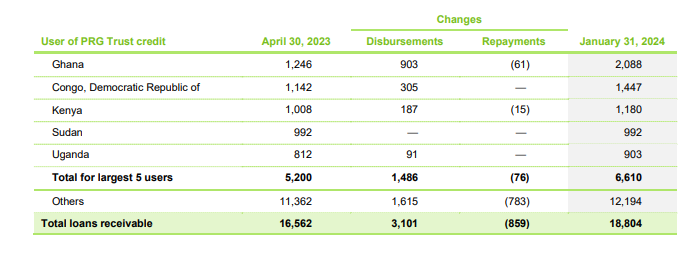
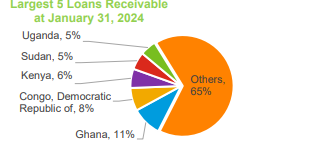
    As of January 31, 2024, Ghana retained its position as the foremost debtor to the International Monetary Fund (IMF) in Africa concerning Concessional Lending and Debt Relief Trust.

    The country’s indebtedness to the Fund amounted to 2.088 billion Special Drawing Rights, equivalent to $2.77 billion.

    According to the IMF’s Quarterly Finances for January 2024, Ghana’s outstanding concessional loans to the institution had increased compared to the figures recorded in July 2023. This surge followed Ghana’s receipt of a $600 million bailout package from the IMF in both June 2023 and January 2024, aimed at revitalizing its economy amid prevailing economic challenges.

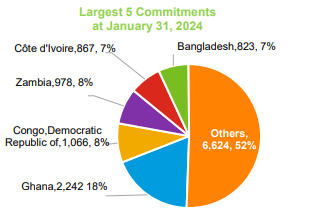
    Ghana’s concessional loan outstanding to the IMF represented 11.0% of Africa’s total indebtedness to the tune of SDR 18.804 billion. Additionally, Ghana demonstrated a commitment to debt repayment by remitting SDR 61 million, equivalent to $81.13 million, to the IMF.

    The loans extended to Ghana by the IMF fall under concessional lending, featuring low-interest financing. Specifically, the PRG Trust offers loans under concessional terms to qualifying low-income member nations.

    Meanwhile, the Democratic Republic of Congo and Kenya maintained their positions as the second and third-largest debtors to the IMF in Africa, respectively, as of January 1, 2024.

  • Brace yourself, economic reforms will be painful – IMF urges Ghanaians

    Brace yourself, economic reforms will be painful – IMF urges Ghanaians

    The International Monetary Fund (IMF) has indicated that Ghana’s journey to economic stability will be challenging but remains hopeful about the country’s ability to overcome current difficulties.

    The IMF has advised Ghanaians to manage their expectations of the government and continue to make sacrifices as the country implements its US$3 billion loan-support program.

    Following the COVID-19 pandemic, Ghana’s economy has faced challenges, leading the government to introduce several taxes and levies, including a COVID-19 Health Recovery levy, Electronic Transactions Levy (E-levy), and Sanitation and Pollution levy.

    Recently, the government announced a 15 percent Value Added Tax (VAT) on residential electricity consumption and an emissions levy as part of its revenue generation efforts.

    However, the announcement sparked public outrage, prompting the government to suspend the taxes for discussions with the IMF on the way forward.

    During a media engagement as part of her first visit to Ghana, Ms. Kristalina Georgieva, Managing Director of the IMF, urged Ghanaians to support the government’s “painful reforms.”

    She expressed optimism that Ghana’s ongoing reforms would ultimately benefit its citizens.

    Recounting the experience of her country some three decades ago, Ms Georgieva said, “My own country [Bulgaria] in the 90s went through a much more severe collapse.

    “Here [in Ghana], we’re talking about inflation of about 54 per cent. Inflation in Bulgaria was over 1000 per cent, and the measures to bring back macroeconomic measures were extremely painful,” she said.

    She mentioned that she was in discussions with the government to ensure that the implemented policies are beneficial and aid in reducing the country’s debt levels while solidifying macroeconomic gains.

    “We understand that the people in Ghana have been impacted and for the low-income household, any additional cost is a problem that is very difficult to bear. We have to look at the fiscal position of government, there are different measures that we can adopt to achieve this,” Ms Georgieva stated.

    She observed that Ghana’s current economic challenges, while not dramatic, necessitated the government’s steadfast focus on implementing the loan-support program.

    The IMF Managing Director emphasized that with strong economic fundamentals, sound macroeconomic policies, good governance, and minimal corruption, Ghana could achieve a resilient economy and a high standard of living.

    She urged the government to prioritize reducing expenditure, increasing revenue generation, and investing more in education and infrastructure development nationwide.

    “What we know is that the government cannot spend more than it generates, and it’s much better to spend money on education and infrastructure than for debt service,” Ms Georgieva said.

    Ghana is currently executing a three-year US$3 billion Extended Credit Facility (ECF) program with the IMF as part of the country’s Post-COVID-19 Programme for Economic Growth (PC-PEG).

    The program’s objectives include restoring macroeconomic stability and debt sustainability, enhancing resilience, and establishing a basis for more robust and inclusive growth.

    To date, Ghana has received US$1.2 billion in two installments from the IMF and is slated to conduct a second review of the program’s implementation in April 2024.

  • Check excessive spending by establishing fiscal council – IMF tells gov’t

    Check excessive spending by establishing fiscal council – IMF tells gov’t

    Managing Director of the International Monetary Fund (IMF), Kristalina Georgieva, has called for the creation of a fiscal council in Ghana to protect macroeconomic stability and ensure responsible management of government fiscal policy.

    During an interview on Citi TV’s Point of View with Bernard Avle, Georgieva stressed the significance of having an independent and credible fiscal council to advise the government on avoiding excessive spending.

    “We do need to have anchors and then stick to that. Yes, the two notes of caution. One, we do need to have anchors and then stick to them. For Ghana, what we are proposing is 55% net present value debt to GDP and 18% max the share of debt service into government revenues. Anchor your situation in a clear, stable manner.

    “And two, we recommend that Ghana takes a very serious look at how the fiscal situation in the future can be stable. So we don’t go up and down again. And we are recommending fiscal council, reputable people, independent, able to say objectively this line of spending, yes and this one, no.”

    Ghana is now close to signing a Memorandum of Understanding (MoU) with bilateral creditors as part of the restructuring of debts owed to these lenders.

    Ghana after defaulting on most of its overseas debt in December 2022 after servicing costs soared, has restructured most of its local debt and is pushing for a deal with holders of about $13 billion in international bonds.

    Ghana’s economy has started to recover since the government last year secured a $3 billion loan programme with the IMF, and in January reached a deal to restructure $5.4 billion of loans with its official creditors.

  • Accept LGBTQ community and Ghana will flourish – IMF Boss

    Accept LGBTQ community and Ghana will flourish – IMF Boss

    Managing Director of the International Monetary Fund (IMF), Kristalina Georgieva, has emphasized the significance of inclusive society, particularly in response to Ghana’s Parliament passing the anti-LGBTQ bill.

    Speaking on the Point of View with Bernard Avle on Monday, March 18, she voiced support for a community that embraces all irrespective of their sexual orientation, race, ethnicity, while insisting that greater inclusivity contributes to a nation’s overall success.

    “I understand that people in Ghana have taken the bill to the court. All I can say is that a more inclusive society is a more successful society. You want Ghana to flourish, make it so that everybody can contribute to the fullest of this country.”

    On Wednesday, February 28, Parliament unanimously passed the anti-LGBTQ+ bill after completing the third reading. The bill has been a subject of intense debate and discussion since its introduction to the legislature three years ago.

    Proponents argue that it is necessary to uphold cultural and religious values, while opponents argue that certain provisions violate human rights and promote discrimination.

    Since its passage, many opponents have expressed their displeasure, with some civil society groups threatening legal action should President Akufo-Addo assent to the bill for it to become law.

    President Akufo-Addo has withheld his accent as the constitutionality of the bill is being contested at the Supreme Court.

    On the show, the IMF boss attributed Ghana’s recent economic challenges to a combination of factors, including the impact of the COVID-19 pandemic and fiscal imprudence during the 2020 election period.

    Georgieva emphasized the importance of drawing lessons from past experiences and applying them to future policy-making.

    She underscored the effectiveness of robust macroeconomic and financial governance in navigating economic uncertainties.

    Georgieva stressed the necessity of implementing strong fiscal and monetary strategies capable of withstanding global financial pressures and fostering sustainable growth.

    “The best avenue to pursue that is to get your policies in good order, get your institutions to deliver transparently for the economy for people. Nothing is more effective than strong macroeconomic and financial performance in a country.

    “We have seen in Ghana, yes it was the COVID-19 shock that brought so much hardship on people. But it was also the excessive spending during the general elections period. Learn lessons from the past, apply for the future,” she quoted by Citinewsroom.com to have said.

  • An inclusive society will make Ghana flourish – IMF boss on anti-LGBTQ bill

    An inclusive society will make Ghana flourish – IMF boss on anti-LGBTQ bill

    Kristalina Georgieva, Managing Director of the International Monetary Fund (IMF), has emphasized the significance of inclusivity, particularly in response to Ghana’s Parliament passing the anti-LGBTQ bill.

    Speaking on the Point of View with Bernard Avle on Monday, March 18, she voiced support for a more inclusive society, highlighting that greater inclusivity contributes to a nation’s overall success.

    “I understand that people in Ghana have taken the bill to the court. All I can say is that a more inclusive society is a more successful society. You want Ghana to flourish, make it so that everybody can contribute to the fullest of this country.”

    On Wednesday, February 28, Parliament unanimously passed the anti-LGBTQ+ bill after completing the third reading. The bill has been a subject of intense debate and discussion since its introduction to the legislature three years ago.

    Proponents argue that it is necessary to uphold cultural and religious values, while opponents argue that certain provisions violate human rights and promote discrimination.

    Since its passage, many opponents have expressed their displeasure, with some civil society groups threatening legal action should President Akufo-Addo assent to the bill for it to become law.

    President Akufo-Addo has withheld his accent as the constitutionality of the bill is being contested at the Supreme Court.

    On the show, the IMF boss attributed Ghana’s recent economic challenges to a combination of factors, including the impact of the COVID-19 pandemic and fiscal imprudence during the 2020 election period.

    Georgieva emphasized the importance of drawing lessons from past experiences and applying them to future policy-making.

    She underscored the effectiveness of robust macroeconomic and financial governance in navigating economic uncertainties.

    Georgieva stressed the necessity of implementing strong fiscal and monetary strategies capable of withstanding global financial pressures and fostering sustainable growth.

    “The best avenue to pursue that is to get your policies in good order, get your institutions to deliver transparently for the economy for people. Nothing is more effective than strong macroeconomic and financial performance in a country.

    “We have seen in Ghana, yes it was the COVID-19 shock that brought so much hardship on people. But it was also the excessive spending during the general elections period. Learn lessons from the past, apply for the future,” she quoted by Citinewsroom.com to have said.

  • Leave COVID-19, uncontrolled spending during 2020 elections worsened Ghana’s economic crisis – IMF

    Leave COVID-19, uncontrolled spending during 2020 elections worsened Ghana’s economic crisis – IMF

    Kristalina Georgieva, Managing Director of the International Monetary Fund (IMF), has attributed Ghana’s recent economic challenges to a combination of factors, including the impact of the COVID-19 pandemic and fiscal imprudence during the 2020 election period.

    Speaking on the Point of View with Bernard Avle on Monday, March 18, Georgieva emphasized the importance of drawing lessons from past experiences and applying them to future policy-making.

    She underscored the effectiveness of robust macroeconomic and financial governance in navigating economic uncertainties.

    Georgieva stressed the necessity of implementing strong fiscal and monetary strategies capable of withstanding global financial pressures and fostering sustainable growth.

    “The best avenue to pursue that is to get your policies in good order, get your institutions to deliver transparently for the economy for people. Nothing is more effective than strong macroeconomic and financial performance in a country.

    “We have seen in Ghana, yes it was the COVID-19 shock that brought so much hardship on people. But it was also the excessive spending during the general elections period. Learn lessons from the past, apply for the future,” she quoted by Citinewsroom.com to have said.

    Georgieva also emphasized the significance of inclusivity, particularly in response to Ghana’s Parliament passing the anti-gay bill.

    She voiced support for a more inclusive society, highlighting that greater inclusivity contributes to a nation’s overall success.

    “I understand that people in Ghana have taken the bill to the court. All I can say is that a more inclusive society is a more successful society. You want Ghana to flourish, make it so that everybody can contribute to the fullest of this country.”

  • Keep reducing inflation, making progress in debt restructuring – IMF tells Ghana

    Keep reducing inflation, making progress in debt restructuring – IMF tells Ghana

    The International Monetary Fund (IMF) has emphasized the importance of fiscal prudence and economic reforms for Ghana’s long-term prosperity.

    Managing Director of IMF, Kristalina Georgieva, highlighted the need to build on the progress achieved under the three-year, three billion-dollar extended credit facility. She emphasized the importance of promoting inclusive growth through these measures.

    “Your growth is better expected, your inflation is lower than expected, the progress in debt restructuring has been faster than expected and now the task is to cement what has been achieved and do it with the unity of this country”.

    During a meeting with President Akufo-Addo, Madam Georgieva acknowledged the strength of Ghana’s economy but cautioned the government to remain vigilant to maintain the ongoing recovery.

    “It is the year to bring confidence in Ghana domestically and internationally at the level it was before. It is possible because we are seeing a world slightly better, so the economic attributes are better, and the critical resource of money will go where confidence in the capacity to perform is highest. So Ghana can be in this place, as it was before. We need to stay the course, Ghana has achieved in a short time of the programme – good indicators”, she stressed.

    President Akufo-Addo highlighted the positive outcomes of Ghana’s decision to seek a balance of payment support from the International Monetary Fund (IMF).

    He credited the recent decline in inflation and the stability of the local currency to the IMF support programme, expressing satisfaction with the results of the bailout.

    The President emphasized that despite challenging economic circumstances, the decision to seek IMF support in July 2022 had proven beneficial and contributed to a noticeable turnaround in Ghana’s economy.

    “The dire circumstances in which we were at the time that we took that very difficult decision and where we are today is a very clear testimony that our decision to seek your support is a decision that was correct, and we have had some benefits from it”, the President pointed out.

  • IMF bailout has been beneficial to Ghanaians – Akufo-Addo

    IMF bailout has been beneficial to Ghanaians – Akufo-Addo

    President Akufo-Addo has stated that Ghana’s decision to seek assistance from the International Monetary Fund (IMF) is yielding positive results.

    He emphasized that the conditions under which Ghana entered the program are steadily improving, and the country remains committed to adhering to the program’s terms.

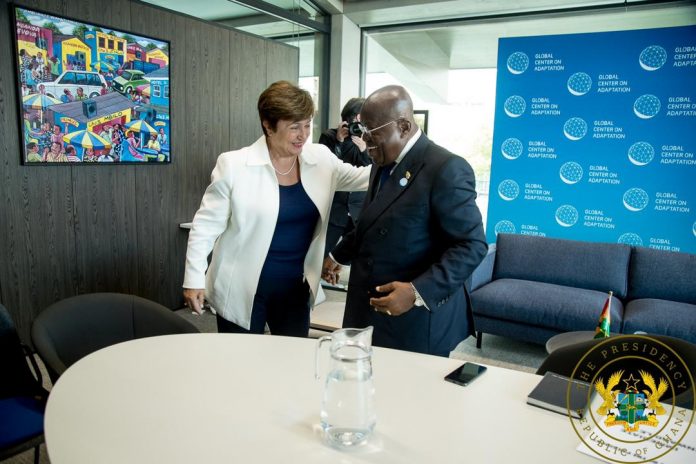
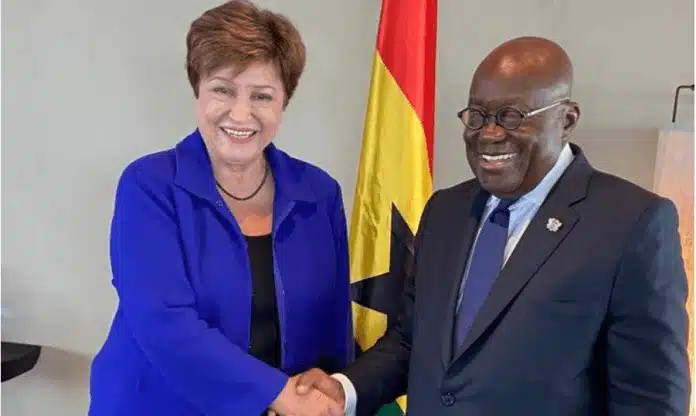
    These remarks were made by the President during a meeting with the head of the IMF, Kristalina Georgieva, who visited him in Accra on Sunday.

    “The decision we made in July 2022 to come and seek your support for the difficult economic circumstances that we had, as far as I am concerned, is a decision that already has paid off.

    “It has paid off in terms of a clear turnaround that we are seeing in our economy,” President Akufo-Addo stated.

    He also emphasized that Ghana has reaped significant benefits from its engagement with the IMF.

    “The dire circumstances in which we were, at the time that, we took that very difficult decision and where we are today, is a very clear testimony that our decision to seek your support is a decision that was correct, and we have had some benefits from it,” he added.

    During the meeting, IMF chief Kristalina Georgieva remarked that investor confidence in Ghana’s economy is slowly rebounding.

    In 2023, Ghana secured a $3 billion IMF extended credit facility (ECF) after then Minister of Finance, Ken Ofori-Atta, was authorized by President Akufo-Addo on July 1, 2022, to commence formal negotiations with the IMF to secure a balance of payment support and resolve Ghana’s economic crisis impacted by the COVID-19 pandemic and the geopolitical armed conflict between Russia and Ukraine.

    Ghana’s three-year-IMF programme is in its first year of implementation, with the nation so far, receiving a total of $1.2 billion from the IMF in two payment tranches of $600 million each.

    It is expected that during Madam Georgieva’s stay in Ghana, the IMF and the government officials will be seeking ways through which they can consolidate collaboration to see Ghana through her current programme with the Fund.

  • Our decision to seek IMF support in 2022 was a correct one – Akufo-Addo tells IMF boss

    Our decision to seek IMF support in 2022 was a correct one – Akufo-Addo tells IMF boss

    President Akufo-Addo has stated that Ghana’s decision to seek assistance from the International Monetary Fund (IMF) is proving beneficial.

    He noted that the conditions that led to Ghana entering the program are steadily improving, and the country is committed to fulfilling the program’s requirements.

    The president made these remarks during a meeting with the head of the IMF, Kristalina Georgieva, in Accra on Sunday.

    “The decision we made in July 2022 to come and seek your support for the difficult economic circumstances that we had, as far as I am concerned, is a decision that already has paid off.

    “It has paid off in terms of a clear turnaround that we are seeing in our economy,” President Akufo-Addo stated.

    He also emphasized that Ghana has greatly benefited from its decision to engage with the IMF.

    “The dire circumstances in which we were, at the time that, we took that very difficult decision and where we are today, is a very clear testimony that our decision to seek your support is a decision that was correct, and we have had some benefits from it,” he added.

    During the meeting, IMF chief Kristalina Georgieva noted that investor confidence in Ghana’s economy is slowly being restored.

    In 2023, Ghana secured a $3 billion IMF extended credit facility (ECF) after then Minister of Finance, Ken Ofori-Atta, was authorized by President Akufo-Addo on July 1, 2022, to commence formal negotiations with the IMF to secure a balance of payment support and resolve Ghana’s economic crisis impacted by the COVID-19 pandemic and the geopolitical armed conflict between Russia and Ukraine.

    Ghana’s three-year-IMF programme is in its first year of implementation, with the nation so far, receiving a total of $1.2 billion from the IMF in two payment tranches of $600 million each.

    It is expected that during Madam Georgieva’s stay in Ghana, the IMF and the government officials will be seeking ways through which they can consolidate collaboration to see Ghana through her current programme with the Fund.

  • IMF boss arrives in Ghana to engage Akufo-Addo, others over economic growth, AI Conference

    IMF boss arrives in Ghana to engage Akufo-Addo, others over economic growth, AI Conference

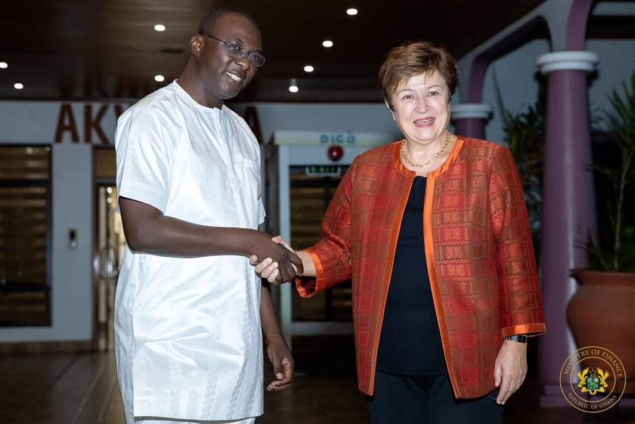
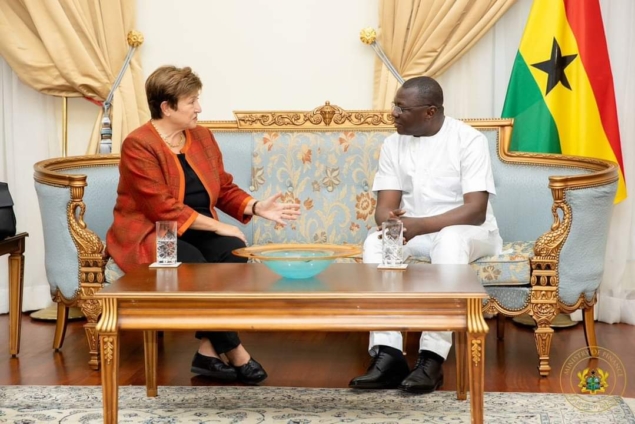
    Managing Director of the International Monetary Fund (IMF), Kristalina Georgieva, has arrived in Ghana, marking her first official visit to the country.

    Madam Kristalina Georgieva was accompanied by the Director of Africa Department at the Fund, Abebie Selassie, Stéphane Roudet, IMF Mission Chief for Ghana and other officials as she expects to hold talks with President Akufo-Addo and Vice President Dr Mahamudu Bawumia.

    Madam Georgieva will also meet with the Minister of Finance, Dr. Mohammed Amin Adam, and the Governor of the Bank of Ghana, Dr Ernest Addison.

    As part of her itinerary, the IMF boss will on Monday, March 18, 2024, attend an Artificial Intelligence (AI) conference jointly organised by the Ministry of Finance and her organisation, the International Monetary Fund under the theme, “AI as a Catalyst to Transform Economies in Sub-Saharan Africa”.

    Madam Georgieva will also be meeting with selected Civil Society Organisations (CSOs) and women groups.

    In 2023, Ghana secured a $3 billion IMF extended credit facility (ECF) after then Minister of Finance, Ken Ofori-Atta, was authorized by President Akufo-Addo on July 1, 2022, to commence formal negotiations with the IMF to secure a balance of payment support and resolve Ghana’s economic crisis impacted by the COVID-19 pandemic and the geopolitical armed conflict between Russia and Ukraine.

    Ghana’s three-year-IMF programme is in its first year of implementation, with the nation so far, receiving a total of $1.2 billion from the IMF in two payment tranches of $600 million each.

    It is expected that during Madam Georgieva’s stay in Ghana, the IMF and the government officials will be seeking ways through which they can consolidate collaboration to see Ghana through her current programme with the Fund.

  • IMF, Finance Ministry to host Artificial Intelligence conference in Accra

    IMF, Finance Ministry to host Artificial Intelligence conference in Accra

    The Ministry of Finance and the International Monetary Fund (IMF) are set to host an Artificial Intelligence (AI) summit in Accra on Monday, March 18, 2024.

    The summit aims to explore the challenges and opportunities that AI presents for developing countries like Ghana.

    Financial and information technology experts believe that AI has the potential to transform economies in Africa, including Ghana. However, they also acknowledge that AI could pose challenges for economic growth and development in countries south of the Sahara, given the continent’s unique characteristics, including its young population.

    While the risk of immediate AI-related disruptions may be lower in emerging markets and developing economies (EMDEs) than in advanced economies, where up to 60% of jobs could be affected, EMDEs are also less equipped to harness the benefits of AI effectively.

    The AI summit, themed “AI as a Catalyst to Transform Economies in Sub-Saharan Africa,” will take place at the Kempinski Hotel in Accra. Participants will include Dr. Mohammed Amin Adam, Minister for Finance, and Madam Kristalina Georgieva, Managing Director of the IMF.

    The summit will feature a panel discussion on the challenges and opportunities of AI for emerging economies, with a focus on Ghana’s digitalization and AI readiness. The discussion will also explore strategies for harnessing AI for positive outcomes and its role in the 4th industrial revolution alongside technologies like cloud computing and the internet.

    The panel will include Ursula Owusu-Ekuful, Minister for Communications & Digitalisation; Madam Kristalina Georgieva, Managing Director of the IMF; Dr. Patrick Awuah, President of Ashesi University; and Dr. Jason Hickey, Head of Google’s AI Research Centre.

  • Standard Bank predicts 2024 economic growth to exceed IMF’s estimated 2.8%

    Standard Bank predicts 2024 economic growth to exceed IMF’s estimated 2.8%

    Africa’s largest bank, Standard Bank, projects that Ghana’s economy will strengthen by 3.2% in 2024.

    This forecast surpasses the International Monetary Fund’s earlier prediction of 2.8%. Among the 18 countries assessed by Standard Bank, Ghana’s anticipated growth rate ranks as the 16th highest.

    The bank attributes this growth primarily to the services sector of the economy.

    However, potential obstacles such as adverse weather conditions, excessive debt, and geopolitical tensions may pose challenges to this growth trajectory.

    “Notably, unfavourable weather concerns, renewed geopolitical risks, and ongoing debt sustainability challenges constraining the fiscal capacity to spur growth, are the primary downside risks for economic growth in SSA [Sub Saharan Africa] for 2024”.

    Prior to the onset of Covid-19 in 2019, Ghana’s economy was expanding at a steady rate of 5% annually.

    However, recent data from the Ghana Statistical Service indicates a growth of 2.0% from July to September 2023, driven mainly by increased activity in the services and agriculture sectors.

    This figure represents a decrease compared to the 2.7% growth recorded during the same period in 2022.

    Elsewhere in Africa, Ethiopia is projected to experience substantial growth in 2024, nearing 10%. According to the International Monetary Fund, Sub-Saharan Africa as a whole is expected to see its economy expand by approximately 4.0% in 2024, a notable increase from the 3.3% growth recorded in 2023.

  • Our relationship with Ghana hasn’t changed despite passage of anti-LGBTQ+ bill – IMF

    Our relationship with Ghana hasn’t changed despite passage of anti-LGBTQ+ bill – IMF

    In light of the recent approval of the Human Sexual Rights and Ghanaian Family Values Bill by Parliament, the World Bank Group has asserted its enduring commitment to its longstanding partnership with Ghana.

    This statement is intended to address and dispel any speculations that the World Bank Group might reduce its support in terms of aid and development assistance to Ghana.

    There have been growing concerns about potential financial challenges for Ghana, especially with warnings from the Finance Ministry indicating a potential loss of over $3 billion in World Bank funding for various programs and projects if the bill becomes law.

    However, a spokesperson from the World Bank has clarified that the institution does not view the recently passed bill as a reason to alter its collaboration with Ghana on development programs.

    The spokesperson underscored the ongoing productivity of the partnership between the World Bank and the Republic of Ghana.

    “The World Bank Group has a longstanding and productive relationship with Ghana,” the spokesman said.

    Addressing inquiries regarding the Human Sexual Rights and Ghanaian Family Values Bill, the World Bank stated its policy of refraining from commenting on specific legislation, especially one that has not been signed into law.

    “The Bill has not yet been signed into Law. We generally do not comment on Bills”.

    At present, it remains uncertain whether the World Bank will take any punitive measures if the bill is fully enacted.

  • We will comment on anti-LGBTQ+ bill after it becomes a law – IMF

    We will comment on anti-LGBTQ+ bill after it becomes a law – IMF

    The International Monetary Fund (IMF) has announced that it will provide comments on the Proper Human Sexual Rights and Ghanaian Family Values Bill after it is officially signed into law.

    The IMF states that its evaluation will specifically focus on the economic and financial consequences of the legislation.

    In a released statement, the IMF emphasized its commitment to diversity and inclusion as integral values. “We cannot comment on a bill that has not yet been signed into law and whose economic and financial implications we have yet to assess.”

    The institution underscores its internal policies prohibiting discrimination based on personal characteristics, including gender, gender expression, or sexual orientation.

    “Diversity and inclusion are values that the IMF embraces.”

    “Our internal policies prohibit discrimination based on personal characteristics, including but not limited to gender, gender expression, or sexual orientation. Like institutions, diverse and inclusive economies flourish,” the statement from the Fund added.

    The IMF asserts that diverse and inclusive economies thrive, aligning with its principles.

    This statement follows the recent passage of the bill by Ghanaian lawmakers on March 28, with support from both the ruling party and the opposition.

    The legislation aims to criminalize LGBTQ+ activities, along with their promotion, advocacy, and funding.

    Offenders may face jail terms ranging from 6 months to 5 years, depending on the nature of the violation.

    Acknowledging the significance of the situation, the IMF states that it is closely monitoring developments in Ghana. However, it refrains from commenting on a bill that has not been signed into law, pending a comprehensive assessment of its economic and financial implications.

    Ghana, facing economic challenges and seeking an IMF bailout, may see uncertainties in securing the third tranche due to the recent legislation.

    The country’s dollar bonds have experienced a decline, ranking as the second-worst performers in an index monitoring emerging-market sovereign hard-currency debt.

    All 14 of Ghana’s dollar notes in the gauge saw a drop in value, with bonds maturing in 2034 experiencing the most significant impact.

    Pressure is mounting on President Akufo-Addo to assent to the bill amid these developments.

  • LGBTQ not part of Ghana’s IMF agreement – Prof. John Gatsi

    LGBTQ not part of Ghana’s IMF agreement – Prof. John Gatsi

    Economics professor and dean of the University of Cape Coast Business School, Professor John Gatsi, has contended that LGBTQ issues were not a stipulation for Ghana when seeking the International Monetary Fund’s (IMF) external credit facility support.

    In response to the IMF’s comments on the anti-LGBTQ+ bill, Gatsi sees these remarks as merely reflecting the organization’s interests.

    Despite the IMF emphasizing diversity and inclusion, Professor Gatsi believes Ghana’s finance ministry is being used to pressure support for the bill’s non-signing.

    He highlighted that during negotiations with the IMF, LGBTQ concerns were not part of the conditions.

    Mr Gatsi stressed that Ghana’s financial dealings involve repayable loans, with parliamentary approval being the primary condition, which has already been met.

    The finance ministry’s report to President Akufo-Addo warned of potential financial losses, estimating over US$3.8 billion from World Bank financing.

    Areas at risk include ongoing projects and negotiations, such as the First and Second Ghana Resilient Recovery Development Policy Operation and the Ghana Financial Stability Fund.

    Additionally, the ministry fears consequences for Ghana’s financial position, which heavily relies on IMF support following debt restructuring and access to foreign exchange.

    As Ghana awaits the review and approval of the third tranche from the IMF, uncertainties persist regarding the impact of the anti-LGBTQ+ bill on these financial arrangements.

    “Diversity and inclusion are values that the IMF embraces,” the Fund emphasised.

  • We are watching recent developments in Ghana closely – IMF on anti-LGBTQ bill

    We are watching recent developments in Ghana closely – IMF on anti-LGBTQ bill

    The International Monetary Fund (IMF) has declined to comment on the anti-LGBTQI+ bill passed by Parliament in Ghana because it has not yet been signed into law by President Akufo-Addo.

    The IMF stated that it has not yet undertaken an economic and financial assessment of the law’s potential impact on the country.

    This response was provided by the Bretton Woods institution in Washington DC, USA, in reply to questions from JOYBUSINESS on March 4, 2024.

    “Our internal policies prohibit discrimination based on personal characteristics, including but not limited to gender, gender expression, or sexual orientation. Like institutions, diverse and inclusive economies flourish”, the IMF said in an email.

    “We are watching recent developments in Ghana closely”, the Fund added.

    This comes at a time when President Akufo-Addo has reaffirmed Ghana’s dedication to upholding human rights, despite the recent passage of the Proper Human Sexual Rights and Ghanaian Family Values Bill, also known as the Anti-LGBTQ+ Bill.

    Speaking at a diplomatic event, he stressed that Ghana maintains its reputation for respecting human rights and following the rule of law.

    The President clarified that the Bill is currently being challenged in the Supreme Court, and until a verdict is reached, his government will not enforce any provisions of the private Member’s bill.

    Prior to this, The Ministry of Finance advised President Akufo-Addo against signing the recently passed Promotion of Proper Human Sexual Rights and Ghanaian Family Values Bill also known as the anti-LGBTQ bill.

    In a statement dated March 4, the Ministry noted that the bill, when passed into law, poses negative impacts on the country’s financial support from international organizations.

    According to the Ministry the expected $300 million financing from the First Ghana Resilient Recovery Development Policy Operation as Budget Support which is currently pending Parliamentary approval might not be disbursed by the World Bank if the bill is approved by Parliament.

    Other financial support from the World Bank Ghana risks losing include, Second Ghana Resilient Recovery Development Policy Operation amounting to US$300 million, $250 million to support the Ghana Financial Stability Fund, Disbursement of undisbursed amounts totaling US$2.1 billion for on-going projects, Preparation of pipeline projects and declaration of effectiveness for two projects totaling worth US$900million.

    In total, Ghana is likely to lose US$3.8 billion in World Bank Financing over the next five to six years.

    With regards to the International Monetary Fund External Credit Facility worth $3 billion, the Ministry noted that there is no direct conditionality over its passage, however, the non-disbursement of the Budget Support from the World Bank will derail the IMF programme.

    The Ministry also warned that a derailed IMF programme will have dire consequences on the debt restructuring exercise with the Official Creditor Committee (OCC) and Eurobond holders, as well as Ghana’s long term debt sustainability.

  • Don’t approve anti-LGBTQ bill; we need money from IMF, World Bank – Finance Ministry advises Akufo-Addo

    Don’t approve anti-LGBTQ bill; we need money from IMF, World Bank – Finance Ministry advises Akufo-Addo

    The Ministry of Finance has advised President Akufo-Addo against signing the recently passed anti-LGBTQ+ Bill into law, citing potential negative impacts on the country’s financial support from international organizations.

    In a press release issued on Monday, March 4, the Finance Ministry cautioned that signing the bill could jeopardize the disbursement of the expected US$300 million financing from the First Ghana Resilient Recovery Development Policy Operation (Budget Support), currently awaiting Parliamentary approval.

    It also warned that ongoing negotiations on the Second Ghana Resilient Recovery Development Policy Operation (Budget Support), totaling US$300 million, could be suspended.

    The Ministry highlighted the potential loss of financial resources and the resulting financing gap in the 2024 budget as major concerns.

    To address these challenges, the Ministry recommended that the President engage with religious bodies to discuss the implications of signing the bill. It also suggested establishing a robust coalition and framework to support key development initiatives.

    “The Presidency may have a structured engagement with local conservative forces such as religious bodies and faith-based organisations to communicate the economic implications of the passage of the ‘Anti-LGBTQ‘ Bill and to build a stronger coalition and a framework for supporting key development initiative that is likely to be affected.”

    Parliament passed the bill on February 28, 2024, criminalizing LGBTQ activities and prohibiting their promotion, advocacy, and funding. Those convicted of such acts could face 6 months to 3 years in prison, while promoters or sponsors could be sentenced to 3 to 5 years.

    The bill’s approval has been met with criticism, notably from Virginia Evelyn Palmer, the United States Ambassador to Ghana, and other stakeholders.

    The UN High Commissioner for Human Rights, Volker Türk, has described the passage of bill as “profoundly disturbing.”

    A portion of the UN Human Rights statement read “I call for the bill not to become law. I urge the Ghanaian Government to take steps to ensure everyone can live free from violence, stigma and discrimination, regardless of their sexual orientation or gender identity. Consensual same-sex conduct should never be criminalized.”

  • IMF deliberately sabotaging Ghana’s economy – Bagbin claims

    IMF deliberately sabotaging Ghana’s economy – Bagbin claims

    Speaker of Parliament, Alban Bagbin, has expressed concerns about the International Monetary Fund’s (IMF) role in Ghana’s economic downturn.

    He expressed skepticism about the IMF’s intentions, suggesting that the organization is manipulating situations to force Ghana to seek their assistance again.

    In his remarks during discussions with the top five schools that participated in the National Public Speaking Competition on Friday, March 1, 2024, Speaker Bagbin implied that the IMF is providing misguided advice, leading the country into economic difficulties.

    “Anytime they want Ghana to falter and return to them, they will tell their small boys to come and misadvise us. When we do the wrong thing, and we collapse, they [IMF] say, aha! That is what they do to us. Ghana, we have been there 17 times; we have not solved our problems,” he said.

    His remarks followed the IMF’s statement regarding the passage of the anti-gay bill, where the IMF reiterated its stance against all forms of discrimination.

    In May 2023, the International Monetary Fund (IMF) on Wednesday approved a $3 billion loan for Ghana, a West African country in the midst of a severe economic crisis, with the first immediate disbursement of about $600 million.

    The programme, endorsed by the IMF board, is spread over 36 months under the Extended Fund Facility.

    During the event, he also expressed concern that events held at the forecourt of the State House are posing security threats to Members of Parliament, jeopardizing their ability to carry out their official duties safely.

    “I’m sure when you were coming, you heard some noise outside. When we are busy doing our work, there are people outside who are permitted to come and make noise. By the time we go outside, they could have broken into our cars and stolen things. You talk to them; it is like they are deaf and dumb; they don’t hear. We are constrained to be able to function properly.”

  • Flashback: Ghana on track for 5th Eurobond – IMF

    Flashback: Ghana on track for 5th Eurobond – IMF

    On 15th May 2016, the then Minister of Finance, Seth Terkper, announced the country’s intention to enter the international bonds market with the goal of raising around one billion dollars.

    Despite earlier concerns from financial experts about the International Monetary Fund (IMF) withholding approval due to Ghana’s debt levels, the IMF has now given its endorsement for the issuance of Ghana’s 5th Eurobond during its review of the Extended Credit Facility program.

    Minister Terkper led a government delegation in a non-deal road show, presenting Ghana’s expanding economic prospects to potential investors.

    With parliamentary approval already secured, the government aims to secure additional funds from the global market to bolster the nation’s growing infrastructure requirements and address maturing debts.

    While the timing of the Eurobond issuance remains uncertain, Joel Toujas-Bernaté, the head of the IMF mission to Ghana, shared in a press conference that the decision would be influenced by prevailing market conditions.

    He emphasized the flexibility of adapting to market fluctuations, suggesting that if conditions are unfavorable at the beginning of the year, the government can utilize existing cash balances.

    Toujas-Bernaté reassured that the IMF supports Ghana’s ability to smoothly adapt to changing circumstances without jeopardizing financing for the year.
    “The concern about debt dynamic season is driven by the fiscal position. At the start of the year, they can use a large part of these cash balances if indeed the market conditions are not right for issuing a new Eurobond,” he said.

    “If the market conditions improve and would make issuance of a Eurobond more attractive, then the strategy may change. And it is here that I think the idea is to adapt to market conditions and the fact that the authorities have this cash,” he explained.

  • We embrace diversity and inclusion – IMF cautions Ghana against anti-LGBTQ bill

    We embrace diversity and inclusion – IMF cautions Ghana against anti-LGBTQ bill

    The International Monetary Fund (IMF) has stated that it is monitoring events in Ghana following the passage of the Proper Human Sexual Rights and Family Values Bill by Parliament.

    Commonly referred to as the Anti-LGBTQ bill, the legislation aims to criminalize LGBTQ+ activities, as well as their promotion, advocacy, and funding.

    The bill’s passage has already drawn criticism from various stakeholders and civil society organizations, including the United States Ambassador to Ghana, Virginia Evelyn Palmer.

    However, in a statement issued by the IMF and reported by Bloomberg, the global lender emphasized that its internal policies prohibit discrimination based on personal characteristics, including gender, gender expression, or sexual orientation.

    The IMF noted that, “Diversity and inclusion are values that the IMF embraces.”

    The International Monetary Fund (IMF) has stated its intention to closely observe events in Ghana in light of the passage of the Proper Human Sexual Rights and Family Values Bill. The bill, commonly known as the Anti-LGBTQ bill, aims to criminalize LGBTQ+ activities, as well as their promotion, advocacy, and funding.

    The IMF has also indicated that it will refrain from commenting on the bill until it is signed into law and its economic and financial implications are thoroughly assessed. Should the bill become law, the IMF will then assess the economic and financial implications of Ghana’s decision to pass the bill.

    Ghana has been seeking a bailout from the IMF following an economic downturn, with the first and second tranches hitting the Bank of Ghana’s account. However, the passage of the bill has cast uncertainty over Ghana’s prospects of securing the third tranche.

    In response to the news of Ghana’s anti-LGBTQ legislation, the country’s dollar bonds experienced a decline, ranking as the second-worst performers in a Bloomberg index monitoring emerging-market sovereign hard-currency debt on Thursday.

    All 14 of Ghana’s dollar notes in the gauge saw a drop in value, with the bonds maturing in 2034 experiencing the most significant impact, plummeting to 43.34 cents on the dollar, marking their lowest level since January 12.

    Meanwhile, pressure is mounting on President Akufo-Addo to assent to the bill.

  • IMF warns of economic repercussions on Ghana over passage of anti-LGBTQ bill

    IMF warns of economic repercussions on Ghana over passage of anti-LGBTQ bill

    The International Monetary Fund (IMF) has expressed its concern regarding recent developments in Ghana following the approval of a bill proposing imprisonment for individuals identifying as LGBTQ.

    In a statement from its Washington headquarters, the IMF underscored its dedication to diversity and inclusion, highlighting these principles as essential within the organization.

    The IMF emphasized its internal policies against discrimination based on personal characteristics, including gender, gender expression, or sexual orientation, noting that economies embracing diversity tend to flourish.

    The bill, passed with bipartisan support, not only criminalizes LGBTQ identification but also targets the financing of LGBTQ groups and sanctions discrimination against them. President Nana Akufo-Addo’s approval is necessary for the bill to become law.

    While acknowledging the significance of the situation, the IMF refrained from commenting on the bill until it is signed into law, stressing the importance of thoroughly assessing its economic and financial implications.

    Ghana’s financial stability, closely linked to IMF assistance amid debt restructuring, adds complexity to the situation. The IMF had agreed to release a second tranche of $600 million to Ghana earlier this year.
    Following the news of the anti-LGBTQ legislation, Ghana’s dollar bonds experienced a decline, ranking as the second-worst performers in a Bloomberg index monitoring emerging-market sovereign hard-currency debt.

    All 14 of Ghana’s dollar notes saw a drop in value, with bonds maturing in 2034 experiencing the most significant impact, reaching their lowest level since January 12.

  • When you’re broke don’t you borrow? – KT Hammond justifies Ghana’s going to IMF

    When you’re broke don’t you borrow? – KT Hammond justifies Ghana’s going to IMF

    Member of Parliament for Adansi Asokwa, KT Hammond, has justified Ghana’s decision to seek assistance from the International Monetary Fund (IMF).

    Addressing Ghanaians in Parliament after President Akufo-Addo delivered the 2024 State of the Nation Address, he noted that the move was necessary given the country’s economic challenges resulting from the COVID-19 pandemic. 

    Ghana’s engagement with the IMF has been a subject of debate, with proponents arguing that it is a necessary step to stabilize the economy and implement crucial reforms, while critics express reservations about the potential implications for national sovereignty and economic independence.

    Despite various promises made by President Akufo-Addo not to resort to IMF assistance during his tenure, Ghana ultimately found itself in a position where seeking external financial support became inevitable. 

    The decision sparked debates and raised questions about the government’s economic management strategies and its ability to fulfill electoral promises.

    However, KT Hammond is responding to such criticisms, arguing that going to the IMF was the responsible course of action to address Ghana’s economic challenges and ensure the country’s financial stability in the long term.

    “When you’re broke, don’t you borrow?” he asked. 

    He further acknowledged the economic hardships currently being experienced by Ghanaians under the current administration. However, he noted that these challenges largely resulted from the COVID-19 pandemic.

  • Ghana must meet its tax obligations to prevent a catastrophe – Mohammed Amin Adam

    Ghana must meet its tax obligations to prevent a catastrophe – Mohammed Amin Adam

    Finance Minister-designate, Dr. Mohammed Amin Adam, has cautioned that Ghana could face serious challenges if it does not meet certain tax obligations required to meet targets set by the International Monetary Fund (IMF).
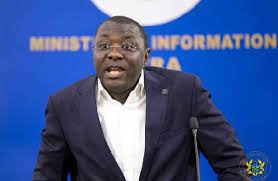
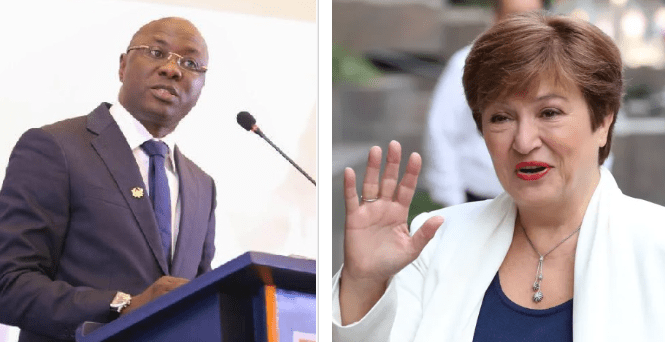
    He has urged the Ghana Revenue Authority (GRA) to proactively address any gaps to ensure revenue generation.

    During an engagement with the Commissioners of the Authority, Dr. Amin Adam emphasized that revenue mobilization is a critical priority for the government.

    Despite this, he commended the GRA for surpassing the revenue target for 2023.

    “Commissioner-General, this institution continues to perform admirably well. Last year, you managed to exceed the revenue target. Although the public seems to question the framework for target setting, I congratulate you on this achievement.”

    “However, this achievement also reveals the depth of potential to be optimised. This view is also shared by the wider public. Achieving and exceeding the targets is also critical to the success of the IMF-Extended Credit Facility (ECF) Programme. We cannot afford to miss our commitments programme”, he stressed.

    Dr. Mohammed Amin Adam emphasized the crucial role of the Ghana Revenue Authority (GRA) in supporting Ghana’s IMF program for 2024.

    “Commissioner-General, I take this opportunity to reiterate to you and your team the three key commitments you made under the programme for 2024: cleaning of the GRA taxpayer register by end-June 2024, complete data migration from all existing portals to the ITAS, operationalize the major modules (registration, returns filing and payments) in the system (and processes needed to be completed prior to that) by end December 2024”, he added.

    The finance minister also announced plans to collaborate with the GRA through a structured framework to surpass the GH¢145 billion revenue target set in the 2024 Budget.

  • Tax reliefs will be implemented without delay – Amin Adam

    Tax reliefs will be implemented without delay – Amin Adam

    Finance Minister-designate , Dr. Mohammed Amin Adam, has emphasized a swift implementation of tax reliefs outlined in the 2024 budget.

    Expressing his commitment to alleviating economic hardships for the poor amidst challenging economic conditions, Dr. Amin Adam, an expert in Energy and Petroleum Policy, assured that policies designed to shield vulnerable segments of society from economic adversities will be promptly executed as outlined in the budget.

    In an interview on Citi FM’s Citi Breakfast Show on Thursday, February 15, Dr. Amin Adam underscored the government’s dedication to the International Monetary Fund (IMF) program.

    The program aims to assist Ghana in addressing its balance of payment challenges, and Dr. Amin Adam assured that it would proceed without any disruptions.

    “We will make sure that we move faster to implement the tax reliefs that were made in the budget and I am going to make sure the poor are insulated….It is important to note that we are under an IMF programme and I want to assure the IMF and the business community that I will ensure that the programme remains on track. I will work to ensure that the programme does not suffer,” he said.

    As a former Minister of State at the Finance Ministry, Dr. Amin Adam is expected to play a key role in reinforcing Ghana’s economy and steering it back toward a path of growth.

  • Let’s work together to stabilize Ghana’s economic – IMF boss to new  Finance Minister

    Let’s work together to stabilize Ghana’s economic – IMF boss to new Finance Minister

    The Managing Director of the International Monetary Fund (IMF), Kristalina Georgieva, has advised the newly appointed Minister of Finance, Dr. Mohammed Amin Adam, to maintain the efforts of the country’s economic reform program.

    In a congratulatory letter, Ms. Georgieva emphasized the importance of Dr. Amin Adam’s leadership in continuing the momentum of the IMF program to achieve economic stability and meet its targets.

    Ms. Georgieva highlighted the significance of guidance in driving the reform effort forward, stating, “Your leadership will be essential in sustaining Ghana’s reform effort and in further extending the current momentum of compelling program performance and gradual economic stabilization.”

    Expressing support, she assured the Minister that the IMF would collaborate with him to contribute to Ghana’s economic recovery. The letter concluded with warm wishes for success in Dr. Amin Adam’s new role.

    Ghana is currently implementing a three-year program with the IMF, aiming to receive a $3 billion support fund.

    The country has already received a second tranche of funding totaling $600 million, following the initial $600 million to support the Balance of Payment account.

    Dr. Mohammed Amin Adam, an Economist and Energy and Petroleum Policy Expert, has an extensive educational background, including a Ph.D. in Energy and Petroleum Economics from the University of Dundee. He has over 25 years of experience in political management, administration, and key roles in the Government of President Nana Akufo-Addo. Dr. Adam is recognized globally for his expertise and has served in various advisory capacities for international organizations and African countries.

  • We are committed to supporting you -IMF Boss to Amin Adam

    We are committed to supporting you -IMF Boss to Amin Adam


    The Managing Director of the International Monetary Fund (IMF), Kristalina Georgieva, has expressed her approval of the new Finance Minister, Dr. Mohammed Amin Adam.

    She emphasized the importance of Dr. Amin Adam’s leadership in maintaining Ghana’s reform initiatives and building upon the ongoing positive trajectory of program performance and economic stabilization.

    Kristalina Georgieva urged Dr. Adam to take the lead in restoring stability to Ghana’s economy.

    Dr. Mohammed Amin Adam, previously the Minister of State at the Finance Ministry, was promoted to the substantive Minister for the Finance Ministry in the recent reshuffle, replacing Mr. Ken Ofori-Atta.

    In her congratulatory statement, the IMF boss stated, “Your leadership will be essential in sustaining Ghana’s reform effort and in further extending the current momentum of compelling program performance and gradual economic stabilization. I would like to assure you of the International Monetary Fund’s continued commitment to support you in these endeavors.”

    Below is the IMF’s congratulatory note.

  • You have our full support – IMF tells Finance Minister designate Amin Adam

    You have our full support – IMF tells Finance Minister designate Amin Adam

    The International Monetary Fund (IMF) has congratulated Dr. Mohammed Amin Adam on his appointment as Finance Minister.

    In a congratulatory message, Kristalina Georgieva, the Managing Director of the IMF, urged Dr. Adam to spearhead efforts to restore stability to Ghana’s economy.

    Georgieva also assured him of the Fund’s unwavering commitment to fostering constructive engagement and providing support.

    “Your leadership will be essential in sustaining Ghana’s reform effort and in further extending the current momentum of compelling program performance and gradual economic stabilization. I would like to assure you of the International Monetary Fund’s continued commitment to support you in these endeavors,” the note read in part.

    Dr. Adam assumed the position on Wednesday, February 14, succeeding Ken Ofori-Atta as the head of the Ministry of Finance.

  • Let’s not deceive ourselves Amin Adam’s appointment won’t turn the economy around – Seth Terkper

    Let’s not deceive ourselves Amin Adam’s appointment won’t turn the economy around – Seth Terkper

    Former Finance Minister, Seth Terkper has cast doubt on President Akufo-Addo‘s choice to replace Ken Ofori-Atta with Dr. Mohammed Amin Adam as Finance Minister.

    Mr Terkper, expressing skepticism, argues that the timing of this change, occurring during the country’s engagement with an IMF program, might hinder Dr. Adam’s ability to have a significant impact on the economic policies of the president and government.

    Following his reassignment, Dr. Mohammed Amin Adam has pledged to prioritize revenue mobilization to fortify the nation’s finances and meet expenditure goals.

    He has also reassured the International Monetary Fund (IMF) of the government’s commitment to the ongoing program, promising alignment with outlined policies and programs in the 2024 budget.

    In an interview with Citi News, Terkper highlighted that budget and economic policies ultimately fall under the President’s authority. With the limited timeframe until the next general elections, he expressed concerns about Dr. Adam encountering challenges in implementing substantial policy changes.

    Terkper remarked, “We are a country where we could not do a turnaround of the economy, and we were preemptive, with everybody blaming it on COVID-19 and the Ukraine war, where some $6 billion flowed into the economy without the ability to turn it around.”

    “This administration is not the only one that has suffered global or domestic setbacks, from droughts or floods to the global financial crisis, and so I think the situation is dire, and so we have to ask ourselves if nine months is enough time to do a turnaround.”

  • I will ensure IMF programme remains on track – Amin Adam

    I will ensure IMF programme remains on track – Amin Adam

    The newly appointed Finance Minister, Dr. Mohammed Amin Adam, has reassured the International Monetary Fund (IMF) that the government will steadfastly adhere to the ongoing program.

    This commitment comes as Dr. Amin Adam takes over the role from Ken Ofori-Atta in a recent ministerial reshuffle.

    In an interview on the Citi Breakfast Show with Bernard Avle on Thursday, February 15, Dr. Amin Adam emphasized the government’s dedication to following the established path in collaboration with the IMF.

    He highlighted the continuation of pro-poor initiatives outlined in the recent budget and pledged to maintain business as usual.

    Dr. Amin Adam also expressed his commitment to swiftly implement the proposed tax reliefs and ensure the protection of the economically disadvantaged.

    “If you look at the budget that was presented this year, there were a number of pro-poor initiatives, and I do not intend to depart from those pro-poor initiatives. And I will ensure that business follows as usual as it should. We will make sure that we move faster to implement the tax reliefs that were made in the budget and I am going to make sure the poor are insulated.”

    “It is important to note that we are under an IMF programme and I want to assure the IMF and the business community that I will ensure that the programme remains on track. I will work to ensure that the programme does not suffer.”

    Acknowledging Ghana’s participation in the IMF program, Dr. Amin Adam assured both the IMF and the business community that he would work diligently to keep the program on track and prevent any deviations.

    The ongoing program represents a strategic partnership focused on addressing economic challenges and promoting fiscal responsibility within Ghana.

    The IMF program involves a comprehensive set of policies and reforms aimed at enhancing economic stability, fostering growth, and creating a conducive environment for sustainable development. Ghana’s engagement with the IMF has been motivated by various economic factors, including fiscal deficits, external imbalances, and the imperative for structural reforms. Historically, the country has sought IMF assistance to tackle fiscal challenges, implement economic reforms, and strengthen macroeconomic fundamentals. The program typically encompasses measures to curb inflation, reduce budget deficits, and bolster overall economic resilience.