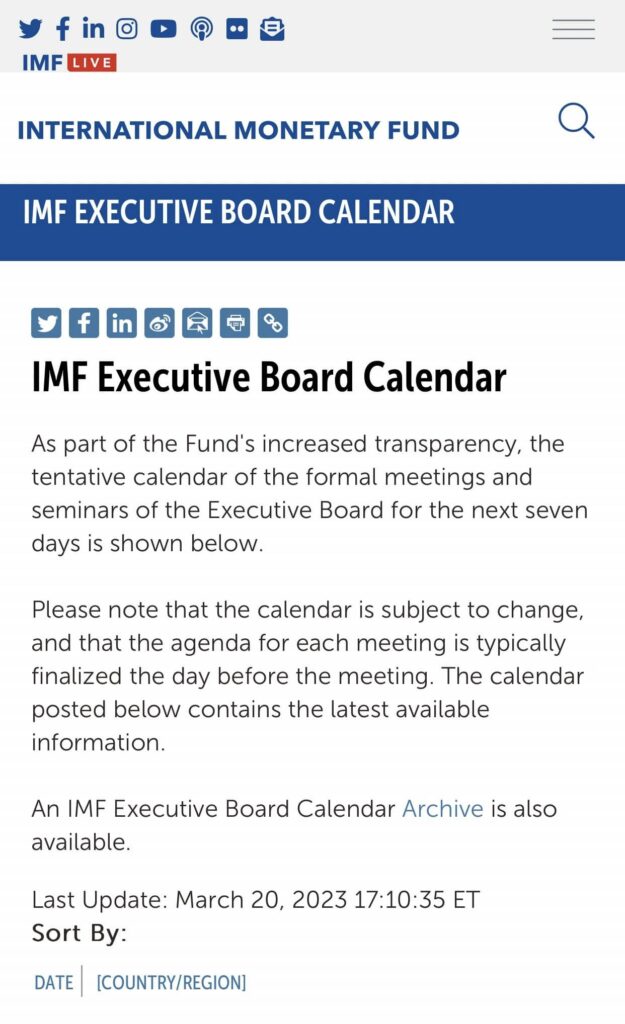
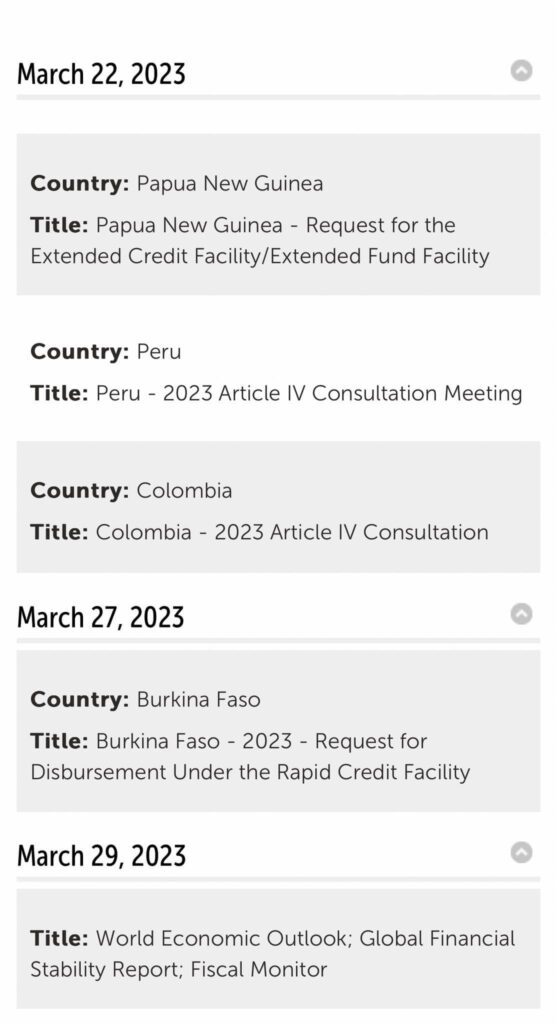
Sources say Ghana’s official creditors are close to granting financial assurance to enable the West African country obtain a credit facility worth $3 billion from the International Monetary Fund (IMF).
Reports from Reuters indicate that a committee which will be co-chaired by France and China as bilateral lenders are expected to officially grant financing assurances as soon as Friday.
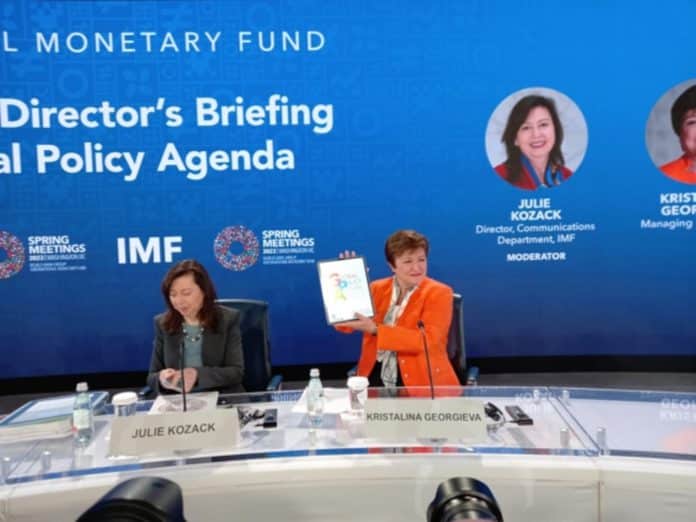
In a news briefing on Thursday, IMF spokesperson Julie Kozack said the Fund is hopeful its executive board can quickly consider the Ghana program once enough official bilateral creditor assurances have been secured.
“We have seen strong progress toward creditors delivering on these financing assurances and we’re hopeful that they can be delivered very rapidly,” Kozack said.
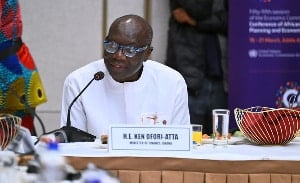
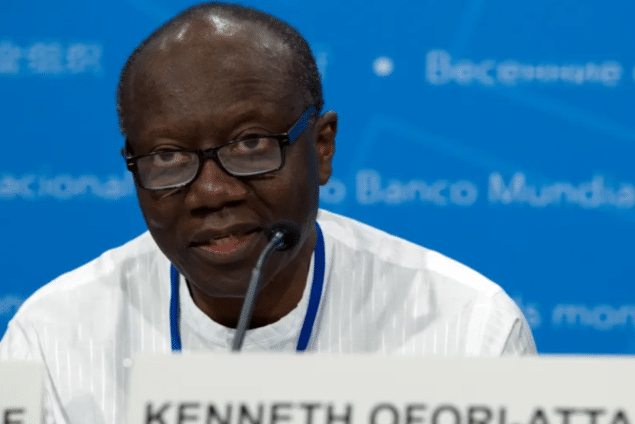
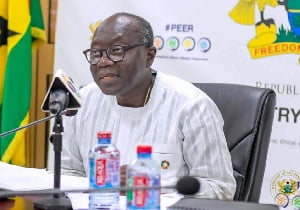
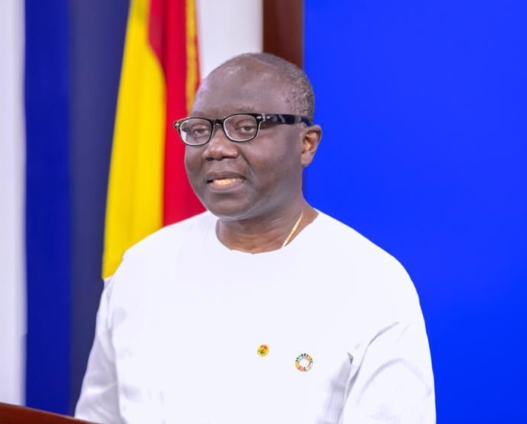
Earlier in April, Finance Minister, Ken Ofori-Atta revealed that Ghana was likely to receive the International Monetary Fund’s (IMF) Board approval for a $3 billion bailout by the close of May 2023.
As Ghana struggles through its economic crisis, defaulting on its debt in December and completing a debt restructuring in February, the IMF bailout is expected to ease her economic burdens.
Ghana is also in talks to rework $14.6 billion of debt to private overseas creditors.
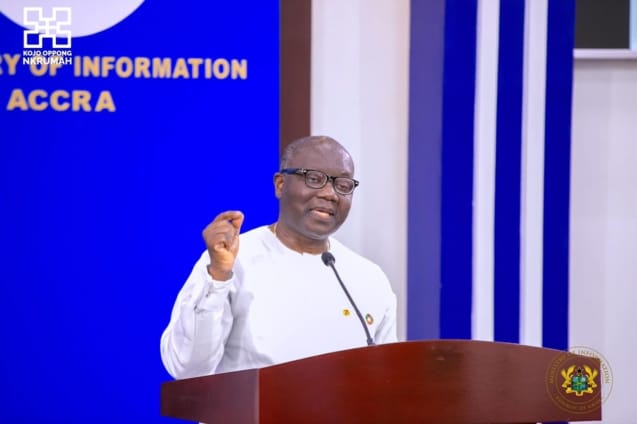
The Minister of Information, Kojo Oppong-Nkrumah has said that securing a deal with the International Monetary Fund (IMF) is not the only solution to the current economic issues.
Providing an update on the engagement with the IMF thus far, he said, “the Government of Ghana has had an enhanced programme which has been designed to help us recover from major shocks we are suffering. And to make that programme effectual, we will need some balance of payments support from the IMF. And that is what we have been working on, and all indications suggest to us that we should be bringing that to a closure pretty soon. But that is not all the panacea to our economic challenges, we have other programmes to help us to bring back growth, help private sector kicking and get cost of living under control”.
The government has since July last year engaged the fund for a $3 billion bailout to help restore the economy.
In addition to this, government has rolled out policies and programmes aimed at restoring macroeconomic stability and debt sustainability.
Industry players have been relentless in their opinions of government’s role in bringing relief to Ghanaians.
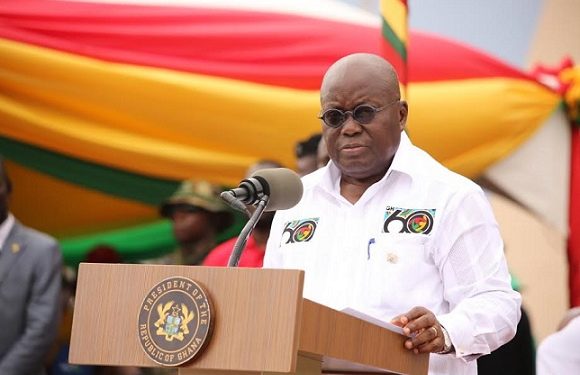
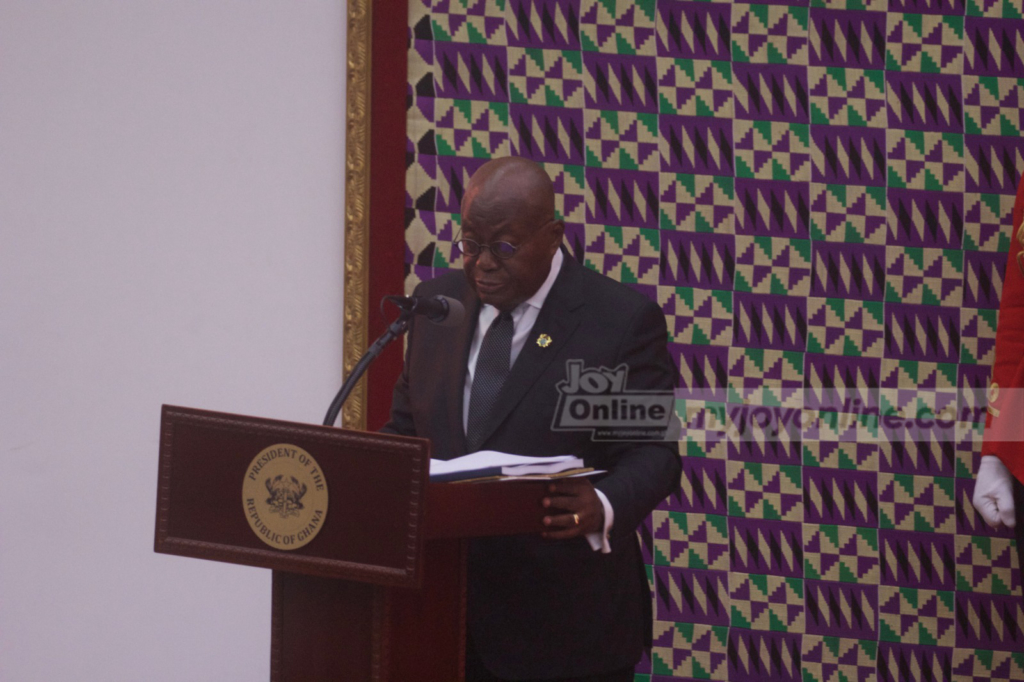
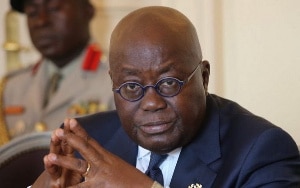
President Nana Addo Dankwa Akufo-Addo on May 2 courted the support of Japan to help Ghana reach an agreement with the International Monetary Fund (IMF) Board for the 3 billion dollar balance of payment support.
According to Akufo-Addo, Japan which is a member of the Paris Club has a major role to play in Ghana securing the IMF deal.
Speaking at a meeting with the Japanese Prime Minister, Fumio Kishida who made a stopover at the Jubilee House Tuesday evening, Mr Akufo-Addo said Ghana will repay Japan’s support.
“Ghana is also counting on the support of Japan in reaching a favourable agreement with the International Monetary Fund which will pave the way for the robust recovery of Ghana’s economy,” President Akufo-Addo said.
The Akufo-Addo-led government has guaranteed that it is making every effort to address the current economic crisis.
Addressing workers during this year’s May Day celebration in Bolgatanga, the President said his government is assiduously engaging the International Monetary Fund (IMF) to secure board approval for Ghana’s $3 billion bailout request to bring relief to Ghanaians.
“We continue to work tirelessly to complete all prior actions required to present Ghana’s request to the IMF’s integrity board for approval. We have also made substantial progress on the debt exchange programme as well as our engagements with bilateral creditors to secure the financing required for the IMF programme,” President Akufo-Addo said.
The government is seeking $3 billion in support from theIMFto address the country’s economic challenges.
President Akufo-Addo also assured that his government will thrive to find lasting peace to the protracted Bawku ethnic conflict before the end of his tenure.
According to him, finding lasting peace in the Bawku conflict remains his highest priority as president.
Meanwhile, the Trades Union Congress has suggested to the government to convert the National Cathedral project into a national hospital.
Addressing the 2023 May Day parade in Bolgatanga in the Upper East Region, the Secretary-General of the TUC, Dr Anthony Yaw Baah said converting the project into a hospital will serve Ghanaians better than a cathedral.
“The president has always said he wants to create another Notre Dame in Ghana, so we can attract a lot of visitors, but we disagree. In fact, comrades, it will be better to convert the project into a national hospital,” Dr Yaw Baah said adding “Mr. President you can also reduce the size of your government. Ghana has too many ministers and deputy ministers.”
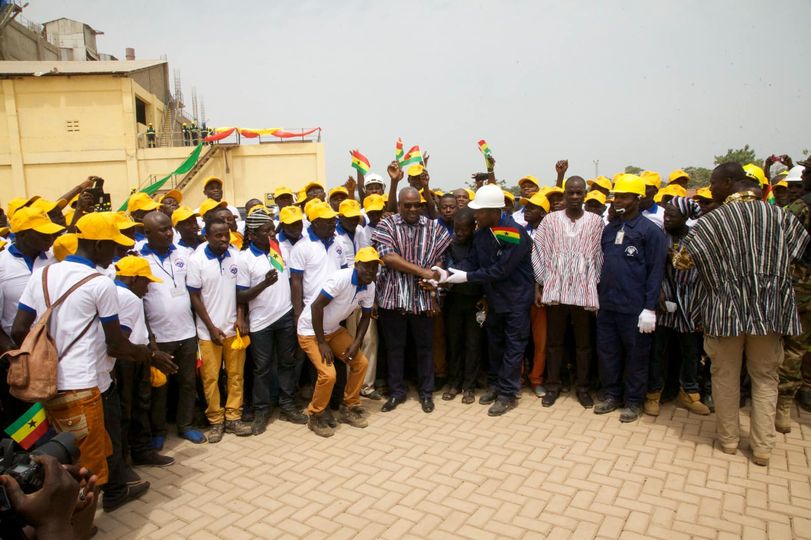
To commemorate Ghanaian workers today, former President John Dramani Mahama has entreated the International Monetary Fund (IMF) to approve Ghana’s request for a $3 billion credit facility in the shortest possible time.
In a Facebook post, the former president noted that it has become imperative that the IMF steps in in order to protect Ghanaian workers.
According to him, further delay may translate into Ghanaian public workers not receiving salary from the government.
“If the Fund does not act urgently, the government would struggle to meet its responsibility of paying workers.
“The situation of our teeming unemployed youth is exacerbated by the government’s inability and unwillingness to pay crucial social protection funds such as LEAP, GETFund, NHIL, and DACF,” portions of his statement read.
He noted that the current rate of unemployment is the worst ever recorded and workers cannot suffer another blow.
“This being the case, government workers – teachers, health workers, civil servants, and security personnel – continue to shoulder the additional burden of an expanding population.
“This desperate state of unemployment comes with extra demands on the time and energy of existing workers and sadly deprives their families of their presence at home.
“The truth, however, is that our nation cannot continue this disastrous path; a path where government deprives the youth of opportunities to work and refuses to secure the investments of retirees because of its reckless mismanagement of the economy leading to the collapse of businesses including Ghanaian-owned banks,” he added.
Despite the current challenges, Mr Mahama urged Ghanaian workers to remain gallant and hope for a better future.
He asserts that the better future “will protect the investments of retirees, restore and revamp collapsed businesses and banks, create genuine jobs and ensure that our statutory vehicles that offer protection to the vulnerable in society are not cruelly starved of funds.”
He indicated that hope cannot be lost as “you (workers) are the backbone of our country, and you epitomize the Black Star of hope and honour, so proudly extolled in our national anthem.”
“It is your steadfastness and dedicated service to our dear nation that has kept us afloat amid our present economic turbulence.
I salute you, Ghanaian Workers, for inspiring us to be resolute and work toward Building the Ghana we want Together,” he concluded.
Given the involvement of numerous parties, the Economist Intelligence Unit (EIU) projects that the International Monetary Fund board approval for Ghana would be postponed due to protracted external debt-restructuring negotiations.
The UK-based company predicted that Ghana would reach restructuring agreements on its public external debt during 2023–2024, involving both official and private creditors. This prediction was made in its 2023 Country Report on Ghana.
This will incorporate a mix of write-offs, maturity extensions, and interest rate decreases.
“We expect official creditors to agree to a deal in 2023, and this, combined with the domestic debt restructuring that has already been secured, should provide enough reassurance to reduce Ghana’s risk of debt distress and allow the IMF to approve the agreed programme”.
“However, there is a material risk that IMF board approval will be delayed owing to prolonged external debt-restructuring negotiations, given the involvement of multiple stakeholders in the process”, it cautioned.
Already, there had been mixed expectations of the IMF support programme by May 2023.
Ghana first requested an IMF extended credit facility (ECF) programme in early July 2022 against a backdrop of unsustainable debt levels, soaring debt-service costs, a severely weakened currency and large twin fiscal and current account deficits.
The local-currency debt swap that was announced by the government in early December 2022, and confirmation of plans to launch an external debt-restructuring programme, paved the way for the government to reach a staff-level agreement with the IMF for a three-year, $3 billion ECF arrangement on December 12, 2022.
Soon afterwards, in mid-December, the country announced the suspension of payments on most of its external debt, setting the stage for a restructuring process.
According to the 2023International Monetary Fund(IMF) Regional Economic Outlook Report (Sub-Saharan Africa), Ghana’s net international reserves will complete the year 2023 with almost three weeks of import coverage (0.8 month).
Again, the report said Ghana’s reserves stood at a little above two weeks (0.6 month) of import cover in 2022.
This is contrary to the Bank of Ghana’s Summary of Economic and Financial Data that the country’s reserves in 2022 was estimated at 2.7 months of import cover.
The implication is if foreign inflows are to stop today, the country’s economy will be in severe trouble, as there are only few dollars in the reserves for balance of payment transactions.
This makes the IMF bailout ($3 billion loan) critical to the country’s economic stability going forward.
The report also said the country’s reserves is expected to grow to about 1.7 months of import cover in 2024. Ghana’s reserves almost empty; to end 2023 at nearly 3 weeks of import cover – IMF
In Sub-Saharan Africa, Zimbabwe (0.2 month), South Sudan (0.5 month) and Ethiopia (0.6 month) are the only countries expected to record import cover lower thanGhana.
Ghana’s reserves stood at $2.62bn – BoG
The Bank of Ghana in its March 2023 Summary of Economic and Financial Data said Ghana’s net international reserves improved slightly to $2.62 billion, about 2.8 months of import cover in February 2023.
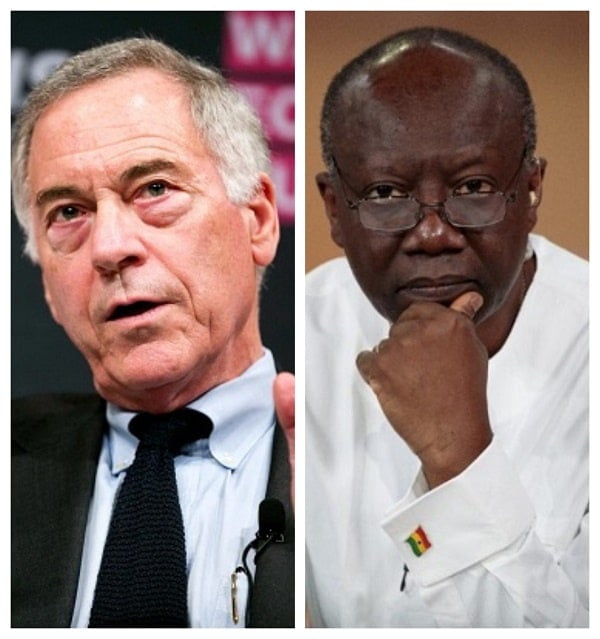
Finance Minister Ken Ofori-Atta has come under fire from US Professor of Economics, Steve Hanke for what he describes as assigning blame for Ghana’s current economic distress.
According to Prof Steve Hanke, Mr Ofori-Atta is denouncing the role he has played in Ghana’s debt worsening.
Ghana is yet to receive a $3 billion credit facility from the International Monetary Fund (IMF) due to delay in receiving assurance from its external creditors.
Responding to the issue, Prof Hanke said “Ghana’s Finance Minister, Ken Ofori-Atta is disappointed that foreign lenders had been ‘slow to act’”.
As 33 African countries suffer from record debt burdens, Ghana’s finance minister, Ken Ofori-Atta, is disappointed that foreign lenders had been 'slow to act.' Instead of recognizing MISMANAGEMENT, he's blaming the CREDITORS for Ghana's debt burden. https://t.co/j1BT2zmNvC
The debt-to-GDP ratio is a measure of a country’s debt in relation to its economic output. A high debt-to-GDP ratio indicates that a country may have difficulty paying back its debt and may be at risk of default. In the case of Ghana, the IMF is projecting that the country’s debt-to-GDP ratio will increase further to 98.7% by the end of 2023, which is a cause for concern.
To address this issue, the Ghanaian government will need to focus on rebuilding fiscal buffers. Fiscal buffers are essentially financial reserves that a government can draw upon in times of economic stress, such the Sinking Fund and Heritage Fund established by the erstwhile NDC government. Unfortunately, most of these funds have been depleted. These buffers provide a cushion that can help the government to maintain essential services and prevent social unrest during times of economic uncertainty as the Ghana faces now.
Developing credible risk-based fiscal frameworks is one way to promote growth and rebuild fiscal buffers. A risk-based fiscal framework involves identifying and mitigating potential risks to a country’s economy. This might involve implementing measures to reduce inflation, improving tax collection, and investing in infrastructure that can support economic growth. But this can only be achieved by cutting inefficiency in government spending and reviewing all if not most government flagship programs. What about the size of government?
By prioritizing the development of credible risk-based fiscal frameworks, the Ghanaian government can help to ensure that the country’s economy remains stable and resilient, even in the face of economic uncertainty. This can help to promote economic growth and development in the long run, while also reducing the risk of default and ensuring that the government can continue to provide essential services to its citizens.
Developing a risk-based fiscal framework for Ghana would involve identifying potential risks to the country’s economy and implementing measures to mitigate those risks. Here are some steps that the Ghanaian government could take to develop a risk-based fiscal framework:
Conduct a risk assessment:
Conducting a comprehensive risk assessment is a critical first step in developing a risk-based fiscal framework for Ghana. This involves a systematic and thorough analysis of the economy to identify potential risks to growth and stability.
Here are some of the factors that the ministry of finance may consider when conducting a risk assessment:
Inflation: High and volatile inflation can be a major risk to economic growth and stability which currently is 45% from the hight of 54%. The government may analyze trends in inflation and inflation expectations, as well as the factors that are driving inflation in the economy. BoG’s government financing is a major factor in inflation drivers.
Exchange rates: Fluctuations in exchange rates can impact trade and investment flows, and can also affect the value of the country’s external debt. The government may analyze trends in exchange rates and the factors that are driving those trends, such as changes in global interest rates or shifts in international trade patterns and the depreciation of the Ghanaian local currency, the cedi.
Commodity prices: Ghana is a major exporter of commodities such as gold, cocoa, and oil. Fluctuations in commodity prices can have a significant impact on the economy. The government may analyze trends in commodity prices and the factors that are driving those trends, such as changes in global demand or supply.
Political instability: Political instability can create uncertainty and negatively impact economic growth. The government may analyze trends in political stability and the factors that are driving political instability in the country especially after the debt exchange program.
External shocks: External shocks such as natural disasters, global pandemics, or financial crises can have a significant impact on the economy. The government may analyze the potential impact of different types of external shocks on the economy, and develop contingency plans to mitigate those risks.
Overall, conducting a comprehensive risk assessment will help the NPP government to better understand the potential risks to the economy and develop a more targeted and effective risk-based fiscal framework.
By identifying and mitigating potential risks, the government can help to promote economic stability and growth, which will benefit the people of Ghana especially the vulnerable who are the worse hit by the current economic crises.
Prioritize risks
Once the government the MoF has conducted a comprehensive risk assessment, the next step is to prioritize the identified risks. Prioritizing risks involves assessing the likelihood of each risk occurring and estimating the potential impact it could have on the economy.
Prioritizing risks helps the government to focus its resources and attention on the most critical risks, and to develop targeted risk management strategies that are appropriate for each risk.
Here are some factors that the government may consider when prioritizing risks:
Likelihood of occurrence: The government may assess the likelihood of each risk occurring, taking into account historical trends, current economic conditions, and other relevant factors.
Potential impact on the economy: The government may estimate the potential impact that each risk could have on the economy, considering factors such as the magnitude of the shock, the duration of the impact, and the potential ripple effects on other sectors of the economy.
Interconnectedness: The government may consider the interconnectedness of different risks and how they could interact with each other to create greater or lesser risk.
Strategic importance: The government may consider the strategic importance of different sectors or industries to the economy and prioritize risks that could have a particularly significant impact on these areas.
Fiscal capacity: The government may consider its fiscal capacity to manage different risks, and prioritize risks that it has the resources and tools to manage effectively.
By prioritizing risks, the government can focus its efforts on developing risk management strategies that are appropriate for each risk. This will help to ensure that the most critical risks are effectively managed, and that the economy remains stable and resilient in the face of uncertainty.
Develop a risk management plan
After identification and prioritization of the risks to the economy, the next step is to develop a risk management plan. A risk management plan is a set of specific measures that are designed to mitigate the identified risks and minimize their potential impact on the economy.
At this juncture, some steps that the government may take when developing a risk management plan:
Develop specific measures for each risk: The government should develop specific measures for each identified risk that are appropriate for the nature of the risk. For example, if inflation is identified as a risk, the government might implement measures such as tightening monetary policy or reducing government spending to curb inflationary pressures and implementation of zero financing of government deficit.
Define roles and responsibilities: The government should define the roles and responsibilities of different stakeholders involved in the risk management plan, such as the central bank, finance ministry, and other relevant agencies like the financial stability council.
Establish targets and indicators: The government should establish specific targets and indicators that will be used to monitor and evaluate the effectiveness of the risk management plan.
Determine resource requirements: The government should determine the resources that will be required to implement the risk management plan, such as funding, personnel, and equipment.
Establish a monitoring and evaluation framework: The government should establish a monitoring and evaluation framework to track the implementation of the risk management plan and assess its effectiveness over time.
By developing a risk management plan, the government can take proactive steps to mitigate the identified risks and promote economic stability and growth. The risk management plan should be regularly reviewed and updated as new risks emerge or as the economic landscape changes.
Monitor and evaluate Risk Management Plan
Regularly monitoring and evaluating the effectiveness of the risk management plan is a critical step in ensuring that the plan remains relevant and effective over time. This involves measuring progress against established targets and indicators, and making adjustments to the plan as needed based on feedback and performance data.
Here are some key activities that the government should undertake to monitor and evaluate the effectiveness of the risk management plan:
Regular reporting: The government should establish a regular reporting schedule to track progress against established targets and indicators, and provide updates on the implementation of specific risk management measures.
Data collection and analysis: The government should collect and analyze relevant data on key economic indicators such as inflation, exchange rates, and commodity prices, as well as on specific risk management measures that have been implemented.
Performance reviews: The government should conduct periodic reviews of the performance of the risk management plan, assessing its effectiveness in mitigating identified risks and promoting economic stability and growth.
Stakeholder engagement: The government should engage with stakeholders, including the private sector, civil society, and international partners, to gather feedback on the effectiveness of the risk management plan and identify areas for improvement.
Continuous improvement: The government should use the feedback and data gathered through monitoring and evaluation activities to continuously improve the risk management plan over time.
By regularly monitoring and evaluating the effectiveness of the risk management plan, the government can ensure that the plan remains relevant and effective in mitigating identified risks and promoting economic stability and growth. This will enable the government to make timely adjustments to the plan as needed, and to continuously improve its performance over time.
Communicate with stakeholders
Communicating with stakeholders is an important step in building confidence in the economy and promoting investment. The Ghanaian government should communicate the risk-based fiscal framework and the measures being taken to mitigate identified risks to key stakeholders, including investors and international organizations like the IMF and world bank.
Here are some key activities that the government should undertake to communicate with stakeholders:
Develop a communication strategy: The government should develop a comprehensive communication strategy that outlines key messages and target audiences, as well as the channels and tools to be used to communicate with stakeholders.
Engage with investors: The government should engage with investors, including domestic and international investors, to communicate the risk-based fiscal framework and the measures being taken to mitigate identified risks. This might involve holding investor briefings, publishing regular economic updates, and engaging with the financial media.
Communicate with international organizations: The government should also communicate with international organizations such as the IMF to provide updates on the implementation of the risk-based fiscal framework and seek feedback on its effectiveness.
Engage with civil society: The government should engage with civil society organizations and other stakeholders to communicate the importance of the risk-based fiscal framework and the measures being taken to mitigate identified risks.
Provide regular updates: The government should provide regular updates on the implementation of the risk-based fiscal framework, including progress against established targets and indicators.
By communicating with stakeholders, the government can build confidence in the economy and promote investment. This will help to ensure the sustainability of the country’s debt and support long-term economic growth and development.
Conclusion
In conclusion, the IMF projection of Ghana’s Debt to GDP Ratio increasing to 98.7% by the end of 2023 underscores the urgent need for the Ghanaian government to prioritize rebuilding fiscal buffers. Developing a credible risk-based fiscal framework that promotes growth is critical to achieving this goal.
The government should conduct a comprehensive risk assessment of the economy, prioritize identified risks, develop a risk management plan, and regularly monitor and evaluate its effectiveness.
The government should also communicate the risk-based fiscal framework and the measures being taken to mitigate identified risks to key stakeholders, such as investors and international organizations like the IMF, to build confidence in the economy and promote investment.
By implementing a comprehensive risk-based fiscal framework and prioritizing the rebuilding of fiscal buffers, the Ghanaian government can mitigate identified risks, promote economic stability and growth, and ensure the sustainability of the country’s debt in the long term.
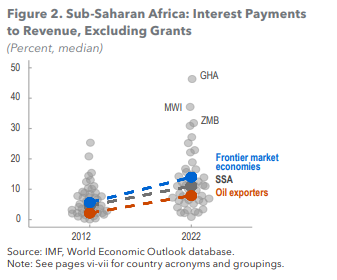
According to the International Monetary Fund’s April 2023 Regional Outlook Report, Ghana used over 45% of its total revenue, excluding grants, to pay interest in 2022.
This pushed the nation to the top spot in Sub-Saharan Africa.
The high interest payments was due to the elevated public debt of the country estimated at 575 billion or $44 billion as of November 2023.
Though the government suspended interest payments on some selected external debts, the interest costs of domestic debt was very high.
Now, the interest payments to be paid this year will depend on a successful external debt restructuring with its creditors – bilateral, multilateral and Euro bondholders.
This may lead to suspension of some of the interest payments or extend the maturity period.
The government in 2023 announced it was highly debt distress, leading to a debt restructuring programme.
Meanwhile, Malawi and Zambia placed 2nd and 3rd respectively in Africa with the highest interest payments in 2022.
They were expected to have spent about 37% and 31% of their revenue excluding grants to pay interest payment.
Sub-Saharan Africa’s public debt ratio at 56% of GDP reaches alarming levels
The IMF said sub-Saharan Africa’s public debt ratio at 56 percent of Gross Domestic Product in 2022—has reached levels last seen in the early 2000s.
“Since the pandemic, the debt increase has been driven by widening fiscal deficits because of overlapping crises, slower growth, and exchange rate depreciations”, it added.
Furthermore, the Fund said elevated public debt levels have raised concerns about debt sustainability, with 19 of the region’s 35 low-income countries already in debt distress or facing high risk of debt distress in 2022—the same situation reported in the October 2022 Regional Economic Outlook: Sub-Saharan Africa.
Government spent ¢33.61bn on interest payments in 2021
In 2021, the government spent ¢33.61 billion on interest payments, the Bank of Ghana Monetary Policy Report disclosed.
According to the report, domestic interest payments accounted for 78.9% of the total interest payments. Total interest payments, however, constituted about 50.4% of domestic revenue.
The government’s newest alternative offer to include pension funds in the current debt restructuring has been rejected by the University Teachers Association of Ghana (UTAG).
Government has said, the decision to include pension funds in the programme is aimed at alleviating the cash constraints on the government in the coming years, while fully compensating the Pension Funds for the value of their current holdings.
But in a memo, UTAG said any move to add pension funds in the debt restructuring programme will overburden its already poor members.
“We are still unable to participate in any intervention that would worsen the plight of the already impoverished Ghanaian University Lecturer. We therefore write to unequivocally reject the request to use our Pension Funds i.e GUSS, SSNIT and any other pension fund that affect our members for the new alternative proposed offer by government.”
“his request by the government comes after organized labour fiercely rejected the inclusion of pension funds in the Domestic Debt Exchange programme.
“We warn that governmental intransigence in this matter would not be countenanced as we are willing to fight to ensure that no one robs our members of their pensions funds”, UTAG added in its statement.
What Finance Minister has been saying
The Minister of Finance, Ken Ofori-Atta had explained that the proposal has been “crafted to facilitate the execution of the MoU, addressing the Government financial needs while maintaining the value of the pension funds.”
“The proposed offer entails exchanging your current holdings of Treasury Bonds, ESLA bonds and Daakye Bonds for a menu of the currently outstanding New Bonds (issued in February 2023 and maturing in 2027 and 2028 respectively. New Bond 2027 and New Bond 2028 featuring an average coupon of 8.4 % with a ratio of 1.15x, thus entailing an increase in patrimonial value.”
“This complemented by an additional cash payment of 10% (strip coupon). The stream of coupons to be received as part of this proposal will therefore be 21% compared to the current 18.5% of the outstanding old bonds,” he added.
He further indicated that “in 2023 and 2024, both instruments will pay 5% coupon in cash and the remainder will be capitalized into the nominal amount of the two bonds in order to comply with the cash constraints and the macro-framework defined under the programme with International Monetary Fund(IMF).”
He says the alternative offer has been designed to “(i) achieve the same average maturity as pension funds current holdings of the old bonds (currently between 4 and 5 years), (ii) achieve a similar average coupon (currently at 18.5%) while(iii) alleviating the cash constraints for the government over the first two years.”
The Finance Minister thus urged the Board of Trustees of pension funds to consider the proposal, indicating that “government is targeting to settle the offer by end of April 2023.”
Former President John Dramani Mahama has for the umpteenth time accused the Akufo-Addo led administration of gross economic mismanagement.
He says government must take full responsibility for the economic hardship Ghanaians are facing and focus on expenditure reduction.
“Ghana is currently on her knees for a bailout with the International Monetary Fund (IMF) amidst intensifying hardships, rising cost of living and a depreciating cedi,” he said.
Mr Mahama, contesting the flagbearer position of the National Democratic Congress (NDC), was addressing party executives in the Krachi East Constituency on his campaign tour.
He urged the Government to focus on social intervention programmes and reduce expenditure, taking into consideration that the present IMF programme would be different from all bailouts the country had ever engaged in.
“This will be the first of its kind the nation embarks on an IMF programme with debts restructure”.
He said the NDC’s greater concern was that the Government rejected every reasonable and constructive suggestion from others on working together for economic improvement.
“Government must stop blaming the Ukraine-Russia war for the economic hardship in the country and explain the exact challenges to the citizenry,’’ he said.
Former President Mahama is expected to visit Krachi, Nkwanta North, Nkwanta South and end his campaign tour at the Akan Constituency in the Kadjebi District.
The three new tax bills passed by parliament late last month have now been signed into law by President Nana Addo Dankwa Akufo-Addo.
This was confirmed by information minister Kojo Oppong-Nkrumah in an interview on April 16, 2023 with Accra-based Joy News.
He told Emefa Apau on The Probe programme that the president’s lawyer Kow Essuman confirmed the assent and said the document has since been deposited with the Clerk of Parliament for other processes.
Oppong-Nkrumah is currently part of the government delegation attending Spring Meetings of the World Bank and International Monetary fund in Washington DC.
The three new taxes are: Excise Duty Amendment Bill 2022, the Growth and Sustainability Levy Bill, 2022, the Ghana Revenue Authority Bill 2022 and the Income Tax Amendment Bill 2022.
The bills were presented to Parliament as part of government’s plans to raise about 4 billion Ghana Cedis annually in domestic revenue mobilisation.
They are also crucial to help secure Board Approval for the US$3 billion International Monetary Fund (IMF) Programme after a staff-level agreement was reached late last year.
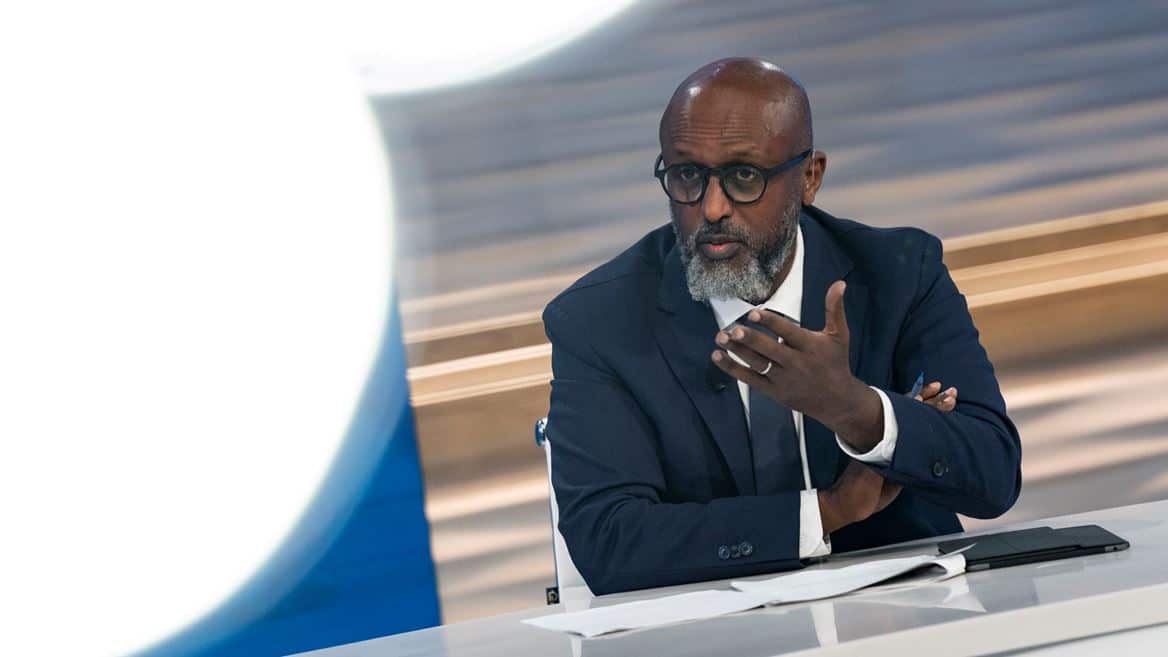
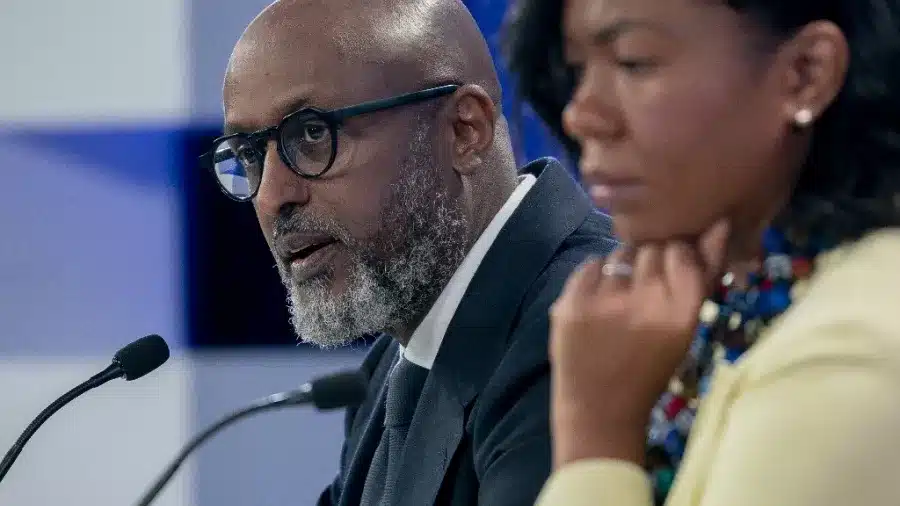
Abebe Aemro Selassie, the director of the IMF’s Africa Department, has revealed that all requirements have been completed by Ghana for the executive board to approve its request for a program, with the exception of financial assurance from external creditors.
He maintained that “we are now comfortable that all of the measures required for us to present the program to our Executive Board are complete, except for the required financing assurances from Ghana’s external creditors.”
Mr. Abebe stated that the staff will move swiftly to submit Ghana’s programme request to the executive board for approval as soon as Ghana obtains this finance certainty from the external creditors.
He added “And we are now comfortable that all of the measures required for us to present the program to our Executive Board are complete, except for the required financing assurances from external creditors.”
The IMF African Department Director disclosed this in response to a question posed by JoyBusiness in Washington DC USA at the launch of the Regional Outlook Report for Africa.
He therefore entreated Ghana’s creditors to fast-track negotiations by providing the financing assurance needed so the IMF can go to the board for Ghana’s programme approval.
“This is why we are also urging creditors to step forward and provide the financing assurances needed for us to present the program to the Board as soon as possible.
The IMF Africa Boss noted that they are very optimistic and keeping their fingers crossed this will happen in the next few weeks.
Asked about government’s commitment to the programme, Mr Abebe noted that “We are very encouraged by the steps that the government has taken over the last several months since the program request.
He also added that Government has taken several measures that support the programme approval by the board .
“It’s been a very difficult time of course, very difficult, very significant, measures that have had to be taken, and the initial steps that the government has taken are very encouraging.”
“Again, to look back to where I started, we’re very comfortable where –- with all the steps that Ghana has done” he added.
The government’s economic management team who have left for Washington to discuss concerns pertaining to its International Monetary Fund(IMF) program have no strategy this is according to managing partner of Ishmael Yamsom and Associates, Michael Harry Yamson.
According to him, despite having responded to various demands by the external creditors, the government has not communicated effectively with the citizenry its plans concerning the programme.
“Government didn’t seem to leave here with a game plan. Andgovernment has not been consistent in communicating its own game plan with Ghana. We are hearing government respond to the external partners are demanding. Ghana itself does not have a game plan.
“That for me is very obvious. Otherwise there shouldn’t even have been a hint of going back to pensioners,” he said on JoyNews’ Newsfile on Saturday 15.
Mr. Yamson lamented the demand of external creditors that requests Ghana to include domestic bondholders in its debt restructuring exercise. According to him, the approach sorts to exacerbate living conditions in the country.
He added that there is a lack of understanding about what the situation means for the average Ghanaian.
According to him, “if Washington and the externals care so much about Ghanaian citizens and living standards, then the question becomes how do you ask the government to come back and destroy household incomes in the name of debt restructuring?”
Mr. Yamson also highlighted the lack of political consensus on government’s inability to generate sufficient tax revenue while in pursuit of an IMF programme. He said the government should have engaged the two major political parties in order to solve tax revenue issues.
He expressed that government ought to have tried solving internal issues before heading for negotiations in Washington.
However, reporting live from Washington, George Wiafe of JoyNews indicated that things are looking quite positive for Ghana as personal engagements with some officials at the meeting show that the country has met almost every requirement for the programme.
“I had an interaction with one person yesterday who is one of the critical actors in Ghana’s programme, in terms of approval and all the rest. Ghana has met everything.
“The only issue right now is the external creditors which they believe that based on the behind-the-scenes engagement that they are also having with these creditors, it appears that these creditors will come on board to approve Ghana’s programme,” he said.
The Finance Minister, Ken Ofori-Atta, has identified five crucial steps that will guarantee Ghana’s success in obtaining financial assistance from the IMF.
At the ongoing IMF/World Bank Spring Meetings in Washington, D.C., USA, the minister provided an overview of these in the Investors’ Presentation.
Electricity tariff hikes
Ghanaians have experienced a continuous hike in electricity and water tariffs since August 2022. According to the government, the tariff increments were necessary to ensure that the Electricity Company of Ghana and Ghana Water Company operate efficiently.
The tariff hikes since then have accumulated to an increase of about 60%. Ofori-Atta noted that this was a necessary condition for Ghana to move ahead with its talks with the International Monetary Fund.
Revenue enhancing measures, including an increase in VAT, E-Levy review
The government, in the 2023 Budget, announced an increment in the VAT rate from 12.5 percent to 15.0 percent, which subsequently took effect on January 1, 2023. Also, the rate for the Electronic Transaction levy was reviewed from 1.5% to 1%. Also, the government is looking to implement some new taxes, including lottery and bet tax, amended excise duty, withholding taxes, etc.
An ambitious 2023 budget
This includes reaching a 1.5% of Gross Domestic Product primary surplus in the medium term, bringing inflation below 8% in the medium term, and restoring external buffers with gross international reserves reaching 3 months of import cover by 2026.
This also includes the government achieving a real Gross Domestic Product growth target of 5% over the medium-term and enhancing competitiveness with exports surpassing 37% of GDP in the medium run.
Another key measure is to ensure fiscal and debt sustainability.
Ofori-Atta said the government is committed to rebuilding reserve buffers, mobilizing external concessional financing from multilateral and bilateral partners, and suspending external debt service payments.
However, the minister assured that government will safeguard social protection programmes and ensure the burden of adjustment is fairly distributed.
“It will reinforce and improve the targeting of social spending to protect the most vulnerable from the impact of the economic crisis, as well as fast-track the implementation of growth-oriented socio-economic policies, such as Ghana CARES, to mitigate the impact of the pandemic and support economic recovery,” the minister said.
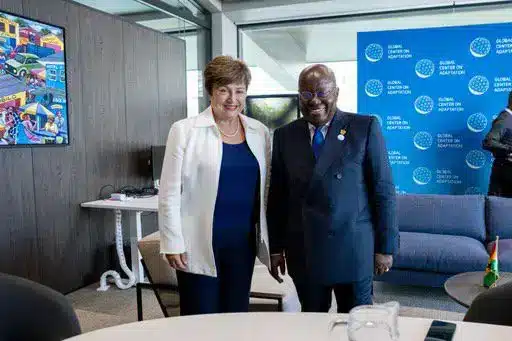
Managing Director of the International Monetary Fund (IMF), Kristalina Georgieva, has assured Ghanaians that the Fund will be working expeditiously to approve the country’s request to obtain a credit facility worth $3 billion.
Engaging stakeholders during the Spring Meetings of the World Bank Group (WBG) on Thursday, Madam Georgieva she expressed optimism about creditors giving Ghana the go ahead to finalise its deal with the Fund.
“To tell you the truth, I am actually quite optimistic. Ghana is going to move; the creditors are going to move; and we (the IMF) are going to move swiftly… so stay tuned and stay positive,” she said.
Her assurance comes amid ongoing discussions between Ghana and its creditors over its debt situation. Ghana’s debt-to-GDP ratio has increased to over 90%, leading to concerns about its ability to repay its loans.
However, Madam Georgieva said the IMF is committed to supporting Ghana’s economic recovery and will work closely with the government and other stakeholders to address the country’s debt challenges.
“We know that Ghana has a strong track record of economic growth and has made significant progress in reducing poverty in recent years,” Georgieva said. “We believe that with the right policies and support, Ghana can overcome its current challenges and continue on a path of sustainable development.”
She also praised the Ghanaian government’s efforts to implement economic reforms, saying that they have taken “difficult but necessary steps” to address the country’s fiscal imbalances.
Madam Georgieva added that, the IMF is committed to providing technical assistance and policy advice to help Ghana implement its economic reform programme.
British Chancellor Jeremy Hunt claims that the country’s economy is “back” and that the Washington meeting of the International Monetary Fund (IMF) has praised his growth strategy.
Following a barrage of criticism, his predecessor Kwasi Kwarteng departed the previous IMF meeting in October early.
According to Mr. Hunt, the international lending organization noticed that he was “putting the British economy back on the right track”.
The UK economy, according to the most recent data, did not expand in February.
The IMF predicted on Wednesday that the UK economy will contract by 0.3% in 2023, ranking it among the worst-performing of the world’s major countries.
When challenged over whether the UK’s current performance undermined his positive message, Mr Hunt said: “It’s other finance ministers who are telling me Britain is back”.
Britain’s economy has only just recovered to the size it was prior to the pandemic, following months of industrial action, rapidly rising prices and labour shortages.
On Friday nurses in the RCN union rejected the offer of a 5% pay rise and said they planned to strike again at the start of May. Meanwhile, NHS junior doctors in England are currently staging a four-day walkout over pay, ending at 07:00 on Saturday.
The wave of industrial action affecting the UK in recent months has contributed to its lack of growth, the Office of National Statistics said this week.
However, Mr Hunt said it was important to avoid fuelling further inflation through pay rises. He said Britain had avoided recession this year “so far”, and that he hoped to see faster growth and falling inflation in the months ahead.
Measures in his March Budget to help businesses recruit more staff and to increase investment, including an increase in childcare funding, should stimulate growth, he added.
Investor confidence in the UK was shaken last year during the short-lived government of prime minister Liz Truss, which saw Mr Kwarteng present an economic strategy that included major tax cuts without an explanation of how they would be funded.
The outlook for the UK, which relies heavily on financial services, could be clouded by current uncertainty in the banking sector, following the collapse of three US banks and UBS’s emergency takeover of Credit Suisse.
However, Mr Hunt said the UK had “a very robust, resilient banking system”, which was now in a much better position than it was before the 2008 financial crisis.
“Am I confident in the resilience of our banking system, the second largest financial services centre in the world?’ Yes, I am,” he said.
While the government is considering reforming some of the rules governing financial services, put in place after 2008, Mr Hunt said the plan was “absolutely not to unlearn the lessons of the financial crisis”.
“We are looking at all of these things, but we’re not going to do it in a way that rows back on any of the very important protections that we have in place,” he said.
But he said the growth of the UK’s tech and life sciences industries meant regulations needed to adapt.
“We have a lot of high growth companies in the UK, and they need to have banking services that suit their needs. And that’s a difference from a decade ago,” he said.
The IMF predicted in a press briefing on April 13, 2023 that growth in sub-Saharan Africa will drop to 3.6 percent in 2023 due to a “big funding squeeze” brought on by the region’s inability to access private financing and the drying up of aid.
If no measures are taken, this shortage of funding may force countries to reduce fiscal resources for critical development like health, education, and infrastructure, holding the region back from developing its true potential.
“I wish I was bearing better news, but unfortunately, we’re expecting growth to decelerate from 3.9 percent to 3.6 percent in 2023. And this to a large extent reflects the big funding squeeze tied to drying up of aid and access to private finance” said Abebe Aemro Selassie, Director of the IMF’s African Department.
Sub-Saharan African countries lag significantly in revenue collections, with a median tax ratio of only 13 percent of GDP in 2022, compared with 18 percent in other emerging economies and developing countries and 27 percent in advanced economies.
“So, there are a number of reforms that need to be pursued. I think first and foremost, of course, is policies to strengthen the resilience of economies. So, many countries, for example, there’s a big challenge on mobilizing more domestic revenues. That needs to be addressed wherever that’s the main challenge. Second, I think it’s also important to consider policies to insulate domestic economies from external environment. So, allowing exchange rates to adjust, interest rates to be recalibrated, to reflect better to reduce inflation are all going to be very important part of the policy response to this adverse external environment,” added Selassie.
The IMF has provided the region with around $50 billion dollar in financing since the start of the pandemic and will continue to work with the region to put in place the right type of policies that are tailor-made to each country’s needs.
“We are engaging like never before with the region. Of course, over the last couple of years, we’ve provided considerable financing to the tune of around $50 billion to support the region. Whether the very difficult economic environment that was facing and we continue to try and provide as much financing as possible to support countries in the coming months. As important, however, of course, are policies and reforms that needs to be pursued by countries, and we are deeply engaged with working with countries to navigate and to put in place the right types of policies in each individual country,” said Selassie.
Finance Minister, Ken Ofori-Atta, has hinted at hikes in electricity tariffs and tax reforms.
These were made known by the Minister as he outlined five key measures necessary for the government to pursue in order to secure an International Monetary Fund (IMF) support programme.
They are electricity tariff hikes which have brought the cumulative increase to 60% since August 2022 and Comprehensive set of revenue-enhancing measures, including increase in the Value Added Tax rate and the review of the Electronic Transaction Levy (E-levy).
The rest are the enactment of an ambitious 2023 Budget, with a frontloading of the fiscal consolidation programme, continued monetary policy tightening to bring inflation under control and comprehensive set of structural reforms, notably public expenditure review.
These were captured in the Investors Presentation by the Finance Minister and supported by the Governor of the Bank of Ghana, Dr. Ernest Addison.
With regard to fiscal and debt sustainability, the Finance Minister said the government has undertaken fiscal adjustment with revenue and expenditure measures to improve debt sustainability and restore macroeconomic stability.
This is expected to address structural bottlenecks including contingent liabilities of State Owned Enterprises, commitment controls and arrears accumulation as well as domestic revenue mobilization.
On monetary and financial sector reforms, Mr Ofori-Atta said government is committed to rebuilding reserve buffers, mobilize external concessional financing from multilateral and bilateral partners, and suspend external debt service payments.
With regard to social protection and structural reforms, the Finance Minister said government will safeguard social protection programmes and ensure the burden of adjustment is fairly distributed.
Again, it will reinforce and improve the targeting of social spending to protect the most vulnerable from the impact of the economic crisis as well as fast-track the implementation of growth-oriented socio-economic policies, such as Ghana CARES to mitigate the impact of the pandemic and support economic recovery.
Government outlines 5 ambitious macroeconomic targets
Meanwhile, the government has outlined five ambitious macroeconomic objectives in the medium term as part of securing a programme from the International Monetary Fund.
They are reaching a 1.5% of Gross Domestic Product primary surplus in the medium term, bringing inflation below 8% in the medium-term and restoring external buffers with gross international reserves reaching 3 months of import cover by 2026.
The rest are reaching a real Gross Domestic Product growth target of 5% over the medium-term and enhancing competitiveness with exports surpassing 37% of GDP in the medium run.
Finance Minister, Ken Ofori-Atta, says Ghana should expect an International Monetary Fund (IMF) Board approval for a programme by the close of May 2023.
According to him, Ghana has made significant progress, hence the need for it to get approval as soon as possible.
Addressing Eurobondholders at an Investors Presentation Forum by the Republic of Ghana, Mr. Ofori-Atta called on external creditors to support Ghana’s quest in securing the programme.
“We do at this time expect an IMF board approval in May [2023] and contemplate a rapid negotiation of a Memorandum of Understanding (MoU) with our creditors. We have made significant efforts on all fronts. We hope we could reach an agreement in principle with you our Eurobond holders quickly”.
“We understand this is a challenging time for all of you to commit and offer a financial support to all of you. But please be assured we are fully committed with you and your advisors to ensure an equitable solution,” he said.
Mr. Ofori-Attasaid access to the international capital market is key on the agenda of government to restore macroeconomic stability.
He maintained that government is committed to fair debt treatment with its commercial creditors.
“Government intends to deepen the relationship with its external creditors. We reaffirm our commitment to work with our private and commercial creditors in all of our engagements,” he added
Mr Ofori-Atta and the Governor of the Bank of Ghana, Dr. Ernest Addison, are leading a high-level Ghana delegation to the World Bank and IMF Spring Meetings, ongoing in Washington D.C.
The government’s spokesperson for governance and security,Palgrave Boakye-Danquah is asserting that the government is systematically enforcing the provisions of the staff level agreement signed with the IMF and is certain that a solution will be struck by the end of the second quarter.
He was optimistic that Ghana will secure the $3 billion bailout from the IMF to improve the country’s economic situation due to the success of the local debt exchange scheme and the support obtained from other creditors.
“I am confident that with the cooperation we are receiving from the Paris Club members and the People’s Republic of China, which sent a delegation from China’s Exim Bank to France over the weekend to meet with officials of the Ministry of Finance, we will be able to go to the board of the fund to finally conclude the agreement by the end of the quarter,” Palgrave Boakye-Danquah told Kwaku Owusu Adjei on Adwenepa on Accra-based Original TV.
He claimed that the agreement with the Fund would pave the way for Ghana’s economy to rebound strongly.
Palgrave Boakye-Danquah asked the friends of the country to speak up at the Fund in favour of initiatives to stabilize the situation and reset the economy.
Ghana is currently seeking an IMF-support programme to the tune of $3 billion to revive its struggling economy.
The government in December 2022 reached a staff-level agreement with the Fund as part of processes leading to a bailout.
Parliament is represented by a nine-member in Washington DC as part of Ghana’s delegation attending the 2023 IMF/ World Bank Spring Meetings.
The delegation is led by MP for Obuasi West and chairman of the finance committee in Parliament, Kwaku Kwarteng.
The eight other members include:
* The vice-chair of the finance committee and MP for Okaikoi Yaw Boamah,
* Minority Leader in Parliament, Cassiel Ato Forson
* Member of Parliament for Oforikrom, Dr Emmanuel Marfo.
* Kennedy Osei Nyarko, chairman of the Roads and Transport, Member of Parliament for Mpraeso
* Davis Ansah Opoku,MP for Mpraeso
* Elvis Morris Donkoh, Member of Parliament for Abura-Asebu-Kwamankese,
* Betty Nana Efua Krosbi Mensah, Member of Parliament for Afram Plains North.
“The meeting is particularly important for us, Parliament as the institution that is responsible for oversight and for budget and also for legislation,” the Oforikrom MP told Accra-based Asaase Radio in an interview.
“Whatever priorities that the government have, we need to make sure that there is an appropriate budget for them. And we will also make sure that whatever commitment government makes, we are able to follow through to make sure they are done,” he stated.
Ghana’s delegation is led by Finance Minister Ken Ofori-Atta along with top finance ministry and Bank of Ghana officials.
Ofori-Atta and his team will be seeking to get assurances from bilateral and multilateral lenders with the view to getting IMF Board approval for a US$3 billion facility.
Government has already got a staff-level agreement in place since late last year and is in the process of completing external debt restructuring after a contentious domestic debt deal was agreed months back.
The Ministry of Finance has said that the sector minister Minister Ken Ofori-Atta has had very productive meetings so far at the #SpringMeeting2023 with the International Monetary Fund (IMF), International Finance Corporation (IFC) and Japan International Cooperation Agency (JICA), among others.
“Grateful for the strong cooperation from our bilateral and multilateral partners!<” the Office of the Finance Minister tweeted on Wednesday, April 12.
The 2023 Spring Meetings of the Fund and the World Bank Group commenced on Monday, April 10 and are expected to end on Sunday, April 16 in Washington DC.
The theme for the programme of events is “Reshaping Development for a New Era”.
At the heart of the meetings is a discussion around the progress of the institutions.
The meeting brings together central bankers, ministers of finance and development, parliamentarians, private sector executives, representatives from civil society organizations and academics to discuss issues of global concern, including the world economic outlook, poverty eradication, economic development, and aid effectiveness.
Ghana hopes to take a big step towards restructuring its $58bn-worth of debt this week, with its bilateral creditors meeting on Tuesday to discuss whether to provide enough relief to unlock a $3bn IMF bailout.
Ghana owes $5.5bn to foreign governments and their state banks. Ken Ofori-Atta, finance minister, said he had “hope” those bilateral creditors would consent to enough debt relief to enable the country to tap an IMF loan package agreed upon last year.
“We hope on April 11 the Paris Club will meet with China present to provide financing assurances to the IMF,” he told the Financial Times. “This will be the defining input that [the IMF] will require to then go to their board.”
Commitments from bilateral creditors to provide debt relief are often the first step to unlocking an IMF-backed restructuring programme. The French Treasury, which hosts the Paris Club of bilateral creditors, said the group was “doing everything” to reach an agreement on the commitments required.
China, which is owed $1.9 billion, was expected by Ofori-Atta to agree to a deal, despite not being a member of the Paris Club.
Ghana stopped repaying most of its debts in December and reached a preliminary deal with the IMF on a rescue package in the same month.
But the IMF’s support is dependent on Ghana meeting a string of conditions, including measures to raise revenues through a rise in the rate of value-added tax, tariff increases on public utilities and an end to central bank finance for the government. The fund also asked Ghana to make progress on restructuring its domestic debts.
Ofori-Atta said the fund’s conditions had been met. “Those are literally all done, so we are pretty much there,” he said. “We have done what is required.”
Its restructuring talks are being closely watched by other low and middle-income countries who are in, or at risk of, default.
Zambia defaulted on its debts in 2020 and its debt restructuring — on which a $1.3 billion IMF programme depends — has stalled amid disagreement among its creditors. Sri Lanka defaulted last year and finally won the backing of the IMF for a $3bn bailout last month.
A breakthrough in Ghana’s debt talks could raise hopes of faster workouts in the restructuring of other countries’ debts in the future.
The IMF and World Bank have warned that a third of developing countries, including 60 per cent of low-income countries, have debts that are unsustainable or in danger of becoming so.
The pandemic, Russia’s war on Ukraine and last year’s surge in global inflation and in the value of the US dollar against other currencies have pushed many countries into economic crisis and to the brink of default.
Once bilateral lenders have promised enough relief to make a country’s debt sustainable, it is up to the borrower to seek similar terms from other lenders including bondholders and commercial banks.
Data from Ghana’s central bank show that the country had external public debts equal to 44 per cent of gross domestic product in September or about $34 billion, according to the IMF. Domestic public debts were equal to 32 per cent of GDP, or about $24 billion.
Ghana halted payments on most of its external debts in December and called on holders of about $11 billion of its domestic debt to take part in an exchange that would significantly reduce the cost of debt service. Holders of about 85 per cent of the eligible domestic debt had agreed to take part, Ofori-Atta said.
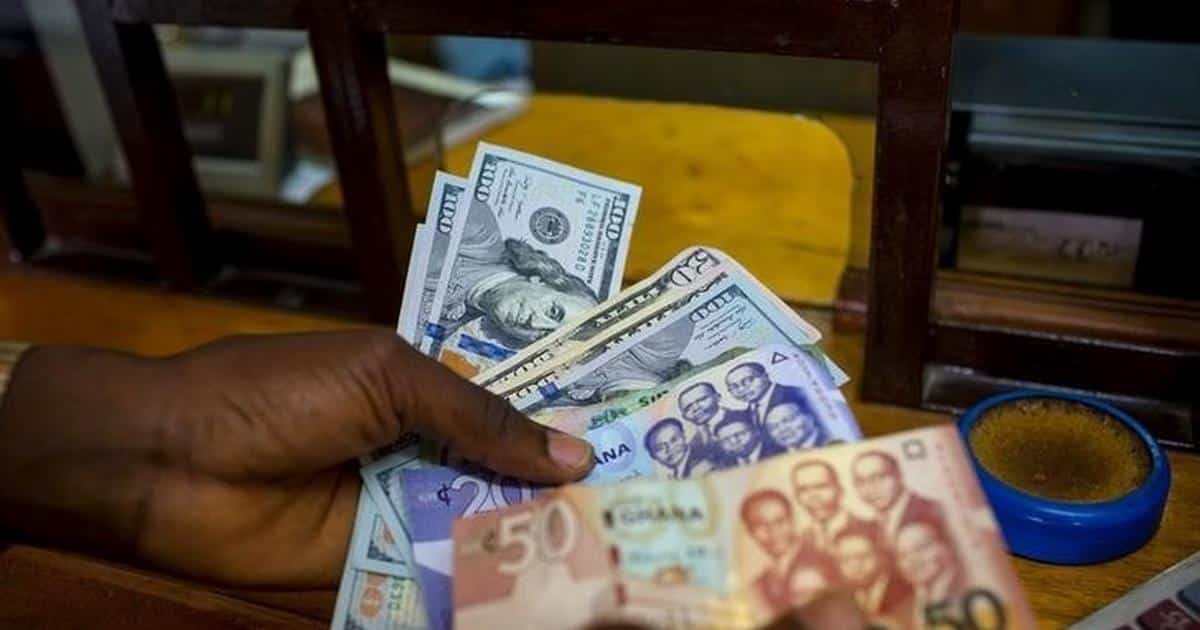
The Ghana Cedi (GHS) recently has witnessed some significant stability against the dollar and other foreign currencies.
Prior to this development, the local currency had been ranked among the worst performing currencies globally.
In October 2022, Bloomberg reported that Ghana’s cedi slumped to become the world’s worst-performing currency (that year) as investors continued to squeeze foreign capital to the west (West) African country before a deal with the International Monetary Fund (IMF).
On Monday, October 17, 2022 for instance, the currency of Ghana which is the world’s second-biggest cocoa producer, depreciated as much as 3.3%, before paring the loss to 11.2750 per dollar at 3:30 p.m in the capital Accra.
However, the currency has recently recorded some significant gains against other major currencies across the globe.
As of April 6, 2023, data from the Bank of Ghana indicated that the cedi is buying at 10.9245 per dollar and selling at 10.9355 per dollar. The cedi is also buying at 13.5890 per pound sterling and selling at 13.5964 per pound sterling. The currency is buying at 11.9380 per Euro as well as selling 11.9488 per Euro.
Here are eight possible factors that have contributed to the cedi’s appreciation.
Lower local demand for USD:
1. There is lower local demand for the US$ as a result of reduced global fuel prices. This means that fuel (Ghana’s biggest import) costs less in US$, thus, putting less pressure on the Ghana cedi.
2. There is also a reduced demand for US$ on imported goods evidenced by reduced activity at ports since January 2023.
USD depreciation against global currencies
3. In 30 days, the dollar depreciated by 2.18 % against the Euro.
4. The USD has also depreciated by 3.34 % against the Yen.
5. Also, the USD depreciated by 4.83 % against the Pound.
Investors no more moving Cedi funds to USD
6. As a result of the the cedi’s relative stability, investors are no longer moving cedi funds to US$.
7. DDEP has been concluded: On February 23, 2023, the Ministry of Finance announced the government’s successful settlement and conclusion of its Domestic Debt Exchange Programme (DDEP) in respect of the GHS-denominated notes and bonds, E.S.L.A. Plc or Daakye Trust Plc. This was achieved on Tuesday, 21st February 2023 (the “Settlement Date”).
A statement issued by the Public Relations Unit of the Ministry said, “This successful result is a significant achievement for the Government in the implementation of the economic strategies of the post-COVID-19 Programme for Economic Growth (PC-PEG) during this current economic crisis.”
8. Expectation of IMF deal by May 2023: Government is also expected to reach a deal with the IMF by May 2023.
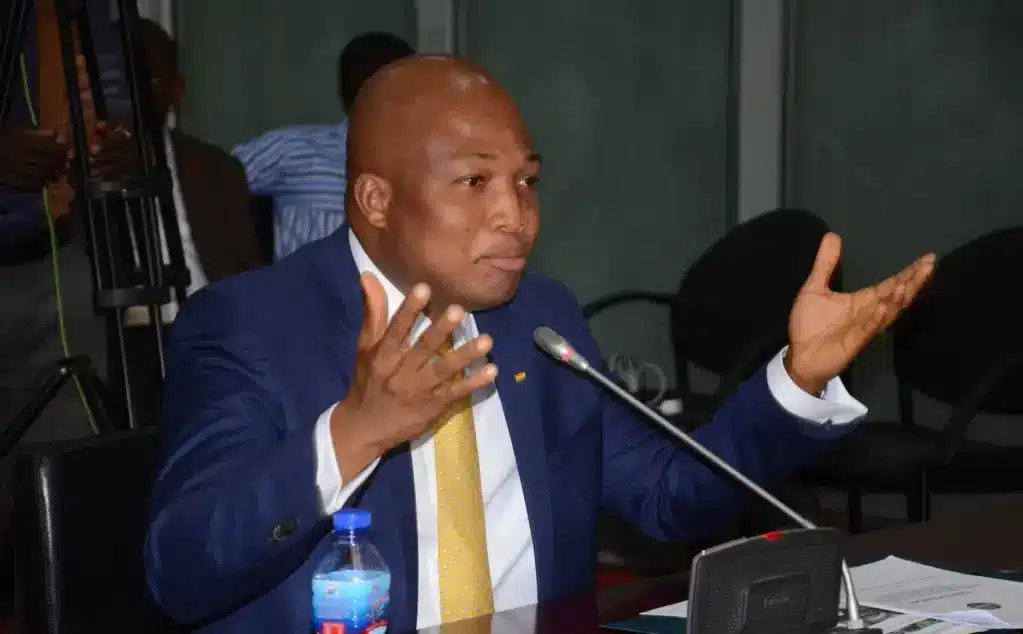
The Member of Parliament for North Tongu, Samuel Okudzeto Ablakwa, has proposed an amendment to Standing Orders (Order 174) to allow the opposition in parliament to head the government assurance committee.
The MP wonders why the government’s guarantee that the IMF deal will be completed by the end of March 2023 fell through.
He is also demanding that the government apologise to the people and explain why the assurance failed.
To end this, he has proposed for the assurance committee of parliament to be chaired by an opposition MP to provide for strict consequences for grand governmental deception.
He wrote “What should happen when a President and his top officials assure Parliament and the entire nation on multiple occasions that Ghana will secure an IMF bailout deal by March this year?
Should the citizenry, like their government functionaries pretend that March didn’t end five days ago?
Don’t Ghanaians deserve an apology and an explanation at the very least?
Is that the superior competence the Akufo-Addo/Bawumia/Ofori-Atta government proclaims?
Why did so many experts, civil society, and the opposition foresee that a March deal was ridiculously impossible, and yet President Akufo-Addo kept issuing firmer assurances including when he delivered his Message on the State of the Nation in Parliament?
Moving forward, there’s an urgent need to amend Parliament’s Standing Orders (Order 174) to expressly make an opposition MP the Chair of the Committee on Government Assurances and to provide for strict consequences for grand governmental deception. Leadership must respect the Ghanaian people.”
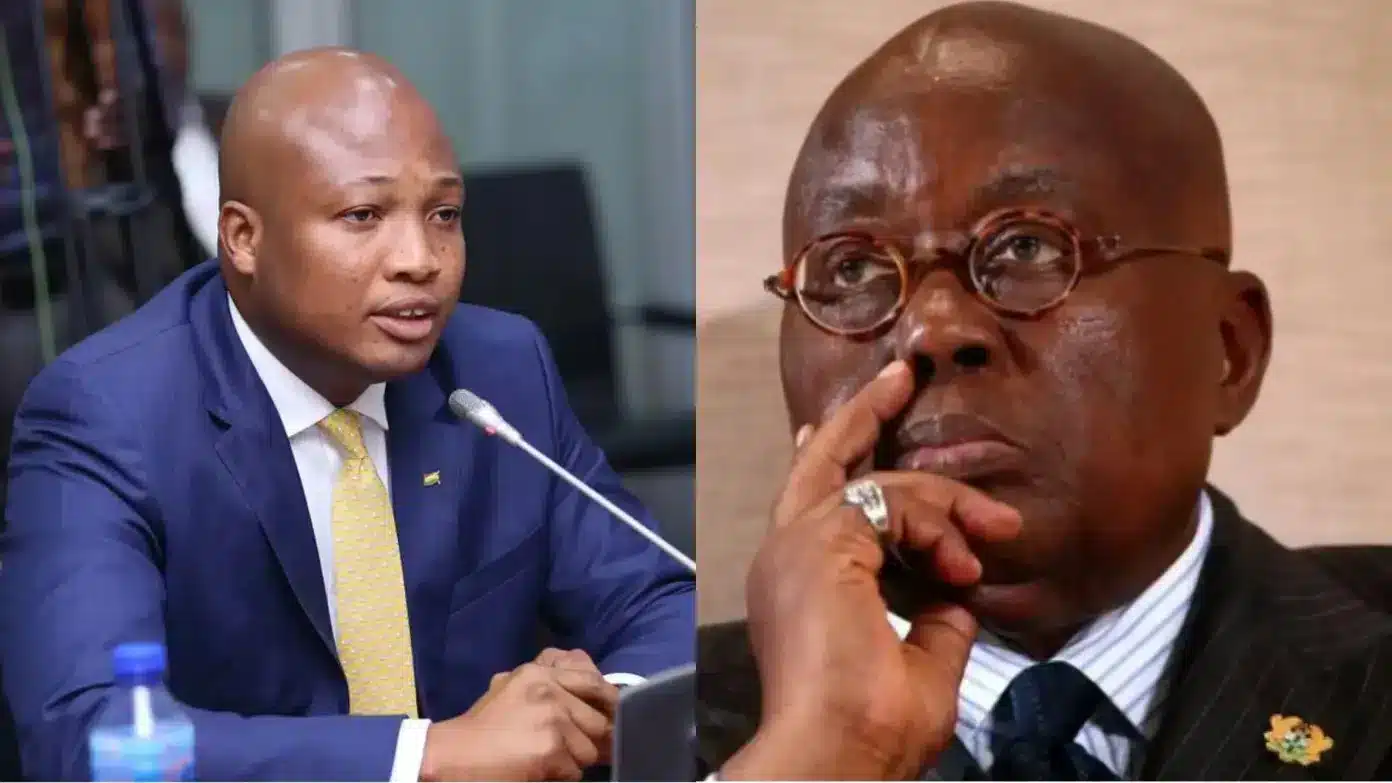
Member of Parliament for North Tongu, Samuel Okudzeto Ablakwa, has taken a swipe at President Akufo-Addo for raising the hopes of Ghanaians with regards to the period in which the country would obtain a credit facility worth $3billion from the International Monetary Fund (IMF).
Addressing members of the Diplomatic Corps at the Peduase Lodge in February, the president gave the assurance that the two parties will broker a deal by the end of March to ensure Ghana’s economy sees a recovery.
“I am confident that with the cooperation we have received from the members of the Paris Club and the People’s Republic of China, which sent a delegation from China’s EXIM Bank to Accra over the weekend to meet with officials of the Ministry of Finance, we shall be able to go to the Board of the Fund to conclude finally the agreement by the end of March,” he said.
However, it has been seven days since the deadline provided by the government elapsed and the government is yet to make a statement about the matter – a situation that has left the North Tongu MP dissatisfied.
In a social media post on April 5, 2023, Mr Ablakwa vented his spleen, arguing that the President Akufo-Addo-led government must answer to Ghanaians and provide reasons why Ghana is yet to conclude its engagement with the Fund.
“What should happen when a President and his top officials assure Parliament and the entire nation on multiple occasions that Ghana will secure an IMF bailout deal by March this year?
Should the citizenry, like their government functionaries, pretend that March didn’t end five days ago? Don’t Ghanaians deserve an apology and an explanation at the very least?” he quizzed.
“Leadership must respect the Ghanaian people,” the legislator added.
He insisted that the government must bear the brunt of its actions as it was cautioned by relevant stakeholders in the economy to be measured in its expectation of an IMF-credit facility in the shortest possible time.
“Why did so many experts, civil society and the opposition foresee that a March deal was ridiculously impossible, and yet President Akufo-Addo kept issuing firmer assurances including when he delivered his Message on the State of the Nation in Parliament,” Mr Ablakwa wrote.
To prevent such an incident from recurring, Mr Ablakwa has called for the amendment of Parliament’s Standing Orders (Order 174) to “expressly make an opposition MP the Chair of the Committee on Government Assurances and to provide for strict consequences for grand governmental deception.”
Background
The IMF staff and the Ghanaian authorities in December 2022, reached a staff-level agreement on economic policies and reforms to be supported by a new three-year arrangement under the Extended Credit Facility (ECF) of about US$3 billion.
This was six months after Ghana officially commenced engagement with the Fund.
Current challenge
Ghana has not been able to secure financing assurances from its partners and creditors. For this reason, it has been unable to present its programme request to the Executive Board for approval.
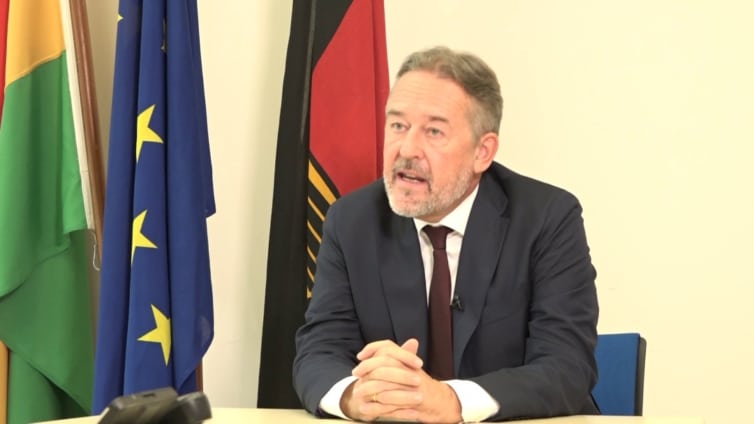
China, Germany are among the countries yet to give Ghana the green light. Per reports, China is Ghana’s single biggest bilateral creditor with $1.7 billion of debt. Finance Minister Ken Ofori-Atta is however optimistic that China would come on board.
What has been said about March deadline
The Finance Minister has warned that the economy would collapse should Ghana fail to secure an agreement with the IMF by March.
Currently, it cannot be said that the economy has collapsed, but the country is facing an economic crisis.
Meanwhile, Former Finance Minister, Seth Terkper, who stated that a March deadline was not achievable, is predicting the end of May 2023 as the likely date for which the Board of the International Monetary Fund will approve a programme for Ghana.
The current economic situation in the nation would have been worse under an NDC administration, according to Justin Frimpong Koduah, general secretary of the ruling New Patriotic Party (NPP).
The country has seen a downturn since 2022 with the government embarking on a debt restructuring exercise, and it’s also seeking a $3 billion bailout from theInternational Monetary Fund(IMF).
Speaking on Face to Face on Citi TV with Umaru Sanda Amadu, Mr. Koduah stated that Ghanaians still have confidence in the government despite the economic challenges expressing hope that they will break the eight in the 2024 polls.
The NPP’s chief scribe indicated that even without the impact of COVID-19 coupled with the Russian-Ukraine war, the NDC wouldn’t have been able to manage the economy.
“Ghanaians still have confidence in this government despite the economic challenges, because they know that between the NDC and the NPP, NPP are better managers of the economy than the NDC. Ghanaians also appreciate the fact that had it not been NPP in power, and if it were the NDC, the situation would have been worse off than what we are experiencing now. I’m telling you if NDC were in government, the situation would have been worse off”.
He added, “Even without any COVID-19 or Russian-Ukraine war, they [NDC] wouldn’t have been able to manage the economy well. We saw what happened under H. E. President John Mahama’s tenure– four years of ‘Dumsor, the scrapping of the teacher/nursing trainee allowances, among others”.
Mr. Koduah called on Ghanaians to exercise restraint assuring that the country will come out of the challenges soon.
He said Ghana had been touted as the fastest-growing economy before COVID-19 struck.
“Ghana was touted as the fast-growing economy in the world until COVID-19. At the end of the day, we will come out of the challenges, unlike the NDC which told Ghanaians that children should stay home and not be allowed to go to school during COVID-19. When we discovered oil, they termed it as coconut oil ‘adwengu’. The same NDC told Ghanaians that free SHS is not possible. Can you tell us that they are better managers of the economy than NPP?” the NPP chief scribe stated.
Parliament on Friday, March 31, passed the Excise Duty Amendment Bill 2022, the Growth and Sustainability Levy Bill, 2022, the Ghana Revenue Authority Bill 2022 and the Income Tax Amendment Bill 2022.
The financial bills seek to raise about 4 billion Ghana Cedis annually as part of domestic revenue mobilisation.
The bills are also crucial to aid the government’s quest to facilitate the Board Approval for the $3 billion International Monetary Fund (IMF) Programme staff-level agreement.
Many industry players have kicked against the passage of the new taxes arguing that it will kill businesses.
The Growth and Sustainability Levy Bill 2022, the Ghana Revenue Authority Bill 2022, and the Income Tax Amendment Bill 2022 have all been approved by the parliament.
The financial bills presented to Parliament by the government seeks to rake in about 4 billion Ghana Cedis annually as part of domestic revenue mobilisation.
The bills are also crucial to aid the government’s quest to facilitate the Board Approval for the $3 billion International Monetary Fund(IMF) Programme staff-level agreement.
The Minority in Parliament earlier communicated its opposition to the bills.
Cape Coast South lawmaker, George Ricketts-Hagan ahead of the votes expressed the Minority caucus’ commitment to resisting the bills as a bold statement to the government that it cannot be reckless with its expenditure and expect Ghanaians to pay the price.
As part of measures to meet the criteria set by the IMF to qualify for a bailout, the government has completed tariff adjustment by the Public Utilities Regulatory Commission (PURC), Publication of the Auditor-General’s Report on COVID-19 spending, and Onboarding of Ghana Education Trust Fund (GETFund), District Assemblies Common Fund (DACF) and Road Fund on Ghana integrated financial management information system (GIFMIS).
The international and domestic bond markets are shut for the financing of government programmes, forcing the government to rely on Treasury Bills and concessional loans as the primary sources of financing for the 2023 fiscal year.
Government in justifying the introduction of the taxes said they are critical for recovery from the current economic crisis.
The minority is against the new income legislation currently before Parliament, according toMahama Ayariga, the member of parliament from Bawku Central.
He said the Minority will vote against the bill when the time comes.
Mr. Ayariga indicated that, unlike the approval of the ministerial nominees where a secret vote was used, a headcount will be conducted to determine whether the new tax bills should be accepted or not and that will help in the rejection of the bills.
Making the declaration on Eyewitness News on Citi FM, Mr. Ayariga disclosed that “it is going to be a voice vote where if you are not satisfied, we call for a division and then there will be a headcount and the matter will be determined, and I am very confident that all our members will be in the House and vote in line with our position to vote against the bill.”
“You will stand and be counted and everybody including your constituents will be watching and so if you don’t go with your constituents, they will see and measure you accordingly,” he further explained.
Mr. Ayariga stressed that the Minority would have been considerate if the government was making efforts at cutting down on its expenditure but so long as it is “only interested in asking Ghanaians to pay more taxes and not cutting down on the consumption of the taxes,” it will not allow such burden on Ghanaians.
Government is under pressure to have three new revenue bills passed by Parliament as it seeks to rake in GH¢4 billion per year to shore up revenue to fix the ailing economy and secure a Board approval for a bailout from the International Monetary Fund (IMF).
The bills which include the Excise Tax Stamp and Excise Duty amendment bills, Income Tax amendment bill and Growth and Sustainability levy bill are already being rejected by some business groups.
Professor Godfred Bokpin, an economist, claims that Ghana’s massive budget deficit is the reason why the Executive Board of the International Monetary Fund appears reluctant to approve the country’s $3 billion bailout.
He claims that the nation’s entire 2023 budget deficit will be $5 billion, $2 billion more than the IMF bailout.
The only reason Ghana was able to obtain a staff-level agreement, according to him, was presumably due to pressure from Washington as a result of Ghana’s recent courtship of the US in an effort to obtain an IMF bailout.
“And I think that in all of this it’s obvious now that the hole that has to be closed is so big, and it’s the reason why the IMF doesn’t want to approve the programme,” he said on JoyNews.
He explained that “if you pick the deficit in 2023 alone, in the budget as approved by the IMF in dollar terms, using Bank of Ghana’s official exchange rate, it’s more than $5 billion to close.
“Meanwhile, if you approve the programme this year, the gap in this year’s budget alone is more than what the IMF programme would bring over three years.
“So the IMF knows very well that without assurance, of either debt relief or fresh funding from Ghana’s multilateral and bilateral partners the programme can only achieve limited effect.”
The Growth and Sustainability Levy Bill, the Excise Duty and Excise Tax Stamp (Amendment) Bills, and the Income Tax (Amendment) Bill will be voted in parliament today, Thursday, March 23.
The Board’s approval of the staff-level agreement for the $3 billionInternational Monetary Fund (IMF) Programme would be made easier with the approval of these unpaid revenue mobilization bills.
The passage of all the outstanding revenue Bills which are necessary for effective Budget implementation as well as boosting efforts at increasing Tax-to-GDP from less than 13% to the sub-Saharan average of 18%
The passage of the Bills will enable the government to complete four out of five agreed Prior Actions in the Staff Level Agreement.
Already, the government has completed tariff adjustment by the Public Utilities Regulatory Commission (PURC), Publication of the Auditor-General’s Report on COVID-19 spending, and Onboarding of Ghana Education Trust Fund (GETFund), District Assemblies Common Fund (DACF) and Road Fund on Ghana integrated financial management information system (GIFMIS).
The passage of all the outstanding revenue Bills which are necessary for effective Budget Implementation as well as boosting our efforts at increasing our Tax-to-GDP from less than 13% to the sub-Saharan average of 18.
The international and domestic bond markets are shut for the financing of government programmes, forcing the government to rely on Treasury Bills and concessional loans as the primary sources of financing for the 2023 fiscal year.
Therefore, consideration and approval of fiscal measures by Parliament are critical for recovery from the current economic crisis.
Director of Revenue Policy Division of the Ministry of Finance George Swanzy Winful explained that the Growth and Sustainability Levy is to raise revenue for growth and fiscal sustainability of the economy.
This he said was necessary to bridge the financing gap created by COVID-19 and Russia-Ukraine war.
He hinted that Growth and Sustainability Levy is a temporal measure expected to apply from 2023 to 2025 to help correct the imbalances being experienced.
Mr Winful explained that Growth and Sustainability Levy replaces the National Fiscal Stabilisation Levy (NFSL).
According to him, National Fiscal Stabilisation Levy (NFSL) was being charged to 11 companies but the Growth and Sustainability Levy will apply to all companies.
He cautioned that if the bills are not passed, the government will be forced to review revenue estimates which will have serious consequences on public funds.
The Director of the Revenue Policy Division of the Ministry of Finance explained that the government has indicated revenue mobilization plans to IMF which includes the outstanding bills.
Therefore, he said failure to pass the bills will exacerbate the already difficult financial position of the country.
He pointed out that the country is in extraordinary times and appealed to the Members of Parliament to pass the outstanding bills today.
Mr Winful pledged that the Ministry of Finance will deepen stakeholder engagements to address the concerns of the public.
Income Tax (Amendment) Bill, 2022
The object of the Income Tax (Amendment) Bill, 2022 is to amend the Income Tax Act, 2015 (Act 896) to revise the rates of income tax for individuals and introduce an additional income tax bracket.
It will introduce a withholding tax rate on the realisation of assets and liabilities and on winnings from the lottery, unify the loss carried forward provisions and revise the treatment of foreign exchange losses.
The Bill will also increase the optional rate for individuals on the gain from the realisation of an investment asset, revise the upper limits for the quantification of motor vehicle benefits and increase the concessional income tax rates.
The individual personal income tax bands have been reviewed to accommodate the minimum wage for 2023 as the basic tax-free income and an additional band at 35% as part of the high net worth taxation policy.
The upper limits for the quantification of motor vehicle benefits have not been revised since 2015.
The government has therefore revised these upper limits to account for inflation.
Compliance with the requirements for payment of tax on the realisation of assets and liabilities is being made more efficient with the introduction of a return to be submitted within 30 days of the realisation and a withholding tax.
The optional tax rate for individuals on the gain from realisations has also been increased.
The rate for income from gifts will also be increased as a consequential amendment.
The loss carried forward provisions are being unified at five percent while the treatment of foreign exchange gains is being restricted to actual losses.
Foreign exchange losses relating to capital expenditure is also to be capitalised.
The income tax rates for temporary concessions are being reviewed upwards with the intent to gradually phase them out.
These amendments are considered necessary to support the growing economy and will lead to a revenue yield of approximately GH₵1.290 billion GH₵1, 290,000,000).
Excise Duty (Amendment) Bill, 2022
The object of the Excise Duty (Amendment) Bill, 2022 is to amend the Excise Duty Act, 2014 (Act 878) to revise the excise tax rates for cigarettes and other tobacco products to conform with the Economic Community of West African States (ECOWAS) Protocols and raise revenue to mitigate the harmful effects of these excisable products.
The Bill will increase the excise duty in respect of wine, malt drinks and spirits; and impose excise duty on sweetened beverages and electronic cigarettes and electronic liquids to increase revenue.
The ECOWAS directive on the harmonisation of excise duties on tobacco products directs that the excise duty on tobacco products must include an ad valorem duty and a specific duty.
Specifically, the ad valorem rate is required to be 50% or more while the specific tax is required to be the minimum equivalent of $ 0,02 per stick in the case of cigarette, cigar and cigarillo and the cedi equivalent of $20 per net kilogramme for all other tobacco products.
The Bill also seeks to amend Act 878 to implement this Directive in line with Ghana being a member of ECOWAS.
There has been an increase in the use of electronic cigarettes and other smoking devices over the last decade.
Currently, these products do not attract excise duty, but Excise duty will be imposed on these products as the nicotine and other chemicals used as additives are also harmful.
Apart from mineral waters and malt drinks, all other sweetened beverages, including processed fruit juices do not attract excise duty,
The Bill amends Act 878 to impose excise duties on these products and increase the excise duty on mineral waters and malt drinks.
Spirits have a higher alcohol content compared to beer but the excise duty on spirits is lower than that of beer.
To address this, the excise duty on spirits is being raised above that of beer in accordance with good practice on the imposition of excise duties.
Consequentially, the excise duty on wines has been reviewed upwards.
For ease of reference and the record, the descriptions of the various products are being revised to conform to the World Customs Organisation Harmonised Commodity Description and Coding System.
The Bill amends Act 878 by substituting the First Schedule with a new Schedule.
The rationale for the amendment is to revise the excise tax rates for cigarettes and other tobacco products to align with the ECOWAS Protocols and impose new excise tax rates on sweetened beverages. The passage of the Bill will yield approximately four hundred and fifty-five million Ghana Cedis.
Growth and Sustainability Levy
The object of the Bill is to impose a special levy to be known as the Growth and Sustainability Levy to raise revenue for the growth and fiscal sustainability of the economy.
The Coronavirus Disease (COVID-19) pandemic led to a significant reduction in revenues. and increased expenditure enormously.
The double jeopardy of the Russian-Ukraine war has also resulted in unprecedented global crises, depreciation in currencies and impacted living conditions and inflation levels.
The Ghanaian economy has not been spared these shocks.
Further interventions are required to raise additional revenue for national development and social protection for the vulnerable.
The introduction of the Growth and Sustainability Levy is part of the Government’s efforts to raise funds for carrying out these interventions.
The Levy is to be imposed on profit before tax of the companies and institutions and on• the production in the case of mining, upstream oil and gas companies specified in the first column of the Schedule.
The estimated revenue for 2023 is approximately GH₵2.216 billion.
The Levy is subject to review by the Minister responsible for Finance in 2025.
An economist, Professor Lord Mensah, has argues that if government reduces spending and effectively restructures its debt, the country’s credit rating will improve.
Fitch has raised Ghana’s Long-Term Local-Currency Issuer Default Rating from RD to CCC.
The issue ratings on domestically issued local-currency bonds that have not yet matured have also been upgraded to ‘CCC’ from ‘D’.
In response to this development, Professor Lord Mensah stated that the government must seek advice on how to improve the economy in order to have a positive outlook.
“If government will listen and try as much as possible to reduce expenditure, that will improve, probably, the rate we find ourselves in. We can even do better. So, there is always room for improvement. Let’s see what comes out in the coming weeks when we get our external debts restructured and then get the IMF programme which could improve the ratings further.”
Fitch typically does not assign Outlooks to sovereigns with a rating of ‘CCC+’ or below.
According to Fitch, the upgrade of Ghana’s LC-denominated debt follows the completion, effective 21 February 2023, of the domestic debt exchange programme by the Republic of Ghana.
Fitch viewed the debt exchange programme as a distressed debt exchange in a context of heightened fiscal pressures, with interest costs amounting to 54% of revenues in 1H22, and a lack of access to international capital markets.
The issue ratings on local-currency notes issued domestically that had a maturity date of 6 February 2023 and for which the remaining due principal payments were made on 13 March 2023 have been withdrawn given the expiry of these notes.
Meaningless upgrade
ButMember of Parliament for Bolgatanga Central and member of Parliament’s Accounts Committee, Isaac Adongo has discredited Fitch’s upgrade.
The Bolgatanga Central lawmaker says there is nothing to celebrate about the upgrade because the reality on the ground is that of hardship and suffering visited on investors and pensioners through the government’s infamous domestic debt exchange programme.
Speaking in an interview on Eyewitness News on Citi FM, Mr. Adongo said that though Fitch thinks Ghana has made some gains with the domestic debt exchange programme, what the government has actually done is postpone the problem of default.
“Fundamentally, there is nothing worthy to celebrate about the upgrade because what they have simply done is deny poor people and pensioners their monies and Fitch is celebrating that as a gain but to the people affected, they will not be happy and will not celebrate such a rating.”
National Communications Officer for the National Democratic Congress (NDC),Sammy Gyamfi, maintains that Ghana’s economy was in ruins long before COVID-19 appeared.
The COVID-19 pandemic and the war in Russia and Ukraine are to blame for Ghana’s economic crisis, according to the Akufo-Addo administration.
IMF Managing Director Kristalina Georgieva earlier confirmed that COVID-19 and the Russia-Ukraine war had a negative impact on the nation’s economy.
Sammy Gyamfi, however, claimed that the IMF chief was being diplomatic with the truth about the true state of the Ghanaian economy when he appeared on Citi TV’s Face to Face with Umaru Sanda Amadu.
He claimed that the IMF managing director massaged the numbers because he didn’t want to endanger the government’s efforts to restructure its debt as part of the bailout, hence the massaged facts regarding the economic crisis.
The NDC’s National Communications Officer reiterated that the economy was broken before the outbreak of COVID-19.
“The economy was worse before COVID-19 came in, even before COVID-19 our economy was broken. It’s not what the IMF or World Bank says, it’s about what the facts say. The IMF is like a doctor, doctors have a certain duty of care to their clients. They will tell you reasons for your sickness but in a diplomatic way and well-dressed manner”.
He maintained, “right now that we have gone to IMF for a bailout, they are our doctor, and we are the patient. They will definitely not say something that actually reflects the reality, knowing that it can hamper the bailout and economic recovery programme we are seeking from them. They were being diplomatic. In diplomatic settings, it’s very normal. If you listen to what these external players are saying, you will be deceived. You need to examine things for yourself, before COVID-19 what was the state of the economy?”.
Mr. Gyamfi asserted that the COVID-19 pandemic cannot be used as a justification by the government for the woes of the country slamming the government for spending money on wasteful ventures.
“They [NPP government] had more resources to transform this country than any government sinceDr. Kwame Nkrumah’s tenure. Yet have wasted these funds on needless and useless ventures such that today they have very little to show for the unprecedented resources they had. These and many falsehoods were presented by President Akufo-Addo in his state of the nation address,” the National Communications Officer of NDC pointed out.
According to him, the local currency had depreciated by close to 13% against the dollar before COVID-19 describing as false claims that the economy was on a good trajectory before the pandemic.
“Before COVID-19, our cedi had depreciated against the dollar by close to 13%. That claim that we were on a good trajectory before COVID-19 is false,” he stated.
Ghana’s objective to receive a credit facility worth $3 billion from the International Monetary Fund (IMF) by the end of March seems to be on tenterhooks.
This is because, on the IMF Executive Board Calendar, the Fund has not made room for a discussion on Ghana’s request for economic support.
From March 22 to 29, 2023, the IMF will be in Papua New Guinea, Peru and Colombia.
In Papua New Guinea, the IMF Board will be looking at the Request for the Extended Credit Facility/Extended Fund Facility.
The IMF Board will have a 2023 Article IV Consultation Meeting and 2023 Article IV Consultation with Peru and Colombia respectively.
The IMF Board per the calendar has no official business up until March 27, 2023, when it engages Burkina Faso over its Request for Disbursement Under the Rapid Credit Facility.
The Board’s final engagement in March happens on March 29, 2023. It will be providing a World Economic Outlook; Global Financial Stability Report; Fiscal Monitor.
According to the IMF on its website, its calendar is subject to change, however the agenda for each meeting is typically finalized the day before the meeting.
President Akufo-Addo has assured that Ghana would receive support from the IMF by the end of this month.
While presenting the State of the Nation’s Address on March 8, he said “we are on course for the IMF Staff to present to the IMF Executive Board Ghana’s programme request for a $3 billion extended credit facility by the end of the month.”
The Minority Leader, Dr Cassiel Ato Baah Forson, is however, pessimistic about Ghana making headway in its engagement with the Fund.
He argued that Ghana is yet to receive financing assurances from its creditors, hence his posture on the subject.
“We need to get China to give Ghana financing assurance that they are ready to accept a haircut. Aside that, we are also expected as a country to get financing assurance from the Paris club, including Germany, who are telling us to go and cut down the size of our government and reduce government expenditure yet we don’t seem to care,” he said.
It has been eight months since the Akufo-Addo-led government reached out to the IMF – believed to be the seventeenth time Ghana has gone to the Fund.
Meanwhile, Finance minister Ken Ofori-Atta will travel to Beijing on Wednesday to meet Chinese officials to discuss a proposed restructuring of Ghana’s debt.
On February 6, 2023, President Akufo-Addo announced China’s relevance in steps towards the recovery of the Ghanaian economy.
Engaging the Finance Minister of Germany, Christian Lindner, the President asked that he put in a word for Ghana to convince President Xi Xinping to assist the West African country.
“We have good relations with China. We would like you to encourage China to participate in these programmes as quickly as possible,” President Akufo-Addo said.
Fifteen days later, reports emerged that Ghana had personally initiated talks with China.
Finance Minister Ken Ofori-Atta planned to visit China, which it owes about $1.7 billion according to Reuters, and holds $5.7 billion of its external bonds by the end of the week (February 26).
Due to the National People’s Congress of China meeting scheduled for March 5, 2023, the meeting was postponed.
On Monday, March 20, 2023, Mr Ofori-Atta left Ghana for China to resume discussions on a debt cancellation.
A former Minister for Finance, Seth Terkper, has cast doubt on the government’s ability to secure a deal with the International Monetary Fund (IMF) by the end of March.
This comes on the back of the government setting an ambitious target of getting a board-level agreement with the IMF by the end of March 2023.
But speaking on the Morning Starr with Francis Abban, Terkper stated that Ghana still has set outstanding obligations and targets it must meet before the board-level agreement can be approved.
“As far as I know and from experience, it may be difficult, and the reason is, in that communication, there are conditions that involve Domestic Restructuring and External Debt Restructuring. We know that we have come to sign an agreement with the domestic debtors.
“Now, as far as I know, with the external, we are in a negotiation with the Chinese, and there isn’t any communication yet; I stand to be corrected with respect to other external creditors,” the former Finance Minister stated.
He continued: “Notably those institutions who formed the committee, if you recall, with respect to our external bonds. So a precondition for a debt restructuring, I don’t think that we are within the eleven days from what I know of accomplishing it.”
Although Ghana’s debt to the IMF remained constant at $1.70 billion in January 2023, it has however been ranked the most indebted African country to the IMF.
According to the Fund’s Quarterly Finances ending January 31, 2023, Ghana’s outstanding loans to the International Monetary Fund stood at 1.278 billion Special Drawing Rights (SDR 1.278 billion) at the end of January 2023, equivalent to $1.708 billion.
This is out of Africa’s total loans outstanding of SDR 16.15 billion to the Bretton Woodinstitution as of January 31, 2023.
The country has, however, so far repaid SDR 53 million, equivalent to $75.7 million to the IMF.
Ghana’s loan exposure to the Bretton Woods institution is classified as concessional lending. Concessional loan comes with a low-interest financing.
Democratic Republic of Congo and Kenya were ranked 2nd and 3rd in Africa with the largest outstanding loans of SDR 1.142 billion and SDR 1.015 respectively to the Fund as of January 2023.
They have also received a disbursement of SDR 304 million and SDR 239 to boost their balance of payments.
Sudan and Uganda were 4th and 5th respectively with their exposure to the Fund estimated at SDR 992 million and SDR 632 million. Uganda has also received a disbursement of SDR 180 million to aid its fiscal economy.
The rest of Africa was indebted to the tune of SDR 10.1 billion to the IMF. The African countries have so far received disbursement of SDR 1.25 billion post-Covid-19.
Today, Monday, March 20 the National Democratic Congress (NDC) will address the country on the theme ‘The True State of the Nation’.
Johnson Asiedu Nketiah, the Chairperson of the NDC, will deliver the speech during the event, which will be held at the University of Professional Studies Accra (UPSA).
The ‘True State of the Nation Address’ is expected to counter ‘The State of The Nation Address’ delivered by President Akufo-Addoon Wednesday, March 8.
The NDC address, under the auspices of the party’s National Communications Bureau, is expected to focus heavily on the economy and factors that have pushed the country for an IMF bailout.
Meanwhile, the Minority in Parliament says Ghana will not be able to secure the International Monetary Fund’s (IMF) board approval at the end of March 2023 contrary to claims by the government.
The opposition group explained that the government has not been able to satisfy the financing assurances regarding the bailout which includes the board documents.
“Mr Speaker, our President said on authority that Ghana would get an IMF Board approval by the end of this month, I don’t know who is briefing our President, but Ghana will not be able to get an IMF Board approval by the end of this month because even the board documents are prepared.
“We need to get China to give Ghana financing assurance and that they are ready to take a haircut and China has not agreed,” Minority Leader, Cassiel Ato Forson said.
President Akufo-Addo is being mislead about the likelihood that the administration will receive an IMF Board clearance this month, according to the Minority leader, Dr. Cassiel Ato Forson,
He said that the procedure that would result in the IMF Board considering Ghana’s request had not yet begun.
According to Dr. Ato Forson, these procedures won’t begin until China consents to provide Ghana with a debt financing assurance.
President Akufo-Addo
However, the Ajumako Enyan Essiam MP said China is currently not ready to accept the haircut being proposed by the Ghanaian government.
“Mr. Speaker, our President said on authority that Ghana would get an IMF Board approval by the end of this month, I don’t know who is briefing our President, but Ghana will not be able to get an IMF Board approval by the end of this month
“We need to get China to give Ghana financing assurance and that they are ready to take a haircut and China has not agreed,” he said in Parliament on Friday, March 17.
Ghana is currently before the Bretton Woods Institution for a $3 billion bailout.
As a result, the government has renegotiated its domestic debt and on course with the foreign partners as well.
Due to this, President Akufo-Addo during the 2023 state of the nation address was confident the government can secure the deal by the end the month.
According to the President, the government is systematically fulfilling the terms of the staff-level agreement reached with the IMF.
“I am confident with the cooperation we’re receiving from members of the Paris Club and the People’s Republic of China, which has sent a delegation from China’s Exim Bank to Accra over the weekend, to meet with officials of the Ministry of Finance, we shall be able to go to the board of the fund to conclude finally the agreement by the end of March,” he said.
But the Minority Leader said Ghana is not likely to clinch a deal with the IMF in March and would be lucky to get a deal in April.
Isaac Adongo, the deputy ranking member of the Finance Committee of the House of Representatives, has hinted that given China’s current economic and geopolitical circumstances, Ghana will likely have difficulty obtaining any sort of debt forgiveness from the Asian power.
Speaking about the challenges Ghana is facing in its request to China for softer terms to repay debts owed to China, Mr. Adongosaid that China’s political and economic ideology is at odds with the conditions of the Paris Club, which increases the risk for any debt relief.
“We need our friendly nations and the bilateral countries to come together and form a committee, but it has been difficult to get China to come to the table even though China is our biggest bilateral lender. The complexity of the China situation is that there are some bits of geopolitics involved where China does not see the Paris Club as anything other than a Western influence and would always want to have equal arrangements with individual countries.”
Mr. Adongo also stressed that the timing of Ghana’s engagement with China is not encouraging as there are other African countries seeking the same help from the Asian powerhouse.
“Unfortunately for us, we have arrived in China at a time when other African countries are already queueing to borrow from them and so it will be difficult for Ghana to jump that queue because whatever China agrees with Ghana will have to be fair with the other countries we came to meet. And also, traditionally, China does not believe that a sovereign country can be poor but does believe that a country can be broke like we are broke but have asserts and other means through which they can collect their money and so China is not a believer of forgiving debts.”
The Bolgatanga Centrallawmaker further bemoaned Ghana’s insignificant progress in achieving debt sustainability though the government had decided to conduct its infamous domestic debt exchange programme in hope of reducing the nation’s debt stock.
Former food and agriculture minister Dr. Owusu Afriyie Akotois certain that Ghana can reduce its reliance on the International Monetary Fund (IMF) if it gives the agriculture sector greater attention.
Speaking to the media, on March 15, Dr Akoto said the country’s economic fortunes can be improved by the agriculture industry.
“To be permanently out of the hands of these international institutions and bilateral donors we must focus on the agric sector; the literature is clear from which sector developed nations focused their energy,” he said.
“We’ve been mining gold for over 100 years, what has that gotten us. Oil same, we’re still in the hands of the IMF,” Akoto told the host Kwaku Nhyira-Addo.
“We’ve been borrowing heavily on the Eurobond marketfor the past few years. So, we shouldn’t go on that illusion that mining will take us out. We discovered oil during former president Kufuor’s time, what has that gotten us? Has it gotten us out of the clutches of the IMF?” Akoto asked.
Aspirant flagbearer of the New Patriotic Party, Dr. Owusu Afriyie Akoto believes making agriculture a priority can alleviate Ghana’s economic difficulties.
He stated that the country’s high dependency on revenues from oil and gold exports has not adequately tackled the country’s economic needs.
“We’ve been digging gold in Obuasi for how long? Over a hundred years. Where has that gotten us? We’re the second biggest gold producer. Where has that gotten us? It has just gotten us into the hands of the IMF. Oil, which President Kufuor’s time was discovered was going to take us out of our many problems, what has it done? Oil production recently has been going down.
“So these things won’t solve our problem. If we rely on gold and oil and all those things we will forever go back to the IMF and IMF and IMF. We’ll continue to borrow and this significant economic development that we all wish could happen will never happen,” he said on PM Express on JoyNews.
Taking priority in agriculture, according to the former Agric Minister, would provide a steady revenue flow for the government to support its development goals.
According to Dr Afriyie Akoto, the Akufo-Addo government laid a firm basis for that transition, which he hopes to expand on if given the go-ahead.
“Agriculture is one reliable sector which can give us the cash flow to enable us to fund all our activities; to fund our industrial development, our health, our education, our infrastructure, the motorways and the bridges and all those things that we want. It is the only one.
“But we haven’t been prioritised it enough to do that. That is my thesis. And what we have done, the Akufo-Addo government has done is to provide the foundation upon which this can happen,” he added.
In the latest development on the government’s engagement with the International Monetary Fund (IMF), President Akufo-Addo has disclosed that the government will submit a program for the $3 billion facility being secured from the IMF by the end of March.
He made this known during the 2023 State of the Nation’s address held in Parliament on March 8, 2023.
During the address the president indicated that the government is making progress with the deal.
“Mr. Speaker, we are also making progress on the external debt negotiations since the Government announced an external debt service suspension on 19th December 2022 for certain categories of external debt, to ensure an orderly restructuring. This suspension is an interim emergency measure toward a comprehensive external debt operation which will contribute to the restoration of our debt sustainability in line with our request for a debt treatment under the G20 Common Framework.
“I want to express our appreciation to the members of the Paris Club and to the Peoples’ Republic of China for the co-operation they have so far exhibited to us in attempting to reach an agreement, and in their attempt to establish an Official Credit Committee. We look forward to their fast-tracking the needed financing assurances for IMF approval. We are confident that, with their co-operation, we will reach our March deadline for going to the Fund,” he said.
Government is still in talks with the IMF to secure a financial bailout for the country. According to the government, discussions with the Bretton Wood institution are far advanced, however, a few outstanding measures have hampered the government from securing the bailout.
“Mr. Speaker, having reached the Staff Level Agreement on 12th December, 2022, after five (5) months of intense negotiations, and completion of most of the prior actions required under the Agreement, we are on course for the IMF Staff to present to the IMF Executive Board Ghana’s Programme request for a three billion dollar (US$3 billion) Extended Credit Facility by the end of the month,” he said.
“I thank the House for its support throughout this process, including the passage of key revenue laws. However, a few more of these measures, namely Income Tax (Amendment) Bill, Excise Duty & Excise Tax Stamp (Amendment) Bills, as well as the Growth and Sustainability Levy Bill, are outstanding, which need the urgent attention of the House and passage to complete the prior actions. This will put us in readiness for our presentation to the Fund Board, and, more importantly, bolster our domestic revenue mobilisation effort,” he said.
Addressing the House, the President acknowledged that given the extent of the fiscal and debt sustainability issue currently being addressed, it is clear that fiscal adjustment and structural reforms are not sufficient for restoration of debt sustainability.
“A critical component of the measures we are implementing to address the current economic crisis is the debt operation, involving both domestic debt and external debt. The debt operation is aimed at returning the country to debt sustainable path by 2028, by reducing the debt-to-GDP ratio on a general classification basis and, in present value terms, from one hundred and three percent (103%) in 2022 to fifty-five percent (55%) by 2028; and reducing the external debt service-to-revenue ratio from twenty-nine percent (29%) in 2022 to eighteen percent (18%) by 2028.
In order to achieve these goals, the President said a decision was taken to execute a Domestic Debt Exchange Programme (DDEP), in addition to fiscal adjustment, external debt operation and structural reforms.
Touting the progress government has made with the DDEP, he thanked organised labour, pensioners, pension fund managers, the Ghana Association of Banks (GAB), Ghana Securities Industry Association (GSIA), Ghana Insurers Association (GIA), the Individual Bond Holders and Retirees Forum, and all others who have contributed to make the programme a success.
“The participation rate of eighty-five percent (85%), representing tendered bonds of eighty-three billion cedis (GH¢83 billion) out of the total eligible bonds of ninety-seven point seven billion cedis (GH¢97,749,624,691), constitutes significant success for the DDE Programme. The eighty-three billion cedis (GH¢83 billion) bonds that were successfully tendered, also, represents sixty-four percent (64%) of the outstanding domestic debt stock of one hundred and thirty billion cedis (GH¢130 billion) at the end of December 2022, as pension funds have been expressly exempted from the DDEP,” he said.
President Akufo-Addo has urged Ghanaians to look for a bright spot despite the persistent economic gloom.
According to him, in light of events elsewhere, the crisis’ effects may have been worse.
Ghana is currently banging on the doors of the International Monetary Fund (IMF) for a bailout amid intensifying hardship, a rising cost of living and a depreciating cedi.
For him, other countries going through a similar predicament have seen chronic shortages seeing winding queues at fuel stations.
“Maybe we should also count our blessings and how together, we are managing the difficulties. We’ve all seen the images around the world. Here in Ghana, we have not had any fuel queues. We have not suffered shortages in food and essential items or the catastrophe of dumsor,” he said on Monday.
He made these comments at the 66th Independence Day Anniversary celebration at Adaklu in the Volta Region.
Addressing the gathering, President Akufo-Addo also communicated his administration’s resolve in finding solutions to the situation.
“We are working hard to resolve them,” he added.
Ghana has currently secured a staff-level agreement with the IMF in its bid to get a $3 billion bailout.
Ghana gained independence from British colonial rulers on March 6, 1957.
The path to emancipation was marked by many struggles, with many nationals laying their lives for the cause.
As a result, Ghanaians set aside the 6th of March each year to commemorate its independence and take stock of the country’s progress.
The theme for this year’s celebration is ‘Our Unity, Our Strength, Our Purpose’.
A finance lecturer at the University of Ghana Business School, Prof. Godfred Bokpin, has asserted that Ghana cannot celebrate its independence as long as social and economic advancement are still constrained by fraud and injustice.
In his opinion, these deeply rooted societal vices that are being left uncontrolled are what’s causing the current economic downturn.
Speaking to the media, Prof. Bokpin said “I think that what is also important is that merely spending on independence means nothing. We need clear timelines and targets to guide our next celebration and more importantly, during the 67th celebration, we should look forward to gaining independence from corruption, nepotism and low productivity.”
“We must look forward to something worth celebrating. It is not enough to spend millions of Ghana cedis to celebrate every 12 months. There are challenges and so if we can’t gain independence from corruption then, it is not worth celebrating anything anymore.”
Ghana’s economic metrics have recently been on the decline, with over 50% inflation and a depreciating cedi driving up living expenses.
In order to help the economy recover, the government has been forced to turn to theInternational Monetary Fund(IMF) for a $3 billion extended loan facility.
The government has implemented a domestic debt exchange program as part of steps to rescue the faltering economy and to satisfy the requirements of the IMF for assistance.
“What it is for us is to use the celebration to look at what the major misses are and what the major hits have been. But if you look at our trajectory since independence, it doesn’t look like we have gained independence. We have been lying to ourselves all this while. Whatever we sought to gain from our independence in 1957 in terms of having control and direction of our economy have not been achieved.”
“Ghana has out of these 66 years spent quality time under the direction, guidance and supervision of the West. So we should really think of independence. We have not been able to turn the aspirations and intents into real sustainable development,” Prof. Bokpin added.
President Akufo-Addo has implored countries considered to be allies of Ghana to support Ghana’s request for a $3 billion extended credit facility (ECF) from the International Monetary Fund (IMF).
A staff level agreement (SLA) between Ghana and the Fund has previously been agreed upon, but the Executive Board of the Fund has not yet given its approval.
The President expressed optimism that it will happen by the end of the month.
On Tuesday, February 28, at Peduase Lodge in the Eastern Region, President Akufo-Addo addressed members of the diplomatic corps as part of the 2023 Presentation of Diplomatic Greetings.
He pointed out that already Ghana has had the tacit support of the so-called Paris Club.
“Just as we manged to achieve a staff level agreement with the Fund in record time in December last year whose terms were systematically fulfilling including the difficult but ultimately highly successful process of the Domestic Debt Exchange Programme, I am confident that with the cooperation we have received from the members of the Paris Club and the People’s Republic of China, which had sent a delegation from China’s EXIM Bank to Accra over the weekend to meet with officials of the Ministry of Finance, we shall be able to go to the Board of the Fund to conclude finally the agreement by the end of March,” he said.
“This will set the stage for the strong recovery of Ghana’s economy. Needless to say, we will hope that all Ghana’s friends will weigh in with words of support at the Fund.”
President Akufo-Addo conceded that the country’s balance of payment in 2022 was thrown out of gear as a result of many factors including the Russia-Ukraine war, plunging the country into “considerable difficulties”.
But he indicated that the move to IMF was for a “short term” to repair the country’s public finances.
The Akufo-Addo administration was recommended to slash expenditures and the size of the government by the German ambassador to Ghana, Daniel Krull.
But, Daniel Krull has been instructed to be more explicit about the areas in which he wants the government to cut spending.
The Chief Executive Officer of the National Youth Authority(NYA) Pius Enam Hadzide indicated that the easiest thing to do is to just call for cuts in government spending and not give specifics.
The German Ambassador while addressing the press on Friday, wondered why Ghana has been crying to the international community for help when the country continues to operate a large size government bigger than that of Germany.
“I only can compare with other countries like my own and I can just come to the conclusion that the number is much higher than in my country. So that might bring me to the conclusion that maybe there’s room for improvement.”
“Well, of course, it depends very much on what kind of expenditures you’re looking at… I’m convinced this is true for if I look at the budget of the German Foreign Ministry of the German government, I’m convinced there are important tasks that can be cut without hurting economic development. And I’m convinced without going into details this also is true for Ghana. There are certain expenditures that can be lowered substantially and make an important impact, and it has to be part of the package.
“I mean, I cannot go out to the international community and say I need help, but I’m not willing to cut my own budget expenditures. I have to be careful not to cut the social expenditures that are destroying lives and families. I have to be very careful not to take measures that might negatively impact economic growth.
“But I’m convinced there are many expenditures that could be looked at very carefully and can be lowered substantially,” he said.
But speaking on the Big Issue, on TV3 Tuesday February 28, Mr Hadzide said “First of all, I think that we must understand that there are rules that govern international diplomacy, and as much as Ambassadors and representatives of sovereigns are allowed certain levels of laxity, there are rules within the Vienna Convention that must guide our narrative.
“I have listened to the Ambassador, he said a lot of good things and he had a lot of vote of confidence for what is happening within our jurisdictions.
“It is reported that he said something about the size of the government, I heard him say that we need to cut public expenditure. If it is about cutting public expenditure, we are aligned with that one. Mr President himself has said, members of the government have said and I have said that we need to find the balance for public expenditure and public government revenue. So yes, it is easy to say we should cut our expenditure but expenditure in what [areas]? We should cut expenditure in the road sector because that is public expenditure or expenditure in education or we should cut our expenditure in the health areas?
“So our development partners must appreciate the severity of our problems and the need for us to jump-start if we have to compete on equal terms. It is easy for them to say cut expenditure here, cut expenditure there.
“I hold the view that these our development partners or bilateral partners and so on, they are not really and truly out there in our best interest. If they had their way, Africa would be a production force for them to be feeding their economies, that was the intention that even drove them to come in the first place to colonize us.”
Mr Hadzide further indicated that it is not automatic that the country should implement whatever demands that are made by the partners.
“When they make their subscriptions, we must look at it in our own context and take our own decisions.”
Germany has asked the Ghanaian government to cut down on its budget.
Ghana has in the last two weeks been appealing to Germany to not only grant the country debt relief, but intercede on its behalf to get China to do same.
Ghana owes China $1.7 billion.
On Friday, in a rare move, the German Ambassador to Ghana, Daniel Krull, went public with his concerns about the huge size of Ghana’s government.
Speaking at a press conference, Mr. Krull questioned why Ghana continues to have a size of government that is far bigger than Germany’s.
“I only can compare and with other countries like my own and I can just come to the conclusion that the number is much higher than in my country.
“So that might bring me to the conclusion that maybe there’s room for improvement,” he said.
He added that “Ghana has a very dense layer of institutions and responsibilities all over the country.”
According to him, Ghana cannot go out to the international community crying for help and still refuse to cut its expenditure.
“Well, of course, it depends very much on what kind of expenditures you’re looking at … I’m convinced this is true for if I look at the budget of the German Foreign Ministry of the German government, I’m convinced there are important tasks that can be cut without hurting the economic development.
“And I’m convinced without going into details this also is true for Ghana. There are certain expenditures that can be lowered substantially and make an important impact and it has to be part of the package.
“I mean, I cannot go out to the international community and say I need help, but I’m not willing to cut my own budget expenditures. I have to be careful not to cut the social expenditures that are destroying lives and families. I have to be very careful not to take measures that might negatively impact economic growth.
“But I’m convinced there are many expenditures that could be looked at very carefully and can be lowered substantially,” he said.
In a related development, German Ambassador to Ghana says Ghana’s talks with the International Monetary Fund (IMF) for a bailout is in danger.
This, Daniel Krull attributes to China’s unwillingness to engage in possible debt relief.
“The biggest elephant in the room is China. China is the largest creditor to Ghana and so far, it’s not fully supporting the setting up of the creditor’s committee where all the creditors will sit down and agree on a package for Ghana,” he said in a yet-to-be-aired interview on Foreign Affairs on the Joy News Channel.
“Time is of the essence, time is running out. Without this agreement with the bilateral creditors, the IMF package is in severe danger,” he added.
Germany says it is ready and willing to help achieve debt relief for Ghana but insists it will only do that if the government of Ghana would put its house in order.
President Nana Addo Dankwa Akufo-Addo on Friday, February 3, 2023, urged Germany to “encourage” China, an ad hoc member of the Paris Club, to support Ghana’s debt restructuring efforts.
He said it was critical that the Paris Club swiftly establishes, with the participation of other official creditors, a creditors committee, to support the efforts that would enable Ghana to restore economic growth.
Linden, who led a delegation from his country, held bilateral talks with the President aimed at boosting relations and economic ties between the two nations.
President Akufo-Addo told the minister that the main concern for his government was to conclude negotiations with the International Monetary Fund (IMF), particularly at the Board Level and seal a deal with the Bretton Woods institution by mid-March this year.
“Our main concern right now is the arrangements that we are in the process of concluding with the IMF…and the specific assistance that will be useful to us and help us fast-track the process”.
“Our target is that by the middle of March, we should be before the Board for the full agreement. We have already taken one important step forward in concluding a staff-level agreement with the IMF and we are now looking to go the full haul in concluding the agreement. We are hoping that it will be done by the middle of March”.
“One of the steps towards that has been the domestic debt exchange programme that we are on, which fortunately, we have quite a lot of difficulties, has now been virtually concluded,” he stated.
However, President Akufo-Addo stressed that there was a vital need for other creditors to support the efforts that his government was undertaking to restructure both the external and domestic debts of the country, to enable the IMF deal to fall through quickly.
“We now have our relations with the Paris club and the common framework, and we are looking for as quickly as possible a creditor committee to be established, so we will have the body with whom we can engage to bring those discussions as quickly as possible”.
“We have good relations with China. We will like you to encourage China to participate in these programmes as quickly as possible…A very important consideration for us is the financial stability fund that has been promised us as one of the key outcomes of these negotiations and definitely once again, your voice in trying to bring that into being is something that we would appreciate very much,” President Akufo-Addo told Finance Minister Lindner.
The President commended the German government for extending support to Ghana to enable her to overcome the current economic difficulties. He said the German government had proven to be a reliable ally and Ghana would continue to count on the European nation as “a privileged partner” as the country seeks a bailout from the IMF.
The IMF, last December reached a Staff-Level Agreement on a $3 billion, three years Extended Credit Facility with Ghana to relieve its debt.
Speaking with Accra-based Joy News on the president’s appeal to the German Finance Minister for debt relief help, as far as China is concerned,
German Ambassador to Ghana, Daniel Krull, said laid out some conditions that he said Ghana must first meet before his country could offer the requested assistance of convincing China to restructure or forgive Ghana $1.7 billion of the West African country’s total debt portfolio of $5.7 billion owed its bilateral partners.
Mr Krull said: “First of all, we insist that those measures that can be taken here in this country have to be taken”.
“The second condition is that; yes, we are willing to take our share of responsibility as one of the major bilateral donors to Ghana but only if all the others also join in this effort”, the ambassador pointed out, adsing: “And there is a multilateral framework that was set up exactly for these kinds of crises and we urge and try to convince all stakeholders in this process to stick to this agreed framework. It’s the G20 framework”.
Being more specific about the pre-conditions, Mr Krull outlined: “Let me point to three elements: the biggest loss maker in Ghana is the energy sector. In this sector alone, each year, GHS1.5 billion in new debt is piled up. So, if that is not solved and you can ask the IMF for $10 billion, you still will not solve the problem in the medium term”.
“So, there has to be an answer in Ghana to the 50% technical and non-technical losses in the energy sector”, Mr Krull notes, stressing: “If that is not resolved, I don’t see how we can make finding a sustainable solution for the financial problems of the country”.
“The second part”, the ambassador said, “is on the other side of the budget and that is the revenues”.
“Ghana has the lowest; one of the lowest tax-to-GDP ratios, not even 13%. So, we have been cooperating with the local authorities and setting up a very smart system of property tax collection”.
“So, I think that is an important way forward and this has to be done and processes and decision-making have to be faster to meet the goals, to be able to meet the targets that have been agreed with the IMF”.
The Ambassador also said he is “still amazed on the procedures for how the budget is set up and how difficult it is to get an understanding of how this all works”.
“And, I think that is something that has to be [improved]. He is, however, confident that with the necessary political will, new opportunities will be created to enhance economic growth”.
The government of the Federal Republic of Germany says it is willing to assist Ghana push through its proposal with its external creditors, especially China, but first some conditions must be met.
The reaction follows President Akufo-Addo’s call on German Finance Minister, Christian Lindner, to “encourage” China to accept Ghana’s proposal for debt relief with its largest external creditor, China.
The Asian country claims about 1.7 billion of the entire external debt portfolio of 5.7 billion United States dollars which Ghana is seeking to restructure.
German Ambassador to Ghana, Daniel Krull in a yet to be aired interview on Foreign Affairs on the Joy News Chanel told host, Blessed Sogah, that his country is willing to help only if certain conditions are met.
“First of all, we insist that those measures that can be taken here in this country have to be taken. The second condition is that, yes, we are willing to take our share of responsibility as one of the major bilateral donors to Ghana.
“But only if all the others also join in this effort. And there is a multilateral framework that was set up exactly for these kind of crisis and we urge and try to convince all stakeholders in this process to stick to this agreed framework. It’s the G 20 framework,” he said.
When asked to lay out the terms of the domestic conditions to be met by Ghana, Daniel Krull indicated that “Let me let me point to three elements. The biggest loss maker in Ghana is the energy sector. This in this sector alone, each year, 1.5 billion new debt is piled up. So if that is not solved and you can ask the IMF for $10 Billion, you still will not solve the problem in the medium term.
“So there has to be an answer in Ghana to the 50% technical and non-technical losses in the energy sector. If that is not resolved, I don’t see how we can make find a sustainable solution for the financial problems of the country”.
He added “the second part is on the other side of the budget and that is the the revenues. Ghana has the lowest one of the lowest tax to GDP ratios, not even 13%. So we have been cooperating with the local authorities and setting up a very smart system of property tax collection. So I think that is an important way forward and this has to be done and processes and decision making has to faster to meet the goals, to be able to meet the targets that have been agreed with the IMF”.
The Ambassador also noted that he’s “still amazed on the procedures for how the budget is set up and how difficult it is to get an understanding of how this all works. And I think that is something that has to be (Improved) approved. He is however confident that with the necessary political will new opportunities will be created to enhance economic growth.”